How to Write Off Bad Debt in the UK: A Practical Guide
Learn how to write off bad debt in the UK with our step-by-step guide. Covers journal entries, VAT relief, evidence, and HMRC rules for tax relief.

You're staring at an invoice that should have been paid weeks ago. The work was completed, the customer accepted it, and your payment terms have been breached. Your emails are being ignored, your cash-flow forecast is now unreliable, and the amount still sits in trade receivables as though the money is on its way.
That's the point at which many contractors and small-business owners make the wrong move. They either keep an old invoice on the ledger indefinitely or post a sweeping year-end provision that may look sensible in the accounts but won't satisfy HMRC's specific-debt test. To write off bad debt properly, you need to separate three decisions: whether the debt is irrecoverable, how to record it, and when VAT and direct tax relief can be claimed.
Table of Contents
- When an Unpaid Invoice Becomes a Bad Debt
- Bad Debt, Doubtful Debt, and General Provisions Explained
- Evidence and Triggers That Justify a Write-Off
- Journal Entries and the Separate Bad Debt Account
- VAT Bad Debt Relief and the Six-Month Clock
- Bad Debt as a Cash-Flow Signal in a Rising Insolvency Climate
- Your Bad Debt Workflow and When to Call Your Accountant
When an Unpaid Invoice Becomes a Bad Debt
A contractor raises an invoice for £4,200. Payment is due within the agreed terms. Day 90 arrives, payment hasn't landed, and the customer has stopped responding. The invoice is overdue, but overdue doesn't automatically mean bad debt.
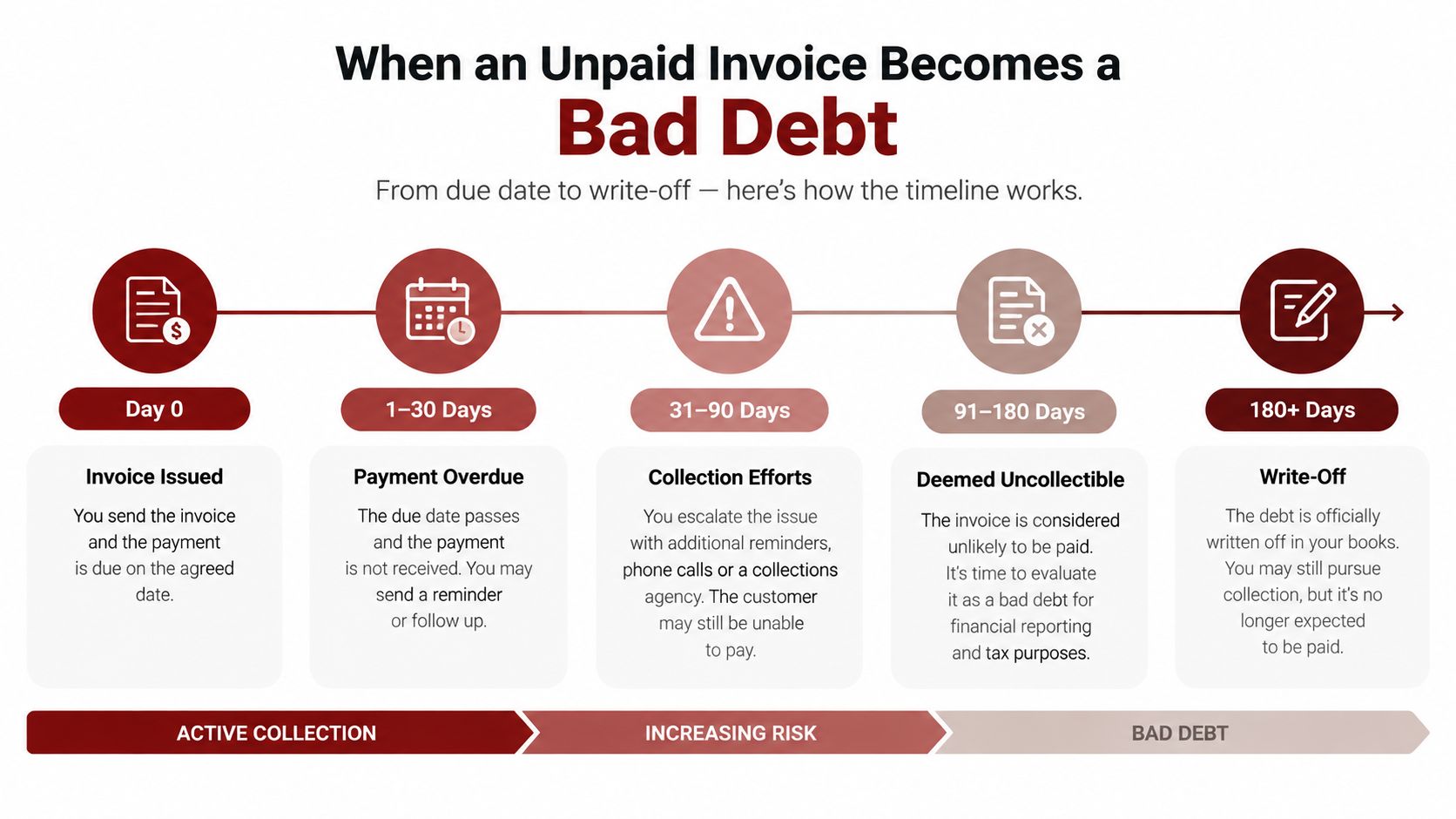
A receivable normally moves through a clear lifecycle:
- Day 0: You issue the invoice and recognise the sale and receivable.
- Payment date: The customer should settle under the contract.
- Early arrears: You chase, confirm the customer received the invoice, and check for a genuine dispute.
- Escalation: You suspend further credit and consider formal recovery action.
- Terminal default: Evidence shows that recovery is no longer realistic.
- Write-off: You remove the specific invoice from receivables and record the loss separately.
The three decisions that matter
Suspend credit when the customer breaks agreed terms and gives no credible explanation. Continuing to supply a customer who already owes you money turns one collection problem into a larger one.
Escalate recovery when ordinary reminders have failed. A formal demand, solicitor, or debt collection agency creates a stronger evidence trail than repeated informal emails. A practical guide to avoid late invoice payments can also help you improve credit control before arrears become routine.
Write off the invoice only when the specific debt has become irrecoverable, or when recovery is sufficiently limited to justify a documented partial write-off. The date should reflect when recovery became hopeless, not the date you want to tidy up the year-end accounts.
HMRC's direct tax position is precise. A company can't claim relief for a general bad debt provision or because an accounting entry reduces the asset's value. The deduction relates to an identifiable debt that's irrecoverable, or to the part of a doubtful debt estimated to be bad, as explained in HMRC's business income manual.
Keep the bookkeeping trail clean. Match the invoice, credit notes, receipts, and bank activity through a documented bank reconciliation process, then retain the collection evidence alongside the write-off decision.
Bad Debt, Doubtful Debt, and General Provisions Explained
These terms aren't interchangeable. The distinction determines whether an amount remains an asset, becomes an accounting estimate, or can support a direct tax deduction.
Suppose a customer owes your business £10,000. You need to assess that balance invoice by invoice, not apply a blanket percentage to the whole debtor book.
| Category | Definition | Balance Sheet Treatment | HMRC Deductible? |
|---|---|---|---|
| Bad debt | A named invoice owed by an identifiable customer that is genuinely irrecoverable | Remove the receivable and recognise a bad debt expense | Yes, where the specific debt meets HMRC's conditions |
| Doubtful debt | Recovery is uncertain, but the debt isn't yet proven irrecoverable | Keep the receivable, with an appropriate specific allowance where justified | Only to the extent estimated to be bad, not automatically |
| General provision | A broad reserve against expected losses across the debtor book | Recognise a general accounting provision if appropriate | No, HMRC doesn't allow a general bad debt provision |
Bad debt is a fact-based conclusion
If the customer has entered insolvency and the appointed practitioner indicates that unsecured creditors are unlikely to receive anything, the relevant invoice may be a specific bad debt. The accounting entry reflects a conclusion about that debt, supported by evidence.
A doubtful debt needs a more cautious treatment. You may expect to recover part of the balance, but you don't yet know the final outcome. Keep the receivable visible, estimate the doubtful portion on a defensible basis, and update the estimate as new information arrives.
A general provision is different. It might be useful for financial reporting, budgeting, or internal risk management, but HMRC doesn't accept it as a direct tax deduction merely because your accounts include it. HMRC's guidance confirms that companies can't obtain relief for a general provision or for writing a debt down below cost or market value without meeting the specific-debt requirements.
Practical rule: Name the customer, identify the invoice, quantify the amount at risk, and record why recovery has failed.
The timing gap matters. Accounts may recognise expected credit losses before a debt is conclusively worthless, while tax relief requires the specific amount to be irrecoverable or estimated to be bad under the applicable rules. Don't let an accounting estimate become a tax claim by default.
Evidence and Triggers That Justify a Write-Off
HMRC will want more than a note saying “customer won't pay”. Your file should show what was sold, who owed the money, what you did to recover it, and why further recovery no longer makes commercial sense.
Start with the core documents:
- Original invoice: Keep the invoice number, date, customer details, net amount, VAT, and total balance.
- Sales contract: Retain the payment terms, acceptance provisions, dispute clauses, and any retention arrangement.
- Credit notes: Record corrections separately, and don't use a credit note to disguise an unpaid but valid sale.
- Chasing history: Save emails, letters, call notes, promises to pay, broken instalment arrangements, and delivery confirmations.
- Formal demands: Preserve letters before action and solicitor correspondence, including proof of delivery.
- Insolvency evidence: File notices relating to a winding-up petition, creditors' voluntary arrangement, company dissolution, or an individual IVA.
For a sole-trader customer, a bankruptcy order or decree may establish that recovery is unlikely. In less formal situations, prolonged silence after a final demand can support the conclusion, but your records need to show that you made reasonable recovery efforts and assessed the customer's circumstances.
Quantify the debt precisely
Don't write off an approximate figure. Reconcile the customer account, deduct every payment and credit note, and identify the exact unpaid invoice or recoverable portion. If a liquidator later pays part of the balance, the amount written off must reflect the actual shortfall.
The write-off date is the date the debt becomes irrecoverable. It isn't automatically the year-end, the date your bookkeeper notices the ageing report, or the date you first feel pessimistic. Record a short internal memo explaining the trigger, evidence reviewed, amount written off, and approval given.
Journal Entries and the Separate Bad Debt Account
The bookkeeping should make the commercial history obvious. The original sale remains visible as revenue, the customer balance is cleared, and the loss appears in a separate bad debts account.
The original sale is recorded as:
- Debit Trade Receivables
- Credit Sales
- Credit VAT Output, where VAT applies
When the specific debt becomes irrecoverable, record:
- Debit Bad Debts, as an expense in the profit and loss account
- Credit Trade Receivables
Don't post the write-off directly against sales. That approach reduces turnover, hides the difference between poor sales performance and collection failure, and weakens the audit trail. A separate account also gives you useful management information about debtor quality and collection performance.
Worked example
Assume an unpaid invoice for £1,200 plus VAT. The original invoice creates a trade receivable for the gross amount, with the net sale and VAT recorded separately. When the full balance is written off, clear the gross receivable through the bad debt account, then deal with VAT relief through the appropriate VAT return once the conditions and timing requirements are met.
If a liquidator later returns 40p in the pound, record the cash received and reverse the relevant part of the previous write-off. The remaining unrecovered balance stays as the bad debt, subject to the evidence and tax treatment.
| Transaction | Debit | Credit |
|---|---|---|
| Original sale, net amount | Trade Receivables | Sales |
| Original sale, VAT amount | Trade Receivables | VAT Output |
| Full write-off | Bad Debts | Trade Receivables |
| Partial recovery from liquidator | Bank | Bad Debts, or recovery account, according to your accounting policy |
| Remaining unrecovered balance | Bad Debts | Trade Receivables |
The precise VAT figures depend on the rate applying to the supply and the invoice details, so don't invent a VAT amount in the ledger. Your accountant should check whether the VAT adjustment belongs in the same period as the accounts write-off or in the later VAT period when the statutory timing condition is met.
For a refresher on the underlying mechanics, review what double-entry bookkeeping means. The corporation tax or self-assessment deduction belongs in the relevant tax computation, not as an unexplained reduction of sales.
VAT Bad Debt Relief and the Six-Month Clock
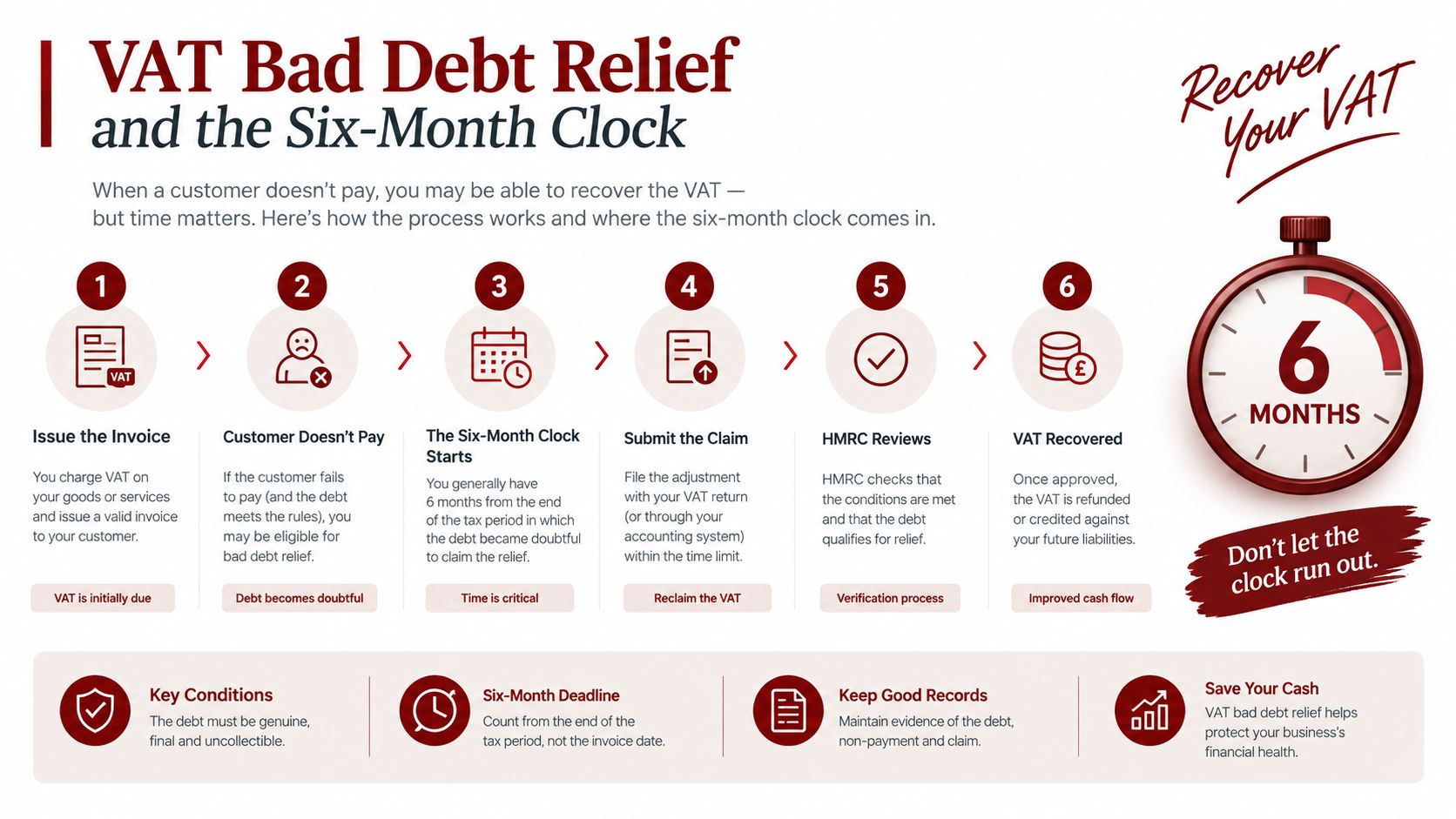
VAT bad debt relief is separate from the direct tax deduction. You may have established that an invoice is irrecoverable for accounting and direct tax purposes, but HMRC applies a specific timing rule before VAT relief can be claimed.
The conditions are practical:
- VAT was accounted for: You included the VAT on the original supply in your VAT returns.
- The debt is written off: The amount is written off in your accounts and transferred to a separate bad debt account.
- Six months have passed: The waiting period runs from the later of the supply date or the date payment became due.
- The claim is in time: You must claim within four years and six months of that later date, according to HMRC Notice 700/18.
That later-date rule is where small businesses slip up. If the invoice was issued earlier but payment became due later, the six-month clock doesn't necessarily begin with the invoice date. Calculate the qualifying date from the later of those two dates, then identify the VAT return in which the claim can be made.
How the VAT adjustment works
The relief is claimed through the VAT return adjustment for bad debt relief. The VAT element is reclaimed through the relevant VAT return, while the original sale remains recorded in the accounts. Your bookkeeping file should connect the invoice, write-off journal, separate bad debt account, and VAT return working paper.
Use Action Accountants' VAT reclaim guidance as a practical checklist, but don't treat the VAT claim as automatic. Claiming before the six-month point, using the wrong VAT period, or missing the final claim window can invalidate the adjustment.
If the customer later pays all or part of the debt, you must account for the corresponding VAT treatment and reverse the relief relating to the amount recovered. Keep a recovery log so a later receipt can't remain disconnected from the original claim.
VAT relief is a deadline-driven tax adjustment. The accounts write-off and the VAT claim must agree, but they don't become valid on the same date merely because you post one journal.
Bad Debt as a Cash-Flow Signal in a Rising Insolvency Climate
Bad debt is a warning from your credit-control system, not just an entry made before the accounts deadline. In the UK, the insolvency backdrop remained stressful during 2025. Individual insolvencies reached 7,889 in February 2025, while monthly insolvencies reached 11,348 in August 2025. The August breakdown included 622 bankruptcies, 6,487 IVAs, and 4,239 DROs, and separate reporting recorded 45,942 DROs over the preceding 12 months. These figures are reported in coverage of the 2025 insolvency data.
Those figures don't tell you whether a particular customer will fail, but they do change the risk environment for businesses that extend trade credit. A customer making partial payments, pushing invoices beyond agreed terms, or concentrating a large share of your turnover with one buyer can damage liquidity before the final default appears.
Turn warning signs into routines
Run an aged debtor review every week. Flag invoices slipping beyond 60 days, investigate partial payments immediately, and set a firm internal decision point at 90 or 120 days for escalation or write-off assessment. These are management thresholds, not HMRC rules, so tailor them to your contracts, sector, and customer risk.
Use public information to review credit limits and stop increasing exposure because a customer places another order. Stage reminders at 7, 14, and 30 days after the due date, then move to formal action rather than allowing informal chasing to continue indefinitely.
A reliable cash-flow forecasting process should include expected receipts by customer, overdue balances, likely recovery dates, and a separate assumption for disputed or distressed debts. That gives you a more credible basis for lender discussions, supplier commitments, and dividend planning.
Prevention is cheaper than losing the margin on completed work and then waiting for tax relief. The earlier you identify a deteriorating debtor, the more options you retain.
Your Bad Debt Workflow and When to Call Your Accountant
Use a written workflow. It stops overdue invoices becoming invisible and gives your bookkeeper a defensible record when the final write-off decision arrives.
- Tag overdue invoices at 30 days. Confirm the invoice reached the right contact and ask whether there's a genuine dispute.
- Issue a letter before action at 60 days. Set out the invoice, balance, contractual basis, and deadline for payment.
- Instruct a solicitor at 90 days. Escalate where the customer ignores demands or keeps extending promises.
- Assess irrecoverability after formal recovery fails. If insolvency evidence or the recovery record supports the conclusion, identify the exact debt and approve the write-off.
- Post the journal separately. Clear trade receivables through the bad debts account, not through sales.
- Review VAT relief at the six-month point. Calculate the later of the supply date or due date, then check the claim window.
- Review aged debtors quarterly. Reassess doubtful balances, customer concentration, credit limits, and expected cash receipts.
For additional collection-process ideas, the 2026 accounts receivable playbook is a useful resource alongside your accountant's advice.
Bring in professional judgement early
An accountant should review the file before you claim relief where the debt is disputed, partly paid, connected to a director or related party, or tied to an insolvency practitioner. They should also check preference claims and any consequences for director loans before the accounts are finalised.
Don't wait until the filing deadline. Ask for a focused review when a major customer defaults, when a debt may be only partly irrecoverable, or when the write-off could materially affect taxable profit. Action Accountants Limited provides bookkeeping, VAT, tax compliance, and practical cash-flow support for small businesses and contractors, including businesses operating in construction and CIS.
If unpaid invoices are affecting your VAT return, tax computation, or cash-flow forecast, speak to Action Accountants Limited for a review of the debtor evidence, write-off journals, and relief deadlines. Book a credit-control check before the next accounts deadline, so a genuine bad debt is documented properly and an avoidable loss doesn't grow unnoticed.