
What Is Accounts Payable and Why It Matters for UK SMEs
Learn what is accounts payable, how it works in practice, and why it matters for UK SMEs, contractors and growing London businesses seeking…

Accounts payable is the money a business owes its suppliers for goods and services already received. In the UK, large businesses paid 15% of invoices late in 2025, while late payment across suppliers has been linked to an £11 billion annual cost to the UK economy, so AP is a cash-flow control, not just bookkeeping.
A London construction founder can understand the pressure quickly. A materials supplier sends an invoice after delivering plasterboard to a refurbishment site. The project manager confirms the delivery, but the invoice sits in an inbox while the director focuses on payroll, subcontractors, and the next tender. The supplier waits, the next delivery may be delayed, and the accounts still don't show the full picture of what the company owes.
That gap between receiving a bill and managing it properly is where accounts payable becomes important. Good AP tells you what the business owes, why it owes it, when payment is due, whether the invoice is accurate, and what compliance checks must happen before money leaves the bank.
Table of Contents
- What Accounts Payable Really Means for a Growing Business
- How Accounts Payable Works from Invoice to Payment
- Accounts Payable vs Accounts Receivable in Plain English
- Why Accounts Payable Matters for UK Cash Flow and HMRC
- Accounts Payable for Construction Contractors and CIS Compliance
- Key Accounts Payable KPIs and the Ageing Report Explained
- Common Accounts Payable Mistakes and Practical Next Steps
What Accounts Payable Really Means for a Growing Business
In plain English, accounts payable means the unpaid bills a business owes to suppliers. The term also describes the process used to receive, check, approve, record, and settle those bills. On the balance sheet, unpaid supplier invoices are liabilities because they represent obligations the business must meet.
Suppose a London refurbishment company orders timber, hires a skip, and receives an invoice from an electrical wholesaler. The business has already received the goods or service, but it hasn't yet paid. AP records that obligation and keeps it visible until the payment clears.
Practical rule: If the business has received the goods or service, the cost and related liability need to be considered even if the bank payment hasn't happened yet.
AP sits inside the wider procure-to-pay process. The chain normally begins when someone identifies a need, obtains approval, places an order, receives the goods or service, checks the invoice, authorises payment, and records the settlement. A purchase order can show what was requested, while delivery records or completion evidence show what arrived.
Why the ledger matters
A nominal ledger gives the business the structure needed to classify costs, liabilities, VAT, and payments correctly. Understanding how a nominal ledger supports business accounting helps a founder see why AP isn't a folder of supplier PDFs.
The AP ledger should answer practical questions. Which supplier is owed money? Which project should bear the cost? Has the invoice been approved? Is VAT supported by the right evidence? Has the business paid it already? Could the invoice be a duplicate?
For a growing contractor, these answers affect tender pricing and project margins. If materials are recorded late, management may think a project is more profitable than it is. If invoices are paid without checking quantities, the company may lose cash through overpayments. If supplier balances aren't reconciled, overdue bills can remain hidden until a supplier stops work.
The point where AP becomes a risk
A small founder may handle a few bills personally. As purchase volume grows, that approach becomes fragile. In a 2026 UK survey of 200 finance professionals, only 15% reported fully automated AP, and 84% of organisations with 100 to 249 staff said manual AP makes scaling harder. The same source reported that 36% of firms in that employee group had no real-time invoice status visibility. These findings are reported by Kefron's UK accounts payable statistics for 2026.
The question isn't whether AP sounds administrative. It's whether the founder can trust the unpaid-liability figure before making a hiring, purchasing, or tax decision.
How Accounts Payable Works from Invoice to Payment
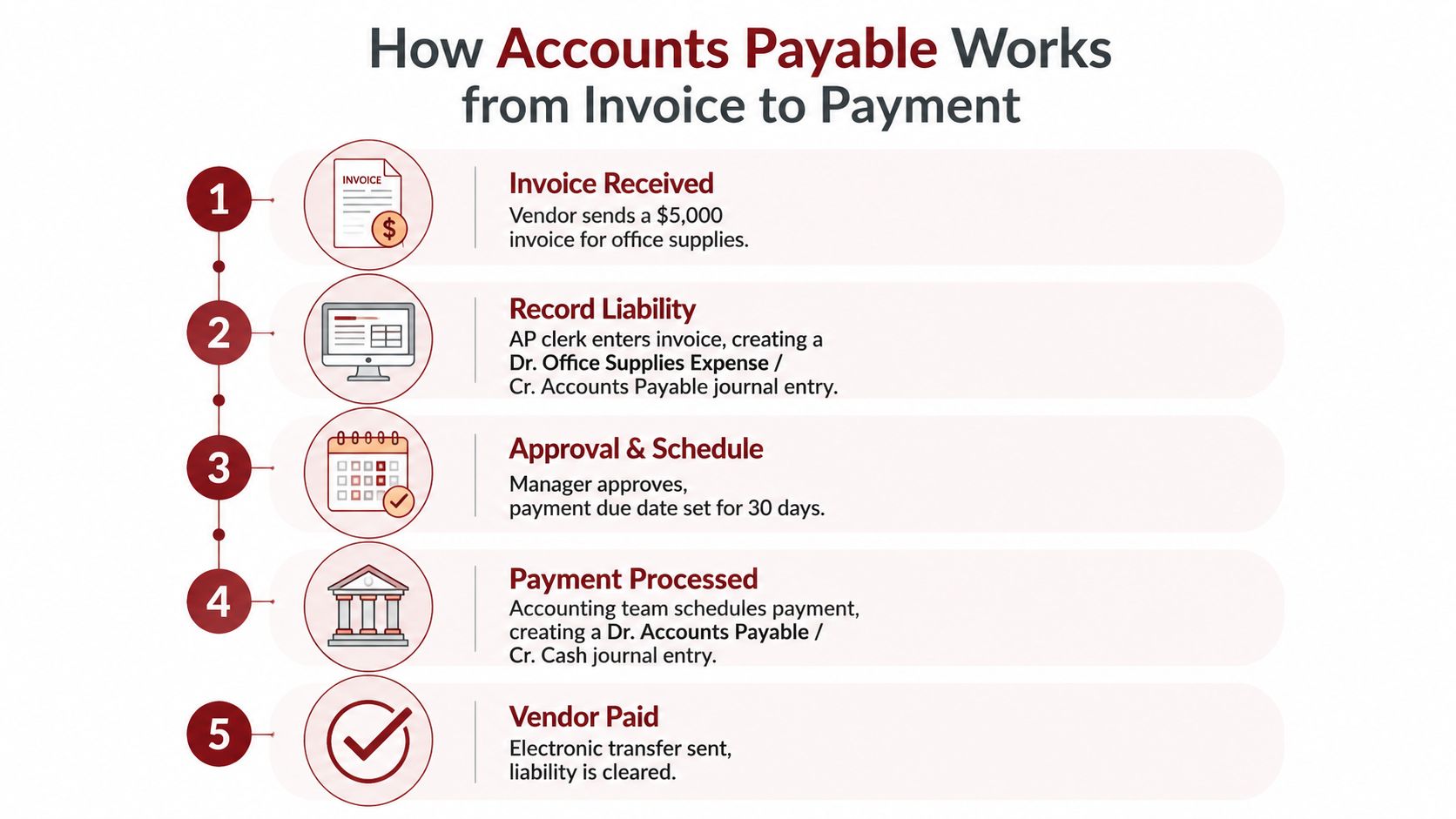
Take a contractor buying office supplies for its London site team. The supplier sends an invoice, and the business needs to move it through a controlled sequence rather than paying immediately.
Start with evidence
First, the AP administrator checks the supplier name, invoice number, date, description, quantities, VAT treatment, and payment details. For a construction business, the administrator should also connect the cost to the right project or cost code. If the invoice relates to work rather than materials, the team needs evidence that the work was completed and approved.
The business then compares the invoice with the purchase order and receiving information where those records exist. This helps confirm that the company ordered the items, received them, and has been charged the agreed amount. A missing approval shouldn't be treated as a minor inconvenience, because it can conceal an unauthorised purchase or a disputed charge.
Record the liability
Assume the invoice is for office supplies and is approved. The accounting entry records the cost and the amount owed:
- Debit: Office supplies expense
- Credit: Accounts payable
The debit records the expense in the appropriate nominal ledger code. The credit creates the supplier liability. The business hasn't lost cash at this point, but its obligations have increased.
When the company pays by bank transfer, the entry changes the position:
- Debit: Accounts payable
- Credit: Bank or cash
The debit removes the liability from AP. The credit records the cash leaving the bank. A later bank reconciliation process checks that the accounting record agrees with the bank statement.
Approve and schedule
Approval should reflect the person who understands the purchase. A site manager may confirm that materials arrived, while a director may authorise an unusual or high-value charge. Separating invoice entry, approval, and payment preparation gives the business more protection than allowing one person to control every stage.
The payment calendar should show the due date, approved amount, supplier, project, and payment status. That creates a working view of upcoming cash requirements and gives the founder time to resolve disputes before the due date.
A well-run AP process doesn't just pay invoices. It creates a reliable trail from purchase request to supplier settlement.
Businesses considering more structured workflows can use resources such as implement AI for AP to assess where invoice capture, matching, approval routing, and status visibility might reduce manual handling.
This short video also illustrates the basic movement from invoice receipt to payment:
Accounts Payable vs Accounts Receivable in Plain English
The simplest distinction is direction. Accounts payable records money the business must pay out, while accounts receivable records money customers must pay in.
A contractor might owe a merchant for steel, creating AP. The same contractor might invoice a property developer for completed work, creating receivables. Both balances matter to cash flow, but they sit on opposite sides of the working-capital question.
| Dimension | Accounts Payable | Accounts Receivable |
|---|---|---|
| What it represents | Money the business owes suppliers | Money customers owe the business |
| Cash direction | Expected cash outflow | Expected cash inflow |
| Balance-sheet category | Liability | Asset |
| Typical document | Supplier invoice | Sales invoice |
| Main control question | Is the bill valid, approved, and due? | Is the customer invoice accurate, issued, and collectible? |
| Main risk | Late payment, duplicate payment, incorrect coding, or unsupported VAT | Late collection, disputed sales, or poor credit control |
| Example | An electrical wholesaler's invoice for site materials | A developer's unpaid invoice for refurbishment work |
Why founders confuse them
The confusion usually starts when the same transaction is viewed from two businesses. Your supplier calls your invoice an account payable. Your customer may record that same invoice as an account payable in its own books, while you record it as an account receivable.
The labels depend on whose accounting records you're looking at. For your company, a supplier invoice is AP because your business owes the supplier. A customer invoice is receivable because the customer owes your business.
This distinction also affects cash planning. A strong receivables balance doesn't necessarily mean the business has cash in the bank, and a low AP balance doesn't necessarily mean all costs have been captured. Founders need to review both ledgers alongside bank balances, committed costs, and upcoming tax obligations.
Why Accounts Payable Matters for UK Cash Flow and HMRC
AP controls working capital because payment timing determines when cash leaves the business. Paying an invoice too early can reduce the funds available for wages, materials, or tax. Paying too late can damage supplier trust, interrupt deliveries, and make a growing firm look unreliable.
UK evidence shows the scale of the issue. Official statistics report that large businesses paid 15% of invoices late in 2025, compared with 25% in 2018, and that the median large business took 32 days to pay suppliers in 2025. The same release says 14% of the total value of invoices was paid late, demonstrating that payment performance must be assessed by invoice count, value, and speed. See the UK government's large business payment practices statistics for 2025.
A separate 2025 release reported that half of supplier invoices were paid late, with an annual economic cost of £11 billion and 38 business closures each day linked to the problem. It also reported that small businesses were owed an average of £42,000 in overdue invoices, that 44% of invoices were paid late, and that £112 billion was locked in late payments. These figures are presented in Green Sheet's report on UK late payments.
AP and VAT evidence
HMRC doesn't treat AP as an informal supplier-bill list. Its controls guidance says postings should represent goods or services received, each invoice should be recorded only once, and input-tax recovery should be supported by evidence, allocated to the correct VAT period, and coded accurately. HMRC also states that valid invoices should be paid within six months of the due date to preserve relevant VAT treatment where the conditions apply. The detailed requirements appear in HMRC's enquiry manual guidance on accounts payable controls.
For a London agency, that means a software supplier's VAT invoice needs correct coding and supporting evidence. For a contractor, materials and service invoices need to be assigned accurately so the VAT account reflects genuine purchases. A rushed process can create a duplicate claim or leave valid input tax unsupported.
| AP Action | Cash Flow Impact | HMRC and Compliance Impact |
|---|---|---|
| Record invoices promptly | Shows upcoming cash commitments | Keeps liabilities and purchase data complete |
| Match invoice to order and receipt | Prevents payment for incorrect or undelivered items | Supports the evidence trail |
| Schedule payment by agreed terms | Protects supplier relationships and avoids avoidable disruption | Helps maintain reliable records |
| Check VAT coding and period | Avoids distorted project and cash forecasts | Supports accurate input-tax recovery |
| Reconcile supplier balances | Identifies missing, duplicated, or disputed invoices | Strengthens the purchase-ledger-to-VAT-ledger chain |
Public-sector purchase terms often require undisputed invoices to be paid within 30 days, and HMRC requires businesses to maintain a VAT account and retain purchase invoices. The National Audit Office purchase terms illustrate why AP teams need to track both payment status and supporting documentation.
Founders who want a practical cash review can use this guide to improve cash flow, but the underlying discipline starts with accurate AP records.
Accounts Payable for Construction Contractors and CIS Compliance
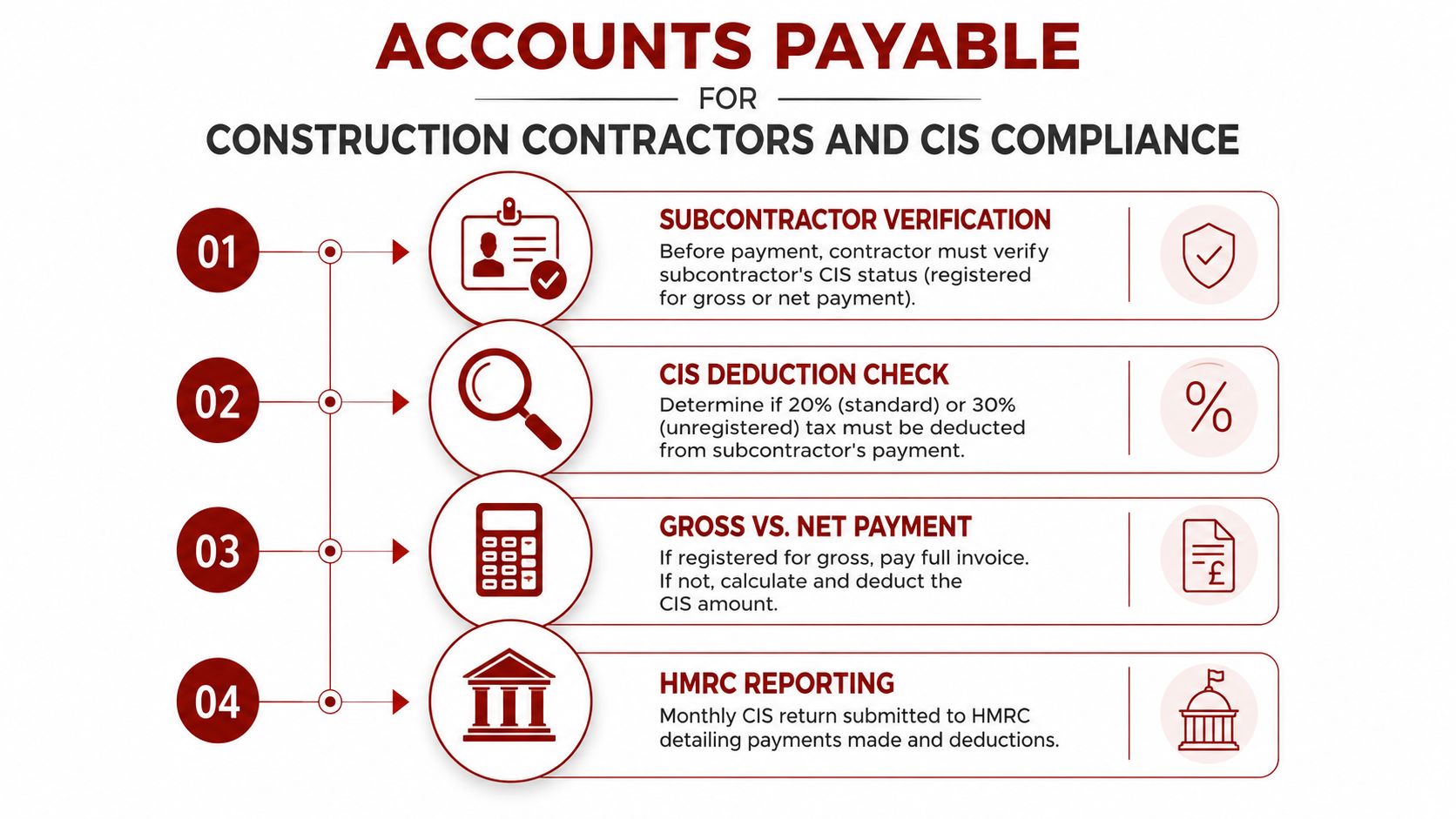
Construction AP has an extra decision before payment. When an invoice comes from a subcontractor, the contractor must establish the subcontractor's CIS status and apply the appropriate treatment before releasing funds.
The supplied CIS workflow identifies 20% as the standard deduction rate, 30% for an unregistered subcontractor, and 0% where the subcontractor is registered and compliant for gross payment. Those rates and the monthly reporting requirement should be checked against the current HMRC process for the particular engagement. A bookkeeping routine that pays only the gross invoice can create an incorrect payment and a compliance problem.
A London refurbishment example
Suppose a contractor is refurbishing a block of flats in North London. A subcontractor submits an invoice for labour and materials. The AP administrator should:
- Verify the subcontractor: Confirm the business identity and CIS status before approval.
- Separate labour and materials: Identify the amounts relevant to the CIS calculation and retain the supporting documentation.
- Calculate the payment: Apply the verified status and correct deduction treatment rather than transferring the gross invoice automatically.
- Record and notify: Post the gross liability, deduction, and net payment clearly, then include the required information in the monthly CIS return.
The AP ledger must show what the contractor owes, what has been withheld, and what has been paid. If a project also contains retentions, the accounts need to distinguish the amount currently payable from the amount held until the relevant contractual condition is met.
Retentions need their own visibility
A retention isn't a vanished cost. It remains part of the contractual liability, even though the contractor doesn't pay that portion immediately. The AP record should show the original invoice, the amount released, the amount retained, the expected release condition, and any dispute.
This matters at project close. If retentions sit in a general unpaid-invoice list without a clear status, the finance team may either pay too soon or fail to release money that is properly due. Both outcomes can create supply-chain tension.
Construction businesses can find sector-focused guidance through accounting support for contractors and construction businesses. A strong process keeps CIS verification, invoice approval, retention tracking, payment notifications, and monthly reporting connected rather than treating them as separate administration.
Key Accounts Payable KPIs and the Ageing Report Explained
An AP ageing report turns an unpaid-invoice list into a management tool. It groups outstanding supplier balances by how long they have remained unpaid, allowing a founder to see which obligations are current and which need immediate attention.
A typical report may use bands such as 0 to 30, 31 to 60, 61 to 90, and over 90 days. These bands are practical review categories, not universal performance targets.
- Current or 0 to 30 days: Invoices may be within agreed terms, but approval or missing evidence can still hold them up.
- 31 to 60 days: Check whether a dispute, coding issue, or cash decision has delayed settlement.
- 61 to 90 days: Escalate ownership. The supplier may already be chasing payment, and the invoice may indicate a wider process failure.
- Over 90 days: Investigate immediately. The balance could be disputed, incorrectly recorded, forgotten, or damaging an important relationship.
The measures behind the report
Days Payable Outstanding, or DPO, estimates how long the business takes to pay suppliers. A high DPO can preserve cash temporarily, but it may also indicate deliberate delay or unresolved invoices. A low DPO may show prompt payment, although paying earlier than necessary can weaken available working capital.
Other useful measures include:
- On-time payment rate: Shows whether approved invoices are settled within agreed terms.
- Invoice processing time: Tracks the time from receipt to approval and posting.
- Early-payment discount capture rate: Shows whether the business identifies and uses worthwhile supplier terms.
- Duplicate-invoice rate: Highlights weaknesses in invoice numbering, matching, or supplier records.
- Blocked-invoice count: Shows how many invoices are waiting for approval, evidence, or dispute resolution.
| KPI and Metric | What It Measures | Healthy Benchmark for UK SMEs |
|---|---|---|
| DPO | Average supplier-payment timing | A level consistent with agreed terms and cash needs |
| On-time payment rate | Settlement discipline | Consistently aligned with supplier terms |
| Invoice processing time | Workflow speed | Short enough to allow review before due dates |
| Discount capture rate | Use of worthwhile early-payment terms | Reviewed against the cash benefit |
| Duplicate-invoice rate | Strength of invoice controls | No unexplained duplicate payments |
| Ageing concentration | Exposure in older balances | Older balances actively explained and resolved |
There is no single healthy AP number for every SME. A contractor with long project cycles, an agency with monthly software charges, and a property business managing retentions will have different payment patterns.
Review the ageing report weekly, assign an owner to every balance beyond 60 days, and record why it remains unpaid. That habit gives the founder an early warning before an overdue account becomes a blocked delivery, a disputed project cost, or a cash crisis.
Common Accounts Payable Mistakes and Practical Next Steps
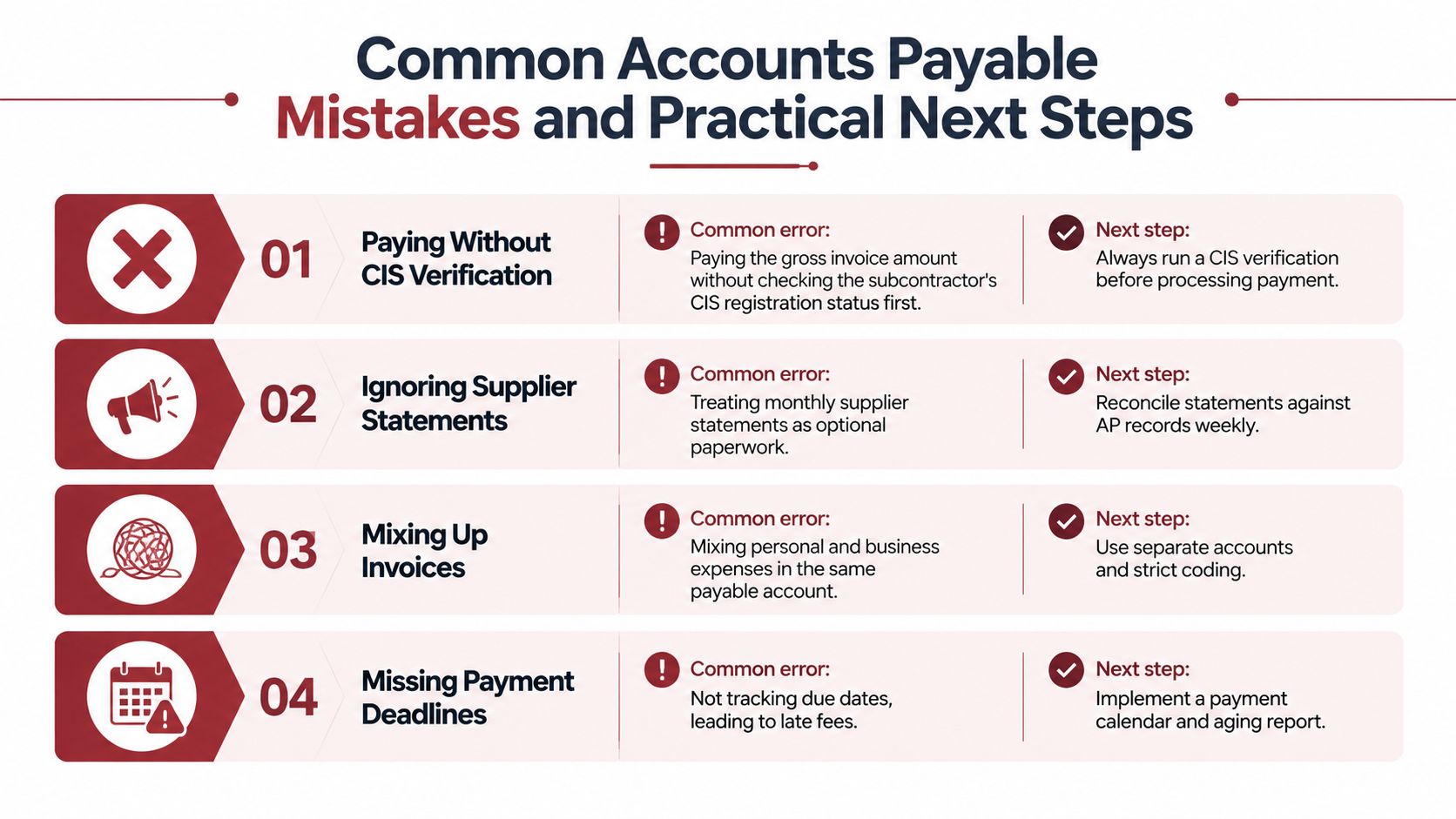
Founders often don't have an AP problem because they lack software. They have one because the business pays first and checks later. That habit creates weak records, unclear liabilities, and avoidable pressure during VAT, CIS, and year-end work.
Common failures include:
- Paying without CIS verification: A contractor transfers the gross subcontractor invoice without checking status or deduction treatment. Run the verification before approval and retain the result with the invoice.
- Ignoring supplier statements: The business files its own ledger but never compares it with the supplier's balance. Reconcile statements against AP records and investigate every difference.
- Mixing personal and business spending: Personal cards, business cards, and supplier payments become difficult to code. Use separate accounts and keep each expense connected to the right business record.
- Missing VAT evidence or deadlines: The team has an invoice but can't support the VAT treatment or period. Store purchase invoices centrally and connect them to the VAT records.
- Leaving the ageing report untouched: The founder sees the total owed but not the invoices becoming overdue. Review ageing regularly and assign responsibility for exceptions.
A practical 90-day reset
Weeks 1 to 2: Create one invoice inbox, save supporting documents consistently, list every supplier, and reconcile supplier statements with the ledger. Don't wait for the next year-end close to discover missing bills.
Weeks 3 to 4: Set approval thresholds that fit the business, define who can approve project costs, and require a second authorisation for sensitive payment changes or unusual transactions.
Weeks 5 to 8: Introduce a weekly ageing review. Mark each invoice as approved, disputed, waiting for evidence, scheduled, or paid. For construction firms, add CIS status and retention fields to the workflow.
Weeks 9 to 12: Review VAT coding, confirm the purchase-ledger-to-VAT-ledger chain, check CIS documentation, and test whether payment records agree with the bank.
Decision point: Rising overdue balances, missed HMRC deadlines, or persistent CIS uncertainty are signals to obtain accounting support rather than adding another spreadsheet.
Action Accountants Limited provides bookkeeping, reconciliations, VAT and tax compliance, payroll, and construction-aware CIS support for growing businesses. If your AP records need a controlled reset or you want reliable visibility over supplier liabilities and project costs, visit Action Accountants Limited to discuss the right support for your business.