
How to Create Budget
How to create budget. Learn how to create a budget that works for startups, sole traders, contractors and landlords.

A London founder checks the business account in week three and sees £14,000. It feels like spare cash, so a holiday gets booked and a supplier payment is brought forward. By week seven, the balance tells a different story. A £9,000 VAT bill, two CIS deductions and an underfunded PAYE run have turned apparent comfort into a cash problem.
That's the central budgeting mistake for founders, sole traders, contractors and landlords. They treat the bank balance as the business position, then wonder why the numbers stop making sense when invoices, tax, payroll and irregular costs arrive. The answer isn't another spreadsheet full of spending categories. It's a control system based on committed costs, accruals, tax timing and frequent recalibration.
UK household spending data reinforces why a single average isn't a useful budget for everyone. The Office for National Statistics expenditure data puts average weekly household expenditure at £676.60 in the year ending March 2025, but the richest fifth spent £1,083.60 a week compared with £407.30 for the poorest fifth. Your budget must reflect your income band, obligations and risk profile, not a national average.
Table of Contents
- Why Most Budgets Fail Before the First Month Ends
- Set Clear Money Goals and Pick the Right Budgeting Horizon
- Build the Budget on Accruals, Not on Your Bank Balance
- Forecast Cash Flow Week by Week with Tax and CIS Built In
- Stress-Test the Lines That Actually Move Your Numbers
- Common Budgeting Mistakes and How to Avoid Them
- When to Bring in an Accountant to Strengthen Your Budget
Why Most Budgets Fail Before the First Month Ends
The founder in that opening scene didn't necessarily spend recklessly. The budget failed because it recorded cash without recording commitments. The account showed money available today, but it didn't show VAT already building, payroll due later, subcontractor costs, or invoices that hadn't yet arrived.
That problem affects a contractor waiting on a client payment, a sole trader receiving uneven transfers and a landlord with rent arriving monthly but repairs and mortgage payments landing on different dates. A category list may include rent, software, travel and marketing, yet still miss the liabilities that determine whether the business can meet its obligations.
Practical rule: If the bank balance is the first number you check, it must never be the only number you trust.
A useful budget starts with three questions. What income is earned? What costs have already been committed? Which amounts must be ring-fenced for tax, payroll or debt before the owner takes anything out? This is the discipline that separates a management budget from a personal spending wishlist.
You'll also want to identify the quieter risks that make a budget unreliable. The financial traps that undermine small business owners include the kinds of omissions that look harmless in a spreadsheet but become expensive when several obligations fall due together.
Build the rest of the process around visibility and timing. Use accruals to understand the underlying position, a rolling cash forecast to understand bank movements, and a weekly review to catch drift while you can still act. A budget shouldn't tell you what you hope to spend. It should tell you what has to be true for the business to remain solvent and make progress.
Set Clear Money Goals and Pick the Right Budgeting Horizon
Start with a survival floor. Put tax, payroll, rent, loan repayments, essential software, insurance and unavoidable operating costs at the top. These aren't targets to trim casually. They're the commitments the business must cover before growth spending or owner drawings.
Then define two separate uses for the money left over:
- Growth target: Hiring, marketing, equipment or training that should support a stated commercial objective.
- Owner draw: A planned amount that doesn't change every time the bank balance looks healthy.
- Contingency headroom: Money retained for late receipts, repairs, cost increases or weak trading.
Choose the horizon that matches the risk. A startup using cash to fund expansion needs a rolling 13-week view, because runway can change quickly. A contractor dealing with CIS deductions and VAT dates should review receipts and payments weekly. A landlord should maintain a 12-month calendar, with mortgage payments, service charges, repairs, insurance and potential voids tagged to the month in which they're likely to occur.
A sole trader with £4,800 monthly net income should begin with the survival floor, not an assumed savings percentage. A contractor forecasting £350 per day across 18 chargeable days has a useful revenue estimate, but that estimate must be adjusted for non-chargeable time, delayed payment and tax reserves. A landlord with two rental units should budget each property separately before reviewing the portfolio total. The combined figure can hide one property consuming the other's surplus.
| Business Type | Best Horizon | Review Cadence |
|---|---|---|
| Startup | Rolling 13-week cash view | Weekly |
| Contractor or sole trader | Weekly receipts and commitments, with monthly accruals | Weekly, plus month-end |
| Landlord with two rental units | 12-month property-by-property schedule | Monthly, with quarterly tax checks |
Write the goal beside the budget line. “Marketing” is vague. “Fund lead generation for the next service launch” gives the spending a test. If a cost doesn't support the survival floor, a measured growth objective or a planned owner draw, challenge it before it becomes recurring.
Build the Budget on Accruals, Not on Your Bank Balance
HM Treasury's Consolidated Budgeting Guidance uses an accruals-based framework, with spending controlled against defined categories and reviewed against management information. The transferable lesson for a small business is straightforward. Budget for the cost when it's committed and for revenue when it's earned, then separately forecast when cash will move.
That distinction matters when a sole trader sends an invoice on 30-day terms. The work may be complete and the income earned, but the cash might not arrive until a later week. The same issue appears when a contractor has CIS deducted at source or when a business commits to materials before the client pays.
Set up the budget in three blocks before entering amounts:
- Fixed costs: Rent, subscriptions, insurance, loan repayments and regular salaries.
- Variable costs: Subcontractor labour, materials, utilities, delivery costs and transaction fees.
- Demand-led costs: Professional fees, training, equipment, repairs and one-off projects.
A £600 monthly bookkeeping cost behaves differently from a £4,000 quarterly VAT bill. The first should appear as a regular monthly commitment. The second needs a monthly accrual or sinking-fund line, followed by a cash movement in the payment month. If both sit in a general “admin” category, the budget hides the timing that matters.
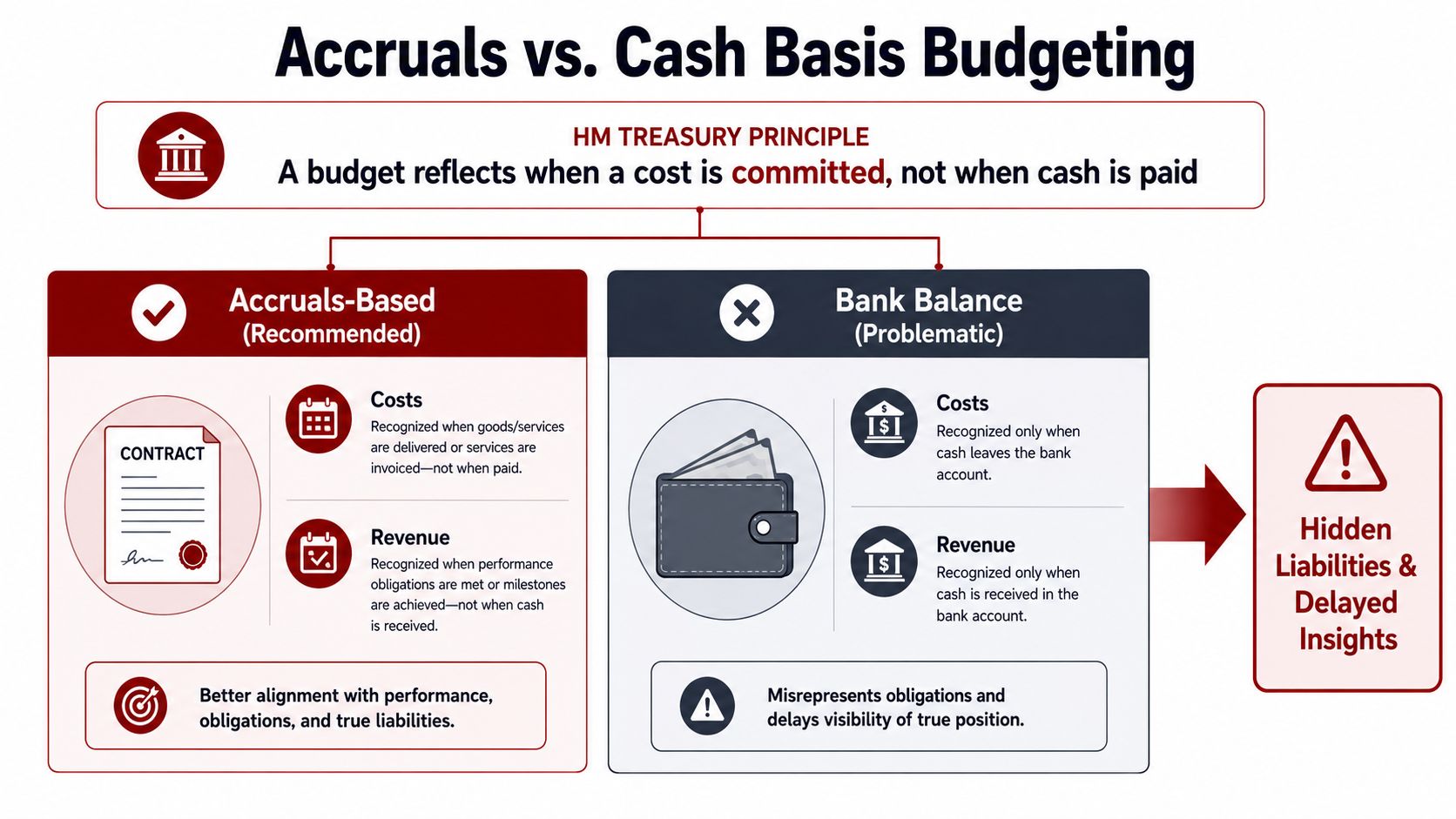
Keep separate columns for budgeted cost, committed cost, recognised cost, cash paid and variance. That layout shows whether a problem comes from overspending, late payment or poor timing. It also gives your accountant a cleaner basis for reviewing the figures. For a plain-language introduction to control your finances with Peaceful Mindful Pocket, use it as a supplementary personal budgeting resource, but don't let a household template replace business controls.
If you need to understand how transactions flow through the accounts, this explanation of double-entry bookkeeping provides useful context. Your operating budget doesn't need to become a ledger, but it must reconcile to one.
Forecast Cash Flow Week by Week with Tax and CIS Built In
Receipts and payments rarely hit the bank in the same week as the underlying work. Build a 13-week forecast with one row per week and show both the commercial event and the cash event. Add a visible minimum cash line. If projected closing balance falls below it, the owner must delay spending, accelerate collection or arrange funding before the shortfall arrives.
Use a simple structure:
- Gross invoices raised
- CIS deducted or other withholding
- Cash received
- VAT due
- Tax reserve movement
- Supplier payments
- Payroll and drawings
- Closing balance
The worked example below uses the planning assumptions supplied for a London contractor. The £8,000 invoice is raised in week one on 30-day terms, with 20% CIS deducted, a 14.5% VAT flat-rate assumption, and a £1,200 tax reserve. These are illustrative planning inputs, not a calculation of the contractor's actual liability. Confirm the correct VAT treatment and tax position before relying on them.
| Week | Gross Invoiced | CIS Deducted | Cash Received | VAT Due | Tax Reserve | Supplier Out | Closing Balance |
|---|---|---|---|---|---|---|---|
| 1 | £8,000 | £1,600 | £0 | £0 | £1,200 | £2,000 | Opening balance less payments |
| 2 | £0 | £0 | £0 | £0 | £0 | £1,000 | Prior closing balance less payments |
| 3 | £0 | £0 | £0 | £0 | £0 | £800 | Prior closing balance less payments |
| 4 | £0 | £0 | £6,400 | £0 | £0 | £1,200 | Prior closing balance plus receipt less payments |
| 5 | £0 | £0 | £0 | £0 | £0 | £600 | Prior closing balance less payments |
| Quarter-end | Add actuals | Add actuals | Add actuals | Move VAT provision | Maintain reserve | Add actuals | Recalculate against minimum cash |
The table's purpose is timing, not false precision. Show the gross invoice in week one, the CIS deduction against the expected receipt, the net receipt around the 30-day payment point, and the VAT and tax movements when they're due. Put the reserve in a separate tax account as soon as the underlying receipt arrives or the liability becomes clear.
Pay suppliers at planned points rather than whenever an email arrives. Align payroll with realistic receipts, not optimistic invoice dates. Overlay actual bank movements on the forecast every week, and roll the view forward so that week thirteen never becomes an abandoned endpoint.
For more ideas on building a usable practical guide to cash flow, focus on the operating rhythm rather than the spreadsheet design. Your forecast only works if someone updates it. Action Accountants' guidance on cash flow forecasting is also relevant when you're linking projected movements to actual business records.
Stress-Test the Lines That Actually Move Your Numbers
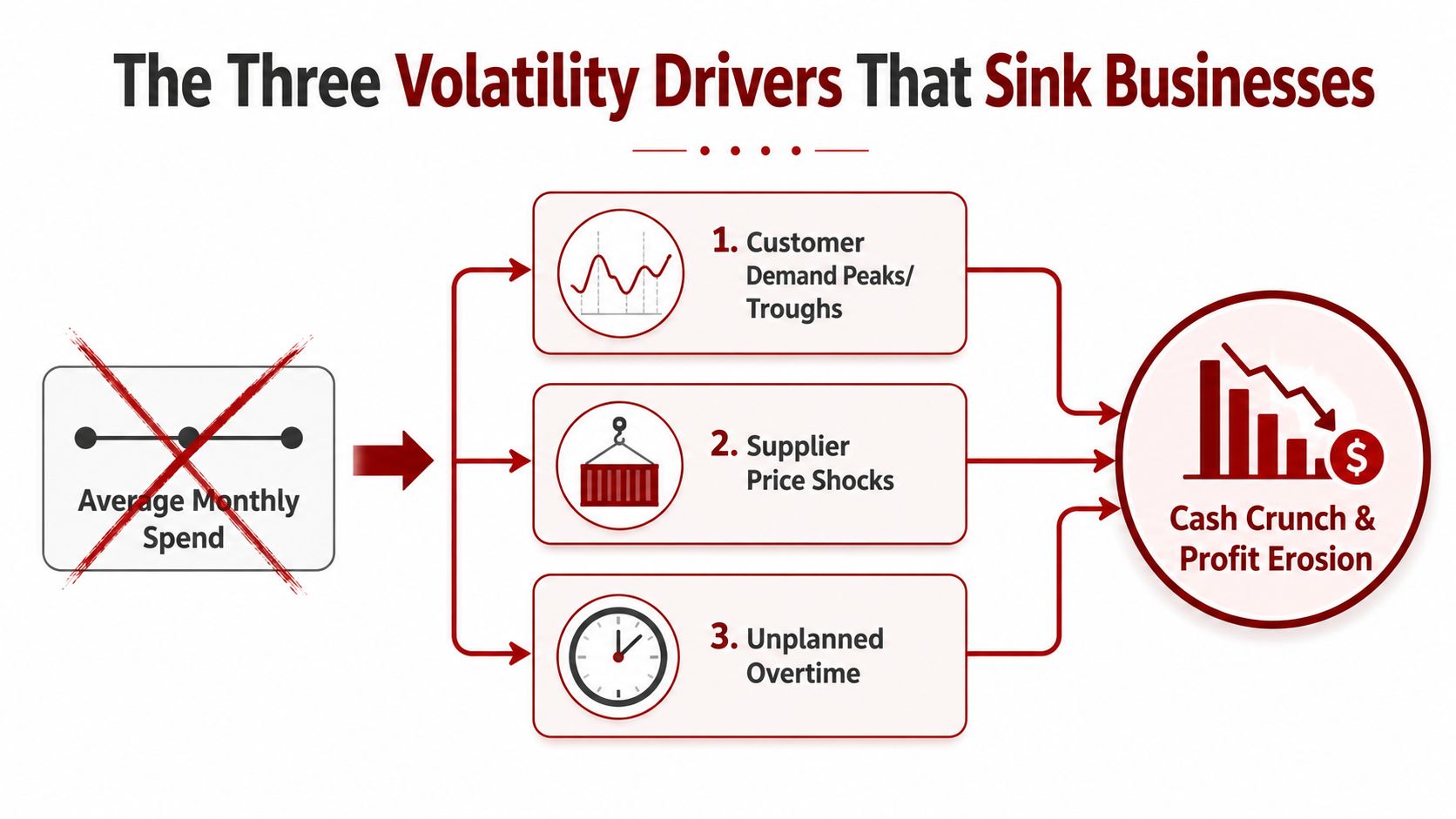
Average monthly spend is a weak planning tool for a business exposed to subcontractors, materials and delayed client payments. It smooths away the exact events that create pressure. Rank costs by volatility and financial impact, then test those lines before you approve the rest of the budget.
The first driver is subcontractor or freelancer fees. The second is materials or stock. The third is client payment timing. These lines can change the cash position much faster than small subscriptions or office purchases, so they deserve the most attention.
Take last quarter's actual figures and ask:
- What happens if a major customer pays later than planned?
- What happens if materials become more expensive before a quote is accepted?
- What happens if the business adds a person before revenue is dependable?
- Which committed costs remain if demand weakens?
- Does the buffer survive the downside case?
A late-paying client can shift the cash position materially. A materials price rise can remove the expected margin from several jobs. An extra hire creates a recurring commitment that remains after the original sales opportunity has passed. Don't average these risks into a “normal month”. Model them as separate scenarios.
What has to be true: If the downside case breaks the buffer, the plan is wrong, not the assumption.
The same template can serve very different clients because the mechanics stay consistent.
Sole trader
A sole trader should separate business costs from personal drawings and avoid treating every payment as available income. If the owner uses a Salary Exchange drawings pattern, record the draw as a planned transfer, not as an informal sweep of whatever happens to remain. Ring-fence 20% to 30% of each payment into a personal tax pot, using the ONS spending data as a reminder that household needs vary sharply by income group and region. The remainder must cover committed business costs before discretionary spending.
Contractor
A contractor's forecast should show CIS deductions withheld at source, VAT return timing and the cost of maintaining an IR35-compliant operating position or using an umbrella arrangement. Don't record the gross invoice as spendable cash. Track the gross commercial value, expected deductions and actual receipt in separate columns.
Landlord
A landlord should give each property its own income and cost section. Schedule mortgage payments, service charges, insurance, repairs and void periods by month. Section 24 tax on mortgage interest needs careful treatment because it's a non-cash adjustment, so the cash forecast and tax computation must not be conflated.
The shared discipline is more important than the labels. Use one tax reserve account, review weekly, and keep the accruals view separate from the bank view. Re-run the stress test monthly, especially after changing prices, taking on staff, signing a lease or accepting a contract with unfamiliar payment terms.
The data supports prioritising major exposure lines. ONS reports that housing, fuel and power, transport, food and recreation account for over half of average household spending, so a business or household budget should test its largest weighted costs before spending time on minor categories. London firms should also use regional breakdowns rather than assuming national averages describe their own pressure points.
The following video offers another visual way to think about volatility and cash pressure. Treat it as a prompt for discussion, not a substitute for your own forecast.
Common Budgeting Mistakes and How to Avoid Them
Most failed budgets show recognisable warning signs. Use this checklist as a diagnostic, then fix the highest-risk item first.
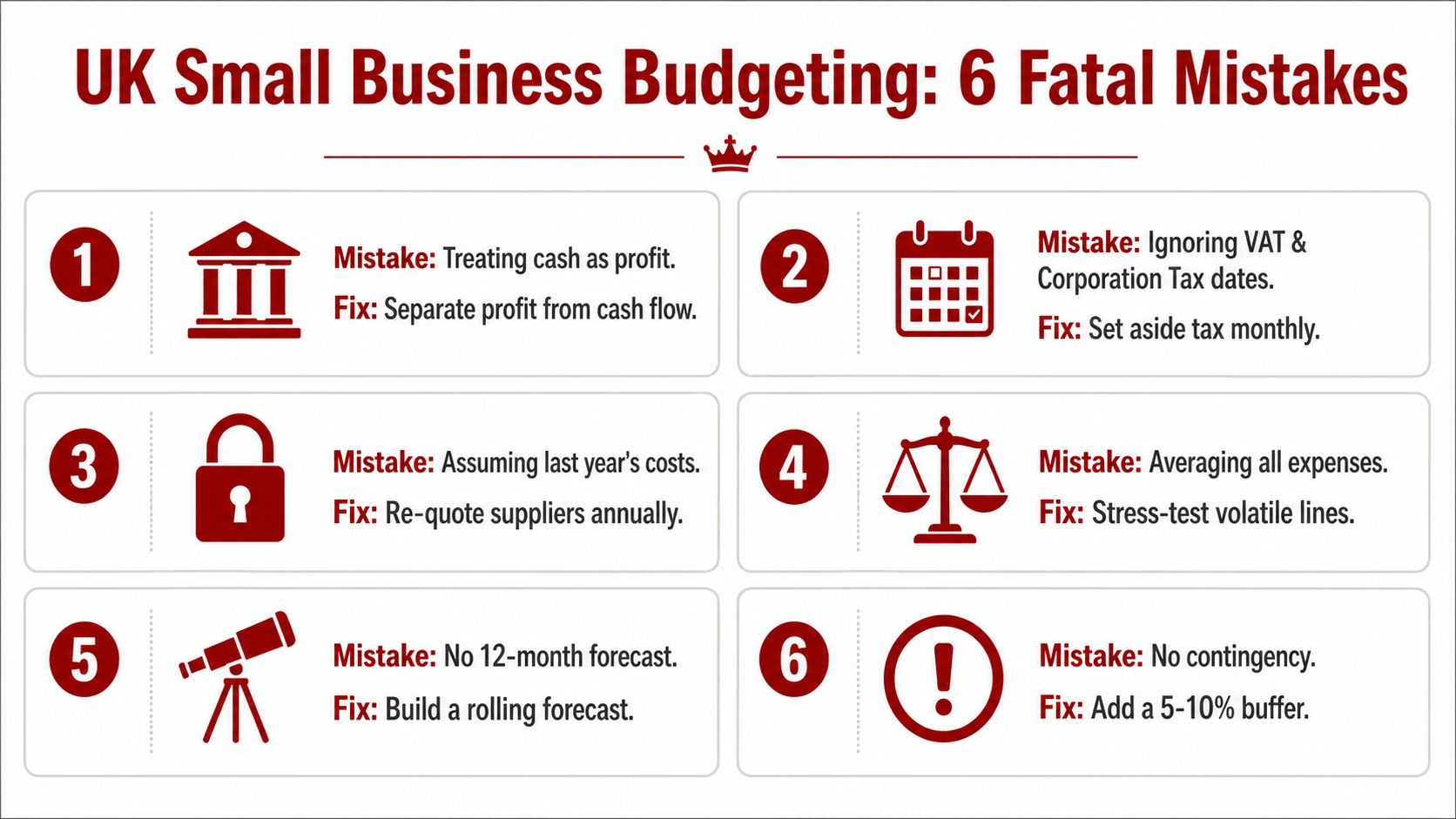
- Treating cash as profit: The warning sign is a healthy bank balance with no record of unpaid bills, tax or committed work. Fix it by maintaining separate accruals and cash views.
- Ignoring VAT and Corporation Tax timing: The warning sign is a tax payment that arrives as a surprise. Fix it by adding monthly provisions and moving the money into a separate reserve.
- Running without a buffer: The warning sign is relying on an overdraft whenever a customer pays late. Fix it by setting a minimum cash line and refusing discretionary spending below it.
- Skipping the weekly review: The warning sign is discovering a missed receipt or overspend at month-end. Fix it by comparing actuals with the forecast on the same day each week.
- Mixing personal and business spending: The warning sign is unclear drawings, unexplained transfers and difficulty reconciling expenses. Fix it with separate accounts and a documented owner-draw policy.
- Over-tracking trivial categories: The warning sign is a detailed spreadsheet that gives no insight into payroll, rent, materials or payment delays. Fix it by ranking lines by volatility and exposure.
Make the monthly ritual short and repeatable. Top up the tax pot, reconcile the accruals view, reweight the volatile lines, and re-forecast the next eight weeks. Don't wait for perfect records. A timely, imperfect review gives you more control than a polished budget reviewed after the problem has already occurred.
Financial resilience remains a practical concern. The UK financial outlook for 2026 reports that only 51% of UK adults say they have a budget for 2026, while 36% expect to be worse off and 61% of budgeters are mainly trying to cover essentials. That's why the first priority isn't an elaborate savings plan. It's a workable control system that protects essentials and makes the next decision visible.
When to Bring in an Accountant to Strengthen Your Budget
DIY budgeting stops being sensible when the business becomes difficult to model without reconciled records. Escalate when turnover is approaching VAT registration, CIS or reverse-charge rules complicate receipts, payroll consumes more than a manageable amount of time, or you're considering funding, R&D claims or dividend planning without a reliable financial view.
An accountant adds value inside the budget, not just at year-end. They can ensure costs are treated correctly under accruals, keep bookkeeping ready for Making Tax Digital requirements, assess whether standard, flat-rate or cash accounting fits the business, manage CIS compliance and link a rolling cash forecast to real filings.
The warning signs are practical:
- You're using gross invoices as available cash.
- Tax reserves are calculated only at quarter-end.
- Payroll, CIS or VAT deadlines keep moving in the spreadsheet.
- You can't explain the difference between profit, cash and drawings.
- Growth decisions depend on an unreconciled bank balance.
That's the point at which formation and company secretarial support, CIS registration and submissions, VAT registration and returns, payroll, bookkeeping and ongoing tax planning become part of the control system. Ways an accountant can help your small business include the compliance and management support that turns a home-built budget into a finance function you can use for decisions.
Action Accountants Limited works with London founders, contractors, construction businesses, landlords and sole traders on these connected requirements. Don't wait until a missed filing or tax bill exposes the weakness. Bring in help when the budget starts influencing commitments you can't easily reverse.
Action Accountants Limited can help you build an accruals-based budget, a tax reserve process and a rolling cash forecast that reflects VAT, CIS, payroll and irregular income. Visit Action Accountants Limited to discuss bookkeeping, VAT, CIS, payroll, tax planning or business formation support for your next stage.