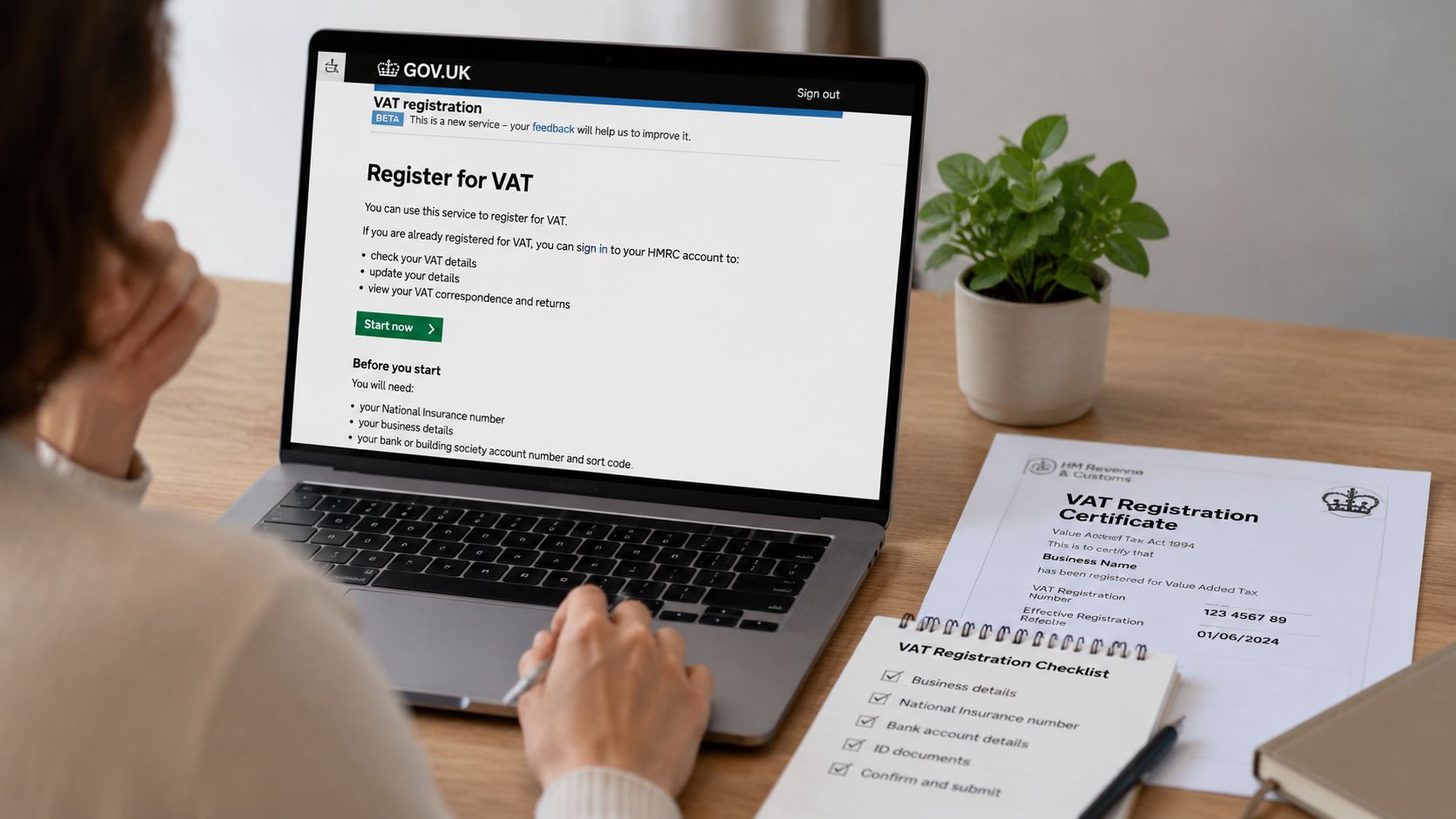
VAT Returns Explained: A Practical UK Compliance Guide
VAT returns explained for UK businesses. Learn what they are, how to calculate VAT, key deadlines, Making Tax Digital, and how to avoid common penalties.
A client emails at 4:55pm on filing day. The bookkeeping isn't reconciled, two supplier invoices are missing, and the VAT balance in the accounts package doesn't match the bank. The return still has to be filed, and the payment still has to reach HMRC.
That situation is avoidable. VAT returns aren't quarterly forms you fill in from memory. They're the visible result of a live data process, built from sales invoices, purchase records, VAT codes, reconciliations and digital links. Get that process right and the return becomes routine. Let the records drift and the final submission exposes every weak point at once.
Table of Contents
- Why VAT Returns Catch So Many UK Businesses Off Guard
- What a VAT Return Actually Is
- Who Must File a VAT Return
- How to Calculate the VAT You Owe
- Key Deadlines and Penalty Bands
- Making Tax Digital and Compliant Software
- Bookkeeping Habits That Make Returns Easier
- What Is Changing Next and How to Prepare
Why VAT Returns Catch So Many UK Businesses Off Guard
A small London studio can deliver a large contract successfully and still run into trouble when its VAT records are not ready. VAT compliance creates a regular operating rhythm: check the registration position, apply the right treatment to sales and purchases, maintain suitable records, submit each return and pay any balance by the deadline. Issuing the invoice is only one part of the job.
Most businesses file every three months. HMRC normally expects the online return and payment one calendar month and seven days after the accounting period ends, giving a typical business 37 days to finish the work and ensure the money arrives. HMRC's VAT return guidance sets out that timetable.
Three failures cause most avoidable problems:
- The records are not ready: Uncategorised transactions, missing invoices and incorrect VAT codes leave the bookkeeping disconnected from the underlying sales and purchases.
- The figures do not reconcile: A return should be supported by source records, reconciliations and a clear digital trail. A spreadsheet balance copied into the return proves very little.
- The deadline is treated as a starting point: Owners begin checking the numbers on filing day, when the return should already have been reviewed and approved.
Practical rule: Close the quarter as you go. Do not turn it into a bookkeeping emergency.
VAT is also a material area of HMRC's work. VAT receipts from April 2026 to August 2026 totalled £80.6 billion, £3.8 billion higher than the same period the previous year, according to HMRC's tax receipts bulletin. HMRC carries out compliance checks, so a weak audit trail is a real business risk, not harmless administration.
The dependable process is clear: confirm whether registration is required, choose the correct VAT treatment, capture transactions through compliant digital links, reconcile the VAT control account, review the return and submit early enough to correct errors. That discipline matters more than memorising individual boxes.
What a VAT Return Actually Is
A VAT return is a periodic declaration of output VAT and input VAT for a business's accounting period. Output VAT is the VAT charged on taxable sales. Input VAT is the VAT a business may reclaim on eligible business purchases. The difference determines whether the business pays HMRC or receives a repayment.
The simplest way to understand it is to follow the money. When a VAT-registered business invoices a customer, it collects VAT as part of the sale. That amount isn't ordinary turnover. It belongs in the VAT records and may become payable to HMRC. When the business buys goods or services for its business activity, it may have paid VAT to suppliers and can potentially reclaim that input tax if the purchase and supporting evidence qualify.
HMRC describes the return as a net calculation of output tax less reclaimable input tax. Its guidance on completing and submitting a VAT return also makes clear that a return is required for every tax period, even where there is nothing to pay or reclaim.
The return follows the ledger
The familiar VAT return contains fields covering taxable sales, output VAT, purchases, input VAT, the net amount due or repayable, and relevant transaction totals. Those fields aren't independent questions. Each figure should trace back to the bookkeeping system and, where necessary, to an invoice or other supporting record.
That makes the return a legal declaration, not an informal estimate. If a business submits figures that understate tax due or overclaim tax recoverable, HMRC says an inaccuracy penalty can reach 100% of the tax understated or over-claimed. The practical response is to build an approval and evidence process before filing, rather than trying to defend unsupported figures later.
Think in movements, not boxes
A useful review asks what happened during the period:
- What taxable sales were made?
- What VAT was charged or accounted for?
- Which purchases relate to the business?
- Which input VAT is supported and recoverable?
- Do the totals agree with the sales ledger, purchase ledger and VAT control account?
Once those questions have clear answers, completing the return is a controlled transfer of information. The form is the final stage, not the place where the accounting work happens.
Who Must File a VAT Return
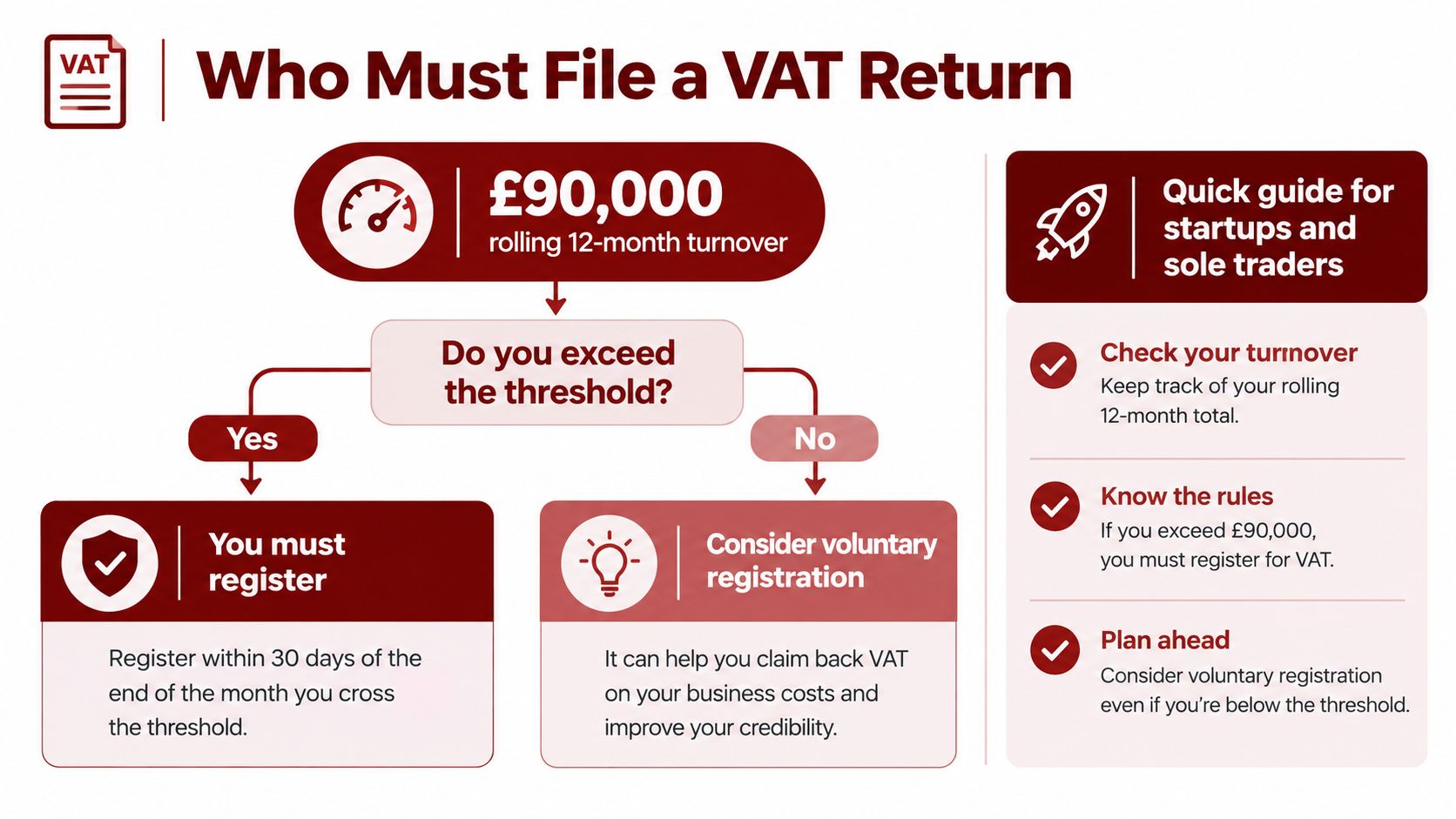
Registration is the starting point. A business that is VAT-registered must submit a return for each VAT accounting period, including a period with no payment due. That obligation applies whether the business is a limited company, partnership, sole trader or contractor.
The registration decision depends on the business's taxable turnover and the nature of its supplies. Exempt supplies aren't treated in the same way as taxable supplies, while zero-rated supplies remain taxable for VAT purposes. Businesses making only exempt supplies may therefore have a different position from a business whose sales are below the registration limit but include zero-rated work.
Voluntary registration needs a business reason
A business below the compulsory registration point can choose to register. That may suit a startup selling mainly to VAT-registered customers, a contractor with substantial VAT-bearing costs, or a business that wants its invoicing and records established before growth makes the decision urgent.
Voluntary registration also creates work. The business must charge VAT where applicable, preserve the required records, submit returns on time and separate VAT from its own income and expenses. It should never be treated as a badge of credibility without considering pricing, customer type and administration.
For a practical explanation of the registration decision, see this guide to the VAT registration threshold in the UK.
Use this quick decision test
- Already registered: File a return for every HMRC accounting period.
- Close to the taxable turnover limit: Monitor the rolling calculation regularly, not just at year end.
- Below the compulsory point: Consider voluntary registration only after modelling customer pricing and recoverable costs.
- Making exempt supplies: Check the exact treatment before assuming registration is unnecessary.
- Selling through a marketplace or from overseas: Establish who carries the VAT obligation for each transaction before relying on the platform's reports.
Registration and charging VAT aren't concepts to guess at from an invoice template. Confirm the effective date on the VAT registration information and make sure the bookkeeping starts applying the correct treatment from that date.
How to Calculate the VAT You Owe
The calculation is simple in principle and difficult in messy records. Start with output VAT on taxable sales. Then identify eligible input VAT on business purchases. The net result is the amount payable to HMRC or the amount potentially repayable.
Don't calculate from money received unless the business is using an accounting method that makes payment timing relevant. Invoice dates, credit notes, advance payments, reverse-charge transactions and mixed VAT rates can all affect the period in which an entry belongs.
A worked structure without guesswork
Use a transaction schedule with these columns:
| Field | What to record | Why it matters |
|---|---|---|
| Sales value | Net value of each taxable sale | Supports the sales total |
| Output VAT | VAT charged or otherwise accounted for | Feeds the output tax figure |
| Purchase value | Net value of eligible business costs | Supports the purchase total |
| Input VAT | Recoverable VAT supported by evidence | Reduces the net liability |
| VAT treatment | Standard, reduced, zero-rated, exempt or outside scope | Prevents mixed coding |
| Accounting date | Date used under the business's VAT accounting method | Keeps transactions in the correct period |
For illustration, suppose a business has £27,500 of quarterly turnover at the 20% standard rate, and £4,800 of VAT on eligible purchases. Those figures come from the worked scenario supplied for this guide, not from an HMRC statistic. The sales output VAT would be £5,500, and subtracting £4,800 of input VAT would leave £700 payable.
The mechanics should then be tested against the return fields:
| Box | Description | Example figure |
|---|---|---|
| Sales field | Total taxable sales and other required sales information | £27,500 net turnover |
| Output tax field | VAT due on sales and other output-tax entries | £5,500 |
| Purchase field | Purchases and inputs required by the return | Reconciled from records |
| Input tax field | Recoverable VAT on eligible purchases | £4,800 |
| Net VAT field | Output VAT less input VAT | £700 payable |
| EU or other transaction fields | Relevant cross-border information where applicable | Only if applicable |
The table is a working model, not permission to put every purchase through the return. A supplier receipt may show a total but still fail to support a VAT claim. Review guidance on claiming VAT back before treating an expense as recoverable.
Reconcile before submitting
Check the sales ledger against issued invoices and credit notes. Check the purchase ledger against supplier VAT invoices. Then compare the VAT control account with the return draft. A difference usually points to a missing document, an incorrect VAT code, a duplicated entry or a transaction posted in the wrong period.
Watch particularly for mixed-rate invoices, reverse-charge transactions, imports and transactions where the invoice date and payment date fall in different periods. Partial exemption can also restrict recovery where a business makes both taxable and exempt supplies. These aren't tidy-up issues for after filing. They determine the calculation itself.
Key Deadlines and Penalty Bands
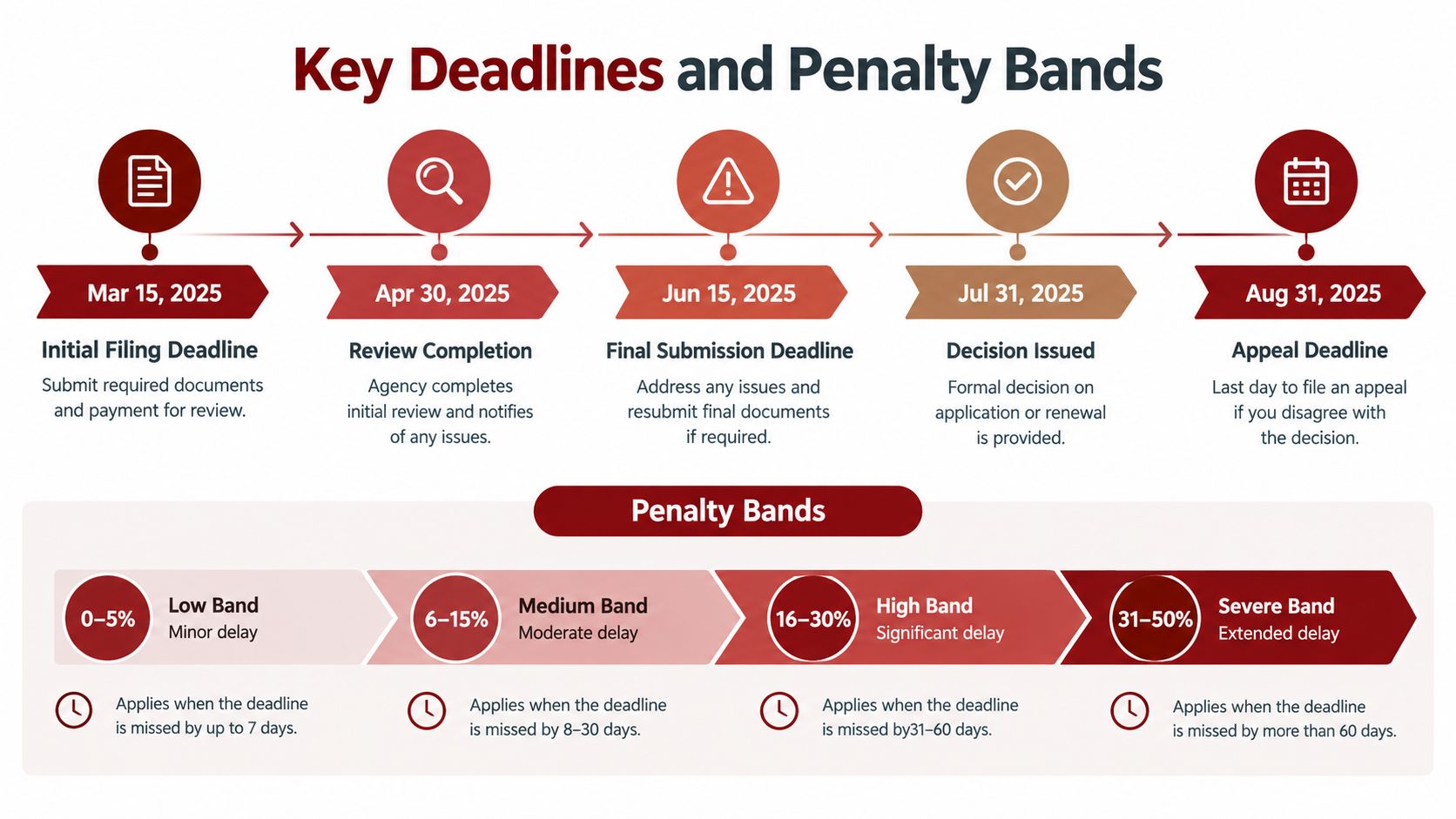
For the usual quarterly VAT period, the online filing and payment deadline is one calendar month and seven days after the period ends. HMRC sets out the rule in its VAT return deadline guidance. Treat that date as the legal boundary, not the day your accountant starts preparing the return. For the latest position on consequences for missed filing and payment dates, check HMRC's late filing and late payment penalty guidance.
Your payment must reach HMRC by the same deadline. Filing on time does not protect you from a late-payment consequence, and submitting the return late creates a separate compliance issue. Keep the expected VAT liability in a separate cash reserve throughout the period. VAT collected from customers is money due to HMRC, not spare working capital.
Annual Accounting works differently
The Annual Accounting Scheme uses different deadlines. For an accounting period between four and twelve months, the return and payment deadline is two months after the period ends. For a period under four months, it is one month after the period ends.
Fewer formal returns do not mean less bookkeeping discipline. You still need complete transaction records, accurate VAT codes and enough cash to meet the liability. Plan interim payments from the scheme information and calendar them in advance. Treating them as unexpected bills is a cash-flow mistake.
Understand the penalty risk
The current late-submission system uses points, while late payment has its own consequences. The outcome depends on the return type, payment history, timing and whether HMRC accepts a reasonable excuse. An old penalty chart copied from a blog is not a reliable basis for planning.
An inaccurate return can create a larger problem than a late return. HMRC penalties may reach 100% of tax understated or over-claimed. Correct a known error promptly rather than leaving it in the records. Use the VAT error correction guidance from Action Accountants as a starting point, then obtain advice if the treatment is material or uncertain.
Filing discipline: Set an internal review date before HMRC's deadline. That earlier date gives you time to find missing records, resolve VAT coding issues, fix software failures and arrange payment.
Create recurring calendar entries for the period end, bookkeeping close, review, approval and payment. Have the return ready before the legal deadline, then check the payment account separately. Pressing submit does not prove that the money has reached HMRC.
Making Tax Digital and Compliant Software
Making Tax Digital is not just an instruction to upload a spreadsheet. HMRC requires nearly all VAT-registered businesses to keep VAT records digitally and submit returns through compatible software. The software must maintain digital records, prepare the return from those records and communicate with HMRC through an API.
HMRC's Making Tax Digital for VAT notice focuses on the digital record and the link between records and submission. That changes the control point. The risk isn't only a mistyped figure in a form. It's a broken chain between receipt capture, bookkeeping, VAT coding, adjustments and the figures transmitted to HMRC.
Choose the workflow before choosing the app
Xero and QuickBooks may suit a small service business with straightforward sales and purchases. A contractor with reverse-charge work, subcontractor costs or more complex VAT treatments may need a specialist VAT module or an accountant-managed system. Businesses that retain a legacy spreadsheet can use bridging software where the setup meets HMRC's requirements, but bridging doesn't repair poor source data.
The selection test is practical:
- Compatibility: Confirm that the software can submit VAT returns through the required HMRC connection.
- Digital links: Make sure figures move electronically between the bookkeeping records, adjustments and submission stage.
- Audit trail: Keep a clear record of who changed a transaction, why it changed and what evidence supports it.
- Control: Restrict manual overrides and review every journal affecting VAT.
A spreadsheet can still have a role in analysis and management reporting. It shouldn't become an untracked second ledger that replaces the accounting records used to prepare the return.
Preserve the chain
Start with digital invoices and receipt capture. Map each VAT code to the correct ledger account. Review the VAT report, post only supported adjustments, lock the period after approval and retain the submission confirmation. Action Accountants' MTD VAT compliance guide covers the operational issues businesses should resolve before filing becomes urgent.
HMRC's technical material also records user feedback that digital filing can speed up preparation and increase confidence in getting tax right. That benefit only appears when the source records are accurate. Software can apply a code consistently, but it can't decide whether the code itself is correct.
Bookkeeping Habits That Make Returns Easier
The quality of the bookkeeping determines the quality of the VAT return. A person who understands every return field can still submit incorrect figures if the sales ledger is incomplete or the purchase records contain unsupported claims.
Capture documents as transactions happen. Don't leave a quarter's receipts in an email inbox or a car glovebox. Digital copies make review easier, but the record still needs enough detail to show the supplier, transaction, VAT treatment and business purpose.
Build a clean coding routine
Separate standard-rated, reduced-rated, zero-rated, exempt and outside-scope transactions in the ledger. A single “expenses with VAT” code hides the distinctions that matter during the review. The same applies to sales. If different supplies receive different VAT treatments, the software must preserve that difference.
Use a short weekly process:
- Capture: Attach every sales invoice, supplier VAT invoice and credit note to the transaction.
- Code: Apply the VAT treatment based on the supply, not on the supplier's name or the account category alone.
- Reconcile: Compare the VAT control account with the bank and ledgers.
- Escalate: Mark unclear property, cross-border, reverse-charge and mixed-use transactions for review.
- Close: Keep a single approved source for the return figures.
A clean VAT return is usually the by-product of clean bookkeeping, not clever box-filling.
Evidence matters
Keep the underlying records for the required retention period and ensure the evidence supports every input VAT claim. A payment leaving the bank doesn't automatically prove that VAT is recoverable. Common failures include claiming VAT from a receipt that isn't a valid tax invoice, treating a private cost as wholly business-related and applying a standard rate where the supply is exempt or zero-rated.
Perform a 15-minute end-of-week review. Before submission, check the sales total, purchase total, VAT control account, unusual journals, credit notes, missing documents and the payment amount. That small routine is more effective than a frantic quarter-end reconstruction.
For a growing business, the “single source of truth” should be software or a controlled spreadsheet with clear ownership and version history. Don't copy totals manually between systems when an approved digital link or import can move the data consistently. Manual transcription is exactly where a correct ledger becomes an incorrect return.
What Is Changing Next and How to Prepare
VAT compliance is moving towards continuous digital data rather than isolated quarterly submissions. The immediate task remains accurate records and timely returns, but businesses should also prepare for more structured invoicing and more direct use of transaction data.
HMRC's 2026 transformation roadmap says VAT invoices for B2B and B2G transactions are planned to be issued electronically from April 2029, subject to the roadmap and implementation details. It also refers to new digital channels for option-to-tax notifications and revocations planned before the end of 2026. These are future changes, not reasons to assume every technical detail is already fixed.
Prepare the data now
A business can future-proof its VAT process without buying every new product on the market:
- Adopt compatible software: Use a system that preserves digital records and supports the required HMRC connection.
- Standardise invoices: Keep consistent customer, supplier, tax and transaction fields so structured data can be used later.
- Map VAT codes: Make sure each VAT treatment connects to the correct nominal ledger and reporting category.
- Review the setup annually: Reassess registration, supply types, software and internal responsibilities as the business changes.
- Document adjustments: Keep a clear explanation and evidence for every manual correction.
Don't wait for a future mandate to fix today's broken reconciliation. A business with complete records, mapped VAT codes and a reliable approval process will handle new digital requirements far more easily than one rebuilding its books after every filing deadline.
VAT returns explained properly means understanding the system behind the submission. Align the data, software and habits now, and the return becomes a routine compliance output rather than a quarterly fire drill.
Action Accountants Limited provides VAT registration, bookkeeping, VAT control and reconciliation, Making Tax Digital support, and VAT return preparation for startups, SMEs, contractors and sole traders. If your records are fragmented or you want a reliable review before the next deadline, visit Action Accountants Limited to discuss your VAT process.