What Is Making Tax Digital for Income Tax in 2026
Learn what is making tax digital for income tax in the UK, who it affects from April 2026, the new quarterly rules, and how to prepare your bookkeeping now.

Making Tax Digital for Income Tax is the UK government's plan to move sole traders and landlords from one annual tax return to digital records, quarterly updates and an electronic final return, starting 6 April 2026 for those with qualifying income over £50,000. The programme later expands to qualifying income over £30,000 from 6 April 2027 and over £20,000 from 6 April 2028.
You may be hearing about it while trying to run your business, manage a rental property or close your accounts. Perhaps your accountant has asked whether your bookkeeping software is compatible, or you've seen different thresholds mentioned and aren't sure which one applies to you.
The important point is that MTD for Income Tax changes how you keep records and report information, not just the date on which you pay tax. The change affects the rhythm of compliance, the software you use and the way you monitor income throughout the year. It also creates a practical timing issue because the legal start date arrives before HMRC's later sign-up activity for the first group.
Table of Contents
- What Making Tax Digital for Income Tax Really Means
- Where MTD for Income Tax Came From
- Who Is in Scope and When
- How Quarterly Updates Replace the Annual Return
- Software and Digital Records You Must Use
- Exemptions, Agent Sign-Up and Penalties
- Common Myths and Your Next Steps
What Making Tax Digital for Income Tax Really Means
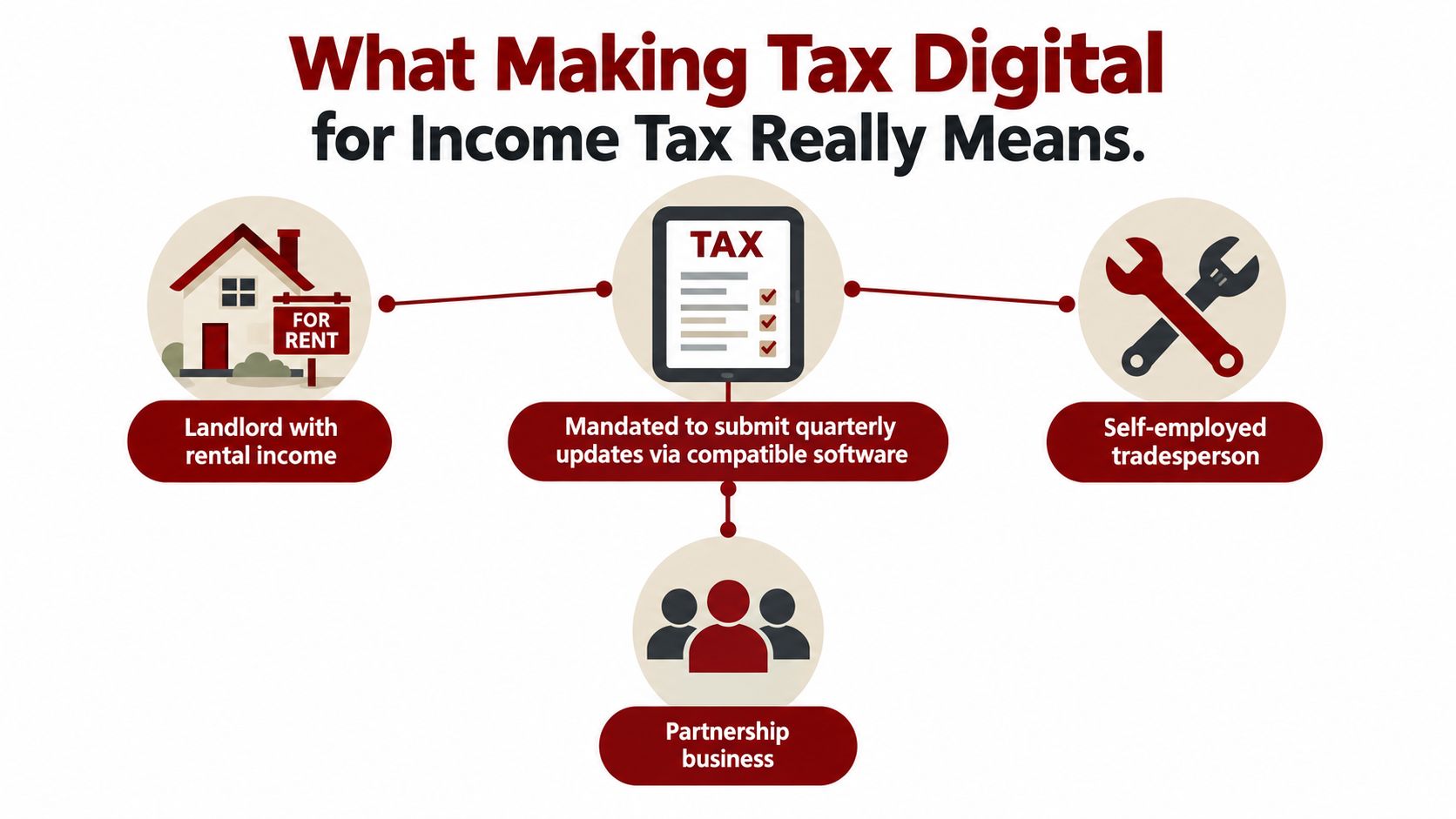
A North London landlord is looking at a profit-and-loss spreadsheet containing rent, repairs and mortgage information. Nearby, a self-employed plumber is sorting receipts from a shoebox while trying to remember which fuel costs relate to work. A small partnership owner is wondering why their accountant keeps asking them to choose accounting software.
For each of them, the answer to what is Making Tax Digital for Income Tax is broadly the same. It's HMRC's move from one annual Self Assessment return towards:
- Digital records for relevant business and property income.
- Four cumulative quarterly updates, submitted through MTD-compatible software.
- An electronic final declaration at the end of the tax year.
The quarterly updates are cumulative, meaning each update reports the position for the year so far rather than only the activity in the latest three-month period. The final declaration then allows the taxpayer to complete the year-end position electronically, including the adjustments and information that aren't dealt with through the routine updates. HMRC's official Making Tax Digital for Income Tax collection sets out the phased policy and reporting model.
Who the change concerns
MTD for Income Tax is aimed at unincorporated income, including sole traders, landlords and relevant partnerships. It doesn't turn a limited company's corporation tax reporting into MTD for Income Tax, and PAYE-only employees aren't brought into the regime merely because they receive employment income.
HMRC's stated purpose is to help people get their tax reporting right, reduce avoidable errors and give taxpayers a clearer view of their likely liabilities during the year. It also forms part of the government's wider effort to improve tax compliance. The practical result is that taxpayers and their agents must work from more current records instead of leaving the whole process until the annual return.
Practical rule: Treat MTD as a bookkeeping and reporting process, not as a new type of tax.
The first mandatory group starts on 6 April 2026. If you're a director or operate through a company, your position is different, so it's sensible to find MTD obligations for directors separately rather than assume the Income Tax rules apply.
Where MTD for Income Tax Came From
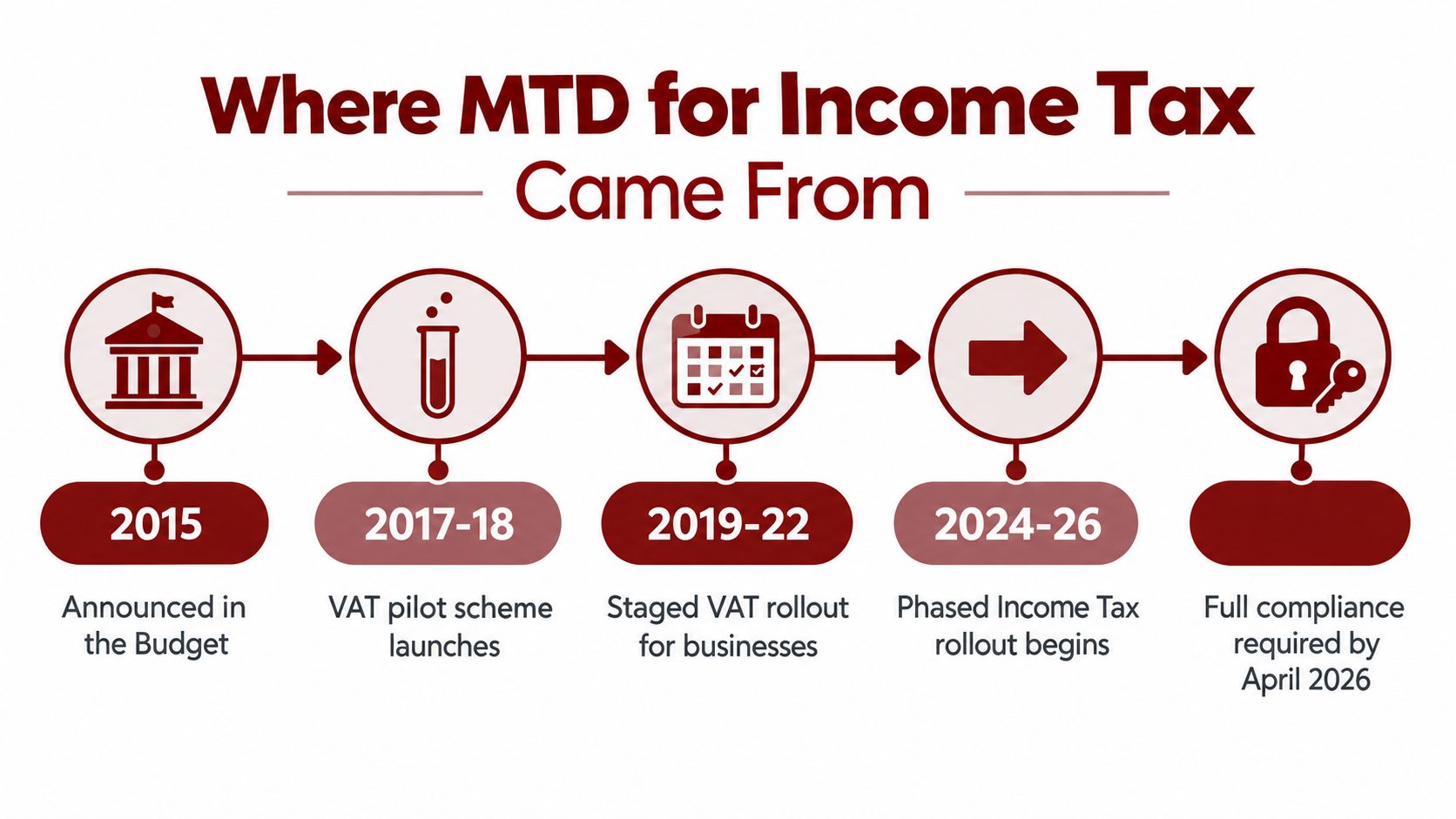
MTD for Income Tax hasn't appeared as a sudden standalone deadline. It's the result of a longer digital tax programme that began with a government announcement in the 2015 Budget, followed by testing and staged implementation in other areas of the tax system.
HMRC used a VAT pilot during 2017-18, followed by a staged VAT rollout running through 2019-22. Those milestones mattered because they gave HMRC, software providers, accountants and businesses experience of linking digital records to tax submissions. The government then decided in the 2021 Autumn Budget to extend MTD to Income Tax.
The original Income Tax timetable was later delayed after consultation during 2022-23. That delay allowed further testing with taxpayers and agents instead of forcing every affected business into one immediate launch. The subsequent sequencing announcement for 2024-25 confirmed the staged Income Tax start dates, with different qualifying-income thresholds applying from 2026 onwards. The VAT compliance guidance for 2026 provides useful context for understanding how the earlier VAT rollout fits into the wider digital tax programme.
The current plan should therefore be read as a staged compliance regime, not one universal switch. MTD for Income Tax is being introduced after years of policy development, VAT testing and changes to the proposed timetable. MTD for Corporation Tax is being considered separately, so company owners shouldn't assume that the Income Tax rollout automatically determines their corporation tax obligations.
For a sole trader or landlord who feels the change has crept up unexpectedly, the history offers one useful reassurance. The launch date is firm for the first group, but the programme itself has been refined over time. That makes preparation more important, because the final rules reflect a sequence of government decisions rather than an overnight experiment.
Who Is in Scope and When
The first question isn't “How much profit did I make?” It's “How much qualifying gross income did I receive?” HMRC tests combined gross income from self-employment and property, before expenses are deducted. If you run a trade and receive rent, both sources can count towards the scope test.
For the first mandatory year, HMRC looks at the 2024-25 tax year when deciding whether you fall into the group starting on 6 April 2026. The staged dates are:
| Cohort | Qualifying gross income from 2024-25 | MTD start date | First quarterly update due |
|---|---|---|---|
| First group | More than £50,000 | 6 April 2026 | 7 August 2026 |
| Second group | More than £30,000 | 6 April 2027 | Date follows the applicable quarterly cycle |
| Third group | More than £20,000 | 6 April 2028 | Date follows the applicable quarterly cycle |
These thresholds and the gross-income test are confirmed in HMRC's guidance on when MTD for Income Tax applies. The first row applies to people whose combined qualifying income was more than £50,000 in 2024-25, not to people whose profit after expenses exceeded that amount.
Examples that cause confusion
A landlord with rental receipts above the relevant threshold may be in scope even if repairs and other allowable costs reduce the eventual profit considerably. Similarly, a plumber whose turnover crosses the threshold may need to assess MTD even if materials, vehicle costs and subcontractor expenses bring taxable profit down.
A sole trader with only PAYE wages generally isn't brought into MTD by those wages. A limited company isn't a sole trader, so its corporation tax obligations should be considered separately. Partnerships need particular care because the partnership activity and each partner's personal tax position interact, and the relevant registration and reporting arrangements must be checked rather than guessed.
If your qualifying gross income is below the applicable threshold, you may not be required to join at that stage. That doesn't mean you can ignore the issue permanently, because the threshold pathway reaches lower income groups later. HMRC's Self Assessment registration guidance can also help if you're uncertain whether your existing tax registration and reporting responsibilities are complete.
A quick self-check
Add together your gross receipts from self-employment and property for the relevant tax year. Don't subtract expenses at this stage. Then compare the total with the threshold attached to the start date you're assessing. If you're close to a threshold, monitor receipts throughout the year instead of waiting for accounts to be finalised.
How Quarterly Updates Replace the Annual Return
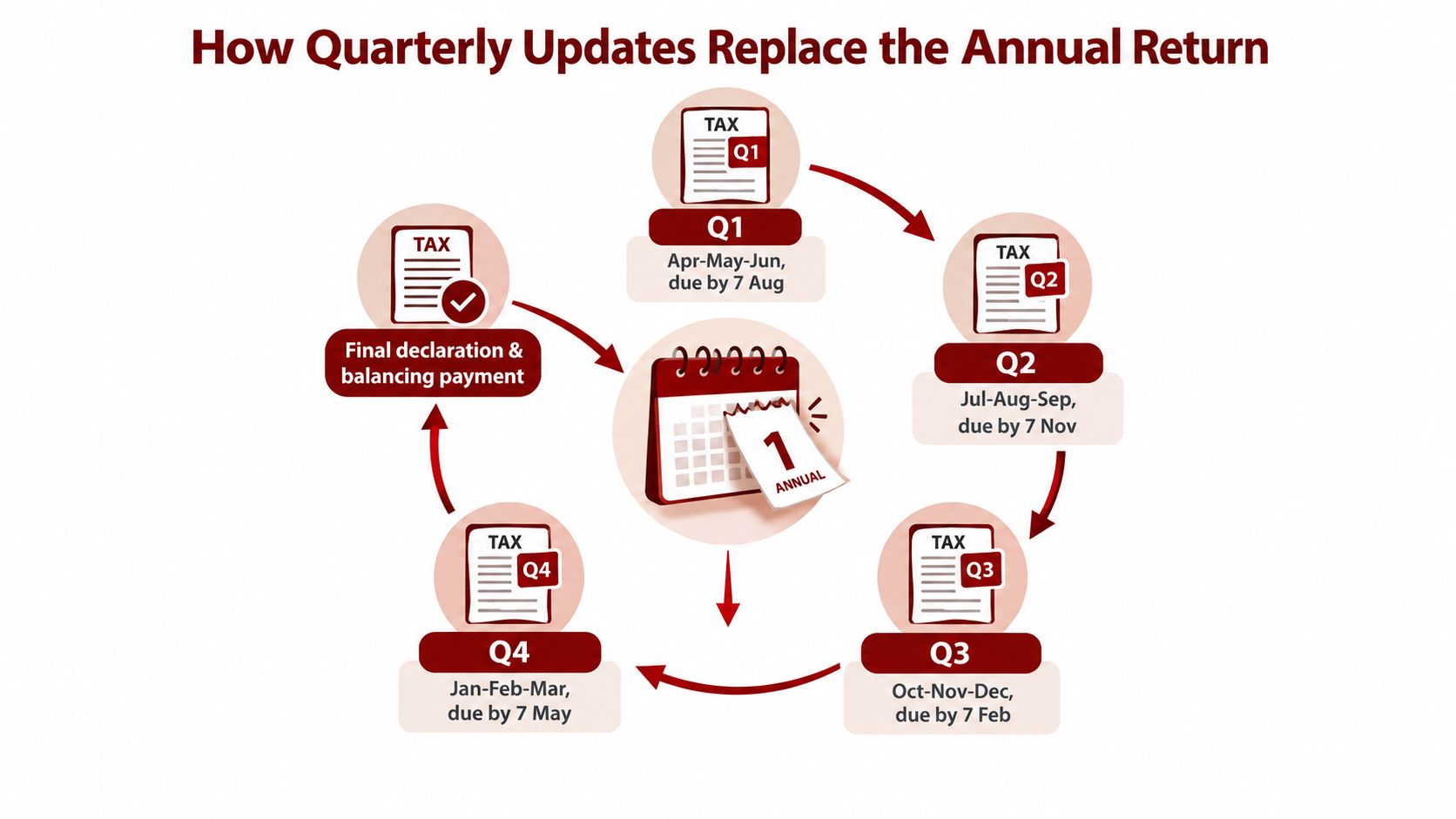
The old pattern was familiar. You kept records, waited until after the tax year, prepared one Self Assessment return and dealt with the final tax calculation. MTD introduces a rolling information cycle, with four cumulative quarterly updates followed by a final declaration.
For a standard tax-year cycle, the practical rhythm is:
- Q1 covers the opening part of the tax year and is due by the 7th day of the month after the quarter ends.
- Q2 adds the next quarter's transactions to the year-to-date figures.
- Q3 continues the cumulative picture.
- Q4 completes the regular reporting for the year.
- The final declaration closes the year electronically and deals with the final adjustments.
The first group's first update is due by 7 August 2026, and HMRC's service guidance confirms the general deadline rule. The reporting process also includes a technical threshold for consolidated expenses. The threshold was updated from £85,000 to £90,000, which affects how software aggregates expense information in quarterly submissions, as explained in the professional FAQ on MTD for Income Tax.
A plumber's running example
Suppose a self-employed plumber's turnover is around £60,000. In the first update, the plumber submits the income and allowable expenses recorded so far. In the second update, the software reports the cumulative total from the start of the tax year through the second quarter, rather than sending only the latest quarter in isolation.
That distinction matters. If a bank transaction was missed in Q1 and corrected before Q2, the next cumulative update should reflect the corrected year-to-date position. The plumber should reconcile bank feeds, check receipt records and review unusual transactions before pressing submit. Quarterly reporting doesn't remove the need for judgement. It makes regular bookkeeping more important.
Quarterly updates aren't quarterly tax payments. The information rhythm changes first, while the established payment arrangements continue separately. If you need to review how payments on account work alongside the new reporting cycle, see this guide to payments on account.
The final declaration is the year-end step. It brings together the cumulative business and property information, allows relevant adjustments and completes the electronic filing process. A disciplined monthly reconciliation is easier than reconstructing a year of transactions just before a quarterly deadline.
The video below offers another visual explanation of the reporting cycle.
Software and Digital Records You Must Use
HMRC-compatible software isn't just any app that stores transactions. It must support the functional requirements of MTD, including keeping required records digitally, maintaining a usable digital link or connected workflow, creating quarterly submissions in the prescribed format and receiving responses from HMRC. It should also support the final declaration process.
A spreadsheet can still be part of the system. It can't normally be the final point that sends the update to HMRC by itself. If you use spreadsheets, you'll generally need bridging software to connect the digital records to the HMRC submission service while preserving the required digital link.
Three routes for different working styles
| Software route | Best for | Typical cost | Key limitation |
|---|---|---|---|
| Full accounting software, such as Xero, QuickBooks, Sage or FreeAgent | Businesses wanting bookkeeping, bank feeds and filing in one environment | Subscription-based | Requires setup and consistent categorisation |
| Bridging software | Businesses that already maintain suitable spreadsheets | Varies by provider | Keeps the spreadsheet workflow, but adds a separate submission step |
| Simpler bookkeeping apps | Smaller or less complex trades and property records | Varies by provider | May not handle unusual income sources or advanced adjustments comfortably |
The records you keep digitally should reflect the information needed to support your tax calculation. That can include business income, allowable expenses, mileage records, capital allowances and relief claims. Keep the source documents and supporting evidence for at least five years, and make sure the digital trail lets you explain how a figure moved from the original record into the submission.
A practical selection checklist
Before choosing software, ask:
- Compatibility: Is the product listed by HMRC as compatible with MTD for Income Tax?
- Coverage: Can it handle separate self-employment and property activities if you have both?
- Corrections: Can you amend errors while preserving a clear audit trail?
- Agent access: Can your accountant review, prepare and submit information efficiently?
- Continuity: Can you export records if you change provider?
Integration is another issue worth checking. Bank feeds, payroll tools, receipt capture and accountant access need to work together without creating duplicate records. A technical OneSafe integration playbook can help you think through how systems exchange information before you commit to a particular workflow. You can also review accounting software integration support if you want help connecting bookkeeping tools to the wider reporting process.
The authoritative starting point is HMRC's own provider list. Don't rely solely on a software advert that says “digital accounting”. Check that the specific product and function you intend to use support the MTD submission you need.
Exemptions, Agent Sign-Up and Penalties
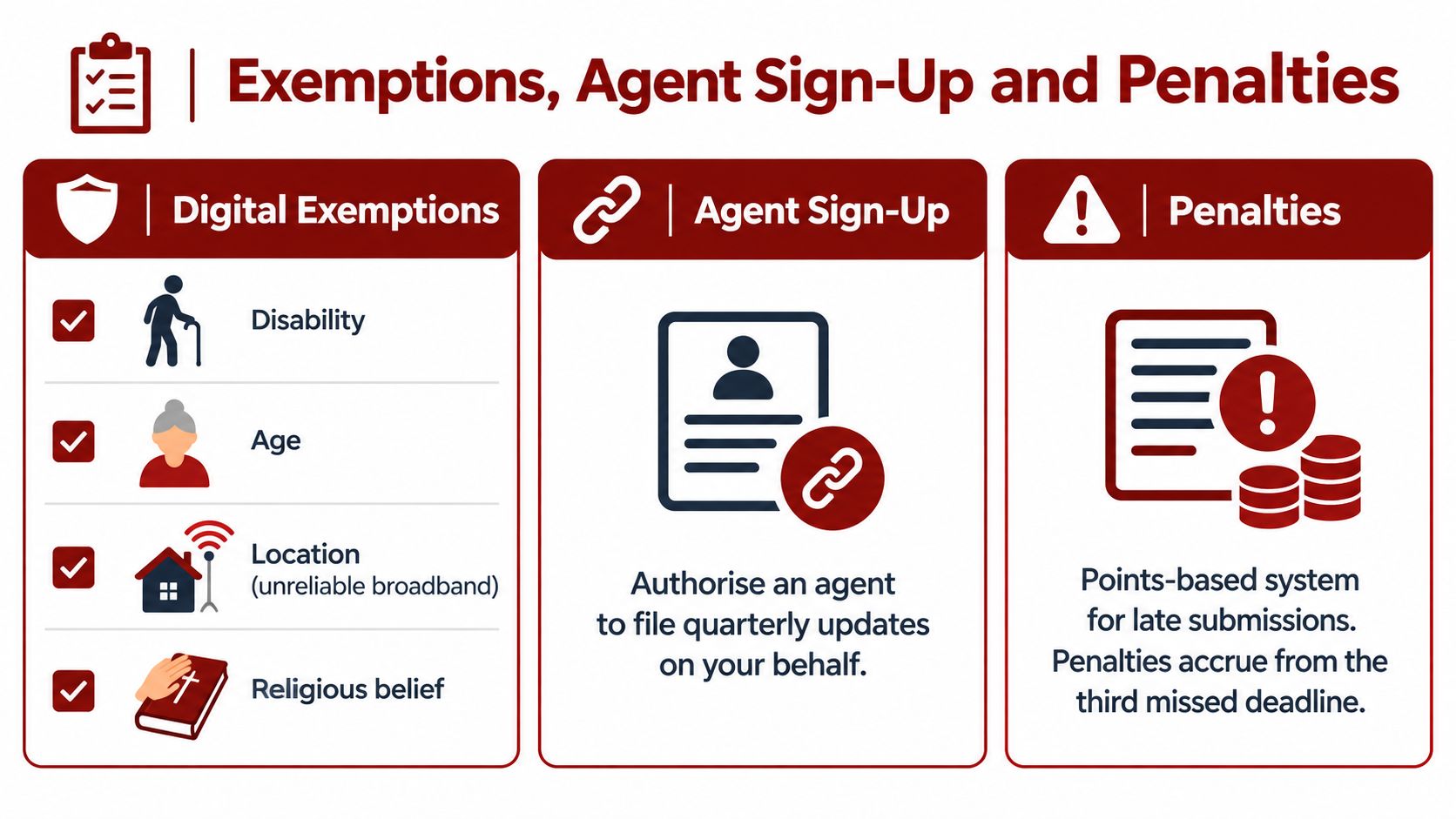
MTD exemptions are narrow. HMRC may consider an exemption where a person can't reasonably use digital tools because of age, disability, location with no reliable broadband or religious belief. A short-term crisis, such as bereavement or serious illness, may also affect a person's ability to comply, but it shouldn't be treated as an automatic permanent exemption.
You apply through GOV.UK, and HMRC can review the position over a two-year review window. An exemption is based on individual circumstances, not on a general dislike of software or a preference for paper records. If you think digital exclusion applies, gather a clear explanation of the practical barrier and apply rather than missing submissions.
The sign-up timing trap
The legal start date for the first group is 6 April 2026, but HMRC says it will start signing people up for the 2026-27 tax year from September 2026. The first quarterly update is due by 7 August 2026, creating an operational gap between the start of the regime, the first reporting deadline and the later onboarding window. HMRC's sign-up guidance for MTD for Income Tax explains this timing.
That gap is easy to underestimate. A taxpayer may assume that no action is needed until HMRC contacts them, while an accountant may already be preparing records and software for the first update. Agents can sign up clients during HMRC's sign-up window once the necessary authority is in place, so discuss the arrangement early if you want your accountant to manage the process.
Penalties remain a compliance concern
HMRC has confirmed a points-based approach for late MTD submissions. Missing a quarterly update can lead to an initial £200 penalty point, followed by a further £200 point for the same failure three months later. If the final declaration is more than three months late, daily £10 penalties can apply, capped at £300. These figures are set out in the professional guidance linked earlier.
Those penalties sit alongside existing Self Assessment late-filing and late-payment penalties. A taxpayer can therefore face more than one type of compliance consequence if they neglect both the MTD process and the remaining tax obligations.
A six-month preparation list
- Confirm scope: Check qualifying gross income and the relevant tax year.
- Choose software: Select an HMRC-compatible product or bridging route.
- Migrate records: Bring income, expenses and supporting documents into a controlled system.
- Test submissions: Practise the digital link and check that cumulative totals reconcile.
- Plan registration: Be ready for the period between April and September 2026.
- Brief your agent: Agree who records transactions, reviews figures and submits updates.
Common Myths and Your Next Steps
Myth one: spreadsheets are banned. They aren't automatically banned. A spreadsheet may remain part of your digital records, but it must connect appropriately to compatible bridging software if it's being used to support the submission. The key question is whether the complete workflow preserves the digital link and sends the update through approved software.
Myth two: MTD is a stealth tax rise. MTD changes record-keeping and reporting. It doesn't, by itself, create a new tax rate or turn an allowable expense into taxable income. It may expose errors or improve the timing of information available to you, but that's different from changing the underlying tax charge.
Myth three: it only affects limited companies. The Income Tax rollout is aimed at sole traders, landlords and relevant partnerships. Limited companies have a separate corporation tax position, so a director shouldn't assume that company incorporation removes every digital reporting question.
Myth four: a landlord below £50,000 can ignore MTD indefinitely. The first threshold is only the opening stage. The programme expands to lower qualifying gross-income groups from later start dates, including those over £30,000 and then over £20,000. Check the threshold pathway rather than relying on the first date alone.
Choose the right preparation track
This month, audit your bookkeeping. Identify every self-employment and property income source, calculate gross receipts before expenses and check which tax year HMRC will use for your start-date assessment.
Before April 2026, choose your software, test a bridging file if you're retaining spreadsheets and agree responsibilities with your agent. Don't wait for a perfect set of accounts before testing the workflow. A failed connection or incomplete category mapping is easier to fix before the first deadline.
Once quarterly updates begin, create a habit around the 7th-of-the-month deadline. Reconcile bank feeds, review cumulative figures, retain source documents and investigate unusual movements before submission. If your business or property arrangements are complex, ask an accountant to confirm your scope and reporting plan rather than making a decision based on turnover or profit alone.
Action Accountants Limited helps sole traders and partnerships prepare for MTD for Income Tax, including quarterly and final MTD submissions, alongside bookkeeping, tax returns and practical compliance support. Visit Action Accountants Limited to discuss your qualifying income, software setup and first reporting deadline.