
Choosing an Accountant for Construction Business in the UK
A practical guide for construction business owners on choosing an accountant for construction business.
You've finished a project, sent the invoice, and expected the payment to strengthen the business. Instead, the amount received is lower than expected, the VAT treatment looks unfamiliar, and your subcontractor statement doesn't appear to reconcile with the bank transaction. Your bookkeeper has posted the labour and materials separately, while someone else has applied CIS deductions without checking whether the customer is an end user.
That situation isn't unusual. The difficult part of construction accounting isn't entering transactions into software. It's sequencing CIS deductions, VAT treatment, subcontractor verification, job costs, payroll and cash-flow forecasting so that one rule doesn't undermine another. Choosing an accountant for a construction business means finding someone who understands what happens between the site, the invoice, the payment run and the VAT return.
Table of Contents
- Why Construction Accounting Is a Different Game
- Navigating CIS and VAT Reverse Charge Without Losing Money
- Job Costing and Cash-Flow Management for Construction Projects
- Software Integrations That Actually Fit Construction Workflows
- Red Flags When Selecting a Construction Accountant
- Gross Payment Status and Cash-Flow Optimization
Why Construction Accounting Is a Different Game
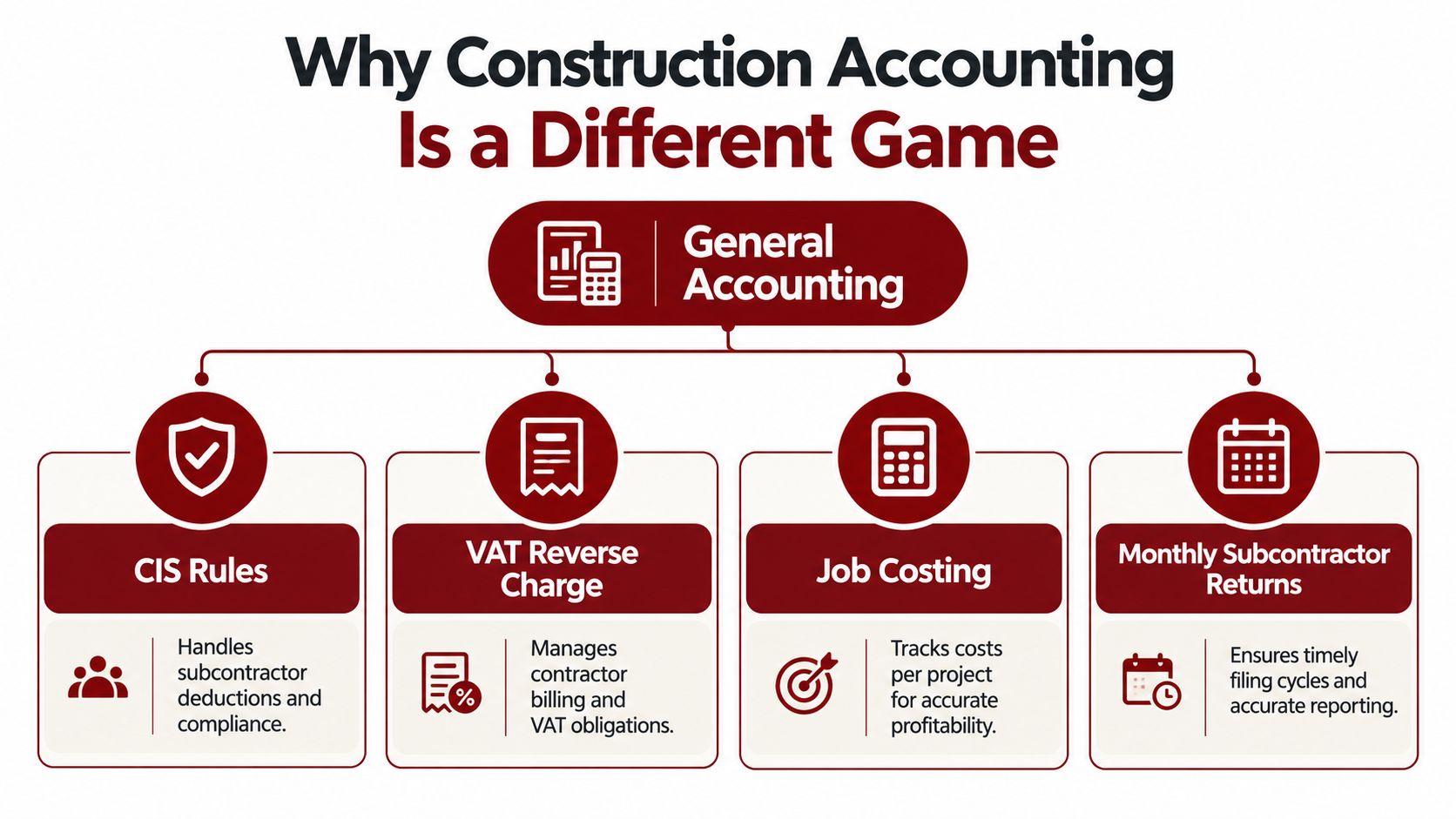
A general accountant may produce accurate statutory accounts and still miss the operational risks that sit inside a construction invoice. Construction businesses often work with a changing mix of contractors, subcontractors, labour-only suppliers, material suppliers and end users. Each relationship can affect how a payment should be processed.
Consider a contractor who receives an invoice for building services. The supplier is registered for VAT, the work falls within CIS, and the contractor has confirmed that the project is for its own business use. The invoice may need reverse charge VAT treatment, while CIS deductions are considered separately. If the accounts team posts ordinary VAT, deducts CIS from the wrong base, or fails to retain the required evidence, the mistake can affect the supplier's cash flow and the contractor's records at the same time.
The scale of the sector makes this more than an occasional technical issue. In Great Britain, construction new work reached £140,684 million in 2024, while new orders reached £71,707 million. The same official data recorded 370,770 VAT- and PAYE-registered construction firms in Quarter 3 2024 and construction-related employment of about 1.4 million workers. These figures are reported in the Office for National Statistics construction statistics tables, and they reflect the variety of businesses an accountant may need to support, from small subcontractors to larger contractors with multiple live sites.
The rules operate together
CIS isn't merely a monthly filing task. Contractors must verify subcontractors, calculate deductions where required, submit returns and maintain records. VAT reverse charge isn't just a tax code selected from a drop-down menu. It changes how VAT appears on the invoice, how the customer accounts for tax and how the transaction affects cash flow.
HMRC's construction guidance describes the wider compliance environment affecting contractors and subcontractors, including the Construction Industry Scheme and construction tax obligations. A specialist accountant uses that knowledge to build controls around the transaction, rather than waiting until year-end to discover that several invoices were treated inconsistently.
Practical rule: If your accountant can't explain how the CIS decision affects the VAT posting and the payment statement, they're looking at only part of the transaction.
Job costing adds another layer. A business may report a healthy overall profit while one project is consuming more labour, plant or materials than expected. Without project-level coding, the accounts can show revenue without explaining where margin has disappeared. A construction-focused accountant will usually want costs allocated by job, phase or cost category, then reviewed against the original budget and current forecast.
What specialist experience protects
Sector experience matters because it changes the questions asked before a payment is released. A construction accountant should want to know:
- Who supplied the work: Is the supplier a subcontractor, a main contractor, a professional adviser or a materials-only supplier?
- What the invoice covers: Does it include labour, materials, plant hire, or a single combined construction service?
- Who receives the service: Is the customer an end user, or is the work being supplied through a construction chain?
- What the records show: Does the invoice agree with the subcontractor statement, CIS return, purchase ledger and bank payment?
- Where the cost belongs: Which project and cost code should absorb the transaction?
That discipline prevents avoidable corrections. It also gives the owner a more reliable view of cash available for wages, materials, tax payments and the next project. A construction accountant isn't merely preparing accounts after the work is complete. They're helping protect the margin while the work is still being delivered.
Navigating CIS and VAT Reverse Charge Without Losing Money
A subcontractor's invoice can look straightforward while creating three separate decisions for the contractor: whether CIS must be deducted, whether VAT is charged or self-accounted, and whether gross payment status removes the deduction. CIS determines whether a deduction is made from a subcontractor's payment. VAT reverse charge determines how VAT is invoiced and reported. Gross payment status changes the CIS payment calculation, not the VAT treatment. Applying these rules in the wrong sequence can reduce cash or leave the contractor with an incorrect VAT return.
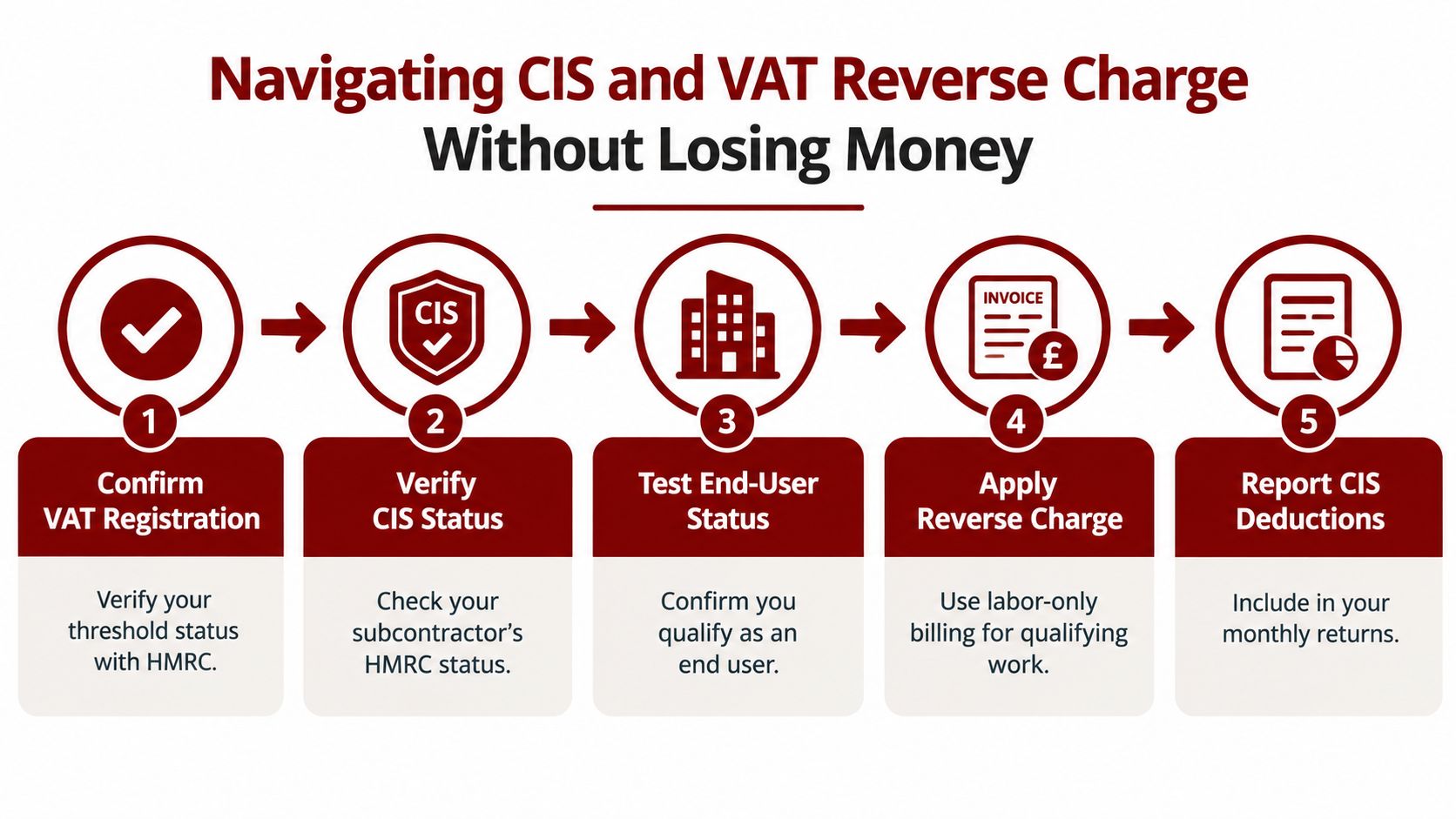
Use a fixed sequence for every relevant invoice.
Start with the parties and the service
Confirm whether the supplier and customer are VAT registered, or required to be registered, then identify precisely what the invoice covers. The construction reverse charge applies to standard- or reduced-rate construction services supplied between UK VAT-registered businesses where the payment is reported within CIS.
Verify the subcontractor's CIS status before payment approval. The contractor needs to know whether deductions apply and whether the subcontractor holds valid gross payment status. A change in status should be visible to the person processing the invoice, rather than discovered after the bank file has been released.
Check the customer's end-user status in writing. If the customer qualifies as an end user, the reverse charge may not apply. A verbal assumption made on site is weak evidence, so retain written confirmation with the supplier and payment records.
The HMRC reverse charge manual explains that the supplier doesn't charge VAT in the usual way when the reverse charge applies. The customer self-accounts for output VAT in box 1 and usually reclaims the corresponding input VAT in box 4. Use this VAT reverse charge explained guide to check how the invoice should be coded before it reaches the VAT return.
Calculate CIS and VAT in the right order
Consider a verified subcontractor without gross payment status who issues an invoice for £10,000 labour and £2,000 materials, where the reverse charge applies and CIS is deducted at 20%. The supplier's invoice total is £12,000, with no VAT added to the amount payable. Materials are excluded from the CIS deduction base, leaving £10,000 subject to CIS. The deduction is therefore £2,000, and the subcontractor receives £10,000.
The customer still records the reverse charge VAT on the taxable construction service and self-accounts in box 1, with the corresponding recovery in box 4 where permitted. The £2,000 CIS deduction is a payment calculation, not a substitute for the VAT entry. If the contractor mistakenly applies CIS to a VAT-inclusive total, or treats the materials and labour as one undifferentiated base, the subcontractor can be underpaid and the contractor's records become difficult to reconcile. If the subcontractor has gross payment status, the CIS deduction is not made, while the reverse charge decision remains based on the service and customer.
Invoice splitting is a poor workaround. Separating labour and materials artificially to avoid reverse charge treatment does not defeat the rule where HMRC regards the transaction as one supply. The HMRC guidance on the Construction Industry Scheme also sets out the need for verification, deductions, monthly returns, deduction statements and record keeping.
A practical reconciliation should tie together:
- The approved invoice, including the service description and materials treatment.
- The CIS calculation, showing the deduction basis and subcontractor status.
- The VAT posting, showing reverse charge treatment and the relevant return entries.
- The payment statement, issued to the subcontractor.
- The bank payment, net of the relevant deduction.
HMRC requires contractors to file CIS returns by the 19th of the month after the tax month, with deduction statements issued within 14 days after each tax month, according to its contractor guidance. A missed return, late statement or unsupported deduction can create disputes and expose the contractor to compliance action.
Decide CIS, decide VAT, record the evidence, then release the payment.
A specialist accountant can review mixed relationships too. A business may be a subcontractor on one project and a contractor on another, so the VAT decision follows the transaction and customer relationship rather than a permanent label attached to the business.
Job Costing and Cash-Flow Management for Construction Projects
A project can be profitable on paper and still leave the business short of cash. That happens when the accounts show revenue without showing when customers will pay, when subcontractors must be paid, which costs belong to each site, and how much tax has been withheld or remains payable.
A useful job-costing system starts with the project structure rather than the chart of accounts. Labour, materials, plant, subcontractors, site expenses and variations should be coded to the relevant job. The accountant can then compare committed costs, posted costs and expected final costs. That view is more useful than a company-wide profit figure that hides overruns on individual projects.

What the monthly numbers should reveal
The monthly management pack should answer practical questions, not confirm that bookkeeping has been completed.
| Question | Useful accounting evidence |
|---|---|
| Which jobs are making money? | Actual cost against budget by project |
| Where is cash tied up? | Debtors, retentions, supplier balances and tax deductions |
| Are subcontractor payments complete? | Approved invoices reconciled to statements and bank payments |
| Is the forecast still credible? | Remaining cost estimates, committed spend and variations |
| What needs attention from the owner? | Exceptions, overdue balances and unusual transaction coding |
Work in progress needs careful handling because the timing of costs and income can make a project look stronger or weaker than the underlying position. The right treatment depends on the accounts framework and the facts of the contract, but the management question remains the same: what has been earned, what has been spent, and what cash is expected to move next?
A generalist firm may offer a lower apparent fee because it performs a narrower compliance role. That can work for a simple business with few transactions and no meaningful project variation. It doesn't work well when someone inside the business must manually reconcile job costs, CIS statements, VAT codes and payment runs every month. The owner may pay the difference through staff time, delayed decisions, rework or cash trapped in incorrect postings.
Cash-flow controls worth requesting
Ask the accountant to show how they would handle the following before you appoint them:
- A rolling cash forecast: Include expected customer receipts, payroll, subcontractor payments, materials, VAT and CIS liabilities.
- Project-level reporting: Show whether the report can separate sites, contracts, departments or cost codes.
- Subcontractor payment cycles: Explain how approved invoices move into payment runs and how deductions are communicated.
- Exception reporting: Flag missing invoices, expired verification, unusual VAT treatment and costs posted without a project.
- Forecast updates: Set a clear process for revising expected final cost when variations or delays arise.
A construction accountant should also explain what information they need from the site team. Timesheets, delivery notes, purchase orders, applications for payment and variation records aren't just paperwork. They support the numbers that tell you whether a job is progressing within its commercial plan.
For a deeper look at the systems behind project-level financial control, review this guide to construction cost management. The right approach doesn't promise that every project will run perfectly. It gives the owner an earlier warning when the figures move away from the plan.
Software Integrations That Actually Fit Construction Workflows
The best accounting software is the one that reflects how the business buys, bills, pays and reports. A platform that handles ordinary sales invoices well may still create manual work if it can't distinguish construction services, materials, subcontractor deductions, project codes and reverse charge VAT.
QuickBooks Online, Xero and Sage can support different parts of a construction workflow, but the product name matters less than the configuration. Ask whether the chosen system can preserve the transaction detail your accountant needs without forcing staff to maintain a separate spreadsheet for every site.
Compare the workflow, not the feature list
| Requirement | Basic setup | More suitable construction setup |
|---|---|---|
| Job costing | General expense categories | Project, phase and cost-code allocation |
| CIS processing | Manual calculations | Integrated verification, deductions and statements |
| VAT treatment | Standard tax codes | Clear reverse charge codes with review controls |
| Supplier management | Contact and payment records | Status tracking, approval workflow and document storage |
| Reporting | Company-wide profit and loss | Job margin, committed cost and cash forecasting |
A small contractor may need a clean ledger, reliable bank feeds, document capture and disciplined project coding. A growing contractor with several live sites may need construction management software linked to the ledger, so approved costs and variations reach the accounts without repeated re-keying.
Integration isn't automatically beneficial. A poorly configured connection can import duplicate bills, assign the wrong tax code or push costs into a general overhead category. Before choosing a platform, test a real transaction from purchase order to invoice, CIS deduction, payment and reporting. Include a mixed invoice containing labour and materials, because that's where simplistic workflows often fail.
Selection test: Ask the supplier to demonstrate your most complicated ordinary transaction, not its easiest sales dashboard.
The same principle applies to larger systems. A careful vendor selection for construction ERP process should compare project controls, accounting integration, subcontractor administration and reporting in one workflow. Don't select an ERP because it has the longest feature list. Select it because your people can use it consistently and your accountant can review the resulting data.
Your accountant should be involved before implementation. They can define the chart of accounts, project codes, VAT mappings, approval rules and reporting requirements. They should also review whether the system can produce records needed for CIS returns and payment statements. Guidance on accounting software integration is useful when deciding which tasks should be automated and which still need human review.
Red Flags When Selecting a Construction Accountant
A firm doesn't become construction-specialist because its website includes a picture of a hard hat. The test is whether its team can work through a real invoice without giving you a vague answer.
Be cautious if the first conversation focuses entirely on year-end accounts. Statutory accounts matter, but they won't correct a subcontractor payment that was processed with an expired status or a VAT code that was wrong from the start. A capable accountant should ask about your sites, customer types, subcontractor mix, payment cycles and current software before recommending a service.
Questions that expose shallow expertise
Ask these questions directly:
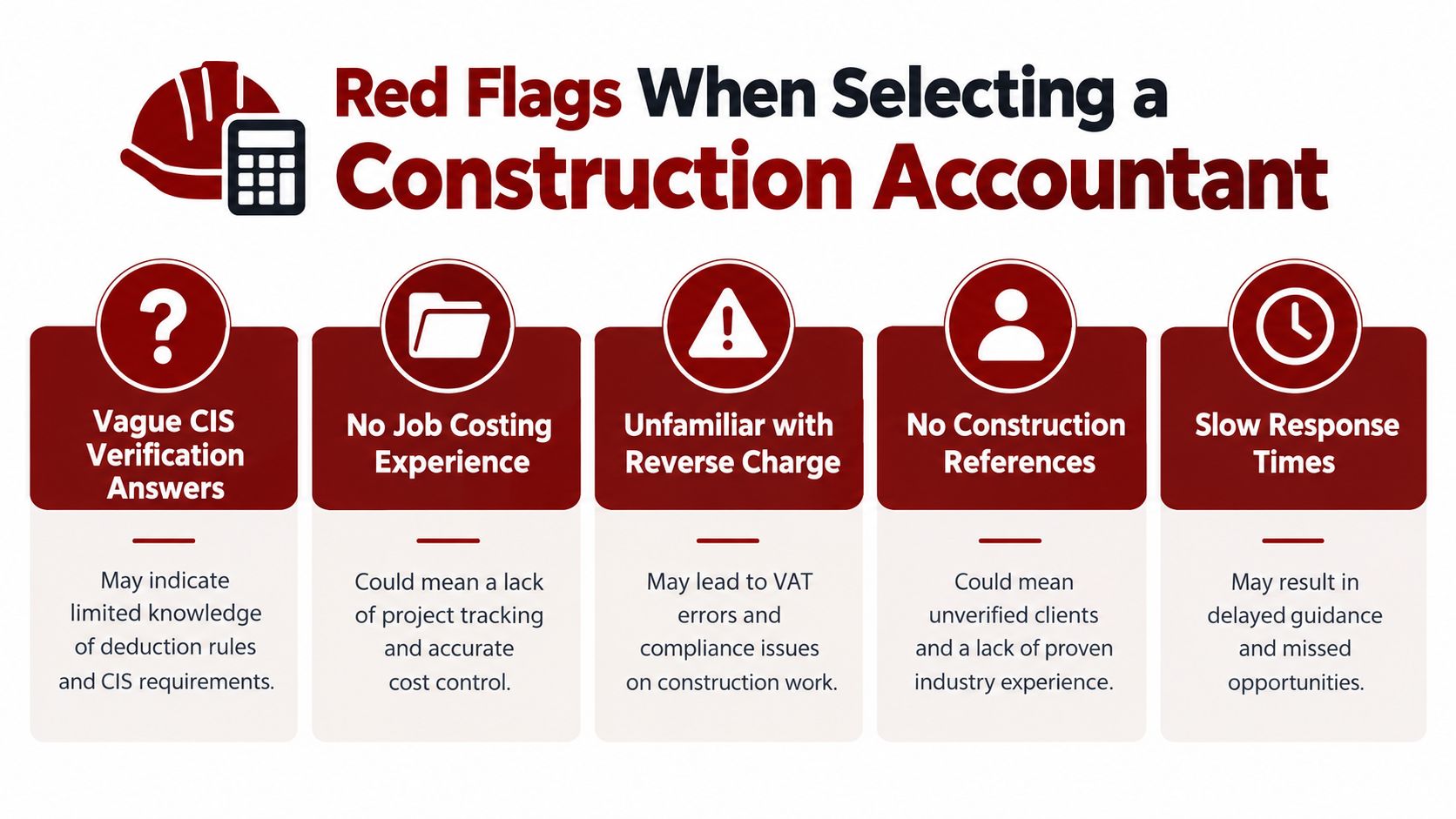
- How do you separate CIS from VAT reverse charge decisions? The answer should explain that CIS deductions and VAT treatment are separate tests that must be reconciled on the same transaction.
- What do you check before a subcontractor payment? Look for verification, status expiry controls, invoice classification, deduction calculation and payment statement review.
- How do you deal with end users? The accountant should ask how written end-user confirmations are obtained and stored.
- How will I see profit by project? A general profit and loss report isn't enough if the business needs job-level control.
- How do you assess gross payment status? The firm should understand the business, turnover and compliance tests, and explain the cash-flow implications.
- What happens when an invoice is unclear? A good answer includes an escalation process, not an automatic tax code.
The HMRC contractor requirements for CIS include subcontractor verification, deductions, monthly returns and full record keeping. If a prospective accountant can't describe how those obligations fit into your payment process, don't assume they'll manage them reliably after appointment.
Marketing claims aren't controls
Another warning sign is a promise that sounds too broad to test, such as “we handle everything” without a defined monthly timetable. Ask who reviews the CIS return, who answers urgent VAT questions, when management reports arrive and how quickly exceptions are raised.
You should also ask for construction references that are relevant to your type of work. A residential builder, civil engineering contractor and labour-only subcontractor can have very different reporting needs. Confidentiality may prevent detailed disclosure, but the accountant should still be able to explain the patterns of work they understand.
The video below offers another visual prompt for assessing the risks that can sit inside construction accounting workflows.
Slow responses are also a practical risk. If your team can't get a clear answer before an invoice is paid, the business may have to choose between delaying a supplier or accepting an uncertain treatment. Agree communication routes and response expectations before the engagement begins.
Gross Payment Status and Cash-Flow Optimization
Gross payment status can improve a subcontractor's cash position, but it isn't an automatic win. HMRC says a subcontractor must pass the business test, turnover test and compliance test to receive gross payments. Status can also expire, so the accounting system needs a way to identify a problem before the next payment run.
A subcontractor without registration may face deductions at 30%, while a registered subcontractor is usually deducted at 20%. Gross payment status removes deductions from payments. These rates and the conditions for gross payment are set out in HMRC's subcontractor guidance.
The cash-flow decision should consider more than the headline deduction. Ask:
- Will the business pass the tests and maintain compliance? Late filings, poor records or unresolved liabilities can undermine the application.
- How much working capital is tied up? Regular deductions may leave a small subcontractor funding materials, wages and travel while waiting for tax reconciliation.
- Can the records support a refund claim? If deductions exceed the tax due, accurate bookkeeping helps identify and recover the overpayment.
- Does the business have the capacity to maintain the status? Gross payment status creates a stronger need for timely accounts, payroll, tax records and ongoing checks.
- What does the forecast show? Compare the cost of compliance work with the cash-flow benefit of receiving payments without deductions.
Limited companies and sole traders may deal with overpaid CIS through different tax processes, so the accountant should explain the route that applies to the business rather than offering a generic promise of a quick refund. A limited company subcontractor that has had more CIS deducted than it needs to pay in tax must claim a refund, which makes clean bookkeeping and year-end forecasting commercially important.
The practical starting point is an eligibility and cash-flow review, followed by a documented application process. Use this guide to apply for CIS gross status as part of that review, not as a substitute for checking whether the status is sustainable.
Action Accountants Limited supports contractors and subcontractors with CIS returns, bookkeeping, VAT, payroll, tax compliance and gross-status work, with records organised around the way construction businesses operate. Visit Action Accountants Limited to discuss your current invoice workflow, job-costing needs and the points where CIS or VAT treatment is putting pressure on cash flow.