What Tax Does a Limited Company Pay in the UK: 2026 Guide
What Tax Does a Limited Company Pay. Find out what tax a limited company pays in the UK for 2026, covering Corporation Tax rates, employer NIC…
You've finished your first trading year, opened the accounts, and finally worked out what the business earned. Then the letters arrive. One concerns Corporation Tax, another relates to the PAYE payroll you ran for yourself or your staff, and a separate VAT statement shows money you collected from customers that now needs to be passed to HMRC.
That's why the question what tax does a limited company pay needs a layered answer. The company, its directors, its shareholders and, in some cases, its customers each sit in a different part of the tax system. The right way to plan is to connect each tax to the moment it affects your bank account, whether that's year-end profit, monthly payroll, a VAT return or a dividend payment.
Table of Contents
- Why a Limited Company Does Not Pay Just One Tax
- Corporation Tax on Company Profits
- Employer National Insurance and Payroll on Salaries
- Dividend Tax for Shareholders on Top of Company Profit
- VAT, Business Rates and Other Operational Taxes
- Associated Companies and How Multi-Entity Owners Change the Picture
- Planning the Combined Tax Bill Across the Year
- Common Questions UK Founders Ask About Limited Company Tax
Why a Limited Company Does Not Pay Just One Tax
A UK limited company is a separate legal person. It earns income, pays business costs, keeps records and calculates tax on its own taxable profits. The owner isn't taxed on every pound that enters the company bank account.
At the same time, the company's director may be an employee. If the company pays a salary, it normally has payroll responsibilities, including PAYE and employer National Insurance. If the company is VAT-registered, it may collect VAT from customers and later account for it to HMRC. When shareholders take dividends, they deal with personal tax on those dividends rather than the company paying that tax for them.
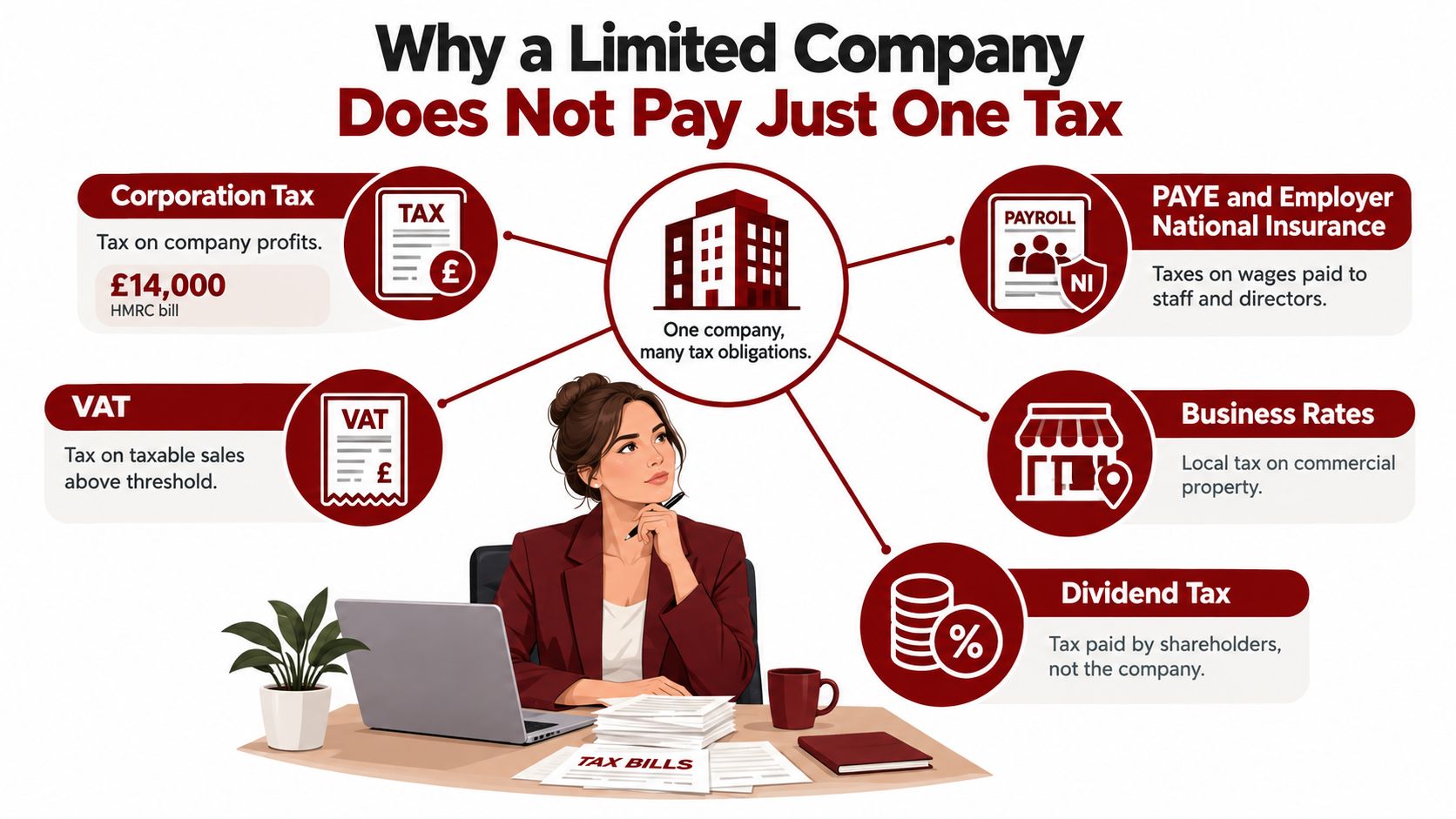
A useful way to picture the system is as several taps connected to the same business:
- Annual profit tap: Corporation Tax is calculated on taxable profit after allowable business costs.
- Monthly payroll tap: PAYE, employee National Insurance and employer National Insurance arise when salaries are processed.
- Sales tax tap: VAT becomes relevant when taxable turnover passes the registration threshold, and the company must separate customer money from its own funds.
- Dividend tap: shareholders may pay personal dividend tax when profits are distributed.
- Property and sector taps: business rates, CIS and other duties can apply depending on premises and activity.
Practical rule: Never treat the company's bank balance as the amount available to spend personally. Some of it may already belong to HMRC, employees or suppliers.
The legal separation matters because a company can have strong sales but little taxable profit after costs, or healthy accounting profit but a difficult cash position because payroll and VAT payments arrive before customers settle invoices. The answer to “what tax does a limited company pay?” therefore starts with who is being taxed, what triggers the liability and when the cash leaves.
Corporation Tax on Company Profits
A company can receive £80,000 from customers and still owe Corporation Tax on a much smaller amount. The tax applies to taxable profit for an accounting period, not to every pound entering the bank account. Turnover is the money earned. Profit is what remains after allowable costs and tax adjustments.
Start with taxable profit
Begin with the accounting profit, then adjust it for tax. Some accounting expenses are not deductible in full, while qualifying business expenditure, capital allowances, pension contributions and available losses can change the taxable figure. Your bookkeeping profit is the starting point, not automatically the amount HMRC will tax.
For companies with the relevant profit levels, the structure works like this:
| Taxable profit band | Rate | How it works |
|---|---|---|
| £50,000 or less | 19% | The small profits rate generally applies. |
| Between £50,000 and £250,000 | Marginal relief | The effective burden rises gradually between the lower and main bands. |
| Above £250,000 | 25% | The main rate applies. |
The rates and thresholds appear in HMRC's guidance on Corporation Tax marginal relief. HMRC's Corporation Tax overview also explains the tax and filing responsibilities. Marginal relief prevents a sudden jump from the lower rate to the main rate. Instead, the calculation increases the effective burden through the middle band.
A worked example
Suppose taxable profit is £80,000. The first £50,000 at 19% produces £9,500 of Corporation Tax. The remaining £30,000 falls within the marginal relief band, so applying one headline rate to the entire profit would give the wrong answer. The final liability is approximately £13,250, subject to the detailed calculation and the company's circumstances.
This is why “a limited company pays 19% or 25%” is incomplete. Profit changes, tax adjustments and associated companies can all affect the calculation.
The cash-flow point matters. Set money aside as profit builds during the year, because Corporation Tax is normally paid after the accounting period ends. The payment deadline generally falls 9 months and 1 day after the period end, while the company must also file its return and notify HMRC that it is chargeable within the relevant notification period. Its bank balance may therefore include cash reserved for this annual bill.
For help preparing and filing the calculation, see Corporation Tax return support.
Employer National Insurance and Payroll on Salaries
A founder draws a £12,000 salary and sees the agreed amount on the payslip. The company's cost is not necessarily the same figure. Payroll also handles employee deductions, employer National Insurance and regular reporting, so salary affects cash flow every month.
For the current regime, employer National Insurance is 15% on qualifying earnings above £5,000, according to the employer tax guidance from TinyTax. The threshold and rate apply to the company's payroll cost, while PAYE and employee National Insurance are deducted from the employee's gross pay.
Follow the payroll calculation
At an annual salary of £12,000, the stated employer NIC threshold means no employer NIC arises. At £40,000, the calculation is 15% of £35,000, creating an employer NIC cost of £5,250 before any available allowance.
Small employers may qualify for Employment Allowance of £5,000, reducing that second example to £250 if the company meets the conditions. The allowance is not automatic. Director-only companies can face specific restrictions, so check eligibility before relying on it in a cash forecast.
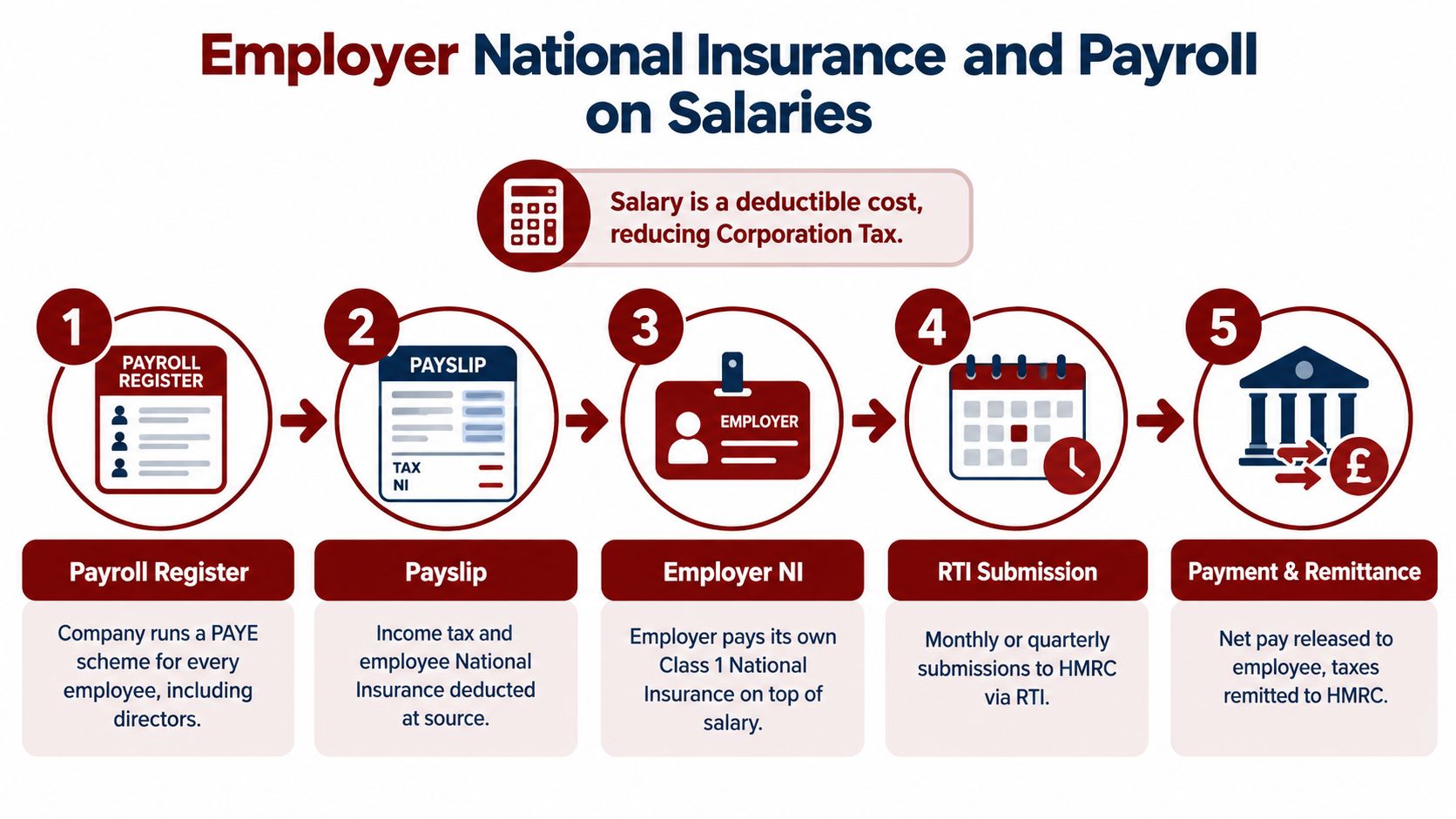
The monthly process has five stages:
- Gross pay: The company records the agreed salary.
- Employee deductions: PAYE and employee National Insurance come off through payroll.
- Employer cost: Employer National Insurance is calculated separately and added to the company's cost.
- RTI reporting: Payroll information goes to HMRC on or before payday.
- Payment and records: The employee receives net pay, while the company pays deductions and keeps payroll records.
Salary is normally an allowable company cost, which can reduce taxable profit for Corporation Tax. The decision still needs a combined view. Employer NIC, personal income tax, pension obligations and the company's available cash all sit alongside the monthly payslip.
A payroll calendar helps prevent missed submissions. Before choosing a system, compare payroll software for small business. For setup and compliance support, see payroll guidance for small businesses.
Dividend Tax for Shareholders on Top of Company Profit
A company has made £60,000 of post-tax profit and has enough cash to distribute it. The owner still cannot treat the whole amount as tax-free personal income. Corporation Tax is dealt with by the company first. Dividend Tax is then considered for the shareholder who receives the money.
Dividends are distributions from available profits, not a company expense. They do not reduce the company's taxable profit in the way an allowable salary cost can. “Double taxation” is a useful shorthand, but the charges fall on different taxpayers at different points: the company pays tax on profit, then the shareholder may pay personal tax on the dividend.
The personal tax bands
For the 2025/26 tax year, the dividend allowance is £500. Dividend income above that allowance is taxed at 8.75% in the basic-rate band, 33.75% in the higher-rate band and 39.35% in the additional-rate band, according to HMRC guidance on dividend tax rates.
| Band | Dividend income | Rate |
|---|---|---|
| Dividend allowance | First £500 | 0% |
| Basic rate | Dividends falling within basic-rate capacity | 8.75% |
| Higher rate | Dividends falling within higher-rate capacity | 33.75% |
| Additional rate | Dividends above the additional-rate threshold | 39.35% |
Your salary and other personal income use up your tax bands before dividends are assessed. For example, someone with a salary of £12,570 and dividends of £60,000 may have a different personal tax bill from another shareholder receiving the same dividend but also having pension income or other earnings.
The personal allowance can taper when adjusted net income reaches £100,000, making larger withdrawals more sensitive to the owner's wider income. Cash in the bank is not enough to approve a dividend. The company must have sufficient distributable reserves, and the declaration should be recorded properly.
Manage the day cash leaves
Corporation Tax is generally paid by the company after its accounting period. Dividend Tax belongs to the shareholder and follows the individual's tax position, so the personal liability may arise after the dividend is paid. A separate reserve helps prevent a large personal bill from being mistaken for available spending money.
The timing matters. A dividend paid once a year creates one larger personal cash-flow decision, while several distributions require a running estimate of the shareholder's remaining allowance and tax bands.
Salary and dividends should therefore be assessed together. Salary can be an allowable company cost, while dividends do not attract employer National Insurance. The right choice depends on the owner's income, pension position, available company profits and cash needs. Compare the combined company and personal bill, rather than selecting the lowest-looking rate in isolation.
VAT, Business Rates and Other Operational Taxes
A client pays an invoice for £1,200, including VAT. The company may receive the full amount, but the £200 VAT element is collected for HMRC. VAT therefore affects cash flow at the sale, even though it is usually not a cost of earning the company's profit.
Mandatory VAT registration applies when taxable turnover exceeds £90,000 in a rolling 12-month period. That test uses taxable turnover, not profit, so a business with tight margins can still have to register. The HMRC VAT registration threshold explains when registration is required.
Keep VAT separate from trading cash
Record output VAT charged to customers as a liability. From this, the company can generally deduct eligible input VAT paid on business purchases. The balance is reported to HMRC, so the amount set aside should reflect the expected return rather than the cash currently visible in the bank.
The standard VAT rate is 20%, although reduced and zero rates apply to qualifying supplies. The correct treatment depends on what the company sells, who buys it and where the customer belongs. This VAT guidance for small businesses covers registration and filing responsibilities.
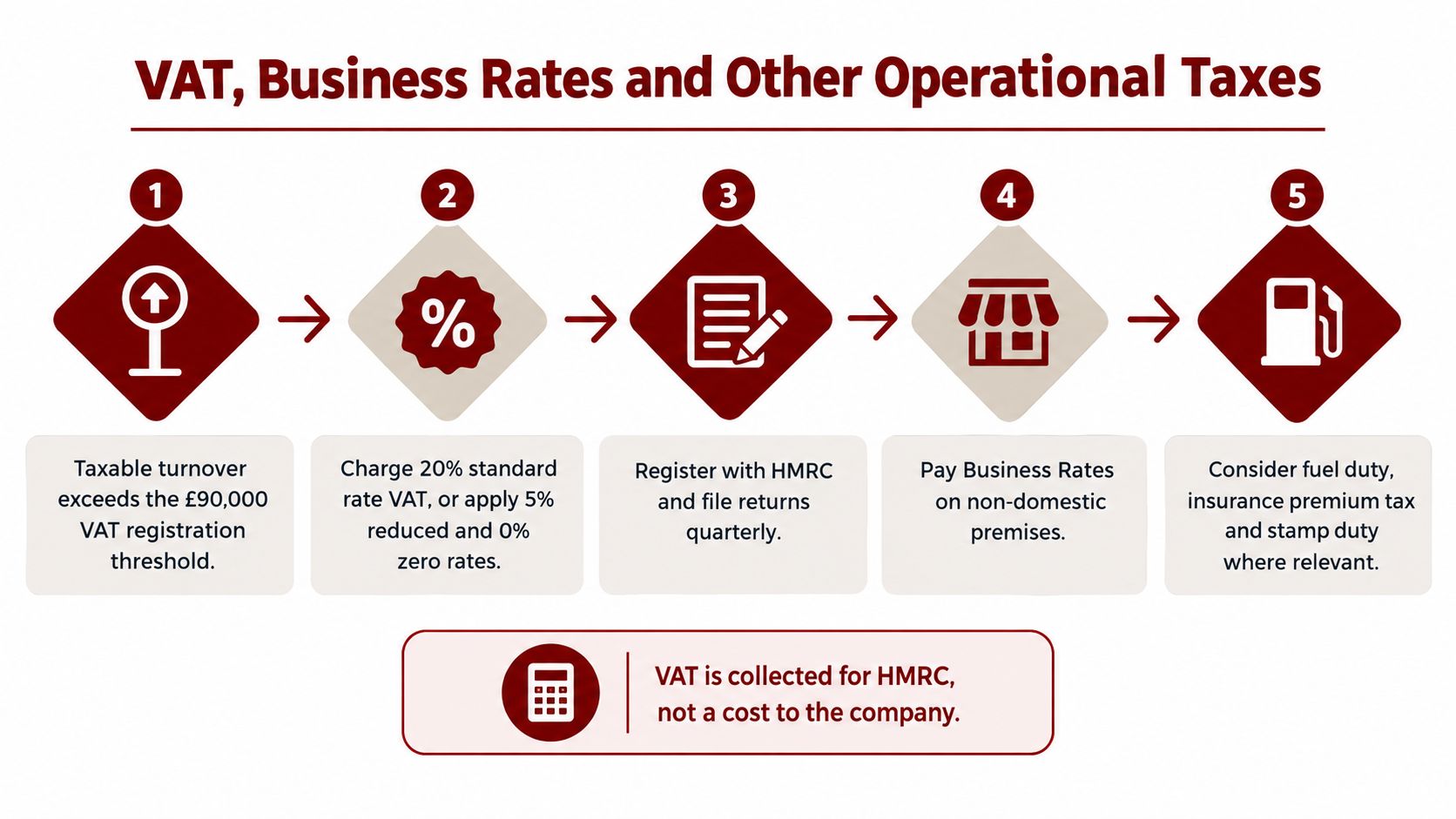
VAT returns are generally filed quarterly. Many registered businesses use Making Tax Digital-compatible software to keep digital records and submit returns. A customer's payment can make the bank balance look healthy, while part of that balance is already owed to HMRC.
Commercial premises may also create business rates, a local tax based on non-domestic property. Working from home does not automatically create a business-rates bill. A separate valuation or substantially business-only use can change the position, so check the property's actual use rather than relying on the home-office label.
Construction companies may have CIS duties. A contractor can need to deduct tax from payments to qualifying subcontractors and report those deductions. Subcontractors may require verification and accurate records. Other transaction or sector taxes can include stamp duty, insurance premium tax and fuel duty.
Property owners considering incorporation or a company purchase should review a UK property investment tax guide before taking professional advice. The practical cash-flow picture is layered: Corporation Tax follows annual profit, payroll taxes arise each pay period, VAT follows the return cycle, and operational taxes arise from premises, workers or particular transactions.
Associated Companies and How Multi-Entity Owners Change the Picture
A founder sets up a second company for intellectual property, property ownership, consulting work or a separate contract. The accounts and bank accounts look separate, yet HMRC may examine who controls both companies before applying Corporation Tax thresholds.
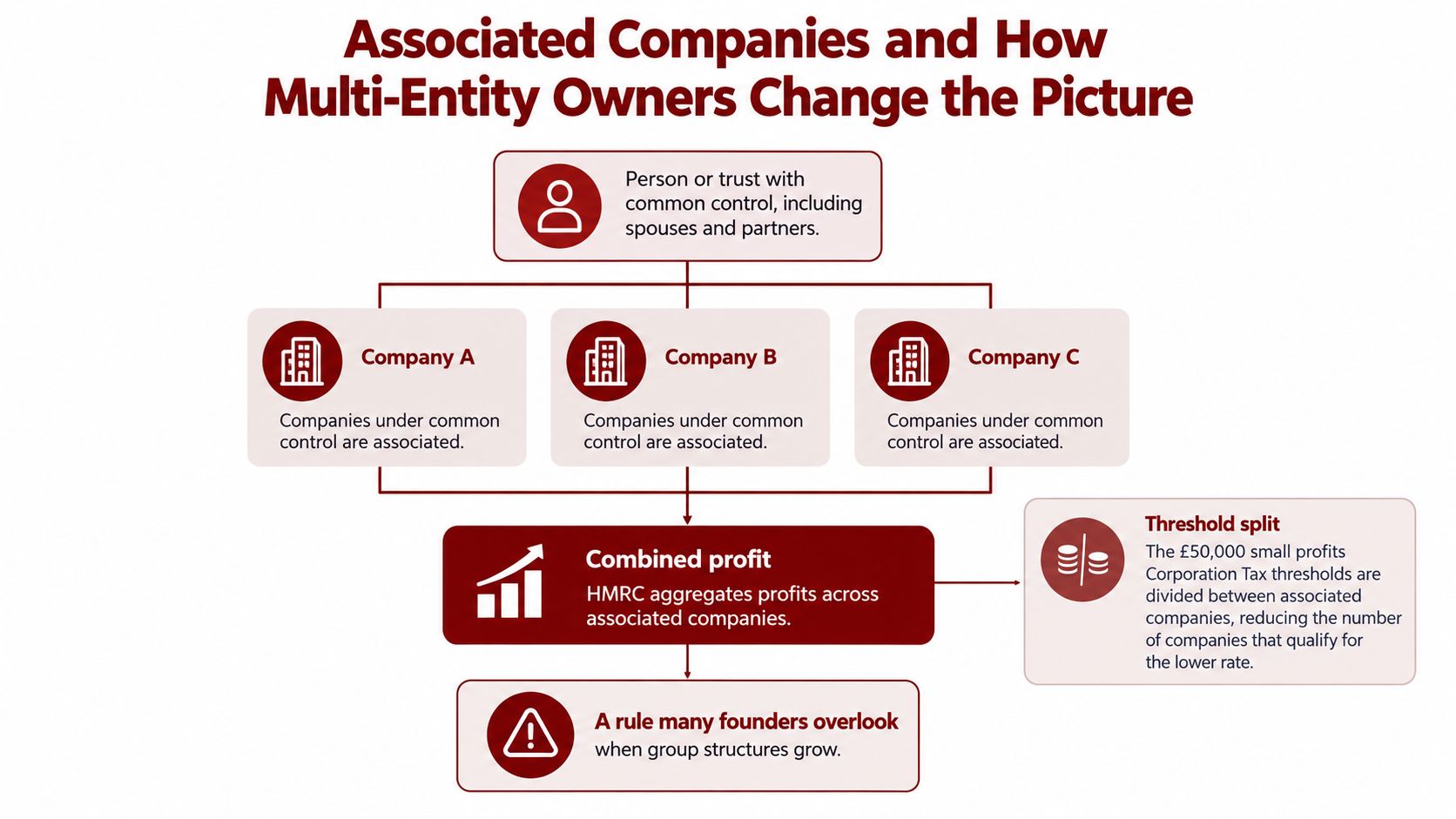
That relationship matters because one company does not always receive a fresh set of tax bands. Companies under common control may need to share the available thresholds, so the headline rates can produce a different result from the one-company example.
Why the thresholds can shrink
The small profits threshold and marginal relief range are affected by the number of associated companies. In practice, the bands may be divided between companies rather than duplicated. Each company can therefore have less profit qualifying for the lower rate.
Suppose two associated companies each make £75,000 of taxable profit. Together, they make £150,000. The threshold calculation must reflect their association, so splitting the profit across two sets of accounts does not automatically create two standalone lower-rate bands.
HMRC guidance on associated companies for Corporation Tax explains the technical framework. The government's 2025 Budget tax overview sets out the continuing structure of the main and small profits rates for the relevant future financial year.
Check before adding another entity
Association can involve more than identical shareholders. Common control, connected interests and some arrangements involving spouses, partners or trusts may require review. The outcome is fact-specific, so a spreadsheet that treats every company as completely independent may give the wrong answer.
A second company can create commercial clarity, but it does not automatically create a second set of tax advantages.
Review the structure before signing the next accounts, charging management fees between companies or splitting director remuneration. Incorporation timing and later changes in control can affect the analysis. Dividend planning also needs care, because each company must have enough distributable reserves before paying shareholders.
The cash-flow effect follows the same layered pattern as the wider tax bill. Extra Corporation Tax is settled through the company's tax cycle, while dividends can create a separate personal tax charge on dividend day. A second company may improve commercial organisation, but it can also change the amount reserved for both payments.
Planning the Combined Tax Bill Across the Year
A founder who plans each tax separately can still run short of cash. Corporation Tax may be an annual payment, payroll is a regular outgoing, VAT follows the return cycle and dividend tax belongs to the shareholder. Put them on one calendar and the business becomes easier to control.
Four decisions to make early
Salary design comes first. Model the director's pay alongside employer NIC and any Employment Allowance eligibility. A salary can reduce company profit, but it also creates payroll administration and may produce employer NIC once the relevant threshold is exceeded.
Expenses belong before the year closes. Don't buy equipment or incur costs solely to reduce tax. Do, however, make sure genuine business expenses are recorded in the correct accounting period, with receipts and a clear business purpose. Late bookkeeping can make an otherwise legitimate deduction invisible when the accounts are prepared.
VAT needs a cash reserve. Transfer the VAT element of customer receipts into a separate holding account if possible. Review the next return before the deadline, not on the day it's due, so missing purchase invoices or incorrect tax codes don't create a surprise payment.
Dividends need personal planning. Check distributable reserves and the shareholder's wider income before declaring a dividend. A company can afford the gross payment while the shareholder still needs to reserve money for personal dividend tax.
A practical annual rhythm
| Cash-flow moment | What to review |
|---|---|
| Monthly payroll | Gross salary, PAYE, employee deductions and employer NIC |
| Each VAT return | Output VAT, input VAT, filing records and payment reserve |
| Before year end | Genuine expenses, capital expenditure and expected taxable profit |
| After the accounting period | Corporation Tax computation and payment planning |
| Dividend declaration | Reserves, board records and the shareholder's personal tax position |
A forecast should show both the company's bill and the owner's bill. If your personal tax position changes during the year, revisit the dividend plan rather than treating the original decision as permanent. Planning for payments on account may also matter where personal tax produces future instalments.
Common Questions UK Founders Ask About Limited Company Tax
Does working from home create business rates? Not automatically. A home-based founder usually needs to examine whether part of the property has a separate business valuation or is used substantially for business-only purposes. Keep the facts clear, especially if you have converted a room, employ staff at home or receive customers there.
Does CIS affect every construction company? No. CIS obligations depend on the company's role and the type of construction work. A business acting as a contractor may need to verify subcontractors, deduct the required amount and submit reports, while a subcontractor has a different compliance position. Construction bookkeeping should identify both roles rather than treating CIS as ordinary payroll.
When does an accountant pay for itself? A sole director with simple transactions, a modest salary and no VAT or CIS may be able to manage basic records with suitable software. Professional support becomes more valuable when the company has several income streams, associated companies, staff, property, research and development claims, complex dividends or limited time for deadlines.
Could R&D relief reduce Corporation Tax? Potentially, if the company's work meets the qualifying conditions and the claim is properly supported. Don't label ordinary product development as R&D without checking the technical and financial rules, because the claim needs evidence.
Is the £1,000 trading allowance an alternative to incorporation? It can be relevant to some small trading activities, but it isn't a universal substitute for a limited company. Compare the allowance, personal tax, National Insurance, legal protection, administration and plans for growth before choosing a structure.
What triggers an HMRC investigation? HMRC can review inconsistencies, unusual claims, late filings, missing records or information that doesn't match other data. An enquiry isn't proof that you've done anything wrong. Accurate bookkeeping, reconciliations and organised supporting documents make a response far less stressful.
For founders who want one team to coordinate the moving parts, Action Accountants Limited provides company accounts, Corporation Tax compliance, bookkeeping, payroll, VAT support and advice for growing businesses, including construction-focused CIS work. Visit Action Accountants Limited to discuss your company's tax calendar and build a cash-flow plan around the dates each liability falls due.