What Is VAT Returns: A Practical UK Guide
What Is VAT Returns. Learn what VAT returns are in the UK, who must file them, and how deadlines, thresholds and MTD rules work in plain…

You've just registered your small business for VAT. After a busy quarter of selling products or services, you open your HMRC account and find a VAT return waiting for you. The form appears to contain nine boxes, each asking for figures you may not have prepared before. The sensible question is simple: what is a VAT return, and what are you expected to report?
A VAT return is your business's periodic calculation of VAT charged to customers, VAT paid on eligible business purchases, and the difference between the two. You submit it to HMRC, usually through Making Tax Digital compatible software, whether the result is a payment to HMRC or a repayment to your business.
Table of Contents
- Why VAT Returns Matter for UK Small Businesses
- The Core Concept Behind a VAT Return
- Who Must Register and When the Clock Begins
- Filing Cycles, Deadlines and the Monthly Rhythm
- Making Tax Digital, Records and Penalty Points
- Two Worked Examples of Completing a Return
- Adjustments Most Filers Forget to Make
- Practical Checklist and What to Watch in 2026
Why VAT Returns Matter for UK Small Businesses
A new wedding-cake baker in Bristol has been VAT-registered for three months. She opens her Government Gateway account for the first time and sees nine empty boxes. She knows what her customers paid, but she isn't sure which amounts belong in the return, whether ingredient purchases reduce the bill, or what happens if the figures produce no VAT to pay.
That uncertainty is common because a VAT return isn't just a sales report. It's a formal reconciliation. The baker reports the VAT she charged on taxable sales, then offsets eligible VAT paid on business purchases. The result determines whether she sends money to HMRC or asks HMRC to repay money to her.
Practical rule: A nil return is still a return. Registered businesses normally have to submit it even when there's no VAT to pay or reclaim. HMRC's VAT return guidance confirms that registered businesses must submit returns for their accounting periods.
Missing the deadline creates a compliance problem independently of the calculation. A business can have no net VAT due and still face consequences for failing to file on time. That's why a reliable process matters more than trying to complete the form from memory at the end of the quarter.
The practical consequences
For a small operator, VAT administration affects several everyday decisions:
- Cash flow timing: The return tells you when a payment to HMRC is due, or when a repayment may become available.
- Evidence for claims: Purchase invoices and digital records support input VAT recovered through the return.
- Business credibility: Suppliers, lenders, accountants, and prospective investors may ask whether VAT records and filings are current.
- Management information: A reconciled VAT account can expose missing invoices, incorrectly coded sales, or unusually high purchase claims.
A useful starting point is the VAT guide for small businesses, particularly if you're still deciding how to organise invoices, bookkeeping, and payment controls.
The rest of the process becomes easier once you separate three questions: what did we charge, what did we pay, and what does HMRC expect to see digitally?
The Core Concept Behind a VAT Return
VAT is not business income. It is money collected on behalf of HMRC that passes through your accounts. A coffee shop may treat it like a separate “VAT jar”: VAT charged on taxable sales goes in, while eligible VAT paid on milk, cups, equipment, and other purchases can reduce the amount sent to HMRC.
The core terms are:
- Output VAT is VAT charged on taxable sales.
- Input VAT is VAT paid on eligible purchases.
- Net VAT is output VAT minus recoverable input VAT, subject to the rules of the business's scheme and transactions.
The standard UK VAT rate is 20%, while particular goods and services may use 5% or 0% rates. The correct rate depends on the supply, how it is used, and the relevant VAT rules. It is not a commercial choice.
Reading the nine boxes
HMRC's return contains nine boxes. Each one answers a defined question about sales, purchases, VAT, or specific Northern Ireland and EU transactions.
- Box 1 records VAT due on sales and other outputs, including relevant reverse-charge amounts.
- Box 2 records VAT due on acquisitions of goods from EU member states where the Northern Ireland rules apply.
- Box 3 totals the relevant output and acquisition VAT due.
- Box 4 records VAT reclaimed on purchases and other inputs.
- Box 5 shows the net VAT to pay or reclaim after comparison of the output and input figures.
- Box 6 records the total value of sales and other outputs excluding VAT.
- Box 7 records the total value of purchases and other inputs excluding VAT.
- Box 8 records the value of dispatches of goods from Northern Ireland to EU member states where applicable.
- Box 9 records the value of acquisitions of goods into Northern Ireland from EU member states where applicable.
The practical calculation follows the movement of that VAT jar. Output VAT is combined with relevant acquisition or reverse-charge entries, then eligible input VAT is deducted. A positive result usually means payment to HMRC. A negative result may indicate a repayment, if the supporting records justify the claim.
Making Tax Digital adds an operational layer. Your bookkeeping software must preserve the figures behind the boxes and use a digital link when the return is submitted. That means the nine-box summary should be the result of reconciled records, rather than figures copied from memory at quarter-end.
Some VAT schemes change the calculation. Businesses comparing tax administration with wider commercial terminology may find a business value added listing useful for general context, but it does not replace HMRC's scheme-specific instructions or professional advice.
Who Must Register and When the Clock Begins
The main compulsory registration test is based on taxable turnover over a rolling 12-month period, not just the amount invoiced in a calendar year. The UK registration threshold rose from £85,000 to £90,000 on 1 April 2024, and the deregistration threshold is £88,000, as set out in HMRC's VAT registration guidance.
“Rolling” means you review the latest 12 months continuously. You don't wait for your accounting year to finish, and you don't reset the calculation when January arrives.
A rolling calculation in practice
Suppose a freelance illustrator earns £7,000 each month from taxable work. She adds each month's taxable turnover to the preceding months, rather than looking only at the current tax year. Once the relevant rolling total exceeds £90,000, she needs to examine the registration deadline and effective date carefully.
The important point is that registration creates obligations beyond obtaining a VAT number. From the effective date, the illustrator may need to charge VAT where applicable, issue compliant invoices, retain supporting records, and submit VAT returns through the required digital process.
Not every business follows the same registration route. Some overseas businesses and specific transaction types can create an obligation without relying on the ordinary domestic turnover test. Online sellers and importers should check the rules for their exact supply chain, customer location, and goods movement rather than assuming the UK threshold answers every question.
Voluntary registration
A business below the compulsory threshold can choose to register voluntarily. That may suit a start-up making substantial VAT-bearing purchases, especially where customers are VAT-registered and can normally account for the VAT charged to them. It can also create extra administration and affect pricing where customers are consumers or otherwise unable to recover VAT.
Before registering voluntarily, compare the likely input VAT recovery with the effect on prices, record keeping, software, and filing duties. The choice should support the business model, not merely create an impression of scale. For a practical explanation of the threshold and its implications, see this guide to the UK VAT registration threshold.
Filing Cycles, Deadlines and the Monthly Rhythm
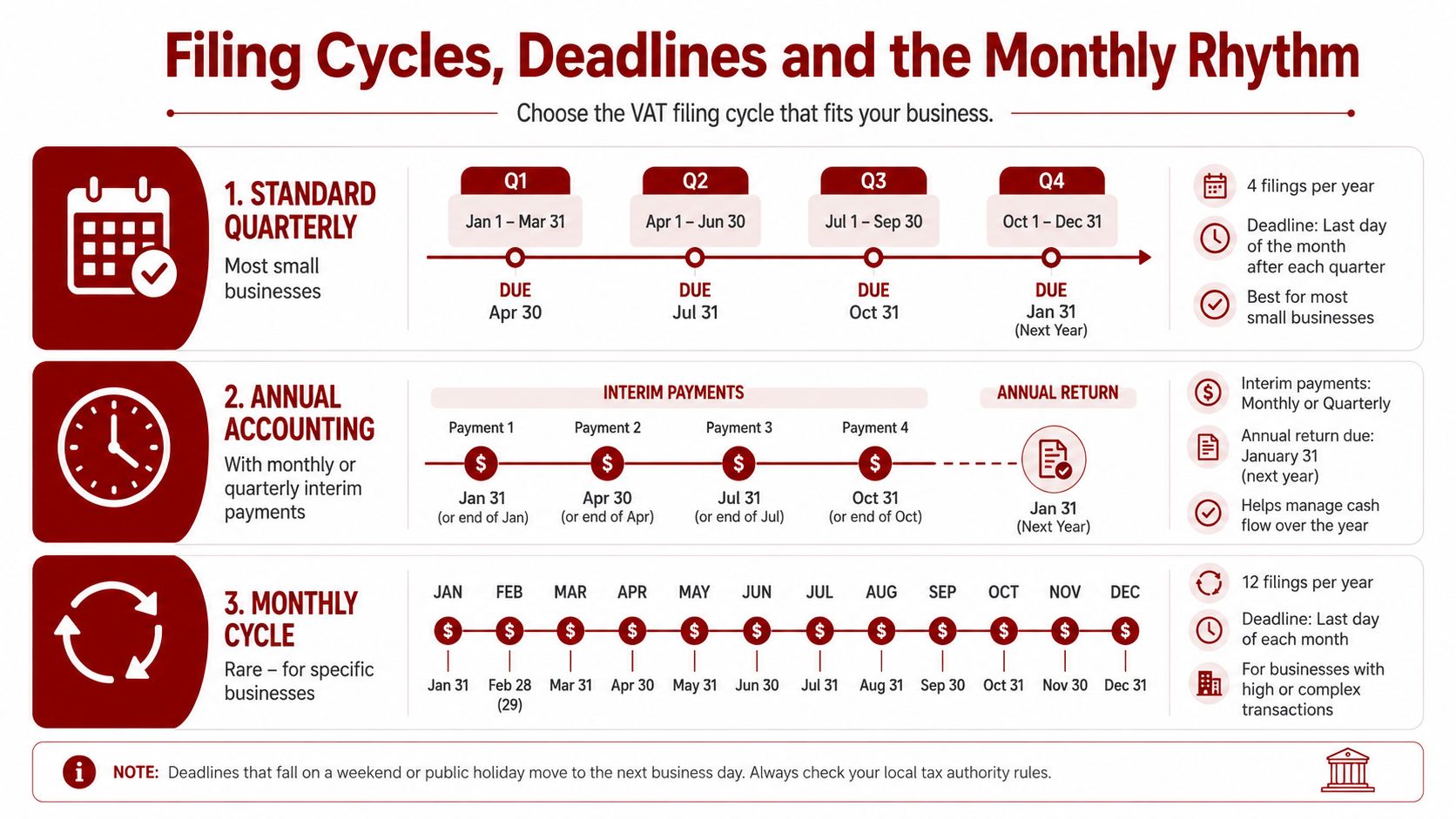
Most small businesses file VAT returns every three months. HMRC normally sets the online filing and payment deadline at one calendar month and seven days after the end of the accounting period, according to its official submission guidance. A quarterly filer therefore faces a recurring statutory timetable rather than a flexible annual admin task.
The quarter-end dates depend on the VAT period shown in the business's online account. Some businesses use calendar quarters, while others have periods ending around February, May, August, and November. Your account, not a generic calendar, determines the actual deadline.
Choosing a workable cycle
The common options have different cash-flow and workload effects:
- Quarterly filing: This is the usual arrangement for small businesses. It gives a manageable reporting rhythm, but a large payment can build up if the business doesn't reserve funds.
- Annual Accounting: The business submits an annual VAT return while making interim payments during the year. This can smooth payments, but it still requires accurate ongoing records.
- Monthly filing: This may suit a repayment trader that regularly expects input VAT to exceed output VAT. It creates more frequent preparation and review.
The filing frequency isn't just an accountant's preference. It affects how quickly errors surface, how often cash moves to or from HMRC, and how much time the owner has to correct missing evidence.
A monthly internal routine
Even with quarterly filing, reconcile every month. Match sales invoices to bookkeeping entries, check purchase invoices, identify missing receipts, review unusual VAT codes, and compare the VAT control account with the underlying ledger.
Use the next month to resolve queries rather than allowing them to accumulate. In the month before submission, lock down the period, review exceptions, and confirm the return agrees with the accounting records. The final week should be for checking and authorising, not searching through an inbox for basic documents.
Payment also needs its own control. Filing and payment deadlines are connected, but the submission does not automatically guarantee that the bank payment will arrive on time. Check your HMRC account and bank instructions early, particularly if you're using direct debit or a payment method with processing time.
Making Tax Digital, Records and Penalty Points
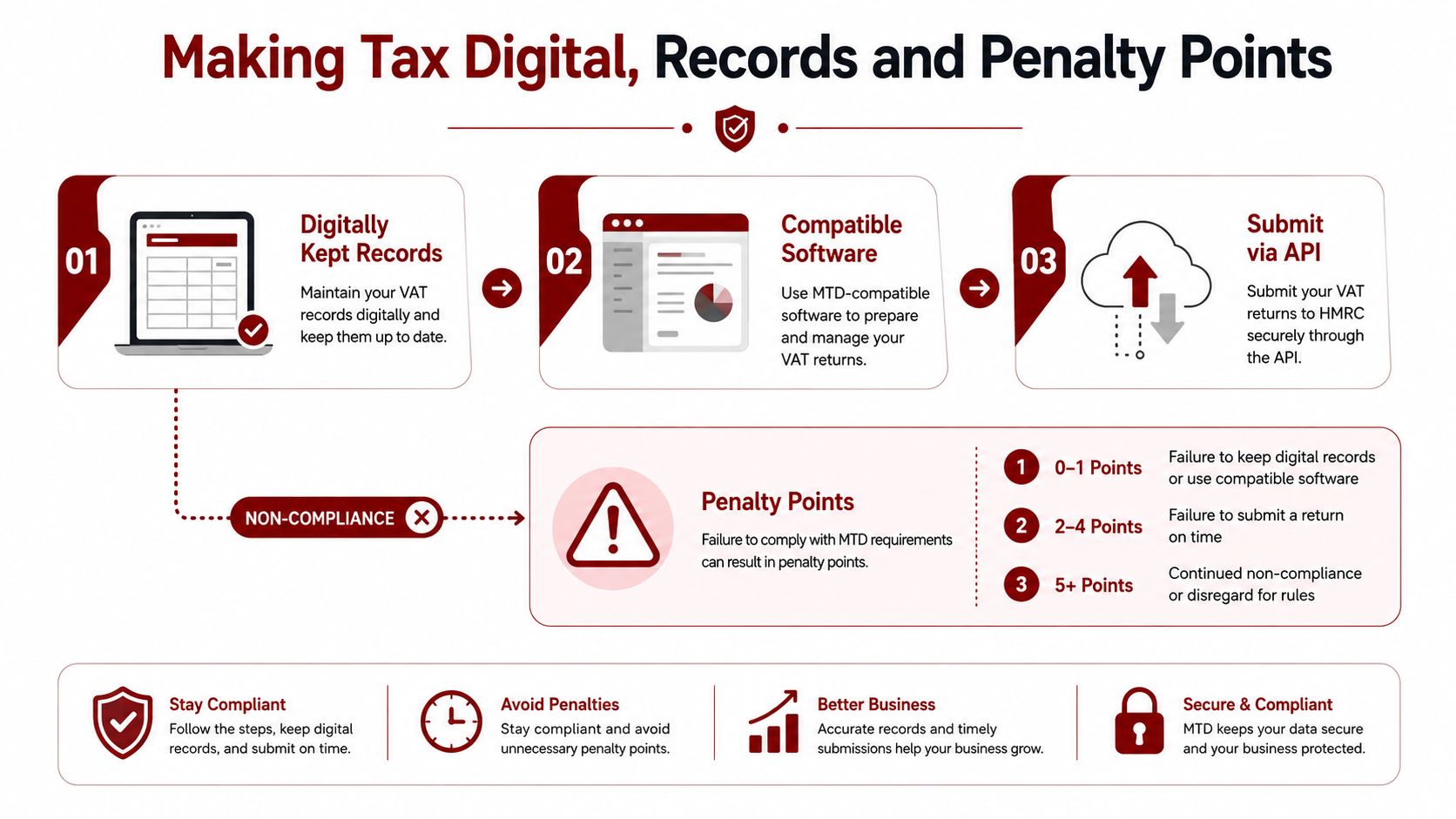
A business preparing its first MTD VAT return needs a reliable chain from each transaction to the figure submitted. Making Tax Digital for VAT changes the operating method. Businesses generally maintain digitally kept records, use compatible software, and submit through software connected to HMRC.
The process works like a clear paper trail. Sales, purchases, VAT codes, and dates are recorded in accounting software. The software then gathers the relevant totals for the return, while the business reviews and authorises them before submission through an application programming interface. The connection should preserve the link between the original transaction and the reported figure.
The records behind the boxes
Keep records that identify the business and its VAT status, show how transactions were treated, preserve dates and amounts, and connect bookkeeping entries to the submitted return. Digital storage does not replace evidence. A scanned invoice can support the entry, but the bookkeeping system must also record the transaction in a form that explains the reported totals.
Retain access to the software and keep an offline export or suitable backup. If the provider becomes unavailable, the business still needs to identify what it reported, which items remain unreconciled, and which documents support the figures.
For a wider view of recurring compliance controls, SupportGPT compliance automation explains how businesses can organise these tasks. Action Accountants' MTD VAT compliance guide for 2026 also covers the practical effect of changing HMRC data requirements, so software and records should be reviewed rather than left on an old setup.
Penalty points as a process warning
HMRC's late-submission regime uses points. Each late submission earns one penalty point. Once the relevant threshold is reached, HMRC charges a £200 penalty, followed by a further £200 for each additional late return while the business remains at that threshold, as explained in HMRC's late return guidance.
For quarterly filers, repeated late submissions can become expensive quickly. Late payment is separate, so set one control for submitting the return and another for ensuring the money reaches HMRC by the payment deadline.
Two Worked Examples of Completing a Return
The same nine-box form can produce very different outcomes because the business model, VAT scheme, and recoverable costs differ. The figures below are illustrative calculations, not a substitute for checking the correct treatment of each invoice.
Example one, a consultant on standard VAT accounting
A freelance consultant issues standard-rate invoices totalling £30,000, including VAT. The VAT element is £5,000. During the quarter, the consultant incurs £4,200 of eligible business expenses, including a laptop and accountancy fees. The input VAT within those costs is £1,840.
The consultant reports the output VAT in Box 1 and the net sales value in Box 6. The purchase VAT goes into Box 4, while the net purchase value goes into Box 7. If there are no relevant EU acquisition, dispatch, or reverse-charge figures, the remaining boxes are completed with the appropriate zero entries.
The net calculation is £5,000 output VAT less £1,840 input VAT, leaving £3,160 to pay. The result comes from the invoices and VAT evidence, not from the consultant's profit.
Example two, a landlord using the Flat Rate Scheme
A landlord registered voluntarily for VAT receives £18,000 of rental income and uses a flat-rate percentage of 12.5%. The scheme calculation produces £2,250 to remit.
Under the Flat Rate Scheme, the business generally calculates VAT due using the scheme percentage rather than recovering input VAT invoice by invoice in the same way as standard VAT accounting. That means the bookkeeping treatment and return figures need to match the scheme's rules. The landlord shouldn't use the consultant's method just because both returns contain familiar boxes.
| Box | Consultant, Standard Rate | Landlord, Flat Rate 12.5% |
|---|---|---|
| Box 1 | £5,000 | £2,250 |
| Box 2 | £0 | £0 |
| Box 3 | £5,000 | £2,250 |
| Box 4 | £1,840 | Scheme treatment applies |
| Box 5 | £3,160 payable | £2,250 payable |
| Box 6 | £25,000 net sales | Scheme calculation basis |
| Box 7 | £3,500 net purchases | Scheme treatment applies |
| Box 8 | £0 | £0 |
| Box 9 | £0 | £0 |
The table demonstrates why a return should be prepared from the correct VAT scheme settings. A software template can calculate quickly, but it can't decide whether a rental supply, expense, or scheme election has been coded correctly.
Adjustments Most Filers Forget to Make
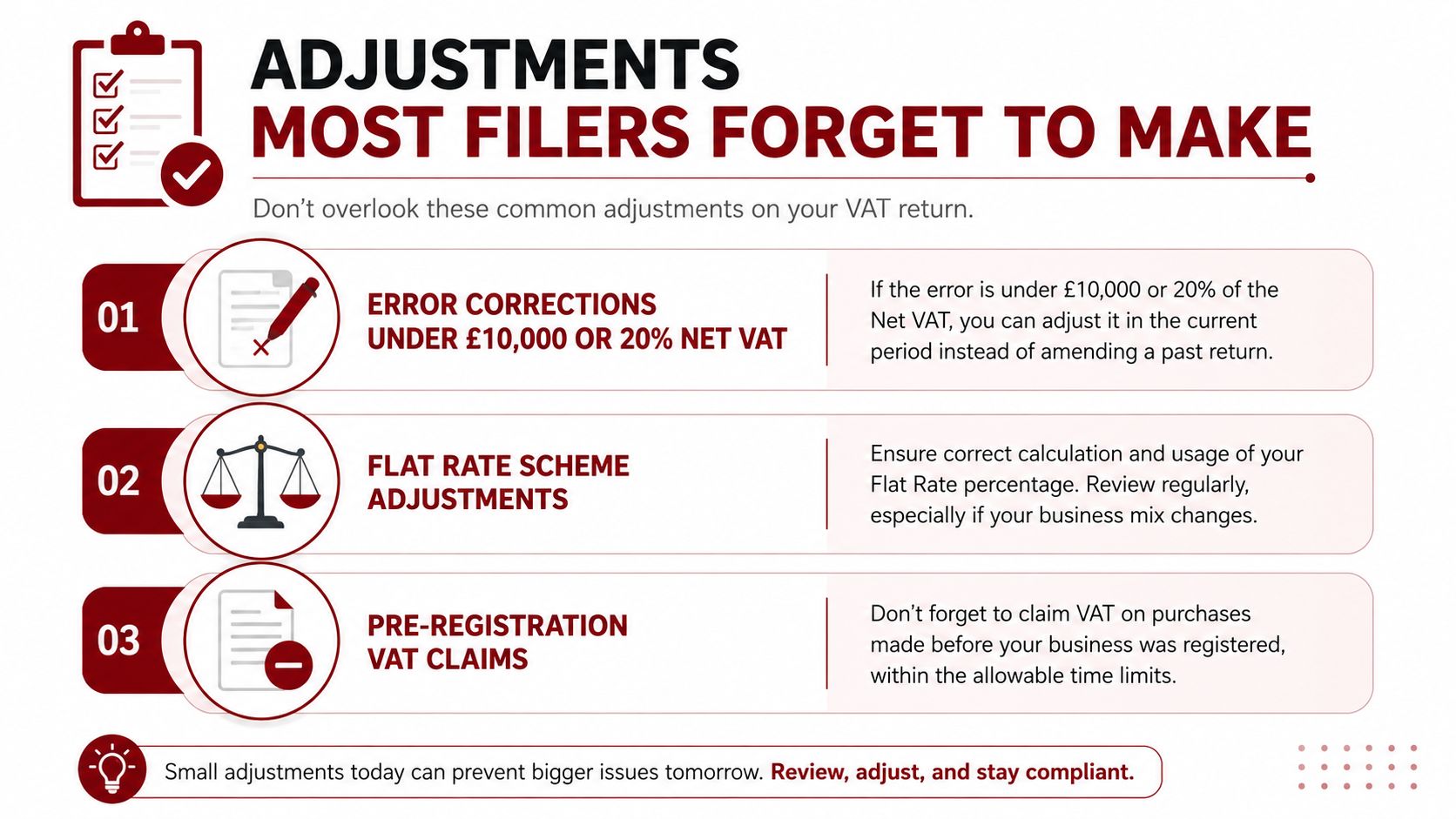
A clean return can still contain a problem if unusual transactions sit outside the normal sales-and-purchases routine. Three areas deserve a deliberate review: correcting earlier errors, handling mixed taxable and exempt activity, and accounting for imports or overseas services.
Correcting an earlier mistake
Not every error requires reopening a submitted return. Smaller errors may be corrected on a later return if they fall within HMRC's permitted limits, including the £10,000 or 20% net VAT threshold, subject to the detailed conditions. Larger or more complex errors may require a separate correction or disclosure.
Keep a short note explaining what went wrong, which period it relates to, how you calculated the adjustment, and why you used the chosen correction route. That note gives your accountant or future self a clear audit trail.
Partial exemption
A business making both taxable and exempt supplies can't automatically reclaim all VAT on shared overheads. Input VAT directly linked to taxable activity may be recoverable, while input VAT linked to exempt activity may not be. Shared costs require an allocation method and a review of whether the de minimis conditions are met.
This often affects landlords, charities, financial businesses, education providers, and any organisation with more than one type of supply. The difficulty isn't the arithmetic. It's identifying which costs relate to which activity before the return is submitted.
Imports and reverse charges
Postponed import VAT accounting can require the business to use import documentation, including relevant C79 certificates where applicable, and reflect the figures in the correct return boxes. Overseas services can also trigger a reverse charge, meaning the business may need to account for output VAT and claim corresponding input VAT where recovery is permitted.
Bad-debt relief and revisions to EU sales reporting can create further complications. Keep an “unusual items” file during the quarter rather than relying on memory at filing time. That simple habit gives each adjustment a document, explanation, and owner.
Practical Checklist and What to Watch in 2026
Good VAT compliance starts before the return appears in your online account. Use a written process that someone else could follow if the owner is ill, away, or dealing with an urgent customer issue.
A same-day checklist
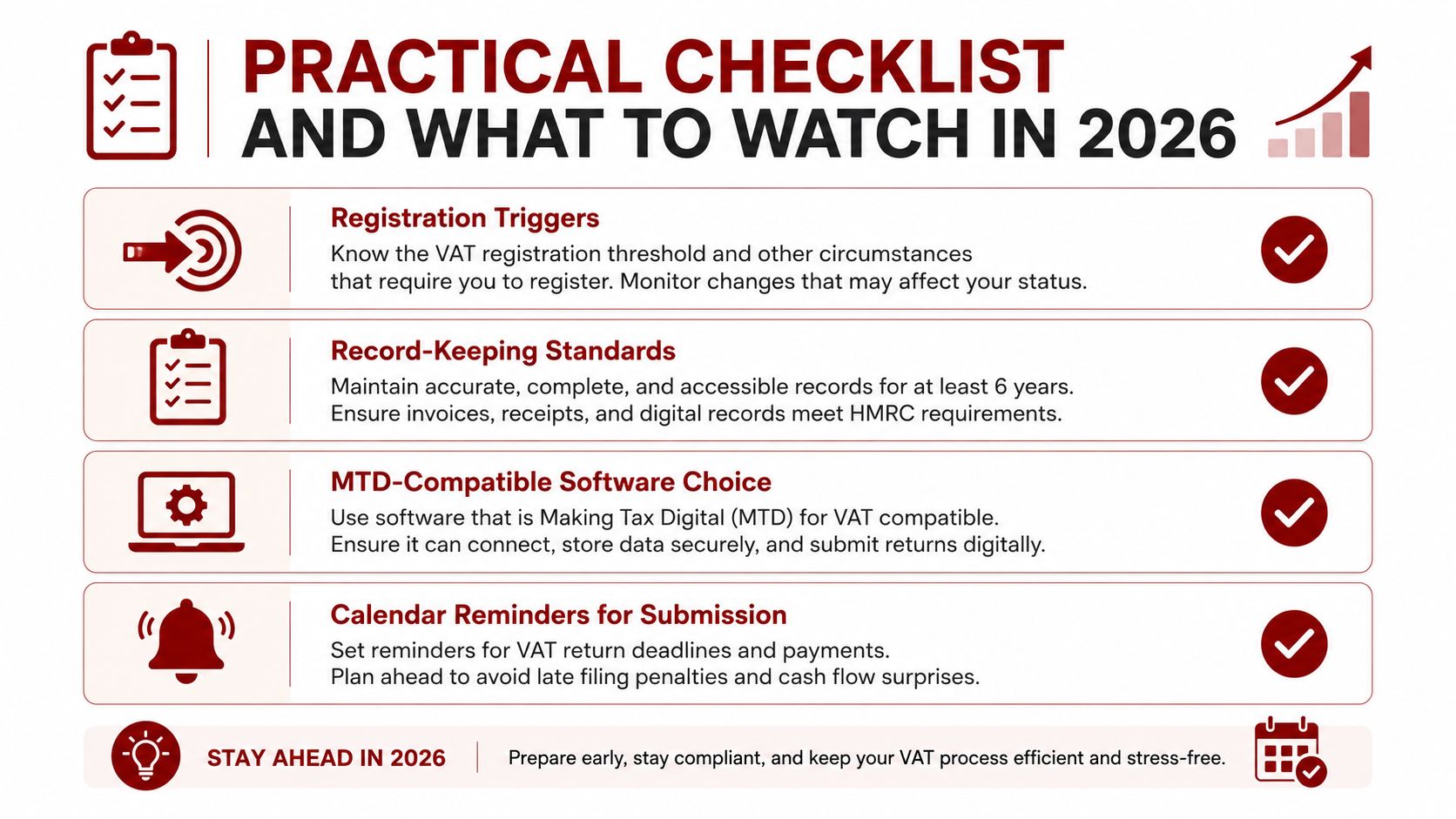
- Review registration triggers: Monitor taxable turnover on a rolling basis and check whether a voluntary registration still fits your pricing and customer base.
- Keep digital records: Store sales, purchases, VAT treatments, dates, and links between transactions and return totals.
- Choose compatible software: Confirm that your bookkeeping platform can maintain the required digital records and submit through the relevant HMRC connection.
- Reconcile monthly: Match bank activity, invoices, credit notes, and VAT control balances before the quarter closes.
- Set two reminders: One reminder should cover return submission, and another should cover payment. They're separate compliance actions.
- Investigate exceptions: Review unusual rates, missing invoices, private-use costs, imports, reverse charges, and mixed taxable or exempt activity.
- Preserve a review trail: Keep notes for adjustments, corrections, and decisions that another person may need to understand later.
A business that treats VAT as a quarterly panic will keep rediscovering the same problems. A business that treats it as a monthly control process can identify errors while the documents, bank transactions, and staff decisions are still easy to trace. For a fuller operational review, use this VAT compliance checklist.
The 2026 information gap
HMRC announced in July 2026 that it plans to stop publishing preliminary and second-estimate VAT gap updates from autumn 2026, replacing them with a single annual VAT-gap estimate within Measuring Tax Gaps. The announcement means official compliance information will become less granular and less timely for businesses looking for current UK-specific risk context. HMRC's statistics announcement also records the latest published VAT gap as £12.1 billion.
That change doesn't alter your filing deadline, but it reinforces the value of business-level controls. HMRC continues to require digital compliance under MTD for VAT, and businesses should understand how their software, records, reconciliations, and approval process work together.
Start by checking your VAT period and next deadline today, then reconcile the most recent month before the next return becomes urgent.
Action Accountants Limited can help prepare and submit VAT returns, reconcile VAT control accounts, and organise bookkeeping around Making Tax Digital requirements. Visit Action Accountants Limited to discuss a practical VAT process for your business.