
Finance for Non Finance Managers: A Practical Guide
Master finance for non finance managers. Learn to read financial statements, manage cash flow, and make confident business…
You've won the contract, issued the purchase orders and hired the people needed to deliver it. The P&L shows a healthy margin, so expansion looks justified. Then the client delays payment, payroll falls due, VAT needs funding and suppliers want settlement. The business is profitable on paper, yet the bank balance is heading in the wrong direction.
That situation is common enough to make finance for non finance managers a leadership discipline, not an accounting nicety. The question isn't whether you can prepare statutory accounts. It's whether you can see how pricing, hiring, purchasing and payment terms affect cash before the decision becomes expensive.
Table of Contents
- The Hidden Cost of Financial Blind Spots
- Decoding the Big Three Financial Statements
- Mastering Working Capital and Cash Flow Forecasting
- Essential Financial KPIs for Everyday Decision Making
- Budgeting and Forecasting for Growth and Stability
- Real World Scenarios for SMEs and Startups
- Building a Productive Partnership with Your Accountant
The Hidden Cost of Financial Blind Spots
A good P&L doesn't guarantee survival. It records revenue when accounting rules say it should be recognised, while your bank account changes only when money arrives or leaves. A growing firm can therefore report profit and still struggle to fund wages, tax, materials or supplier payments.
The risk increases when operational managers treat finance as something the accounts team owns. Every department makes financial decisions. Sales agrees payment terms, operations commits to stock, project managers approve labour, and founders authorise investment. If those decisions aren't connected to cash conversion, growth can create pressure faster than it creates liquidity.
The London Foundation for Banking & Finance research report reports that 20.3 million UK adults, or 39%, don't feel confident managing their money. It also identifies particularly low financial literacy among women, people on low incomes, people with lower educational attainment, ethnic minorities, younger adults and older adults. For business leaders, the implication is practical: confidence with financial decisions can't be assumed.
Management rule: If a manager can approve spend, promise delivery or negotiate terms, that manager needs enough financial understanding to explain the cash consequence.
Parliament's review of SME leadership and management capability found a long-standing training gap. In 2016, only about a quarter of SME owners had undertaken specific management training in the previous 12 months, while roughly the same proportion had never taken such training, and only one-fifth of SMEs had invested in external leadership and management training, as recorded in the House of Commons review. That historical evidence supports a clear recommendation: founders should give non-finance managers a working financial toolkit before they hand them control over budgets, contracts or resources.
A useful starting point is to review the financial traps that quietly undermine small business owners. The aim isn't to turn every manager into an accountant. It's to make financial consequences visible while there's still time to act.
Decoding the Big Three Financial Statements
You don't need to memorise accounting standards. You need to know which question each statement answers and which operational behaviour sits behind the figures.
The P&L shows performance over time
The Profit and Loss statement is a video, not a photograph. It shows sales, direct costs, overheads and the resulting profit or loss across a period. Read it from the top down:
- Revenue: Are sales growing because of more customers, higher prices, larger orders or one-off work?
- Gross profit: Does each sale leave enough after direct delivery costs?
- Operating expenses: Are payroll, rent, software, marketing and professional fees rising faster than the activity they support?
- Net result: Does the reported profit reflect repeatable trading, or does it depend on unusual income or delayed costs?
A falling gross margin deserves attention before overheads obscure the problem. It may indicate discounting, supplier price increases, inefficient delivery or a contract that was underpriced from the start.
The Balance Sheet shows what the business controls and owes
The Balance Sheet is a snapshot at a specific date. It lists assets, liabilities and equity. For a non-finance manager, the most useful areas are usually cash, receivables, stock, payables, loans and tax liabilities.
Receivables represent work already invoiced but not yet collected. Stock represents cash tied up in goods that haven't been sold or used. Payables and tax liabilities show obligations that will draw on future cash. A business can look valuable because it has assets and reported earnings, yet remain exposed if too much of its working capital is trapped or its short-term obligations are due before collections arrive.
The Cash Flow Statement shows whether operations produce cash
The Cash Flow Statement is the oxygen gauge. It tracks cash generated or consumed by operating activity, investing activity and financing activity. Managers should focus first on operating cash flow, because a business that repeatedly consumes cash through normal trading needs a clear explanation.
Don't confuse cash movement with profit. A customer invoice can improve the P&L without increasing the bank balance. A loan can improve the bank balance without improving profitability. A major equipment purchase can reduce cash immediately while its cost reaches the P&L gradually.
Management reporting for SMBs can help managers turn these statements into a recurring decision tool rather than a retrospective pack. Your monthly review should connect the three views and ask one direct question: what operational action explains this financial movement?
Mastering Working Capital and Cash Flow Forecasting
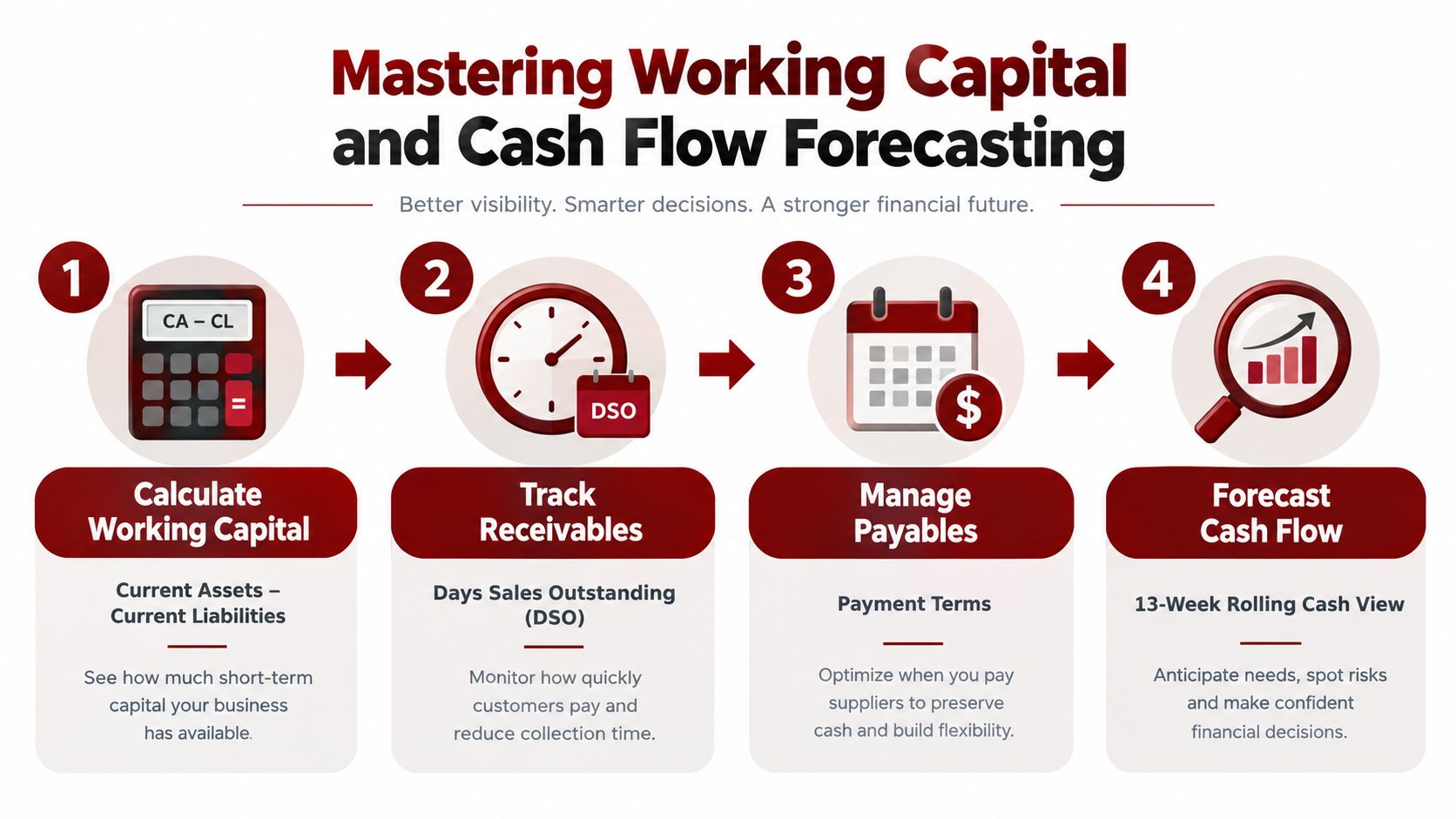
Working capital equals current assets minus current liabilities. In practical terms, it measures the short-term resources available after short-term obligations are considered. The calculation matters because operational timing changes liquidity.
If customers take longer to pay, receivables rise and cash stays outside the business. If stock sits unused, money remains locked in inventory. If suppliers allow sensible payment terms, the business can retain cash for longer without breaching agreements. The UK government guide to financial management for SMEs highlights cash-flow monitoring, a named owner for chasing late payments and regular management accounts as practical controls.
Manage the conversion cycle deliberately
Assign ownership to each lever. Sales should agree commercially sensible payment terms, project teams should invoice promptly against deliverables, operations should challenge slow-moving stock, and someone specific should chase overdue accounts. “Finance is looking at it” isn't an operating process.
The same logic applies to suppliers. Extending payment terms can protect liquidity, but late payment can damage trust and supply continuity. Use agreed terms, negotiate openly and prioritise payments according to contractual, operational and legal consequences.
For a wider explanation of the cycle, Nexist working capital solutions provides useful context on how receivables, inventory and payables interact. Your own management pack should then translate that theory into named owners, dates and exceptions.
Use a 13-week view of cash
A 13-week rolling cash-flow forecast gives managers a week-by-week view of expected inflows and outflows. It makes timing risk visible before the bank balance becomes critical, particularly when payroll, rent, VAT, HMRC liabilities and supplier invoices cluster in the same period. The practical value of this approach is outlined in small business cash-flow guidance for the UK.
Build the forecast from bank balances, confirmed customer receipts, realistic collection assumptions, payroll, tax, rent, suppliers, finance payments and planned investment. Update it every week. Don't hide uncertainty inside a single optimistic number. Mark receipts as committed, probable or uncertain, then run the forecast using the level of confidence that matches the risk.
Variance analysis turns the forecast into a management instrument:
- Timing issue: The customer will pay, but later than planned. Rephase spending and intensify collection.
- Collection problem: The invoice is overdue or disputed. Escalate ownership and resolve the commercial blockage.
- Margin problem: The work generates insufficient cash after delivery costs. Reprice, renegotiate scope or stop repeating the mistake.
- Structural funding gap: The business needs a financing decision, not another round of delayed payments.
A forecast doesn't create cash. It creates decision time. That time lets managers defer non-essential expenditure, accelerate receivables, renegotiate commitments or discuss funding before suppliers and staff feel the consequences.
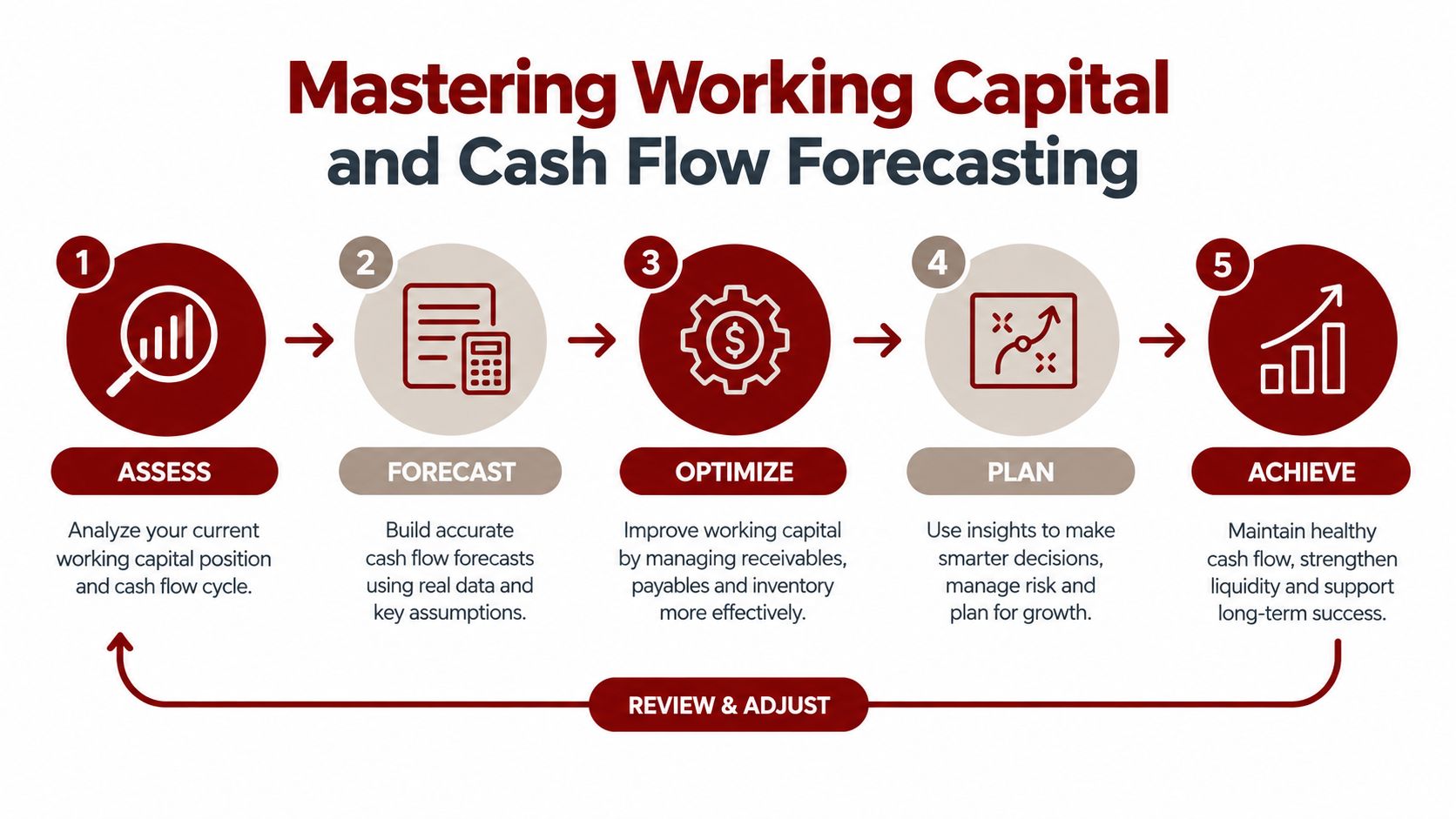
For a straightforward operational reference, use cash flow forecasting guidance alongside your internal forecast. Keep the model simple enough that managers will update it, and disciplined enough that assumptions are visible.
Essential Financial KPIs for Everyday Decision Making
The bank balance tells you what cash is available now. It doesn't tell you whether that cash is being generated by trading, borrowed, held temporarily for tax or consumed by an inefficient operating model. A useful dashboard combines liquidity, margin and operating efficiency.
Start with a small set of measures. Too many KPIs create reporting activity without better decisions. Each metric should have an owner, a review frequency and a defined response when it moves outside tolerance.
| KPI / Ratio | What It Measures | Warning Signs |
|---|---|---|
| Current ratio | Whether current assets can cover current liabilities | Liquid resources are tightening while obligations remain fixed |
| Gross margin | What remains after direct delivery or production costs | Discounts, supplier increases or rework are reducing contribution |
| Operating margin | Profit left after operating overheads | Payroll and overhead growth is outpacing profitable activity |
| Debtor days | How quickly customers pay invoices | Receivables are ageing, disputes remain unresolved or collections depend on chasing |
| Creditor days | How long the business takes to pay suppliers | Payments exceed agreed terms or supplier relationships are deteriorating |
| Inventory days | How long cash remains tied up in stock | Slow-moving, obsolete or over-purchased items are accumulating |
| Operating cash flow | Cash produced or consumed by normal trading | Profit is reported but core operations repeatedly absorb cash |
Ratios need context. A single month can be distorted by billing cycles, seasonal activity, a large contract or an unusual payment. Compare the movement with the underlying operational explanation, then decide whether the response belongs in pricing, purchasing, collections, staffing or funding.
Turn metrics into decisions
A sales manager shouldn't celebrate revenue without checking payment terms and margin. An operations manager shouldn't cut purchasing blindly if the result is missed delivery. A founder shouldn't approve a new hire based only on expected annual profit if the payroll commitment arrives before the related income.
The dashboard should therefore pair each KPI with a question:
- Margin: Which products, projects or customers are absorbing effort without adequate contribution?
- Receivables: Which invoices need a named intervention this week?
- Inventory: What can be sold, returned, reduced or stopped?
- Cash flow: Which payment or commitment creates the greatest near-term exposure?
Managers looking to make their dashboard more forward-looking can review how to be proactive with KPIs. For deeper interpretation, financial ratio analysis can help connect movements to solvency, efficiency and profitability rather than treating ratios as isolated scores.
Budgeting and Forecasting for Growth and Stability
A budget should be a decision framework, not a document prepared once for a lender and ignored afterwards. It sets the resources required to deliver the plan, the revenue assumptions supporting those resources and the cash consequences of both.
Build the model from operational drivers. For a service firm, that may include billable capacity, utilisation, pricing, payroll and collection timing. For a construction business, it may include project milestones, labour, materials, subcontractors, retention and CIS-related obligations. For a product business, it may include units, supplier terms, stock purchases and fulfilment costs.
Separate the plan from the latest view
A static budget preserves the original plan. It helps you understand what changed, but it won't tell you what is now likely to happen. A rolling forecast updates the expected outcome as new information arrives. Keep both. The first protects accountability, while the second supports action.
Review budget versus actual performance at least monthly. Investigate material variances by cause, not just by account code. Revenue may be late rather than lost. Materials may be over budget because scope changed. Payroll may be higher because a strategic hire started earlier. Each explanation demands a different response.
Model three credible outcomes
Use expected, downside and upside scenarios, but don't turn them into decorative spreadsheet tabs. Attach decisions to each scenario:
- Expected: Continue planned hiring, purchasing and investment, provided cash and margin remain within agreed limits.
- Downside: Freeze discretionary spend, tighten approval thresholds, accelerate collections and delay non-essential recruitment.
- Upside: Protect delivery capacity first, then invest only where the forecast shows the business can absorb the commitment.
Include delayed customer payments and cost increases in the downside case. The most dangerous budget is the one that assumes sales arrive on time and costs remain static. A forecast should show managers what they can still afford, what they must protect and which trigger requires escalation.
Real World Scenarios for SMEs and Startups
Financial judgement becomes useful when a founder must choose between competing uses of cash. The right question isn't "will this make money?" It's "when does cash leave, when does cash return, and what could disrupt that timing?"

A large contract with upfront delivery costs
A new contract may look attractive because the quoted price exceeds direct costs. Before signing, map the payment schedule against payroll, materials, subcontractors, insurance, mobilisation and rework risk. Check whether the contract allows deposits, staged billing or retention release, and test what happens if the customer pays late.
A contract that produces accounting profit can still create a funding requirement. Approve it only when the forecast shows how the business will fund the gap and what protections exist if delivery takes longer than planned.
A senior hire versus contractors
Compare more than salary. A permanent hire carries recruitment costs, employer obligations, equipment, management time and a continuing commitment if demand falls. Contractors may cost more per day but preserve flexibility, while they can also create dependency or knowledge-transfer risk.
Ask what level of recurring revenue supports the role, which work the person will replace or generate, and when the cash benefit is expected. Use a downside forecast that assumes slower sales and a delayed ramp-up. If the role is strategically necessary, stage the commitment through a defined start date, deliverables and review points rather than relying on enthusiasm.
The following video offers another way to frame financial planning decisions in practical business terms.
Equipment or technology investment
Start with the operational problem, not the product brochure. Quantify the purchase price, implementation, training, maintenance, financing cost and disruption. Then identify the measurable driver, such as capacity, labour reduction, quality, delivery speed or compliance.
Don't approve an investment because it has a persuasive return-on-investment claim. Test the payback under weaker demand, higher running costs and slower adoption. A cheaper option that fails to solve the constraint can waste more cash than a larger purchase, while an expensive system can become a burden if the team won't use it.
For each decision, require a one-page approval note covering the P&L effect, cash timing, working-capital impact, key assumptions and the condition that would cause you to stop or revise the plan.
Building a Productive Partnership with Your Accountant
The best finance for non finance managers approach isn't to become an accountant. It's to become a better client and decision-maker. Your accountant can prepare accurate records, but they can't advise effectively if they only hear about a new contract, hire or investment after the commitment is signed.
Separate compliance from management support. Statutory accounts, VAT returns and tax filings protect obligations. Management reporting, forecasting, scenario analysis and commercial advice help you decide what to do next. You need both, but they require different meetings, information and expectations.
Run a useful monthly review
Send questions before the meeting. Ask which movements matter, whether cash is being generated by operations, which liabilities are approaching, whether margins have changed and which forecast assumptions deserve challenge. Bring operational context, including pipeline quality, customer disputes, staffing plans and supplier issues.
Ask for plain-language explanations. If a figure doesn't make sense, keep asking until you understand the business implication. Agree who owns each follow-up, what information is required and when the answer will arrive.
Set the relationship up for action
A productive accountant partnership should include:
- A recurring review rhythm: Don't wait for year-end accounts to discover a working-capital problem.
- Clear deliverables: Agree the reports, forecast updates, tax planning and advisory support you expect.
- Fast escalation: Define which cash, tax or compliance issues require immediate contact.
- Commercial context: Give your accountant enough information to challenge assumptions, not just record transactions.
Use this practical guide to ways an accountant can help your small business when defining the scope of support. Then book a finance review, bring your latest P&L, Balance Sheet and cash forecast, and leave with named actions rather than general reassurance.
Action Accountants Limited helps growing businesses with bookkeeping, management reporting, tax, VAT, payroll and practical cash-flow advice, including CIS-aware support for construction firms. Visit Action Accountants Limited to arrange a conversation about turning your numbers into clearer decisions and stronger financial control.