What Is a VAT: The UK Guide for Growing Firms
Discover what is a VAT, how UK thresholds work, and which scheme saves you money. Practical guidance for startups, contractors, and landlords.
VAT is a consumption tax added to many goods and services, collected by businesses on behalf of HMRC. The current UK VAT registration threshold is £90,000 in taxable turnover.
You may not notice the issue at first. A founder wins a large contract, a contractor takes on several new projects, or a consultancy starts invoicing bigger corporate clients. Turnover rises quickly, but the owner keeps treating VAT as an end-of-year accounting task. By the time someone checks the figures, registration may already be overdue and cash set aside for growth may actually belong to HMRC.
That's why the useful question isn't only “what is a VAT?” The practical question is when VAT becomes your responsibility, how it moves through your bank account, and which controls stop a routine return becoming an expensive compliance problem.
Table of Contents
- Understanding What Is a VAT in the UK
- How VAT Is Charged and Recovered
- Navigating Registration Thresholds and Deadlines
- Choosing the Right VAT Scheme for Your Business
- Sector Specific Rules for Contractors and Landlords
- The Filing Process and Common Compliance Pitfalls
- Next Steps for Professional VAT Management
Understanding What Is a VAT in the UK
VAT, or Value Added Tax, is an indirect consumption tax. The final customer normally bears the cost, while the business charges it, records it, and pays the relevant amount to HMRC. Your business is therefore acting as a collection point in the supply chain, not treating VAT as revenue.
For a VAT-registered business, the basic process has three parts:
- Charge VAT on taxable sales. This is output VAT.
- Pay VAT on eligible business purchases. This is input VAT.
- Offset input VAT against output VAT and pay the balance to HMRC, or claim a repayment where the figures produce a credit.
The tax is designed to follow consumption. A business generally collects VAT from its customer and recovers eligible VAT incurred on business inputs. That makes VAT different from corporation tax or income tax, which are costs of the business. VAT held in your bank account after a customer pays an invoice may be a liability, not available working capital.
The UK rates that matter
The standard VAT rate is 20%, while a reduced rate of 5% applies to some goods and services. The UK also has a zero rate, meaning VAT is charged at 0% while the supply remains within the taxable VAT system. The official history of UK VAT shows that the standard rate has changed repeatedly since VAT was introduced, while the zero rate has existed throughout the system's history. HMRC's UK VAT statistics commentary sets out that structure and rate history.
That distinction between zero-rated and exempt is critical. Zero-rated sales count as taxable turnover and can support input VAT recovery under the normal rules. Exempt supplies don't carry VAT, and they can restrict the VAT you're allowed to recover on related costs. Treating the two categories as interchangeable is a common route to an incorrect registration decision or an overstated repayment.
A business approaching the threshold should review its sales categories before registration, not after. The VAT guide for small businesses can help founders understand the practical impact, but your own invoices, contracts, and customer mix still need reviewing.
VAT has existed in the UK since 1 April 1973, when the standard rate was 10%. It has since been adjusted several times, with the current standard rate at 20%. Those changes matter because VAT is a policy system, not a permanent fixed charge. Your pricing, contracts, and accounting software must be able to accommodate rate and classification changes.
How VAT Is Charged and Recovered
The cleanest way to understand VAT is to follow one transaction from sale to return.
Suppose a London design startup is VAT registered. It invoices a client for a standard-rated service at a net price of £5,000. At the standard rate, the invoice includes £1,000 of output VAT, so the client pays £6,000 in total. The £1,000 isn't the startup's income. It's tax collected from the client.
The startup also buys business materials and software from VAT-registered suppliers. Assume the eligible input VAT on those purchases totals £300. Its VAT position for the period is therefore:
- Output VAT: £1,000 charged to the client
- Input VAT: £300 incurred on eligible business purchases
- VAT payable: £700 before other adjustments
The calculation looks simple. The evidence behind it is where problems arise. The business needs records that show what it sold, the VAT treatment applied, what it bought, and why the purchases were for business purposes.
What you can and can't recover
Input VAT recovery depends on the purchase, its business use, and the quality of the supporting record. A valid VAT invoice is usually central to the claim. A bank statement showing that money left the account doesn't automatically prove that recoverable VAT was charged.
Keep a disciplined purchase process:
- Check supplier invoices: Confirm the supplier's details, VAT treatment, and the amount of VAT charged.
- Separate business and private spending: Mixed-use costs need careful treatment rather than an automatic full claim.
- Review entertainment costs: Client entertainment and similar expenditure can carry restrictions, so don't reclaim by habit.
- Match documents to transactions: Store invoices with the relevant bank or accounting entry.
- Investigate unusual claims: A large input VAT balance may reflect genuine investment, but it may also reveal duplicate invoices or incorrect coding.
Vehicle-related costs deserve particular care. If your business uses fuel cards or provides company-car benefits, review the treatment rather than assuming every fuel transaction is recoverable. Guidance on VAT on fuel cards is useful background for checking how fuel, private use, and benefit arrangements interact.
Cash timing creates the real pressure
Under normal invoice-based accounting, output VAT can become due when the invoice is issued, even if the customer pays later. That creates a funding gap for businesses with long payment terms. A consultancy can complete work, issue an invoice, and owe VAT before the client settles the underlying bill.
That's why VAT should be forecast alongside receivables. At each month-end, estimate the VAT attached to unpaid sales and keep a separate reserve. Don't wait until the return is prepared to discover that a customer's delayed payment has consumed money earmarked for HMRC.
Practical rule: Treat VAT collected on sales as restricted cash until your return has been prepared, checked, and paid.
The reverse situation can also occur. A business investing heavily in equipment or materials may incur more input VAT than it charges during a period, producing a repayment position. That isn't free money. HMRC can examine whether the purchases were genuine, correctly documented, and connected with taxable business activity.
Navigating Registration Thresholds and Deadlines
The £90,000 VAT threshold isn't an annual target that you check after preparing year-end accounts. HMRC applies a rolling test. You must register when taxable supplies exceed £90,000 in the previous 12 months, or when you expect taxable supplies to exceed £90,000 in the next 30 days alone. The rules are set out in HMRC's VAT registration guidance.
That forward-looking test catches businesses that receive a major contract or expect a sudden spike in sales. A founder who says, “We haven't reached the threshold yet,” may still have a registration obligation if the next month's contract pipeline crosses it.
What counts towards the test
Taxable turnover is the total value of supplies that are not exempt. The classification matters more than the label used in your bookkeeping software.
Zero-rated sales count towards taxable turnover. They carry VAT at 0%, but they remain taxable supplies. Exempt supplies don't count in the same way, and they can affect how much input VAT you can recover. Outside-the-scope income also needs separate treatment and shouldn't be casually included or excluded without checking the underlying transaction.
This creates particular difficulty for mixed-income businesses. A landlord with different property activities, a training provider combining taxable and exempt work, or a business selling products with different VAT treatments may have a turnover report that looks clear but gives the wrong registration answer.
Use a monthly control, not a year-end review
Set up a rolling schedule that shows:
- The previous 12 months: Add taxable supplies and remove the oldest month as each new month closes.
- The next 30 days: Review signed contracts, committed orders, and invoices expected to be issued.
- Supply classifications: Mark standard-rated, reduced-rate, zero-rated, exempt, and outside-the-scope income separately.
- Management action: Escalate the position before the threshold is crossed, not after.
Non-established taxable persons can have no registration threshold at all and may need to register when they make taxable supplies of any value in the UK. That rule is easy to miss if your business is based overseas or operates through a non-UK establishment.
The threshold changed to £90,000 from 1 April 2024, after being frozen at £85,000 for years. Older online articles and spreadsheets may therefore give you the wrong trigger. VAT registration threshold guidance for UK businesses is a useful starting point, but the decision should be based on current HMRC rules and your actual supply profile.
Registration also changes your pricing conversation. If your customers are VAT-registered businesses, they may focus on the net price because they can often recover VAT. If your customers are consumers or exempt businesses, VAT may increase the price they feel directly. Decide whether contracts are VAT-inclusive or VAT-exclusive before you issue the invoice.
Choosing the Right VAT Scheme for Your Business
The standard method isn't automatically the most suitable one. Scheme selection affects when you pay HMRC, how much administration you carry, and whether your bookkeeping reflects the cash sitting in the bank.
The main choices have different purposes:
| VAT Scheme | Best Suited For | Key Cash Flow Benefit |
|---|---|---|
| Standard VAT accounting | Businesses with predictable invoicing and strong bookkeeping controls | Provides the normal output VAT and input VAT calculation |
| Cash Accounting Scheme | Firms whose customers pay slowly or whose bad-debt exposure is significant | Output VAT is accounted for when customers pay rather than when invoices are issued |
| Annual Accounting Scheme | Eligible businesses wanting fewer formal VAT returns and regular payment planning | Allows one VAT return per year and can make cash planning more structured |
| Flat Rate Scheme | Smaller businesses with a straightforward cost base that meet the scheme conditions | Simplifies the VAT calculation, although it may not produce the lowest liability |
| Margin Scheme | Businesses where VAT is calculated on the margin for qualifying transactions | Avoids applying VAT to the full selling price where the scheme rules apply |
HMRC sets the main eligibility ceiling for the Cash Accounting Scheme and Annual Accounting Scheme at estimated annual VAT taxable turnover of £1.35 million or less. The HMRC overview of VAT schemes explains the conditions and the intended cash-flow effects.
Match the scheme to how customers pay
A B2B agency with long payment terms should examine Cash Accounting first. Under that approach, the business accounts for output VAT when the customer pays, which can prevent VAT from draining cash before the invoice is settled. The trade-off is that input VAT is also tied to payment timing, and the scheme requires consistent records.
Annual Accounting can suit a business with stable operations, organised management accounts, and a preference for one annual return. It won't remove the need for accurate records. It may also be a poor fit if turnover is volatile or management needs frequent VAT visibility.
The Flat Rate Scheme can simplify administration for an eligible consultant with limited VAT-bearing expenses, but simplicity isn't the same as saving money. A firm with substantial input costs may give up more VAT recovery than it gains from the simplified calculation. Review the numbers before choosing it. Advice on the UK Flat Rate Scheme can help you frame that comparison.
Contractors and landlords need a closer review
A contractor with significant materials, plant, or subcontractor costs should be wary of selecting a scheme solely to reduce paperwork. A landlord or property investor may have exempt and taxable income, which makes input VAT recovery and partial exemption issues more important than the headline scheme description.
Build a decision paper before registering or switching:
- Compare customer payment timing with supplier payment timing.
- Identify the VAT on recurring costs and major purchases.
- Separate taxable, zero-rated, and exempt activities.
- Model the administration required each month or year.
- Review the result with an adviser before committing.
The correct scheme is the one that supports accurate reporting and protects working capital. Don't choose based on a generic recommendation made for a different sector.
Sector Specific Rules for Contractors and Landlords
A contractor can understand the standard VAT calculation and still get the return wrong. Construction work, subcontractor arrangements, and property transactions introduce classifications and invoicing requirements that ordinary sales-led bookkeeping may not capture.
Construction needs transaction-level discipline
A construction business should review every contract for its VAT treatment, the parties involved, and the documentation expected. The Construction Industry Scheme creates separate tax administration around contractor and subcontractor payments, while the domestic reverse charge can change who accounts for VAT on qualifying construction services.
Under a reverse-charge arrangement, the supplier may not receive the VAT cash they would normally collect on an invoice. The customer accounts for the relevant VAT instead, subject to the rules applying to that supply. That can prevent the supplier from holding VAT cash, but it can also create a serious working-capital problem if the business has payroll, materials, and subcontractor costs to fund.
A contractor should maintain:
- Contract records: Keep the scope, customer status, and VAT decision together.
- Invoice controls: Use wording and VAT treatment appropriate to the transaction.
- CIS records: Reconcile subcontractor deductions and payment records separately from VAT.
- Project coding: Allocate materials, labour, and subcontractor costs to the correct job.
- Review points: Recheck treatment when the contract changes or the customer adds new work.
Don't allow a bookkeeper to select “standard VAT” from a dropdown without seeing the contract. A wrong treatment can affect both the supplier's return and the customer's records.
Landlords must separate property activities
Residential lettings and commercial property transactions don't automatically receive the same VAT treatment. Residential rental income is commonly exempt, while commercial property may involve an option to tax and different consequences for charging VAT and recovering related costs. The treatment depends on the property, the election made, the transaction, and the use of the premises.
A landlord buying, refurbishing, or converting property should obtain advice before signing a contract. Input VAT on professional fees and building work can become a major cost if the related income is exempt or if the business hasn't established the correct treatment in advance.
Keep separate records for each property and activity. Mixing residential rent, commercial rent, service charges, repairs, and personal expenditure in one account makes partial recovery decisions harder and weakens the audit trail.
A property invoice is not just a payment record. It's evidence of the supply, the parties, the property use, and the VAT decision.
The same principle applies to contractors. Sector-specific VAT work is not an add-on to bookkeeping. It should be built into onboarding, contract review, invoicing, and monthly reconciliation.
The Filing Process and Common Compliance Pitfalls
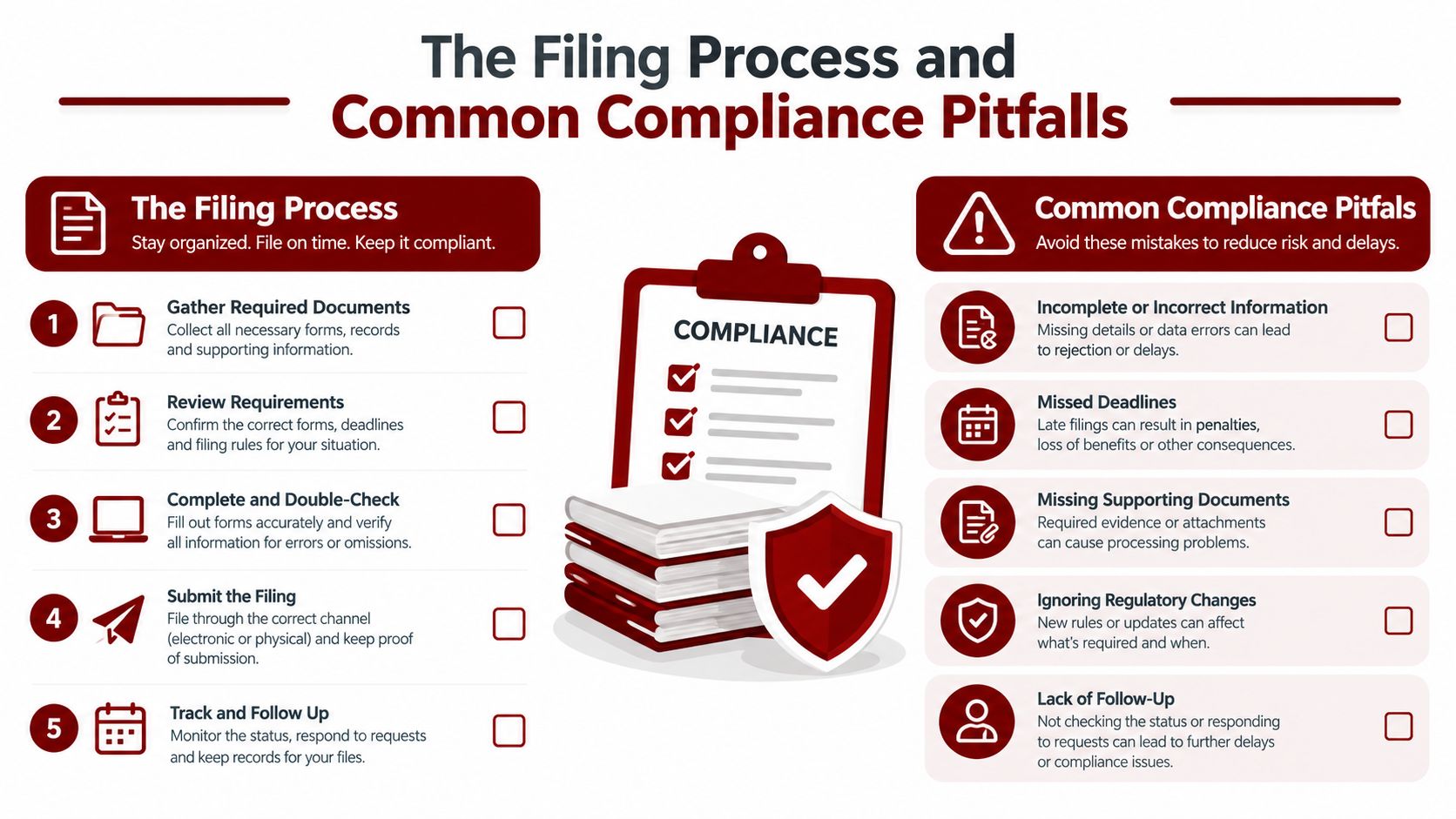
A VAT return is a legal submission, not a routine report that can be completed from the bank feed without review. The business must maintain digital records, calculate output and input VAT correctly, submit the return through compatible software, and pay what it owes by the deadline.
Most VAT returns are submitted quarterly, and the usual online deadline is one calendar month and seven days after the accounting period ends, with payment generally due on the same day. The precise treatment can vary by scheme, so build the deadline into your accounting calendar rather than relying on memory.
What a controlled process looks like
A reliable workflow has distinct stages:
- Capture: Record sales invoices, purchase invoices, credit notes, and adjustments digitally.
- Classify: Assign the correct VAT treatment to each transaction.
- Reconcile: Compare the VAT control account to the sales ledger, purchase ledger, and bank records.
- Review: Investigate unusual rates, large claims, duplicate documents, and negative balances.
- Submit and pay: Send the return through compatible software, retain the submission evidence, and settle the liability.
Making Tax Digital means compatible software and digital record keeping are central to the process. It doesn't mean the software understands your contracts. A system can submit an incorrect return efficiently if the underlying codes and invoices are wrong.
HMRC estimates the VAT gap at 6.6% of theoretical VAT liability, equal to £12.1 billion for 2024/25, compared with 5.8% and £10.3 billion for 2023/24. HMRC's VAT gap measurement shows why errors and non-compliance matter beyond an individual business. The figures also reinforce a practical point: VAT risk is often a controls problem, not a failure to understand that the standard rate exists.
Errors that deserve immediate attention
Businesses commonly create avoidable exposure by:
- Reclaiming VAT without a valid supporting invoice.
- Treating zero-rated sales as exempt.
- Applying a standard rate to a supply that needs specialist classification.
- Claiming private or restricted expenditure as wholly business-related.
- Omitting credit notes and refunds from the return.
- Using the wrong scheme for the business model.
- Filing from incomplete records because a customer has not yet paid.
- Assuming an old threshold or outdated software setting is still correct.
Professional oversight is most valuable before submission. Help with filing a UK VAT return can include reconciliation, error review, and preparation of the return, rather than pressing submit.
A monthly VAT review is usually more effective than a quarterly scramble. It gives the business time to correct invoices, chase missing evidence, identify a cash shortfall, and change pricing before the next return becomes urgent.
Next Steps for Professional VAT Management
VAT becomes manageable when you treat it as a recurring operating process rather than a tax form. The right controls should tell you when registration is approaching, how much cash is reserved for HMRC, which sales need specialist treatment, and whether the figures in the return agree with the underlying records.
Use this checklist now:
- Measure monthly: Track taxable turnover on a rolling basis and review the next 30 days of expected supplies.
- Classify sales: Separate taxable, zero-rated, exempt, and outside-the-scope income.
- Protect cash: Move the VAT element of customer receipts into a reserve account or ring-fenced forecast.
- Check contracts: Review construction work, property transactions, long-term retainers, and unusual customer arrangements before invoicing.
- Test the scheme: Compare standard, Cash Accounting, Annual Accounting, Flat Rate, and Margin Scheme implications.
- Reconcile early: Match sales, purchases, VAT control accounts, credit notes, and payment records before the filing deadline.
- Escalate complexity: Get advice when you approach the threshold, take on a reverse-charge construction contract, acquire commercial property, or discover mixed taxable and exempt income.
A good adviser should help with more than registration. The work should include selecting a suitable scheme, setting up MTD-compatible processes, reviewing invoice wording, reconciling VAT accounts, and preparing returns that reflect the commercial reality of the business.
Action Accountants Limited provides VAT registration support, VAT planning and administration, control and reconciliation work, VAT return preparation, and Making Tax Digital support for businesses including contractors, landlords, sole traders, and growing companies. If your turnover is approaching the threshold or your transactions have become difficult to classify, visit Action Accountants Limited to discuss a practical VAT control and filing process.