VAT Threshold Turnover: A Founder's UK Guide
Understand the UK VAT threshold turnover rule, how the rolling 12-month test works, and what £90,000 means for your small business in 2026.

You've just sent another invoice, checked the bank balance, and realised your business is growing faster than your admin. The question isn't whether you've made a profit. It's whether your vat threshold turnover has crossed the point where HMRC requires registration.
That point is easy to misunderstand. A tax year isn't the test, payments received aren't always the relevant timing, and a large expense bill doesn't reduce the turnover figure. The practical answer depends on what you supplied, when you supplied it, and what your taxable sales totalled over the latest rolling period.
Table of Contents
- What the VAT Threshold Turnover Rule Actually Means
- How the Rolling 12-Month Turnover Test Works
- Exceptions, Distance Sales, and Other Triggers
- Worked Examples for Real Small Businesses
- Threshold History and the £90,000 Buffer
- Practical Next Steps for Founders
What the VAT Threshold Turnover Rule Actually Means
The current UK VAT registration threshold is £90,000 of taxable turnover in any rolling 12-month period. HMRC says registration becomes compulsory when taxable turnover is more than that amount, rather than when your profit or cash balance reaches it. The threshold took effect on 1 April 2024, when the government increased it from £85,000. HMRC's VAT thresholds guidance sets out the current registration and deregistration limits.
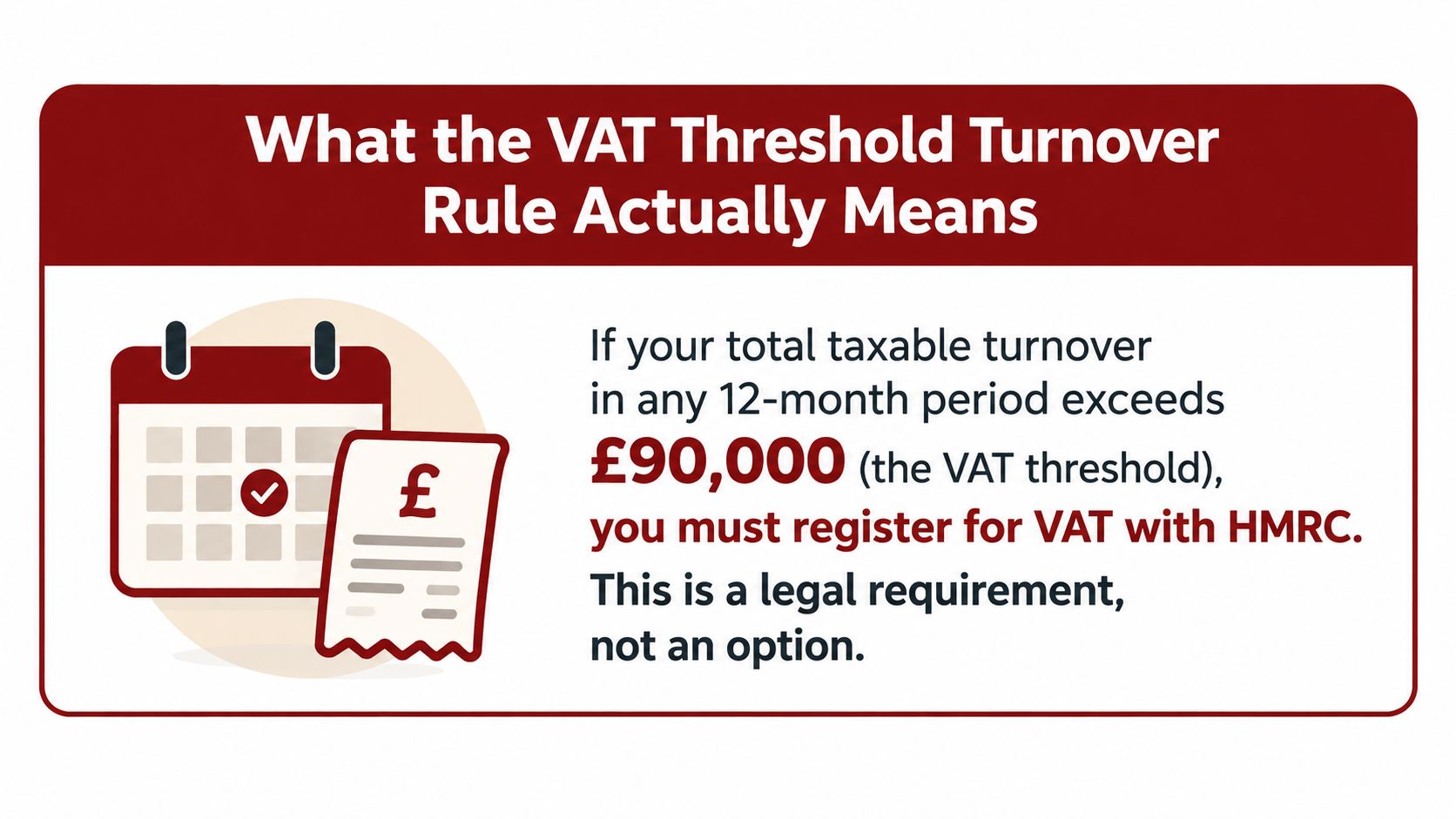
Turnover means the value of relevant taxable sales before VAT is added. It isn't profit, the amount sitting in your business bank account, or the invoices customers have paid. Costs such as software, materials, rent and subcontractors don't reduce the sales total used for the threshold.
Crossing the threshold creates two immediate pressures:
- Registration: You generally have to notify HMRC within the applicable 30-day period once the rolling test shows you're liable.
- Pricing: From the effective registration date, you must account for VAT on relevant sales. If your prices were agreed without allowing for VAT, the amount you retain can fall unless you renegotiate or rework your pricing.
The details matter, particularly for consultancies, tradespeople, online retailers and agencies whose sales rise unevenly. Start with the UK VAT registration threshold guide if you need the formal framework, then apply the rolling calculation to your own sales ledger.
International work adds another layer. If you also contract across borders, specialist guidance such as VAT compliance for UAE contractors can help separate UK registration questions from overseas VAT obligations.
How the Rolling 12-Month Turnover Test Works
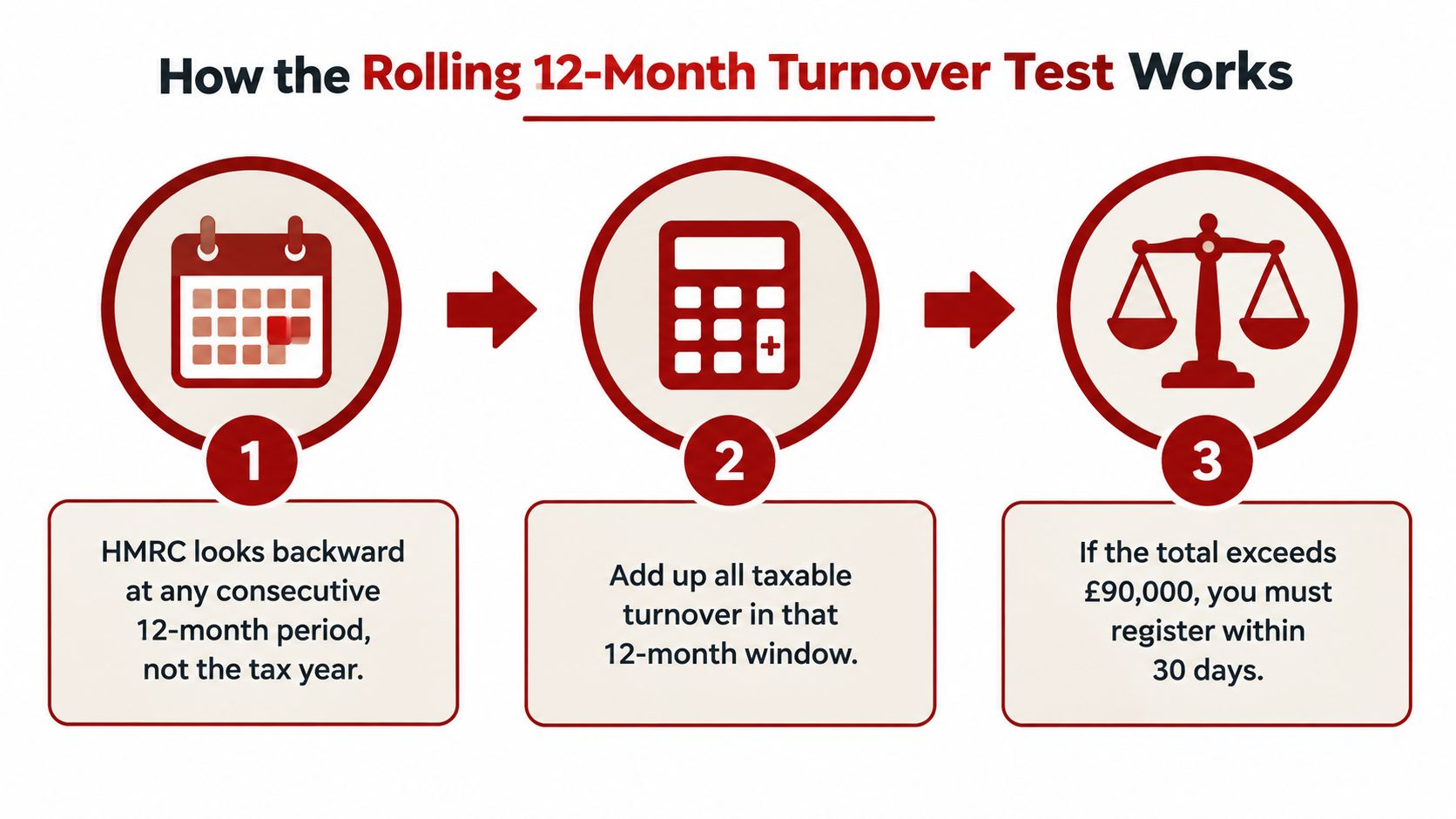
HMRC doesn't ask whether your sales fit neatly inside your accounting year. It looks backwards from the relevant point and totals taxable turnover across any consecutive 12-month window. That means a business can cross the line in the middle of its financial year, after a strong trading period, or before its year-end accounts are prepared.
Run the calculation every month
Use a simple sequence:
- Choose the latest completed month. Add that month's relevant taxable sales to the previous 11 months.
- Remove the oldest month. As the window moves forward, the earliest month drops out.
- Compare the new total with £90,000. If the total exceeds the threshold, identify the month in which the excess occurred and begin the registration process.
A fixed tax-year report can still help you understand trading patterns, but it's only a reference point. It won't replace the rolling calculation. A business with a quiet start and a strong second half may exceed the threshold long before its annual accounts show a complete trading year.
Forecast the next pressure point
Don't wait for the total to surprise you. Take the latest completed month's sales as a rough run-rate indicator, then compare that pattern with your current rolling total and signed work. A single month isn't a legal forecast, but it's a useful management warning.
You also need to check the separate forward-looking rule. If you reasonably expect taxable turnover to exceed the threshold in the next 30 days, registration can be triggered even when the previous rolling period hasn't crossed it. A large order, new contract or scheduled dispatch can therefore create an obligation before historical sales reach the limit.
Practical rule: Keep one turnover figure for the backwards-looking rolling test and a separate forward-looking note for the next 30 days.
The registration clock isn't the date printed on the invoice that takes you over. For the rolling test, the deadline is calculated from the end of the month in which the threshold was exceeded, so record the monthly total and the exact date you identified the breach. For goods, dispatch or the point at which the goods change hands can matter more than when the customer pays.
Digital record-keeping is easier when the bookkeeping system is configured correctly from the start. Businesses preparing for broader VAT reporting can also use this Making Tax Digital VAT compliance guide as a practical reference.
This video provides a visual explanation of the rolling calculation:
Exceptions, Distance Sales, and Other Triggers
The £90,000 figure is the main rule, but it isn't the only route into compulsory VAT registration. Founders often focus on their UK sales and miss a different trigger created by international trading, acquisitions or an immediate expectation of rapid turnover.
| Trigger | Threshold | Clock Starts |
|---|---|---|
| Rolling taxable turnover | More than £90,000 in a rolling 12-month period | When the rolling total exceeds the limit |
| Expected taxable turnover | Expected to exceed £90,000 in the next 30 days | When the expectation becomes clear |
| Intra-Community acquisitions | Above the applicable acquisition limit | When the relevant acquisition condition is met |
| Certain distance sales | Goods removed from the UK to another EU member state under the applicable rules | When the relevant distance-sales condition applies |
The historic acquisition route includes £85,000 for intra-Community acquisitions, while distance-selling rules can apply when goods leave the UK for another EU member state. These are specialist areas, so don't force overseas transactions into a UK-only spreadsheet. The treatment depends on the nature of the supply, customer location and timing rules.
Cash basis accounting doesn't turn the VAT threshold into a cash-received test. Invoiced cash, accruals and the value of goods or services supplied are not interchangeable concepts. VAT timing rules can depend on the supply, tax point and commercial facts, so an unpaid invoice may still matter.
Services create their own classification questions, particularly where a business has UK customers, overseas customers or supplies with different VAT treatment. Review VAT on services before assuming every receipt belongs in the same column.
Voluntary registration is also available below the compulsory threshold. It can make sense where customers are VAT-registered businesses, eligible input VAT recovery is commercially meaningful, or the founder wants the business operating inside the VAT system before growth makes registration unavoidable. It's a poor choice when consumer pricing is sensitive and the administrative burden brings little benefit.
Worked Examples for Real Small Businesses
The easiest way to understand vat threshold turnover is to watch the window move. These examples use simple monthly figures to show the calculation, not forecasts of what any particular business will achieve.
Aisha's steadily growing illustration practice
Aisha trades as a sole trader. From month six onwards, her taxable sales are approximately £7,000 per month. Her first five months are quieter, at £3,000 per month.
| Month | Aisha, sole trader (£) | Rolling total (£) | Tom, seasonal retailer (£) | Rolling total (£) |
|---|---|---|---|---|
| January | 3,000 | 3,000 | 5,000 | 5,000 |
| February | 3,000 | 6,000 | 5,000 | 10,000 |
| March | 3,000 | 9,000 | 5,000 | 15,000 |
| April | 3,000 | 12,000 | 5,000 | 20,000 |
| May | 3,000 | 15,000 | 5,000 | 25,000 |
| June | 7,000 | 22,000 | 5,000 | 30,000 |
| July | 7,000 | 29,000 | 5,000 | 35,000 |
| August | 7,000 | 36,000 | 5,000 | 40,000 |
| September | 7,000 | 43,000 | 5,000 | 45,000 |
| October | 7,000 | 50,000 | 5,000 | 50,000 |
| November | 7,000 | 57,000 | 80,000 | 130,000 |
| December | 7,000 | 64,000 | 80,000 | 210,000 |
Aisha hasn't crossed the limit by December in this first trading cycle. But the rolling window continues. If the same pattern persists, the earlier £3,000 months will eventually be replaced by £7,000 months. The important lesson is that month six onward is not judged against a fresh tax year. It remains part of a moving 12-month calculation.
At £7,000 a month, Aisha's sales are close enough to the threshold that she should monitor the ledger monthly, forecast signed projects and prepare pricing before registration becomes urgent. Her registration date and first return deadline can't be stated precisely without the actual transaction dates and effective registration date.
Tom's seasonal decoration shop
Tom's business records £5,000 per month from January to October, followed by £80,000 in November and £80,000 in December. The October rolling total is £50,000. November then pushes the 12-month total to £130,000, so he has exceeded the threshold during the November trading period.
Tom can't wait until January to deal with VAT. He needs to identify the relevant date in November, apply the applicable registration deadline, and review orders, dispatches, customer pricing and records from the effective registration date. The cash-flow effect is especially serious for a consumer-facing shop because customers may resist an unexpected price increase, leaving Tom to absorb VAT from existing prices.
Seasonal businesses need a threshold plan before the busy season, not a tidy-up after it.
A founder whose rolling total peaks at £88,000 and then falls hasn't exceeded the £90,000 registration threshold on that basis. If already registered, however, the lower £88,000 deregistration threshold becomes relevant. It creates a buffer, but falling below it doesn't automatically cancel registration. The business must consider the formal deregistration process and whether the underlying conditions are satisfied.
Threshold History and the £90,000 Buffer
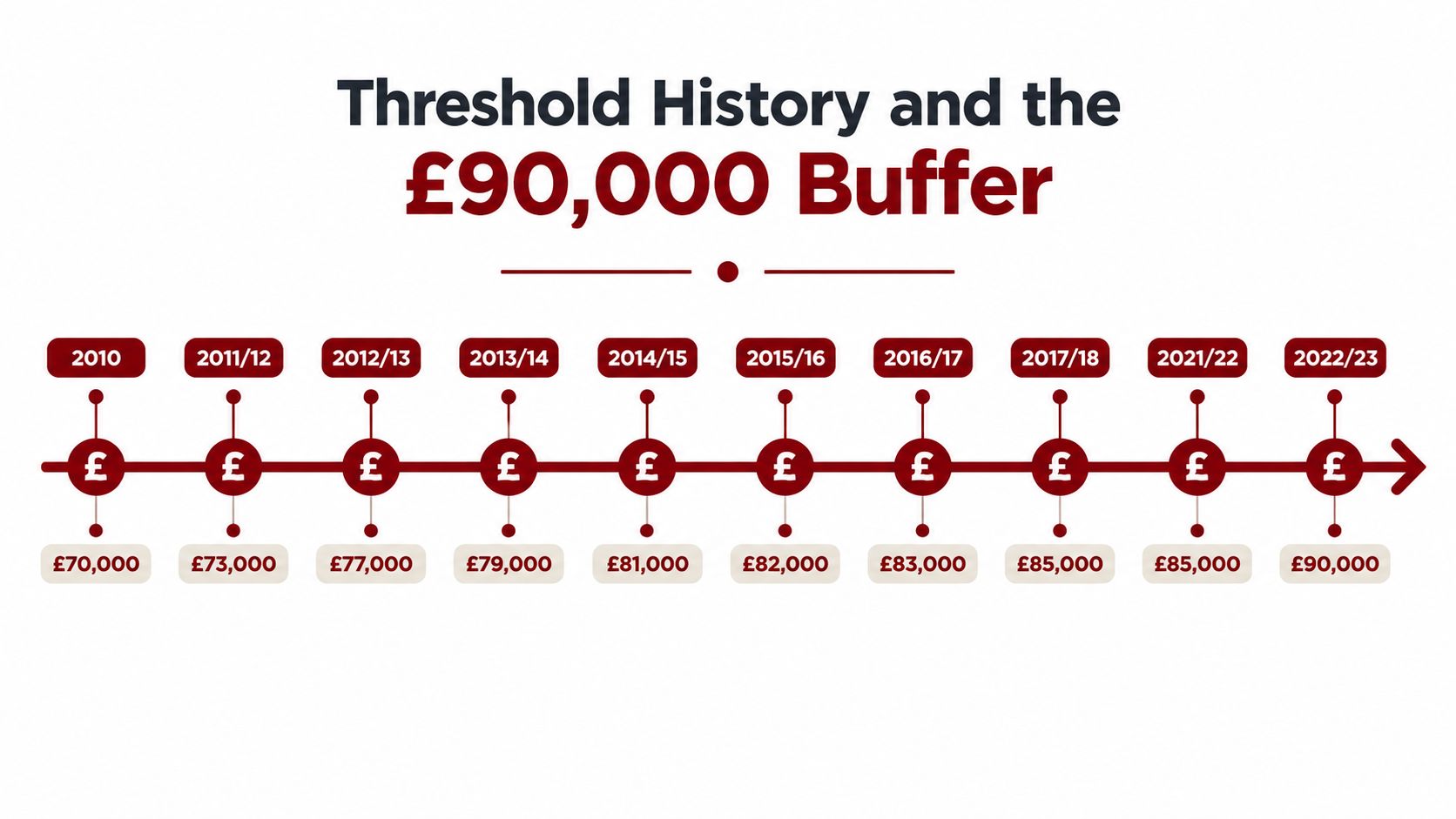
The current limit didn't appear in isolation. HMRC's threshold history records an annual registration limit of £61,000 from 1 April 2006 to 31 March 2007, followed by gradual increases that reached £85,000 on 1 April 2017. That £85,000 level then stayed unchanged through 31 March 2024, before rising to £90,000 from 1 April 2024. HMRC's published threshold history shows how policy adjustments, rather than an automatic formula, determine the limit.
The 2024 increase was the first uplift after seven consecutive tax years without a change, and it represented a 5.88% increase from £85,000. That stability made planning easier in one sense, but it also meant founders couldn't assume the threshold would remain permanently fixed. The government can alter the point at which a small business enters the VAT system.
Why the lower limit matters
The deregistration threshold is £88,000, which sits £2,000 below the registration threshold. HMRC increased the registration and deregistration limits from £85,000 and £83,000 respectively in April 2024. The government's threshold announcement confirms both current figures and the change.
That gap is practical policy engineering. Without it, a business hovering around one figure could repeatedly enter and leave VAT registration as sales moved slightly up and down. The buffer gives a VAT-registered founder room to assess whether lower turnover is a genuine change rather than a temporary dip.
For cash-flow planning, treat £90,000 as the entry warning and £88,000 as the possible exit point, not as two interchangeable targets. Keep records that show the rolling movement, because deregistration is an application and not an automatic switch.
Practical Next Steps for Founders
You don't need a complicated dashboard to control this. You need a reliable monthly routine and a clear decision before the numbers become uncomfortable.
Build the tracker first
Add a rolling turnover column to your spreadsheet or bookkeeping software. Each month, total taxable supplies for the latest 12-month window, remove the oldest month, and record the result alongside the date reviewed.
Use separate categories for taxable, exempt and out-of-scope income. Keep zero-rated taxable sales visible rather than hiding them in an “other” line, and make sure credit notes, deposits and dispatches are treated consistently with the relevant VAT timing rules.
Forecast before the breach
Project signed work and realistic sales for the coming months. Flag the month in which the rolling total could exceed £90,000, then review customer contracts and price lists before that point.
If you're already close, don't wait for annual accounts. Ask an accountant to test the calculation against source invoices, supply dates and overseas transactions. That review is cheaper and cleaner before the effective registration date has passed.
Decide whether voluntary registration earns its keep
Voluntary registration can be sensible where you sell mainly to VAT-registered businesses or have meaningful eligible input VAT on equipment, stock and other purchases. It can be less attractive for a consumer-facing business whose customers can't recover VAT and who compare your final price directly with competitors.
Weigh three things:
- Customer mix: Business customers may view VAT differently from private customers.
- Input VAT: Check which costs carry recoverable VAT.
- Administration: Allow for VAT records, returns, pricing changes and payment planning.
Act within the registration window
If compulsory registration applies, use HMRC's online process and establish the effective date from the relevant trigger. Then configure your accounting software, update invoice wording, separate VAT cash in your bank account and set aside money for the eventual return.
Choose a VAT accounting approach only after checking how it fits your cash collection, customer base and record-keeping. Don't select a scheme because its name sounds simpler. The wrong choice can create avoidable reconciliation work.
A focused VAT compliance checklist should cover the records you'll need, including VAT invoices, evidence supporting zero-rated supplies, mileage and fuel receipts, and import documentation.
Keep evidence and ask early
Retain the sales ledger behind every rolling total. If HMRC asks why you registered, didn't register or applied to deregister, a dated calculation with supporting records is far stronger than a reconstructed spreadsheet.
Action Accountants Limited can review rolling taxable turnover, VAT registration dates, pricing and ongoing compliance for founders and small businesses. Visit Action Accountants Limited to discuss your figures before a threshold decision becomes a cash-flow problem.