
What Is CIS Gross Payment Status: A 2026 Guide
What is CIS Gross Payment Status. Learn what CIS gross payment status means in the UK Construction Industry Scheme, who qualifies, how it changes…
CIS gross payment status lets a UK subcontractor receive 100% of every invoice, with no tax deducted at source by the contractor, instead of the standard 80% for a registered subcontractor or 70% for an unregistered subcontractor.
You've just landed your first substantial contract. The work is booked, materials need ordering and wages or household bills still have to be paid. Then the contractor's payment portal shows less money than you expected. The invoice total looks right, but the amount reaching your bank account doesn't.
That reduction usually comes from the Construction Industry Scheme, or CIS. If you're registered as a subcontractor but don't hold gross payment status, the contractor normally deducts CIS tax before paying you. Understanding how CIS deductions work is essential before you price work or plan your cash flow.
Gross payment status changes the timing of that tax deduction. It doesn't make your income tax-free, and it isn't just another name for CIS registration. It's an HMRC-approved status that allows an eligible subcontractor to receive the full invoice amount and account for their own tax through the usual tax process.
Table of Contents
- The Moment Your Invoice Looks Smaller Than Expected
- How CIS Gross Payment Status Actually Changes Payments
- Who Qualifies Under the HMRC Turnover Tests
- Applying for Gross Payment Status and Checking What You Hold
- What Gross Status Means for Cash Flow and Bookkeeping
- Common Misconceptions That Lead to Costly Mistakes
- Putting It All Together and When to Bring in a Specialist
The Moment Your Invoice Looks Smaller Than Expected
An electrician in North London completes a £5,000 kitchen rewire for a main contractor. The work passes inspection, the invoice is approved and the payment date arrives. The contractor's portal shows £4,000 paid, leaving £1,000 withheld under CIS.
That £1,000 has not vanished. The contractor has deducted it and accounted for it through the Construction Industry Scheme. A registered subcontractor without gross payment status normally has 20% deducted, so 80% of the invoice reaches the bank. An unregistered subcontractor generally has 30% deducted and receives 70%. HMRC explains these payment rules in its guidance on getting paid as a CIS subcontractor.
The timing can still create pressure. The electrician may need to pay for cable, labour, vehicle costs, insurance and other running expenses before the withheld amount helps with their tax calculation. Gross status changes that weekly cash position by allowing the full invoice value to arrive first.
The plain-English meaning
CIS gross payment status means the contractor pays the subcontractor in full, with no CIS deduction at source. The subcontractor receives 100% of the invoice amount, then remains responsible for declaring the income and paying the tax due through the usual tax process.
The status works like keeping the money in your business account until your own tax bill is due. HMRC has approved the business for this arrangement, so the contractor does not deduct CIS from each payment.
Practical rule: Check the payment status shown for your business before accepting a major contract. CIS registration alone does not guarantee payment in full.
Your invoice must still describe the correct work and materials and apply the right VAT treatment. Gross status changes the CIS deduction on payment. It does not remove your bookkeeping, VAT or wider tax responsibilities. A clear record of invoices, costs and money received helps you distinguish available working cash from money set aside for tax. For background on the deduction itself, see this guide to how CIS deductions work.
How CIS Gross Payment Status Actually Changes Payments
A gross-status subcontractor sees a different result in the bank account after every approved invoice. The contractor pays the invoice without a CIS deduction at source, so the full amount arrives first. That can make it easier to cover materials, wages, fuel, insurance and other weekly costs while work is under way.
For a registered subcontractor without gross status, the contractor usually withholds CIS before paying the balance. On a £2,400 invoice, that means £480 does not arrive with the payment, leaving £1,920 in the business account. Gross status leaves the subcontractor with the full £2,400, so the practical difference is £480 of immediate working cash.
The bookkeeping entry should reflect what happened:
- record the invoice income at its full value;
- record the bank receipt for the amount paid;
- where CIS was deducted, record the deduction separately rather than treating the smaller receipt as the invoice value;
- with gross status, there is no CIS deduction entry to reconcile for that payment.
This distinction keeps sales records, bank transactions and tax calculations aligned. An online CIS deduction calculator can help check an invoice where a deduction may apply, especially if you work for several contractors with different payment arrangements.
The tax hasn't vanished
Gross status changes when the tax is collected, not whether the income is taxable. A sole trader or partner still declares the income through Self Assessment. A limited company still records the income in its accounts and deals with its relevant company tax obligations.
The extra cash therefore needs a plan. Treat it like money held in the business account until your tax position is calculated, rather than as spare profit. A regular transfer into a separate tax account can prevent a strong payment week from creating a shortfall later. The amount to set aside depends on your income, allowable expenses and wider tax position, so a fixed percentage may not suit every subcontractor.
VAT remains a separate responsibility. If the construction industry domestic reverse charge applies, gross payment status does not change that treatment. Your invoice and VAT records must still follow the rules for the work supplied.
Who Qualifies Under the HMRC Turnover Tests
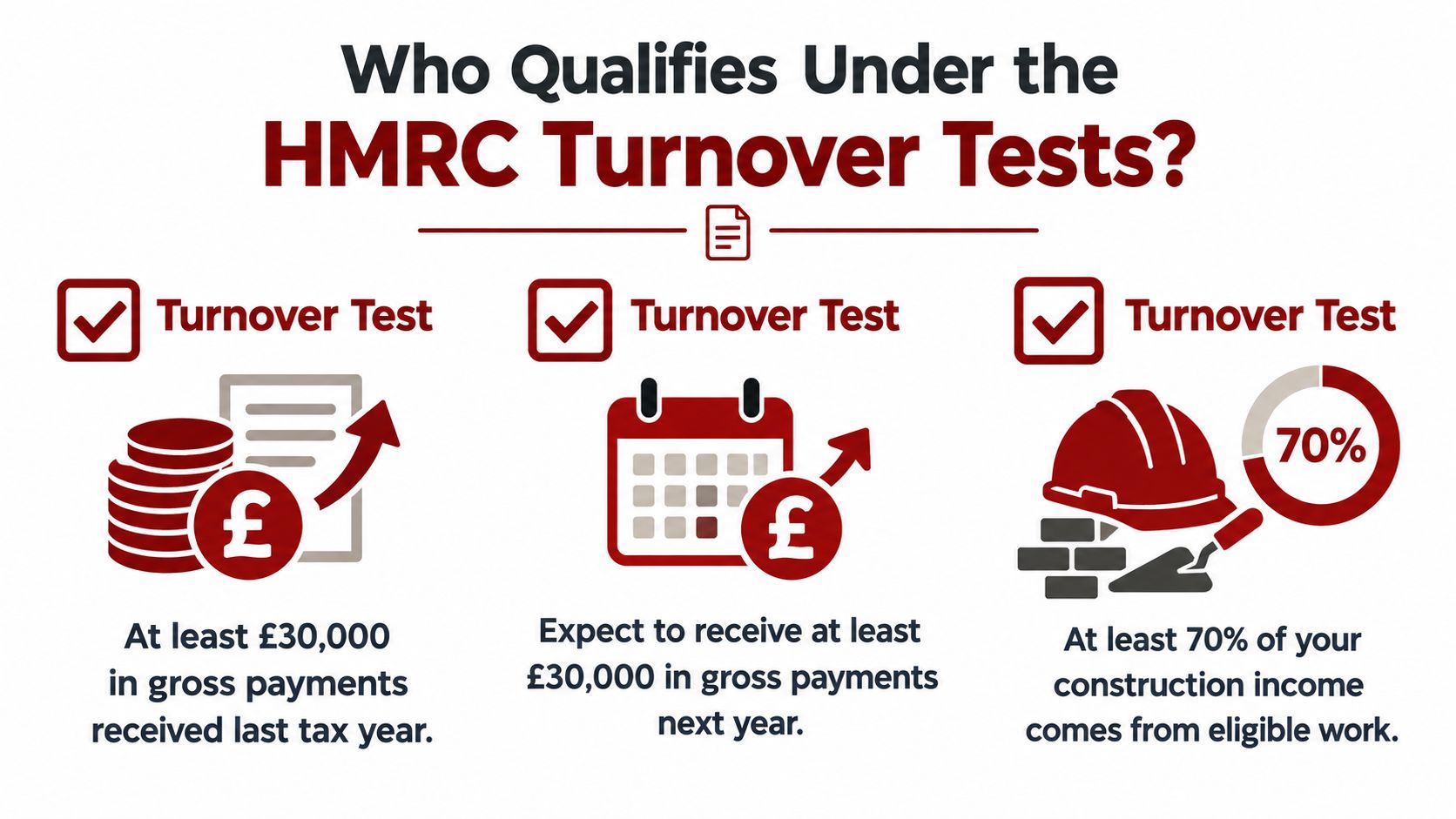
HMRC doesn't approve gross payment status just because a subcontractor has registered for CIS or has won a large project. You must satisfy the relevant business, turnover and compliance conditions, with the turnover calculation based on construction payments and excluding VAT and materials.
Start with your business structure
For a sole trader, HMRC's 12-month turnover test requires at least £30,000 from qualifying construction payments, excluding VAT and materials. The same £30,000 threshold applies for each partner in a partnership, or the partnership can meet the whole-business threshold of £100,000. For a company, the threshold is £30,000 per director, or £100,000 for the company as a whole. These figures are set out in HMRC's gross payment status guidance.
If a company is controlled by five people or fewer, HMRC also states that it must have annual turnover of £30,000 for each controlling person. That makes the legal structure and ownership details important, particularly where a limited company has several directors or connected businesses.
Separate qualifying income from total sales
Your total turnover isn't automatically the figure HMRC uses. Remove VAT and the cost of materials, then identify the payments that arise from eligible construction work. Keep invoices, bank records and contracts organised so you can explain how the number was calculated.
The business must also operate as a construction business or provide labour for construction work, with payments made through a business bank account. HMRC reviews gross-status holders every year, so the figures need to remain supportable after approval.
Treat compliance as part of eligibility
Late returns, unpaid liabilities and poor records can undermine an otherwise strong turnover position. Before applying, check that your relevant tax filings and payments are up to date, and resolve discrepancies before HMRC reviews the application.
Applying for Gross Payment Status and Checking What You Hold
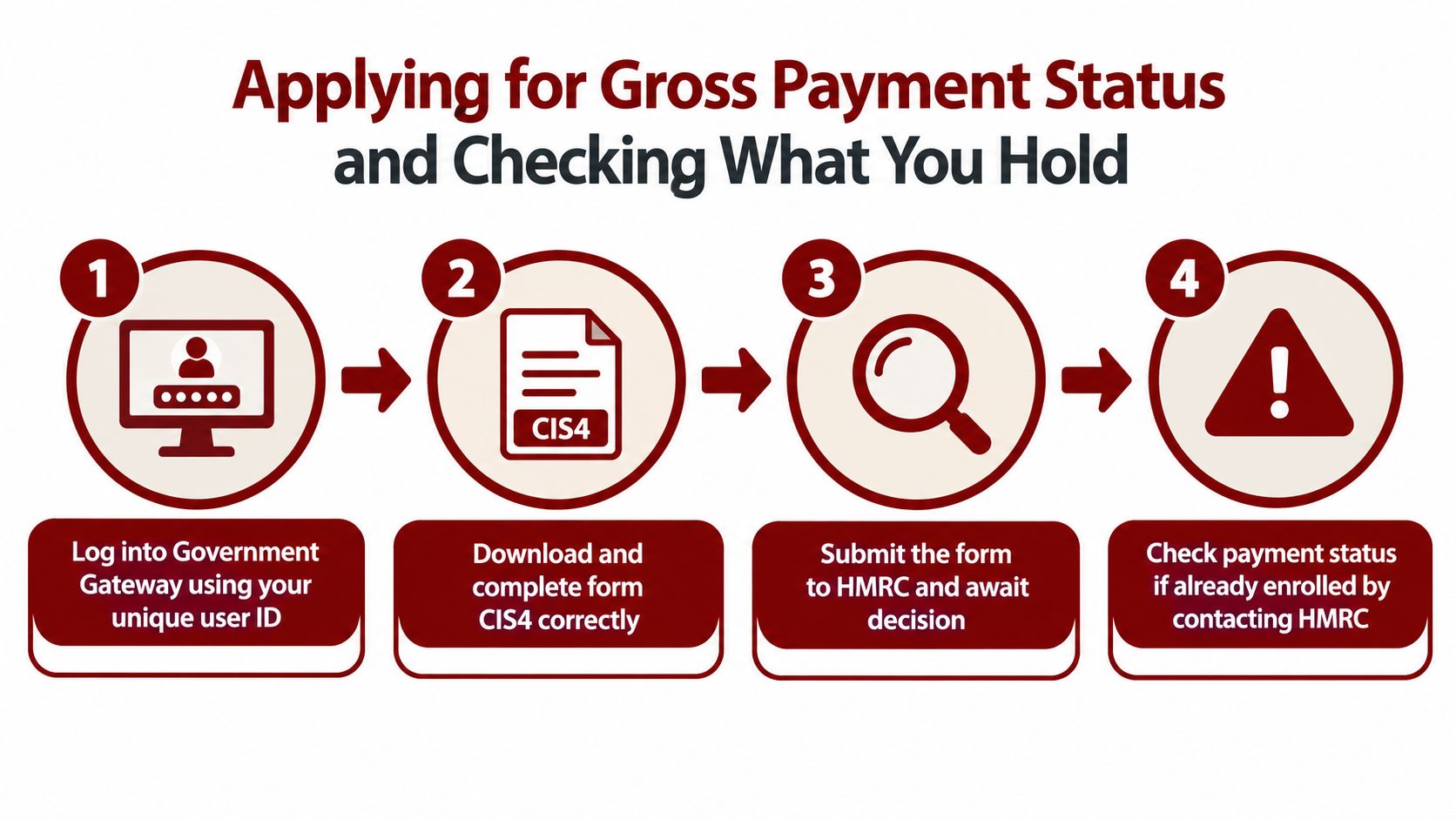
You can apply when you register as a CIS subcontractor or later, once your business meets the conditions. Use the official HMRC route and have your records ready rather than relying on an estimate from a recent invoice.
A practical application file should include:
- Business identity: Your Unique Taxpayer Reference, legal business name and trading address.
- Trading history: Your business start date and the construction turnover figures HMRC needs to assess.
- Banking details: The business account through which the construction payments are made.
- Supporting records: Invoices, payment records and bookkeeping reports that explain your turnover calculation.
Apply before the first payment cycle
If you're registering for CIS for the first time, consider applying for gross status as part of that process. If you wait until after the contract begins, the contractor may initially deduct CIS while HMRC assesses your position. That can create avoidable reconciliation work and a short-term funding gap.
You can use Action Accountants' guide to applying for CIS gross status to prepare the information and records you'll need. Don't submit figures that include VAT or materials when those amounts should be excluded from the relevant turnover test.
Keep evidence of the decision
HMRC communicates the outcome and records the status against your CIS details. If you're unsure whether you hold gross status, check your CIS online account or contact HMRC through the official service. Your contractor can also confirm the status they see when verifying you for payment.
If the decision or status appears delayed, check for mismatched legal details, incomplete turnover evidence or an unresolved compliance issue. A contractor's payment system may also need updating after approval, so confirm the first gross payment rather than assuming the change has happened automatically.
The following video can help you understand the application process and the practical information involved.
What Gross Status Means for Cash Flow and Bookkeeping
A sole-trader electrician wins two £5,000 jobs in a month. Without gross status, each payment arrives reduced by the relevant CIS deduction. With gross status, both full invoice amounts reach the business bank account, giving the electrician more control over ordering materials, paying assistants and covering ordinary overheads.
On a £5,000 invoice, the registered-subcontractor deduction is £1,000, leaving £4,000 cash received. For an unregistered subcontractor, the deduction is £1,500, leaving £3,500. Gross payment status leaves the full £5,000 available before the subcontractor sets aside their own tax provision.
| Deduction rate | Amount withheld | Net cash received | Suggested tax pot |
|---|---|---|---|
| 30% | £1,500 | £3,500 | Set aside an amount based on your personal tax position |
| 20% | £1,000 | £4,000 | Set aside an amount based on your personal tax position |
| 0% | £0 | £5,000 | Create your own tax provision from the gross receipt |
The difference is £1,000 compared with the registered rate and £1,500 compared with the unregistered rate on that invoice. That is working capital held by the subcontractor rather than withheld at source. For a wider view of forecasting and working capital advice, look at how planned cash commitments can be matched against expected receipts.
The bookkeeping trade-off
Gross status removes one recurring payment deduction, but it creates a stronger need for disciplined records. You should:
- Post the full receipt: Record the invoice and the complete bank payment without creating a CIS deduction that didn't occur.
- Maintain a tax reserve: Move a planned provision into a separate account when customers pay you.
- Review cash regularly: Compare money available with upcoming tax, materials, payroll and supplier commitments.
- Retain contractor records: Keep payment statements and confirmations, even where no CIS amount was deducted.
Without gross status, your bookkeeping team must reconcile deducted amounts against CIS statements and make sure those deductions are correctly reflected in the relevant tax return. Gross status simplifies that particular reconciliation, but it doesn't replace monthly bookkeeping or cash forecasting. A cash-flow improvement approach for small businesses can help you turn the extra liquidity into a planned reserve instead of untracked spending.
Gross payment status gives you control of the cash. It also gives you responsibility for not mistaking cash in the bank for money available to spend.
Common Misconceptions That Lead to Costly Mistakes
Gross status affects when money reaches your account, but it does not remove your tax responsibilities. Three misunderstandings cause avoidable problems for subcontractors.
Myth one, gross means tax-free
The contractor pays your invoice without a CIS deduction. You still declare the income and pay the tax due. If the full receipt goes on equipment, vehicle costs or personal drawings, the later tax bill may arrive before you have set money aside.
Treat each gross receipt as allocated cash. Use one portion for the job and operating costs, transfer a planned amount to a tax reserve, and regard the balance as available only after checking the business's position. This makes the extra cash a managed resource rather than an invitation to increase spending.
Myth two, CIS registration means you'll be paid gross
CIS registration lets a contractor verify you under the scheme. Gross payment status is separate HMRC approval, and it determines whether the contractor applies a CIS deduction to your payment.
As detailed earlier, registration alone does not mean the invoice will be paid in full. The bookkeeping consequence is easy to miss: if you post an invoice as paid at 100% but the bank shows a deduction, your sales ledger and bank reconciliation will not agree. Record the invoice at its full value, enter the actual bank receipt, and post the CIS deduction to the appropriate CIS control account or records. Keep the contractor's payment statement to support the entry.
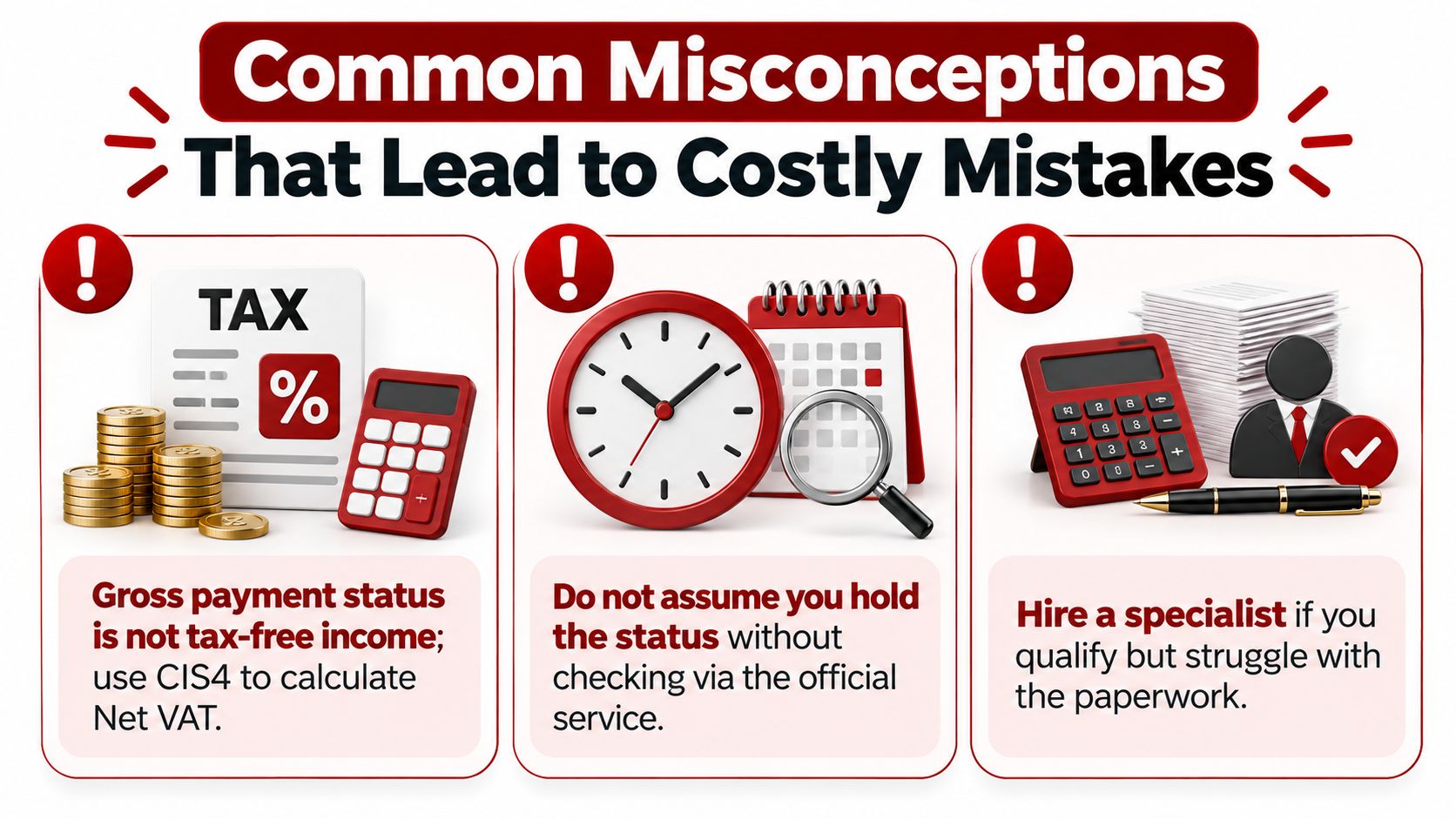
Myth three, approval lasts forever
HMRC reviews gross-status holders each year. Late returns or unpaid tax can put the approval at risk, even where construction turnover remains healthy. Keep bookkeeping current, check tax forecasts and meet filing and payment deadlines.
Use a short control list:
- Reconcile monthly: Match invoices, bank receipts and contractor statements.
- Review before deadlines: Find missing records and liabilities before returns are due.
- Retain turnover evidence: Keep documents supporting your construction-income calculation.
- Act on HMRC notices: Read compliance messages and status decisions promptly.
Putting It All Together and When to Bring in a Specialist
Gross payment status works best when you treat it as part of a complete operating routine, not as a one-off application. Check that your CIS registration is active, calculate qualifying construction turnover correctly, review your compliance record and confirm the status HMRC has recorded.
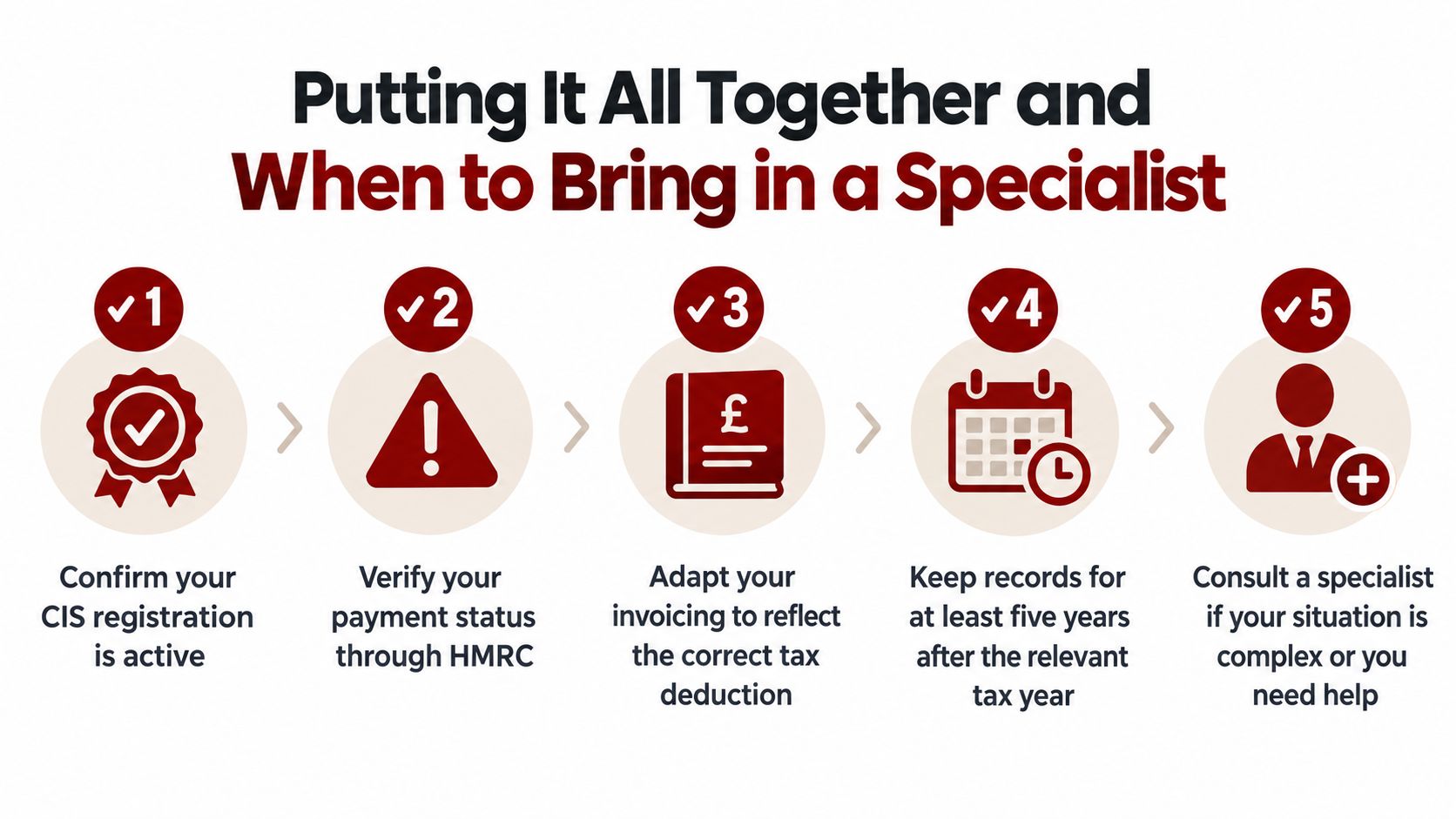
A practical checklist looks like this:
- Confirm registration: Make sure your CIS subcontractor details are correct.
- Check approval: Verify whether HMRC has granted gross payment status.
- Invoice accurately: Apply the correct CIS and VAT treatment to each contract.
- Record receipts: Separate gross income from payments where deductions were made.
- Protect compliance: File returns, pay liabilities and retain supporting records on time.
The status isn't something to take for granted. HMRC reviews it annually and can withdraw it when the business no longer meets the conditions. A missed deadline can therefore affect both immediate cash flow and the amount contractors pay you in future.
Your spreadsheet may cope while you work for one contractor. It becomes harder when several sites produce different invoices, payment dates and CIS statements. That's the point at which a construction-focused accountant can manage CIS records, reconcile contractor statements, prepare returns and help you plan for tax without taking you away from site work.
Action Accountants Limited provides construction and CIS support, including CIS returns, subcontractor payslips and guidance with gross-status applications. If you want your eligibility checked or your bookkeeping organised around gross receipts, visit Action Accountants Limited to discuss the right support for your business.