
CIS for Subcontractors: A Practical 2026 Guide
CIS for subcontractors explained clearly. Learn registration, deduction rates, gross payment status, returns, and how to avoid common CIS mistakes in 2026.

You've landed a decent-sized job, sent the invoice, and expected the full amount to hit your bank. Then the contractor pays less than you billed, and you're left staring at the remittance wondering what happened.
That's the moment many start searching for CIS for subcontractors. Fair enough. But the bigger mistake is thinking CIS is only about the deduction rate. It isn't. The cash deduction matters, yes. The bigger risk is whether HMRC agrees you were self-employed in the first place.
If you've just started trading, or you've stepped up from small private jobs into contractor work, this is what you need to get right now. Not next quarter. This month.
Table of Contents
- What CIS Actually Is and Why It Hits Your Invoice
- Registering as a CIS Subcontractor Before Your First Payment
- Understanding Deduction Rates and Contractor Verification
- Gross Payment Status and Whether It Is Worth the Hurdle
- Invoices, Monthly Returns and Bookkeeping Under CIS
- How CIS Deductions Interact With Your Tax Return
- The Employment Status Risk Most CIS Guides Miss
- Your 30-Day CIS Action Plan and When to Get Help
What CIS Actually Is and Why It Hits Your Invoice
Your first bigger contractor job goes in, you invoice for the agreed amount, and the payment arrives short. No one has underpaid you by mistake. The contractor has probably made a CIS deduction before sending the money on.
Under the Construction Industry Scheme, contractors deduct money from the labour part of a subcontractor's payment and pay that over to HMRC on the subcontractor's behalf. HMRC explains the scheme in its guide to the Construction Industry Scheme.
Here is the point that catches people out. CIS is a payment system, not a separate tax. It changes what lands in your bank now, then gets dealt with properly through your tax position later.
That matters because your invoice can be right and your cash can still be tight.
Why the deduction hits your invoice
CIS usually applies to construction work and similar labour supplied to a contractor. The deduction is generally taken from the labour element, not from materials you have clearly charged for separately. If your invoice is vague, incomplete, or bundles everything together badly, you make it easier for the contractor to deduct more than necessary.
So be disciplined. Split out labour and materials clearly on every invoice. Keep supplier receipts. Match your invoice wording to the actual job.
That protects cash flow, and it helps with something many CIS guides barely mention. Your paperwork should also support the fact that you are running a business on your own account, not working like an employee with a different label.
The part many subcontractors miss
A lot of new subcontractors treat CIS as a simple percentage problem. It is bigger than that. HMRC can still challenge your employment status even if deductions have been made under CIS.
If the working arrangement looks like employment, one main contractor, tight control over your hours, little financial risk, no genuine right to send someone else, HMRC may look past the CIS label and ask harder questions. That can cause tax trouble for you and the contractor.
So from the first invoice, act like a genuine subcontractor. Use written terms. Quote for jobs properly. Keep evidence that you decide how the work is done, carry your own business costs, and can work for more than one contractor. CIS admin and employment status evidence should sit together, not as two separate problems.
If you want the plain-English version before getting into the admin, read this simple CIS explanation for subcontractors and contractors.
What to do this month
Price work based on the cash you will receive after CIS, not the headline invoice total. Keep labour and materials separate. Save every deduction statement. And do not assume being paid under CIS automatically proves you are self-employed.
It does not. Your contract, your invoicing, and the way you work do that.
Registering as a CIS Subcontractor Before Your First Payment
Your first big invoice goes in. You expect the cash to land. Instead, the contractor says they cannot process you properly because you are not set up, and your payment gets held up or hit at the higher deduction rate. That mistake is avoidable.
Register before the first payment run. Do it now, not after the job starts.
CIS does not replace self-employment. You need both in place. First register for Self Assessment as self-employed. Then register as a CIS subcontractor with HMRC. If you want the steps laid out clearly, use this guide on how to register for CIS.
Once that is done, send the contractor the exact details they need to verify you. If your name, UTR, or business details do not match HMRC records, expect delays. Contractors do not usually wait around and sort this out for you.
What changes once you register is simple. A verified, registered subcontractor is usually paid under the standard CIS setup. If you are not registered, or HMRC cannot verify you, the contractor may have to deduct at the higher rate. Gross payment status only applies if HMRC has already approved it.
That is the tax side. The status side matters just as much.
If you turn up with no written terms, use the contractor's paperwork without checking it, and work under conditions that look like a job rather than a business, you create a second problem. You may be paid under CIS and still give HMRC a reason to question whether you were self-employed. Read the clauses on control, substitution, equipment, and who fixes defective work. These essential contract review steps for legal teams are a useful sense-check before you sign.
Registering for CIS is free. Losing cash or creating an avoidable status argument is not.
This month, get registered, get verified, and keep copies of the registration details and contract you gave the contractor. If HMRC ever asks whether you were running your own business, that paperwork helps answer the question from day one.
Understanding Deduction Rates and Contractor Verification
Your first decent invoice goes in. You expect one figure to hit your bank. The payment lands short, and the contractor says, “That's the CIS rate HMRC gave us.” That is usually the end of the argument.
The rate is not a negotiation between you and the contractor. HMRC decides it when the contractor verifies you. The contractor then applies that result to the part of your payment that falls within CIS. If you want a plain-English refresher on what a CIS deduction means on a real invoice, read that before you start disputing deductions.
Keep the position clear in your head:
| Rate | Who It Applies To | What Gets Deducted | Who Decides |
|---|---|---|---|
| 0% | Subcontractors already approved for gross payment status | No upfront CIS deduction on in-scope payments | HMRC through contractor verification |
| 20% | Registered subcontractors HMRC can verify | CIS deducted from the in-scope labour element | HMRC through contractor verification |
| 30% | Subcontractors who are not registered, or cannot be verified properly | Higher CIS deduction from the in-scope labour element | HMRC through contractor verification |
Verification is basic admin, but it has an immediate cash effect. The contractor sends your details to HMRC, usually your UTR and trading details. HMRC sends back the treatment. If your record does not match what you gave the contractor, expect delay, higher deductions, or both.
That is the tax side. There is a second risk many subcontractors miss. If your paperwork and working setup look too much like employment, you can be paid under CIS and still give HMRC a reason to question whether you were self-employed. Verification does not settle status. It only tells the contractor what deduction rate to use.
Get the basics right before the first payment run:
- Give the contractor the exact name, business name, and UTR HMRC holds.
- Split labour, materials, VAT, and other charges clearly on the invoice.
- Check the contract matches how you work on site, especially control, substitution, equipment, and who pays to fix defective work.
- Keep copies of the verification details and the deduction statements you receive.
One wrong assumption causes two problems at once. You lose cash through the wrong deduction rate, and you weaken your evidence that you are running a genuine business rather than working like an employee.
If the contractor says verification is still pending, chase it the same day. Waiting is how subcontractors end up with a payment shortfall they only notice after the money lands.
Gross Payment Status and Whether It Is Worth the Hurdle
Gross payment status sounds brilliant because it removes upfront withholding. Sometimes it is brilliant. Sometimes it just gives disorganised subcontractors enough rope to hang themselves with.
What HMRC expects
HMRC says gross payment status is available only if the compliance and turnover tests are met. The business must operate through a bank account, have a history of paying tax and National Insurance on time, and meet annual turnover thresholds ignoring VAT and materials. The thresholds are at least £30,000 for a sole trader, £30,000 per partner or £100,000 for a partnership, and £30,000 per director or £100,000 for a company. Where a company is controlled by five or fewer people, the turnover test is £30,000 for each of them, according to HMRC's gross payment status rules.
That's the formal side. The other side is discipline.
Standard CIS versus gross payment
| Test | Standard CIS Registered | Gross Payment Status |
|---|---|---|
| Upfront CIS deduction | Yes, after verification | No, if HMRC has granted status |
| Need to meet HMRC turnover test | No | Yes |
| Need good tax compliance history | Basic compliance still matters | Yes, heavily |
| Cash flow on each invoice | Lower in-hand cash | Full in-hand cash |
| Risk if you don't save for tax | Lower, because tax is withheld | Higher, because nothing is withheld |
Is it worth it
For some subcontractors, yes. If you're established, organised, and constantly funding labour, fuel, and materials, gross payment status can ease pressure because the invoice lands intact.
But don't chase it just because you hate deductions. If you're the sort of person who waits until filing season to open HMRC letters, gross payment status isn't a benefit. It's a trap. You'll feel richer month to month and then get flattened by your own tax bill later.
A lot of sole traders apply too early. If your turnover is still finding its feet and your record keeping is patchy, standard CIS is often the safer lane until the business is more stable.
Invoices, Monthly Returns and Bookkeeping Under CIS
You finish a decent month, send the invoice, and then the payment lands short. Sometimes that is a correct CIS deduction. Sometimes it is bad paperwork. If your invoice is vague, your materials are not split out, or your records do not match the contractor's statement, you create your own cash flow problem and hand HMRC a reason to question whether you are really running a business.
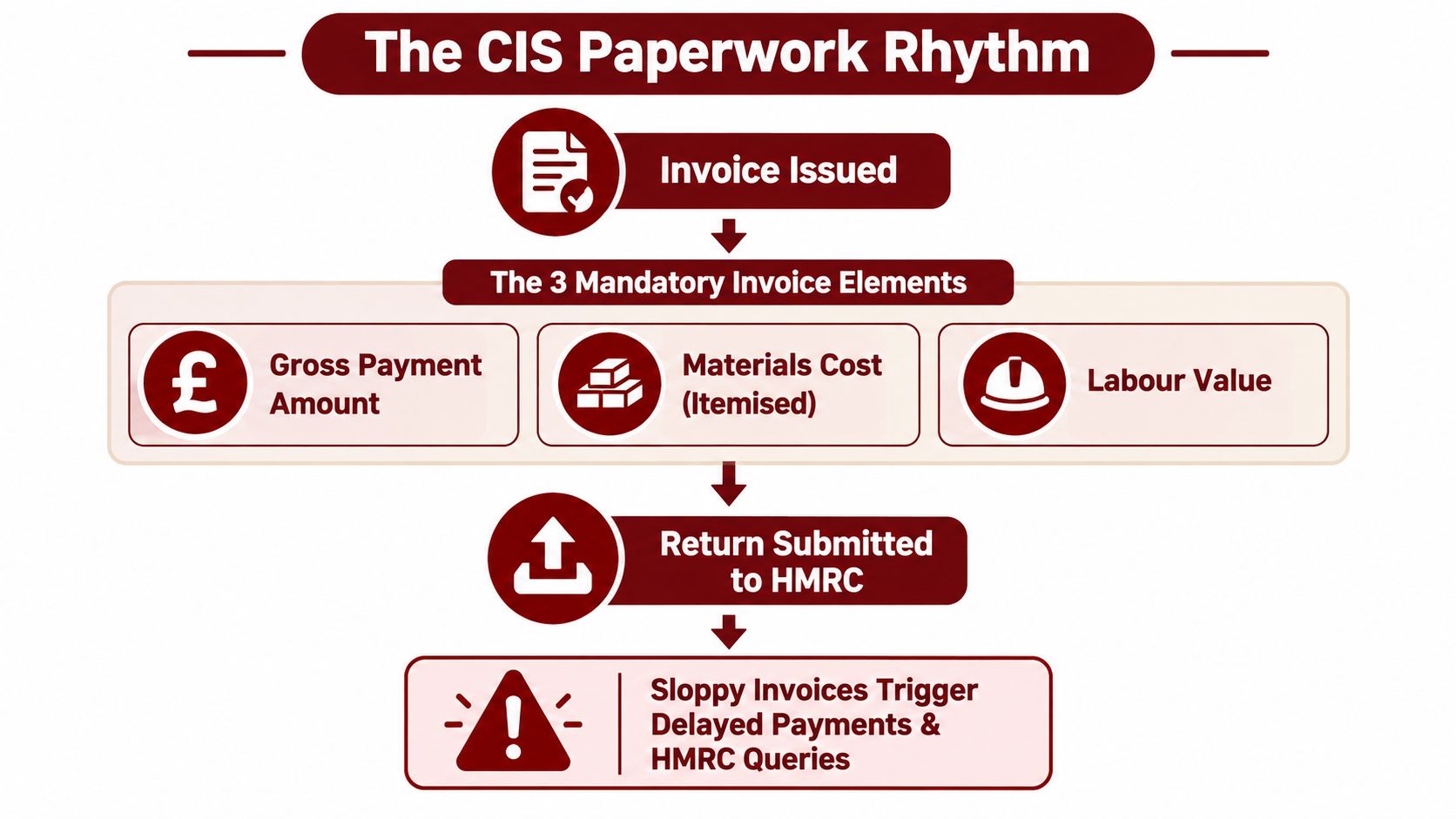
What your invoice needs to show
Your invoice needs to do two jobs. It needs to get you paid correctly, and it needs to show you are operating like a genuine subcontractor rather than someone being treated like payroll with a different label.
Keep it clean and specific:
- Your business name and contact details
- Invoice date and unique invoice number
- Contractor's name
- Description of the work done
- Labour shown separately from materials
- Gross amount before CIS
- VAT shown properly, if you are VAT registered
- Payment terms
That split between labour and materials matters. Contractors usually deduct CIS from labour, not from the cost of materials you have paid for. If you bundle everything into one figure, do not be surprised when too much gets deducted.
Clear invoices also help on the status side. A proper invoice trail, numbered consistently and tied to actual jobs, supports the argument that you are trading on your own account. For a practical refresher on layout and legal basics, this guide to UK invoice compliance 2026 is useful.
What the contractor files, and what you must keep
The contractor files the return. You do not. But you still need the paperwork behind it, because your tax return, your cash flow, and your self-employment position all depend on those records being right.
Keep a file for every payment:
- Your invoice
- The contractor's remittance or payment advice
- The CIS deduction statement
- The bank entry showing what arrived
- Any job sheet, purchase receipt, or materials backup linked to that invoice
If you want to understand what sits behind the contractor's filing process, read this guide on CIS monthly returns. It helps you spot when the deduction on your payment does not match what should have been reported.
The bookkeeping habit that protects cash and status
Update your records every month. The same week if you can.
Match three figures every time: the gross invoice, the CIS deduction, and the net cash received. If one of them is wrong, chase it straight away while the contractor's accounts team can still trace it and the site manager still knows what the payment relates to.
Do not rely on your bank feed as your bookkeeping. Bank entries only show what hit the account. They do not prove what work was billed, what materials were excluded, or whether the deduction was correct.
Good bookkeeping does more than tidy up year end. It gives you evidence that you price jobs, buy materials, issue invoices, and bear business risk yourself. That is the sort of trail that helps if HMRC ever looks past CIS and asks the harder question about employment status.
If you need help, Action Accountants Limited offers CIS support covering registration, bookkeeping, verification records, monthly return support, and deduction statement handling. If your invoice volume is low, a spreadsheet can still do the job. Only keep that route if you update it every month.
Sloppy paperwork delays payment, causes wrong deductions, and weakens your position if HMRC challenges your status.
For smaller subcontractors, simple software or a clean spreadsheet is enough. If you already have missing statements, mixed personal spending, and invoices saved in WhatsApp threads, stop patching it up and get a bookkeeper involved now.
How CIS Deductions Interact With Your Tax Return
You finish a big job, the contractor knocks CIS off your payment, and your bank balance says you have already paid plenty of tax. That is how subcontractors get caught. CIS deductions reduce what lands in your account, but your tax return still starts with your full trading income and your actual business costs.
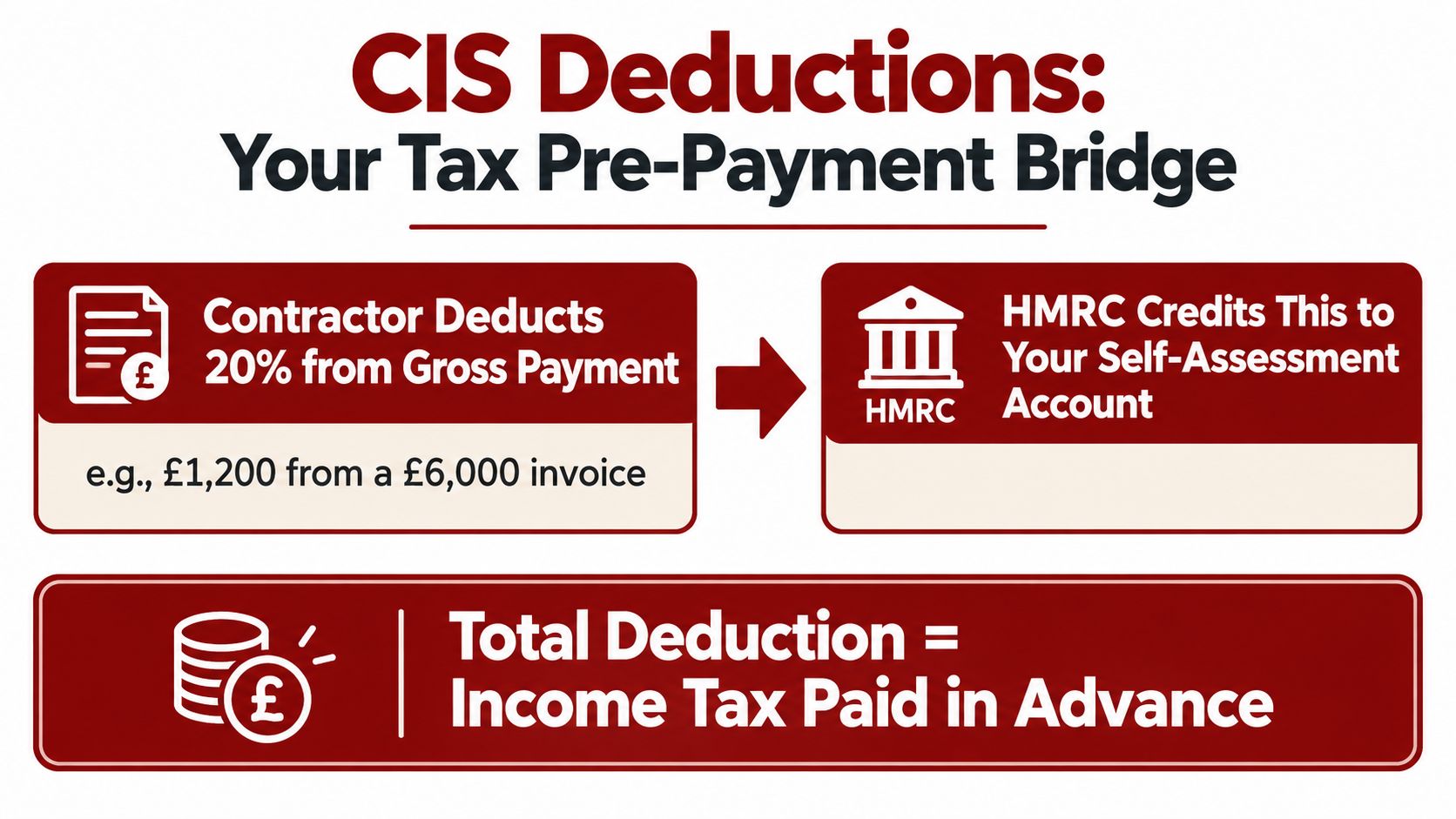
What goes on the return
Put your gross self-employment income on the return. Use the full amount invoiced for your work, not just the net payments after CIS. Then claim allowable expenses. After that, enter the CIS tax deducted during the year so HMRC gives you credit for tax already paid on account.
HMRC treats CIS deductions as advance payments towards your tax and National Insurance through Self Assessment, as set out in its CIS for subcontractors guidance.
If you only use the money that hit your bank, your figures are wrong. That mistake can overstate or understate profit, trigger questions from HMRC, and leave you arguing over credits that should have been claimed properly the first time.
What usually happens at year end
Your return normally lands in one of two places:
- Refund due. This is common if too much CIS was deducted during the year, or your profits were lower than expected.
- Tax still to pay. This happens when your profit, other income, or payments on account push the final bill above the CIS already credited.
Plenty of first-time subcontractors expect CIS to wipe out the January bill. It often does not. If you had a strong year, took money out freely, or had little spent on allowable costs, you can still owe a chunk.
The part that affects cash flow
CIS helps with discipline because tax is being paid across the year. It does not remove the need to save. Keep a tax buffer anyway.
Why? Because CIS deductions do not cover everything neatly for every subcontractor. You may still have Class 4 National Insurance, tax on other income, or payments on account for the next year. A refund one year can turn into a bill the next if your work ramps up fast.
Get the evidence right
Your deduction statements matter because they prove what the contractor withheld and reported. Without them, claiming the right CIS credit gets harder and slower.
Use a simple monthly check:
- total gross invoices raised
- total CIS deducted
- total cash received
- deduction statements received for each payment
If one contractor's figures do not match, fix it before year end. Do not wait until your tax return is due.
One more point. Clean CIS records do more than support a tax refund or reduce errors. They also help show you are running a real business with proper invoicing, cost control, and financial risk of your own. That matters if HMRC ever looks past the deductions and questions whether you are self-employed.
The Employment Status Risk Most CIS Guides Miss
This is the part too many subcontractors ignore because it's uncomfortable. You can be fully registered under CIS and still have a status problem.
If HMRC decides your working arrangement looks more like employment than genuine subcontracting, the deduction rate you chased becomes a side issue.
Why this risk is getting attention
Recent reporting has highlighted stronger HMRC enforcement around misclassification. One 2026 industry article describes a £15bn CIS crackdown and says HMRC determinations are reclassifying some CIS subcontractors and consultants as employees for tax and National Insurance purposes, as discussed in this article on HMRC's CIS crackdown and contract lessons for contractors.
That matters because many CIS guides stop at registration and deduction rates. They don't deal with status tests, contract wording, or proof that you're in business on your own account.
What a borderline engagement looks like
If you work long-term for one contractor, at one site pattern, under close supervision, using their tools, on terms that look like a disguised wage arrangement, don't assume CIS registration saves you.
Use this as a reality check:
| Status Indicator | Borderline Engagement | Genuine Subcontractor |
|---|---|---|
| Clients | Works only for one contractor for an extended period | Has more than one client or actively tenders for other work |
| Equipment | Uses the contractor's main tools and kit | Uses own equipment where appropriate |
| Control | Told exactly how, when, and where to work like staff | Controls how the work is delivered within the contract |
| Financial risk | Little real risk beyond turning up | Can make a profit or loss on the job |
| Substitution | No practical right to send someone else | Genuine ability to provide a substitute, if contract allows |
| Commercial basis | Pay resembles wages or a straight staff day rate | Invoices for contracted work with business records to support it |
What evidence actually helps
You need more than a label saying “subcontractor”.
Useful evidence includes:
- Written contracts: especially clear clauses on scope, substitution, and responsibility.
- Multiple-client history: quotes, invoices, and enquiry trails matter.
- Own insurance and equipment records: they support the case that you're trading independently.
- Job-based invoicing: stronger than paperwork that reads like disguised payroll.
- Records showing financial risk: remedial work, fixed-price jobs, purchased materials, or pricing decisions.
If your arrangement would look strange to an HMRC officer reading it cold, fix it now. A clean CIS setup with weak employment status is not a win. It's just a better-documented future argument.
Your 30-Day CIS Action Plan and When to Get Help
If you've just landed your first proper contractor job, don't overcomplicate this. Handle it in order.
Start with the registration side, then build the records, then test whether your working arrangement stands up.
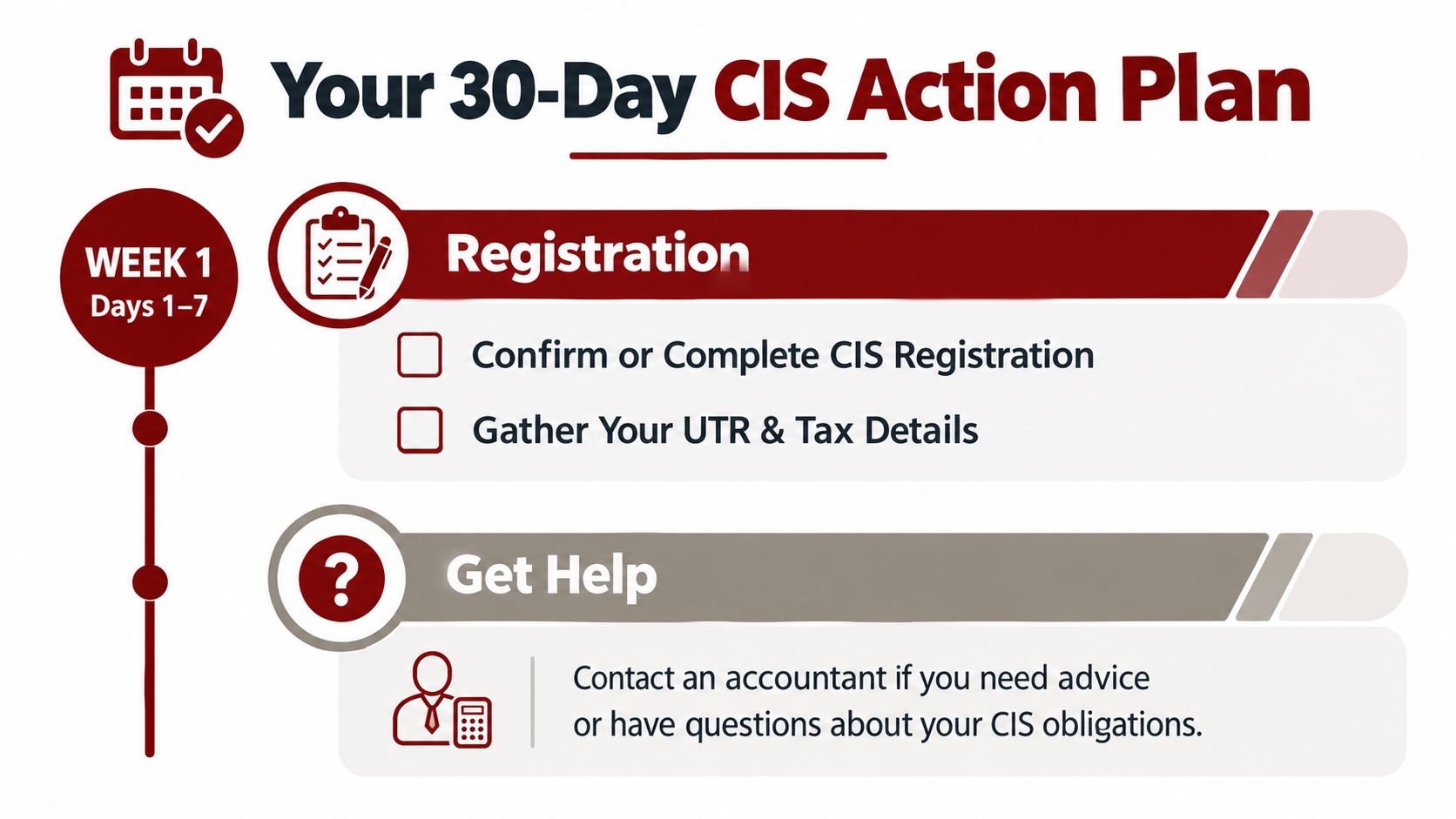
Days 1 to 7
- Confirm your tax setup: make sure you're registered correctly and that the contractor has the right details.
- Collect your core identifiers: UTR, trading name, address, and any business bank details should be easy to hand over.
- Check how the contractor has set you up: if they've got bad details, the deduction result can go wrong fast.
Days 8 to 14
- Build one invoice template: separate labour, materials, and anything else the contractor needs to process cleanly.
- Create one monthly filing habit: save invoices, deduction statements, and remittances in the same place every month.
- Tag CIS in your bookkeeping: don't let deductions disappear into a generic sales ledger mess.
Days 15 to 21
- Forecast your tax position: don't assume CIS has covered everything.
- Review whether gross payment status is realistic: only if your compliance and trading position are solid.
- Check any higher deductions: if something looks wrong, challenge it while records are fresh.
A quick walkthrough can help if you prefer hearing the practical points rather than reading them.
Days 22 to 30
- Get your status file in order: signed contract, insurance, own equipment records, and evidence of work for more than one client.
- Review the commercial reality: if you're effectively working like staff, sort that issue before it grows.
- Know when to bring in help: do it when deductions don't reconcile, when status looks doubtful, or when HMRC starts asking questions.
The right time to get advice is before a dispute, not after one. CIS is manageable when the paperwork is current and the status position is honest. It gets expensive when both are weak.
If you need help getting your CIS setup right, sorting deduction records, or checking whether your subcontractor arrangement would stand up under HMRC scrutiny, Action Accountants Limited can help with the accounting, bookkeeping, and practical CIS admin around it. If you've just landed a bigger job and don't want your first month under CIS to turn into a tax mess, that's the moment to get it reviewed properly.