
CIS Construction Industry Scheme Explained
Master the CIS Construction Industry Scheme with this practical guide covering contractor duties, deduction rates, monthly returns, and compliance tips.

You've just hired your first subcontractor. The work is scheduled, the invoice looks straightforward, and you're ready to make payment. Then someone asks whether you're registered for the CIS construction industry scheme, whether the subcontractor has been verified, and why part of the invoice must be sent to HMRC.
That's where many otherwise well-run businesses get caught. CIS isn't a tax deduction applied by traditional building firms. Property developers, landlords, retailers, and other mixed-activity businesses can also fall within its rules. The costly mistakes usually happen before the first return, when nobody has decided whether the work is covered or who carries the contractor responsibility.
Table of Contents
- Who the Construction Industry Scheme Actually Covers
- Registering and Verifying Subcontractors Correctly
- Understanding CIS Deduction Rates and Payment Rules
- Filing Monthly CIS Returns and Paying HMRC on Time
- Deemed Contractors and Property Work Edge Cases
- Common Compliance Pitfalls and Practical Bookkeeping Tips
- Your CIS Compliance Action Plan
Who the Construction Industry Scheme Actually Covers
The Construction Industry Scheme, or CIS, governs how contractors handle payments to subcontractors carrying out construction operations in the UK. The scheme was introduced in 1971 to address tax evasion in the construction sector and was later overhauled into an online system in 2007, as explained in this history and practical overview of CIS.
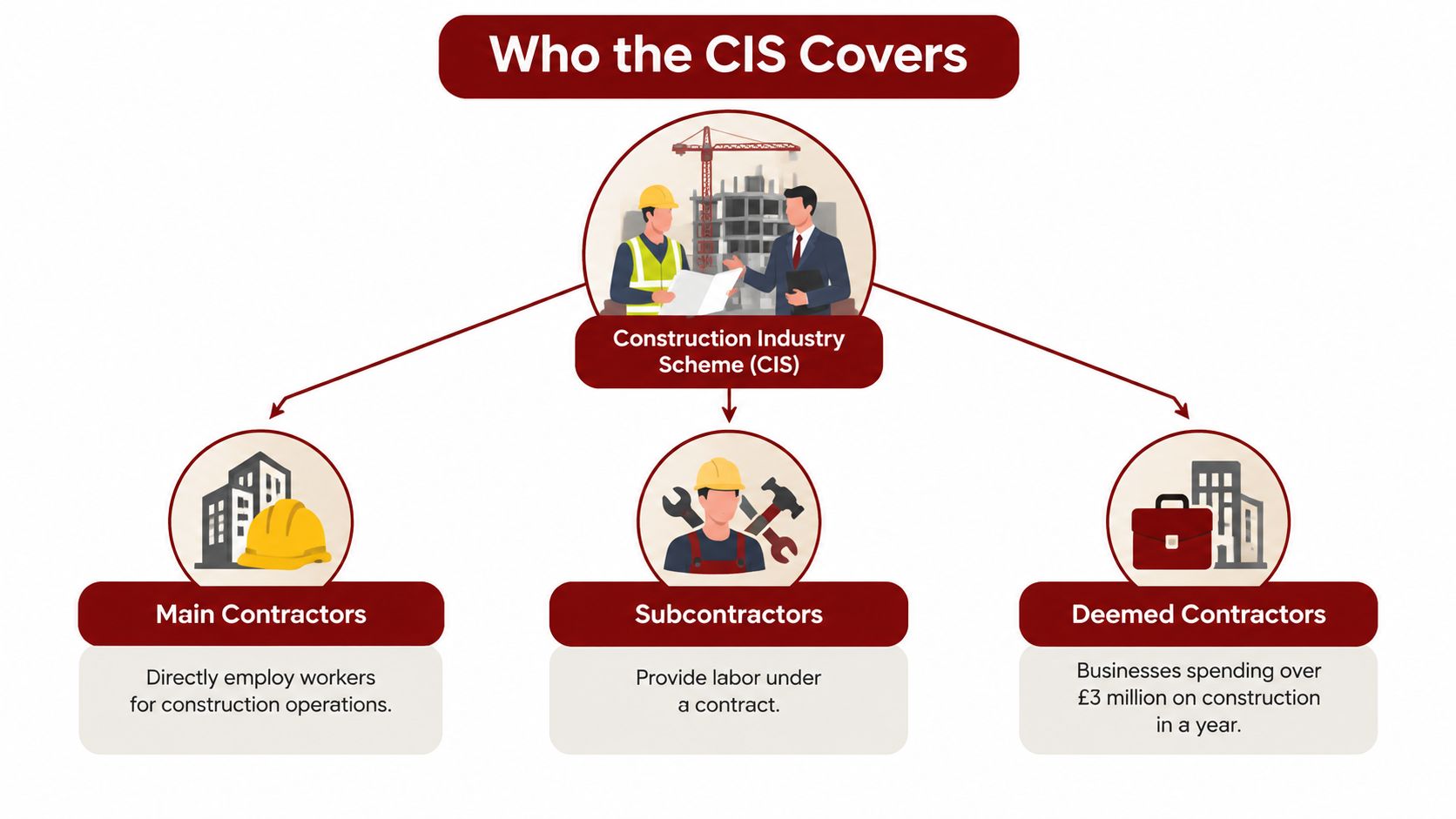
CIS creates two main roles. A contractor pays subcontractors for construction work and carries the reporting and deduction obligations. A subcontractor performs that work under a contract and receives payment after any required CIS deduction. A business can occupy either role depending on the project, and one company may be a contractor on one job while acting as a subcontractor elsewhere.
Construction work is broader than building from scratch
CIS can apply to work connected with constructing, altering, repairing, decorating, or maintaining buildings and structures. That means a contractor shouldn't assume the scheme only concerns bricklaying or major structural projects. Refurbishment, fit-out, and other property work can require careful classification.
Mainstream construction businesses usually know they need to register. The danger lies with businesses that describe themselves as property, retail, facilities, or professional services companies while paying tradespeople to carry out construction operations. If your business pays a subcontractor for covered work, the label on your company website doesn't settle the question.
Practical rule: Decide whether CIS applies before agreeing the payment process, not when the first invoice arrives.
A subcontractor also needs to understand the effect of registration. The standard deduction is 20% for a verified subcontractor and 30% for an unverified subcontractor, while gross payment status can result in no CIS deduction, subject to the relevant conditions. Subcontractors who are new to the scheme can use this practical guide to CIS basics for subcontractors before accepting work.
If you're self-employed and unsure how CIS interacts with your wider tax position, review the guidance on CIS and self-employed contractors. The key point is simple. CIS isn't optional once your business falls within its scope, and getting the classification wrong can affect payments, records, and HMRC reporting.
Registering and Verifying Subcontractors Correctly
Don't pay a new subcontractor first and investigate CIS later. A reliable process starts before work begins and separates registration, verification, and payment approval.
Set up the contractor process first
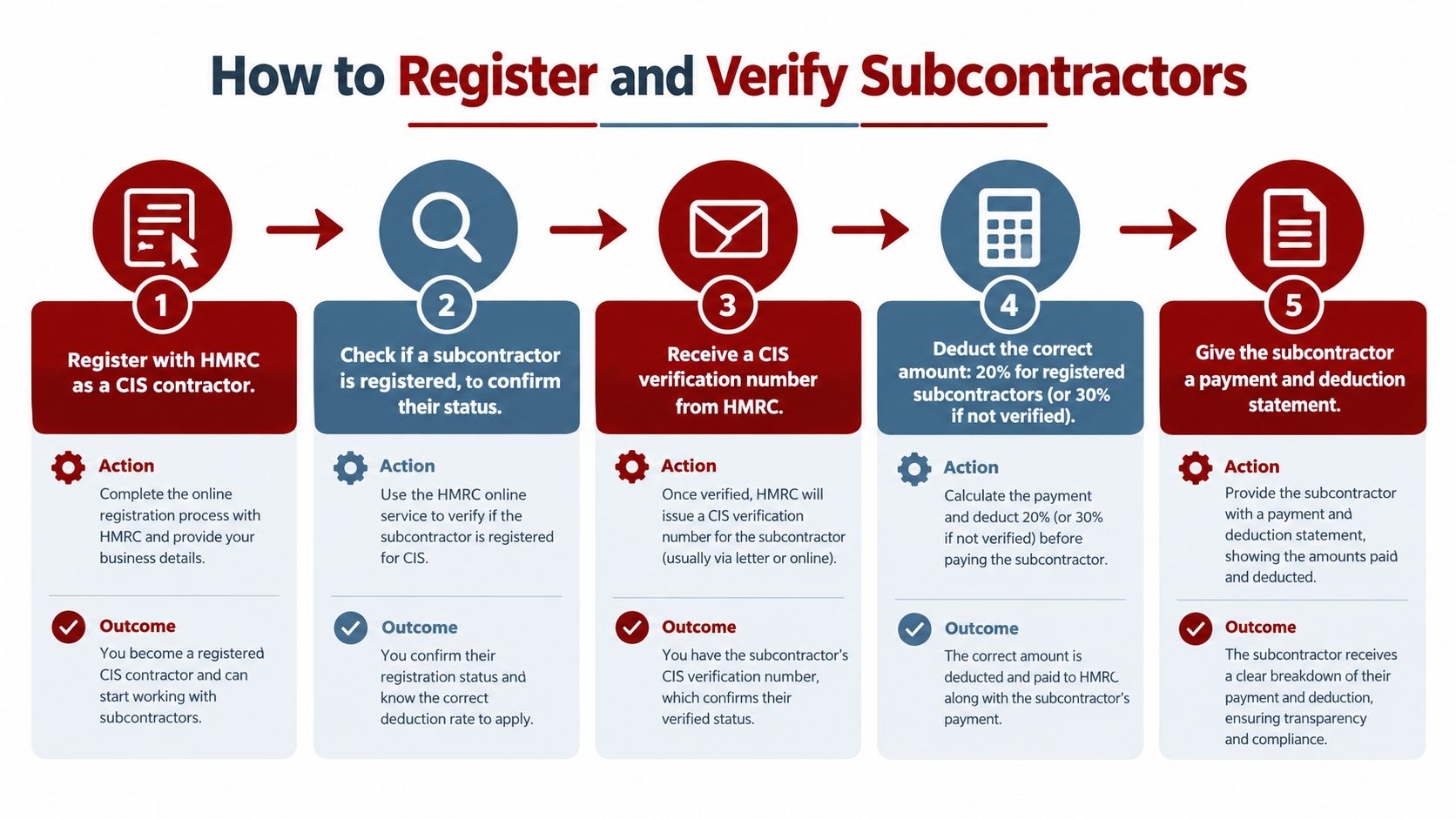
A business that must operate CIS needs to register with HMRC as a contractor before taking on its first subcontractor. That registration should sit alongside your accounting setup, not in a forgotten HMRC login. Assign responsibility to one person and create a written approval point before any subcontractor payment is released.
For each subcontractor, collect the legal name, trading details, tax information, and payment information needed for HMRC verification. Then use the HMRC verification service to confirm the subcontractor's status and the deduction rate that applies. Keep evidence of the verification result with the supplier record.
The verification outcome normally determines whether the subcontractor is:
- Registered for CIS: Apply the statutory 20% deduction to the relevant payment, as set out in HMRC's CIS guidance.
- Unregistered or not verified: Apply the 30% deduction required for an unregistered subcontractor.
- Approved for gross payment status: Apply a 0% CIS deduction, provided HMRC confirms that status.
The gross payment route has its own eligibility requirements. Relevant guidance refers to turnover tests such as £30,000 for sole traders and £200,000 for partnerships or companies, so don't treat a subcontractor's request for gross payment as proof that no deduction is due. HMRC's verification result is the control that matters.
Build a repeatable verification log
Record the date of verification, the HMRC result, the applicable rate, and the person who approved the supplier. If the subcontractor's status changes during the contract, verify again rather than relying on an old result.
Your payment workflow should block three events:
- A subcontractor submits an invoice before verification.
- Accounts staff pay the invoice without checking the deduction rate.
- The business loses the verification evidence needed to support its return.
Use this step-by-step guide to registering for CIS when you're setting up the process. Registration and verification are not administrative formalities. They determine how much cash reaches the subcontractor and how much your business must account for to HMRC.
Understanding CIS Deduction Rates and Payment Rules
CIS deductions are advance payments towards the subcontractor's Income Tax, Corporation Tax, and National Insurance liabilities. They aren't a final tax charge, and the subcontractor's eventual tax position may require further payment or create an amount to reclaim.
The three statutory outcomes are straightforward once HMRC has confirmed the subcontractor's status:
| Subcontractor Status | Deduction Rate | Example on £5,000 Labour |
|---|---|---|
| Registered subcontractor | 20% | £1,000 deducted, £4,000 paid |
| Unregistered subcontractor | 30% | £1,500 deducted, £3,500 paid |
| Gross payment status | 0% | £0 deducted, £5,000 paid |
The figures in this table apply to the £5,000 labour example only. The statutory rates are confirmed in HMRC's explanation of CIS deductions. In practice, you must identify the amount subject to CIS rather than automatically applying a deduction to every line on an invoice.
Separate labour from materials
Ask subcontractors to show labour and materials clearly. CIS generally focuses on the construction payment, while genuine materials and other permitted non-labour amounts may need separate treatment. If an invoice combines everything into one unexplained total, your bookkeeping team can't confidently calculate the deduction or defend the treatment later.
Don't accept a vague instruction such as “deduct CIS from the net invoice”. Review the contract, the invoice breakdown, and the actual work. VAT also needs to be recorded correctly, because the CIS calculation shouldn't be treated as a substitute for proper VAT bookkeeping.
Cash-flow warning: A CIS deduction reduces the subcontractor's immediate payment, but it doesn't reduce the underlying invoice value in your records.
Give the subcontractor a payment and deduction statement showing the gross amount, deductions, and net payment. That document helps the subcontractor reconcile their records and prevents disputes over missing cash. It also gives your business a clear audit trail.
Your accounting software should handle supplier records, deduction calculations, statements, and reconciliations without relying on disconnected spreadsheets. If you're comparing platforms, this guide to the best accounting software for builders can help you assess construction-focused features. For a plain-English explanation of the calculation itself, see what a CIS deduction is.
Filing Monthly CIS Returns and Paying HMRC on Time
CIS compliance runs on a fixed monthly cycle. Treat it like payroll, not like an occasional bookkeeping task that can wait until the accounts are tidy.
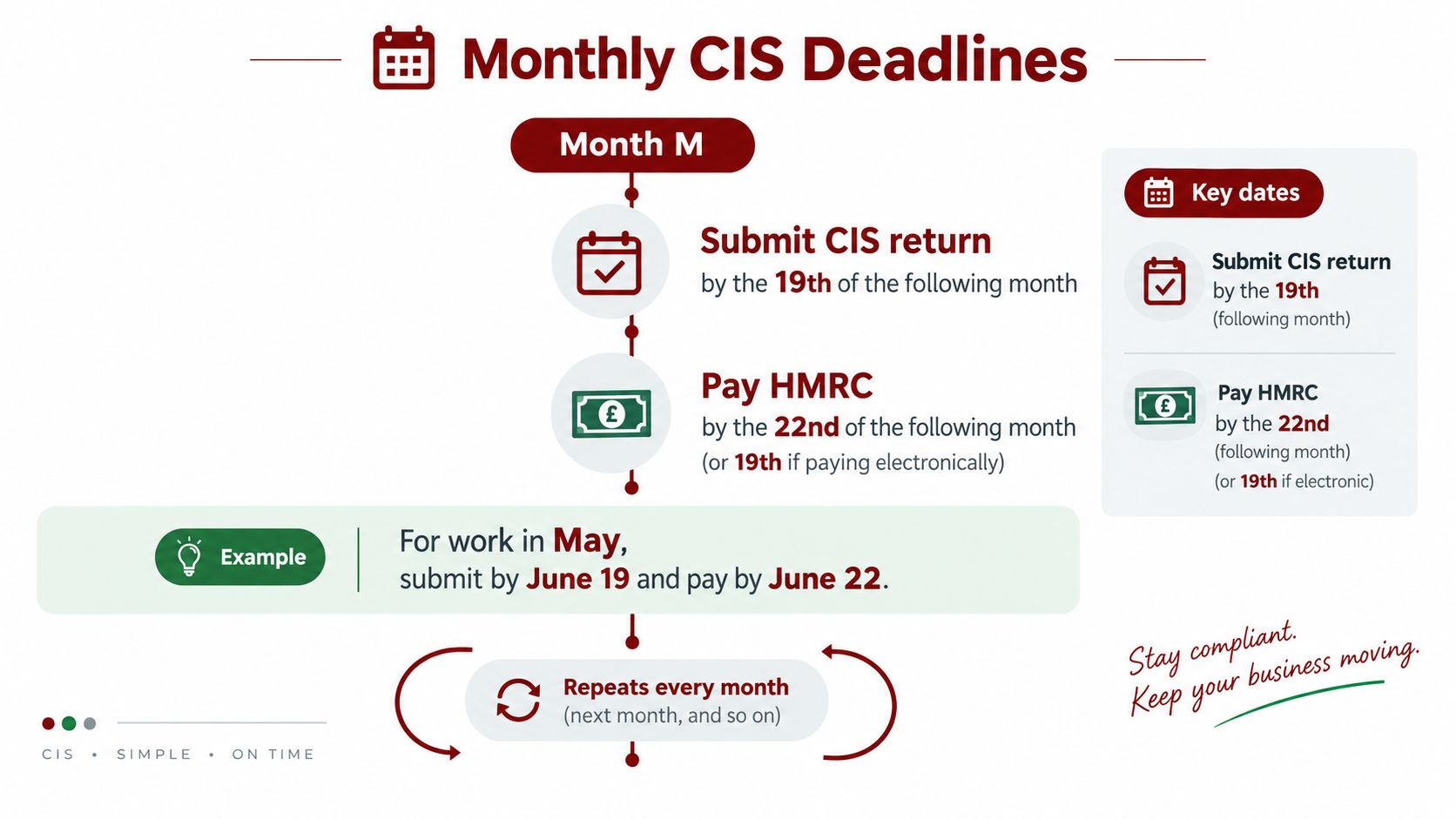
For each tax month, close the subcontractor ledger, check the verification records, reconcile the deductions, and prepare the return. HMRC requires the contractor to submit the CIS monthly return by the 19th of the month after the tax month. The deductions must reach HMRC by the 22nd of that month, or by the 19th if paying by post, according to HMRC's payment deadline guidance.
Use a monthly close checklist
Your internal deadline should be earlier than HMRC's deadline. That gives you time to resolve an incorrect supplier record, a missing invoice breakdown, or a failed payment.
A practical close includes:
- Review payments: Identify every subcontractor payment made during the tax month.
- Match verification: Confirm each deduction rate against the recorded HMRC result.
- Check the return: Ensure the figures agree with your CIS ledger and payment statements.
- Submit and retain evidence: Save confirmation of the return and the payment instruction.
- Reconcile HMRC payments: Match the amount paid to the CIS liability in your accounts.
A return is still part of the monthly discipline when there have been no relevant payments. Follow HMRC's process for reporting the position rather than assuming silence is acceptable.
Late filing or late payment can trigger automatic penalties and interest. The risk isn't limited to the penalty itself. A late process can distort subcontractor balances, leave insufficient cash available for HMRC, and create repeated corrections in later periods.
The CIS monthly returns process should therefore be owned by a named person, supported by calendar reminders, and reviewed as part of every month-end close.
Deemed Contractors and Property Work Edge Cases
The most dangerous CIS assumption is, “We're not a construction company, so CIS doesn't apply.” HMRC can treat a business as a deemed contractor when it spends more than £3 million on construction operations in a rolling 12-month period, even if construction isn't its main trade. The rule is based on the business's construction spending, not its industry label, as set out in HMRC's contractor responsibilities.

Property businesses need a classification decision
A property developer commissioning construction work is an obvious candidate for contractor obligations. A landlord arranging refurbishment may be less obvious, particularly if the landlord also runs another business. A retail group refurbishing premises, or an SME paying for repeated fit-out and maintenance work, needs to examine the nature and scale of the work rather than rely on its normal business description.
The right question isn't “Are we builders?” It's “Are we paying for construction operations covered by CIS, and do we meet the deemed contractor test?”
Keep the grey areas out of the payment run
HMRC recognises exclusions and special cases. These include certain work paid for by specified bodies and work on a subcontractor's own property where the value is less than £1,000 excluding materials, as noted in the government guidance above. Those exclusions shouldn't become a blanket excuse to ignore classification. The contract, payer, property, and nature of the work all matter.
Use a written decision record for borderline projects. State what work is being commissioned, who is paying, whether the payment is for construction operations, and why CIS does or doesn't apply. Revisit the decision when the scope expands.
Accountant's view: Mixed-activity businesses should monitor construction spend before they approach the threshold, not wait until the first payment after it.
If your business is likely to become a deemed contractor, register before taking on the first subcontractor, verify suppliers, keep full records, and build monthly returns into the finance calendar. A single misread of a fit-out or refurbishment project can affect deductions, reporting, and cash flow.
Common Compliance Pitfalls and Practical Bookkeeping Tips
Most CIS failures aren't caused by complicated calculations. They're caused by weak handovers between the site team, commercial manager, and accounts department.
The first mistake is paying before verification. A subcontractor can be familiar, recommended, and reliable, but that doesn't replace the HMRC verification result. Make verification a supplier onboarding requirement, and don't allow an urgent payment request to bypass it.
The second is accepting invoices that don't separate labour and materials. That makes the CIS calculation uncertain and encourages inconsistent treatment across projects. Set an invoice standard in the subcontractor agreement and reject unclear invoices before they enter the payment run.
Build controls around the ledger
A spreadsheet can support a small operation, but it becomes fragile when supplier records, payment statements, and monthly returns sit in separate files. Choose software that can preserve the verification trail and reconcile CIS deductions to the general ledger. Keep project codes consistent so you can investigate a payment without searching through unrelated transactions.
Use these controls:
- Supplier gate: No CIS supplier becomes payable until their status is recorded.
- Invoice review: Labour, materials, VAT, and other charges are separately identified.
- Payment approval: The reviewer confirms the deduction rate before release.
- Monthly reconciliation: The CIS liability agrees with statements, bank payments, and the submitted return.
- Document retention: Verification results, invoices, statements, and return confirmations stay together.
Another common error is treating deductions as the subcontractor's final tax. Explain that CIS deductions are advance payments, then direct the subcontractor to keep statements for their own tax return and reconciliation.
Control that pays for itself: Reconcile the CIS liability every month. Don't wait for year-end to discover that a deduction was posted to the wrong supplier or period.
Late returns and late HMRC payments need an escalation process. If the responsible person is absent, someone else must know where the records are, what has been submitted, and what remains payable. CIS bookkeeping works when the business turns compliance into a repeatable operating routine rather than personal memory.
Your CIS Compliance Action Plan
Start with a written scope decision. Identify whether your business is a mainstream contractor, a subcontractor, or a non-construction business that may become a deemed contractor. Record the reasoning for property, refurbishment, fit-out, and maintenance projects that don't fit neatly into your usual trade.
Then put the controls in this order:
- Register with HMRC: Complete contractor registration before engaging the first subcontractor where CIS applies.
- Verify every subcontractor: Record the HMRC outcome and applicable deduction status.
- Approve invoices properly: Separate labour from materials and check the treatment before payment.
- Issue statements: Show the gross payment, CIS deduction, and net amount paid.
- Close monthly: Submit the return by the 19th and pay HMRC by the 22nd, subject to the postal deadline described earlier.
- Reconcile continuously: Match the CIS ledger, supplier statements, bank payments, and HMRC records.
- Review mixed activity: Monitor construction spending and revisit deemed contractor status as projects change.
Construction estimating also deserves attention because poor project costing can hide the scale of construction spend and leave finance teams reacting too late. A tool such as Exayard construction estimating software can help organise estimates and project information before those figures feed into purchasing and accounting workflows.
For a growing contractor, professional support is practical risk control. An accountant who understands CIS can manage registration, verification records, monthly returns, deduction statements, bookkeeping, and subcontractor tax issues while keeping project information connected to the accounts. Action Accountants Limited is one option for businesses that need CIS-aware accounting and compliance support alongside wider bookkeeping and tax work.
Action Accountants Limited helps UK contractors, subcontractors, landlords, and mixed-activity businesses manage CIS registration, verification records, monthly returns, deduction statements, bookkeeping, and related tax compliance. Visit Action Accountants Limited to discuss your current setup and put a reliable CIS process in place before the next payment run.


