
CIS What Does It Mean: A Practical Guide for UK Construction
CIS stands for the Construction Industry Scheme, an HMRC tax-withholding system where contractors deduct money from subcontractor payments and pass it to HMRC as an advance payment towards the…

CIS stands for the Construction Industry Scheme, an HMRC tax-withholding system where contractors deduct money from subcontractor payments and pass it to HMRC as an advance payment towards the subcontractor's tax and National Insurance. The deduction depends on the subcontractor's verified CIS status, and getting that status or calculation wrong creates avoidable trouble.
You've just agreed your first job. A subcontractor sends an invoice for £1,000, and you're ready to pay it. Then someone mentions CIS. Should you transfer the full amount, hold money back, or ask the subcontractor to sort it out? That moment catches new contractors every week.
The right answer starts with understanding what CIS does, and what it doesn't do. It's a payment and reporting system designed for construction work, not a replacement for checking employment status, reading invoices carefully, or keeping proper records.
Table of Contents
- What CIS Actually Means for Your Construction Business
- Contractor vs Subcontractor Under CIS Rules
- How to Register and Verify for CIS
- Understanding CIS Deduction Rates and Calculations
- Common CIS Mistakes and Misconceptions to Avoid
- How CIS Connects to Payroll VAT and Tax Returns
- Getting Expert CIS Support for Your Business
What CIS Actually Means for Your Construction Business
The Construction Industry Scheme, or CIS, requires contractors to deduct tax from payments to subcontractors and pass those deductions to HMRC. HMRC describes CIS as a withholding system for construction payments, with the deductions treated as advance payments towards the subcontractor's tax and National Insurance liability. You can read the official HMRC explanation of the Construction Industry Scheme before making your first payment.
CIS exists because construction has traditionally relied heavily on mobile, short-term subcontracting arrangements. HMRC's published history explains that the scheme developed from anti-evasion rules dating back to the 1970s, and that the modern statutory regime took effect on 6 April 2007 under the Finance Act 2004 framework. The point isn't to create an extra tax. It's to make tax collection more reliable where workers and businesses may move from project to project.
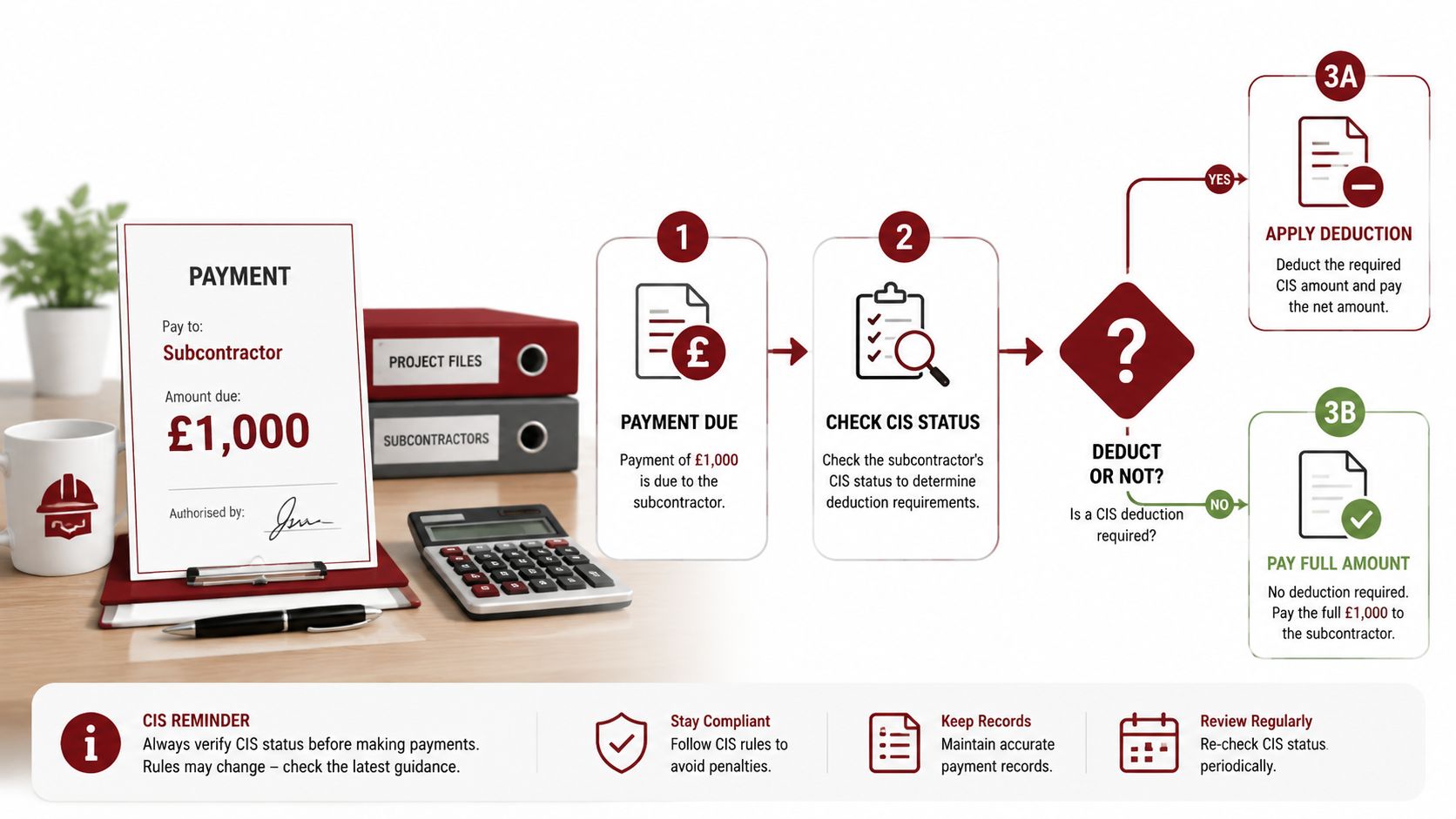
The basic payment decision
If your business pays a subcontractor for construction work, you need to establish whether CIS applies before paying. The process is straightforward in principle:
- Identify the work and the parties involved.
- Check whether you're acting as a contractor for that payment.
- Verify the subcontractor with HMRC.
- Separate labour from materials and other excluded amounts.
- Apply the verified deduction rate.
- Pay the subcontractor and retain the required records.
The person doing the work doesn't choose whether CIS applies. The contractor paying for the work carries the operational responsibility for verification, deduction, reporting, and payment to HMRC.
Practical rule: Never treat CIS as an instruction to deduct money from every invoice that arrives from a self-employed person. First establish the construction scope, the parties' roles, and the worker's actual status.
A business operating in UK construction should treat CIS as a core control from the start. The scheme has a substantial administrative footprint across the supply chain, as shown by HMRC evaluation material summarised by PKF Francis Clark's CIS guide. If you ignore the regime, HMRC can pursue under-deducted tax, late returns, interest, and penalties.
For help organising the wider bookkeeping and compliance work, contractors can also review accounting support for construction contractors. Good accounting records won't fix an incorrect CIS decision, but they make the correct process much easier to operate consistently.
Contractor vs Subcontractor Under CIS Rules
Your CIS role depends on what your business does in the transaction, not just on how it's registered.
A contractor is the business paying for construction work. That may be a mainstream building contractor, a property developer, or another business whose construction spending brings it within the deemed contractor rules. A subcontractor is the person or business carrying out construction work for that contractor. The subcontractor might operate as a sole trader, partnership, or limited company.
Use the payment direction test
Ask one question: is my business paying someone else to carry out construction work?
- If yes, your business is acting as a contractor for that payment. You may need to verify the subcontractor, calculate the deduction, submit CIS information, and pay HMRC.
- If you're carrying out construction work for another business, you're acting as a subcontractor for that contract. Your customer may deduct CIS from your labour payment.
- If you do both, you have both responsibilities. A roofing company can be a subcontractor on a major building project, then become a contractor when it hires a scaffolding firm for its own job.
That overlap is where many businesses lose control. A firm may register as a subcontractor, receive invoices from its own clients, and then assume that registration covers everything. It doesn't. The moment the firm hires others for construction work, it needs to consider its contractor obligations separately.
CIS status also has no power to decide whether someone is self-employed. A subcontractor can have a CIS deduction applied and still be an employee under the working arrangement. Control, personal service, mutuality of obligation, financial risk, and the practical way the work is performed all matter. Treating CIS registration as proof of self-employment can leave a business exposed to PAYE and National Insurance problems.

Safety responsibilities create a separate but related issue. If you're unsure who controls site safety, supervision, or instruction, Safety Space's guide to contractor WHS duties provides useful context on the distinction between contractors and subcontractors.
For a broader review of your business position, contractor accountancy support in London can help you keep CIS decisions aligned with payroll, accounts, and tax reporting.
How to Register and Verify for CIS
Registration needs to happen before money starts moving. Waiting until the first invoice arrives is a poor system because the contractor may need time to set up the relevant HMRC accounts and the subcontractor may not have the expected deduction status.
Contractors should set up the right account first
A contractor generally needs to register as a new employer with HMRC, then register specifically for CIS online. HMRC activation can take up to two weeks, so a new contractor should build that time into the project setup rather than treating registration as an administrative afterthought.
Once registered, the contractor must verify each subcontractor before making the relevant payment. Verification confirms the subcontractor's identity and tells the contractor which deduction rate applies.
Subcontractors need the correct CIS status
A subcontractor should register for CIS through Government Gateway. Standard registration normally means deductions are made at the registered rate. A subcontractor may instead apply for gross payment status, which means the contractor pays without a CIS deduction if HMRC grants that status.
Gross payment status isn't automatic. HMRC assesses qualifying conditions covering the business, its construction activity, turnover, and compliance history. Registering for Self Assessment alone doesn't mean a subcontractor is registered for CIS, and it doesn't create gross payment status.
Verification is a payment control
Before paying, collect the subcontractor's legal details and Unique Taxpayer Reference. Don't rely on an old invoice or a verbal assurance that the subcontractor is “gross.” Keep the verification result with the payment paperwork.
HMRC can change a subcontractor's status. Re-verify when circumstances indicate a change, rather than assuming a previous result remains appropriate indefinitely. Maintain a simple register showing the subcontractor, verification date, result, rate, invoices, deductions, and payment date.
The HMRC-focused CIS registration guidance from Action Accountants can help new businesses work through the setup sequence. The important recommendation is simple: register early, verify before paying, and retain evidence of the decision.
Understanding CIS Deduction Rates and Calculations
For ordinary CIS payments, the relevant deduction rates are 20% for a registered subcontractor, 30% for an unregistered subcontractor, and 0% where HMRC has granted gross payment status. Those rates are not choices the contractor can make to suit cash flow. They follow the subcontractor's verified position.
The calculation also doesn't normally apply to the whole invoice. The contractor calculates CIS on the relevant labour amount after excluding VAT and allowable materials, along with the relevant plant hire or equipment amounts.
Work through the invoice in the right order
Suppose an invoice contains:
- Labour: £1,000
- Materials: £400
- VAT: £280
The CIS calculation starts with the £1,000 labour amount, not the invoice total. At the registered rate, the deduction would be £200 and the subcontractor would receive £800 for the labour, plus the excluded materials and VAT amounts, subject to the invoice and VAT treatment being correct.
At the higher rate, the deduction on the same labour amount would be £300. With gross payment status, there would be no CIS deduction, although the subcontractor remains responsible for its own tax obligations.
| Invoice Component | 20% Registered | 30% Unregistered | 0% Gross Status |
|---|---|---|---|
| Labour amount | £1,000 | £1,000 | £1,000 |
| CIS deduction | £200 | £300 | £0 |
| Labour paid to subcontractor | £800 | £700 | £1,000 |
| Materials and VAT | Excluded from CIS calculation | Excluded from CIS calculation | Excluded from CIS calculation |
The dangerous mistake is applying the percentage to the full invoice. If the contractor applies 20% to the combined £1,400 labour and materials, the deduction becomes £280 instead of £200. That over-deducts £80 from the subcontractor before considering VAT, and it usually leads to a dispute that could have been avoided by demanding a properly itemised invoice.
The rate comes from verification. The base comes from the invoice. You need both answers before calculating anything.
Plant requires particular care. Plant or machinery supplied without an operator is generally outside CIS, while plant supplied with an operator can fall fully within the scheme. The practical CIS deduction calculation guidance is useful when an invoice combines labour, materials, plant, and VAT.
CIS deductions aren't an additional charge imposed on the subcontractor. They're advance payments towards the subcontractor's eventual tax and National Insurance liability, which the subcontractor accounts for through its wider tax position.
Common CIS Mistakes and Misconceptions to Avoid
Most CIS problems don't begin with a complicated tax arrangement. They begin with a rushed payment, a vague invoice, or an assumption that sounds reasonable.
CIS registration doesn't prove self-employment
A subcontractor may be registered for CIS and still be an employee based on the reality of the engagement. If the contractor controls the person's hours, methods, location, and ongoing work in a way that resembles employment, CIS registration doesn't remove the need for an employment-status assessment.
The practical fix is to assess the working relationship before the first engagement and revisit it when the arrangement changes. Don't allow a UTR, invoice, or CIS registration to replace that assessment.
Materials and plant can distort the deduction
A contractor who sees one invoice total and applies the deduction automatically may deduct from materials that should be excluded. The same problem appears with plant hire. Plant supplied without an operator is outside CIS, but plant with an operator can be within scope.
Require invoices to show labour, materials, plant, equipment, and VAT separately. If the subcontractor won't provide enough detail, pause the payment and resolve the classification before processing it.
Verification prevents the wrong rate
Paying before verification can result in the higher deduction being applied, followed by a cash-flow dispute with the subcontractor. Verify first, save the result, and record the rate used for each payment.
CIS doesn't replace Self Assessment
A subcontractor can't assume that deductions settle every tax responsibility. The subcontractor still needs accurate records and must claim CIS deductions against its overall tax liability through the appropriate tax return process. Where deductions exceed the final liability, the tax position may produce a repayment, but that depends on the complete return.
Late monthly returns create another avoidable problem. The first late filing penalty is £100, and further penalties can escalate if the return remains outstanding. Put the CIS deadline into the same accounting calendar as VAT and payroll, then assign one person to review it before submission.
Use a short control list:
- Before engagement: assess employment status and confirm the parties' roles.
- Before payment: verify the subcontractor and inspect the invoice breakdown.
- Before filing: reconcile deductions to invoices, payment records, and deduction statements.
- Before year-end: give the subcontractor complete CIS records for tax reporting.
How CIS Connects to Payroll VAT and Tax Returns
CIS sits alongside other HMRC obligations. It doesn't replace payroll, VAT, or Self Assessment, and treating it as one combined process creates confusion.
A contractor with employees usually runs PAYE payroll and CIS reporting as separate streams. Payroll deals with employees. CIS deals with relevant construction payments to subcontractors. The accounting software or payroll platform may bring both liabilities into the same HMRC payment process, but the underlying records and classifications remain different.
CIS deductions taken from subcontractor payments must be reported through monthly CIS returns, with the amounts paid to HMRC by the relevant deadline. The contractor should reconcile the return to its payment ledger before submission, not after HMRC raises a query.
VAT adds another layer. CIS deductions are calculated on the relevant amount before VAT, while the construction VAT reverse charge can change how VAT appears on an invoice. A contractor must therefore check both the CIS treatment and the VAT treatment instead of assuming that one determines the other.
For subcontractors, CIS deductions are credited against the tax liability shown on the relevant Self Assessment return. That makes deduction statements important evidence. Keep invoices, payment records, verification details, CIS statements, monthly returns, and VAT records together so the year-end reconciliation can be completed from a clear audit trail.
A disciplined monthly close is more reliable than trying to reconstruct the position from bank transactions months later. Review labour, materials, plant, VAT, deduction rate, and payment date in one place.
Getting Expert CIS Support for Your Business
CIS is a poor area for trial and error. One worker treated as self-employed when the facts point to employment, one incorrect treatment of plant, or one missed return can create work far beyond the original payment.
A construction accountant can take responsibility for the recurring controls:
- Registration: setting up contractor and subcontractor CIS obligations correctly.
- Verification: maintaining subcontractor records and checking rates before payment.
- Calculations: separating labour, materials, plant, equipment, and VAT.
- Returns: preparing monthly CIS submissions and reconciling them to the ledger.
- Statements: issuing clear deduction statements for subcontractors.
- Tax coordination: aligning CIS with VAT, payroll, accounts, and tax returns.
Action Accountants Limited provides CIS bookkeeping and registration support for contractors and subcontractors, including verification records, monthly CIS returns, deduction statements, and related VAT and tax compliance. That kind of support is particularly useful for construction businesses in North West London, from Edgware and Harrow to the surrounding areas, where the owner is usually managing projects, labour, suppliers, and customers at the same time.
Don't wait for an HMRC letter to discover that your process is incomplete. Book a CIS review, test a sample of recent invoices, and correct the gaps while the records are still accessible.
Action Accountants Limited can help you register correctly, verify subcontractors, calculate deductions, prepare monthly CIS returns, and keep CIS aligned with VAT and tax reporting. Visit Action Accountants Limited to discuss a practical CIS review before a payment error becomes a penalty or cash-flow problem.


