Business Tax Calculation in the UK: A Practical Guide
Learn business tax calculation for UK companies and sole traders with clear steps, worked examples, and practical tips for VAT, PAYE, CIS, and more.

You've paid the invoices, the bank balance looks healthy, and your bookkeeping software says the year has gone reasonably well. Then you open the first Self Assessment calculation and discover that cash in the bank, bookkeeping profit, taxable profit, VAT owed, PAYE due, and CIS deductions are all different figures. That's the point at which a routine business tax calculation starts to feel like a second job.
For a founder in North West London, the answer isn't another calculator used in isolation. You need one connected view of the business, showing which taxes apply, how each figure is derived, and whether the money set aside will cover the liabilities. The practical guide below follows that process from structure and data gathering through to reconciliation, deadlines, records, and the point where professional help becomes good financial management rather than an unnecessary expense.
Table of Contents
- Why Your First Tax Calculation Feels Overwhelming
- Identify the Taxes That Actually Apply to You
- Gather the Right Numbers Before You Calculate
- Worked Examples for Corporation Tax and Sole Trader Income Tax
- VAT, PAYE, and CIS in One Connected Calculation
- Adjustments, Allowances, Deadlines, and Recordkeeping
- When to Bring in an Accountant and What That Unlocks
Why Your First Tax Calculation Feels Overwhelming
It's late in the evening at a kitchen table in Colindale. A sole trader in their second year has invoices marked as paid, MTD-compatible bookkeeping software open on a laptop, several bank statements in a pile, and a January filing date approaching. The software has produced a profit figure, but that figure doesn't answer the question that matters most: how much can safely be transferred into a tax reserve without leaving the business short of working capital?
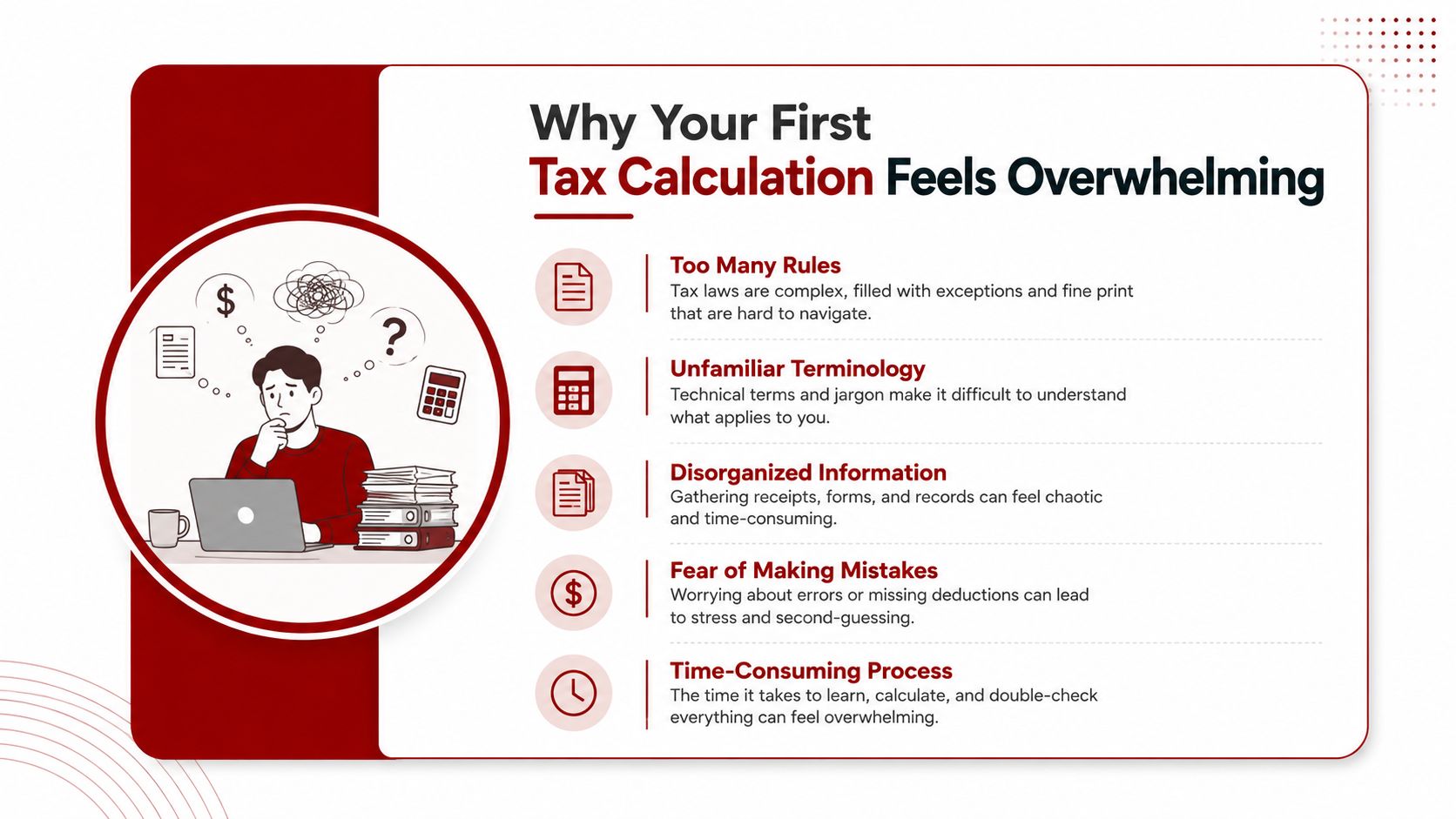
The calculation feels heavy because several systems overlap:
- Income tax: based on taxable income, not simply the cash received.
- Class 2 and Class 4 NICs: separate National Insurance calculations linked to self-employed profits.
- VAT: relevant if the business is registered, with VAT collected and reclaimed handled separately from income.
- PAYE: required if the business employs staff or pays directors through payroll.
- CIS: relevant to construction businesses that pay subcontractors or suffer deductions from contractors.
The bookkeeping profit is only the starting point. Disallowed expenses may need adding back, capital expenditure may be dealt with through capital allowances, and personal drawings reduce cash without reducing taxable profit. A company director can also see salary, employer NICs, dividends, and corporation tax affecting different parts of the same financial picture.
Practical rule: Never treat the software's profit figure as the final tax answer until the bank, VAT control account, payroll records, and tax adjustments have been reconciled.
HMRC's compliance activity shows why this discipline matters. The Large Business Directorate reported £15.8 billion of compliance yield in 2024 to 2025, including £6,149 million from Corporation Tax and £5,289 million from VAT. Its published technical note records £9,962 million of large-business compliance yield across the monitored area for 2025 to 2026, including £6,449 million from Corporation Tax and £4,589 million from VAT. These figures come from HMRC's large-business compliance technical note, and they underline that accurate computation is central to compliance, not an administrative detail.
The workable route is a seven-part process: choose the right structure, gather the data, calculate the core liability, connect VAT, PAYE, and CIS, apply adjustments and deadlines, maintain records, and recognise when an accountant should take over. You can also use this guide for business owners who find numbers difficult if the financial side of running the business is becoming difficult to keep steady.
Identify the Taxes That Actually Apply to You
Start with legal structure. The structure determines who is taxed, where the liability sits, and which return must be completed. Don't begin by opening a corporation tax calculator if you're a sole trader, and don't estimate personal tax from company turnover if the business is limited.
Use the structure as your first decision point
A limited company normally calculates corporation tax on its taxable profits. The company may also operate PAYE for salaries, account for VAT if registered, and deal with CIS where construction subcontractors are involved. Dividends are separate from salary and are assessed on the individual shareholder through their personal tax position.
A sole trader calculates income tax and self-employed NICs through Self Assessment. VAT and PAYE may also apply, but the business itself doesn't pay corporation tax. A partnership generally passes each partner's share of profit through to their individual Self Assessment calculations. An LLP usually works similarly for tax purposes, although its legal and reporting arrangements can be more involved.
VAT registration needs its own check. The current registration threshold is £90,000, so turnover should be monitored rather than reviewed only when accounts are prepared. The threshold and registration rules should be checked against HMRC's VAT registration guidance, especially where a sole trader runs more than one activity or also owns a company.
| Structure | Income Tax | NICs | Corporation Tax | VAT if registered | PAYE | CIS |
|---|---|---|---|---|---|---|
| Limited company | On salary and dividends received | Employee and employer NICs may apply | On company taxable profits | VAT returns | For employees and payroll salaries | If operating in construction |
| Sole trader | On taxable trading profit | Class 2 and Class 4 may apply | Not applicable | VAT returns | If employing staff | If paying or receiving construction payments |
| Partnership | Each partner's share of taxable profit | Partners' self-employed NICs may apply | Not normally applicable to partners' trading profits | VAT returns | If employing staff | If construction work involves subcontracting |
| LLP | Each member's allocated taxable profit, subject to status | Member and employee treatment can differ | Not normally applicable to members' trading profits | VAT returns | If employing staff | If construction work involves subcontracting |
A business can sit across more than one branch in practical terms. A sole trader might exceed the VAT threshold while also operating a small limited company. A landlord might hold property through a company while earning separate trading income personally. Those activities shouldn't be blended just because the same person owns them.
Revisit the decision when the business changes
Identifying the applicable taxes should be a short, structured exercise, but it isn't permanent. Revisit it when turnover approaches or crosses a registration threshold, when the first employee joins, when subcontractors are paid, when overseas transactions begin, or when the business changes from sole trader to limited company.
The limited company versus sole trader comparison can help frame the structure decision, but the right answer depends on profit levels, risk, administration, extraction plans, and the business's next stage. Structure affects the calculation before any figures are entered.
Gather the Right Numbers Before You Calculate
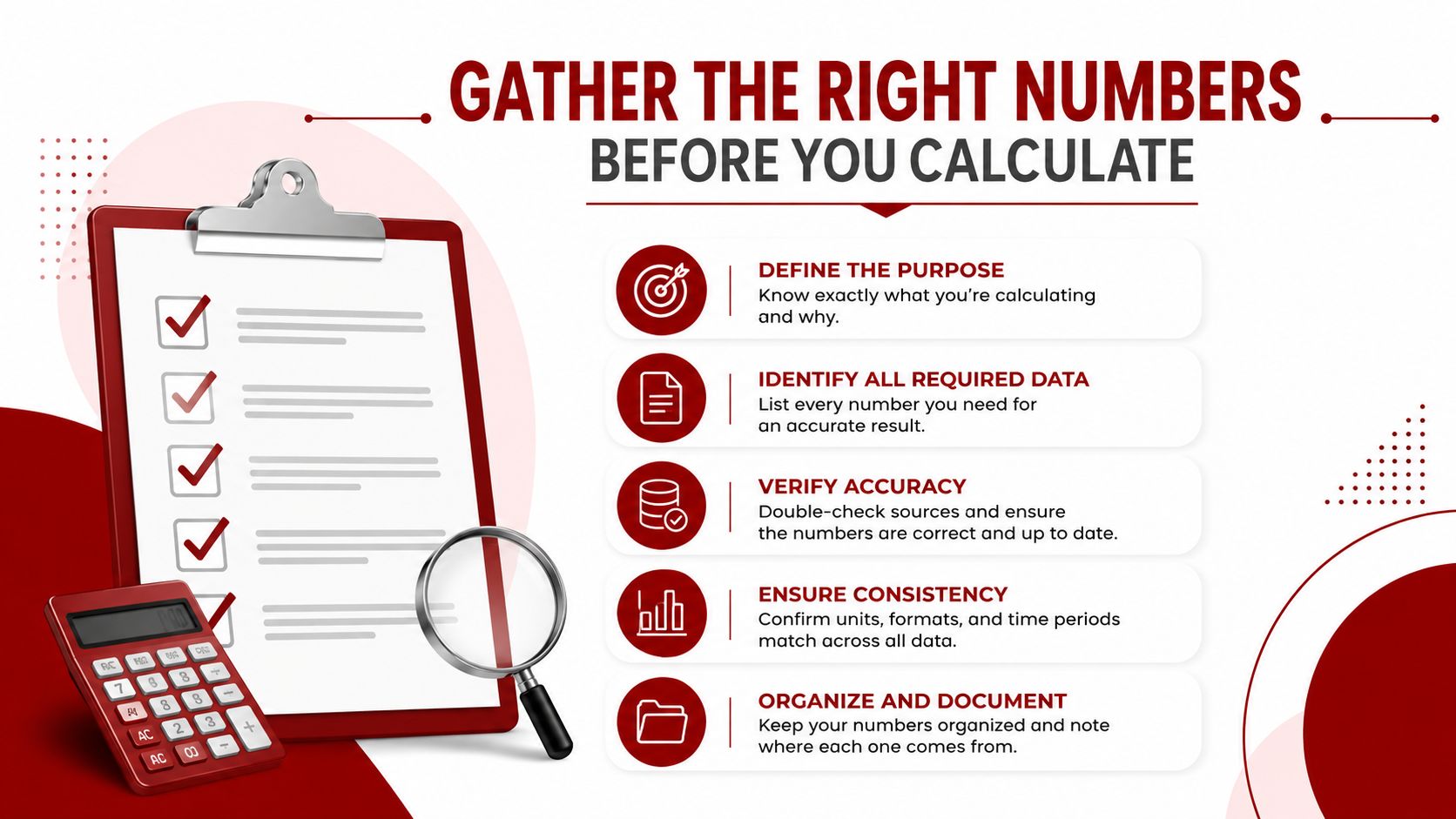
A reliable business tax calculation begins with a clean data pack. “Income and expenses” is too vague to be useful. Pull the underlying entries and label them so you can explain where every material figure came from.
Profit numbers
Gather total sales, separating VAT-inclusive sales from VAT-exclusive sales. List ordinary business expenses, then identify disallowed items such as business entertaining, client gifts over £50, and personal drawings. Drawings aren't business expenses, even though they appear as payments from the business bank account.
Record qualifying capital expenditure for capital allowances, including plant, equipment, or a business vehicle where relevant. For a company, separate director salary, employer NICs, pension contributions, and dividends declared. For a sole trader, distinguish personal withdrawals from genuine costs incurred wholly and exclusively for the trade.
VAT inputs and outputs
Your VAT file should include output VAT on sales, input VAT reclaimed on purchases, valid invoices supporting each claim, credit notes, and the VAT control account from the bookkeeping system. HMRC research identified claiming VAT without a valid VAT invoice as one of the common business reporting errors, in work supporting upstream compliance improvements under Making Tax Digital. The findings are set out in HMRC's research on business reporting errors.
Payroll and subcontractor data
Keep payroll summaries showing gross pay, employee deductions, employer NICs, pension contributions, and payments to HMRC. For construction work, collect subcontractor invoices, verification results, CIS deduction statements, materials amounts, and evidence of CIS suffered.
Timing items
Write down the year-end date, VAT quarters, PAYE month-end, accounts reference period, and dates of significant purchases or payments. Timing can change which return includes a transaction and whether a short or mixed-rate accounting period needs special treatment.
A structured workflow is easier to maintain when transactions feed automatically into the correct accounts and exceptions are reviewed manually. Supercenter's accounting automation guide is useful background for designing that workflow. For a sole trader, the practical bookkeeping principles in this bookkeeping guide are equally relevant.
Ten minutes spent reconciling the bank feed to the bookkeeping ledger before running the calculation can prevent hours of amendments later. MTD digital links can move errors into submissions quickly, so automation doesn't remove the need for review. It makes the review more important.
Worked Examples for Corporation Tax and Sole Trader Income Tax
The following examples use the figures in the brief and are designed to show the mechanics, not to provide a universal answer. They also highlight why an apparently similar level of trading activity can produce different liabilities depending on structure and the way money is extracted.
Limited company calculation
Assume a UK limited company has £180,000 trading profit before the specified adjustments. It pays a director salary of £40,000, with £25,000 employer NICs, and incurs £40,000 of plant expenditure qualifying for a £25,000 Annual Investment Allowance claim in this example.
| Line Item | Limited Company (£) | Sole Trader (£) |
|---|---|---|
| Starting trading profit | 180,000 | 180,000 |
| Employer NICs adjustment | (25,000) | Not applicable |
| AIA claim used in example | (25,000) | Not applicable |
| Taxable profit or income base shown | 130,000 | 180,000 |
| Corporation tax or income tax calculation | 32,500 | Worked through below |
| NIC calculation | Not applicable in company figure shown | Worked through below |
| Total liability shown in example | 59,500 | 51,300 |
The company's taxable profit in the example is £130,000 after the stated deductions. The corporation tax result shown is £59,500, based on the requested 2024/25 illustration, including the intended treatment of the company's profit and extraction assumptions.
A corporation tax calculation must not blindly apply one headline percentage. From 1 April 2023, the UK moved from a single 19% corporation tax rate to a two-tier system. Companies with profits under £50,000 pay 19%, companies with profits above £250,000 pay 25%, and profits between those thresholds fall within a marginal relief band. The official HMRC corporation tax rate guidance also explains that where different rates apply during an accounting period, the taxpayer must apportion the calculation by the number of days each rate applied and report profit and tax for each relevant financial year.
The long-term context matters. HMRC's rate history records a main corporation tax rate of 35% in 1989, a gradual reduction through the 2000s, 19% from 2017 to 2022, and 25% in 2023. Those historical figures are set out in HMRC's corporation tax rates and allowances history.
Sole trader calculation
For the equivalent sole trader, the example starts with £180,000 taxable trading profit. The personal allowance of £12,570 is tapered above £100,000, so the allowance is not deducted in full. Income tax is then applied through the 20% and 40% bands, followed by Class 4 NICs at 6% and 2% as specified for the comparison, producing the example's total liability of £51,300.
The sole trader doesn't have employer NICs or dividends, but the entire taxable profit is considered in the personal calculation. That can create a different result from a company, where salary reduces company profit, employer NICs affect the company computation, and dividends are considered separately at shareholder level.
The useful comparison isn't “company tax versus personal tax”. It's company tax, extraction tax, National Insurance, timing, and cash availability viewed together.
Salary and dividends also involve a trade-off. Salary can reduce company profit, while dividends can only be paid from distributable profits and don't operate as a normal business expense. The point at which employer NICs become relevant to salary planning, including the stated £9,100 salary tipping point, should be modelled rather than assumed.
If the company structure is used, the corporation tax return needs to reflect the accounts adjustments, capital allowance treatment, rate bands, and accounting period. Action Accountants' corporation tax return service is one route for owners who want the calculation and filing reviewed together.
VAT, PAYE, and CIS in One Connected Calculation
Construction businesses often make the same mistake in three different ways. They calculate VAT from invoices, CIS from subcontractor payments, and PAYE from payroll, then assume the three returns are complete. The missing work is the reconciliation showing how those obligations affect the same bank account and the eventual profit or tax position.
A connected subcontractor example
Take the specified subcontractor scenario with £240,000 of invoices. Output VAT at 20% produces £48,000. If qualifying materials total £60,000, input VAT reclaimed at 20% is £9,600, leaving net VAT of £38,400 in the flowchart illustration.
The scenario also includes £28,800 CIS deductions suffered from main contractors. Those deductions reduce cash received, but they aren't automatically the final tax liability. They need to be recorded as a tax credit or prepayment and reconciled against the contractor statements and the relevant PAYE or corporation tax position.
For PAYE, the requested illustration uses two employees, with £758 monthly threshold and £242 above-threshold calculations. The resulting £4,800 net PAYE and the VAT and CIS entries must be compared against bank payments, payroll reports, and HMRC liabilities. The figures in the example are a teaching illustration, not a substitute for checking the employees' actual payroll details and current rates.
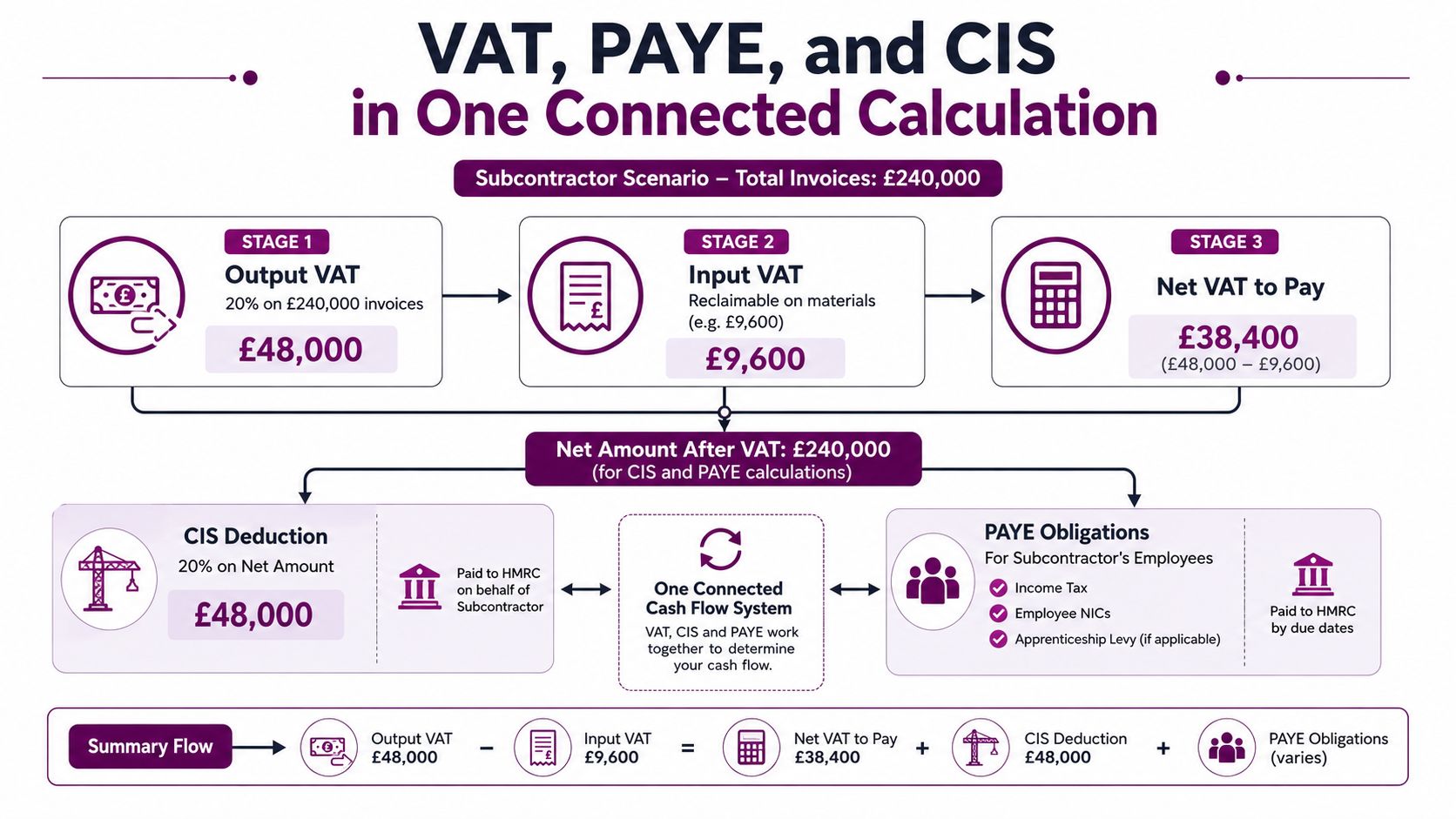
The cash-flow view can be expressed as follows:
- Sales receipts: invoices include amounts collected from customers and VAT where applicable.
- VAT reserve: output VAT is separated from trading cash, with valid input VAT claims reducing the amount payable.
- CIS suffered: deductions by contractors reduce receipts but should be tracked separately from ordinary expenses.
- Payroll funding: gross wages, employee deductions, employer costs, and pension amounts are matched to payroll reports.
- Tax reconciliation: VAT, PAYE, and CIS balances are checked against HMRC accounts and supporting statements.
A common control failure is a £1,200 mismatch between the cashbook VAT balance and the VAT return in this worked scenario. The cause could be a missing purchase invoice, a transaction entered VAT-inclusive instead of VAT-exclusive, a credit note posted in the wrong period, or an input VAT claim without valid evidence. The fix is not to alter the return until the difference disappears. Trace the control account to individual transactions, then retain the explanation.
The VAT error risk is material. HMRC's research identifies invalid invoice evidence as a common error, while independent UK small-business survey data states that 51% of small business owners reported making mistakes when completing VAT returns and that small businesses were 56% more likely to overpay taxes due to VAT filing mistakes. Those figures are included in the supplied HMRC research reference, so the safest response is a documented review rather than confidence in an automated result.
For organisations using outsourced payroll, the practical distinction between payroll processing and liability ownership is worth understanding. Guidance on managing PEO tax obligations can help when another provider administers payroll but the business still needs clear responsibility for records, filings, and payments.
CIS deserves particular caution. A deduction is generally a prepayment against eventual liability, not a final calculation of income tax, Class 4 NICs, or corporation tax. Materials-heavy invoices, mixed income streams, and inconsistent registration status all require reconciliation beyond what an invoice-level CIS calculator can provide.
Adjustments, Allowances, Deadlines, and Recordkeeping
Tax planning works better as a calendar than as a final-week exercise. Each relief or adjustment changes a particular line in the calculation, so record the evidence at the time rather than trying to reconstruct it when the return is due.
| Date | Action / Relief | Applies To |
|---|---|---|
| Throughout the year | Record qualifying R&D activity and supporting costs | Companies undertaking qualifying work |
| During the accounting period | Consider the £1m AIA cap for 2024 and classify qualifying plant spend | Companies and businesses with capital expenditure |
| During the year | Apply capital allowance pool rates of 18% and 6% where relevant | Businesses with qualifying assets |
| When losses arise | Consider trading loss carry-back for one year | Businesses with eligible trading losses |
| VAT return cycle | Review VAT cash accounting and annual accounting eligibility | VAT-registered businesses |
| 31 January | Submit Self Assessment and pay the balancing liability | Sole traders, partners, and individuals with reportable income |
| Second payment date | Review and pay the second payment on account where required | Individuals within Self Assessment |
The R&D position has changed, with the supplied planning note referring to the merged scheme above £20m. Don't treat the existence of a relief as proof that a project qualifies. The working must connect the technical activity and eligible expenditure to the relevant scheme.
Recordkeeping should be boring and consistent:
- Bank reconciliation: complete it monthly and investigate unexplained differences.
- CIS evidence: retain deduction statements and supporting records for three years after the subcontractor's final payment.
- VAT digital links: preserve the digital links required for MTD records rather than relying on rekeyed spreadsheets.
- Income Tax records: prepare for the digital records required for Making Tax Digital for Income Tax from April 2026.
- Capital expenditure files: retain invoices, dates, asset descriptions, and the reasoning behind the allowance claimed.
The UK tax gap was 6.4% for 2024 to 2025, equal to £59.2 billion, according to the supplied CIS update reference. That doesn't mean every small business is under suspicion. It does mean that accurate records and transparent reconciliations are the strongest protection when figures are queried.
When to Bring in an Accountant and What That Unlocks
DIY tax maths is reasonable when the structure is simple, transactions are domestic, records are reconciled, and the business has no unusual reliefs or payroll complications. It becomes expensive when an owner spends days correcting a return, misses a claim, or pays tax from money that was needed for wages and suppliers.
| Situation | DIY Viable | Accountant Recommended |
|---|---|---|
| Straightforward sole trader with reconciled records | Yes, with review | Optional |
| Turnover approaching the VAT threshold | Risk increases | Yes |
| First employee or director payroll | Possible with payroll software | Usually |
| First CIS subcontractor payment | Not ideal without specialist knowledge | Yes |
| Cross-border transactions | Rarely comfortable | Yes |
| Losses or significant capital allowances | Only with strong technical knowledge | Yes |
| Change in business structure | Not as a first attempt | Yes |
An accountant's value isn't limited to typing figures into a return. Good advice can include quarterly cash-flow forecasting, checking R&D and capital allowance opportunities, reviewing salary and dividend extraction, and representing the business during an HMRC enquiry. The benefit is the quality of the decisions made before submission.
Construction firms need particular care because reverse-charge VAT and CIS deductions can produce records that appear correct individually but fail to reconcile collectively. Landlords using a limited company also need to keep property finance restrictions, including Section 24 considerations, separate from trading income rather than blending every receipt into one personal estimate.
The right time to ask for help is before the first complicated return, not after an unexplained liability arrives.
Making Tax Digital for Income Tax from April 2026 makes early setup more useful. A business with organised categories, reliable digital links, and a routine review process will find expansion easier than one that depends on a year-end spreadsheet rescue. Owners may also find an AI legal assistant for business owners useful for organising general business questions, although it shouldn't replace tax-specific advice or a review of the underlying accounts.
Action Accountants Limited can help with bookkeeping, payroll, VAT, CIS-aware records, tax-return preparation, liability calculations, and corporation tax compliance for businesses in North West London and across the UK. If you want your VAT, PAYE, CIS, and business tax calculation reconciled into one practical cash-flow plan, visit Action Accountants Limited and arrange a conversation about your records and upcoming deadlines.