
Company Secretarial Fees: A UK Pricing Guide
Understand company secretarial fees in the UK. Learn how statutory costs, service bundles, and compliance complexity impact your budget and…

UK company secretarial fees typically range from £100 to £5,000 annually, but the main cost driver is whether the quote includes mandatory Companies House statutory charges or just the professional service retainer. A low headline price can therefore look attractive while excluding the filings, updates and remedial work your company genuinely needs.
Most advice on company secretarial fees starts with the wrong question: “What's the cheapest annual package?” That approach treats corporate compliance as a commodity and makes unlike-for-like quotes appear comparable. They aren't.
One provider may be quoting only for preparing and filing a confirmation statement. Another may include register maintenance, PSC updates, director changes, registered-office administration and routine governance support. A third may include Companies House charges as disbursements, while a fourth leaves those costs entirely outside the advertised price.
The sensible comparison is not between annual totals. It's between what the fee pays for, what the government charges separately, and what happens when your company changes.
Table of Contents
- The Reality Behind Company Secretarial Quotes
- Separating Statutory Charges from Professional Fees
- Comparing Retainers and Ad Hoc Pricing Models
- Events That Trigger Unexpected Secretarial Costs
- Evaluating True Value in Compliance Partnerships
- The High Cost of Neglected Statutory Registers
- How to Select the Right Secretarial Support
The Reality Behind Company Secretarial Quotes
The published UK pricing range runs from £100 to £5,000 a year, depending on the level of support and the complexity of the company, as illustrated by recent UK pricing guidance on company secretarial services. That range is useful, but it doesn't tell you what a particular quote includes.
A basic company with stable ownership may need a predictable annual filing and occasional administrative help. A growing company issuing shares, changing its PSC details, appointing directors or preparing for investment needs far more oversight. Calling both arrangements “company secretarial support” hides the commercial difference.
The all-inclusive package problem
“All-inclusive” sounds reassuring, but the phrase has no universal meaning. It might include routine correspondence and confirmation statement preparation, while excluding share transfers, bespoke resolutions, register reconstruction, urgent filings or Companies House fees. Unless the proposal defines those terms, you're comparing marketing language rather than services.
A £150 annual package might leave you paying separately whenever the ownership structure changes. A £500 package might include services your company never uses. Neither price is automatically good or bad. The question is whether the scope matches your risk and expected activity.
Practical rule: Ask the provider to split every quote into statutory disbursements, recurring administration and event-driven work.
That split matters because Companies House charges are not professional income. They're regulator-set costs paid for particular filings. Your accountant or company secretarial provider may collect them from you, but should identify them separately rather than allowing them to disappear inside a vague annual bundle.
The professional fee pays for people, systems and judgement. That can include checking company information, preparing filings, maintaining the register of members, recording ownership changes, monitoring deadlines and advising when a proposed action needs formal documentation. It may also cover communication with directors and shareholders, which is often where a supposedly simple task becomes time-consuming.
For founders trying to understand the wider governance environment, understanding the EU Inc proposal can provide useful context on how businesses and corporate structures may be organised across jurisdictions. It doesn't replace UK compliance advice, but it reinforces why company records and governance arrangements deserve more attention than a basic filing checklist.
You should also ask whether the provider is responsible for identifying missing information or merely filing what you send. Those are different services. A filing agent may process instructions. A compliance partner should also tell you when the information appears inconsistent, incomplete or commercially risky.
A useful starting point is to review the precise scope of company secretarial services from Action Accountants alongside competing proposals. Don't buy the cheapest line on the page. Buy the clearest scope for the way your company operates.
Separating Statutory Charges from Professional Fees
Companies House fees establish the unavoidable baseline for many company secretarial budgets. From 1 February 2026, the government schedule sets the digital confirmation statement fee at £50, the paper fee at £110, digital incorporation at £100 and paper incorporation at £124. The current schedule is published in the Companies House fees guidance.
Those charges apply regardless of which accountant, solicitor or company secretarial provider prepares the filing. A provider can make the process easier, check the information and submit it electronically, but it can't remove the statutory charge.
The 2026 baseline
| Filing type | Digital fee | Paper fee | Cost uplift |
|---|---|---|---|
| Confirmation statement | £50 | £110 | Paper costs 120% more |
| Incorporation | £100 | £124 | Paper costs 24% more |
The table makes the commercial point clearly. Digital filing is not just more convenient. It is materially cheaper for the two core filings shown here. A paper-heavy workflow adds avoidable cost before a professional has done any work.
The confirmation statement is an annual confirmation that key company information remains accurate. It isn't the same as annual accounts, corporation tax or bookkeeping. If a provider quotes for “annual compliance”, ask whether that means only the confirmation statement or a wider package of accounts, tax and secretarial administration. A plain-English guide to what a confirmation statement is can help you separate those obligations before requesting quotes.
What you're actually paying for
A transparent invoice should distinguish at least three categories:
- Companies House disbursements: The statutory charge for a specific filing, such as incorporation or a confirmation statement.
- Recurring professional work: Deadline monitoring, data checks, filing preparation, register maintenance and routine correspondence.
- Event-driven support: Work caused by a share issue, PSC change, director appointment, restructuring, urgent filing or historic error.
This distinction protects both sides. You can see whether a price increase comes from a government fee or from extra professional work. The provider can explain why a transaction falls outside the standard annual service instead of presenting an unexplained surcharge.
Historical changes make this separation even more important. Companies House stated that the online or software confirmation statement fee rose from £13 to £34, while software incorporation rose from £10 to £50, before the 2026 changes moved those digital fees to £50 and £100 respectively, as set out in the government's overview of Companies House services. Statutory costs have therefore been reset more than once, and an old online fee quoted in a blog or sales page may no longer be reliable.
A professional retainer should never make a government charge look like an accountant's margin.
When you receive a proposal, ask for an example invoice showing the recurring fee and a separate line for each anticipated filing charge. Also ask whether the provider will notify you before a statutory fee changes. That small control prevents an apparently fixed package from becoming a source of dispute.
Comparing Retainers and Ad Hoc Pricing Models
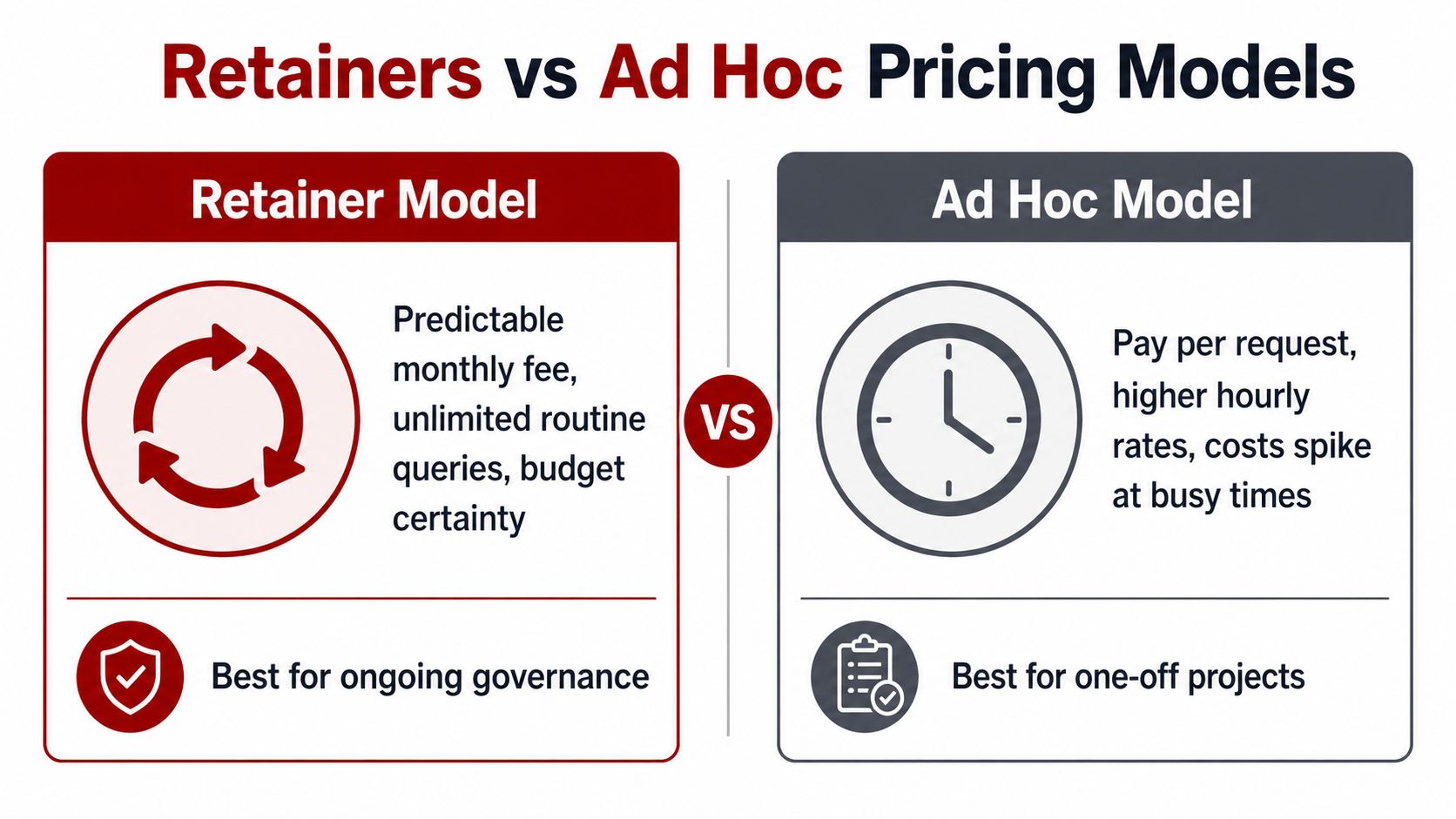
Once statutory charges are separated, the main pricing decision concerns the professional work. UK providers generally structure company secretarial fees around an annual retainer, ad hoc billing or a hybrid arrangement.
A retainer gives you a predictable recurring cost. In return, the provider normally performs defined routine tasks and may answer ordinary queries within the agreed scope. This works well when directors want someone to monitor deadlines and keep the company record orderly throughout the year.
Ad hoc billing is different. You pay when you request a filing, update or piece of advice. That can suit a dormant or very simple company with little activity, particularly if the owner is comfortable managing deadlines personally. It becomes less attractive when the company is growing and changes arrive irregularly.
When a retainer makes sense
Choose a retainer when you value continuity more than the possibility of paying nothing during a quiet month. It is especially suitable where:
- Ownership changes regularly: Share issues, transfers and PSC updates need a consistent process.
- Several directors or shareholders are involved: More people create more opportunities for incomplete instructions and inconsistent records.
- The company expects investment or expansion: A clean corporate record is easier to maintain continuously than reconstruct under transaction pressure.
- The directors don't want deadline responsibility: A named provider can monitor dates and request information before a filing becomes urgent.
The critical phrase is “within scope”. Many low-cost retainers cover the annual confirmation statement but charge separately for share transfers, new appointments, bespoke resolutions and register clean-up. That isn't necessarily unreasonable. It becomes unreasonable when the exclusions are buried.
When ad hoc work is acceptable
Ad hoc support can be sensible for a straightforward company with stable ownership, few corporate events and a director who actively manages the records. It offers flexibility and avoids paying for a broad service that isn't used.
The risk is that directors often seek help only after an event has happened. A late request may involve checking historic records, correcting Companies House information and preparing several connected documents. The provider then has to charge for urgency and investigation rather than routine processing.
For a broader comparison of recurring professional retainers, you can compare monthly accounting fees while keeping the same principle in mind: compare scope, exclusions and response obligations, not just the monthly figure.
A hybrid model is often the most commercially sensible choice. Pay a fixed amount for deadline monitoring and the annual cycle, then agree a clear rate card for share transactions, ownership changes and remedial work. Before selecting a firm, use this guide on how to choose an accountant to assess communication, systems and accountability as well as price.
Events That Trigger Unexpected Secretarial Costs
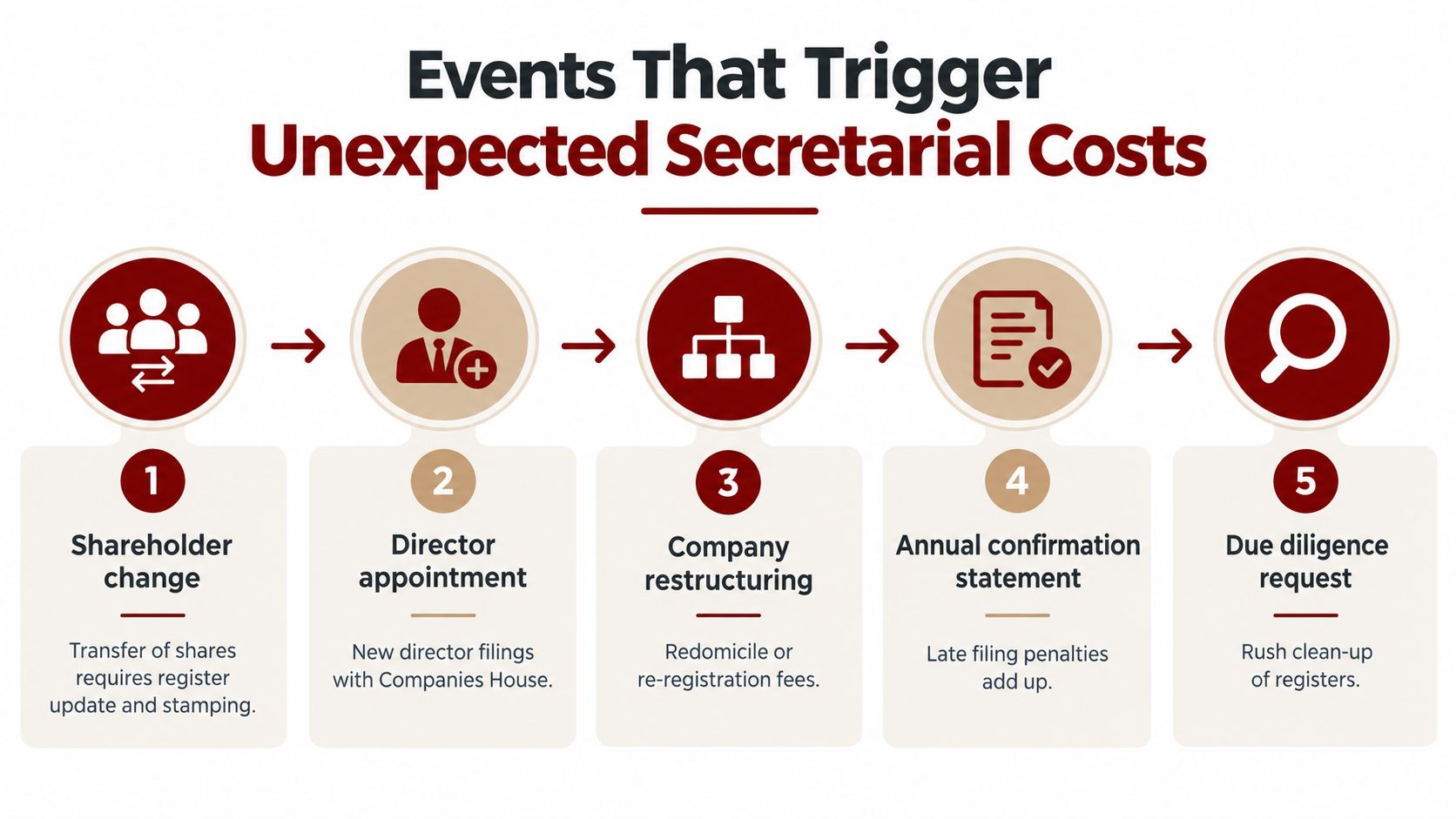
The annual confirmation statement is visible and predictable. The expensive work usually begins between annual filing dates, when the company changes and the records need to change with it.
A provider has to establish what happened, when it happened, who approved it and which records and filings must reflect it. If the client sends only a short email saying “we've issued shares” or “a director has left”, the professional work has not yet been defined. The provider must turn that instruction into an accurate corporate record.
The events that change the bill
Share issues and transfers require more than updating a spreadsheet. The provider may need to review the existing share structure, record the transaction correctly, update the register of members and prepare the relevant Companies House filing. A transfer can also raise questions about supporting documents, consideration and whether the company's records agree with the transaction history.
PSC changes can happen after an investor joins, a shareholder crosses a control threshold or ownership moves through a group structure. The provider needs accurate information about the underlying ownership, not merely a new name to type into a form.
Director appointments and resignations create both filing and record-keeping work. The date matters, the identity details must be correct and the company's internal records should reflect the decision. A provider may also need to prepare or check board documentation, depending on the engagement.
Group restructures are more complex because several companies may change at once. A change in ownership or control can affect parent and subsidiary records, shareholdings and the information held across the group. The work multiplies when one entity's records depend on another entity's transaction.
Funding rounds and exits create time pressure. Investors, lenders and buyer advisers expect corporate records to support the ownership story. If the records are incomplete, the secretarial provider may need to reconstruct history while several parties wait.
The largest bills often arise not from one filing, but from a chain of connected corrections. An overlooked share allotment can affect the register of members, ownership information, later confirmations and transaction documents. That's why a low annual fee can become expensive when the company has outgrown its original administrative habits.
A practical control is to notify your provider before signing or completing any ownership, director or group transaction. Early review is usually more orderly than asking someone to repair the record after the event. A detailed outline of company secretarial duties can help directors identify which changes should trigger a conversation.
Budgeting insight: The annual filing is predictable. Corporate events are where the cost and risk concentrate.
Ask your provider for a rate card covering each event. It should explain whether the price includes advice, resolutions, register updates, Companies House filing and follow-up corrections. That information lets you forecast the cost of growth rather than treating every transaction as an unwelcome surprise.
Evaluating True Value in Compliance Partnerships
The value of company secretarial support isn't limited to the form submitted to Companies House. It lies in keeping the company's legal and ownership records aligned with what the directors and shareholders have done.
A competent provider should ask useful questions. Who approved the share issue? Does the proposed transaction fit the articles and existing share rights? Has the ownership information changed elsewhere? Are the company's internal records consistent with the public filing? Those questions prevent data entry from becoming a false sense of compliance.
What professional judgement looks like
Routine filing is process-driven. Corporate governance often isn't. A provider should know when an instruction is simple enough to process and when it needs clarification from the directors, solicitor or tax adviser.
For example, a construction contractor may need company secretarial support alongside CIS-aware accounting and payroll. A property investor may operate a holding company and trading subsidiary with different ownership or financing arrangements. In both cases, the filing itself may be straightforward, but the surrounding records and decisions require care.
A valuable provider will also create an audit trail. That means retaining instructions, approvals, completed documents and filing evidence in a way that another professional can understand later. Good records reduce the time needed for due diligence and help directors answer questions without searching through old emails.

A commercial test for value
Don't ask only whether the provider files on time. Ask whether the service helps you avoid preventable remedial work.
| Question | What a strong answer should cover |
|---|---|
| Who monitors filing dates? | A named person, system or documented process |
| Who checks ownership changes? | Someone who understands the register, not just the filing form |
| What happens when information is missing? | A defined escalation process before submission |
| What records do I receive? | Filing evidence, updated records and accessible history |
| What is excluded? | Events, advice and urgent work listed plainly |
| How does the provider communicate? | A reliable channel and response expectation |
A cheaper provider can cost more. If the firm only reacts to instructions, it may process a filing correctly while missing a related inconsistency. A more involved service can identify the problem earlier, when the correction is easier and the directors still remember what happened.
Price remains important. You shouldn't pay for strategic governance support if you only need a basic annual filing. But you should also avoid paying a basic-filing price for a company that is fundraising, restructuring or adding shareholders. Match the service to the decisions your company is making.
The High Cost of Neglected Statutory Registers
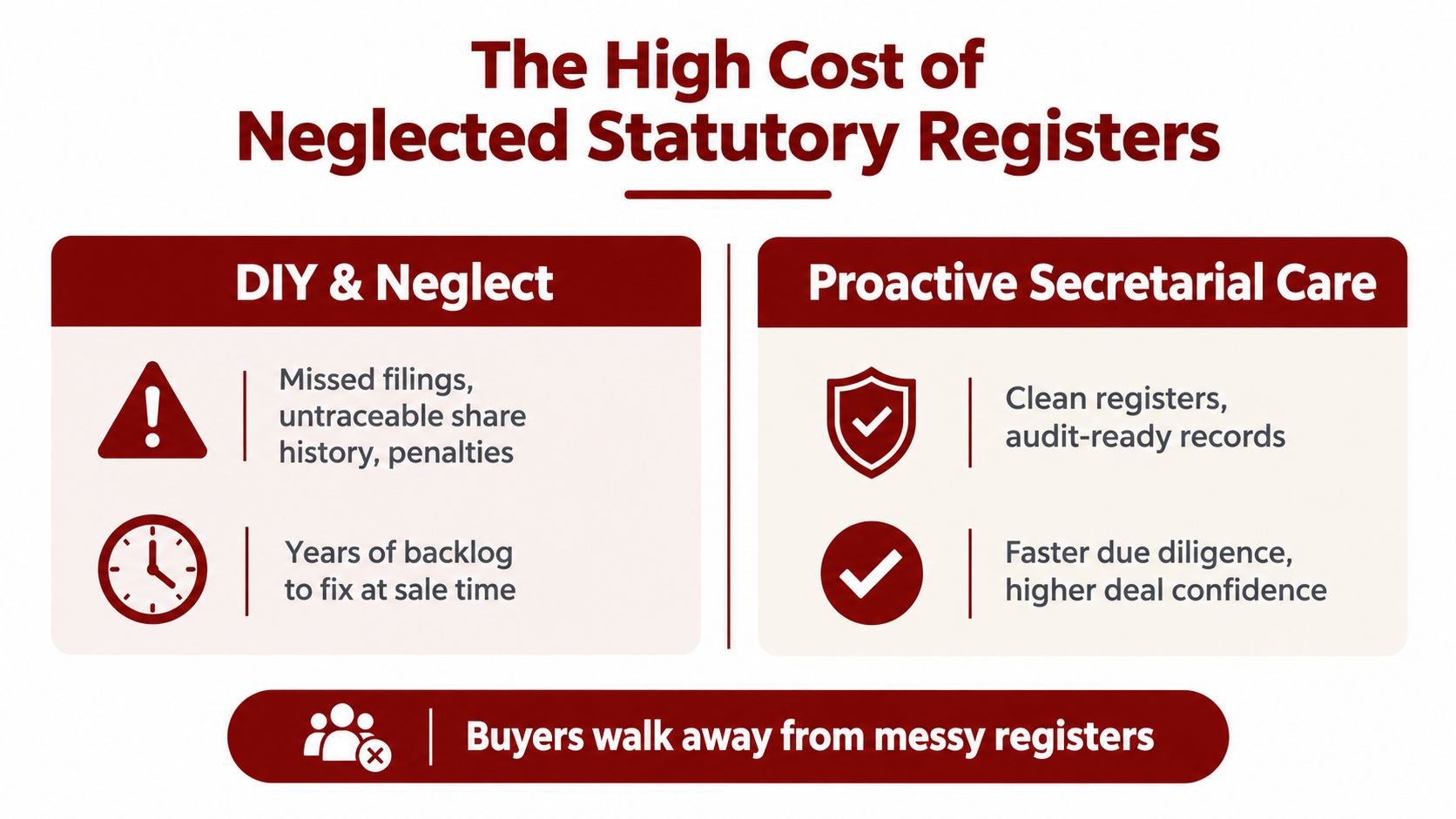
DIY administration looks cheap because the cost is hidden in the director's time and deferred risk. The problem appears later, usually when an investor, lender or buyer asks for a coherent history of ownership and management.
A neglected record may contain missing transfers, inconsistent dates, outdated ownership information or documents that were never formally approved. Companies House information might not match the company's own records. The longer the gap continues, the more difficult it becomes to determine what happened and which correction is legally appropriate.
Why reconstruction is different from maintenance
Maintenance records an event while the facts are available. Reconstruction investigates events after the fact.
A professional may need to examine old share certificates, board minutes, bank records, emails, incorporation documents and previous filings. They may need to ask former directors or shareholders to confirm details. If the company has changed advisers, some documents may be spread across several systems.
That work is not a routine annual fee. It involves investigation, judgement and responsibility. The provider cannot just copy the latest Companies House entry if it doesn't reflect the legal history.
The financial pressure becomes sharper during due diligence. A transaction has its own timetable, and advisers may raise further questions when the records don't reconcile. Directors then face a choice between paying for urgent remediation or delaying the transaction while the history is clarified.
Digital-first administration reduces avoidable friction. It makes it easier to store approved documents, track changes, search historical records and file electronically. It doesn't remove the need for director approval or professional judgement, but it creates a clearer trail than scattered paper files and informal email instructions.
The statutory price difference reinforces that point. A paper confirmation statement costs £110, compared with £50 digitally, and paper incorporation costs £124, compared with £100 digitally, under the 2026 Companies House fee schedule. The figures are set out in the Companies House confirmation statement service.
Governance principle: Maintaining accurate records during ordinary trading is cheaper and calmer than proving the company's history during a sale.
The right lesson isn't that every company needs an expensive outsourced secretariat. It's that every company needs a reliable process. A founder can manage routine records internally if the company has clear ownership, disciplined approvals and a secure filing system. As soon as those controls weaken, professional support becomes a sensible risk decision rather than an administrative luxury.
How to Select the Right Secretarial Support
Start with your company's activity, not with a provider's package name. List the changes you expect, the records you currently maintain and the tasks you don't have time to monitor. A stable owner-managed company and a venture-backed group should not receive the same company secretarial proposal.
Then ask for a written scope. It should state the recurring work, the event-driven work, the exclusions, the response process and the treatment of statutory charges.
Questions to put to every provider
- What is the annual professional fee? Ask for the retainer without Companies House disbursements.
- Which filings are included? Require the provider to name each routine filing rather than using “full compliance”.
- Are PSC and director changes included? Check whether the price covers the filing, internal record update and follow-up.
- What happens after a share issue or transfer? Request a specific rate or worked example.
- Who owns the records? Confirm that you can retrieve your registers, approvals and filing evidence if you leave.
- How are digital filings handled? Ask who submits them, who reviews them and how you receive confirmation.
- What does historic clean-up cost? Establish whether onboarding includes a review of existing records or assumes they're accurate.
- Who gives governance advice? Clarify when the provider will refer a matter to a solicitor or tax adviser.
Don't accept “unlimited support” without a definition. Unlimited routine questions may still exclude a complex transaction. Equally, don't assume a fixed annual retainer includes every company change. The written engagement letter should settle that before work begins.
You should also test communication. Ask how the provider requests missing information, how approvals are recorded and what happens when a deadline is approaching. A technically capable firm that communicates poorly can still leave directors exposed.
International founders may also want to compare how different jurisdictions describe the service. For example, reviewing Irish company secretarial services can clarify which elements are jurisdiction-specific and which are basic governance practices that any organised company should expect.
Finally, choose a model that can expand with the business. A small retainer with transparent event pricing may be appropriate today. If you expect new shareholders, group entities, property acquisitions or external investment, ask how the provider will adjust the service before those events arrive.
Action Accountants Limited offers company formation and company secretarial support, including confirmation statement preparation, company information reviews and compliance administration. Visit Action Accountants Limited to discuss a transparent fee structure that separates Companies House charges from professional work and fits your company's stage of growth.