
Confirmation Statement Cost Explained and How to Save
Confirmation statement cost explained for 2026. See Companies House fees, accountant charges, deadlines and how to save on your annual filing.

£50 is the Companies House fee for filing a confirmation statement online in 2026, while paper filing costs £110. The fee is payable once per 12-month payment period, so extra confirmation statements filed within that same period don't create another confirmation-statement charge.
A Companies House reminder can arrive at an awkward moment. You're concentrating on sales, payroll, tax or a customer deadline, then notice that your company has an annual filing due. The immediate question is usually simple: what will this confirmation statement cost, and can I avoid paying more than necessary?
The answer has two parts. First, there's the official Companies House charge. Second, there may be an accountant's fee if you want someone to check the records and submit the statement for you. The route you choose, the timing of any additional filing and the condition of your company records all affect the practical cost.
The 2026 fee change makes this worth reviewing rather than treating the filing as a routine minor expense. The digital fee is now £50 and the paper fee is £110, following the official change on 1 February 2026 (Companies House fees). However, the payment-period rule gives directors useful flexibility. If you need to file again during the same 12-month payment period to update information, you generally won't pay the confirmation-statement fee again.
This guide separates the government fee from professional support, explains the timing rules in plain English and shows how to budget without confusing a confirmation statement with annual accounts.
Table of Contents
- Introduction: What You Will Pay This Year
- Understanding What a Confirmation Statement Really Is
- Companies House Fees Online Versus Paper Filing
- What Accountants Typically Charge and What Is Included
- Filing Frequency Deadlines and How to Stay on Track
- Penalties Late Filing Risks and Cost Saving Options
- Making the Right Choice for Your Company Budget
Introduction: What You Will Pay This Year
A founder checking the business bank account sees a Companies House reminder. The company is small, its records are straightforward and the filing should be routine. Then the founder notices the 2026 fee change and asks a practical budgeting question: could refiling later, correcting information or using an accountant increase the total?
For a standard digital submission, the core confirmation statement cost is £50. A paper filing costs £110, making it £60 more for that filing route. The digital charge changed on 1 February 2026. These are Companies House fees, separate from any amount an accountant charges for professional support.
The three costs to separate
Build the budget in three parts:
- Companies House fee: The required government charge for the filing method selected.
- Accountant service fee: A separate charge for reviewing company information, preparing the statement and submitting it for you.
- Correction or administration work: Possible extra professional work if records need updating or an error requires investigation.
The payment rule affects whether a second submission increases the government cost. Companies House charges the confirmation-statement fee once during each 12-month payment period. If the company files another statement within that same period to update its information, the additional filing generally does not create another confirmation-statement charge.
Practical rule: A second filing does not automatically mean a second government fee. Check whether the company remains within the same 12-month payment period before budgeting for another charge.
This can matter when a startup changes shareholders, a dormant company corrects its registered details or an active company needs to keep its public record accurate. Refilling within the payment period may therefore save money, provided the company needs the update and the filing is submitted correctly. The payment rule does not remove the compliance responsibility. Each statement still needs accurate information and timely submission.
The 2026 rise also makes digital filing the clearer low-cost option where the company can use it. A director with simple, accurate records may submit online without professional help. If the company is unsure about PSC information, shareholdings or its registered office, paying for a review can prevent correction work and give the budget a more realistic total.
Understanding What a Confirmation Statement Really Is
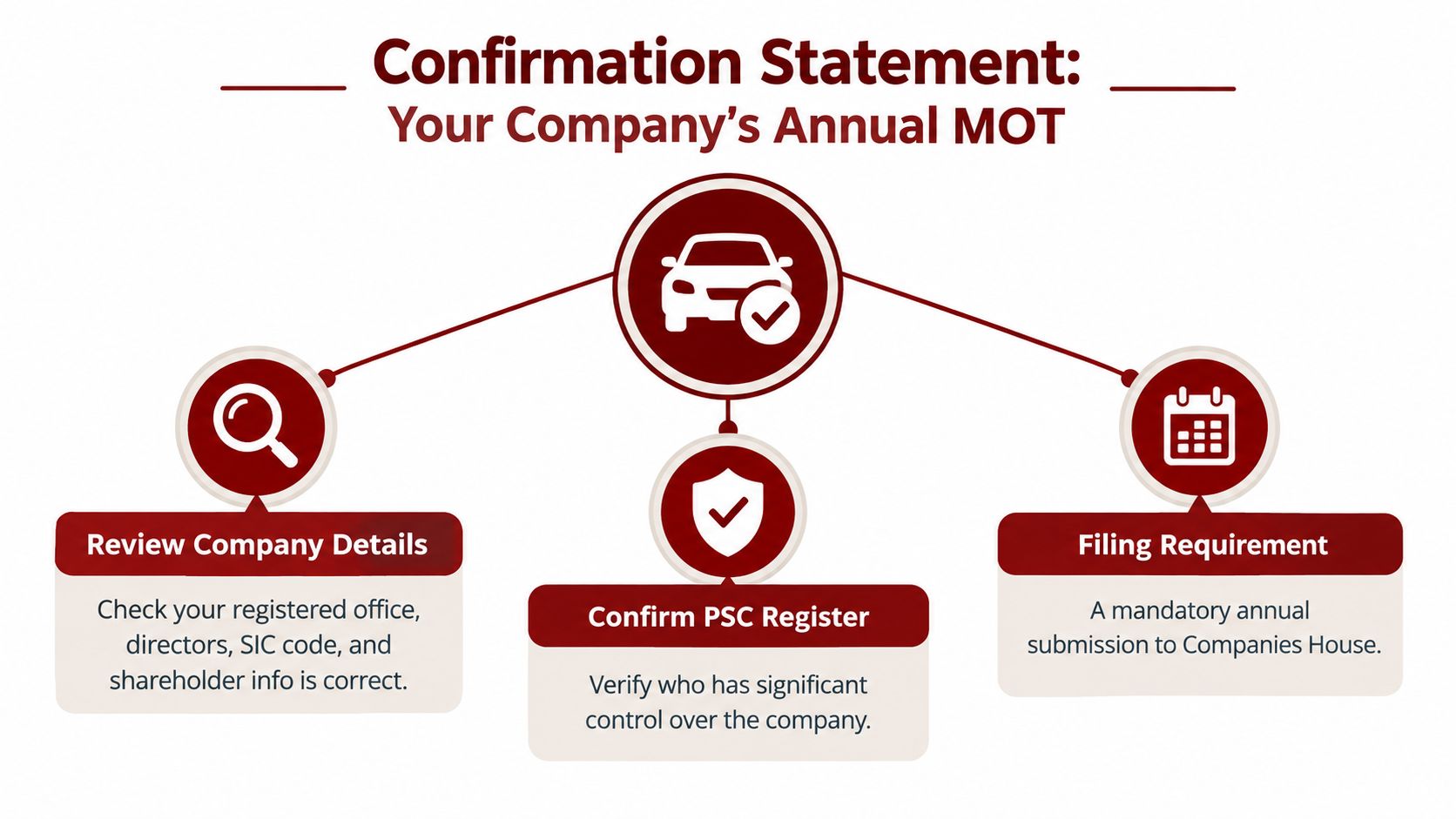
Think of a confirmation statement as an annual MOT for your company's public record. An MOT doesn't tell you how profitable the car is. It checks whether the vehicle meets the required standards at the time of inspection. A confirmation statement works in a similar way for company information held at Companies House.
The filing confirms that the registered details are up to date. It isn't a report on revenue, profit, cash flow or tax. Those matters belong in other compliance documents, including annual accounts and tax returns.
What you check before filing
Before submitting, review the information that Companies House expects the company to keep current:
- Registered office: Confirm that the official address is correct and that company correspondence can reach you there.
- Directors: Check names and appointment details, and make sure changes have been reported through the appropriate process.
- SIC code: Confirm that the description of the company's business activity still reflects what it does.
- Shareholder information: Review the share structure and shareholder details shown on the register.
- People with significant control: Check that the PSC information remains accurate.
These checks explain why the filing exists. Customers, lenders, suppliers and other interested parties use the public register to understand who runs a company and what it does. An inaccurate entry can create questions later, particularly when a business opens an account, seeks finance or changes ownership.
How it differs from annual accounts
Annual accounts describe financial performance and financial position. A confirmation statement checks corporate information. The two filings may be due around similar times, but they serve different purposes and should be tracked separately.
A company can therefore have no trading activity and still need to file a confirmation statement. Dormant status doesn't remove the obligation to keep the company's registered information current. Likewise, filing annual accounts doesn't automatically complete the confirmation statement requirement.
New directors often find the distinction clearer when they ask one question: am I reporting money, or am I confirming company details? If you're reporting the company's finances, you're probably dealing with accounts. If you're confirming ownership, control, addresses or business classification, you're looking at the confirmation statement. For a fuller explanation of the filing and its contents, see this guide to what a confirmation statement is.
Companies House Fees Online Versus Paper Filing
A founder filing after the 2026 fee change faces a simple choice: pay the lower online charge or budget for paper submission. Companies House charges £50 online and £110 on paper. Online filing is therefore £60 cheaper for each chargeable payment period, provided the director can use the digital service. The official filing guidance explains the available routes and requirements (Companies House filing guidance).
| Filing Route | Fee 2026 | Previous Fee | Increase |
|---|---|---|---|
| Online | £50 | £34 | About 47% |
| Paper | £110 | £62 | About 77% |
The official announcement records the previous fees and the increases that took effect on 1 February 2026. The online fee rose by about 47%, while the paper fee rose by about 77%, as shown in the Companies House fee change announcement. Those changes matter when setting a compliance budget, particularly for a company that previously treated the filing as a minor annual expense.
Why online filing usually wins
Online filing saves money in two ways. It carries the lower government fee and avoids the higher charge attached to paper submission. For a director with straightforward records, the digital route is usually the clearest budget choice.
| Your situation | Sensible route | Budgeting point |
|---|---|---|
| Simple records and confident director | Online filing | Use the lower direct fee |
| Records need checking | Online filing with professional support | Add the service charge, but retain the digital route |
| Limited digital access | Paper filing | Allow for the higher official fee and slower processing |
| More than one update in the same period | File the necessary update | The confirmation-statement charge is payable once in the payment period |
The once-per-12-month payment rule changes the calculation when information needs correcting. Suppose the company files its confirmation statement, then discovers that its shareholder or registered-office details need updating. A second confirmation statement in the same payment period does not create another confirmation-statement fee.
The rule is not permission to leave inaccurate information on the register. File the correction when needed, then check the company's payment period before assuming that a further submission will add another government charge. In some cases, timely refiling improves the record without increasing the official confirmation statement cost.
Professional help remains a separate budget item. Compare what the firm checks, prepares and submits, rather than comparing only its fee with the Companies House charge. Company secretarial services can include wider administrative support alongside the filing.
What Accountants Typically Charge and What Is Included
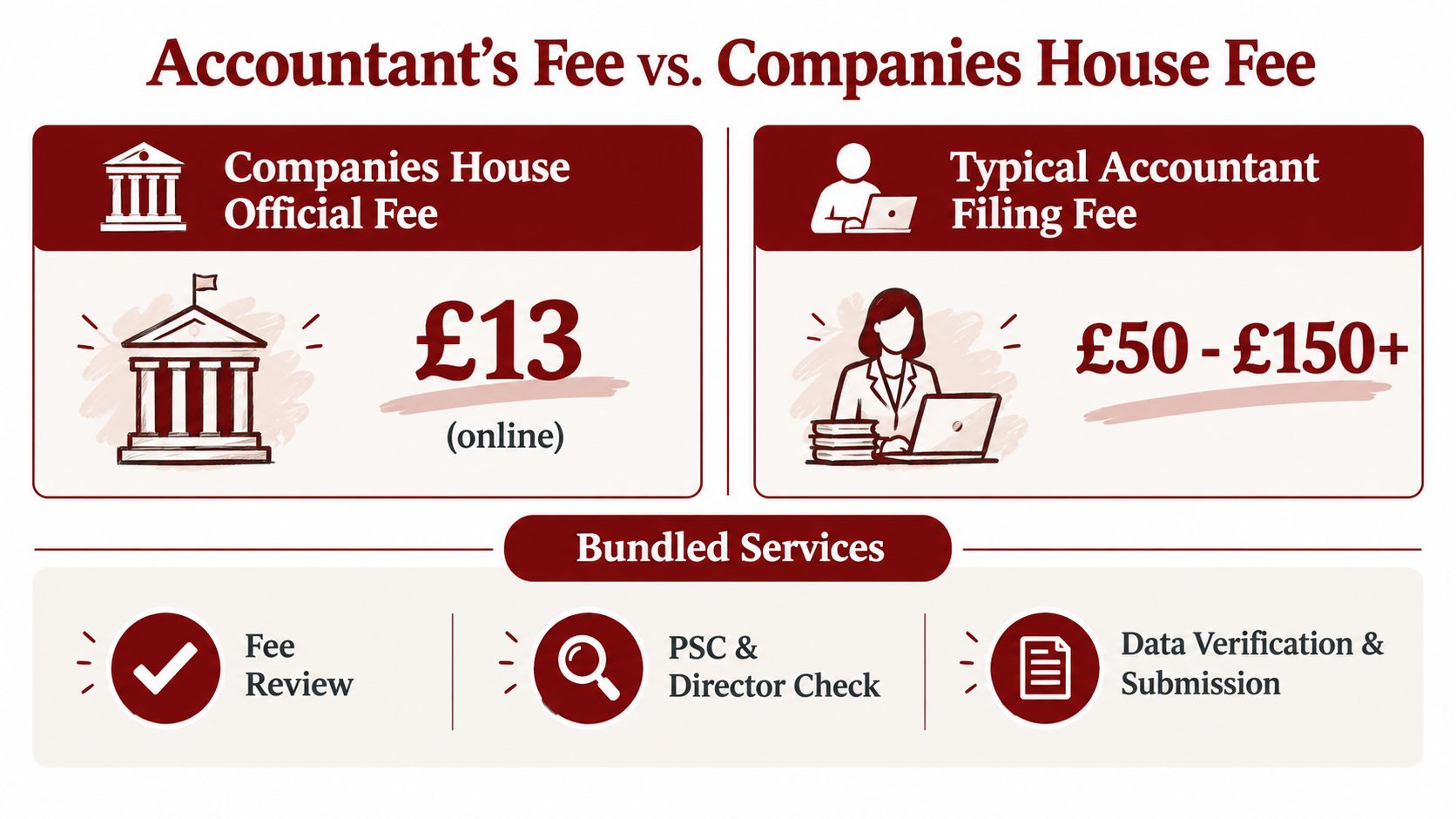
An accountant's invoice isn't an alternative way to pay the Companies House fee. It normally covers time, responsibility and professional checking. The accountant may review the company's record, identify inconsistencies, ask for missing information, prepare the submission and retain evidence that the filing was completed.
That service can be valuable when the company has changed directors, issued shares, altered its business activity or moved premises. It can also be useful when the director has never filed before and would rather have a clear process than use the register alone.
What a basic service may include
Ask the firm to state exactly what its fee covers. A standard confirmation statement service may include:
- Information request: The accountant asks you to confirm changes to directors, shareholders, PSCs, addresses and business activity.
- Record review: The firm compares your answers with the company's Companies House information.
- Submission: The accountant completes and files the confirmation statement through the appropriate channel.
- Completion evidence: You receive confirmation that the filing has been submitted or accepted, depending on the firm's process.
The Companies House fee may be passed through separately or included in the quoted price. That distinction matters. A quote that appears to be £100 may or may not include the official filing charge, and VAT may also apply depending on the provider and service.
Questions that expose the real price
A useful quote should answer practical questions without jargon:
- Is the Companies House fee included?
- Is VAT included or added?
- Does the service cover a basic filing only, or record corrections as well?
- Will the accountant check PSC and share information?
- Does the price cover another filing during the same payment period?
- Are urgent submissions charged separately?
- What happens if the company record contains an inconsistency?
Corrections are often where the scope changes. An accountant may need to investigate historic filings, prepare additional forms or explain what evidence is required. That work isn't the same as submitting a clean confirmation statement, so it may reasonably appear as an add-on.
A low headline fee can become expensive if it excludes the checks your company actually needs.
The right comparison is therefore total service value, not just the cheapest advertised number. A director with one company and perfectly maintained records may only need a basic submission. A growing business with frequent changes may value a recurring company secretarial arrangement, because it creates a place to record changes as they happen. Guidance on assessing the relationship and service scope is available in this resource on how to choose an accountant.
Filing Frequency Deadlines and How to Stay on Track
Timing determines both compliance and cost. Companies House guidance uses a 12-month payment period for the confirmation-statement fee, while the confirmation statement itself must be filed within the required window after the review date. Directors should check the company's own record rather than relying on a generic calendar date.
The review date is linked to the company's filing history and incorporation details. The Companies House register shows the relevant due information, which makes it the safest place to confirm the deadline.
A simple filing timeline
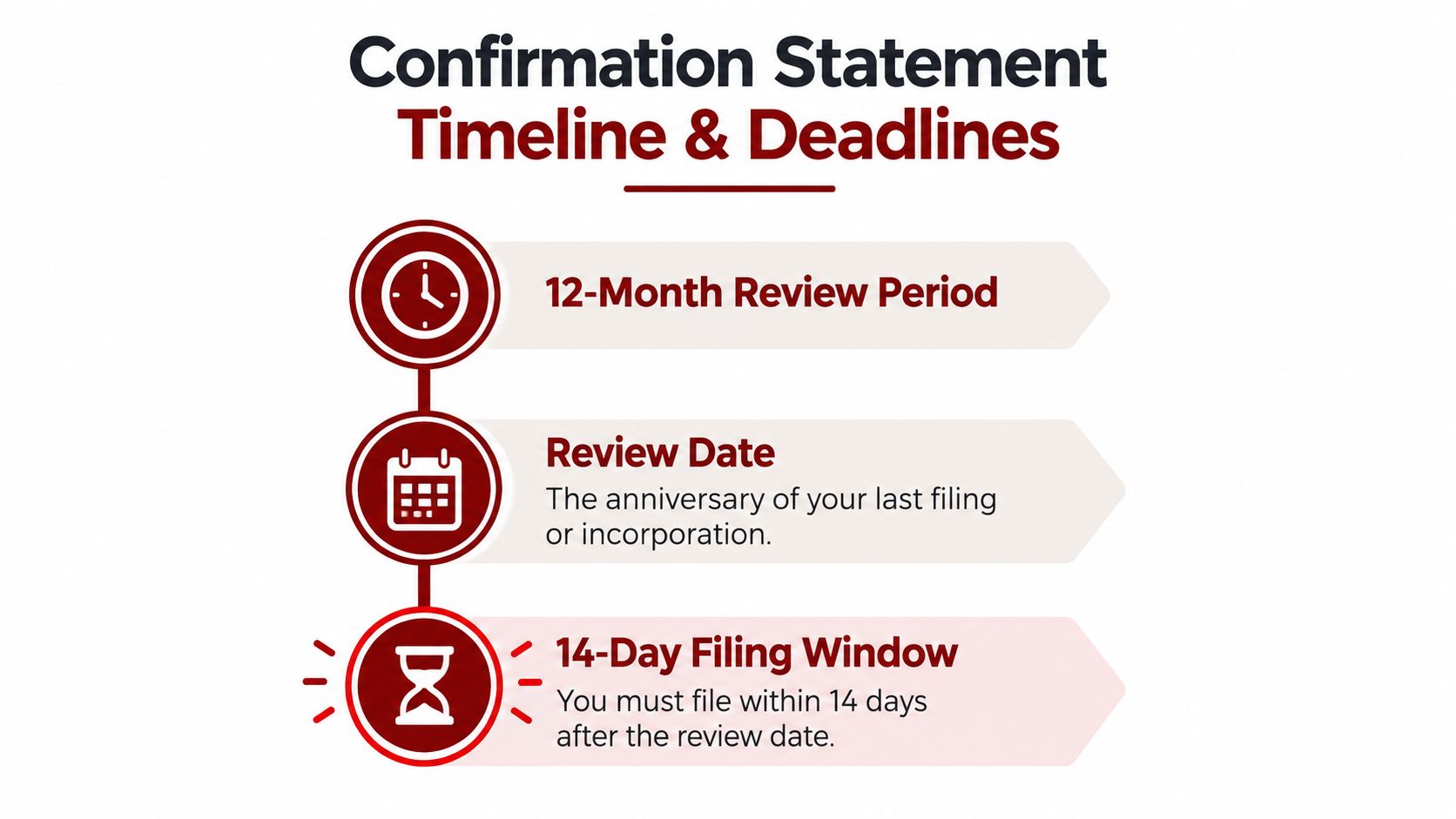
Use this sequence:
- Review period: The company moves through its 12-month review period.
- Review date: You check the company details and identify the review date shown for the filing.
- Filing window: You submit the confirmation statement within 14 days after the review date.
- Payment-period check: Before making any additional filing, establish whether the company remains within the same 12-month payment period.
Filing early can be useful when the information is already correct and the director wants to clear the task. But timing can affect the company's future filing cycle, so don't file early just because you received a reminder. First check what date the early submission will establish and whether it fits your wider compliance schedule.
Calendar habit: Set a reminder before the review date, not on the final day of the filing window.
A practical system has three reminders. The first prompts you to review the record. The second gives you time to collect details from shareholders or directors. The third warns you to verify that Companies House has accepted the submission.
Keep this deadline separate from annual accounts. Accounts involve financial information and have their own timetable. A single compliance calendar can contain both tasks, but each entry should identify the document being filed.
For a visual explanation of the filing process and timing, you can also use this confirmation statement filing video.
Penalties Late Filing Risks and Cost Saving Options
A low confirmation statement cost only stays low when the filing is complete, accurate and submitted on time. If a deadline is missed, the company may spend more later dealing with the correction, the follow-up, or the wider compliance problem.
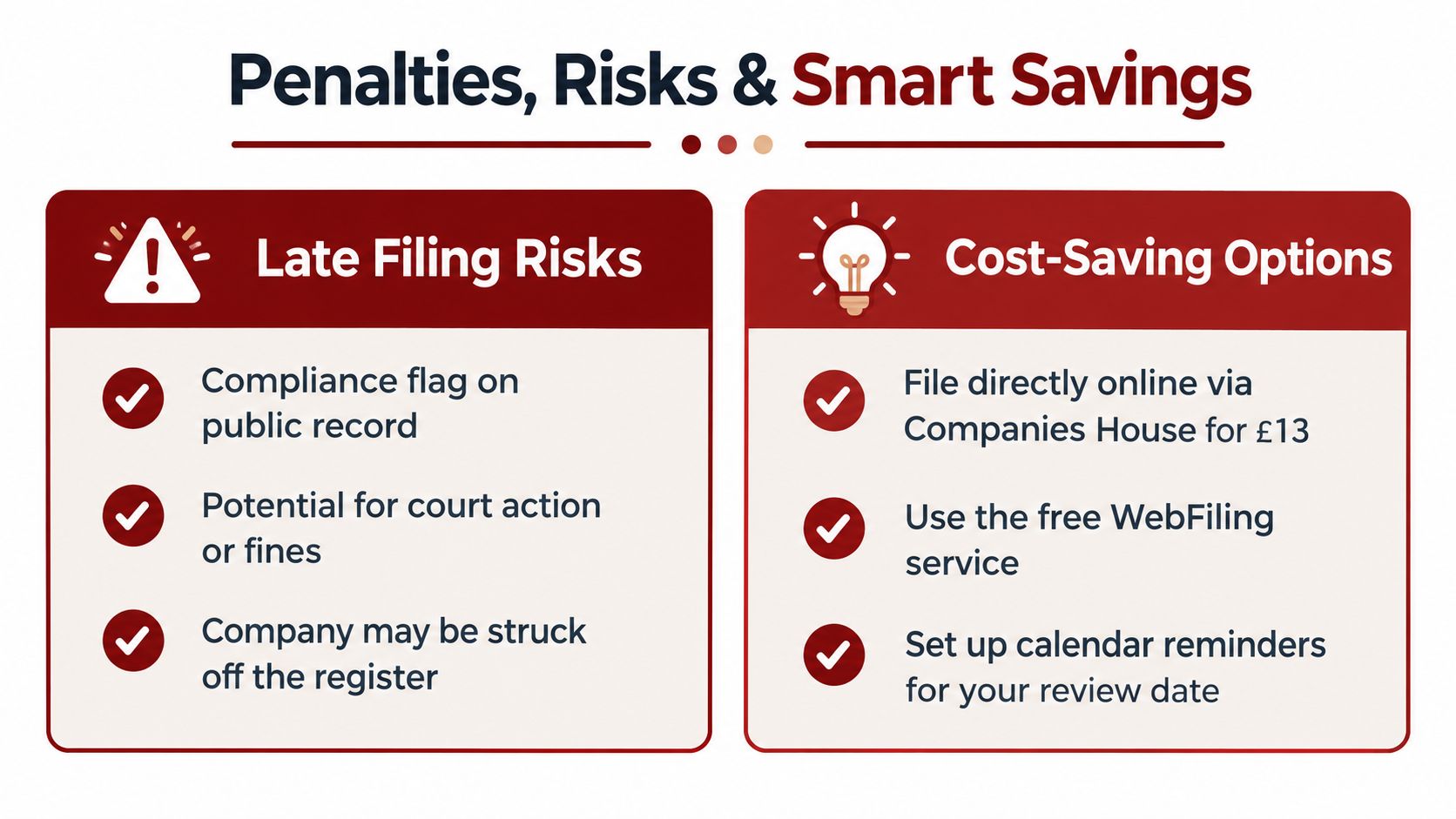
Late or missing filings can leave a public compliance mark on the record. In more serious cases, Companies House can move from reminders to enforcement, and the company may face court action, fines or removal from the register. Directors should treat the confirmation statement as a legal duty, not a box-ticking update.
Where the saving comes from
The first saving is avoiding a second filing problem. The confirmation statement charge is payable once in each 12-month payment period, so a careless refile can create extra cost even before any penalty risk is considered, per Companies House confirmation statement guidance. That is why the budgeting question is not only “online or paper?”, but also “do we need to file again yet?”
The 2026 fee rise makes that choice sharper. The official fee-change announcement shows that the digital route became more expensive, and the paper route rose even more sharply than the online route. For businesses comparing routes, the message is simple, use the digital path where you can, because paper filing now carries a heavier cost burden and more operational friction.
A sensible saving plan focuses on habits that stop mistakes before they become repeat work:
- Use the payment period well: If a correction is needed, check whether the company is still inside the same 12-month payment period before assuming another government charge applies.
- Prepare before signing in: Collect the company details first, then file in one sitting, so an interrupted return does not drift past the deadline.
- Choose support with a purpose: An accountant makes sense when the review, correction work or deadline management is worth the fee, which is the kind of trade-off discussed in cost management for accounting firms.
- Record changes immediately: Keep a simple company secretarial log. For example, note “2 May, new director appointed, PSC update required, check register before next filing.” Small notes like that are cheaper than rebuilding the company history at filing time.
The cheapest filing is usually the one that avoids rework, protects the public record and gets the date right first time.
Making the Right Choice for Your Company Budget
Your confirmation statement budget has three levers. Route controls the official charge. Timing determines whether a later filing falls within the same 12-month payment period. Support determines whether you pay a professional to review and submit the information.
A simple company with unchanged details may be comfortable filing online directly. A company with new shareholders, director changes or uncertain PSC information may prefer professional support. Neither approach is automatically right for every business. The correct choice depends on the quality of your records and how much responsibility you want to retain personally.
A practical decision checklist
Before filing, answer these questions:
- Have you checked the review date? Use the Companies House record rather than guessing from memory.
- Are the company details accurate? Review the registered office, directors, SIC code, shareholders and PSC information.
- Will you file online? If you can use the digital route, it carries the lower official charge.
- Is another filing likely? Check the payment period before budgeting for a second confirmation-statement fee.
- Do you need an accountant? Ask whether the quote includes the government charge, VAT, record checks and corrections.
- Have you separated accounts from the confirmation statement? Put both obligations in your calendar, with separate descriptions and deadlines.
The best cost-saving decision isn't always the lowest invoice. It is the option that keeps the company compliant, prevents repeated administrative work and gives the director confidence that the public record is correct. Businesses reviewing wider overheads can also consider these cost reduction strategies while protecting essential compliance processes.
Check your company's review date now, confirm whether its details have changed and decide whether direct online filing or supported submission suits your records. Making that decision before the deadline gives you time to resolve discrepancies without turning a routine filing into an urgent expense.
Action Accountants Limited provides confirmation statement and company secretarial support, including practical help reviewing company details and managing compliance submissions. Visit Action Accountants Limited to discuss the right filing support for your startup or growing UK business.