
Do I Need an Accountant for a Limited Company Explained
Do I need an accountant for a limited company? Learn compliance deadlines, costs, services and when hiring pays off for UK founders.

The morning after Companies House confirms your new limited company, the excitement often gives way to a less attractive question: do I need an accountant for a limited company? You may have a business bank account to open, invoices to send and clients waiting, while statutory accounts, Corporation Tax and company records sit in the background.
The direct answer is no, UK law doesn't generally require you to appoint an accountant. You can prepare and file your own documents. But that legal freedom doesn't remove your responsibilities as a director, and it doesn't make the filing system simple.
The practical distinction: being legally allowed to self-file isn't the same as being operationally safe to self-file.
I advise first-time directors to judge the decision by risk, complexity and time, not by the word “optional”. A straightforward dormant company may be manageable without ongoing accountancy support. A trading company with VAT, payroll, CIS, property income or several directors can become expensive to run casually.
This guide sets out the three separate compliance clocks, what an accountant does, how DIY compares with professional support, and when the fee starts making financial sense. For founders in Colindale, Kingsbury, Edgware, Finchley and the wider North West London area, Action Accountants Limited's guide to registering a new business is a useful starting point if incorporation is still fresh.
Table of Contents
- Introduction Why This Question Matters Right After Incorporation
- What Limited Company Compliance Actually Requires in the UK
- What an Accountant Does for a Limited Company Beyond Filing
- Doing It Yourself Versus Hiring an Accountant Pros and Cons
- How Much an Accountant Costs and When the Fee Pays for Itself
- Signs It Is Time to Hire an Accountant for Your Limited Company
- Next Steps for Founders in London and North West London
Introduction Why This Question Matters Right After Incorporation
A limited company gives your business its own legal identity. That separation can be valuable, but it also creates a formal framework around your records, tax and filings. Once you're a director, you can't treat the company bank account as an extension of your personal finances or leave paperwork until you have a quiet weekend.
The common mistake is to think there is one annual “accounts deadline”. There isn't. Your company has separate obligations to Companies House and HMRC, each with its own timing and preparation requirements. The first accounts can also follow different rules from later accounts, which catches many new directors who assume the dates will be obvious.
You may be perfectly capable of using accounting software, reconciling transactions and submitting forms. The question is whether you'll maintain that discipline while delivering work, chasing customers, managing suppliers and making decisions about drawings or dividends. Software can organise information, but it can't take responsibility for whether you've entered the right information or interpreted a rule correctly.
That is why the best answer to do I need an accountant for a limited company depends on the company you're running. Don't pay for a large package if the business is dormant and uncomplicated. Don't reject professional cover because filing is technically possible.
Legal permission answers whether you can file alone. Operational safety answers whether you should.
The decision becomes clearer when you examine the three compliance clocks first, then separate basic filing from the wider support an accountant can provide. Once you compare the likely fee with late penalties, lost time and avoidable errors, the choice is usually less mysterious.
What Limited Company Compliance Actually Requires in the UK
A limited company is a separate legal entity, but the director remains responsible for keeping adequate records, approving accounts and making sure filings reach the correct authority. Using FreeAgent, Xero, QuickBooks or another platform doesn't transfer that responsibility to the software provider.
The easiest way to understand the system is to picture three alarm clocks running at the same time. They relate to connected information, but they don't ring on the same date.
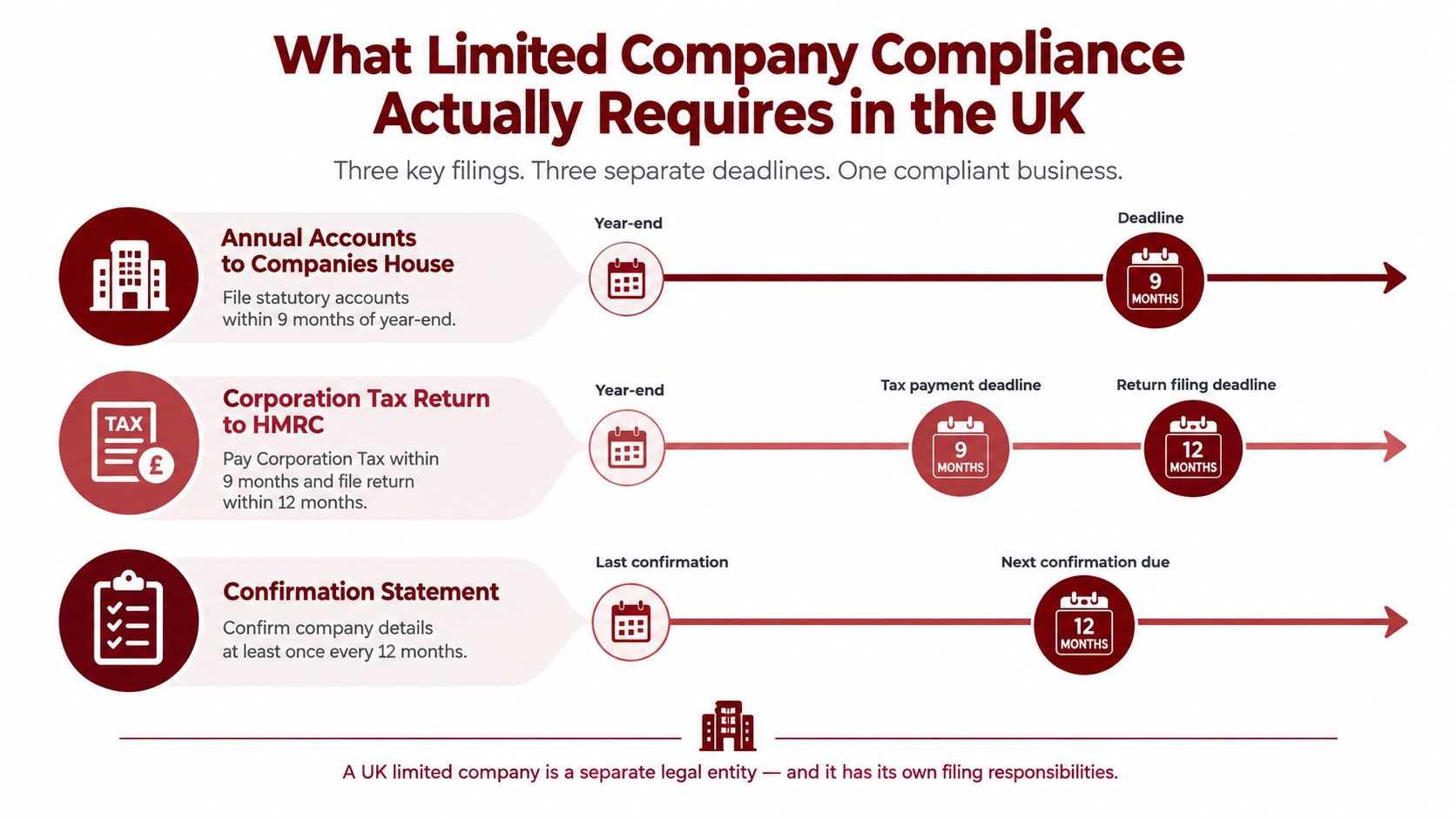
The Companies House clock
Your annual accounts must usually be filed with Companies House within 9 months of the accounting reference date, often described in practical terms as the company year-end. The government's guidance on preparing and filing annual accounts explains the relevant filing framework.
For the first set of accounts, the deadline can be 21 months from incorporation if that is longer. That longer first period doesn't mean you can ignore bookkeeping until the deadline. You still need reliable records from the day the company begins trading.
Your accounts must present the company's financial position in the required format. Directors need to review and approve what gets filed, even if an accountant prepares the documents.
The Corporation Tax clock
Corporation Tax creates a separate deadline. The tax must be paid, or HMRC must be notified where appropriate, within 9 months and 1 day after the end of the accounting period. The payment date isn't the same as the Company Tax Return date, so treating them as one task is risky.
The third alarm concerns the Company Tax Return, which must be filed within 12 months of the period end. You can therefore face a tax payment requirement before the final return filing deadline. That gap requires cash-flow planning, not just form completion.
Property activity can add another layer of judgement. If your company owns or disposes of property, understanding how HMRC values your property can help you identify when a valuation issue may need specialist input alongside accounting advice.
Your records connect every clock
Invoices, expenses, bank transactions, payroll records, VAT information and director transactions feed into the accounts and tax calculations. A missing receipt or incorrectly categorised payment can affect more than one submission.
You can read more about what statutory accounts are before deciding whether you have the knowledge and time to prepare them. In practice, timing mistakes are often more dangerous than complicated-looking forms, because the penalties apply automatically once the deadline passes.
The practical test is simple. Can you identify each deadline, close the books accurately, calculate the tax, approve the accounts and file the right documents without relying on memory? If not, professional support is sensible.
What an Accountant Does for a Limited Company Beyond Filing
An accountant's value isn't limited to pressing “submit”. Good support creates a chain from the first transaction to the final tax return, with checks at each stage. That matters because accounts prepared from disorganised records are slower, harder to review and more likely to contain omissions.
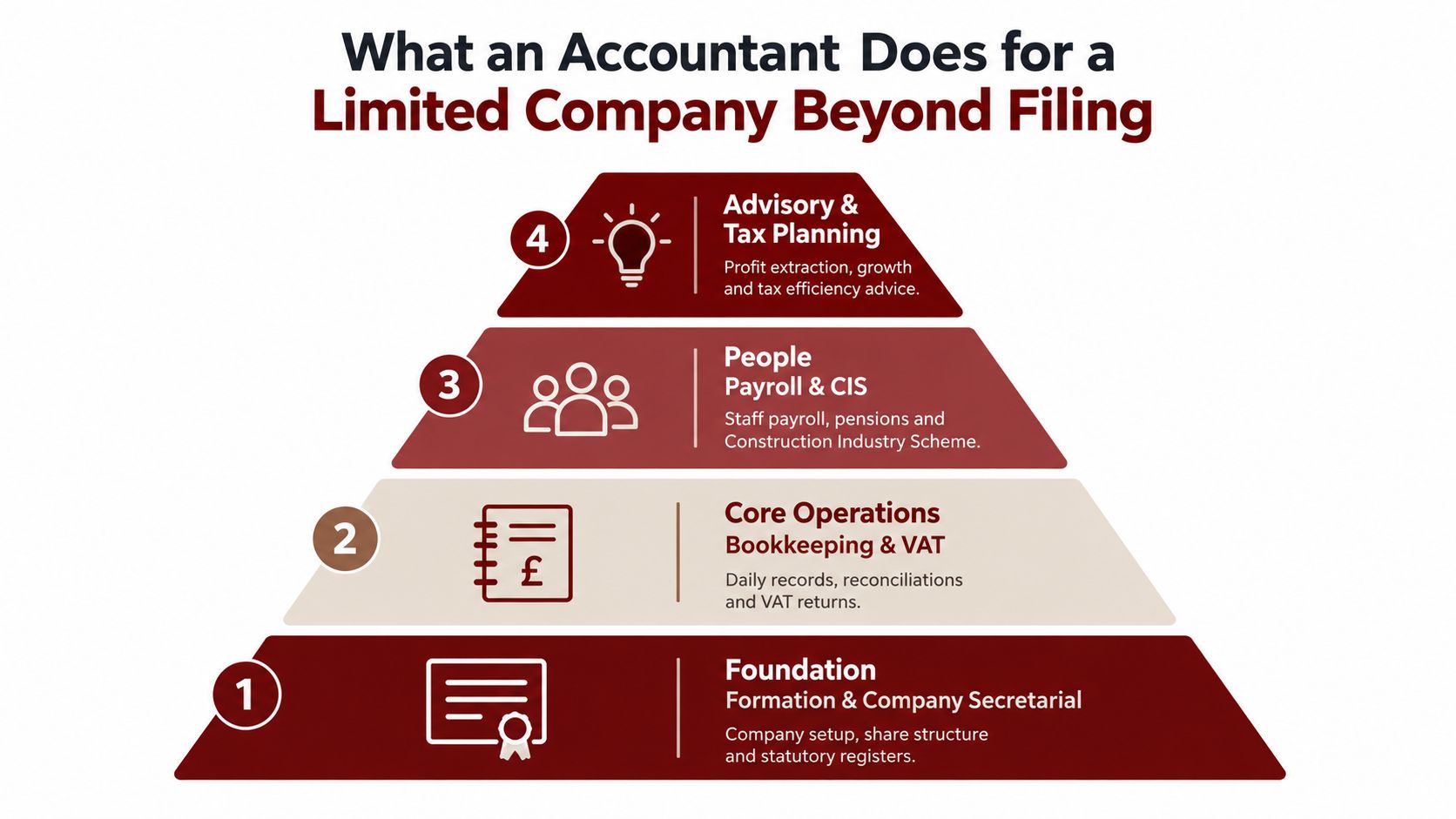
The foundation is formation and company administration
At the start, support may include choosing an appropriate share structure, maintaining statutory registers, recording director changes and keeping company details organised. Company secretarial work sounds minor until a change in ownership, registered office or director makes the records important.
A sensible accountant can also explain the distinction between company money and personal money, set up an orderly chart of accounts and establish a process for approving expenses. Those decisions reduce clean-up work later.
Bookkeeping and VAT keep the records usable
Bookkeeping means recording sales, purchases, expenses, bank movements and money owed. Reconciliations then test whether the accounting records agree with the bank and other evidence. Without that foundation, annual accounts become a reconstruction exercise.
VAT adds filing obligations and judgement about how transactions should be treated. A business may need help deciding which records to retain, how to handle VAT on expenses and how to prepare returns consistently. If you're comparing software for a trade business, these accounting software reviews for trades can help you understand the features that matter, although software selection doesn't replace tax advice.
Payroll, CIS and tax turn records into decisions
Once you employ people, payroll involves pay calculations, deductions, reporting and workplace pension administration. Construction businesses may also need Construction Industry Scheme processes for subcontractors. A missed or incorrect process can create follow-up work precisely when you're trying to deliver projects.
At the top of the service stack, an accountant prepares statutory accounts and Corporation Tax returns, then helps you understand salary, dividends, expenses and cash retained in the company. Personal tax returns may also matter for directors, landlords or individuals with income outside the company.
The workflow is cumulative:
- Bookkeeping: Captures the underlying transactions.
- Reconciliations: Checks that the records reflect reality.
- Accounts: Converts the records into statutory financial statements.
- Tax and advice: Uses the figures to meet obligations and plan sensibly.
Action Accountants Limited, led by Georgie Zdrenghea, provides formation, bookkeeping, payroll, VAT, statutory accounts, tax and advisory support for businesses including construction and property clients. The wider point is that you can buy these services separately, but fragmented responsibility often leaves gaps between them. You should understand exactly who checks the records, calculates the tax and owns each deadline.
For a practical overview of wider support, see eight ways an accountant can help your small business.
Doing It Yourself Versus Hiring an Accountant Pros and Cons
DIY filing can be a reasonable decision for a director who has a simple company, understands the records and treats compliance as a scheduled business process. It becomes a poor decision when “simple” really means “I haven't looked closely yet”.
The legal question is only the starting point. The operational question is whether you can manage the separate Companies House and HMRC clocks while maintaining accurate records. Here is the comparison I use with new directors.
| Factor | DIY Approach | With an Accountant |
|---|---|---|
| Upfront cost | Lower direct spend, especially where software handles basic records | Ongoing fee for agreed compliance and advisory work |
| Control | You see and enter every transaction yourself | You retain approval while delegating preparation and checks |
| Deadlines | You must maintain your own calendar and reminders | The accountant tracks agreed deadlines and requests information |
| Bookkeeping | You reconcile, classify and correct transactions | Support can include bookkeeping, review or year-end adjustments |
| VAT | You prepare returns and resolve treatment questions | The accountant prepares or reviews returns and flags issues |
| Payroll | You manage pay, deductions and pension administration | Payroll is processed and reported as part of the service |
| CIS | You manage subcontractor verification and deductions | A construction-aware accountant can handle the relevant workflow |
| Advice | You research decisions yourself | You can ask about dividends, expenses, tax and growth before acting |
| Risk | Errors and late filings remain your responsibility | Professional preparation adds review and deadline discipline, but director responsibility remains |
Where DIY works
DIY is most defensible when the company is dormant or has very limited activity, there are no employees, no VAT complications and no construction subcontractors. You still need to keep records, understand the filing dates and retain evidence. A basic package can be enough if you know exactly what it covers.
The benefit is direct control and a lower immediate outlay. The cost is your time and the risk that you only discover a problem when preparing the first accounts.
Where professional support wins
An accountant earns their fee through more than document production. They can challenge unclear transactions, identify director loan issues, prepare tax computations, maintain a filing timetable and explain what the figures mean before you make a withdrawal or investment.
If you're weighing firms, use a structured process such as how to choose an accountant. Ask whether the quote includes bookkeeping, VAT, payroll, CIS, year-end accounts, Corporation Tax and director tax returns. A cheap headline price can become expensive if every important task sits outside the package.
How Much an Accountant Costs and When the Fee Pays for Itself
UK-facing guidance places small-company accountancy packages at roughly £800 to £2,000 a year, with more complex packages rising to approximately £1,500 to £4,800 annually. These ranges come from guidance on how much an accountant costs, and they should be treated as market indications rather than a quote for your company.
Price depends on the work involved. A dormant company with clean records needs less support than a trading business with VAT, payroll, CIS, property income, multiple directors or frequent bookkeeping questions. The right comparison is not “accountant versus free”. It is professional support versus the combined cost of fees, time and mistakes.
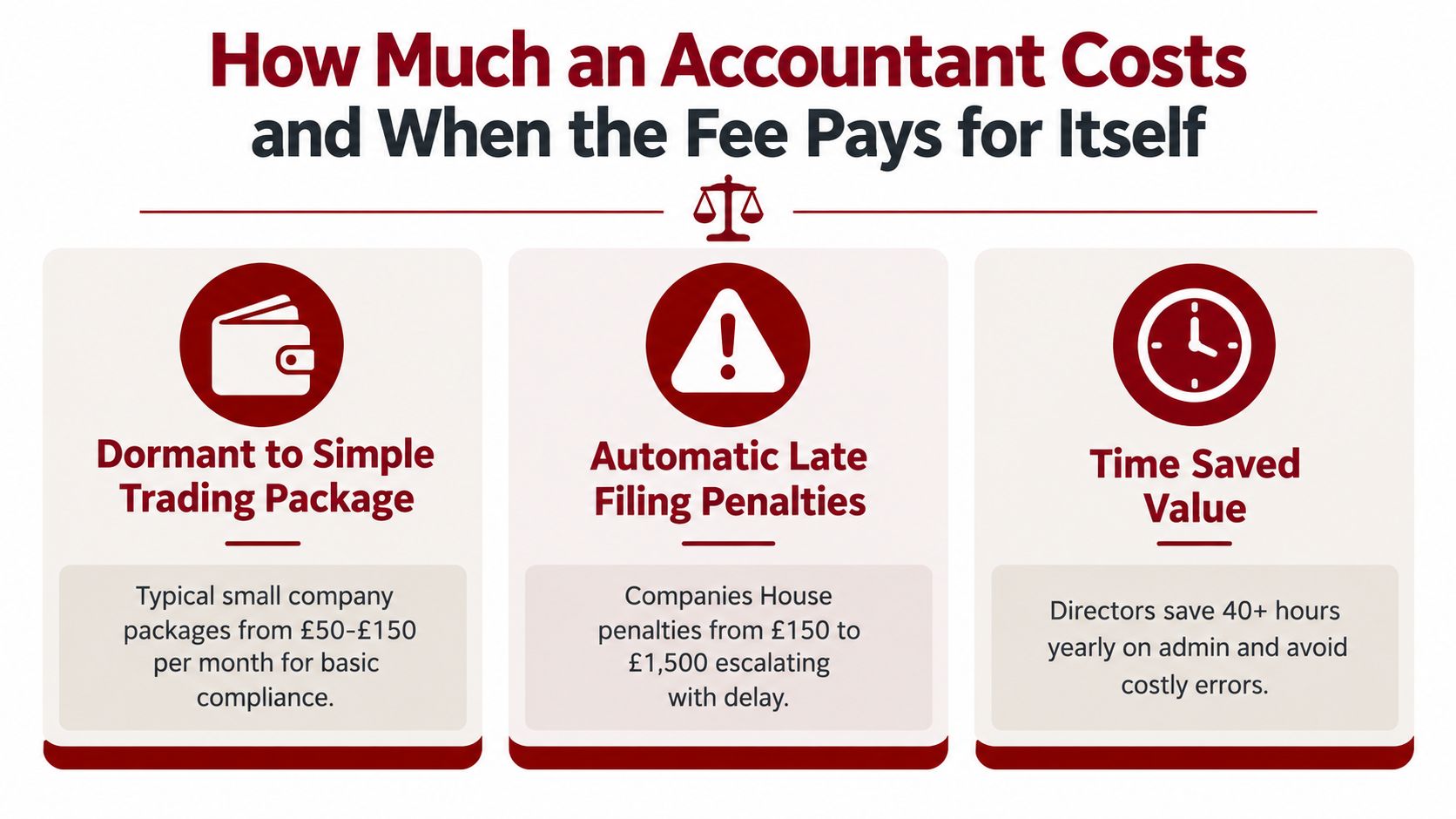
The penalty arithmetic is unforgiving
For a private limited company, Companies House charges £150 when accounts are up to one month late, £375 when they are more than one month but not more than three months late, £750 when they are more than three months but not more than six months late, and £1,500 when they are more than six months late. The official late filing penalty guidance confirms that penalties double when accounts are late in two successive years.
One missed filing can therefore cost more than routine compliance support, before considering the time spent correcting the issue. Late accounts can also lead to enforcement action beyond a fine, including the company being struck off the register.
This isn't an unusual administrative hazard. Companies House issued 317,985 late-filing penalties in 2024 to 2025, according to its Independent Adjudicators' annual report. The previous year saw 323,643 penalties worth £164.7 million, while 98.5% of accounts were filed on time and the 1.5% filed late generated almost £80 million from about 80,000 double penalties, as reported in the same official source.
Calculate your real break-even point
Don't only ask whether the annual fee fits your budget. Ask how many evenings you'll spend maintaining the books, how confidently you can calculate Corporation Tax, what happens if a customer dispute delays your records and whether you'll recognise a director loan or disallowed expense.
A simple company may reasonably wait before appointing an accountant. But once the business is active and the compliance workload competes with billable work, the fee often buys certainty, recovered time and fewer preventable decisions. Request a written scope, confirm filing responsibilities and choose the lightest service that covers your risks.
Signs It Is Time to Hire an Accountant for Your Limited Company
You don't need to wait for a crisis. Certain changes make the decision clear because they add another compliance layer or increase the consequences of poor records.
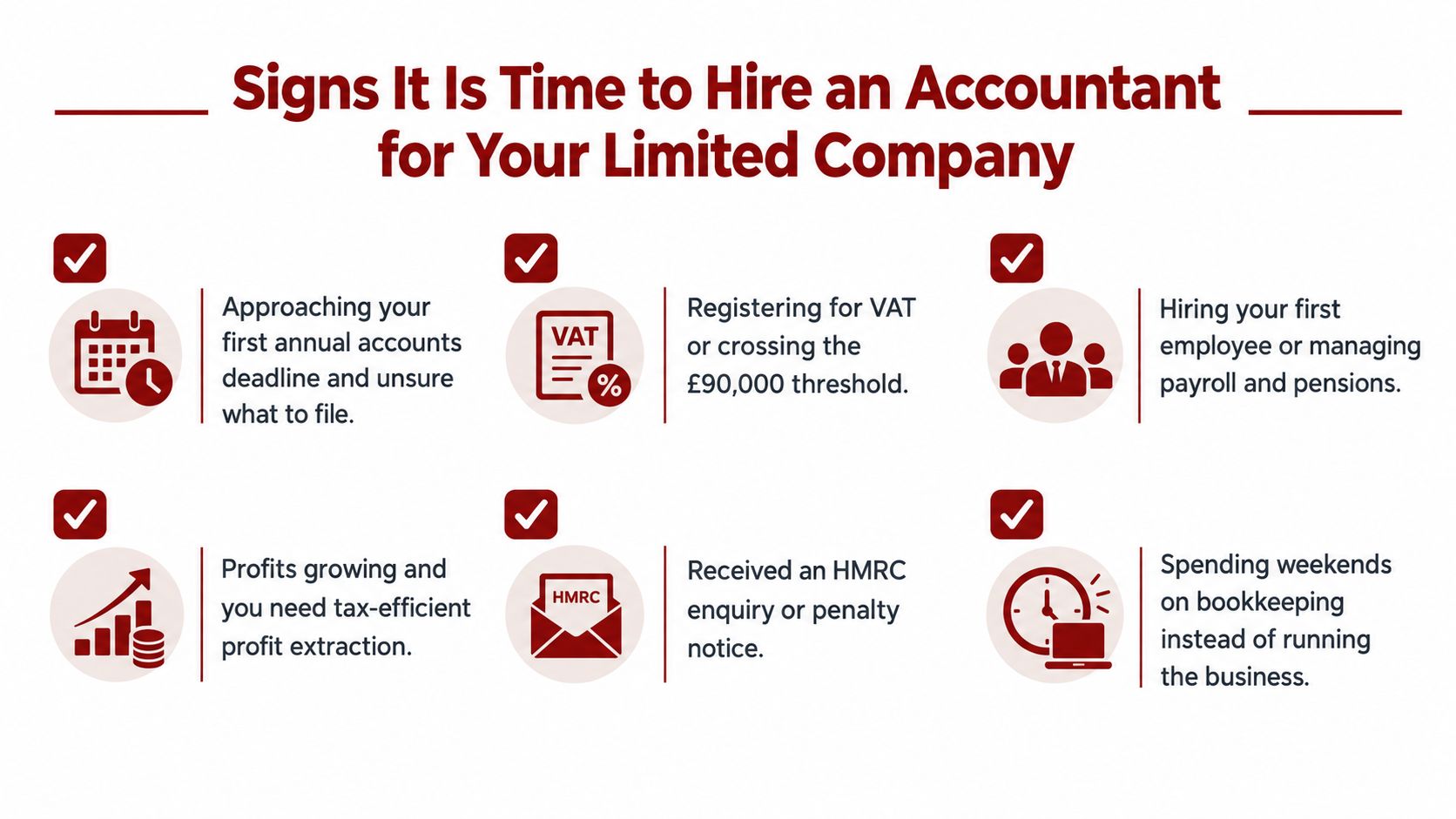
Look for these signals:
- Your first accounts deadline is approaching: If you aren't sure which accounts to file, how to close the records or how the first-period timing applies, get help before the deadline becomes urgent.
- You're registering for VAT: VAT requires consistent transaction treatment and regular reporting. It also makes bookkeeping quality more important.
- You're hiring staff: Payroll, deductions and pension administration create recurring obligations that don't disappear when trading gets busy.
- You're using subcontractors in construction: CIS needs a process for subcontractor information, verification, deductions and records. A general bookkeeping habit may not cover it.
- The company is buying property or earning property income: Transactions can involve valuations, financing, expenses and tax treatment that deserve review before completion.
- The books are falling behind: A backlog is rarely just an admin problem. It can hide missing invoices, duplicated expenses, unpaid tax or unclear company drawings.
- HMRC or Companies House has contacted you: A penalty notice, enquiry or compliance query is the point to bring in someone who can interpret the request and protect the response timetable.
- You're making profit extraction decisions: Dividends, salary and retained funds should follow the company's actual results and records, not guesswork.
For contractors and landlords around Colindale, Kingsbury, Edgware and Finchley, sector experience can matter as much as general filing knowledge. A dormant company or simple side hustle may still be suitable for DIY. An expanding operation with several income streams usually isn't.
Next Steps for Founders in London and North West London
Start with your company's accounting reference date and write down every Companies House and HMRC deadline in one calendar. Then gather the bank statements, sales invoices, purchase receipts, payroll information, VAT records and details of any money you've paid into or taken from the company.
Next, choose the level of support you need. You might only require year-end accounts and Corporation Tax preparation, or you may need monthly bookkeeping, VAT, payroll, CIS and regular management advice. Ask for a clear scope that states who prepares the records, who reviews them, who submits each return and how the accountant communicates missing information.
Don't choose solely on the cheapest annual figure. Choose a process that matches your transactions and your ability to stay organised. Responsive communication matters when a deadline is approaching, and construction or property activity requires an adviser who understands the records behind the numbers.
Action Accountants Limited works with founders and established businesses in Colindale, Kingsbury, Queensbury, Edgware, Finchley and across North West London, with remote support available elsewhere in the UK. A first conversation should leave you with a clearer view of your obligations, the records required and whether full support is justified.
Book an initial review before the next deadline, not after a penalty notice. Protect the company's records, preserve your time and make decisions from reliable figures rather than paperwork anxiety.
Action Accountants Limited provides limited company accounts, Corporation Tax returns, bookkeeping, VAT, payroll, CIS and practical business advice for founders across North West London and the wider UK. Visit Action Accountants Limited to discuss the right level of support for your company and arrange an initial conversation.