
Owner Managed Business Explained and How to Run It Well
What is an owner managed business? Learn structures, tax, payroll and growth tips to run your owner managed business with confidence.

You've started the business, won the work and built a reputation. Now you're answering client messages before breakfast, approving supplier payments at lunch and checking the payroll after dinner. In a North West London business, that can feel normal for a while. You're the person setting prices, managing delivery, dealing with HMRC and deciding whether there's enough cash to pay yourself.
That combination gives an owner-managed business its energy. Decisions happen quickly because the person with the responsibility is close to the work. It also creates a risk that becomes harder to ignore as the business grows: too much knowledge, authority and financial control can sit with one person.

The central question: Is your business benefiting from your involvement, or has it become dependent on your constant availability?
This guide takes you from the basic meaning of an owner managed business to the decisions that matter in practice. You'll look at business structures, salary and dividends, HMRC reporting, compliance controls, cash-flow planning and the point at which delegation becomes a protection for the business rather than a loss of control. If financial information feels harder to use than it should, this guide to staying financially steady when numbers aren't your native language can help you build confidence without pretending every decision is simple.
Table of Contents
- Introduction What It Really Means to Run an Owner Managed Business
- Understanding the Owner Managed Business Concept
- Choosing the Right Structure for Your Owner Managed Business
- How Pay and Tax Work When You Are the Owner and the Manager
- Staying Compliant Without Losing Control
- Practical Accounting Cashflow and Growth Planning for Founders
- Next Steps to Build a Resilient Owner Managed Business
Introduction What It Really Means to Run an Owner Managed Business
The phrase owner managed business describes more than a legal structure. It describes where ownership and day-to-day control meet. You might own a limited company, trade as a sole trader or share a partnership, but the defining feature is that you're directly involved in running the operation.
That involvement can be a genuine advantage. You know which customers pay promptly, which jobs regularly overrun and which supplier can be trusted when a deadline moves. A large organisation may need several meetings before making a decision that you can make over a coffee.
The same closeness can make the business fragile. If you alone understand the bank position, approve every purchase, hold the customer relationships and know how work moves through the company, an illness, family emergency or sustained period of pressure can interrupt trading. The business may be profitable on paper while remaining dependent on your memory and stamina.
The UK has long relied on this model. The Family Business Research Foundation reports about 5.13 million family businesses in 2023, more than 93% of all UK firms, with roughly 1.05 million employing staff. Its research also says 73% of SME employers were family-owned in 2024, and around 72% were both family-owned and family-managed. These figures show why owner management isn't a niche arrangement. It's a central part of how UK businesses operate. (Family Business Research Foundation data)
You'll get more value from the model when you separate three things:
- Ownership: Who benefits from profits and carries the long-term risk?
- Management: Who makes operational decisions and directs people?
- Control: Which approvals, records and checks prevent mistakes?
At the beginning, one person may hold all three roles. Above a certain level of complexity, that arrangement needs to evolve. The aim isn't to remove the owner's judgement. It's to make sure the business can use that judgement without requiring the owner to touch every task.
Understanding the Owner Managed Business Concept
Think of an owner-managed company as a small boat where the owner is both captain and navigator. The captain chooses the destination, accepts the commercial risk and decides which opportunities are worth pursuing. The navigator studies the route, monitors fuel and keeps the boat moving safely through changing conditions.
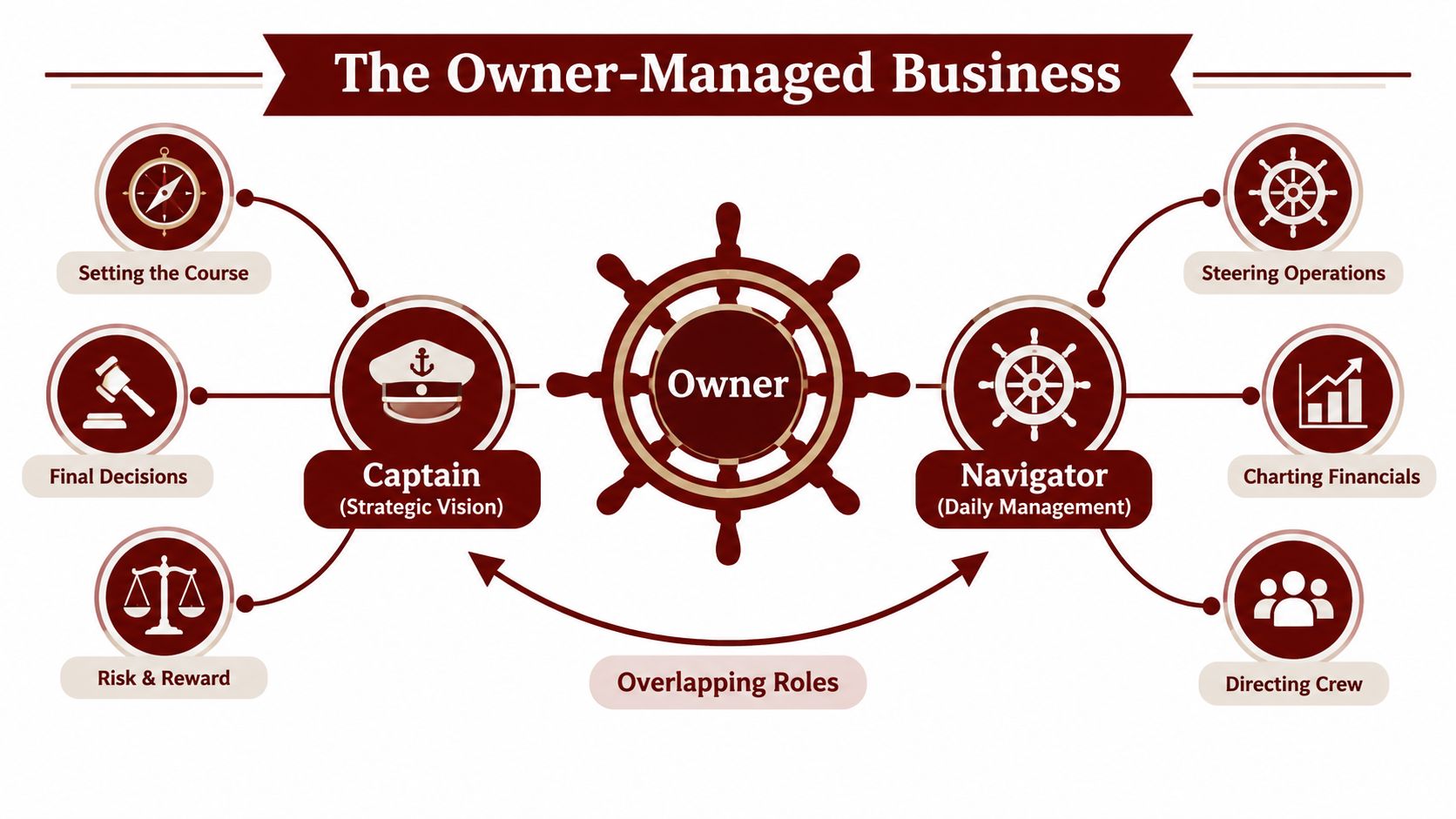
In business terms, the owner may set the strategy while also:
- approving quotes and contracts;
- handling customer complaints;
- managing staff and subcontractors;
- checking bank transactions;
- processing or reviewing payroll;
- deciding when to draw money from the business.
That overlap creates speed, accountability and context. You don't need to explain every commercial detail to a distant decision-maker. You already know why a customer matters, why a project is risky or why a particular cost is necessary.
It can also create concentration risk. A decision may be made quickly, but nobody else may understand the reasoning. A payment may be authorised correctly, but the records may remain incomplete. A customer relationship may be strong, but it may exist only in the owner's phone.
Owner managed and founder-led are not identical
A founder-led business can develop a management team that runs most daily activity while the founder concentrates on product direction, investment or culture. An owner-managed business keeps the owner close to operational decisions, even when the business has employees or meaningful turnover.
That distinction matters when a firm grows beyond its early stage. A founder can remain influential without approving every invoice. An owner manager who continues to hold every decision may become the main operating constraint.
The government's business population estimates show the scale of the UK's owner-operated base. At the start of 2025, the UK had an estimated 5.7 million private-sector businesses, and 4.3 million had no employees beyond the owners. (UK business population estimates for 2025)
Why sector makes a difference
Direct control is especially common where margins, delivery and compliance are closely connected. Government-backed survey analysis for 2020 found that 78% of SME employers were majority-owned by the person or family who established them, while 77% were family-owned businesses. Family ownership covered 80% of micro businesses, 66% of small businesses and 58% of medium-sized businesses. Construction recorded 88% family-owned businesses, with retail and wholesale at 84%, and transport, accommodation and food both at 83%. (Family Business Research Foundation reports)
For a contractor, for example, the owner may know which site requirements affect costs and which subcontractor documents are still outstanding. That knowledge is valuable. The next step is to record and share it so the business doesn't lose control when the owner is unavailable.
Choosing the Right Structure for Your Owner Managed Business
Your legal structure is the vehicle carrying the business. The right choice depends on risk, ownership, administration, tax advice and how you expect the business to develop. It isn't a permanent statement about your ambition, but changing structure later can involve cost and disruption.
| Feature | Sole Trader | Partnership | Private Limited Company |
|---|---|---|---|
| Ownership | One individual owns the business | Two or more partners share ownership | Shareholders own shares in the company |
| Liability | The owner and business are generally not legally separate | Partners may have personal exposure | The company is a separate legal entity, subject to exceptions |
| Decision-making | Direct and simple | Shared according to the partnership agreement | Directors manage the company for shareholders |
| Administration | Usually lighter | Partnership records and tax responsibilities apply | Accounts, company records, payroll and filings require more organisation |
| Profit extraction | Business profit belongs to the owner | Profits are allocated between partners | Salary, dividends and other payments require proper treatment |
| Best fit | A low-risk freelance or early trading activity | A jointly run professional or trading venture | A business taking on greater risk, staff, contracts or retained profits |
A sole trader structure can suit a freelance designer who has limited contractual exposure and wants straightforward administration. It may be less comfortable for a contractor taking on substantial project obligations, employing staff or entering agreements where a claim could threaten personal assets.
A partnership gives two or more people a shared route into business, but the relationship needs careful documentation. Partners should agree how profits are divided, who can commit the business, what happens if one person leaves and how disputes are handled. Friendship isn't a substitute for a written agreement.
A private limited company creates a separate legal identity and can provide a clearer framework for ownership, director responsibilities and retained profits. It also brings more administration. Directors must maintain company records, file required documents and keep business and personal transactions distinct.
A useful test: Choose the structure that matches the risk and governance the business needs, not only the structure with the lightest paperwork today.
Structure also affects credibility with customers, lenders and suppliers, although a company name alone won't fix weak records or poor cash flow. If you're considering buying an existing operation rather than starting from scratch, a business acquisition financing guide can help you understand the funding questions that sit alongside structural advice.
Before registering or changing anything, compare the trade-offs with an accountant. This limited company versus sole trader comparison is a useful starting point, but your decision should reflect your income, contracts, personal risk and plans for reinvestment.
How Pay and Tax Work When You Are the Owner and the Manager
If you run a limited company from a home office in North West London, it is easy to treat the business bank account as an extension of your own. Legally and for tax purposes, it is not. You need a clear method for taking money out, usually through salary, dividends or a planned combination.
Salary is pay for your work as an employee or director. It goes through payroll, giving you a regular personal income pattern. Depending on the circumstances, it can also create employer and employee National Insurance costs. The rules can be easier to assess with guidance on National Insurance for company directors.
Dividends are payments to shareholders from available profits. They require appropriate company records, including evidence that the distribution was properly declared. A bank transfer does not become a dividend because it is labelled “dividend”. If the company has no distributable profits, the payment may need different treatment.
The old habit of assuming dividends are always the obvious choice is unsafe. HMRC reporting has become more detailed for close-company arrangements. Directors of close companies may need to disclose further dividend and shareholding information on Self Assessment, with around 900,000 people in scope, according to the reporting discussed by Andrew Hague. (HMRC owner-managed business reporting and tax changes)
Compare the practical routes
| Route | What it provides | What you must watch |
|---|---|---|
| Salary | Regular pay through payroll | PAYE, National Insurance and affordability |
| Dividends | Shareholder distributions from profits | Available profits, board records and personal tax reporting |
| Combination | A balance between regular income and profit extraction | Correct treatment of each payment and updated modelling |
Cash needs come first. Before taking money out, allow for VAT, tax, payroll, suppliers, equipment and a sensible working buffer. Above £1m turnover, rising owner pay can also signal that the founder is carrying too much operational and financial responsibility. Delegating bookkeeping, payroll or approval controls may protect decision quality as the business grows.
Keep a record explaining the payment decision. Store payroll documents, dividend vouchers, board minutes and accounting entries together. If money moves without being identified as salary, dividend, expense repayment or a director's loan, the accounts become harder to understand and defend.
The right mix depends on profit, other income, share ownership, pension arrangements, National Insurance, cash reserves and current tax rules. Use a remuneration model rather than a rule remembered from an earlier tax year, and review it when profits, responsibilities or HMRC reporting requirements change.
Staying Compliant Without Losing Control
Compliance is the operating record of the business. It tells you what the company owes, what it owns, which returns are due and whether decisions were made properly. In a small firm, the owner often remains the person who must make sure the system works, even when an accountant or bookkeeper prepares the paperwork.
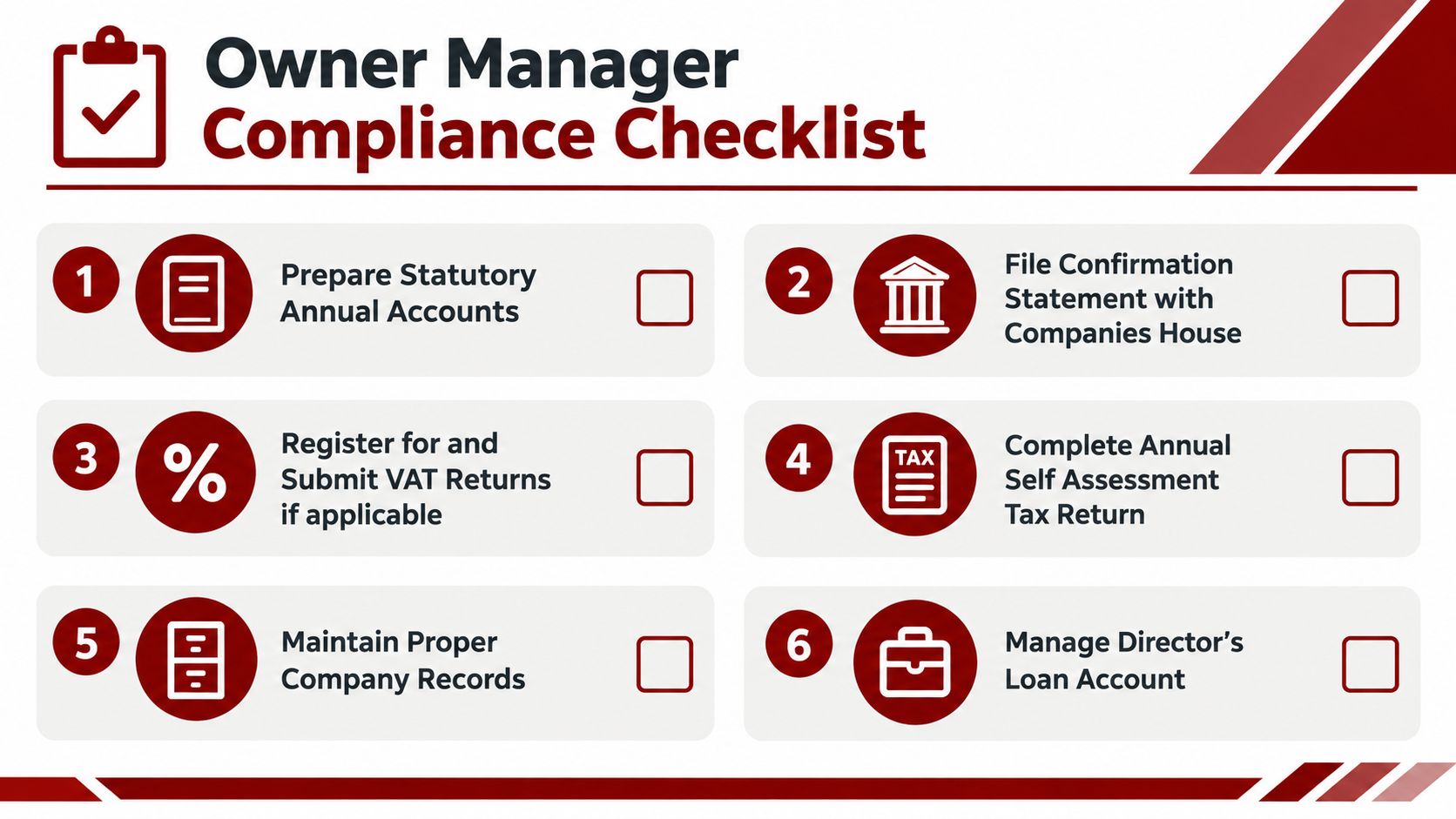
Keep a live compliance calendar
A calendar should show the task, responsible person, review date and evidence saved. It shouldn't live only in the owner's head.
- Statutory accounts: Prepare and submit the company's annual accounts when required.
- Companies House records: File the confirmation statement and keep company information accurate.
- VAT: Register and submit VAT returns where the business is required to do so.
- Self Assessment: Complete the owner's personal return where applicable.
- Company records: Keep invoices, bank records, payroll information, contracts and decision records organised.
- Director's loan account: Review money moving between the director and company so balances don't become unexplained.
A good monthly routine makes the annual obligations less intimidating. Reconcile the bank, review unpaid invoices, check supplier balances, confirm payroll entries and investigate unusual transactions. The owner should receive a short management view, not just a folder of historic transactions.
Build controls around real risks
Construction businesses need particular care with subcontractor records and CIS processes. A mistake may begin as missing information on one job but can affect payments, reporting and the relationship between the contractor and subcontractor. Sector knowledge matters because compliance isn't separate from how work is delivered.
Control doesn't mean signing every document personally. Set approval limits, use separate user access, require supporting evidence for payments and arrange an independent review of important reconciliations. If you outsource bookkeeping, ask for a regular exceptions report so you can focus on items that need judgement.
Practical rule: Delegate preparation where appropriate, but retain visibility over the figures, deadlines and decisions that could materially affect the business.
Practical Accounting Cashflow and Growth Planning for Founders
A founder can win a large contract and still face a cash shortage a few weeks later. Supplier bills, wages, tax and delayed customer payments may arrive before the new revenue does. Sales show activity, while cash flow shows whether the business can pay for its next move.
Begin with a consistent monthly information pack. Include the bank balance, unpaid invoices, supplier commitments, payroll, tax liabilities, gross margin by meaningful work type and the owner's planned drawings. A simple format works if it is updated regularly. Comparisons between months help you spot pressure before it becomes an emergency.
A rolling cash-flow forecast turns those figures into choices. Test what happens if a customer pays late, a project costs more than planned or you hire administrative support. It will not predict every event, but it can give you time to delay spending, chase debts or arrange funding.
For a practical way to measure monthly money flow, track money received, money committed and cash still available. Cash-flow forecasting support can then help turn those figures into a repeatable planning routine.
Recognise the owner-overburdened point
As turnover grows, the question changes. Can the control system handle more work without routing every decision through the founder?
Warning signs include:
- You approve routine payments because nobody else has authority.
- Customers contact you for information the team should hold.
- Month-end figures arrive too late to guide decisions.
- Trading slows whenever you take time away.
- Staff complete tasks, but nobody owns the full process.
- Profit targets look unclear after tax and overheads.
Above £1m turnover, owner-managed can start to mean owner-overburdened. The business may still depend on one person for approvals, customer knowledge and commercial judgement. Moore's UK Owner-Managed Business Survey reports that smaller OMBs are less confident about meeting profit targets than larger OMBs, while tax concern rose to 37% of OMBs from 21% in late 2023. (Moore UK Owner-Managed Business Survey)
Crossing that turnover level does not require a large management team. It does require a review of decision rights, reporting and workload. Under closer HMRC scrutiny, the owner should also revisit whether salary, dividends, expenses and loans still reflect the company's finances and the work being performed. Documented decisions and reliable records make that review easier.
Delegate in layers
Start with repeatable administration, such as invoice chasing, bookkeeping preparation or diary management. Next, give trusted people ownership of procurement, job scheduling or customer onboarding. Keep strategic decisions, risk appetite and major commitments with the owner until reporting is timely and managers have shown they can handle them.
Governance can stay proportionate. A weekly cash review, monthly management meeting, written approval limits and quarterly tax planning may protect the business better than a complex process nobody follows. The aim is to make growth less dependent on the founder, while keeping the founder informed about decisions that could materially affect the company.
Next Steps to Build a Resilient Owner Managed Business
A resilient owner managed business should not rely on its owner answering every question, approving every payment and remembering every process. As turnover grows, the owner can become the main operational risk. Clear decisions, dependable records and shared knowledge let the company continue when the owner is unavailable.
The UK market is made up largely of smaller businesses, so building capacity matters alongside winning sales. The Moore survey summarises evidence showing that SMEs account for almost all UK private-sector businesses and generate more than half of total turnover. (Moore UK Owner-Managed Business Survey) That scale does not remove the need for governance. It makes practical systems more useful, especially once the owner is managing a team, several customers or turnover above £1m.
Three decisions to make this month
- Confirm the structure. Check whether your sole trader, partnership or limited company arrangement still fits your risk, contracts and growth plans.
- Review owner pay. Separate salary, dividends, expenses and loans. Then test whether each reflects the company's finances and the work being performed, particularly under closer HMRC scrutiny.
- Remove one dependency. Choose a recurring task or decision that someone else can own, with a written process and a clear review point.
Delegation can begin without immediate recruitment. Specialist bookkeeping, payroll support or administration may remove pressure from the founder. For suitable remote tasks, you could explore services that hire a virtual assistant from Latin America. Keep sensitive financial approvals, payment access and final oversight under controlled permissions.
Governance should fit the business. A weekly cash review, monthly management meeting, written approval limits and quarterly tax planning can provide useful guardrails without burying the team in paperwork. Start with one accurate monthly report, one documented approval process and one task transferred from your personal queue. These changes reduce owner dependence and support clearer tax decisions as the business grows.
Action Accountants Limited supports owner-managed businesses with formation, bookkeeping, payroll, statutory accounts, VAT, tax returns and practical management advice, including CIS-aware support for construction businesses. Visit Action Accountants Limited to discuss compliance, cash flow and sustainable growth.