
What Is Double Entry Bookkeeping and Why It Matters
Double-entry bookkeeping is an accounting method where every financial transaction is recorded in at least two accounts, as a debit in one and a credit in another, so the books always balance and…

Double-entry bookkeeping is an accounting method where every financial transaction is recorded in at least two accounts, as a debit in one and a credit in another, so the books always balance and errors are caught immediately. Its printed method was first fully described in 1494 by Luca Pacioli in Venice, while the first English book on the subject appeared in London in 1543. The University of Nottingham records this development.
You've probably met the confusion in a more practical form. You're running a new business in North West London, invoices are going out, money is arriving in the bank, and a spreadsheet appears to show a healthy balance. Then your accountant asks about debits, credits, VAT, payroll journals, or CIS deductions, and the numbers suddenly feel less straightforward.
Double entry is the logic that connects those individual transactions into a reliable picture of your business. It shows not only what happened to your bank balance, but also what you earned, what you owe, what customers owe you, and how each transaction affects profit and financial position.
Table of Contents
- Why Every UK Business Owner Needs to Understand Double Entry Bookkeeping
- How Debits Credits and Account Types Work Together
- The UK History Behind the Worlds Most Trusted Accounting System
- Real Transaction Examples From Sales to CIS Payments
- Why Double Entry Is a Control System Not Just a Record
- Common Bookkeeping Mistakes and How Double Entry Catches Them
- Preparing for Making Tax Digital and Mandatory E-Invoicing
- Next Steps for Founders and Contractors in North West London
Why Every UK Business Owner Needs to Understand Double Entry Bookkeeping
A founder in North West London might start with a simple spreadsheet containing sales, expenses, and a running bank balance. That can feel sufficient while activity is light. The difficulty begins when a customer hasn't paid an invoice, a supplier bill is outstanding, VAT has been charged, or a construction subcontractor payment includes a CIS deduction.
Double-entry bookkeeping records each transaction in at least two accounts. One account receives a debit and another receives an equal credit. The terms don't mean good or bad, and they don't mean money in or money out by themselves. They describe the two sides of an accounting record.
That structure matters because a business transaction rarely affects only cash. A sale can create revenue, a customer balance, and VAT due. A supplier payment can reduce the bank balance while settling a liability. Payroll can involve gross wages, deductions, employer costs, and the amount paid to staff.
Why the system matters in the UK
HMRC describes a true double-entry system as linked books covering the cash book, sales ledger, purchase ledger, and nominal ledger. That arrangement helps a business prepare a balance sheet and isolate errors through reconciliation. HMRC's guidance on accounting systems explains why the ledgers must work together rather than operate as disconnected lists.
The same logic supports VAT records, expense coding, payroll journals, CIS reporting, statutory accounts, and finance applications. You don't need an accounting degree to understand the foundations. You need to identify which accounts changed, decide whether each account increased or decreased, and apply the correct debit or credit.
For a broader introduction to organising records and producing useful management information, Senki's decision-ready business books guide provides helpful background. This article focuses on the double-entry logic underneath those records.
How Debits Credits and Account Types Work Together
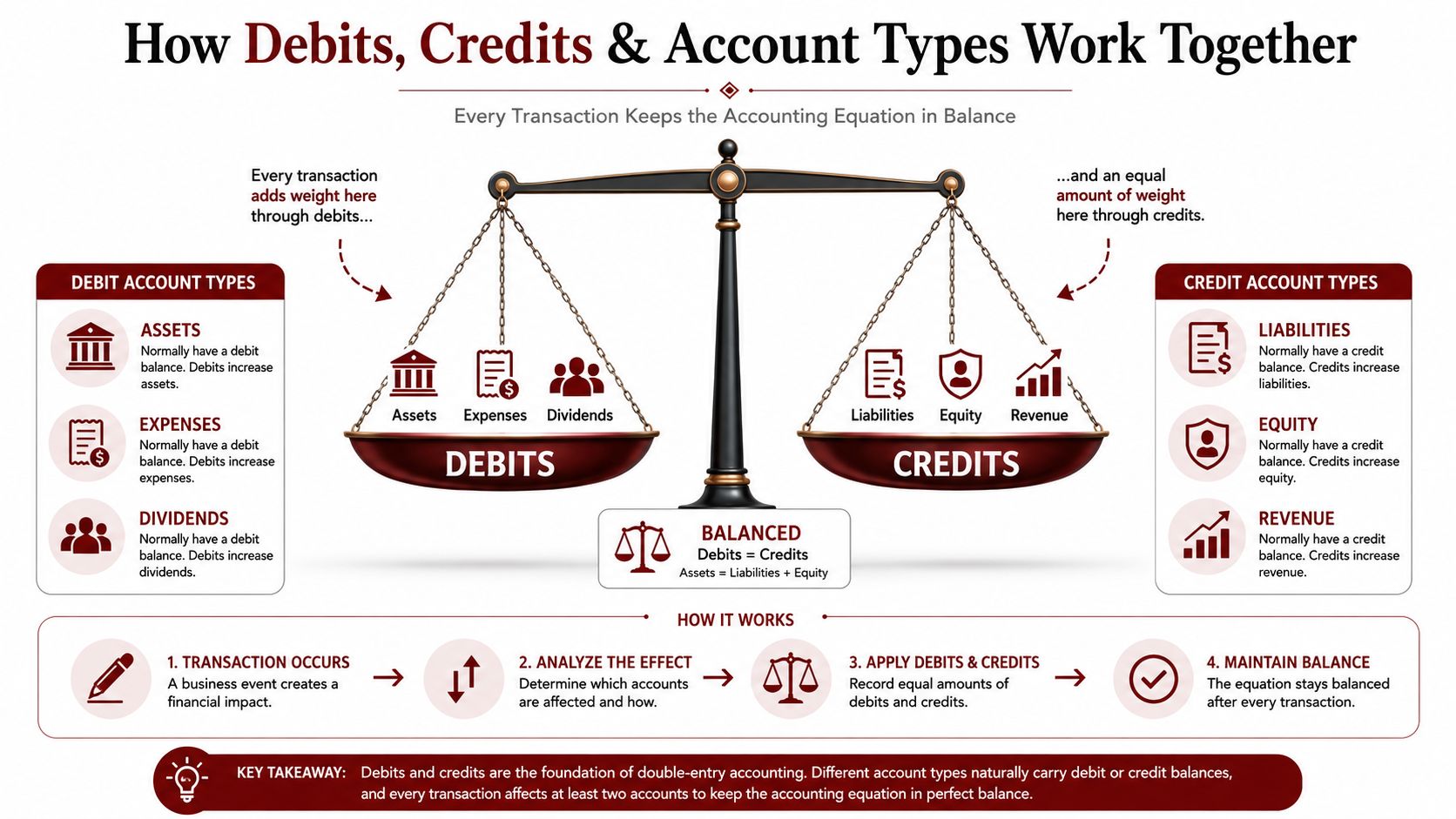
Think of double entry as a weighing scale. A transaction places an amount on the debit side and an equal amount on the credit side. The entries may affect different types of accounts, but the total remains balanced.
A debit is recorded on the left side of an account. A credit is recorded on the right. Neither word means positive or negative in ordinary language. A debit can increase an asset or expense, while a credit can increase revenue or a liability.
The five account families
Most bookkeeping entries sit within five broad categories:
- Assets: Things the business owns or controls, such as bank funds, equipment, and amounts due from customers.
- Liabilities: Amounts the business owes, including supplier balances, loans, VAT due, and deductions awaiting payment.
- Equity: The owner's interest in the business after liabilities are considered.
- Revenue: Income earned from selling goods or providing services.
- Expenses: Costs incurred to operate the business.
A useful memory aid is DEAD CLIC. Debits increase Drawings, Expenses, and Assets. Credits increase Liabilities, Income, and Capital. The rule also works in reverse, so a credit reduces an asset or expense, while a debit reduces a liability, income, or capital account.
| Account type | Usually increases with | Usually decreases with |
|---|---|---|
| Assets | Debit | Credit |
| Expenses | Debit | Credit |
| Liabilities | Credit | Debit |
| Revenue | Credit | Debit |
| Equity and capital | Credit | Debit |
Suppose your business pays a supplier invoice from its bank account. The supplier liability decreases, so you debit Accounts Payable. The bank asset decreases, so you credit Bank. If the invoice was already recorded when received, the payment settles the liability rather than creating a new expense.
Practical rule: Always ask which accounts changed first. Decide the debit and credit only after you know whether each account increased or decreased.
Your nominal ledger is where these account movements are organised. For a focused explanation of its role, see this guide to what a nominal ledger is. Landlords and property owners may also find these landlord record keeping tips useful when separating rental income, property costs, and owner transactions.
The UK History Behind the Worlds Most Trusted Accounting System
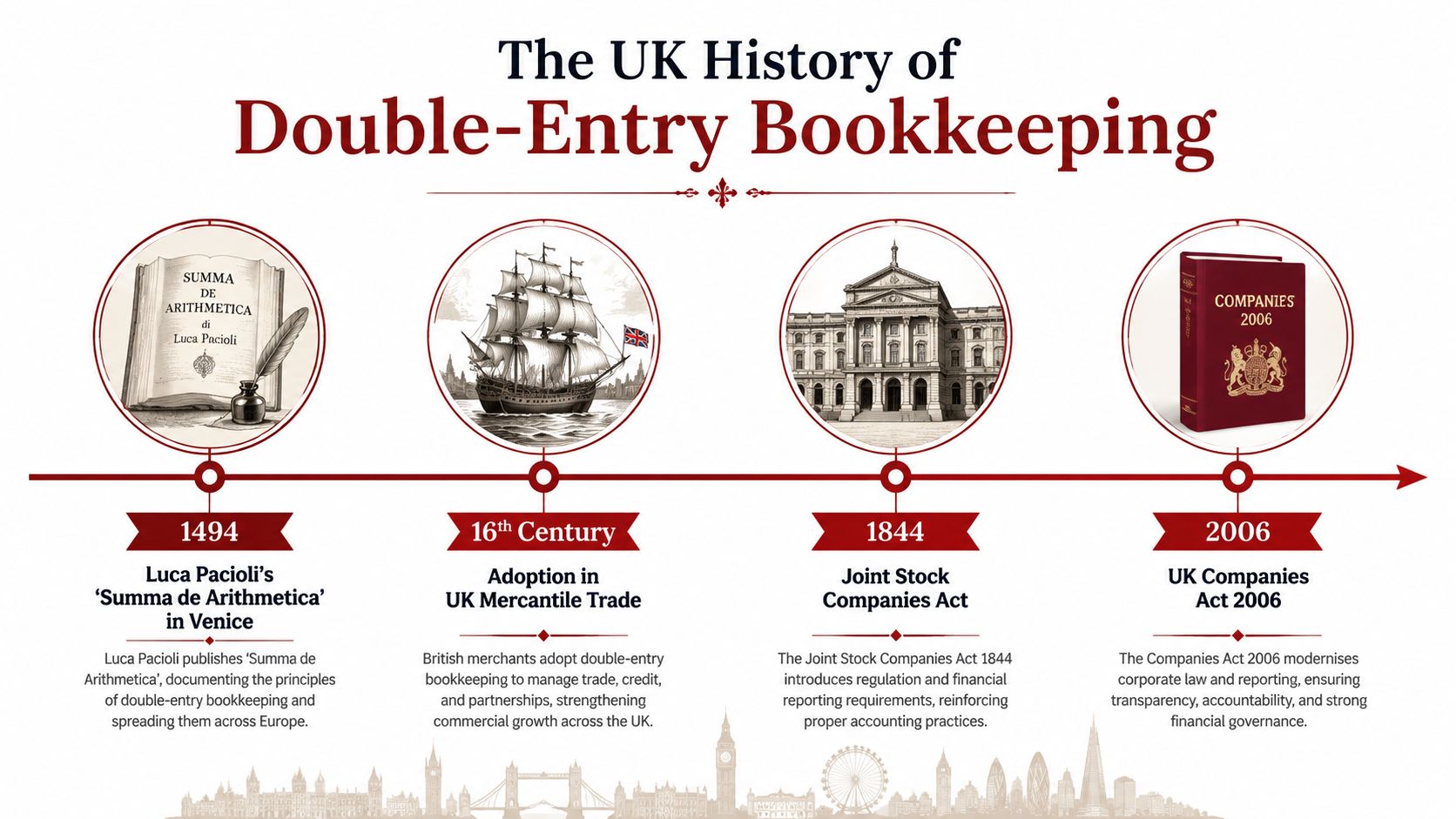
Double entry reached Britain gradually. Luca Pacioli described the method in print in Venice in 1494. Hugh Oldcastle's book, published in London in 1543, became the first English book on double-entry bookkeeping. James Peele's 1553 publication followed as the third English book on the subject, while Richard Grafton helped introduce the system to England. These milestones are recorded in the university's historical account.
Publication did not mean immediate adoption. Double entry became widely used in Britain during the mid-to-late nineteenth century, as the accounting profession developed and company legislation introduced limited liability. This academic synthesis places that shift within the wider development of modern business regulation.
From merchant records to professional reporting
The method suited a growing commercial economy because every transaction had two connected effects. Merchants could follow goods, money owed, capital, income, and costs through linked records instead of relying on a simple cash list. As firms grew and legal duties became more formal, owners, creditors, and regulators gained a clearer way to review financial activity.
European merchant records from the 1290s provide surviving examples, while organised accountancy in the UK developed later, during the first half of the nineteenth century. Double entry therefore existed before the UK accountancy profession. Its importance increased as bankruptcy, insolvency, company winding-up, and corporate reporting demanded dependable records.
Its durability comes from a straightforward control. Matching debits and credits create a trail that can be checked, while connected ledgers support financial statements that can be reconciled. The same discipline now helps a construction contractor prepare CIS records, keep cleaner digital accounts for Making Tax Digital, and maintain reliable invoice data as mandatory e-invoicing approaches in 2029. It applies just as well to a property business in Edgware or a technology company near King's Cross.
Real Transaction Examples From Sales to CIS Payments
Worked entries make the method easier to understand. The amounts below are illustrative examples, and the VAT and CIS treatment should always reflect the transaction and the business's actual circumstances.
A sale including VAT
Assume a business raises a customer invoice for £1,200 including VAT. The receivable increases by £1,200. The net sale increases revenue, while the VAT element creates a liability to HMRC.
Using the VAT treatment specified in the transaction, the entry is:
- Debit Accounts Receivable, £1,200
- Credit Sales Revenue, the net sale value
- Credit VAT Liability, the VAT element
The debit equals the two credits. When the customer pays, record a debit to Bank and a credit to Accounts Receivable for the amount received. The payment doesn't create new revenue because the sale was recorded when the invoice was raised.
An office expense paid from the bank
For an office expense of £350 paid by bank transfer:
- Debit Office Expenses, £350
- Credit Bank, £350
The debit records the cost in the profit and loss account. The credit records the reduction in the bank asset. If the supplier invoice was entered earlier, the payment would instead debit Accounts Payable and credit Bank.
A payroll run
Payroll usually affects several accounts rather than just wages and bank. A payroll journal can record gross wages as a debit to Wages Expense, employee deductions as credits to PAYE and employee National Insurance liabilities, employer National Insurance as a debit to Employer National Insurance Expense with a corresponding liability credit, and net pay as a credit to the bank or payroll clearing account.
The exact journal depends on the payroll report and the accounts used. The key point is that the total debits must equal the total credits, and the liabilities must remain visible until the relevant amounts are paid to HMRC or other recipients.
A CIS subcontractor payment
Assume a subcontractor's gross payment is £2,000, with a 20% CIS deduction. The withheld amount is not an extra business cost. It's an amount deducted from the subcontractor's payment and held as a liability for the CIS process.
The entry is:
- Debit Subcontractor Costs, £2,000
- Credit Bank, the net amount paid
- Credit CIS Liability, the withheld amount
That entry records the full cost, the cash leaving the business, and the deduction awaiting payment or reporting. For more detail on the calculation, use this guide to calculate CIS deductions.
| Transaction | Debit Account | Credit Account | Amount |
|---|---|---|---|
| Customer sale including VAT | Accounts Receivable | Sales Revenue and VAT Liability | £1,200 total |
| Office expense paid by transfer | Office Expenses | Bank | £350 |
| Payroll journal | Wages and employer costs | PAYE, National Insurance, and Bank or payroll clearing | Based on payroll report |
| CIS subcontractor payment | Subcontractor Costs | Bank and CIS Liability | £2,000 gross |
Why Double Entry Is a Control System Not Just a Record
A cash list tells you what passed through the bank. Double entry tells you what that movement means. That distinction helps a business owner separate a customer receipt from revenue, a loan from income, a VAT balance from profit, and a supplier payment from the expense originally recorded.
The control begins with a simple condition: total debits must equal total credits. If one side is missing or entered with the wrong value, the trial balance exposes the imbalance. HMRC states that accounts containing a balance sheet are prepared on double-entry lines, even where the underlying records weren't maintained that way throughout the year. HMRC's accounting guidance explains the importance of this structure.
Where the control helps operationally
Double entry supports several checks that matter to a small business:
- VAT review: Sales entries can separate revenue from VAT liability, while purchase entries distinguish recoverable VAT where applicable.
- Cash-flow visibility: Receivables and payables show amounts due, even when the bank balance looks comfortable or alarming.
- CIS oversight: A dedicated CIS liability account makes withheld deductions visible instead of burying them inside subcontractor costs.
- Management reporting: Profit and loss reports show performance, while the balance sheet shows assets, liabilities, and equity.
- Finance applications: Lenders can review connected records rather than relying only on a bank balance or an informal spreadsheet.
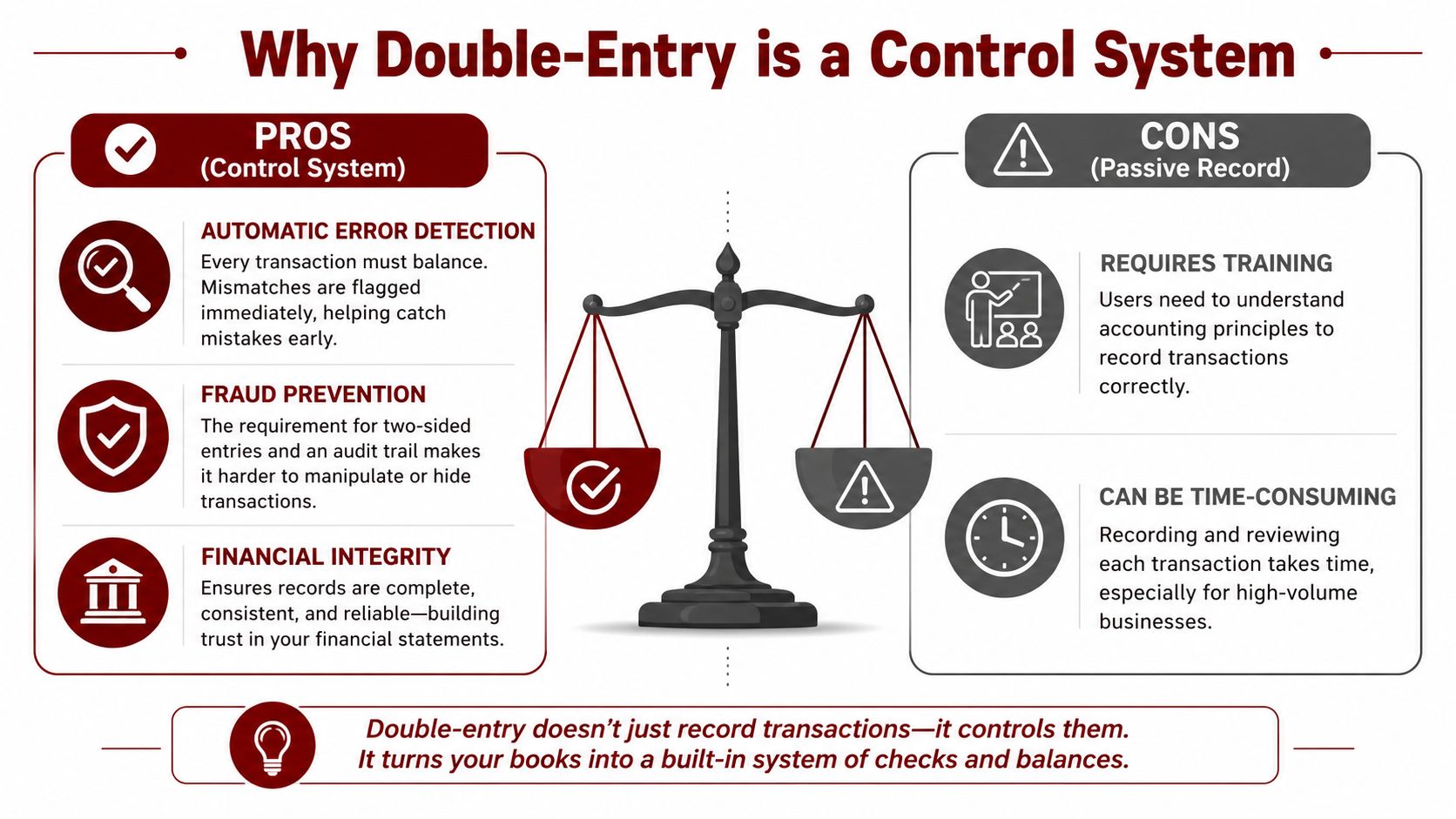
The system won't prevent every mistake. A transaction can be posted to the wrong account while still balancing. That's why bank reconciliation, invoice review, supporting documents, and sensible account structures remain essential. The bank reconciliation process helps compare recorded bank activity with the actual statement and investigate differences.
A balanced trial balance means the arithmetic works. It doesn't, by itself, prove that every transaction has been classified correctly.
Common Bookkeeping Mistakes and How Double Entry Catches Them
Double entry is often described as an error-proof method. That's too strong. It catches many mechanical errors, but it can't automatically understand whether a genuine business purchase belongs in an expense account or an asset account. Your controls must therefore combine the balance check with review and reconciliation.
Duplicate sales or receipts
If you enter the same invoice twice, revenue and receivables may be overstated. If the bank receipt is recorded only once, reconciliation can reveal that the customer balance and ledger activity don't match the supporting records. Remove the duplicate entry rather than forcing the bank balance to agree with the ledger.
Incorrect expense classification
A capital purchase posted as an ordinary expense can distort both profit and the balance sheet. The double-entry correction normally transfers the amount from the incorrect expense account to the appropriate asset account, subject to the applicable accounting treatment. The entry may balance throughout, so account review matters as much as the trial balance.
Missing VAT postings
A sale recorded as revenue without the related VAT liability can leave the tax control account incomplete. The correction posts the VAT element to the VAT liability account and adjusts the original revenue or receivable entry if necessary. Review the invoice, tax treatment, and VAT return before making a correction.
Unrecorded CIS deductions
If the gross subcontractor cost is recorded but the deduction isn't credited to a CIS liability account, the bank payment and the liability won't tell the same story. Correct the journal by separating the net bank payment from the withheld amount, then reconcile the liability to the CIS records.
Transposed figures
A transposition, such as entering £450 instead of £540, may create an imbalance if only one side contains the error. If both sides use the wrong amount, the trial balance can still balance while the business records remain wrong. Compare journals with invoices, payment evidence, payroll reports, and supplier statements before submission or year-end close.
These checks matter before VAT returns, CIS reporting, HMRC enquiries, and funding applications. Early corrections are easier to explain than a year of unexplained balances.
Preparing for Making Tax Digital and Mandatory E-Invoicing
Digital tax compliance changes the practical role of bookkeeping. A business won't prepare tidy accounts at year-end and treat the rest of the year as an administrative afterthought. Its records increasingly need to move through compatible software, with transaction data organised in a way that supports digital reporting and review.
HMRC has confirmed that mandatory e-invoicing for all VAT invoices is coming from 2029, and the government's consultation response describes a future environment built around digital records and software integration. The UK government's e-invoicing consultation response sets out that direction.
Why double entry fits the digital environment
An e-invoice is more than a PDF sent by email. Machine-readable invoice information must connect with customer balances, sales income, VAT treatment, and payment status. A properly configured double-entry system gives each invoice a place in the ledger and creates the related entries when the transaction is recorded.
That doesn't mean software eliminates judgement. Someone still needs to decide whether an invoice is standard-rated, outside scope, reverse charge, or subject to another treatment. Construction businesses also need to review CIS status, deduction rates, subcontractor records, and payment statements rather than trusting an automated category without inspection.
Making Tax Digital adds another reason to organise records now. Whether you use Xero, QuickBooks, FreeAgent, or another compatible platform, the chart of accounts should reflect how the business operates. The benefits of cloud accounting include connected records and easier access, but the quality of the output still depends on correct setup and regular review.
Software rule: Automation should post consistent entries faster. It shouldn't replace the person who checks whether the entry makes commercial and tax sense.
Founders, landlords, and contractors can reduce future disruption by moving away from disconnected spreadsheets, keeping source documents organised, and asking an accountant to review the ledger structure before reporting requirements become urgent.
Next Steps for Founders and Contractors in North West London
If you're starting or growing a business in Wembley, Harrow, Barnet, Brent, Colindale, or nearby areas, treat double entry as part of your operating system rather than an annual filing exercise.
Start with a compatible accounting platform that can support digital records and connect to your bank. Then create a chart of accounts that reflects your activity, including sales, supplier costs, payroll, VAT, loans, drawings, assets, and any CIS liabilities.
Keep personal and business finances separate from the beginning. This makes reconciliations clearer and gives you a more dependable view of cash available for wages, tax, suppliers, and growth.
Construction contractors should also review CIS responsibilities, subcontractor records, deduction evidence, and payment reporting. Landlords and property businesses need consistent separation of rental income, property expenses, finance costs, and personal movements. A periodic review with a qualified accountant can identify classification problems before they affect VAT, CIS, tax estimates, statutory accounts, or a finance application.
The most useful first question isn't “Do my books look tidy?” It's “Can every important balance be explained from the underlying transaction?”
Action Accountants Limited provides bookkeeping, payroll, VAT, tax, statutory accounts, and CIS-aware accounting support for founders, SMEs, landlords, and contractors. If you want your double-entry records organised around real compliance and cash-flow needs, visit Action Accountants Limited to discuss your bookkeeping requirements and arrange an initial consultation.


