Sole Trader VAT Registration: The 2026 Practical Guide
Master sole trader VAT registration in 2026. Learn thresholds, HMRC online steps, post-registration duties, and penalties for a smooth compliance transition.

You're probably in one of two positions right now. Your sales have picked up, the bank balance looks healthier, and someone has just asked, “Are you VAT registered?” Or your bookkeeping is a bit behind, you've added up recent invoices, and you've realised the problem isn't tax at year end. It's whether your turnover has already pushed you into a VAT obligation.
That's where sole trader VAT registration stops being a dry HMRC admin task and starts affecting pricing, cash flow, invoicing, software, and your stress levels. If you handle it late, VAT comes out of money you thought was yours. If you handle it properly, it becomes manageable.
A lot of sole traders make the same mistake. They watch profit. HMRC watches taxable turnover. Those are not the same thing, and that gap is where people get caught.
Table of Contents
- Why VAT Registration Matters to Your Cash Flow
- Understanding VAT Thresholds and Registration Timing
- Preparing and Submitting Your VAT Registration Application
- Choosing the Right VAT Schemes for Your Business
- Essential Post-Registration Duties and Compliance
- Avoiding Penalties and Common Registration Pitfalls
Why VAT Registration Matters to Your Cash Flow
A sole trader decorator in North West London can have a perfectly decent year and still get a nasty surprise. Work builds steadily. Materials pass through the books. A couple of larger jobs land close together. On paper, it feels like progress. In practice, VAT can arrive before the business has adjusted its prices, invoice wording, and payment routine.

That's why I tell clients not to treat sole trader VAT registration as a compliance footnote. It changes how cash moves through the business. Once registered, part of the money you collect from customers is no longer yours to spend. If you keep treating gross receipts like available cash, you'll squeeze yourself.
What catches sole traders out
The biggest trap is psychological. You see a strong month and assume you're doing well. Then you discover that taxable turnover, not profit, drives the registration test. A business with thin margins can hit the VAT line faster than the owner expects, especially if there's a burst of contract work.
The UK business base shows why this matters. ONS-based reporting estimated that at the start of 2025, 2.6 million businesses, or 46%, were VAT and/or PAYE registered, while 3.0 million businesses, or 54%, traded without either registration (UK VAT registration statistics). Plenty of businesses operate below registration, but once you move towards the boundary, planning becomes essential.
Practical rule: If crossing into VAT would force you to absorb the tax instead of passing it on, your margin is weaker than you think.
The immediate cash flow impact
Three things usually happen at once:
- Prices become a live issue. If your clients are private individuals, adding VAT can make you look more expensive overnight.
- Payment timing matters more. If customers pay late, you can end up owing HMRC before you've been paid, depending on the scheme you use.
- Bookkeeping stops being optional. You need cleaner records, sharper invoice control, and a proper filing routine.
If late payment is common in your trade, look closely at the VAT Cash Accounting Scheme. It can be a practical way to stop VAT from draining cash before the customer has paid.
Understanding VAT Thresholds and Registration Timing
A sole trader can have a strong month, land one decent contract, and create a VAT problem before the quarter has even finished. By the time HMRC catches up, the damage is usually practical rather than theoretical. Backdated VAT, rushed bookkeeping, and avoidable penalties.
For UK sole traders, VAT registration is triggered when taxable turnover exceeds £90,000 in any rolling 12-month period, or when turnover is expected to exceed £90,000 in the next 30 days. HMRC also requires registration within 30 days of the end of the month in which the threshold is crossed, and the threshold rose from £85,000 to £90,000 in April 2024 (HMRC VAT registration rules).
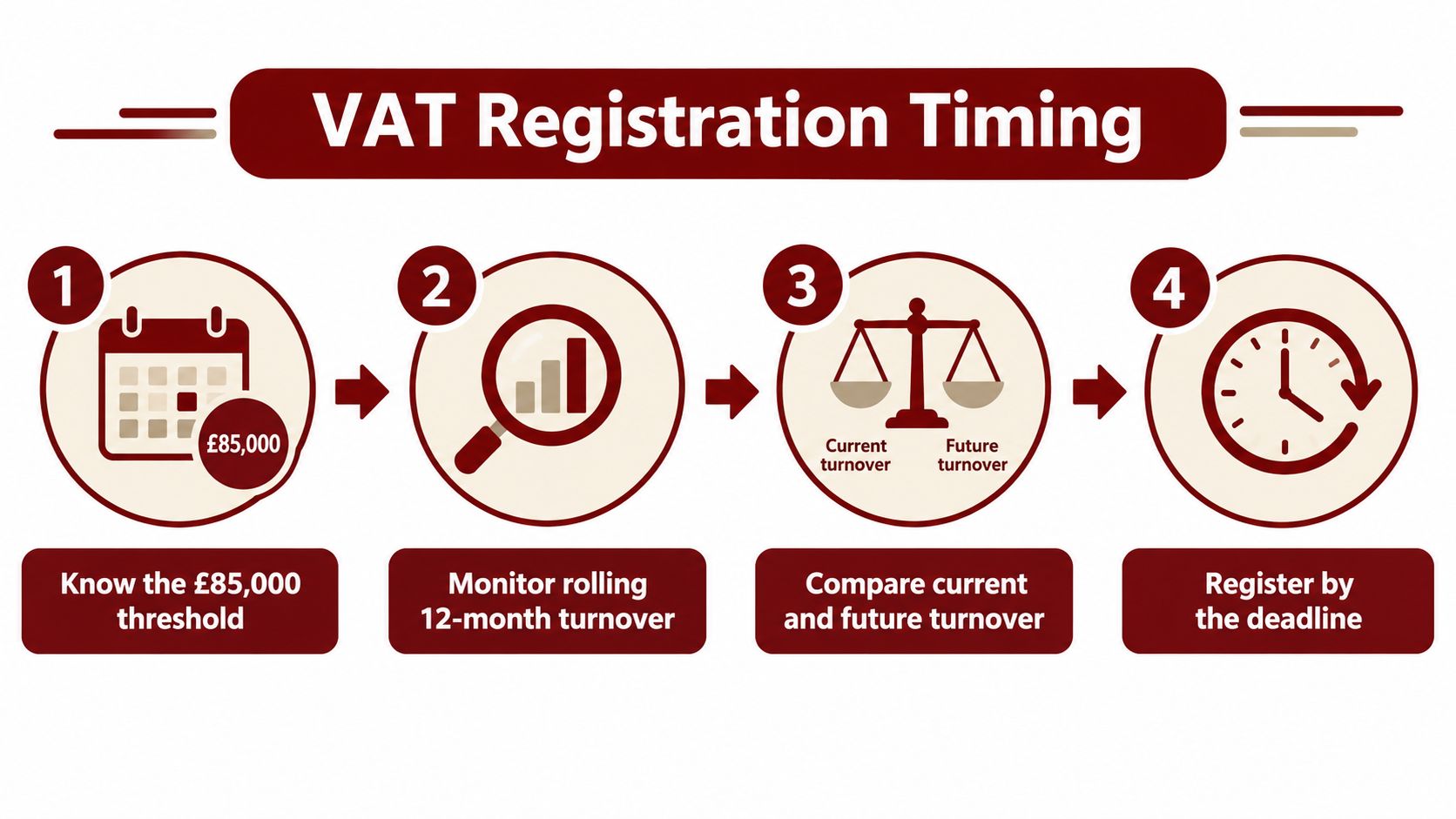
The threshold is straightforward on paper, but applying it to rolling 12-month periods is where sole traders commonly misjudge their position. HMRC looks at each month in turn and asks what your taxable turnover was for the previous 12 months. That means an old spike in invoicing can still push you over the line even if the current month feels quieter.
That rolling test catches traders who only review the numbers at year end. It also catches those who watch the bank balance instead of dated invoices. VAT timing runs on taxable turnover and liability dates, not on whether the cash has landed.
Mandatory registration versus voluntary registration
Mandatory registration is a legal requirement. Voluntary registration is a commercial choice.
If you cross the rolling threshold, or you know a single contract will push taxable turnover above £90,000 in the next 30 days alone, register. Do not wait for the next bookkeeping tidy-up. Delay usually means HMRC sets an earlier effective date of registration, and you are left funding VAT that was never added to the original invoices.
Voluntary registration needs colder judgment. It can work well if your customers are VAT-registered businesses, your costs carry input VAT, and your records are already clean enough for Making Tax Digital. It is often a poor decision if you sell mainly to private customers and your pricing has no room for a 20% shock.
For a useful comparison of how another system handles sole trader indirect tax, this guide on sole trader GST explained for Australian tradies is worth a read. Different country, different rules, same commercial pressure. Once tax has to be added to invoices, pricing discipline and admin standards matter immediately.
How to track it properly
Use a method you will keep up with every month.
- Run a monthly rolling check. Review the latest 12-month total at the end of each month, not when the accountant asks for records.
- Separate taxable, zero-rated, and exempt income correctly. Sloppy coding gives you a false reading and causes problems later when returns are filed under MTD.
- Record the evidence. Keep a dated schedule showing when you reviewed turnover, what was included, and when the threshold was crossed.
- Watch the next-30-days rule separately. A signed contract can trigger registration faster than the rolling test.
The practical detail on the UK threshold and the rolling test is covered well in this guide to the VAT registration threshold in the UK.
If you prefer a visual walkthrough before acting, this short explainer helps frame the timeline and deadlines:
Register on time, but get the date right as well. The date is what decides whether you file cleanly or end up with a backdated VAT bill and a penalty argument you are unlikely to win.
Preparing and Submitting Your VAT Registration Application
You cross the threshold, file the application in a rush, then wait for a VAT number while invoices stack up and cash collection slows. That is how a simple registration turns into a working-capital problem.

The application itself is straightforward. The risk sits behind it. If your records, dates, bank details, and trade description do not line up, HMRC asks questions, your VAT number takes longer, and you are left deciding whether to hold invoices, reissue them later, or fund the VAT gap yourself.
The Association of Taxation Technicians notes that about 20% to 25% of VAT registrations take more than 14 days because applications are incomplete, badly completed, or missing routine information, and around 5% can take up to 10 weeks due to more rigorous HMRC checks (ATT VAT registration guidance). For a sole trader, that delay is not just admin. It can interrupt billing, confuse customers, and put pressure on cash flow fast.
Get the file ready before you log into HMRC
Do the prep first. Then submit.
Have these points confirmed and written down:
- Identity details: Your legal name, trading name if different, UTR, National Insurance number, and current address exactly as they appear on HMRC records.
- Business activity: A clear description of what you sell. “Consultancy” is often too vague. State the service or goods in plain English.
- Registration date: The correct effective date of registration, based on when you became liable or the date you want voluntary registration to start.
- Turnover support: A simple schedule showing the figures behind the date. Keep it with your records in case HMRC asks.
- Bank details: An account in the taxable person's name. If the name does not match, expect delays.
- MTD readiness: Decide which software you will use from day one. If registration goes through and your records are still scattered across spreadsheets, email, and a shoebox of receipts, your first return will be harder than it needs to be.
That last point gets missed all the time. Sole traders treat registration as a one-off form. HMRC treats it as the start of digital filing and ongoing record-keeping. Set the process up now, while the facts are fresh.
Errors that cause trouble
HMRC delays usually come from ordinary mistakes, not exotic tax issues.
The common ones are predictable: names or addresses that do not match HMRC records, a trade description that is too vague, the wrong VAT liability treatment, invalid signatory details, a registration date that does not fit the turnover evidence, or bank details in the wrong name. None of this is complicated. It is just sloppy, and sloppy applications get parked.
A bad registration date causes the worst pain. If the date is too late, you can end up owing backdated VAT on sales already made. If the date is wrong in the other direction, you may start charging VAT before your systems and pricing are ready. Either way, you lose control.
Checkpoint: Before you submit, match the application against your bookkeeping, HMRC records, bank account, and the schedule that supports your registration date.
A practical submission routine
Use a short checklist and clear it properly.
| Step | What to do | Why it matters |
|---|---|---|
| 1 | Confirm the effective registration date | It determines when VAT starts and which sales are affected |
| 2 | Match names and addresses to HMRC records | Inconsistencies trigger queries and delays |
| 3 | Write a precise trade description | HMRC needs to understand what you supply |
| 4 | Check signatory and bank account details | Wrong names often stall the application |
| 5 | Save the turnover working and submission copy | You may need both later if HMRC asks questions |
If you do not want to handle the filing yourself, software providers, bookkeepers, and firms such as Action Accountants Limited can submit the registration for you. Fine. But do not outsource the thinking. You still need to approve the date, the business description, and the records behind the application, because those are the points that affect your cash flow and your compliance position.
Choosing the Right VAT Schemes for Your Business
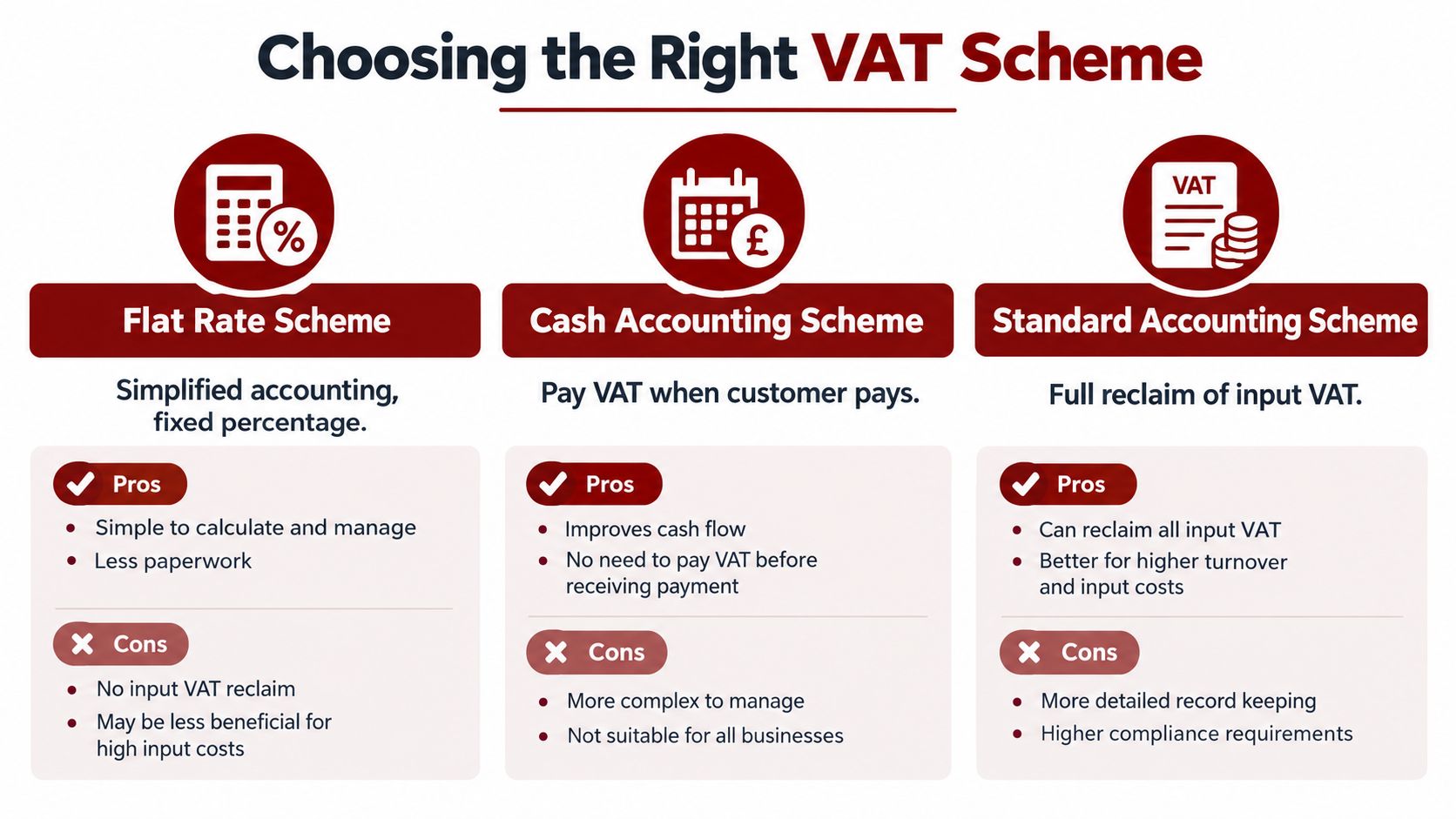
Once your registration is live, your next decision affects cash flow straight away. Most sole traders focus on “being registered” and overlook the accounting scheme. That's a mistake. The scheme changes when VAT becomes payable and how much admin you carry.
The three broad routes
Here's the practical comparison:
| Scheme | Best fit | Main upside | Main drawback |
|---|---|---|---|
| Standard accounting | Sole traders with regular input VAT to reclaim | Direct and widely understood | Can create pressure if customers pay late |
| Cash accounting | Businesses with slow-paying clients | VAT follows cash received more closely | Still needs disciplined records |
| Flat Rate Scheme | Simpler businesses wanting a lighter method | Easier administration in the right case | May be poor value depending on costs |
How I'd think about the choice
If your customers usually pay fast and you buy plenty of VAT-bearing goods or services, standard accounting can work perfectly well. It's conventional, familiar to accountants, and gives a clear picture.
If late payment is part of your life, cash accounting deserves serious attention. Many sole traders don't fail on profit. They fail on timing. VAT due before money arrives is a classic pressure point.
If simplicity matters and your cost base is relatively light, review the VAT Flat Rate Scheme. It suits some businesses well. It suits others badly. Don't pick it because it sounds easier. Pick it only if the numbers and recordkeeping fit your trade.
My blunt recommendation
Don't choose a scheme based on habit or what your mate uses. Choose it based on:
- Who pays you and how quickly
- How much input VAT you usually incur
- Whether admin simplicity is worth any trade-off
- How volatile your monthly cash position is
The right scheme should support your cash cycle, not fight it.
Essential Post-Registration Duties and Compliance
Getting the VAT number is the starting line. After that, the discipline has to become routine. Many sole traders slip, especially if they've managed on basic spreadsheets and informal invoicing up to now.
What must change immediately
Your invoices need to be issued properly. Your records need to be complete. Your VAT transactions need to be captured in a system that supports digital filing under Making Tax Digital for VAT.
That doesn't mean you need a complicated finance department. It does mean you need a process. Xero, QuickBooks, Sage, and other compliant tools can do the job if they're set up correctly. A messy ledger inside good software is still a messy ledger.
Your working checklist
Use this as a live operational list:
- Invoice correctly: Once registered, issue invoices that reflect your VAT position properly and consistently.
- Keep digital records: Don't leave receipts in a van, a kitchen drawer, or your inbox for months.
- Reconcile regularly: Match sales, purchases, and bank movements so your VAT return isn't guesswork.
- Review industry-specific rules: If you work in construction, check whether reverse charge treatment applies to what you do.
- File on time: Build a repeating calendar reminder and act before the deadline week.
The part people underestimate
Making Tax Digital changes the standard. You're no longer just “doing a return”. You're maintaining digital records and submitting through compatible software. If your books are updated only when panic sets in, VAT becomes harder than it needs to be.
A simple monthly routine works best:
- Week one: Raise and file invoices properly.
- Mid-month: Post purchase bills and receipts.
- Month end: Reconcile bank and review VAT coding.
- Before filing: Check unusual items manually.
The filing process itself should be straightforward once the records are clean. If you need a practical overview, this guide on how to file a VAT return is a sensible place to start.
Keep VAT separate in your mind and in your bank planning. If you treat it like general income, it will trip you up.
Avoiding Penalties and Common Registration Pitfalls
Think penalties only happen when someone ignores VAT entirely. That's too simplistic. In reality, sole traders often get into trouble while trying to do the right thing, just too late, too loosely, or with the wrong date.
The first bad assumption is that being under the threshold means you can forget VAT completely. You can't. You still need to monitor turnover properly, because the crossing point can arrive abruptly. The second bad assumption is that once you realise you should have registered, the fix is only administrative. It isn't. A late registration can leave you owing VAT on past sales, and that money may already be spent.
The practical pitfalls I see most often
- Watching profit instead of turnover: This is still the classic error.
- Using rough dates: Registration timing needs evidence, not memory.
- Charging ahead with bad records: If the books are incomplete, the VAT position will be shaky.
- Voluntarily registering without a pricing plan: That can hurt if your customers are price-sensitive consumers.
What to do if you think you're late
Act quickly and cleanly. Don't start inventing numbers, and don't wait until your next tax return to sort it out. Pull together the turnover records, identify when the threshold was crossed, and work from there.
If you're still below the threshold and considering voluntary registration, challenge your own reason. “It looks more professional” isn't enough on its own. If your customer base won't tolerate the pricing effect and you won't recover enough input VAT to offset the hassle, voluntary registration may add friction.
Final warning: The expensive VAT mistakes usually begin as small admin shortcuts.
If your sole trader VAT registration position is unclear, get it reviewed before the problem grows. That's cheaper than repairing late registration, backdated liabilities, and poor records after HMRC has started asking questions.
Action Accountants Limited helps sole traders with VAT registration, bookkeeping setup, VAT scheme selection, and ongoing return compliance, including cases where turnover has crept up faster than expected. If you want someone to check your threshold position, clean up the records, and handle the process properly, visit Action Accountants Limited.