
Making Tax Digital Deadlines: A 2026 UK Compliance Guide
Making Tax Digital deadlines explained for 2026. Learn which taxes are in scope, exact filing dates, penalty rules, and practical steps to stay compliant.

Priya used to file her Self Assessment once a year at the kitchen table in her Bristol home. Now her calendar has four quarterly update dates, a final declaration, digital bookkeeping tasks and a software decision she hadn't budgeted for. That change is the practical reality behind the new Making Tax Digital deadlines.
MTD for Income Tax isn't one extra tax return. It's a new operating rhythm for sole traders, landlords and self-employed people with several income streams. The businesses affected must keep digital records, prepare figures throughout the year and submit information at fixed points, rather than allowing twelve months of transactions to build into one stressful filing exercise.
Table of Contents
- The New Compliance Rhythm UK Businesses Face
- What Making Tax Digital Actually Means
- Exact MTD Deadlines and Income Thresholds
- From Annual Return to Five Compliance Points
- Role-Specific Steps for Sole Traders, Landlords and Contractors
- Penalties, Grace Periods and Late Filing Recovery
- Your 90-Day MTD Readiness Plan
The New Compliance Rhythm UK Businesses Face
Priya's old routine was familiar. She earned money, kept receipts in a drawer, postponed bookkeeping, then tried to reconstruct the year before the Self Assessment deadline. Her accountant could correct many issues at year end, but the process depended on memory, clean paperwork and a large amount of last-minute work.
MTD replaces that pattern with a continuous cycle. Transactions need to be recorded digitally, reconciled regularly and reviewed before each quarterly update. The final declaration still matters, but it no longer carries the entire burden of explaining the year's activity.
Practical rule: Treat every month as a small year end. If the records are current, the quarterly submission becomes a review task rather than a rescue operation.
Three groups need particular attention:
- Sole traders: Those with qualifying income above £50,000 for the 2024 to 2025 tax year should have started using MTD from 6 April 2026, according to HMRC's guidance on the first quarterly update.
- Landlords: Rental income counts alongside other qualifying income when deciding whether a person falls into scope. Someone with several properties must assess the combined position, not examine each property in isolation.
- Contractors: A contractor operating through a limited company may still have personal Self Assessment responsibilities for income outside the company. The company structure doesn't automatically remove every personal reporting obligation.
HMRC says 436,000 sole traders and landlords have already made their tax digital, while its research records technology comfort among businesses at 58%. Those figures indicate why readiness can't be reduced to remembering a date. Software confidence, transaction classification and responsibility between client and accountant all affect whether the process works. See HMRC's update on sole traders and landlords going digital for that context.
The sensible response is to decide who owns each task. If you're unsure how a business decision affects contracts, data handling or tax records, an AI legal assistant for business owners can help you identify questions to raise with your accountant or solicitor. It isn't a substitute for regulated tax advice, but it can help organise the discussion.
What Making Tax Digital Actually Means
Making Tax Digital is HMRC's system for requiring digital records and electronic tax submissions through compatible software. For Income Tax, it affects qualifying self-employed businesses and landlords. The practical requirement is not to scan receipts. Your underlying records must be maintained digitally, and the software must support the relevant MTD function.
MTD for VAT is already mandatory for VAT-registered businesses. MTD for Income Tax is the next major stage for sole traders and landlords who meet the qualifying income thresholds. Corporation Tax isn't part of the Income Tax rollout, and dividend income reported on a personal return isn't transformed into quarterly trading income merely because the recipient also has an MTD obligation.
The four working parts
- Digital records: Record income and expenses in compatible software. Keep separate categories for trading, property and other relevant activities.
- Quarterly updates: Submit a summary of income and expenses for each fixed period. This is information sent to HMRC, not a demand to pay tax immediately.
- End of Period Statement: Reconcile the year's figures and make adjustments that can't sensibly be finalised in the quarterly summaries.
- Final declaration: Confirm the overall position through the annual process, including other personal income and reliefs where applicable.
The quarterly update gives HMRC a view of the year's developing figures. It doesn't replace the tax calculation, and it doesn't turn every submission date into a payment date. Tax remains connected to the final Self Assessment position, which is why businesses must distinguish reporting deadlines from payment deadlines.
The policy logic is straightforward. HMRC wants more timely records, fewer avoidable errors and less dependence on an annual reconstruction. For the taxpayer, the benefit only appears if the bookkeeping is consistently maintained. A digital system filled with uncategorised transactions on the evening before a deadline is still a poor process, even if it technically uses approved software.
VAT-registered businesses should also keep their existing VAT workflow separate from Income Tax reporting. The 2026 guide to Making Tax Digital for VAT compliance is useful for checking how those obligations sit alongside the Income Tax changes.
Exact MTD Deadlines and Income Thresholds
Start by identifying your qualifying income and the date your cohort is expected to enter the system. Sole traders and landlords with qualifying income above £50,000 for the 2024 to 2025 tax year should comply from 6 April 2026. The next cohort, with qualifying income above £30,000, is expected to begin from 6 April 2027. Taxpayers above £20,000 are projected to join from 6 April 2028, according to HMRC's Income Tax MTD eligibility guidance.
These thresholds apply to the relevant qualifying income, so check the figures across each sole trader or property business before choosing your start date. Contractors should assess their self-employed income in the same way. Set up digital records before the applicable tax year begins, rather than waiting for the first reporting deadline.
The reporting timetable
| Compliance Event | Period Covered | Submission Deadline | Action Required | Payment Due? |
|---|---|---|---|---|
| Quarterly update 1 | 6 April to 5 July | 7 August | Submit the period's income and expense summary | No |
| Quarterly update 2 | 6 July to 5 October | 7 November | Submit the period's income and expense summary | No |
| Quarterly update 3 | 6 October to 5 January | 7 February | Submit the period's income and expense summary | No |
| Quarterly update 4 | 6 January to 5 April | 7 May | Submit the period's income and expense summary | No |
| Final declaration | Full tax year, after year-end adjustments | 31 January after the tax year ends | Finalise the tax position and complete the annual process | Tax payment may be due |
The first quarterly period runs from 6 April to 5 July, with the update due by 7 August. The following periods end on 5 October, 5 January and 5 April, with submissions due by 7 November, 7 February and 7 May. The official quarterly update timetable sets out these reporting points.
Quarterly updates report income and expenses. They do not create a tax bill or replace the final tax calculation. Payment remains linked to the annual Self Assessment position, so use this UK Self Assessment deadline guide and confirm the result with your accountant.
Set a review date before every submission. Reconcile bank transactions, check unpaid invoices and investigate unusual expense categories. Sole traders should separate business and private costs, landlords should keep property records current, and contractors should retain contract income and expense evidence. This gives you time to correct the records before submitting figures to HMRC.
From Annual Return to Five Compliance Points
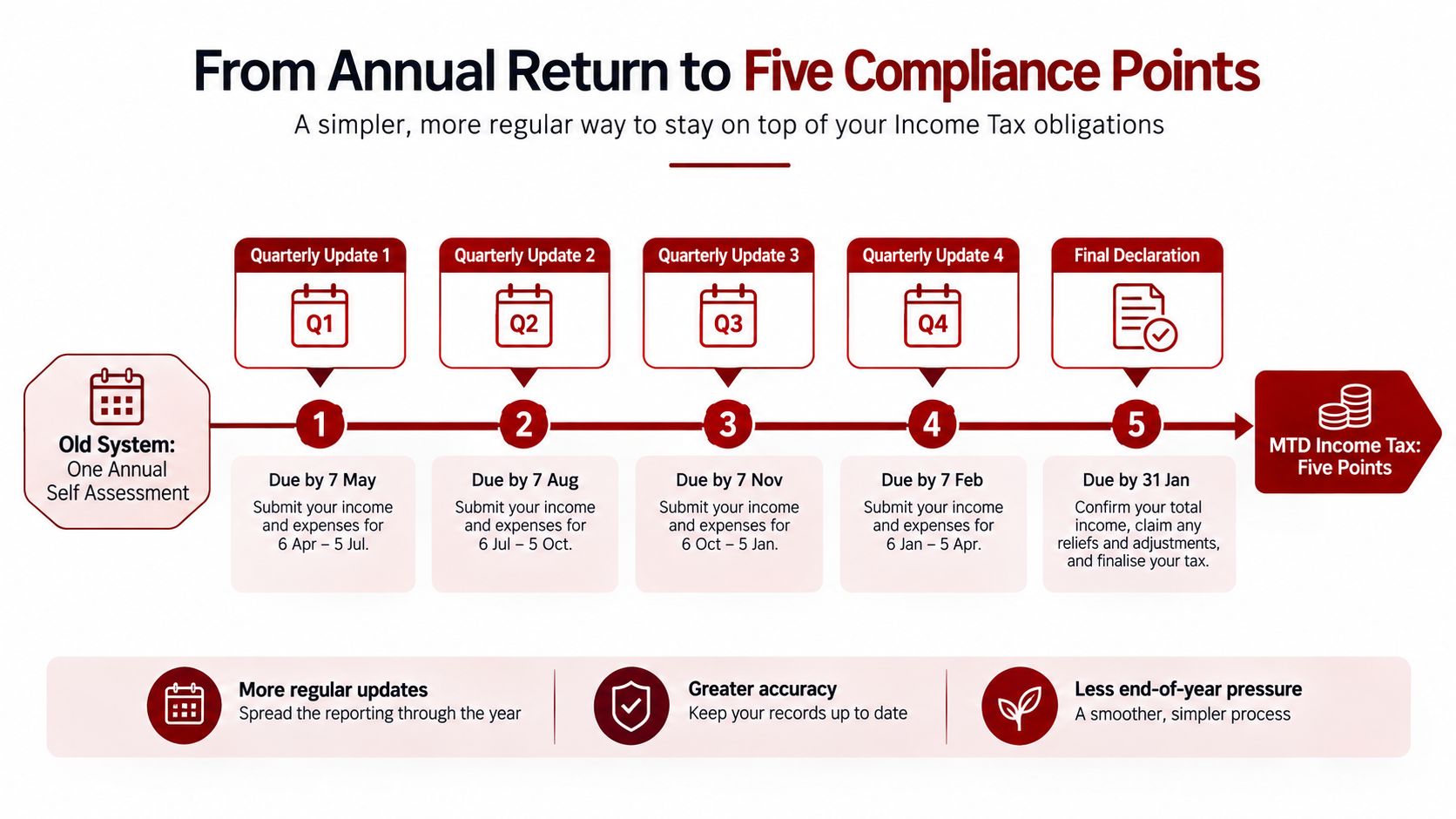
The important behavioural change is simple: one annual filing becomes four quarterly updates plus a final declaration. That creates five compliance points across the tax year, not five tax bills and not five replacements for the final tax calculation.
Each quarterly update summarises the transactions in its fixed period. It should be generated from digital records and submitted through compatible software. A PDF export or a spreadsheet emailed to an accountant isn't the same as submitting the required digital information through the MTD process.
Build a monthly close routine
The strongest process is monthly, even though HMRC asks for quarterly submissions. At each month end, the business should:
- Reconcile bank accounts: Match payments and receipts to the accounting records.
- Classify transactions: Separate sales, materials, subcontractor costs, travel, finance costs and private items.
- Review exceptions: Investigate missing invoices, duplicate entries and unexplained bank movements.
- Update supporting records: Keep property schedules, CIS paperwork and contract income organised.
- Mark the quarter complete: Freeze the period for review before submission.
Software selection matters. Choose a system that can keep a reliable digital audit trail, connect to the relevant MTD service and handle the income streams you have. If several tools are involved, map how information moves between them rather than assuming an integration will solve classification problems. Businesses looking to streamline compliance reporting should focus first on ownership, review controls and exception handling, not automation alone.
The final declaration is the point at which the year's figures are reconciled and the wider personal position is completed. It doesn't remove the need for accurate quarterly data. Instead, it gives the accountant a controlled finalisation stage rather than a year's worth of unprocessed transactions.
Accountant's view: The deadline is the visible part of MTD. The real work happens in the weeks before it, when transactions are coded, evidence is checked and exceptions are resolved.
Role-Specific Steps for Sole Traders, Landlords and Contractors
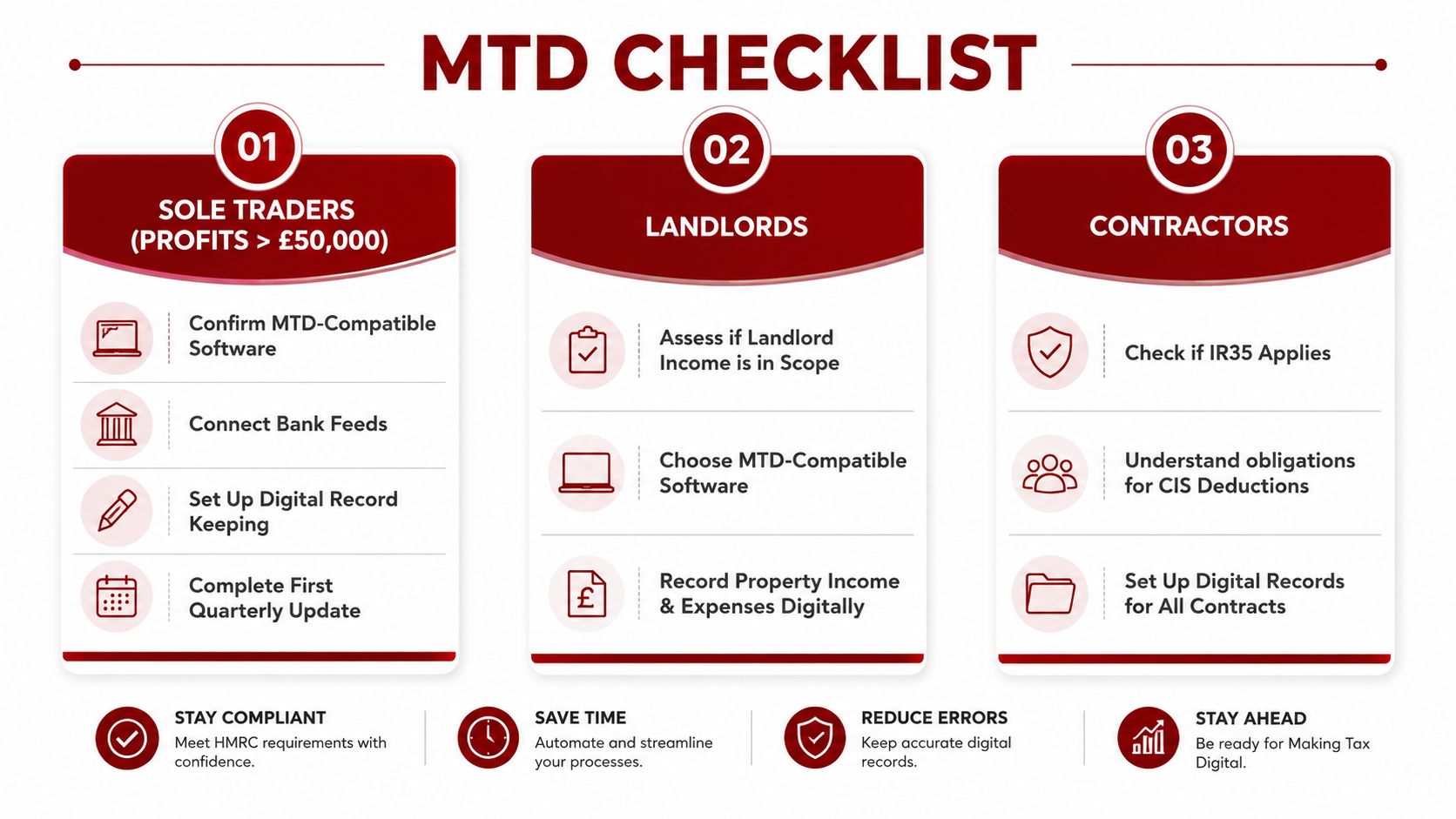
MTD creates five compliance points each year, but the work behind them differs by activity. A sole trader with one business account needs clear bookkeeping controls. A landlord must track each property. A contractor must separate contract income, CIS deductions and subcontractor records. Use the relevant route below, then have an accountant review any mixed or unusual income.
Sole traders above the first threshold
Set up the system before the first quarterly deadline. Check that your bookkeeping platform supports MTD functions, connect suitable bank feeds and create categories that reflect how the business earns and spends money.
Your checklist is:
- Choose compatible software: Confirm it records digital transactions and submits quarterly updates.
- Reconcile monthly: Resolve missing receipts and unexplained payments as they occur, rather than leaving an annual tidy-up.
- Separate private use: Mark personal withdrawals and mixed-use costs clearly so they are not treated as business expenses.
- Review each quarter: Check that income is complete, expense evidence is available and unusual movements have an explanation.
- Keep records organised: Store invoices, receipts, bank information and adjustments in a digital system that you can retrieve quickly.
Use a bookkeeping service for sole traders if you need help agreeing which tasks you handle and which your accountant handles. Put that division in writing before the first submission.
Landlords with several properties
Landlords need records at property level. Record rental income and allowable expenses digitally, retain evidence for each property and decide how to allocate shared costs before submitting anything. Trading income and rental income may need to be considered together when assessing the qualifying position, so do not review each activity in isolation.
The threshold dates determine when preparation must be complete. Those above £50,000 join the first cohort from 6 April 2026. Those above £30,000 join from 6 April 2027. Review expected income before the relevant tax year and check how ownership, property expenses and other income affect the records you will submit.
Construction contractors and CIS workers
Contractors should record gross contract income, CIS deductions and subcontractor information separately. Your software must let you match statements and distinguish deductions from turnover. Otherwise, quarterly figures can be incomplete or misleading.
Partnership work needs its own boundary. Confirm which records belong to the partnership and which belong on your individual return. If you operate through a limited company, keep company accounts separate from personal Self Assessment records, then identify any personal income that remains reportable.
Penalties, Grace Periods and Late Filing Recovery
Missing a quarterly update and missing a tax payment are separate problems. The quarterly update penalty system is points-based, while late payment has its own consequences. Don't assume that correcting one automatically resolves the other.
The supplied penalty guidance describes a system in which a missed submission adds a point. For quarterly updates, the first financial penalty is triggered when four points are reached, with a £200 penalty, and further missed submissions can lead to additional penalties while the threshold remains active.
The penalty tiers
| Points Accumulated | Penalty Triggered | Amount |
|---|---|---|
| One point | A compliance point recorded | No financial penalty at this stage |
| Two points | Points continue to accumulate | No financial penalty at this stage |
| Three points | One point below the quarterly threshold | No financial penalty at this stage |
| Four points | First quarterly-update penalty triggered | £200 |
| Further points after the threshold | Additional late submissions while the threshold remains active | £200 per applicable penalty |
The first-year grace arrangement matters, but don't treat it as permission to ignore the timetable. The first missed quarterly update in a tax year can carry a point without an immediate financial penalty under the stated arrangement. A point still records a failure, and repeated lateness creates a larger administrative problem.
If you miss a submission
- Submit it promptly: Don't wait until the next quarter or annual return.
- Check the figures: Correct incomplete or misclassified records before submitting an amendment.
- Review the penalty position: Establish whether the grace arrangement applies and whether the point has been recorded.
- Ask HMRC for a review: If you had a reasonable excuse, request a review before paying a disputed penalty.
- Protect the payment date: The annual tax payment remains a separate priority. If you can't pay, contact HMRC quickly about available arrangements.
The most expensive mistake is often not a small quarterly correction. It's failing to plan for the final tax liability and then missing the payment deadline. Keep a tax reserve, forecast the likely liability with your accountant and don't confuse a successful quarterly submission with settled tax.
Your 90-Day MTD Readiness Plan
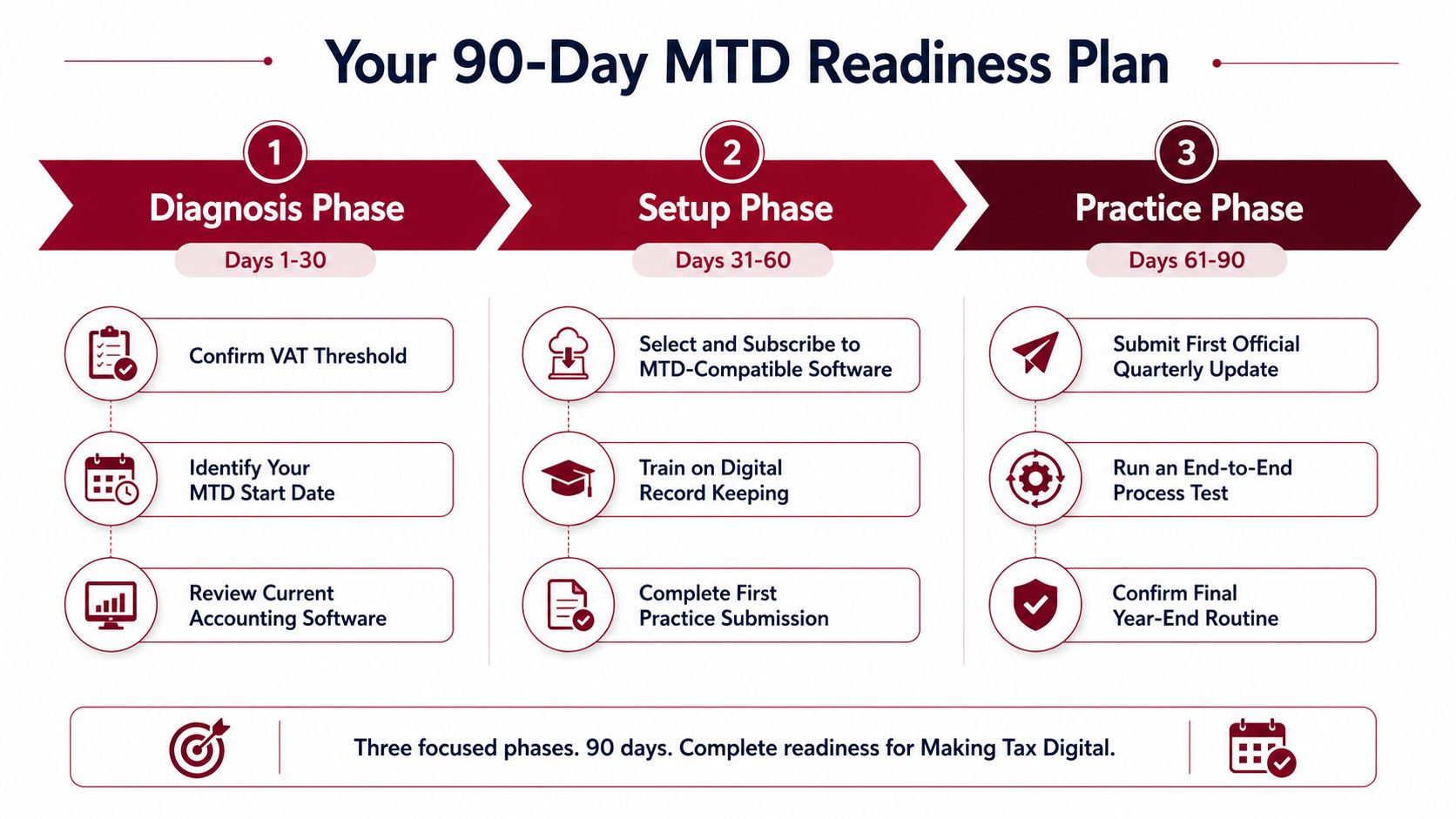
A business that leaves preparation until the first quarterly update will be trying to fix records, choose software and meet a filing deadline at once. Use the next ninety days to make monthly bookkeeping routine, so each quarterly submission becomes a controlled review and approval.
Days 1 to 30, diagnose the gap
Confirm your qualifying income and likely MTD start date first. Review every income stream, including self-employment and property income, then compare your existing records with the digital requirements.
- Check the cohort: Apply the relevant income threshold and tax year.
- Audit the records: Locate missing invoices, paper receipts, uncategorised bank entries and duplicate spreadsheets.
- Review software: Check that your platform supports the required MTD functions.
- Assign responsibility: Record who enters transactions, who reviews them and who submits each update.
Do not change software before identifying the business need. A landlord, CIS contractor and consultant can require different integrations, categories and reporting controls. Select a system that reflects the records you keep, not one chosen solely for its marketing.
Days 31 to 60, set up the system
Configure the chosen software, connect suitable bank feeds and establish opening balances. Reconcile the opening position before importing new activity. Otherwise, old errors can appear in every later report.
Run a practice period using genuine transactions. Test sales income, expense categories, property costs, CIS deductions and private transactions. If your accountant submits on your behalf, agree the handover date, review process and supporting evidence before approval.
Businesses planning accounting software integration should map the route from the original transaction to the quarterly submission. The map should identify who creates the entry, which account records it, who checks the reconciliation and who approves the final figures. Fix gaps before they become deadline failures.
Days 61 to 90, practise the habit
Set a fixed monthly close date, schedule a quarterly review and place reminders ahead of each HMRC deadline. Train everyone who enters transactions, then complete an end-to-end test covering bookkeeping, reconciliation, review, approval and submission.
Use this video for a visual introduction to the workflow. Check the detail against current HMRC guidance and your software configuration before relying on the process.
The rollout continues after the first cohort. Taxpayers above £30,000 are expected to join from 6 April 2027, and those above £20,000 from 6 April 2028. Businesses below the first threshold should prepare before inclusion becomes unavoidable.
Action Accountants Limited can help sole traders, landlords and contractors review their MTD start date, organise digital bookkeeping, reconcile records and prepare for quarterly reporting. Discuss a process built around your income streams and the relevant Making Tax Digital deadlines.