Can a Sole Trader Claim VAT Back? Complete Guide
Can a sole trader claim VAT back? Yes, but only when registered. Learn thresholds, pre-registration rules, and flat rate scheme traps in 2026.
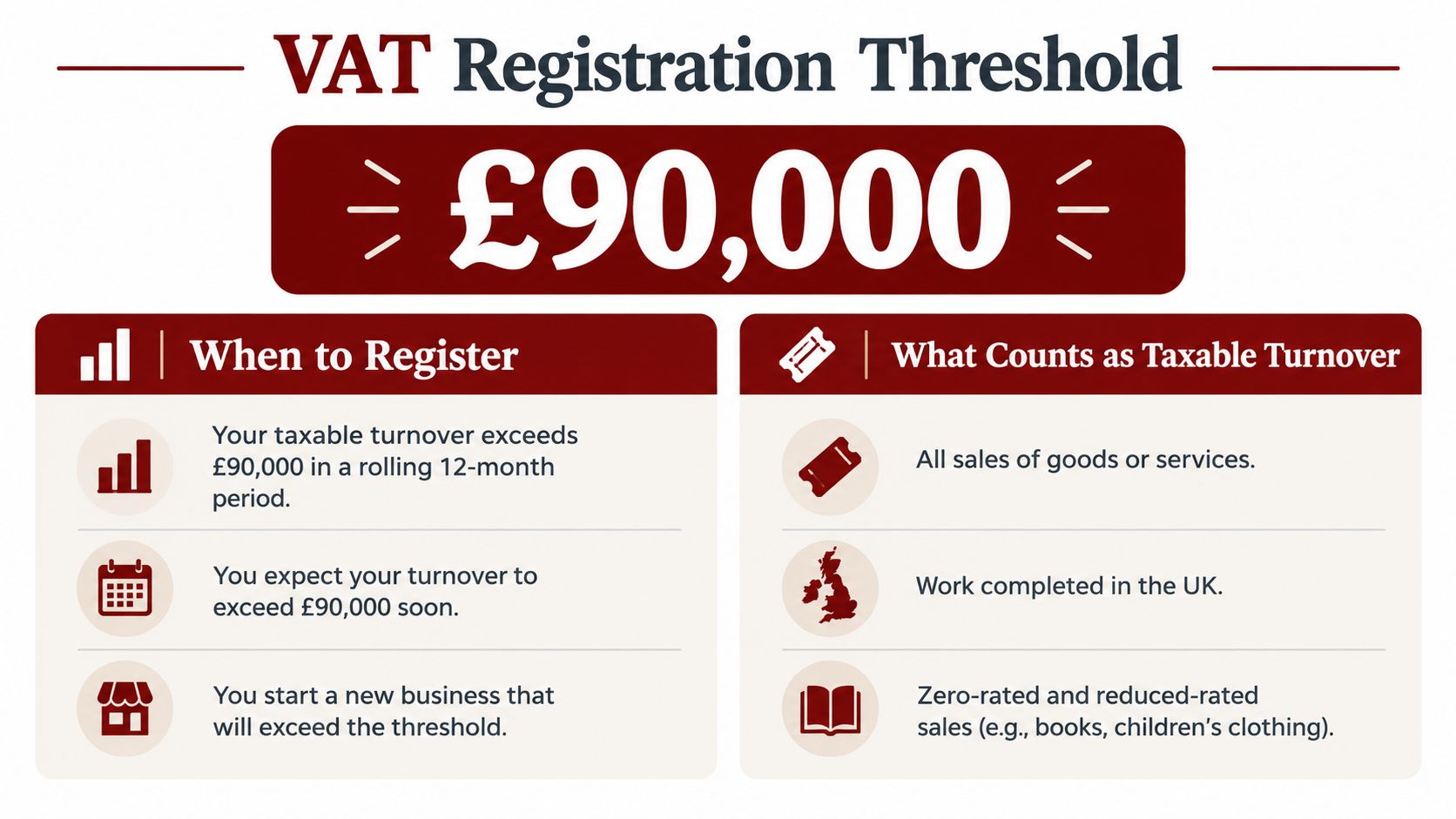
Yes, but only if you're VAT-registered. HMRC's current registration threshold is more than £90,000 in total taxable turnover over a rolling 12-month period, although you can register voluntarily below that level.
The counterintuitive part is that VAT registration doesn't turn every business purchase into a tax deduction. VAT is generally a pass-through tax. You charge VAT on taxable sales, record VAT paid on eligible business costs, and use the VAT return to reconcile the two. You can reclaim qualifying input VAT, but private spending, unsupported purchases, and costs outside HMRC's recoverability rules don't qualify.
That distinction matters because a sole trader can be VAT-registered and still have a poor reclaim process. Missing VAT invoices, mixed personal use, late records, and unsuitable accounting schemes can reduce the practical value of registration. The question isn't only whether a sole trader can claim VAT back. It's whether the business can maintain the evidence, digital workflow, and cash controls needed to claim it correctly.
Table of Contents
- Can a Sole Trader Actually Claim VAT Back
- The VAT Registration Threshold That Determines Everything
- Reclaiming VAT on Pre-Registration Purchases
- Flat Rate Scheme versus Standard Accounting
- Worked Example Showing VAT Reclaim in Practice
- The Hidden Compliance Burden Most Guides Ignore
- Your Next Steps Before Claiming VAT Back
Can a Sole Trader Actually Claim VAT Back
A sole trader can reclaim VAT only after becoming VAT-registered, whether registration is compulsory or voluntary. HMRC allows recovery on qualifying purchases used for taxable business activity, but the claim depends on evidence, correct coding, and a clear business purpose. The rules are set out in HMRC's guidance on reclaiming VAT on business expenses.
A purchase made while unregistered normally includes VAT in its full cost. After registration, eligible input VAT is claimed through the VAT return rather than deducted informally from profit. The invoice must show the supplier's details, VAT amount, and purchase date, and your records should distinguish business use from private use.
Practical rule: VAT registration gives you access to the reclaim process. It does not make every VAT charge on a receipt recoverable.
The compliance trap is treating eligibility as the hard part. In practice, cash flow and records cause more problems. A sole trader may pay suppliers before reclaiming the VAT, collect VAT from customers that is not yet theirs to spend, and then face a return deadline with incomplete invoices. Digital records also need to support the required Making Tax Digital process, so a spreadsheet or bank feed alone may not provide a reliable audit trail.
Use a simple control before each return: match every claimed amount to a valid VAT invoice, check the VAT rate, flag mixed-use costs for apportionment, and reconcile the VAT account to the return. Keep a separate cash reserve for output VAT instead of treating the balance in your bank account as available profit.
Registration can work well where customers are VAT-registered or the business has substantial VAT-bearing costs. It may be less attractive where customers are consumers, because charging VAT can increase the price they see, while recoverable input VAT remains limited. A directory that helps you find tax advisors for business can help you assess the commercial effect, recordkeeping demands, and cash flow impact before registering.
The VAT Registration Threshold That Determines Everything
The figure most sole traders need to monitor is £90,000 of taxable turnover in a rolling 12-month period, according to the GOV.UK VAT threshold guidance. The test is not based on your profit, bank balance, or chosen accounting year. It concerns taxable turnover, so zero-rated sales can still matter even though no VAT is charged to the customer.
The threshold increased from £85,000 to £90,000 in April 2024, a change recorded in the guidance for sole traders claiming VAT. Because the measurement is rolling, you should review the previous 12 months regularly rather than wait for the end of the tax year. A sudden contract, completed project, or concentrated sales period can move you across the limit before your annual accounts reveal it.
Compulsory and voluntary registration
Crossing the threshold creates a registration obligation. Staying below it doesn't prevent you from registering. A sole trader can choose voluntary registration specifically to recover VAT on eligible business expenses, provided the business follows the associated charging, recordkeeping, and return requirements.
Voluntary registration can work when:
- Your customers are VAT-registered businesses: They may focus on the net price because they can generally account for the VAT themselves.
- Your planned costs contain meaningful input VAT: Equipment, stock, and professional services may create recoverable VAT, subject to the normal rules.
- You want a structured VAT process: Registration can force better invoicing and bookkeeping discipline as the business grows.
It can work badly when most customers are private individuals, margins are tight, or the business has little VAT-bearing expenditure. Charging VAT can affect the price customers see, while the compliance work continues regardless of whether your reclaim is substantial.
Registration also brings practical identifiers and administration. Guidance on business identification numbers from HireAccountants is useful if you're organising the wider set of numbers and records attached to a new or expanding business. For a focused explanation of the threshold and its consequences, see this guide to the UK VAT registration threshold.
Reclaiming VAT on Pre-Registration Purchases
Registering late doesn't automatically mean every earlier VAT cost is lost. UK guidance allows a registered business to consider certain pre-registration purchases, but the timing and evidence rules are strict. The commonly applied benchmark is four years for goods and six months for services, provided the goods or assets are still used in the business and the required VAT invoices are retained, as set out in HMRC's input-tax and cancellation guidance.
Goods include durable business assets such as equipment, furniture, or a computer. Services cover items such as accounting support, software access, or professional work. The categories aren't interchangeable, so don't apply the longer goods period automatically to recurring services.
Apply the test purchase by purchase
Take a laptop bought three years before registration. If it remains in business use and the supplier issued a valid VAT invoice, it may fall within the pre-registration goods window. A software subscription incurred two months before registration may fall within the services window, assuming it relates to the business and the VAT evidence is adequate.
The practical test is cumulative:
- Was the purchase made within the relevant period?
- Is it still used for the business?
- Does the supplier's document support the VAT amount?
- Can you distinguish taxable business use from private use?
- Have you already reclaimed the VAT elsewhere?
A receipt showing a total price may not provide enough information. Keep the VAT invoice and connect it to the transaction in your bookkeeping system. If an asset is partly personal, claim only the business-related element that the records support.
Evidence beats memory. A spreadsheet note saying “business laptop” doesn't replace a valid VAT invoice or a defensible use calculation.
Cancellation creates another boundary. A business may reclaim VAT on qualifying supplies received while registered if it hasn't already claimed it, but it can't reclaim VAT on goods bought after cancellation or VAT charged more than four years ago. That makes the registration lifecycle important. If you expect to cancel, review outstanding purchases and potential adjustments before the effective cancellation date rather than assuming the opportunity remains open.
Pre-registration claims can improve cash flow, but they can also expose weak records. Reconstructing several years of purchases after registration is a poor substitute for keeping invoices as you buy. Create a separate pre-registration review, classify goods and services, remove private costs, and retain the calculations with the VAT return workings.
Flat Rate Scheme versus Standard Accounting
The standard VAT scheme and the Flat Rate Scheme solve different problems. Standard accounting tracks the VAT charged to customers and the eligible input VAT paid to suppliers. The Flat Rate Scheme applies a fixed percentage to relevant turnover and normally limits the input VAT you can reclaim, subject to specific exceptions such as qualifying capital assets.
The Flat Rate Scheme can reduce calculation complexity, but simplicity isn't the same as saving money. A sole trader with substantial VAT-bearing purchases may recover more under standard accounting. Another trader with limited input VAT may value the reduced administration, but that decision should follow a comparison of actual costs rather than an assumption that “flat rate” is automatically better.
| Feature | Standard Scheme | Flat Rate Scheme |
|---|---|---|
| VAT charged on sales | Record output VAT at the applicable rate | Charge VAT as required, then calculate the scheme payment |
| Input VAT recovery | Reclaim eligible input VAT through the return | Generally restricted, with limited exceptions |
| Best fit | Businesses with meaningful eligible costs and reliable records | Businesses prioritising simpler calculations where the scheme result is favourable |
| Main risk | More detailed transaction coding and reconciliation | Unrecoverable input VAT can outweigh the administrative convenience |
| Decision basis | Compare output VAT with eligible input VAT | Compare the fixed-rate result with the standard-scheme result |
How to make the comparison
List your recurring VAT-bearing purchases, then separate them into fully business, mixed-use, and non-recoverable categories. Include equipment, software, professional fees, and operating costs, but don't assume the VAT on every expense qualifies. Compare the likely reclaim under standard accounting with the amount that would remain embedded in costs under the Flat Rate Scheme.
The scheme choice also affects forecasting. Under standard accounting, a large purchase can create a temporary repayment position or reduce the amount payable on a return. Under flat rate, that purchase may have little effect unless it falls within an exception. If your costs change sharply during growth, a scheme that looked convenient during a quiet period can become expensive.
Read the detailed explanation of the VAT Flat Rate Scheme before registering or switching. A professional should model the choice using your sales profile, customer type, cost base, and recordkeeping capacity. Don't choose flat rate because the label sounds easier. Choose it only when the numbers and workload justify the restriction on input-tax recovery.
Worked Example Showing VAT Reclaim in Practice
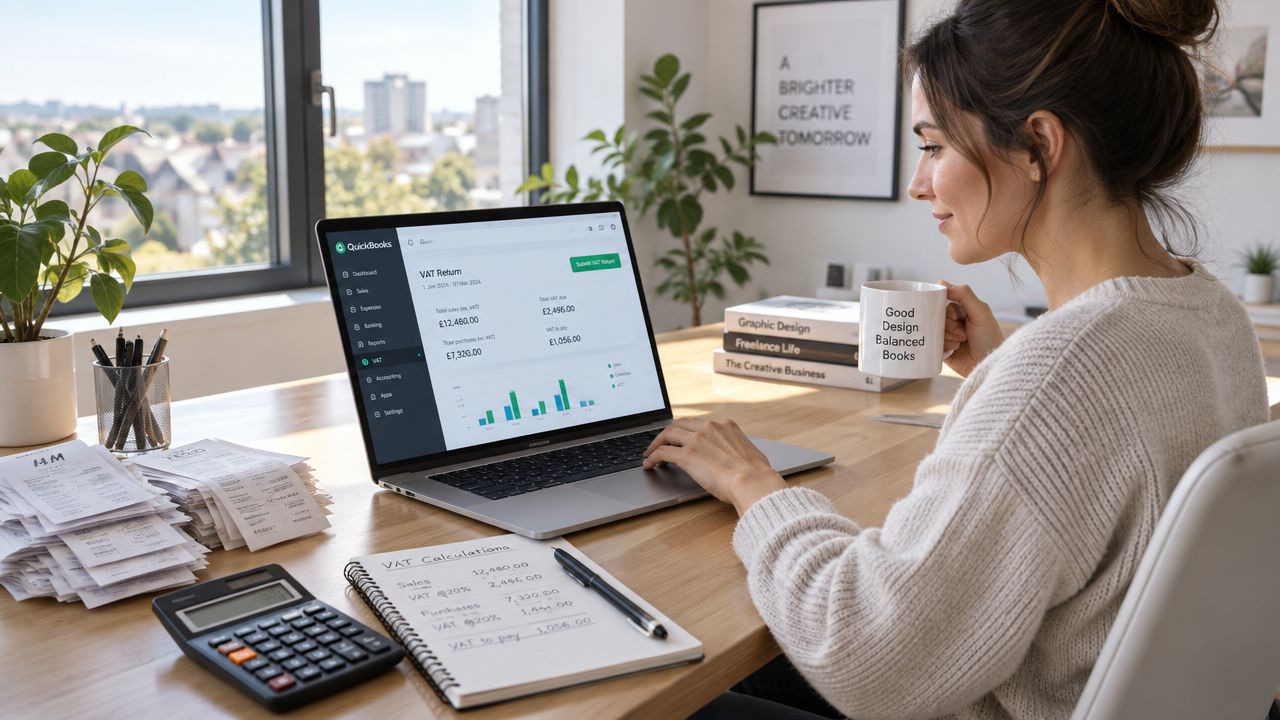
Consider Sarah, a freelance graphic designer with annual turnover of £75,000. She's below the compulsory registration threshold, so she chooses voluntary VAT registration because her customers are mainly businesses and she expects significant equipment and software costs.
During her first quarter, Sarah spends £8,000 on equipment and software, including £1,600 of input VAT. Those figures are a supplied illustration, not a general VAT assumption. Her result depends on the invoices she receives, the VAT treatment of each item, and the extent of business use.
Sarah's record-by-record process
Sarah doesn't enter the £8,000 as one undifferentiated expense. She saves each VAT invoice, checks that the supplier's details and VAT amount are present, and records the purchase date, category, gross amount, VAT amount, and business-use percentage.
Her laptop is used partly for personal browsing. Rather than claiming the full VAT amount automatically, she records the private element separately and claims only the supported business portion. Software used exclusively for client work is treated differently, but she still checks that the supplier charged VAT and that the service falls within the relevant business activity.
At the end of the quarter, Sarah's bookkeeping report separates:
- Output VAT: VAT charged on her taxable client invoices.
- Input VAT: Eligible VAT on equipment and software.
- Private or unsupported costs: Amounts excluded from the reclaim.
- Net position: Output VAT less allowable input VAT.
She then submits the figures through her VAT return and keeps the invoices and workings together. The reclaim isn't a separate application for each purchase. It's part of the return mechanism.
The useful habit: Record the VAT at the point of purchase, not when the return deadline is approaching.
Sarah also protects cash flow by treating VAT received from clients as money reserved for the return, not as available profit. Her £1,600 illustration may reduce the amount she pays to HMRC or contribute to a repayment position, but it doesn't remove the need to fund future VAT liabilities. A single large reclaim can create false confidence if the business spends the money before reconciling its next period.
The Hidden Compliance Burden Most Guides Ignore
VAT recovery is often presented as a yes-or-no question. In practice, the difficult part is maintaining a reliable chain from invoice to digital ledger to VAT return. A sole trader needs valid VAT evidence, a clear business purpose, accurate treatment of mixed-use costs, and a process that distinguishes input VAT from ordinary expenses.
The digital obligation makes that workflow more important. VAT-registered businesses are already within Making Tax Digital for VAT, which requires digital records and digital submission of VAT returns. From 6 April 2026, some sole traders and landlords with annual income over £50,000 must use Making Tax Digital for Income Tax, according to HM|||| даирилири
Business's Making Tax Digital guidance. A trader can therefore face overlapping digital reporting responsibilities while also monitoring the VAT registration threshold.
Why invoice discipline controls cash flow
A missing invoice can turn an expected reclaim into an excluded cost. A private-use adjustment can reduce the recoverable amount. A poorly coded transaction can distort the return and leave you unable to explain how the figure was calculated.
That's why bookkeeping for sole traders isn't just year-end tidying. Proper bookkeeping gives you an ongoing view of VAT collected, VAT paid, upcoming liabilities, and unreconciled transactions. Use accounting software that supports digital records, upload invoices promptly, and reconcile the business bank account regularly.
The cost-benefit decision is particularly important for voluntary registration. If recoverable input VAT is modest, the administrative effort may outweigh the cash benefit. If your business has substantial equipment purchases, grows towards the threshold, or sells mainly to VAT-registered customers, the discipline may be worthwhile. Either way, reserve VAT cash separately and don't treat a repayment as disposable income.
Here's a short visual explanation of the return process and the records involved:
Your Next Steps Before Claiming VAT Back
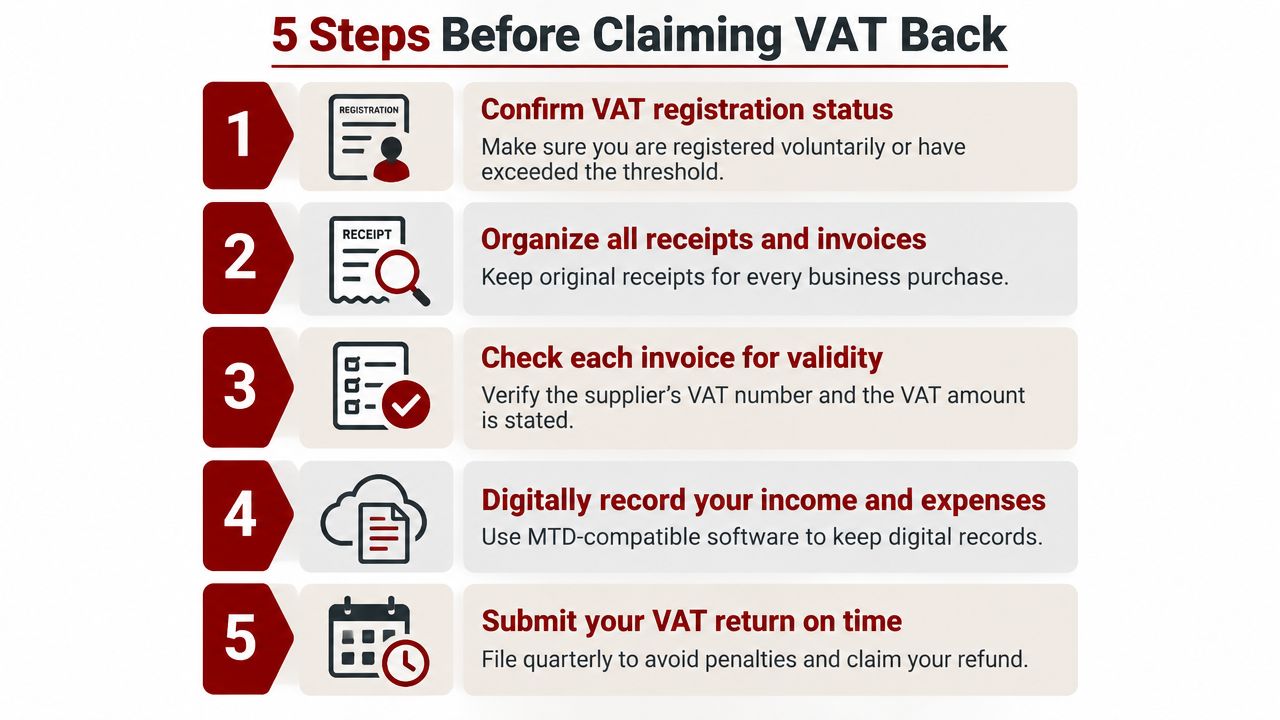
Before you attempt a reclaim, work through these checks in order.
Confirm your registration status. Check the effective date on your VAT registration certificate. If you're not registered, determine whether compulsory or voluntary registration is appropriate before treating VAT as recoverable.
Gather invoices by date and purpose. Create separate folders for pre-registration goods, pre-registration services, current purchases, and mixed-use costs. This makes the timing test and business-use review easier.
Inspect every invoice. Confirm that the VAT amount is identifiable and that the document supports the supplier transaction. Don't rely on a bank statement alone when the VAT evidence is missing.
Model the scheme choice. Compare standard accounting with the Flat Rate Scheme using your actual sales and eligible costs. A simple spreadsheet can reveal whether administrative convenience comes at the expense of recovery.
Set up digital records before the first return. Use MTD-compatible software or a suitable digital workflow, record transactions promptly, and keep the VAT workings with the supporting invoices. The guide to filing a VAT return can help you understand the submission process.
You don't need to manage this in isolation, but you do need organised source records. A specialist professional services newsletter can provide useful accounting updates, while specific advice is preferable where registration, mixed use, or scheme selection is unclear.
Action Accountants Limited can assess your VAT registration position, organise the bookkeeping workflow, and prepare and file VAT returns for qualifying sole traders. Visit Action Accountants Limited to discuss your records, expected costs, and the practical cash-flow impact before you register or submit a reclaim.