VAT Returns Dates Filing Deadlines and Calendar Guide
Never miss HMRC deadlines. Complete guide to VAT returns dates, quarterly and annual filing periods, penalties and reminder calendars.

The standard UK VAT return deadline is one calendar month and 7 days after the end of the accounting period for both filing and payment. For standard quarterly periods ending 31 March, 30 June, 30 September and 31 December, the usual deadlines are 7 May, 7 August, 7 November and 7 February respectively.
You've probably got a client deadline, payroll run or site job competing for attention, while your bookkeeping is still catching up with the last VAT quarter. That's how a straightforward compliance task becomes a rushed submission, an unexpected payment problem or an avoidable HMRC penalty. As a North West London accountant, I'd rather you treat VAT return dates as fixed business controls, not reminders to deal with when everything else is finished.
Table of Contents
- Introduction to VAT Returns Dates and Why Deadlines Matter
- How to Read Your VAT Return Period and Accounting Dates
- VAT Filing Categories Compared by Business Type
- Quarterly VAT Returns Dates and Filing Calendar Examples
- Monthly and Annual VAT Returns Dates Explained
- Late Filing and Late Payment Penalties You Must Avoid
- How to Set Reminders and Never Miss a VAT Deadline
- Quick Reference VAT Dates Lookup and Related Resources
Introduction to VAT Returns Dates and Why Deadlines Matter
You are closing the quarter, chasing an unpaid invoice and checking whether the bookkeeping is complete. Meanwhile, HMRC's VAT deadline is approaching. Treat that date as a fixed business control, because a rushed return can create an avoidable payment problem or late-filing penalty.
For standard online filing, HMRC sets the deadline at one calendar month and 7 days after the end of the VAT accounting period. The same date normally applies to submitting the return and paying the VAT due, as confirmed by HMRC's VAT return guidance. A quarter ending on 31 March is normally due on 7 May. A quarter ending on 30 June is normally due on 7 August.
That gives the business a practical 37-day window after a quarter-end. Use it properly. Missing invoices, unreconciled bank transactions, incorrect purchase VAT and uncertain cash reserves can consume those days before anyone prepares the return. The deadline therefore affects bookkeeping, cash-flow forecasting and payment scheduling together.
Practical rule: Include the VAT liability in your cash-flow plan before preparing the return. Filing on time does not protect you from the consequences of paying late.
Your timetable follows the accounting period assigned to your business, not the calendar quarter that fits your internal reporting. Businesses may file quarterly or monthly, while Annual Accounting follows a separate timetable. Check your VAT certificate and HMRC VAT account before relying on a generic calendar.
Who needs this reference
This quick-lookup guide is useful for:
- Startups: Confirm the period HMRC assigned before setting up the first finance routine.
- Contractors: Coordinate VAT work with project invoicing, CIS administration and irregular receipts.
- Established SMEs: Use a recurring review process instead of leaving the return until the last minute.
- Self-employed professionals: Keep a clear calendar and reconciled records to reduce filing pressure.
Start with your period dates, identify your filing category, then use the relevant quarterly, monthly or annual calendar. If records are incomplete, do not guess the figures. Resolve the bookkeeping issue early or get professional help before submitting the return.
How to Read Your VAT Return Period and Accounting Dates
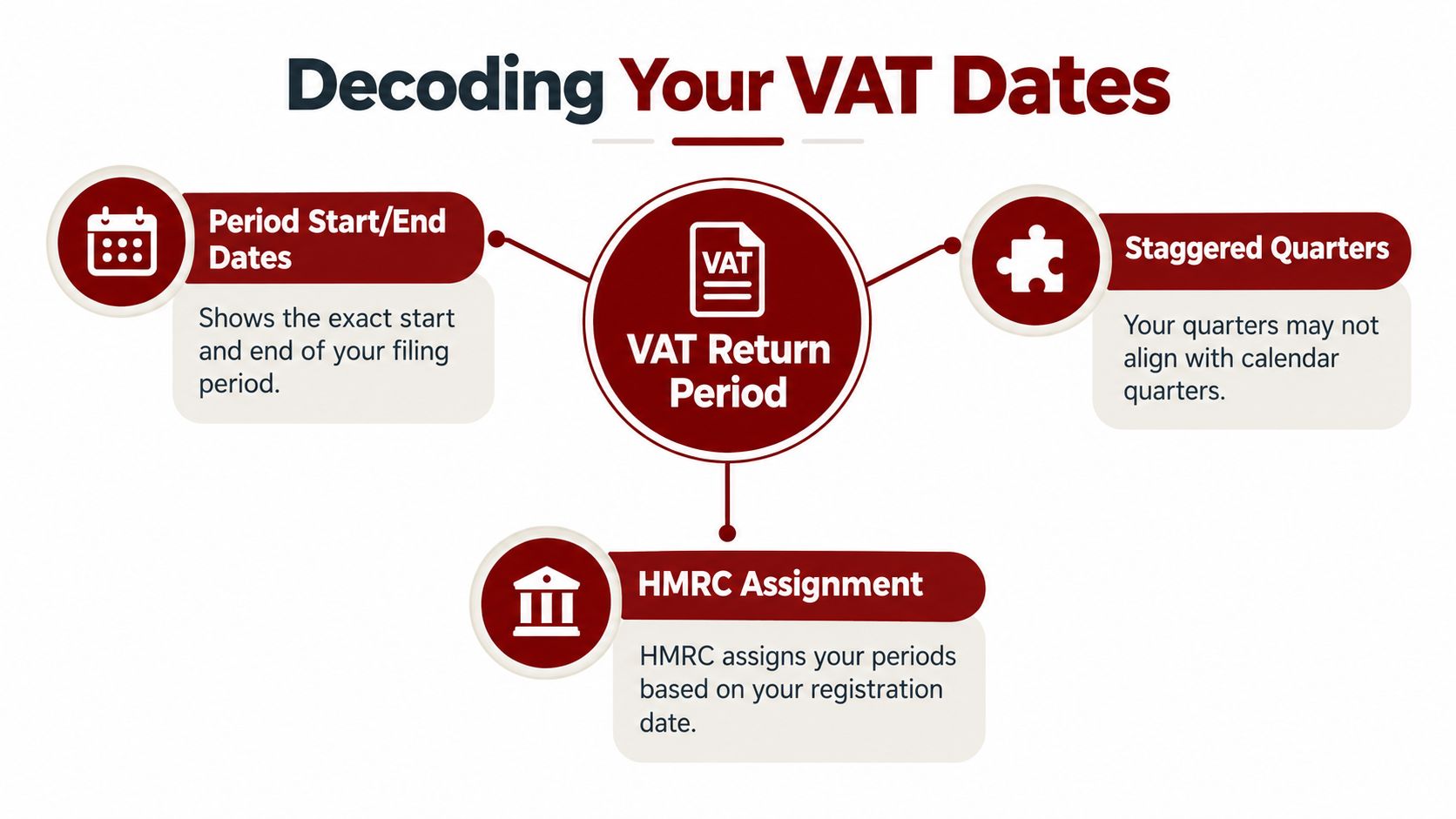
Your first task is to identify the exact VAT period, not to assume your business uses January to March, April to June and so on. HMRC assigns accounting periods when you register or when your filing arrangements change. The period may use staggered quarters that don't match your management accounts.
Find the dates that control your return
Look in your VAT certificate, HMRC VAT account and Making Tax Digital software for:
- Period start date: The first date included in the return.
- Period end date: The final date whose sales and purchases belong in that return.
- Submission deadline: The date by which HMRC must receive the return.
- Payment deadline: Normally the same date under the standard online timetable.
If your certificate shows a period ending on 31 January, don't move those transactions into a calendar-quarter return ending 31 December because it makes your bookkeeping easier. Your VAT return follows the period HMRC has given you.
Decode a non-standard quarter
Suppose your VAT period runs from 1 February to 30 April. The return covers that precise period, and the deadline is calculated from 30 April under the applicable scheme rules. The key point is the period end, not the month in which most of your work took place.
A contractor might have a return ending in a month that differs from the company's year-end. That isn't automatically an error. It may be a normal HMRC stagger. Check the VAT account before changing software settings, moving transactions or asking for an amendment.
Confirm your filing rhythm
Your software should display whether you file monthly, quarterly or annually. Compare that information with the VAT account. If the two systems disagree, pause the filing process and investigate. A bookkeeping platform can calculate figures correctly against the wrong period, which still creates a compliance problem.
For practical guidance on preparing the return through compatible software, use this guide to filing a VAT return. Once you've confirmed your period, use the quarterly VAT calendar or the monthly and annual deadlines to locate the relevant rule.
VAT Filing Categories Compared by Business Type
The right filing frequency depends on how your business manages transactions, cash flow and administrative work. Quarterly filing is the common reference point, but it isn't the only option. Monthly filing may suit a business that regularly reclaims VAT, while Annual Accounting changes the timetable and requires careful payment planning.
| Scheme | Period Length | Deadline Rule | Best For |
|---|---|---|---|
| Quarterly filing | Three-month accounting periods | One calendar month and 7 days after period end for standard online returns | Startups, SMEs and many contractors |
| Monthly filing | One-month accounting periods | One calendar month and 7 days after period end under the standard online rule | Businesses needing more frequent VAT recovery or reporting |
| Annual Accounting | Annual accounting period, subject to scheme rules | Two months after the end of a period lasting 4 to 12 months, or one month after a period under 4 months | Smaller businesses seeking a less frequent return cycle |
Quarterly filing
Quarterly returns usually provide a workable balance. You don't have to prepare a return every month, but you also avoid leaving the full year's VAT reporting until one annual submission. The drawback is that a quarter can contain a high volume of transactions, particularly for construction firms with multiple subcontractors, reverse charge considerations and delayed paperwork.
Monthly filing
Monthly returns create a tighter bookkeeping rhythm. That can be useful where the business regularly expects repayments, because the VAT position is reported more frequently. It also means less time is available between period-end and deadline, so automation and prompt invoice capture matter.
Annual Accounting
Annual Accounting has a distinct timetable and shouldn't be treated as quarterly filing with fewer submissions. The scheme can reduce return preparation, but it doesn't remove the need to reserve cash or maintain accurate records throughout the year. Review the detailed VAT Flat Rate Scheme guidance separately if you're considering scheme options, because filing frequency and VAT calculation method are different decisions.
Decision point: Choose the rhythm your bookkeeping process can support consistently, not the option that looks simplest on paper.
A startup with clean digital records may manage quarterly filing comfortably. A contractor with frequent VAT repayments may prefer monthly returns. A small business with limited transaction volume may value annual reporting, provided it can budget for interim payments and the final balancing amount.
Quarterly VAT Returns Dates and Filing Calendar Examples
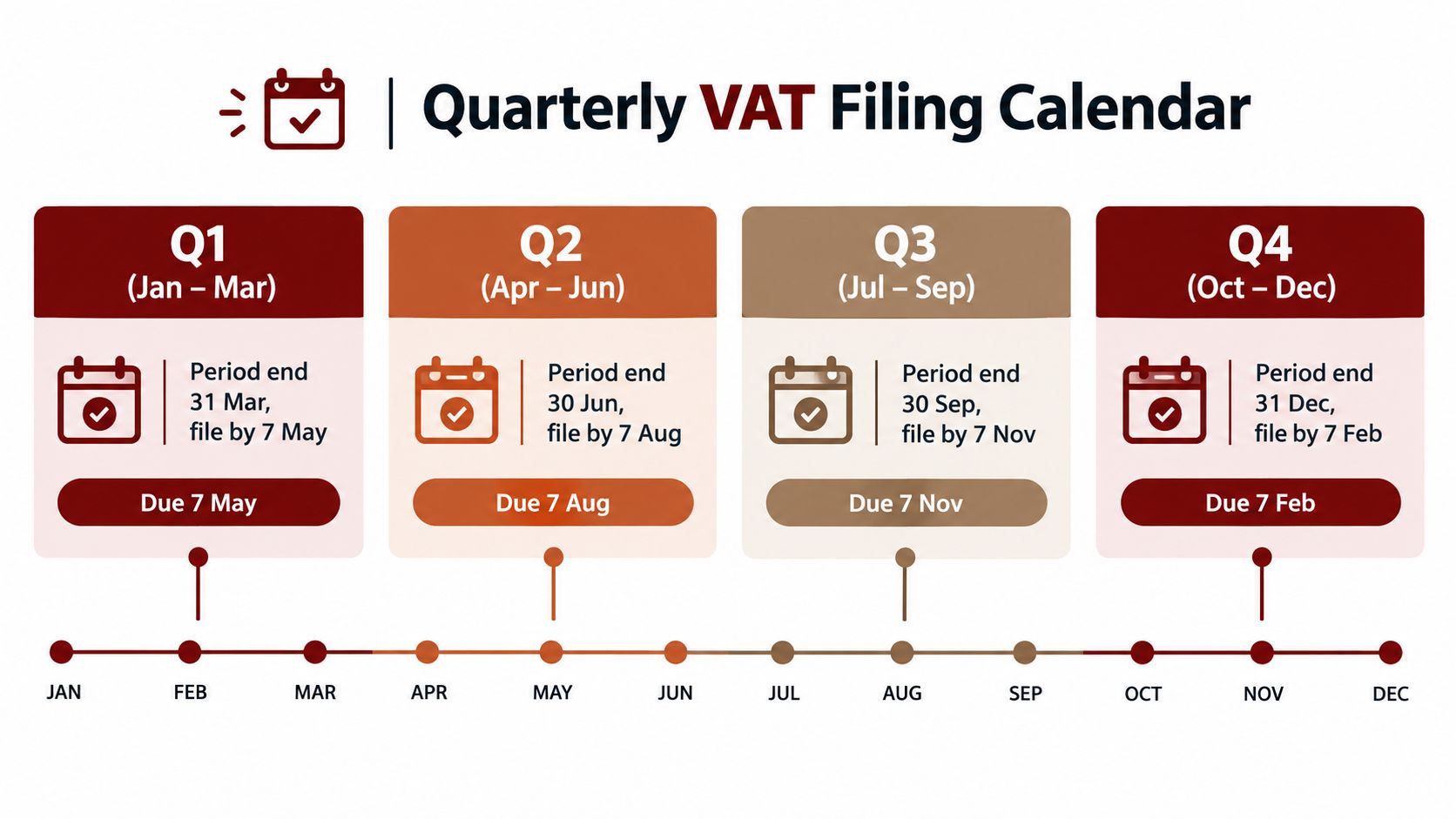
A quarter ending on 30 June gives you a filing and payment deadline of 7 August. Use this quick lookup for the standard quarterly stagger, then confirm your actual dates in your VAT account. HMRC assigns different quarter-end months to some businesses.
For the standard cycle, periods end on 31 March, 30 June, 30 September and 31 December. The matching deadlines are 7 May, 7 August, 7 November and 7 February, giving you 37 days after quarter-end to submit and pay.
Standard quarterly lookup
| VAT period ends | Standard filing and payment deadline |
|---|---|
| 31 March | 7 May |
| 30 June | 7 August |
| 30 September | 7 November |
| 31 December | 7 February |
Treat this table as a reference, not a substitute for checking your account. If your VAT period ends in a different month, work from that actual accounting period and follow the deadline displayed by HMRC.
A worked planning routine
For a quarter ending on 30 June, set your internal close date shortly after 30 June. Reconcile the bank, review sales invoices and chase missing purchase records while there is still time to investigate unusual figures.
Keep the work in five separate stages:
- Record capture: Enter all relevant sales and purchase documents.
- VAT review: Check tax codes, invoices and transactions requiring specialist treatment.
- Reconciliation: Match the bookkeeping records with the bank and supporting schedules.
- Submission: Review the return through compatible software and retain confirmation.
- Payment: Arrange payment so HMRC receives the funds by 7 August.
The deadline remains fixed if it falls on a weekend or bank holiday. Do not treat the next working day as an automatic extension. Founders who schedule payments manually should arrange them before the due date.
Self-employed contractors managing VAT alongside wider tax reserves can use this guide to bookkeeping for self employed taxes when building a recurring records and payment routine.
The following video supports your understanding of the filing process. It does not replace the deadline shown in your VAT account.
Monthly and Annual VAT Returns Dates Explained
Monthly and annual filing require different working habits. Monthly VAT returns use the standard deadline calculation for each individual accounting period. Annual Accounting has separate rules, so you mustn't apply the quarterly formula automatically.
Monthly returns
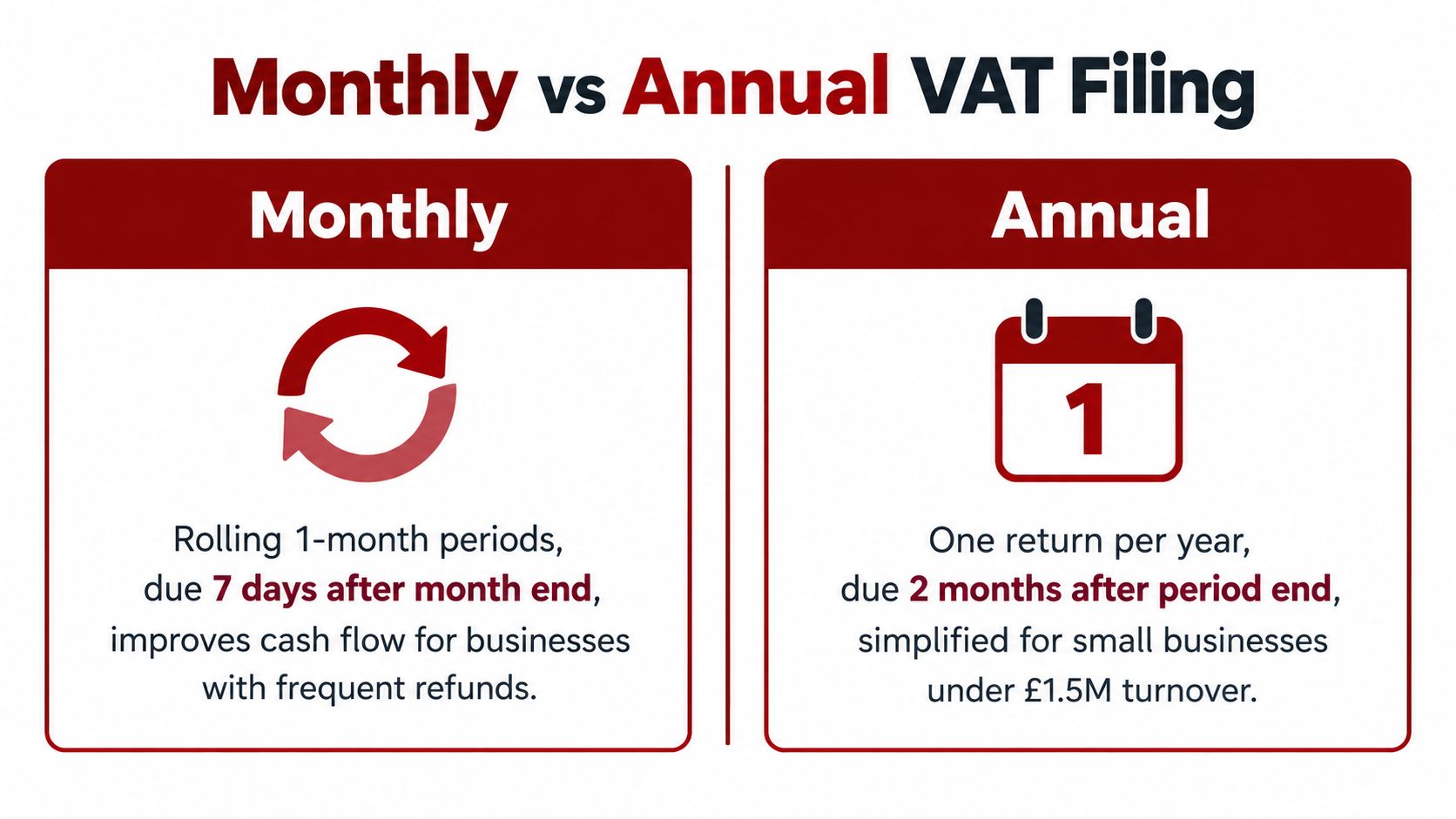
A monthly filer has a rolling one-month period. The filing and payment deadline is normally one calendar month and 7 days after the month-end under the standard online rule. This produces a regular cycle of shorter reconciliations rather than a larger quarterly exercise.
Monthly filing can suit businesses that regularly reclaim VAT or need a more frequent view of their VAT position. The trade-off is operational discipline. Every month needs prompt invoice processing, bank reconciliation and review of VAT treatment. A business that struggles to close its books quarterly won't solve that weakness by filing monthly.
Set a fixed internal close date soon after each month-end. Have the person responsible review exceptions, not just totals. Large movements in output VAT, input VAT or net VAT should trigger a question before submission.
Annual Accounting
Annual Accounting has separate deadlines. For an accounting period lasting 4 to 12 months, the VAT return and payment deadline is 2 months after the end of the accounting period. If the period is under 4 months, the deadline is 1 month after the end. These rules are set out in HMRC's Annual Accounting return and payment guidance.
For a period lasting 4 to 12 months, that creates a planning gap of roughly 61 days after period-end, compared with the 37-day standard quarterly window. The extra time can help a smaller firm complete records and retain cash for longer, but it isn't spare money. Annual Accounting normally involves interim payments during the year, followed by the return and any balancing payment.
| Filing arrangement | Main planning issue |
|---|---|
| Monthly | Shorter close cycle and frequent payment or repayment activity |
| Quarterly | Regular reporting with a 37-day post-period deadline |
| Annual Accounting | Fewer returns, interim payments and a longer final deadline for qualifying periods |
The Annual Accounting rules demonstrate why your scheme matters as much as your period end. Check the exact notice and deadline in the VAT account, especially if the accounting period is shorter than the standard annual cycle.
Late Filing and Late Payment Penalties You Must Avoid
Late filing and late payment are separate problems. A return can be submitted late even when no VAT is payable, while a submitted return can still lead to payment consequences if the amount due doesn't reach HMRC on time.
The supplied penalty graphic includes specific point, fine and interest figures, but those figures aren't contained in the verified data provided for this article. They shouldn't be used as a substitute for the current HMRC rules. Check your HMRC account and official guidance before relying on any penalty amount or interest calculation.
What lateness can trigger
Missing a filing date can create a compliance record even where the return shows no VAT to pay. Late payment can create a separate financial issue, with consequences depending on the amount owed, how long it remains unpaid and the rules applying to that VAT period.
Don't rely on online summaries that give one universal penalty formula. HMRC rules can distinguish between submission and payment, and the relevant scheme and period can affect the treatment. If you've missed a date, check the account immediately, submit the outstanding return and establish what payment action is required.
You should also review the VAT error correction guidance if the problem is an incorrect return rather than a late one. Correcting an error and dealing with a late submission are different tasks.
Make the cost visible in your process
A late VAT return can consume more than the financial consequence. It takes time to investigate, creates uncertainty for cash flow and can disrupt other compliance work. For a contractor, an unresolved VAT issue can sit alongside CIS records, payroll and subcontractor queries, putting pressure on the entire finance function.
Use three controls:
- Account review: Check HMRC messages and penalty status after each submission.
- Evidence retention: Keep the submission confirmation, payment record and working papers.
- Escalation: Ask an accountant to review the position quickly if you're late, unable to pay or unsure whether the return is correct.
The strongest response is prevention. The next section turns the calendar into a repeatable workflow.
How to Set Reminders and Never Miss a VAT Deadline
A deadline system should work when you're busy, travelling between sites or dealing with a difficult customer. One calendar alert isn't enough. Build a short chain of ownership, bookkeeping checks and payment controls around the date shown in your HMRC account.
Create a recurring VAT workflow
Start by entering every period end and deadline into the business calendar. Add alerts well before the legal cut-off, then assign one person to own the return even if another person prepares the bookkeeping.
A reliable sequence looks like this:
- Close the period: Stop unreviewed transactions from slipping into the next return.
- Reconcile records: Match bank activity, sales invoices and purchase documents.
- Review exceptions: Investigate missing VAT invoices, unusual tax codes and large movements.
- Prepare the return: Use Making Tax Digital compatible software connected to the correct VAT account.
- Approve and submit: A second review is useful where the figures are material or the business has complex transactions.
- Arrange payment: Keep the payment plan separate from the submission approval.
- Archive evidence: Store the return, calculations and payment confirmation together.
Build reminders around work already happening
Tie VAT preparation to your month-end bookkeeping rather than treating it as an isolated tax task. Construction clients should also coordinate the review with CIS and payroll administration, because missing paperwork in one area often signals incomplete records elsewhere.
Use a shared task list with clear ownership. “Finance team” is not an owner. Name the person who must chase documents, the person who reviews the VAT treatment and the person who authorises payment.
Put the VAT deadline in the calendar, but put the preparation deadline earlier.
Direct Debit can reduce the risk of manually missing the payment, but it doesn't remove the obligation to prepare and submit the return correctly. Keep enough funds available and check that the collection arrangement is active. If cash flow is already strained, contact HMRC before the deadline to discuss the available options rather than allowing the payment to fail.
Action Accountants Limited can support businesses with VAT return preparation, bookkeeping and wider compliance, including processes that need to work alongside CIS obligations. If you outsource the work, give the accountant access to complete records and agree an internal cut-off that leaves time for questions.
Quick Reference VAT Dates Lookup and Related Resources
Bookmark this page, but always treat your HMRC VAT account as the final reference for your own period and scheme. The tables below are designed to help you identify the relevant rule quickly.
Filing frequency lookup
| Your arrangement | What to check first | Deadline reference |
|---|---|---|
| Standard quarterly | Confirm the period end and stagger | One calendar month and 7 days after period end |
| Monthly | Confirm each month-end period | One calendar month and 7 days after period end |
| Annual Accounting | Confirm the length of the accounting period | Two months after a 4 to 12 month period, or one month after a period under 4 months |
For the standard quarterly stagger, use this compact calendar:
| Period end | Deadline |
|---|---|
| 31 March | 7 May |
| 30 June | 7 August |
| 30 September | 7 November |
| 31 December | 7 February |
Your quick-check list
- Confirm the scheme: Check whether you're quarterly, monthly or on Annual Accounting.
- Confirm the period: Read the exact start and end dates from HMRC, not just your internal calendar.
- Confirm filing and payment: Under the standard rule, both normally share the same deadline.
- Check strictness: HMRC says the date doesn't move for a weekend or bank holiday.
- Keep evidence: Save the submitted return, supporting records and payment confirmation.
- Escalate early: Get advice before the deadline if figures are incomplete or cash is tight.
For businesses that need a practical example of working papers and VAT preparation, this product page for VAT returns bookkeeping offers useful context on the records that support a return. You can also use this VAT compliance checklist to turn the lookup table into a recurring control.
The important terms are simple. The accounting period is the span covered by the return. The period end is the date from which the deadline is calculated. Your tax point helps determine when a transaction falls into VAT reporting, so don't rely only on the date cash reaches your bank. If your circumstances involve specialist VAT schemes or cross-border reporting, check the relevant HMRC guidance rather than applying the standard quarterly rule.
If you're a founder, contractor or growing North West London business, Action Accountants Limited can handle VAT return preparation, bookkeeping, payment planning and related compliance controls. Visit Action Accountants Limited to discuss your VAT return dates and put a dependable filing process in place before the next deadline.