
VAT Return Late Submission Penalty: Rules, Costs, and Fixes
Understand the VAT return late submission penalty, how HMRC points add up to £200 fines, and the practical steps to avoid or appeal them in 2026.
You've opened an HMRC notice, checked the bank account and thought: but we paid the VAT. Or perhaps there was nothing to pay, so the return slipped behind wages, supplier invoices and everything else demanding your attention. A VAT return late submission penalty can feel disproportionate when you're trying to keep a small business moving.
Don't start by arguing with the notice. Establish what was late, check your existing points and preserve the evidence. Filing, payment and challenging a penalty are separate jobs, and leaving any of them unattended makes the situation harder to resolve.
Table of Contents
- Why the Late Submission Penalty Changed Everything in 2023
- How the Points Threshold and £200 Penalty Actually Work
- Worked Examples of Penalty Costs in Practice
- Late Submission Versus Late Payment and What Each Costs You
- Reasonable Excuse, Delegated Compliance, and What HMRC Really Wants
- Your 30-Day Window to Review or Appeal the Penalty
- A Proactive Plan to Avoid the Next Penalty Notice
Why the Late Submission Penalty Changed Everything in 2023
Consider a hypothetical quarterly filer in Colindale. The owner approves the figures, assumes the bookkeeper has submitted them and gets on with running the business. Later, an HMRC notice arrives. The payment went through, but the return didn't.
The owner's instinct is understandable: HMRC has its money, so what's the problem? The problem is that paying VAT and submitting the return are separate obligations.
For VAT accounting periods beginning on or after 1 January 2023, HMRC replaced the default-surcharge regime with a points-based late-submission system, affecting approximately 2.4 million VAT-registered businesses, as explained in HMRC's announcement of the VAT penalty reforms.
The old assumption no longer works
Under the previous default-surcharge approach, the financial consequence was more directly associated with late payment and the business's compliance history. The replacement separates the filing consequence from the payment consequence. Treating the bank transfer as proof that VAT compliance is finished is therefore a mistake.
Think of two clocks running independently. One concerns the return reaching HMRC. The other concerns payment. Completing one task doesn't complete the other, even when your internal process puts both on the same checklist.
Practical rule: Close the VAT task only when you've checked both the submission confirmation and the payment position.
That distinction matters when you delegate. An owner may approve payment while a bookkeeper waits for approval to submit. Unless someone checks both outcomes, each person can believe the other has finished the job.
Replace assumptions with visible ownership
I recommend recording responsibility against the actual tasks, not writing “accountant handles VAT” in a handover document.
- Preparation: Who reconciles the records and resolves outstanding queries?
- Approval: Who authorises the figures, and who covers their absence?
- Completion: Who checks that submission succeeded and payment was dealt with?
For businesses reviewing their digital process, the Making Tax Digital VAT compliance guide is a useful companion to that responsibility check. Software belongs inside a controlled workflow, not in place of one.
The practical change is straightforward: stop managing VAT as a single event. Manage preparation, filing and payment as distinct tasks with evidence that each is complete.
How the Points Threshold and £200 Penalty Actually Work
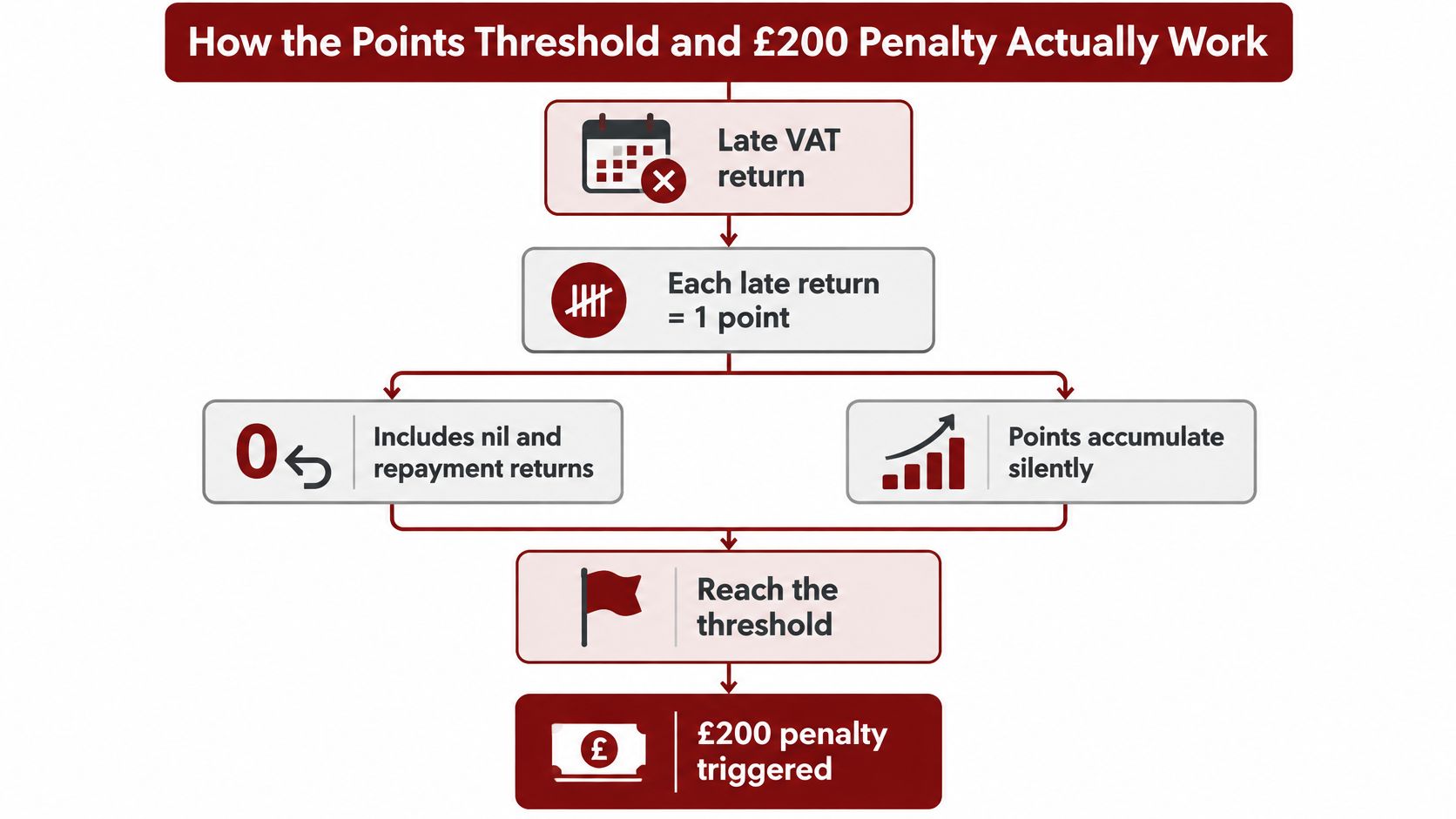
A late return normally creates a penalty point, not an immediate cash penalty. The monetary charge starts when accumulated points reach the threshold for your filing frequency.
Under HMRC's late-submission points guidance, each late return normally creates one point, including nil and repayment returns. The thresholds are 2 points for annual filing, 4 for quarterly filing and 5 for monthly filing; reaching the applicable threshold triggers £200, followed by another £200 for each subsequent late return while the business remains at that threshold.
The diagram summarises the route from missed submission to financial penalty.
Check your balance before judging the notice
The useful question isn't whether this return was late. It's what your points position was before it became late.
An isolated failure and a failure at the threshold have different financial outcomes. That's why you should inspect the account history rather than assess the notice in isolation.
- Identify the filing frequency: Use the business's actual arrangements, not an assumption based on another company.
- Check existing points: Match the recorded failures against your submission records.
- Separate points from charges: A points notice and a financial penalty aren't interchangeable.
- Include quiet periods: A return showing no VAT payable still needs attention.
This last point catches founders who have paused trading or are waiting for their first substantial sales. A lack of tax to pay doesn't make the submission optional.
Expiry isn't a substitute for compliance
Points generally expire after 24 months, calculated from the first day of the month following the failure, but expiry is restricted at the applicable maximum. In HMRC's explanation of point expiry, a return due on 7 April 2024 produces a point expiring on 30 April 2026, provided the taxpayer hasn't reached the threshold.
Don't turn that into a blanket instruction to wait for old points to disappear. Once you're at the maximum, the relevant compliance conditions matter.
My recommendation is to keep a points register alongside the filing calendar. Record the affected return, check whether the point is disputed and assign someone to monitor the position. A single missed submission needs correcting; a pattern needs a different operating process.
Worked Examples of Penalty Costs in Practice
The examples below are illustrative calculations, not client case studies. They apply the HMRC rules set out above, assuming no successful challenge, no relevant point expiry and no change in filing frequency. They cover submission penalties only.
Different filing patterns create different exposure
Annual filer with consecutive missed returns. Starting with no points, the initial late return creates a point without a submission charge. The next late annual return reaches the applicable threshold and triggers the fixed penalty. The important feature isn't how busy the business was during either year, but the accumulated filing record.
Quarterly filer with repeated slippage. If a quarterly business starts without points and misses fewer returns than its threshold, it can have a poor filing record without yet incurring a monetary submission penalty. That isn't a safe position. Another failure may be the one that changes the cash consequence.
Monthly filer with an extended compliance gap. Once the monthly threshold is reached, another late return attracts another charge while the business remains there. Sending outstanding returns in a batch doesn't make them timely.
The table uses the thresholds and fixed charge in the preceding HMRC guidance. Its totals are arithmetic illustrations, not additional charges prescribed by a separate rule.
Penalty Cost by Filing Frequency
| Filing frequency | Points threshold | First £200 penalty triggers after | Cost if next 4 returns are all late |
|---|---|---|---|
| Annual | 2 | Second late return, assuming no expiry | £800 |
| Quarterly | 4 | Fourth late return, assuming no expiry | £800 |
| Monthly | 5 | Fifth late return, assuming no expiry | £800 |
Table assumption: “Next” means the business has already reached its applicable threshold and remains there throughout those subsequent late submissions. It does not mean starting from a clean record.
Look beyond the headline charge
The immediate cash cost matters, particularly where payroll and suppliers already compete for funds. But the management cost deserves attention too: retrieving records, checking submissions, reconstructing communications and preparing a challenge all take time.
Don't assume that a small fixed penalty justifies ignoring the underlying problem. Equally, don't inflate it into an existential crisis.
Treat the notice as a prompt to repair the process, not as proof that the business is beyond repair.
The most useful distinction is between an isolated disruption and a recurring control failure. If every return depends on the owner remembering to chase someone, you haven't solved the problem by paying the latest notice. You've bought time until the next deadline.
Late Submission Versus Late Payment and What Each Costs You
A filing problem needs a filing response. A payment problem needs a payment response. Don't use one as a reason to postpone the other.
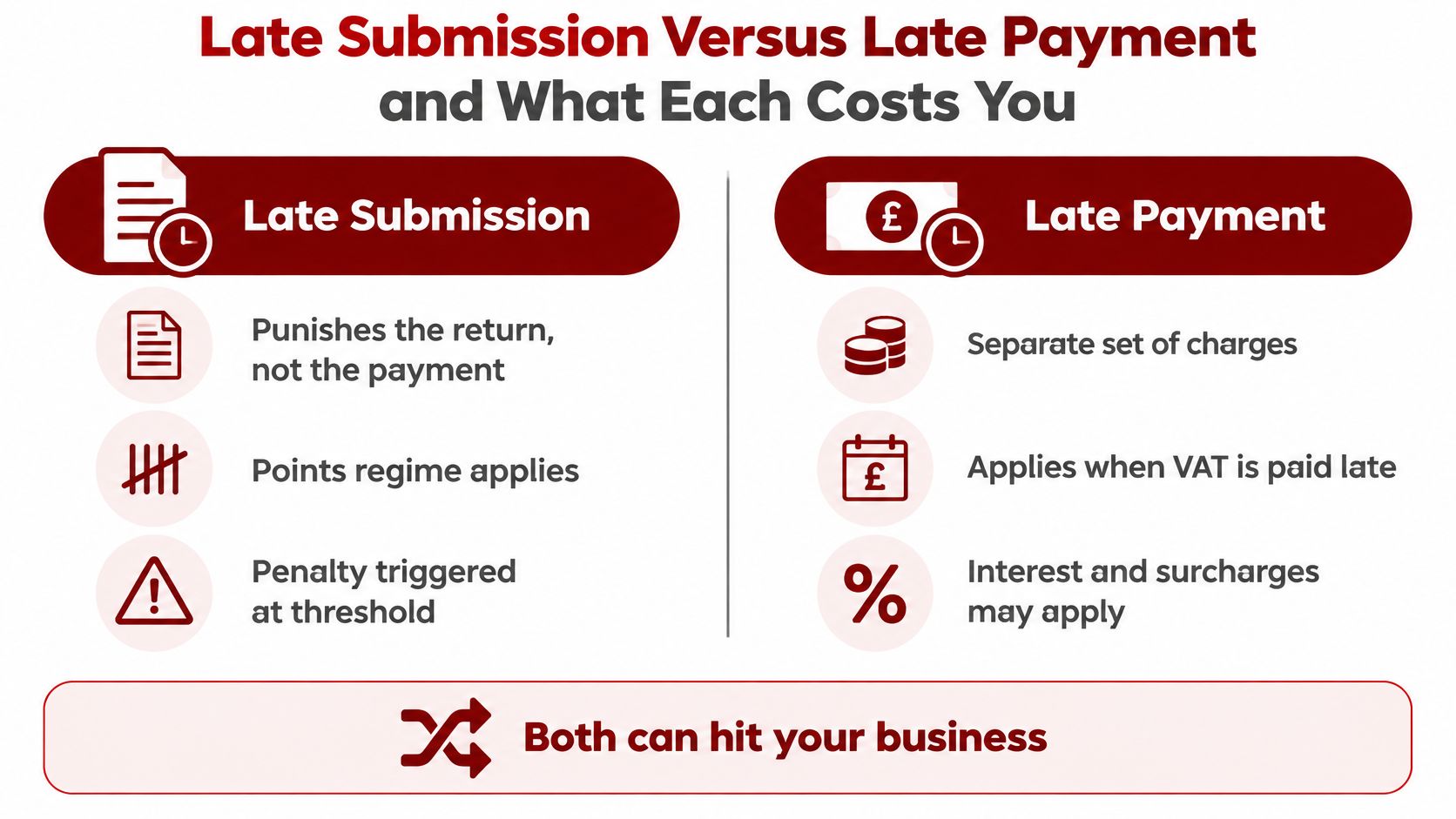
The current reform separates submission points and fixed penalties from late-payment penalties and interest. Payment-specific rates and charges need checking against the circumstances of the unpaid VAT; they shouldn't be guessed from a submission notice.
Use this comparison to identify which obligation remains unfinished.
Check the return and the money separately
| Operational question | Filing check | Payment check |
|---|---|---|
| What needs completing? | Submission of the return | Payment of the VAT due |
| What evidence should you retain? | Successful submission confirmation | Payment record and account reconciliation |
| Who should own the follow-up? | Named filing owner | Named payment owner |
| What if something goes wrong? | Resolve the submission failure | Address the unpaid balance separately |
The visual's reference to surcharges shouldn't be read as a revival of the old default-surcharge regime. For the current arrangements, keep late-payment penalties and interest distinct from the submission system.
An owner who can't fund the VAT should still deal with the return. Conversely, making a transfer doesn't resolve an unsuccessful submission. Both situations call for action, but not the same action.
Build payment into the forecast
My recommendation is a dedicated VAT reserve supported by a realistic cash-flow forecast. Set an internal funding date ahead of the payment deadline, then check whether the reserve matches the developing liability.
That's a cash-management control, not a filing control. You still need a separate submission check, especially if another person prepares or approves the return.
For a video explanation alongside those checks, use the following resource.
Don't close the file because someone says the VAT is “sorted”. Ask whether that means prepared, approved, submitted or paid. Those words describe different stages, and the evidence should match the answer.
Reasonable Excuse, Delegated Compliance, and What HMRC Really Wants
“My accountant was dealing with it” isn't automatically a defence. Neither is “the software normally does it”.
HMRC's reasonable-excuse guidance explains that there's no statutory definition of reasonable excuse. HMRC considers the individual circumstances, whether the failure was corrected without unreasonable delay and, where someone else was relied upon, whether the taxpayer took reasonable care to avoid the failure.
That makes delegation a question of conduct and evidence. Appointing a bookkeeper doesn't explain whether you supplied the records, answered queries, approved the return or checked that submission had happened.
Explain the disruption and its effect
Circumstances that may support a reasonable excuse include serious illness, unexpected hospitalisation, fire, flood, theft, computer failure, HMRC online-service failure and certain disability or mental-health-related difficulties. None should be presented as an automatic exemption. The explanation must connect the event to the missed obligation.
Honesty and good faith alone aren't enough. A sincere account of being overwhelmed is different from evidence explaining why the return couldn't reasonably be submitted.
Consider a hypothetical construction subcontractor whose external bookkeeper couldn't proceed without missing records. That differs materially from an owner who supplied everything, confirmed responsibility and retained messages showing repeated attempts to secure submission. The label “outsourced bookkeeping” tells HMRC little about either situation.
Build an evidence pack, not a complaint
I recommend assembling relevant material into a dated chronology.
- Engagement terms: Show who was responsible for preparation, approval and submission.
- Submission records: Preserve logs, confirmations, failed attempts and relevant software error messages.
- Disruption evidence: Include appropriate illness records, outage details or other supporting documents.
- Communications: Retain HMRC correspondence and exchanges with the person handling the return.
- Correction timeline: Explain when the impediment ended and what happened next.
LegesGPT's AI legal assistant is an option to consider for organising questions before taking advice. Don't treat generated wording as evidence or upload sensitive records without checking the relevant privacy terms.
Evidence first: A clear chronology supported by records is more useful than a forceful letter unsupported by documents.
Keep a calculation error separate from the reason for missing submission. If reviewing the records reveals incorrect VAT figures, use the VAT error-correction guidance to assess that issue independently.
The objective is a precise explanation of what prevented compliance, what reasonable care you took and how promptly you corrected the failure. Don't promise yourself an appeal win before those questions have answers.
Your 30-Day Window to Review or Appeal the Penalty
Put the challenge deadline in the diary as soon as the notice arrives. A taxpayer usually has 30 days from the penalty notice to request a review or appeal under the HMRC guidance cited above. Follow the instructions on the actual notice rather than relying on a remembered conversation.
The process visual provides an organising checklist, subject to the important correction immediately below it.
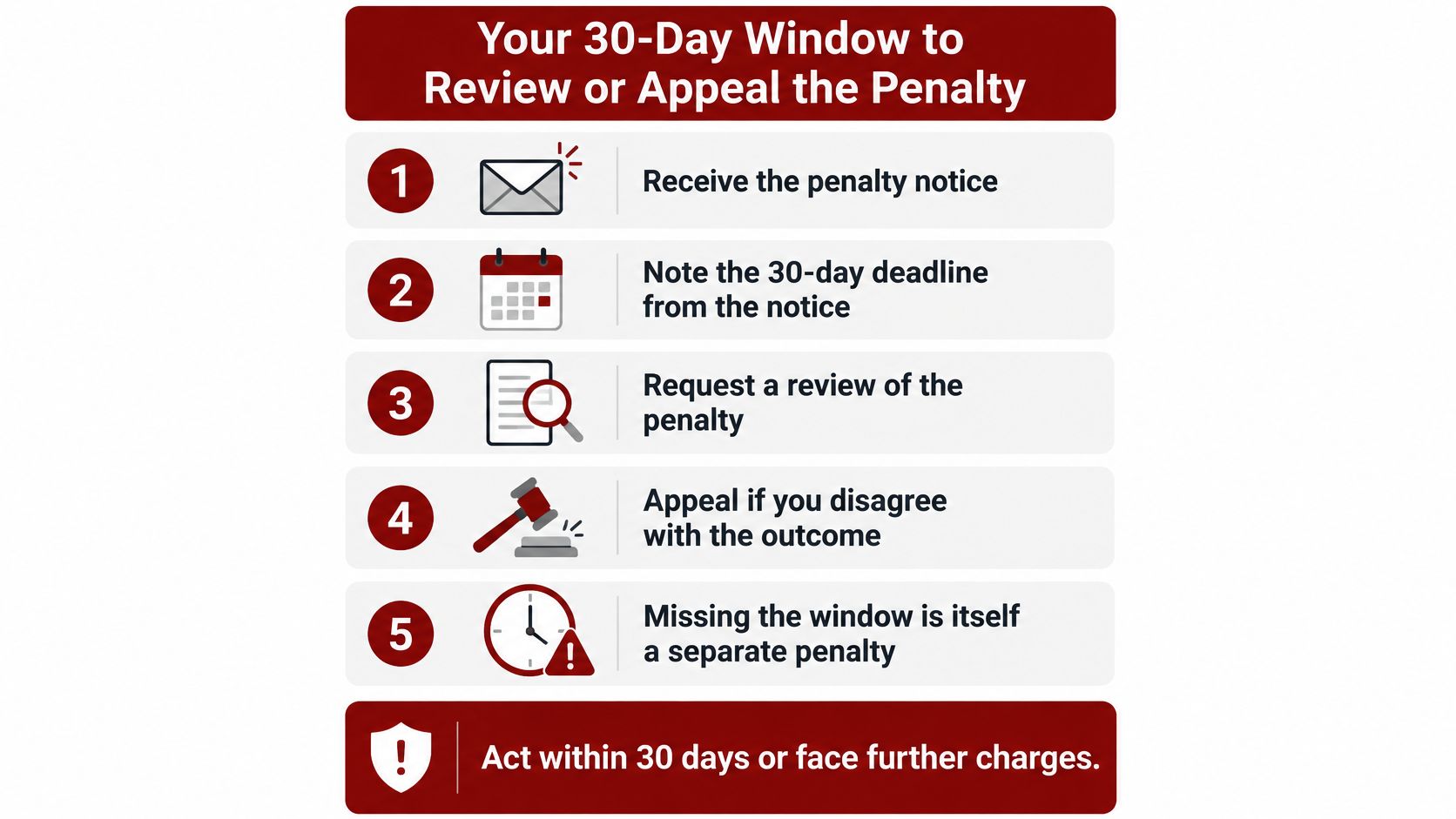
Important correction: Missing an appeal deadline does not automatically create a separate VAT penalty or further charges. The risk is losing the ordinary opportunity to challenge the decision. Don't rely on the visual's statements to the contrary.
Make the request specific
A challenge should identify the decision and explain why it's wrong or why the failure is excusable. I recommend including:
- The notice details: Identify the penalty reference, affected return, relevant dates and any amount charged.
- The grounds: Explain whether you dispute the underlying facts or rely on a reasonable excuse.
- The evidence: Attach the records supporting each material part of your explanation.
- The remedy sought: State clearly what decision you want HMRC to reconsider.
An internal HMRC review asks HMRC to reconsider its decision. A tax tribunal appeal seeks an independent determination. They aren't interchangeable descriptions of writing a complaint, so check which route you're taking and the applicable instructions.
Correct the failure without losing the challenge
Submit the outstanding return promptly and deal separately with overdue VAT. Don't delay protecting your challenge deadline while waiting for every operational issue to be resolved.
Professional representation becomes worth considering where the chronology is disputed, responsibility is unclear or the evidence needs careful interpretation. The point isn't to make the letter sound legal. It's to present the relevant facts accurately, preserve the procedural position and avoid undermining a legitimate challenge with unsupported assertions.
A Proactive Plan to Avoid the Next Penalty Notice
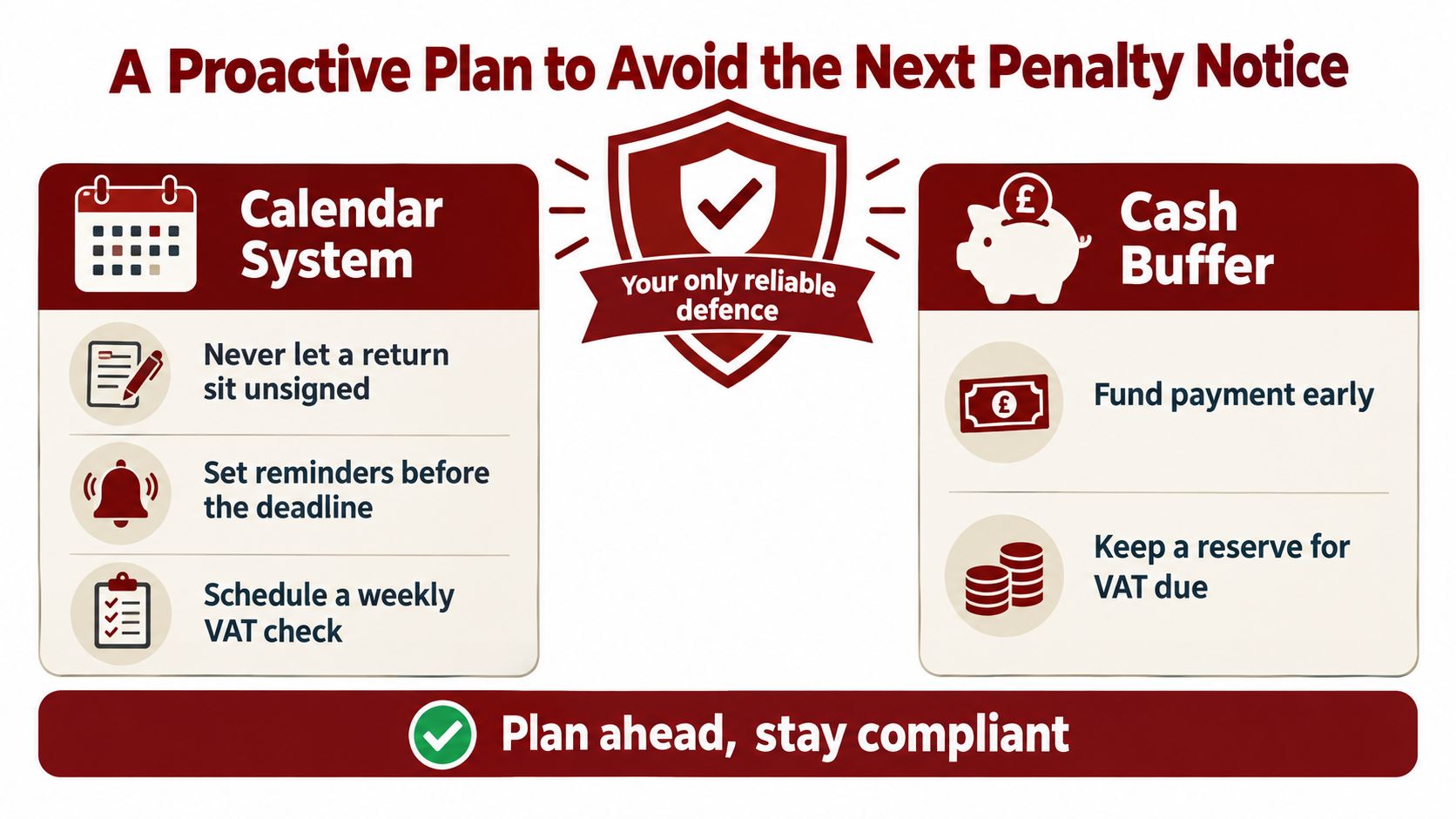
Build a process that works when the owner is busy, the bookkeeper is absent and an approval is delayed. A reminder alone won't do that. You need an owner, a cover arrangement and evidence of completion.
Use the planning visual as a prompt for the controls your business needs.
Make responsibility visible
Set internal preparation and approval dates ahead of the statutory deadline. Name the filing owner, arrange a second reviewer for material or unusual transactions and document the handover whenever the bookkeeper changes.
A founder preparing their own return needs an approval pause and a completion check. A construction business needs a workflow that accommodates its CIS and VAT records. A VAT-registered property business needs someone to resolve transaction queries before submission becomes urgent.
Use the guide to filing a VAT return to support the operational checklist. Then adapt it to the people who do the work.
Keep this beside the filing calendar
| Do | Don't |
|---|---|
| Name an owner for submission | Assume delegation proves completion |
| Set internal dates before the deadline | Leave approval until the last moment |
| Retain confirmation of successful filing | Confuse preparation with submission |
| Maintain a VAT reserve | Treat available cash as spare cash |
| Document handovers and cover arrangements | Depend on one person's memory |
The aim isn't a more elaborate spreadsheet. It's a process in which someone notices an unfinished task early enough to act. Keep the controls simple enough that the team uses them every time.
For London businesses wanting an external option, Action Accountants Limited provides bookkeeping, VAT return preparation and compliance support from its Colindale practice. Ask the team to review your penalty notice, check the supporting records and agree who will own preparation, approval and submission before your next deadline.