Sole Trader vs Limited Company Tax Comparison UK Guide
Clear sole trader vs limited company tax comparison for UK founders, contractors and landlords.
You've finished a project in North West London, sent the invoice, and started planning the next contract. Then the client says payment will take another 60 or 90 days. Meanwhile, VAT and tax deadlines keep moving, and you still need money for rent, wages and household bills. At that point, choosing between a sole trader and a limited company becomes more than a question of which headline tax rate looks lower.
The right structure affects when tax arises, how you access business cash, what happens when a customer pays late, how much administration you carry and whether business liabilities remain personal. This sole trader vs limited company tax comparison uses the 2025-26 rules, worked figures and practical cash-flow tests rather than treating annual tax as the whole answer.
Table of Contents
- The Two Routes UK Founders Can Take
- How Each Structure Is Taxed in 2025-26
- Worked Example on the Same Profit Figure
- Allowable Expenses, VAT and Compliance Costs
- Cash-Flow Reality When Payments Are Late
- Which Structure Suits Your Scenario
- Decision Checklist and Next Steps
The Two Routes UK Founders Can Take
A new consultant in Colindale might start with a laptop, a handful of clients and no certainty about next year's revenue. Registering as a sole trader is quick and straightforward. Forming a limited company creates a separate legal entity, but it also brings company accounts, payroll decisions and more disciplined cash management.
The choice matters because the two structures tax profit differently. A sole trader is personally taxed on taxable business profits, whether the money remains in the business account or has been withdrawn. A company pays tax on its profits first, then the owner pays personal tax when extracting value through salary or dividends.

If you're still deciding how to start, registering a new business is only the first step. You also need to consider liability, VAT, client expectations, payment terms, drawings and whether profits will be reinvested.
My practical view: if your business is small, low-risk and mainly exists to pay you for your own work, simplicity can win. If profits are building, liability is material or you want to retain money for growth, a company deserves serious modelling.
This isn't a once-and-forget registration decision. Changing structure later can affect contracts, banking, tax reporting and how you extract accumulated profits. Make the choice using a realistic profit forecast and a cash-flow plan, not a generic internet threshold.
How Each Structure Is Taxed in 2025-26
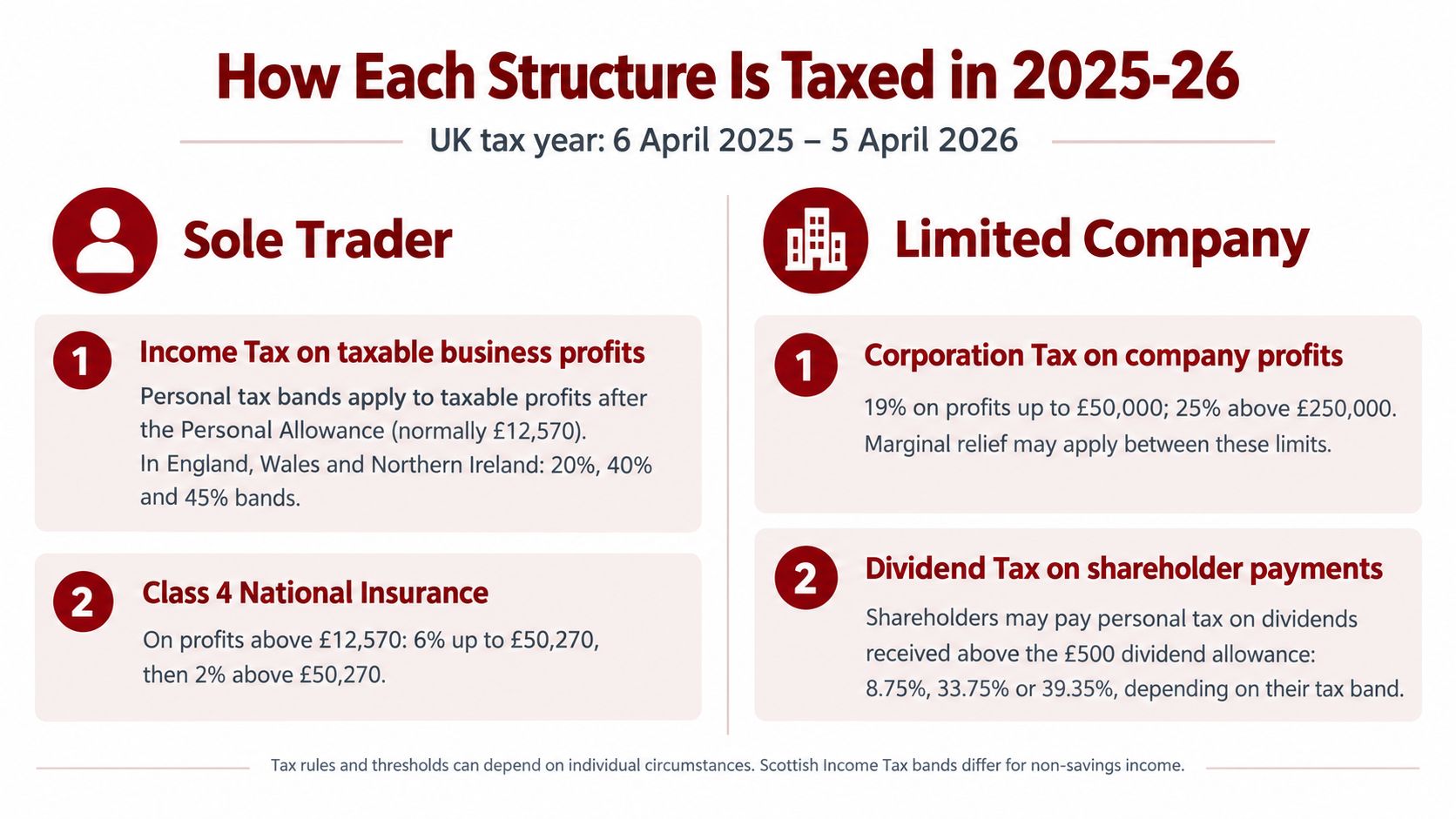
The basic distinction is simple. A sole trader pays personal tax on taxable business profit. A limited company pays Corporation Tax before the owner extracts money. The second route can create two layers of tax, although the owner has more control over timing and extraction.
For 2025-26, individual income-tax rates are 20% at the basic rate, 40% at the higher rate and 45% at the additional rate. A sole trader may also pay Class 4 National Insurance at 6% on profits between £12,570 and £50,270, reducing to 2% above £50,270. These figures are set out in the UK government's 2025-26 tax rates and allowances.
A limited company is taxed separately. For 2025-26, the main Corporation Tax rate is 25%, while companies with profits of £50,000 or less may qualify for the 19% small-profits rate, subject to associated-company and profit-allocation rules. The company's accounting profit, salary costs, pension contributions and allowable expenses all affect the calculation.
The owner then decides how to take money out:
- Salary: The company normally treats salary as a business cost, while the director may face Income Tax and employee National Insurance. Employer National Insurance can also arise, depending on the salary design.
- Dividends: Dividends come from post-tax company profits. They aren't subject to employee or self-employed National Insurance, but they are personally taxable above the dividend allowance.
- Retained profit: Money left inside the company remains company money. It can fund equipment, staff or working capital, but it isn't automatically personal spending money.
For 2025-26, dividend tax rates are 8.75% for basic-rate taxpayers, 33.75% for higher-rate taxpayers and 39.35% for additional-rate taxpayers, with a £500 dividend allowance, according to the current and past Income Tax rates published by GOV.UK. Owners should also understand their filing responsibilities before committing to a structure. A company's Corporation Tax return is one of the recurring obligations covered by Corporation Tax return guidance.
For a wider international perspective on contractor structures, see what Pipeline On says, but don't import overseas rules into a UK decision. The useful UK comparison is total tax, extraction method, compliance cost and cash retained in the business.
Worked Example on the Same Profit Figure
A clean example shows why comparing 25% Corporation Tax with a sole trader's Income Tax rate gives the wrong impression.
Assume a company has £100 of profit eligible for the 25% Corporation Tax rate. The company pays £25, leaving £75 available for distribution. If the owner is a higher-rate taxpayer, dividend tax at 33.75% on that taxable dividend is £25.31 before considering the allowance. The owner receives approximately £49.69 after both taxes. The illustrative combined burden is about 50.3%, although the actual outcome varies with salary, allowances, expenses and retained profits.
| Route | Headline rate | Effective burden on £100 profit | Key variable |
|---|---|---|---|
| Sole trader | Income Tax plus Class 4 NIC | Depends on the owner's marginal band and available allowances | Total taxable profit and personal income |
| Limited company | 25% Corporation Tax, then dividend tax | About 50.3% in this higher-rate illustration | Salary, dividend timing, allowance and retained profit |
A sole trader doesn't face a separate Corporation Tax layer. The same £100 is assessed through personal Income Tax and potentially Class 4 NIC, so the bill depends heavily on which part of the owner's personal tax bands the profit occupies.
This is why a company can look less attractive when the owner withdraws every pound immediately, but more useful when profits are retained for equipment, staff or a cash reserve. A salary can change the company's taxable profit, while pension contributions and legitimate expenses can alter the overall result.
The £500 dividend allowance, pension contributions, personal allowance, associated companies and the split between salary and dividends all matter. So does the owner's other income. A proper calculation must model the individual's whole position, not apply one percentage to the trading profit.
Allowable Expenses, VAT and Compliance Costs
Tax follows the profit left after legitimate business costs. Both structures can generally claim allowable costs that are incurred wholly and exclusively for the business, provided the records support the claim. Typical examples include equipment, professional subscriptions, business mileage and an appropriate share of home-working costs.
A limited company may also make employer pension contributions for a director, but that doesn't mean every personal expense becomes deductible. Keep invoices, receipts, mileage records and a clear business purpose. If you're unsure what a sole trader can claim, use this practical guide to tax-deductible expenses for self-employed workers.
VAT is a separate question from legal structure. The registration trigger is based on taxable turnover, not whether you operate as a sole trader or company. Once VAT obligations apply, you'll need reliable bookkeeping, properly timed returns and enough cash set aside for the payment date. VAT collected from customers isn't your profit.
The sole-trader route usually has less administration. You'll still need accurate records and Self Assessment, but there's no company confirmation statement or statutory company accounts. A limited company normally adds:
- Companies House obligations: Company information and required filings must stay current.
- Payroll administration: A director's salary needs an appropriate payroll process.
- Statutory accounts: The company's accounting records and accounts must be prepared correctly.
- Separate banking: Company money should remain distinct from personal money.
- Extraction records: Dividends need sufficient distributable profits and proper documentation.
For 2026-27, voluntary Class 2 National Insurance costs £3.65 per week below the small-profits threshold, while Class 4 remains 6% and then 2% above the relevant thresholds, as explained in the GOV.UK National Insurance guidance. For contractors comparing wider self-employed costs, this guide for 1099 contractors provides additional context, although UK tax treatment must remain the reference point.
The mistake I see most often is treating extra accounting fees as the only cost of incorporation. The owner's time, missed deadlines, software, payroll and restricted access to company cash can matter just as much as the invoice from the accountant.
Cash-Flow Reality When Payments Are Late
A lower annual tax bill doesn't help if your main customer pays after your VAT or tax money is due. UK research commissioned by the Department for Business and Trade and the Office of the Small Business Commissioner estimates that late payments affect more than 1.5 million businesses, or 28% of businesses, each year. The same research estimates that about £26 billion is owed at any time and that late payment contributes to roughly 14,000 business closures. These figures appear in the late-payment research from the Small Business Commissioner.
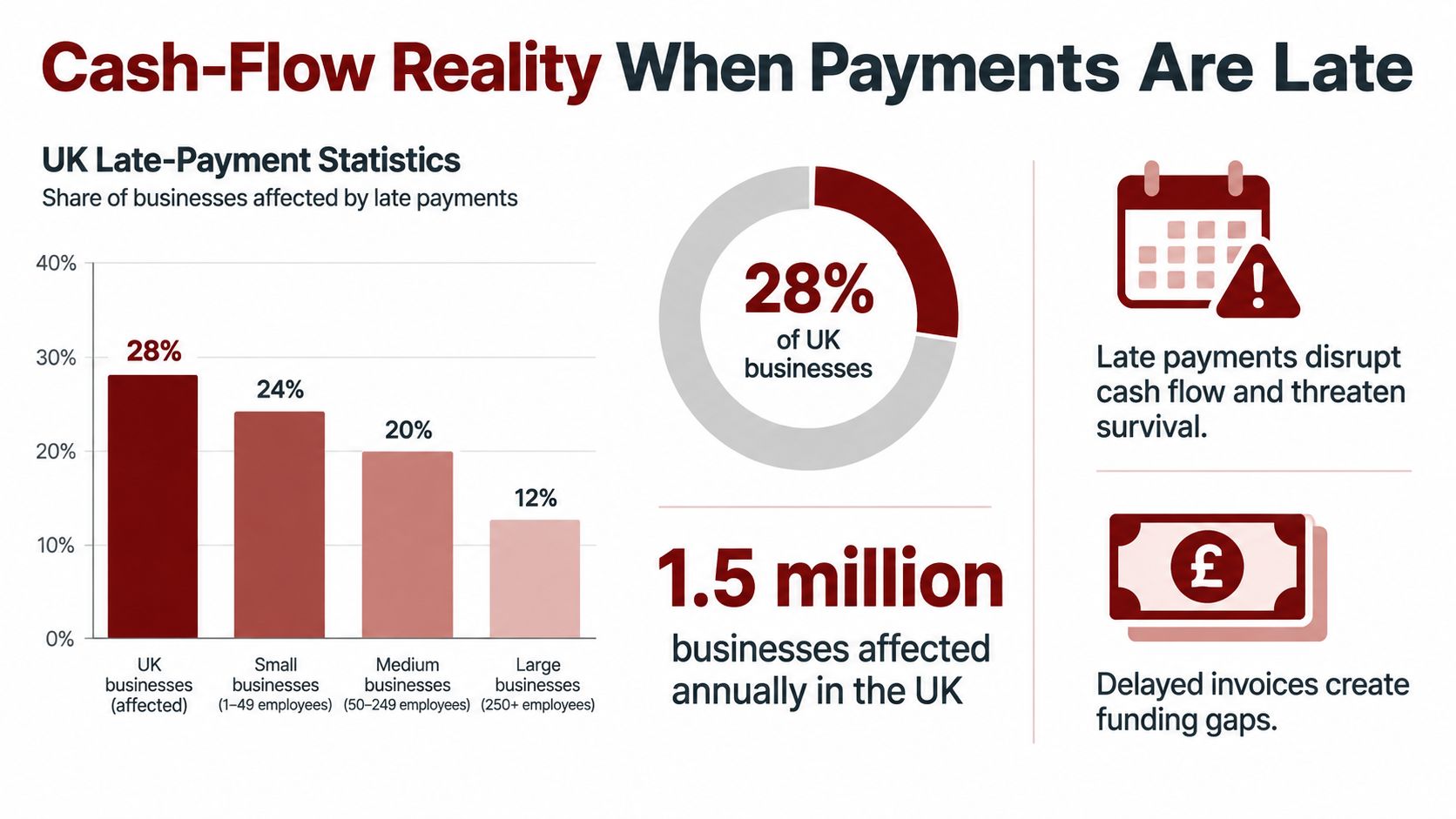
Suppose a contractor completes work, raises an invoice and receives no cash for 60 or 90 days. The VAT position may still require planning, and tax is based on the relevant accounting rules rather than on whether the customer has paid promptly. The owner still needs a minimum personal income, operating cash and a reserve for the eventual bill.
A sole trader can usually access money in the business account without declaring a dividend. That flexibility is useful during a short-term squeeze, but it comes with personal responsibility for business debts and tax. If the business cannot pay, the owner doesn't have a separate legal boundary protecting personal finances.
A company creates better separation, but it doesn't create cash. A dividend can't be used as a substitute for money that hasn't arrived or profits that aren't distributable. The director may need a planned salary, retained reserves or carefully timed dividends. Taking money informally from the company can create an overdrawn director's loan and a separate problem.
Cash-flow rule: model the worst realistic payment delay before choosing the structure. Include VAT, tax, payroll, subcontractor costs, household drawings and the reserve you need to keep trading.
Use a rolling forecast and review it before accepting a project with long payment terms. Practical cash-management measures are set out in this guide on how to improve cash flow. For a contractor, resilience often matters more than a small difference in the annual tax calculation.
Which Structure Suits Your Scenario
Construction contractors and subcontractors
For a North West London contractor working through CIS payment chains, a limited company is usually the stronger long-term route once profits are consistently substantial and the work carries contractual or site risk. It can support clearer commercial separation and a planned salary-and-dividend approach, but it won't remove IR35 issues, employer obligations or the need to fund gaps between applications and payment.
Verdict: incorporate when the profit pattern, risk and client expectations justify the administration. Before switching, model CIS deductions, VAT, personal drawings and the longest payment delay you can realistically face.
Landlords and property investors
A small landlord often values simplicity more than a company structure. Incorporation can become relevant where the owner plans to retain profits, acquire further property or use a lender that requires a company or special-purpose vehicle. Financing terms, interest treatment, extraction and ownership arrangements can outweigh a simple comparison of personal and company tax.
Verdict: stay simple while the portfolio is modest and the money is needed personally. Consider a company only after modelling the property, finance and extraction position as one plan.
Early-stage startups
A founder with uncertain revenue and low initial risk often benefits from starting as a sole trader. It keeps bookkeeping and reporting more manageable while the idea is tested. A company becomes more compelling when a co-founder joins, investors expect shares, contracts create meaningful liability or profits need to remain in the business.
Verdict: start as a sole trader when validation matters most, unless funding, ownership or risk makes incorporation necessary from the beginning. Set a review date based on profit trend, not a rigid headline threshold.
Decision Checklist and Next Steps
Before choosing, gather:
- Profit forecasts: Compare expected profit with actual results and identify whether growth is stable or temporary.
- Extraction needs: State how much you need personally each month and how much can remain in the business.
- Payment exposure: Test a 60-day or 90-day delay, including VAT, payroll, suppliers and tax.
- Risk profile: Consider contracts, professional liability, construction exposure and personal assets.
- Compliance appetite: Price bookkeeping, payroll, accounts, returns and the time you'll spend maintaining records.
- Contract status: Contractors must review IR35 and the terms of each engagement separately.
- Growth plans: Factor in employees, investors, retained profit, saleability and future ownership changes.
My recommendation is straightforward. Use a sole trader structure for a low-risk business that needs simplicity and distributes most of its modest profit. Choose a limited company when risk, retained profit, commercial expectations or sustained profitability justify the extra controls. Don't incorporate solely because someone quotes a lower Corporation Tax rate.
For a review, Action Accountants Limited can compare both routes using your forecast, extraction needs, payment terms and North West London circumstances.
Action Accountants Limited provides formation support, bookkeeping, payroll, VAT, statutory accounts and personal and corporate tax advice for founders, contractors, landlords and growing businesses. Visit Action Accountants Limited to request a free initial review of your sole trader versus limited company decision.