
IFRS 16 Leases Explained for UK Business Owners
A practical guide to IFRS 16 leases in the UK. Learn how it affects your balance sheet, EBITDA, tax planning, and compliance for SMEs and property investors.
A London business owner can feel perfectly comfortable about a lease until the accounts suddenly show a substantial new asset and liability. The premises haven't changed, the vehicles are still parked outside, and the monthly payments still leave the bank account in the usual way. Yet the reported balance sheet, EBITDA, borrowing ratios and year-end disclosures may look materially different.
That's the practical challenge behind IFRS 16 leases. The standard changed how lessees present most leases, but the first question for many UK private businesses is more basic: are you applying IFRS Accounting Standards, or does FRS 102 apply to you? The answer affects transition, exemptions, calculations, controls and communication with lenders.
Table of Contents
- Why IFRS 16 Changed Everything for UK Lessees
- Understanding the Definition and Scope of IFRS 16
- How Lessee and Lessor Accounting Differs Under the New Standard
- Transition Approaches and Implementation for SMEs
- Measurement, Presentation, and Journal Entry Examples
- The Hidden Risks of Data Quality and Judgement
- Disclosure Checklist and Common Pitfalls to Avoid
Why IFRS 16 Changed Everything for UK Lessees
A warehouse operator, retailer or property investor can sign the same lease, make the same payments and still report a very different balance sheet after adopting IFRS 16. Future rental commitments that once sat largely outside the balance sheet become a recognised financing obligation. The contracts have not changed, but reported assets, liabilities and performance measures can shift materially.

IFRS 16 applied to annual reporting periods beginning on 1 January 2019 and introduced a largely single lessee model. A qualifying lease generally creates a right-of-use asset and a matching lease liability, subject to available exemptions. The Financial Reporting Council's discussion of improvements in lease reporting describes the scale of the change for IFRS-reporting listed companies. Estimated lease commitments were approximately £2.2 trillion, and more than 85% had previously been excluded from company balance sheets.
Why the numbers can unsettle a growing business
The accounting framework matters before any calculation begins. A UK private company may report under FRS 102, rather than full IFRS, so its lease treatment may differ. Owners and advisers should confirm the applicable framework before assuming that every lease belongs on the balance sheet under IFRS 16.
Performance measures can also move. Reported assets and liabilities rise, while the former operating lease charge is generally replaced by depreciation and interest. The IASB impact analysis estimated that bringing leases onto the balance sheet could increase EBITDA by about 10%, because depreciation and interest usually sit below EBITDA, as explained in the FRC reporting material cited above.
That change does not create cash or improve the underlying contract. It changes how the cost appears in the accounts. Anyone reviewing borrowings, covenant calculations or an EBITDA-based valuation should check whether the agreement uses IFRS 16 figures, legacy measures or its own definition.
Practical rule: Treat lease accounting as a financing and reporting issue, not only as a rent expense exercise.
The data burden is practical too. A growing North West London business may have property leases, vehicle agreements, equipment rentals and service contracts containing embedded leases. Commercial review should start before the accounting entry. Reading tips for negotiating an office lease can help founders identify break clauses, renewal options and payment structures that later affect measurement and judgement.
Understanding the Definition and Scope of IFRS 16
A contract contains a lease when it gives a customer the right to control the use of an identified asset for a period in exchange for consideration. That definition requires more than spotting the word “rent” in an agreement. The asset may be explicitly named, such as a particular office or van, or implicitly identified through the way the supplier fulfils the arrangement.
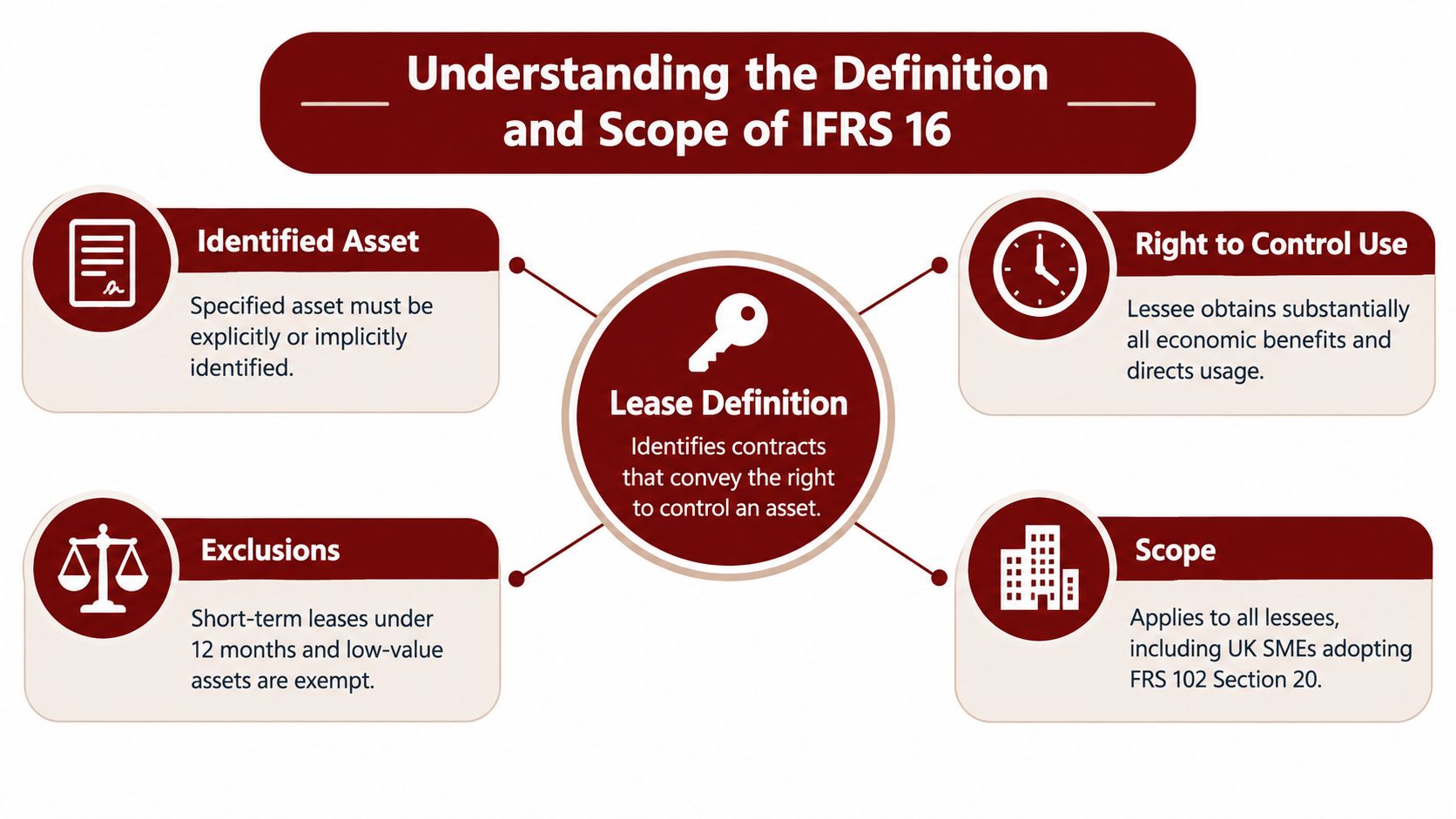
The customer must obtain substantially all the economic benefits from use and direct how, and for what purpose, the asset is used. A service contract can therefore contain an embedded lease even when the document is not labelled a lease. A construction business should examine arrangements for machinery, site cabins, vehicles and dedicated equipment rather than relying only on the accounts payable description.
Start with the reporting framework
Many UK private companies don't apply full IFRS. They may report under FRS 102, including the revised Section 20 lease requirements. The FRC's FRS factsheets explain that the amendments make FRS 102 lease accounting substantially closer to IFRS 16, with general recognition of a right-of-use asset and lease liability for lessees, subject to exemptions.
The amendments apply to accounting periods beginning on or after 1 January 2026, and early adoption is permitted only alongside the wider periodic-review amendments, according to the FRC material. That creates an important decision point for a private company:
- IFRS reporter: Apply IFRS 16 and document the relevant accounting policies, judgements and disclosures.
- FRS 102 reporter: Assess the revised Section 20 requirements, transition provisions and any permitted simplifications.
- Group company: Check whether the parent's reporting framework, consolidation requirements or group accounting policies change the practical answer.
- Property investor or landlord: Separate your lessor accounting from any lessee accounting for premises, offices, vehicles or equipment used by the business.
Understand the exemptions
The short-term exemption can be elected for leases with a term of 12 months or less. IFRS 16 also permits an exemption for leases of low-value underlying assets. These elections must be applied consistently within the relevant policy approach and supported by an inventory that shows which contracts were assessed.
The critical mistake is to assume that lease size alone determines the framework. Reporting status, group structure, contract terms, transition elections and policy choices all matter. A lease-population review should identify the applicable standard first, then assess scope and exemptions.
How Lessee and Lessor Accounting Differs Under the New Standard
For a lessee, IFRS 16 largely removes the former operating-versus-finance distinction. At commencement, a lease longer than the permitted short-term period is generally recorded as a right-of-use asset and lease liability, unless the underlying asset qualifies for a low-value exemption.
The liability is the present value of lease payments. Discounting starts with the interest rate implicit in the lease when that rate can readily be determined. If it can't, the lessee uses an incremental borrowing rate, meaning the rate the business would expect to pay to borrow over a similar term with comparable security and economic conditions. The UK government's IFRS 16 application guidance sets out this mechanics and the related practical judgements.
The lessee view
A lessee's opening accounting normally involves:
| Item | What it represents |
|---|---|
| Right-of-use asset | The right to use the underlying asset during the lease term |
| Lease liability | The present value of qualifying unpaid lease payments |
| Depreciation | The systematic reduction of the right-of-use asset |
| Interest | The finance cost arising on the lease liability |
The liability is subsequently reduced by payments and increased by interest. The right-of-use asset is depreciated, subject to the applicable accounting requirements. The combined expense is often more front-loaded than a straight-line operating rent charge because interest is higher earlier in the liability schedule.
A complete contract review matters more than a clever spreadsheet formula. The business needs evidence for the lease term, renewal and termination options, index-linked payments, incentives, rent-free periods and any modification. For day-to-day reconciliations and property records, a practical guide to rental bookkeeping can help clarify the supporting information that should flow into the accounting records.
The lessor view
Lessor accounting retains a distinction between finance leases and operating leases. The question is whether the arrangement transfers substantially all the risks and rewards associated with ownership. A property investor may therefore have a different accounting outcome as lessor from the outcome the tenant records as lessee.
That asymmetry creates a common control issue for landlords with operating companies. The same contract needs to be reviewed from each party's perspective, with separate records for rental income, receivables, property assets and any leases taken by the landlord's own business.
The same premises can be an operating lease for the landlord and a recognised right-of-use asset for the tenant.
Transition Approaches and Implementation for SMEs
Transition fails when a business begins with journals instead of contracts. The finance team should first establish which reporting framework applies, identify the first affected reporting period and decide which transition options are available. A company moving within FRS 102 shouldn't automatically copy an IFRS implementation without checking the specific amendments and permitted simplifications.
Build the implementation file
A workable sequence for a London SME looks like this:
- Inventory every arrangement. Search property files, procurement records, vehicle schedules, supplier contracts, board papers, invoices and legal correspondence. Include arrangements that may contain embedded leases.
- Determine scope. Identify the asset, control rights, payment terms and lease term. Record why an arrangement is included or excluded.
- Choose exemptions and transition elections. Document the short-term and low-value policy choices where relevant, together with the transition method permitted by the applicable framework.
- Calculate opening balances. Measure the liability using the present value of remaining qualifying payments and establish the right-of-use asset, including relevant adjustments.
- Reconcile to the ledger. Tie the opening asset and liability to the nominal ledger, supporting schedules and financial statement disclosures.
- Create an ongoing register. Assign responsibility for new contracts, modifications, index changes and reassessment triggers.
The transition method can affect comparatives and opening equity. A modified retrospective approach generally recognises the cumulative effect at the date of initial application without restating comparative periods, subject to the applicable standard and elections. Practical simplifications may include relying on previous assessments of whether a contract is a lease, or using permitted hindsight in determining lease terms. Those choices need a documented rationale.
Make the process fit the business
A property investor may need a portfolio-level register, while a construction contractor may need a procurement control that flags equipment and site arrangements before payment begins. Lease data can sit in accounting software, a dedicated lease tool or a controlled spreadsheet, but the system must preserve source contracts, assumptions, approval history and change records.
Technology support can help when multiple systems exchange contract, payment and general ledger data. For businesses reviewing that architecture, Amax IT consultancy services may be relevant to the wider systems and workflow design. For UK private companies, the FRS 102 changes guidance should be considered alongside the company's reporting framework and transition timetable.
Measurement, Presentation, and Journal Entry Examples
The accounting becomes easier to understand when the entries follow the economic story. Suppose a business begins a qualifying lease and measures the opening lease liability at £120,000. For illustration, assume the right-of-use asset is also £120,000, with no other opening adjustments.
The commencement entry would be:
| Debit | Credit |
|---|---|
| Right-of-use asset £120,000 | Lease liability £120,000 |
This is an illustrative accounting example, not a benchmark or estimate for a particular business. The actual right-of-use asset may differ because of prepaid amounts, incentives, initial direct costs or other adjustments required by the applicable framework.
What happens after commencement
Assume the business pays £30,000 during the first reporting period, incurs £6,000 of lease interest and records £24,000 of depreciation. The example produces these entries:
| Transaction | Debit | Credit |
|---|---|---|
| Lease interest | Lease interest expense £6,000 | Lease liability £6,000 |
| Lease payment | Lease liability £30,000 | Cash £30,000 |
| Depreciation | Depreciation expense £24,000 | Accumulated depreciation, right-of-use asset £24,000 |
The closing lease liability in this simplified example is £96,000, calculated as the opening liability, plus interest, less the payment. The closing right-of-use asset is £96,000, before considering any other adjustments, because the example uses equal opening value and depreciation.
The total first-period expense is £30,000, made up of depreciation and interest. Under a former straight-line operating lease presentation, the same cash arrangement might have been represented as one operating rent expense rather than two separate charges. The pattern isn't necessarily level under IFRS 16 because interest depends on the outstanding liability.
Present the information clearly
The right-of-use asset and lease liability should be presented or disclosed in a way that lets users understand their nature. Depreciation normally sits with operating costs, while interest is presented as a finance cost. Principal repayments reduce the liability and cash, but they don't create a new expense.
The general ledger needs separate, traceable accounts for the asset, accumulated depreciation, lease liability, interest and cash movements. A clear nominal ledger guide is useful when deciding how lease schedules should reconcile to the statutory accounts.
The Hidden Risks of Data Quality and Judgement
The hardest part of IFRS 16 is often not the present-value calculation. It's proving that the business found every relevant contract and made supportable decisions about terms, options and payments.

A lease register built only from the property folder will miss vehicle agreements, equipment rentals, dedicated logistics arrangements and embedded leases in service contracts. It may also contain an outdated renewal assumption. A business that expects to exercise an extension option at commencement may need a different lease term from one that has no reasonable basis for doing so.
The IASB's post-implementation review of IFRS 16 concluded that the standard is overall working as intended. That conclusion doesn't remove the operational work required to maintain reliable inputs or reassess judgements when circumstances change.
Questions the register must answer
- Completeness: Which departments can enter contracts, and how does finance learn about them?
- Identification: Does the supplier control the asset, or does the business control its use?
- Term: What evidence supports renewal, break or termination assumptions?
- Payments: Which amounts are fixed, indexed, variable or linked to usage?
- Changes: Has a modification, rent review, replacement asset or renegotiation occurred?
- Rate: Why is the chosen implicit rate or incremental borrowing rate reasonable?
Audit evidence starts with the contract and the decision trail, not the final spreadsheet.
Refresh the register at least as part of the annual reporting process, and update it when procurement, property or fleet events occur. Integration with accounting software workflows can reduce rekeying, but automation won't correct an incomplete contract population or an unsupported judgement.
The practical control should include a named owner, a review date, source documents and approval for significant assumptions. This is particularly important for construction businesses with changing sites and equipment, and for landlords whose arrangements may include both property income and operational leases.
A short visual explanation can help non-finance managers understand why contract details matter.
Disclosure Checklist and Common Pitfalls to Avoid
A lease disclosure should let an accounts reader understand the business's commitments, judgements and effect on the financial statements. The required detail depends on whether the business reports under full IFRS, IFRS 16, or the relevant FRS 102 requirements. A practical review should cover:
- Policy elections: Record any short-term and low-value exemptions adopted, where applicable.
- Lease population: Reconcile contracts in the register to property, fleet, equipment and supplier records.
- Measurement: Document the discount-rate method, lease term, renewal options and payment assumptions.
- Balance sheet: Agree right-of-use assets and lease liabilities to the general ledger.
- Income statement: Separate depreciation and interest from other operating and finance costs.
- Changes: Record modifications, reassessments, index-linked payment changes and termination decisions.
- Cash flow: Explain the classification and reconciliation of lease payments under the applicable framework.
- Covenants: Compare statutory figures with the definitions used in facility agreements.
The checklist should also include a sign-off against the year-end accounts, supported by this statutory accounts checklist. Reconcile the maturity analysis in the notes to the lease liability in the nominal ledger and to facility covenant definitions before approval. Differences between those records often point to missing contracts, outdated assumptions or presentation errors.
Pitfalls that create avoidable problems
A private company does not automatically apply IFRS 16. The relevant framework may instead be revised FRS 102, with different transition choices and disclosure requirements. Confirm the reporting framework before preparing the schedules. Keep the contract and assessment supporting any short-term or low-value conclusion rather than treating the conclusion as self-evident.
Assumptions also need review after signing an extension, issuing a formal break notice, completing a rent review or changing payment terms. These events may require reassessment. Presenting an EBITDA increase as an economic improvement can also mislead, because the change generally reflects expense classification rather than improved trading performance.
The wider reporting change remains a useful control reminder. The FRC's lease reporting announcement highlights the importance of complete lease information and clear reconciliation. Smaller businesses need the same discipline, scaled to their own contracts and reporting framework.
A well-maintained register supports financing discussions, covenant analysis, budgeting and defensible accounts. Action Accountants Limited helps UK businesses review lease populations, distinguish IFRS 16 from revised FRS 102 requirements, maintain accounting records and prepare statutory accounts for London SMEs, construction businesses and property operations. Visit Action Accountants Limited to discuss a lease accounting review.