
CIS Requirements for Contractors: Your Complete Guide 2026
Master CIS requirements for contractors and subcontractors. Covers registration, deductions, reporting deadlines, fraud risks, and common compliance…
CIS protects approximately £7.7 billion in UK tax revenue each year. Contractors generally deduct 20% from verified subcontractors, 30% where a subcontractor is unregistered or cannot be verified, and 0% where HMRC has granted gross-payment status.
Those CIS requirements exist because HMRC treats construction payments as a high-risk area, where upfront deductions act as an advance against a subcontractor's tax and National Insurance liabilities. The practical consequence is clear: CIS isn't just an accounts task completed after payment. It controls who gets paid, how much they receive, what evidence the contractor retains, and whether the monthly return can be supported when HMRC asks questions.
Table of Contents
- Understanding CIS and Why Construction Payments Are Different
- How Contractor and Subcontractor Registration Works
- CIS Deductions Explained Rates, Bases and Payment Rules
- Monthly CIS Returns Deadlines and the New Nil Return Rule
- Gross Payment Status Risks and the 2026 Fraud Power
- CIS Compliance Checklist for UK Construction Contractors
Understanding CIS and Why Construction Payments Are Different
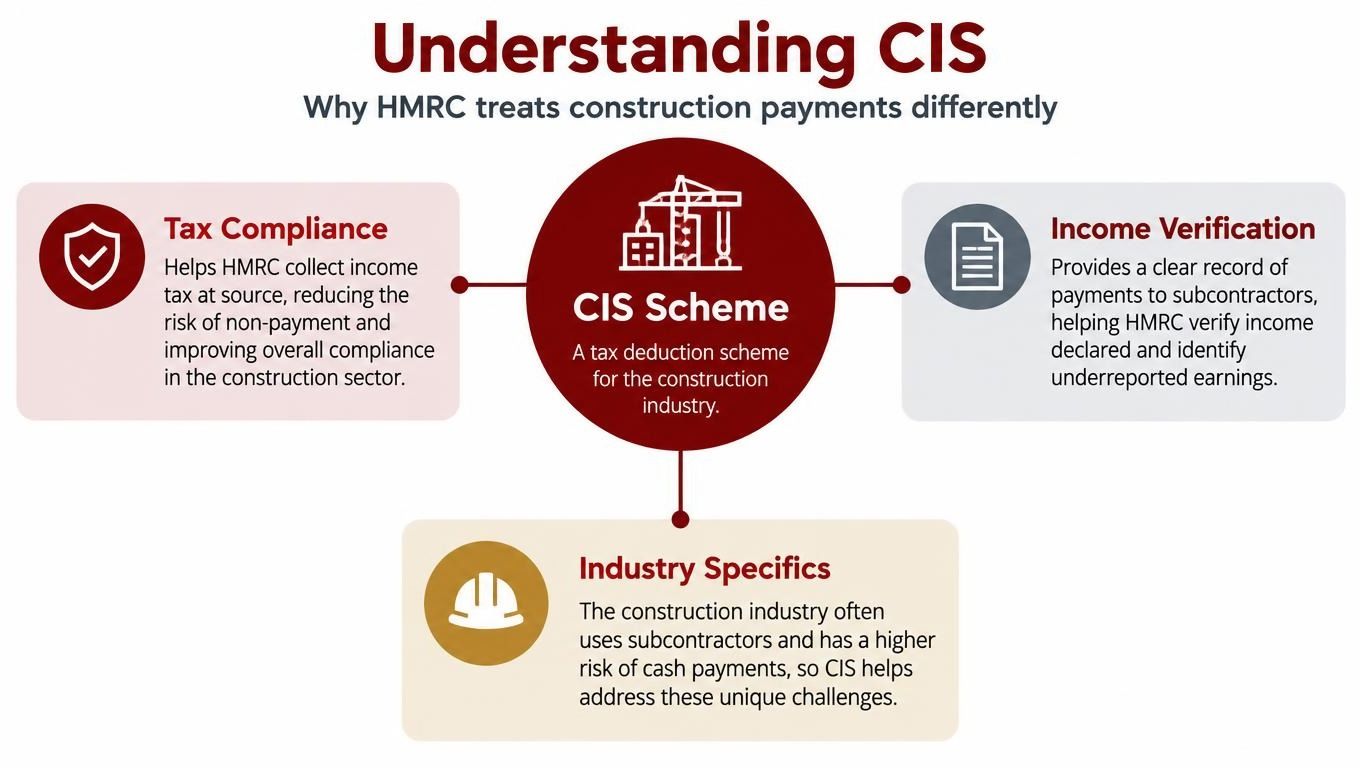
The scale of CIS explains why small errors matter. A UK government consultation estimated that the scheme protects approximately £7.7 billion in tax revenue each year (HMRC consultation on CIS reform). CIS was introduced in 1971 as a tax-revenue protection measure because HMRC identified construction as presenting a particular compliance risk, including large numbers of mobile workers and cash payments.
That history changes how a contractor should view the scheme. CIS is not just a method for standardising invoices or producing subcontractor statements. It links construction payment processing to the subcontractor's tax and National Insurance position. The contractor becomes responsible for checking status, applying the right treatment and reporting the payment accurately.
Why the payment process matters
A contractor that treats CIS as paperwork usually discovers the problem at the worst possible time. A payment may already have been made, the subcontractor may be pressing for cash, and the bookkeeping record may not show whether the amount related to labour, materials or a different legal entity.
The stronger approach puts CIS controls before payment release. The payment workflow should answer four questions:
- Who is being paid? Confirm the legal name and trading identity.
- What work was supplied? Separate labour from qualifying materials.
- What status applies? Retain evidence of HMRC verification or gross-payment treatment.
- What must be reported? Record the payment in the correct CIS period and issue the required statement.
This is also why contractors should understand the difference between a genuine subcontractor arrangement and an employment relationship. CIS treatment doesn't turn every worker into a subcontractor. The business still needs to assess the underlying engagement and keep its records consistent with the work performed.
Practical rule: Treat every CIS payment as a controlled tax transaction, not as an ordinary supplier invoice.
For a plain-language overview before building a procedure, see CIS explained simply. Businesses researching HMRC as a counterparty or buyer can also use H M Revenue & Customs buyers as a supplementary commercial resource.
A reliable CIS process protects more than the contractor's compliance position. Correct deductions help subcontractors manage their tax position, prevent avoidable disputes and reduce the risk that a cash-flow problem is created by an incorrect deduction.
How Contractor and Subcontractor Registration Works
The modern CIS process replaced the old documentation system on 6 April 2007. Registration cards, tax certificates and payment vouchers were removed, and HMRC introduced verification and monthly reporting instead (HMRC CIS reform manual).
That change is important operationally. A contractor shouldn't rely on a card, a historic email or a subcontractor's verbal assurance. The relevant control is the current verification outcome, matched to the entity that will receive the payment.
A contractor's first-payment checks
Before releasing the first relevant payment, establish whether the business operates CIS as a contractor and identify every subcontractor who may fall within the scheme. Then verify each subcontractor through the HMRC process and store the result with the supplier record.
A useful supplier file contains:
- The correct legal identity, including the name used for verification and payment.
- Verification evidence, retained with the date and the resulting payment treatment.
- The trading name and bank details, where these differ from the registered legal entity.
- The agreed scope of work, so labour and materials can be reviewed properly.
- A payment history, allowing later reconciliation to invoices and CIS returns.
A subcontractor's VAT registration or incorporation status doesn't establish gross-payment status. Nor does a polished invoice prove that the business is correctly registered for CIS. Gross treatment comes from HMRC approval and must be checked rather than assumed.
What subcontractors should do
Subcontractors should register with HMRC where required, provide accurate legal details and respond promptly if verification fails. A failed match can lead to the higher deduction, delayed payment or a dispute that could have been avoided by correcting an identity mismatch before work begins.
The three broad outcomes are straightforward:
| Verification outcome | General deduction treatment |
|---|---|
| Registered and verified subcontractor | 20% |
| Unregistered or not matched during verification | 30% |
| HMRC-approved gross-payment status | 0% |
The rates are only useful when attached to the correct entity. If a subcontractor changes company, moves from sole trader to limited company or starts trading under a different name, the contractor should pause and verify the new arrangement. Reusing an old supplier record is one of the easiest ways to apply the wrong treatment.
For a practical registration walkthrough, contractors and subcontractors can consult how to register for CIS. The aim isn't to collect documents for their own sake. It is to make sure the payment record, verification result and legal identity all point to the same business.
CIS Deductions Explained Rates, Bases and Payment Rules
CIS deductions affect the subcontractor's cash flow immediately, so the calculation needs to be transparent. A verified and registered subcontractor generally receives a payment after a 20% deduction, an unregistered or unverifiable subcontractor generally faces 30%, and an HMRC-approved gross-payment subcontractor generally receives payment with 0% deducted (HMRC guidance on making CIS deductions).
The contractor doesn't bear the deduction as an extra cost. The amount is withheld from the subcontractor's payment and treated as an advance against that subcontractor's tax and National Insurance liabilities. That distinction matters when assessing project cost, subcontractor disputes and the effect of a payment on working capital.
Calculate the right base
The deduction isn't automatically applied to the entire invoice. The contractor should identify the relevant CIS amount and distinguish labour from qualifying materials. If the calculation includes amounts that should have been excluded, the subcontractor receives too little cash. If labour is excluded incorrectly, the contractor may under-deduct and face a compliance problem.
A sound payment certificate should show:
- the gross amount being assessed;
- qualifying materials, where applicable;
- the CIS amount subject to deduction;
- the applicable rate;
- the deduction;
- the net payment; and
- the subcontractor's payment-and-deduction statement.
This level of detail gives both parties a way to reconcile the payment. It also makes a later review far easier than trying to reconstruct the calculation from a bank statement and a short invoice description.
The cash-flow trade-off
Applying 30% when 20% should have applied can put unnecessary pressure on a subcontractor who may already be funding labour, transport and materials before payment. Applying 20% without valid verification creates the opposite problem, because the contractor may have to explain an under-deduction.
Gross-payment status can improve a qualifying subcontractor's immediate cash flow, but it doesn't remove the need for disciplined records. The contractor should retain the status evidence, monitor changes and ensure that the payment is made to the approved entity.
A supplier register should therefore be status-controlled, not merely a list of names. Reconcile it to invoices and payment records, particularly where businesses use multiple trading names or change legal entities.
Control that works: Lock the deduction rate to the verified supplier record, then require a review when the supplier's legal name, bank details or engagement changes.
Accounting software can help with structured records, but configuration still needs human review. A resource such as Snyp's guide to builder accounting may help contractors compare bookkeeping approaches, while how to calculate CIS deductions gives a focused reference for the calculation itself.
The best process doesn't hide the deduction. It shows the basis clearly, preserves evidence and gives the subcontractor a statement that can be matched to its own tax records.
Monthly CIS Returns Deadlines and the New Nil Return Rule
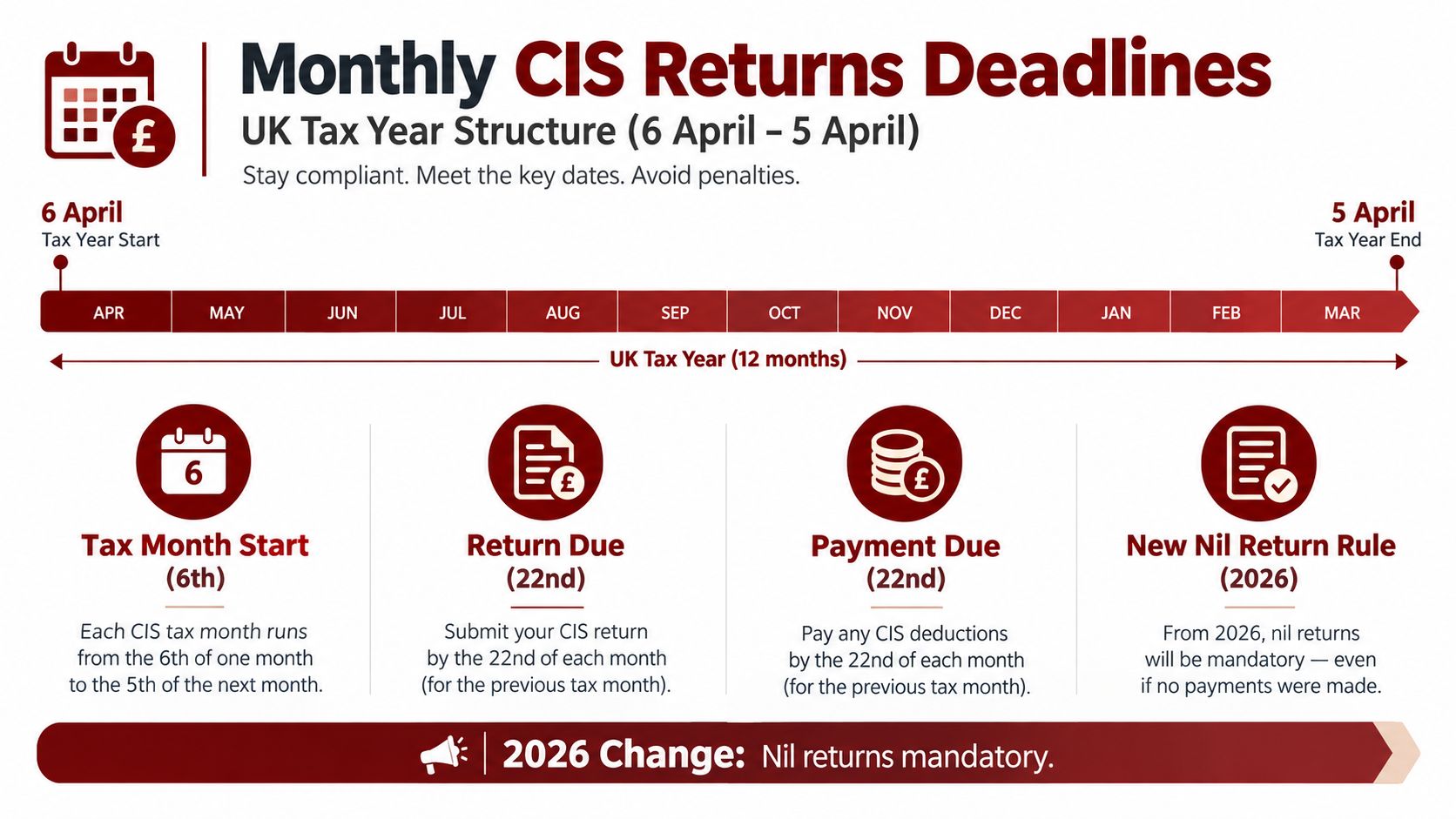
CIS reporting follows a tax month that runs from the 6th of one calendar month to the 5th of the next. The contractor must submit the CIS300 return, or a nil declaration where applicable, by the 19th of the month in which that period ends (HMRC guidance on monthly CIS returns). Missing that date can affect cash flow quickly, particularly where deductions, subcontractor statements and the contractor's own payment records no longer reconcile.
The return must include relevant subcontractors paid under CIS, including subcontractors paid gross. Gross-payment status does not remove the reporting obligation. Omitting a gross-paid subcontractor can leave the return incomplete even though no deduction was made.
The nil-return decision
From 6 April 2026, contractors must submit a nil CIS return for every month in which no subcontractor was paid, unless they notify HMRC in advance that they will not make such payments (HMRC consultation on CIS administration changes). The full late-filing penalty regime returns with this requirement.
The practical decisions are:
- No subcontractor was paid during the period. Submit a nil return unless an advance inactivity notification covers that period.
- No subcontractor was hired. This may support an inactivity notification, but the contractor still needs to manage its HMRC position rather than assume no action is required.
- A subcontractor was hired but not paid. Review the period carefully. The filing decision depends on payments, not solely on whether someone worked on the project.
- An unexpected reportable payment is made during an inactive period. Reassess the notification and filing position promptly.
An inactivity notification is forward-looking. It does not replace checks of the bank account, payment ledger and subcontractor records. A single unplanned payment can change the filing position.
Build a five-day close
Start the close before the statutory deadline:
- Close the CIS period on the 5th. Freeze the relevant payment population.
- Reconcile invoices and payment dates. Invoice dates alone do not establish the reporting period.
- Check every subcontractor status. Match each supplier record to its verification evidence.
- Recalculate labour and materials. Investigate unusual or manually adjusted entries.
- Prepare the return early. Submit several working days before the 19th and archive the acknowledgement.
Late filing can attract penalties starting at £100 for one day, rising to £200 after two months, and potentially reaching £300 or 5% of CIS deductions after six months. That is a direct cost, but the operational effect can be wider: unresolved returns leave payment records, subcontractor statements and management cash forecasts out of step.
Keep CIS reconciliation separate from payroll and VAT reconciliation. A single broad bookkeeping review makes it easier to omit a labour payment or assign it to the wrong CIS period.
Gross Payment Status Risks and the 2026 Fraud Power
Gross-payment status is usually discussed as a subcontractor cash-flow benefit. That is only half the picture. From 6 April 2026, HMRC can immediately remove gross-payment status where a business makes or receives a payment it knew or should have known was connected with fraud, assess the related tax loss and impose a penalty of 30% of that loss. A business whose status is removed immediately for fraud or serious non-compliance can also be blocked from reapplying for five years (HMRC guidance on tackling CIS fraud).

The important change in thinking is that HMRC verification may not be the end of the contractor's responsibility. A formal status result doesn't necessarily protect a business that ignores obvious warning signs around a payment.
What a sensible counterparty review looks like
Before relying on gross treatment, confirm the legal entity, retain the verification evidence and reconcile the invoice to the bank account receiving the funds. Investigate last-minute changes to payment instructions, especially where the new account belongs to a different name or jurisdiction.
Also consider the commercial pattern. Labour-only arrangements, circular payments, unexplained credits and invoices that don't match the work performed deserve escalation. Smaller construction firms often lack a procurement department, but they can still document who approved the supplier, who checked the bank details and who reviewed the unusual feature.
Fraud control: Verification confirms a tax status. It doesn't replace judgement about whether the underlying payment makes commercial and operational sense.
The best control is proportionate rather than bureaucratic. A small contractor doesn't need a complex procurement manual to create an audit trail. It needs a consistent onboarding checklist, a second-person review for changed payment instructions and a clear route for escalating concerns.
The following video provides additional context for contractors considering how payment controls fit into wider fraud prevention:
Apply for gross status only when the business can support it with reliable records and transparent transactions. Contractors considering the application process can review apply for CIS gross status, but approval should never be treated as a reason to weaken supplier checks.
CIS Compliance Checklist for UK Construction Contractors
CIS compliance works best as a repeating control cycle, not as a task someone remembers when the accountant requests the records. The contractor needs a process that starts with supplier onboarding, continues through payment approval and ends with a reconciled monthly return.
The first control is ownership. Assign responsibility for verification, deduction review and return submission. If the same person handles every stage, introduce a second review for unusual suppliers, changed bank details and manual adjustments.
Before work begins
Create a supplier file before the first relevant payment, not after the subcontractor has chased an overdue balance.
- Confirm identity: Match the legal entity, trading name and payment details.
- Assess the engagement: Record the work being performed and whether CIS treatment is relevant.
- Verify status: Retain HMRC evidence and connect it to the exact supplier record.
- Set expectations: Explain deductions, statements and the documents needed for payment.
- Flag changes: Require review when the business changes name, structure or bank account.
This reduces the chance that a subcontractor is paid under a copied supplier record or an informal trading name. It also gives the accounts team a dependable starting point when the monthly return is prepared.
At payment approval
The payment certificate is the critical control point. Review the invoice against the work completed, separate labour from qualifying materials and apply the rate recorded for the verified entity.
A useful reviewer should be able to see:
| Review point | Evidence to retain |
|---|---|
| Supplier identity | Legal name and supplier record |
| CIS status | Verification or gross-status evidence |
| Calculation | Labour, materials, deduction and net payment |
| Payment | Approved invoice and bank record |
| Subcontractor communication | Payment-and-deduction statement |
Don't allow a manual override without a reason. A note such as “status checked again because the company changed its trading name” is more useful than an unexplained change to the deduction rate.
At monthly close
On the 5th, reconcile the period by payment date and identify every relevant subcontractor payment. Include gross-payment subcontractors in the reporting population, review nil-return obligations and make sure the return is submitted ahead of the 19th deadline.
Automation can help with reminders, duplicate supplier checks and document storage, but it shouldn't conceal exceptions. Tools aimed at reducing compliance human errors are useful when they support a documented process rather than replace review.
When something goes wrong
If the contractor discovers an incorrect deduction, missing verification record or omitted payment, preserve the original evidence and obtain professional advice promptly. Don't overwrite the ledger just to make it appear tidy. The correction should show what happened, why the treatment was wrong and how the revised figures connect to the payment record.
CIS failures often affect subcontractor relationships before they become an HMRC issue. An unnecessary deduction can disrupt wages and materials purchasing, while an under-deduction can leave the contractor exposed. Clear statements, prompt communication and a consistent correction process protect both sides.
Action Accountants Limited provides construction-focused bookkeeping, CIS returns, subcontractor payslips, gross-status support and related tax services for contractors and subcontractors. For firms in North West London or elsewhere in the UK, specialist support can help turn fragmented payment records into a controlled monthly process.
Action Accountants Limited can review your CIS registration, supplier verification, deduction calculations and monthly return routine. Visit Action Accountants Limited to discuss practical support for keeping CIS requirements under control while protecting construction cash flow.


