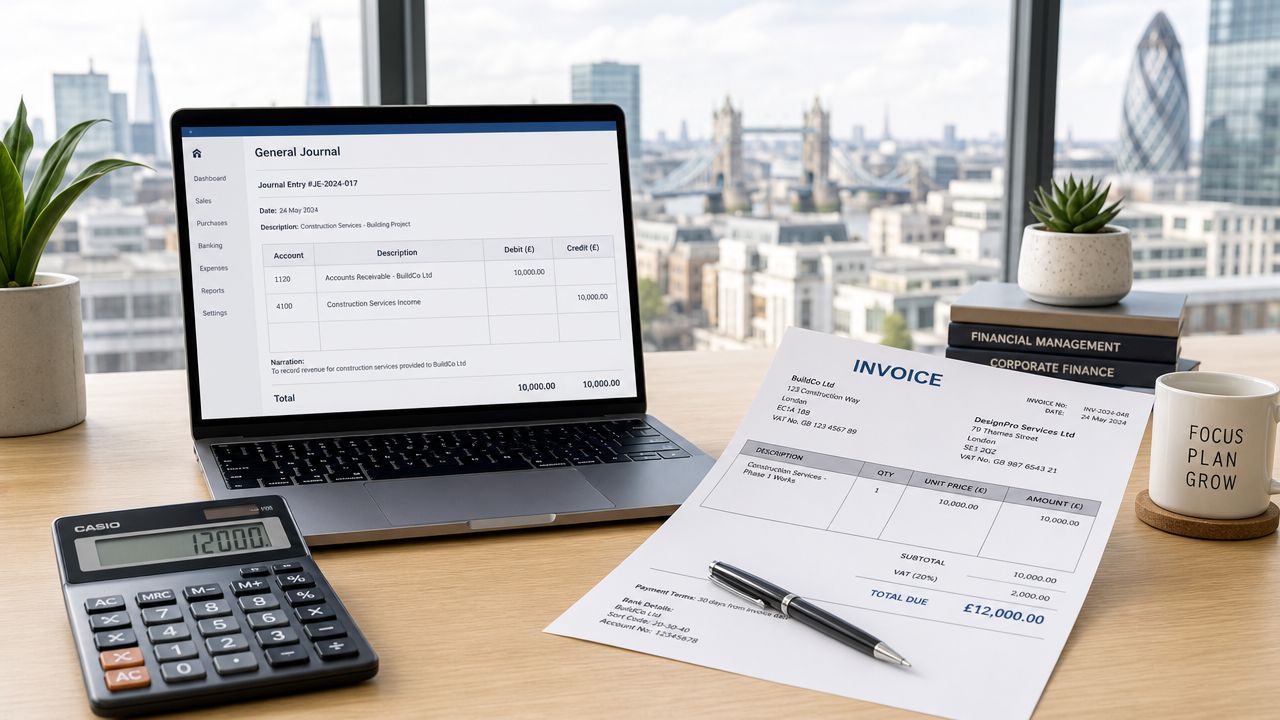
Accounting Records Retention: A Practical UK Guide
Accounting records retention explained for UK small businesses and landlords. Learn legal periods, sample schedules, secure storage, and disposal best practice.
The most common UK retention period is six years from the end of the relevant accounting period for company tax purposes. Company-law books, VAT, payroll and AML records run on their own clocks, and the longest applicable period always wins.
You're clearing a filing cabinet in your London office, and the question looks simple: can last year's invoices go through the shredder? The answer depends on what each document proves, which obligations it supports, and whether an enquiry, dispute or late return has changed the deadline.
That's why “keep everything for six years” is useful as a warning, but too vague as a policy. Accounting records retention is a decision matrix, not a single date. A purchase invoice may support corporation tax, VAT and a supplier dispute. A payroll file may support PAYE, employment claims and an internal investigation. One record can therefore inherit several legal clocks.
The practical rule is straightforward. Classify each record by purpose, identify every applicable retention period, and follow the longest one. Keep a written record of the decision, the expiry date and any event that pauses deletion.
Table of Contents
- Why the Six-Year Rule Is Only the Starting Point
- The Legal Baseline Every UK Business Must Know
- Retention Periods by Record Type
- Secure Storage for Paper and Digital Records
- Disposal Policies That Protect You
- Sample Retention Schedule for Small Businesses and Landlords
- A Practical Retention Checklist You Can Use Today
- Why Retention Is an Ongoing Habit Rather Than a One-Off Task
Why the Six-Year Rule Is Only the Starting Point
A founder who destroys an invoice because it has passed a convenient date may remove evidence the business still needs. The invoice might support a VAT return, explain a bank payment, substantiate a corporation tax deduction or prove the terms of a supplier relationship. The document's age tells you when it was created. It doesn't tell you when every legal obligation connected with it ends.
HM Revenue & Customs says companies and unincorporated associations required to submit a Company Tax Return must retain records and supporting documents until the latest of the sixth anniversary of the end of the relevant accounting period. The clock therefore usually runs from the accounting period end, not from the invoice date. HMRC's company and accounting records guidance also makes clear that the period can extend where a return is late, HMRC requires a return after the normal deadline, or an enquiry or compliance check remains open.
A sensible archive also preserves the evidence behind the accounts, not only the signed accounts themselves. That includes ledgers, invoices, receipts, bank evidence, payroll records, journals and reconciliation support. Company registers and governance documents need separate treatment, so founders should keep them organised alongside statutory registers rather than burying them in a general bookkeeping folder.
Practical rule: Never ask, “Has this document been kept for six years?” Ask, “What obligations does this document support, and which one expires last?”
The longest clock controls
Company law, corporation tax, VAT, payroll, AML and contractual disputes can all apply to the same file. The result is predictable. A private company may meet the Companies Act minimum for a ledger but still breach HMRC requirements by deleting it too early. A client file may contain customer-due-diligence evidence that follows one period and VAT evidence that follows another.
This is why a blanket destruction date creates risk. Build the policy around record categories and legal triggers. If an investigation, dispute, insolvency process or late filing remains unresolved, suspend destruction even if the normal date has passed.
The six-year baseline is therefore a useful starting point, not permission to shred automatically. It tells you where tax compliance commonly begins. Your matrix decides where each record ends.
The Legal Baseline Every UK Business Must Know
A company deletes an old ledger after three years, then receives an HMRC enquiry about the accounting period it supports. The Companies Act deadline may have passed, but the tax deadline has not. That is the compliance problem the six-year rule helps prevent.
Section 388 of the Companies Act 2006 sets a minimum period for company accounting records. A private company must preserve required accounting records for three years from the date they are made. A public company must keep them for six years from that date. The records must also allow directors to prepare accounts and show the company's financial position with reasonable accuracy. See Section 388 of the Companies Act 2006.
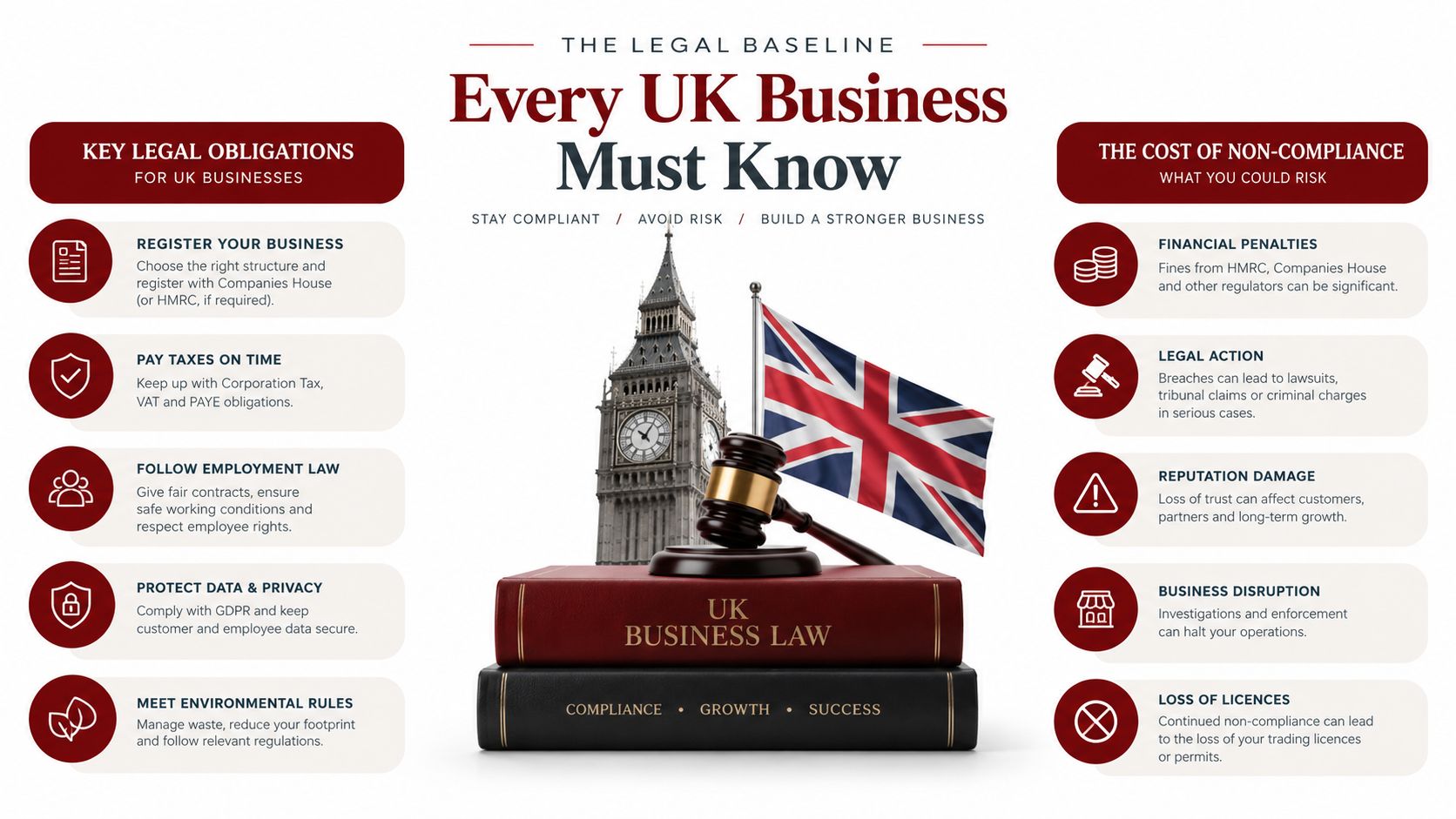
The private-company minimum is not a safe destruction date. HMRC commonly requires tax records for six years from the end of the accounting period. A business can comply with the Companies Act and still breach its tax obligations by deleting the same invoices, ledgers or bank evidence too soon.
Apply one decision matrix to every record
Use this order when setting a retention date:
- Identify the entity. A private or public company, sole trader, landlord and partnership may follow different rules.
- Identify every purpose. A document may support company law, corporation tax, VAT, payroll, AML, a contract or a dispute.
- Set the trigger. The clock may begin when the record is created, at the accounting-period end, at the tax-year end, after filing, or when a business relationship ends.
- Apply the longest period. Overlapping legal clocks do not cancel one another. The longest period controls.
- Place an exception hold. Pause routine deletion for open enquiries, disputes, appeals, insolvency matters, late returns or threatened litigation.
That matrix works across ordinary small-business records, landlord files and construction-sector paperwork. A contractor's invoice may support corporation tax, VAT, payroll allocation and a contractual claim. Keep it until the latest applicable period ends.
Failure to keep required company accounting records can lead to a fine of up to £3,000, and a director may face disqualification. Company secretarial duties also require proper attention, so statutory and governance records belong in a controlled archive rather than an informal bookkeeping folder.
The six-year rule is the practical floor for many tax records, not a universal ceiling. Its clock usually runs from the accounting-period end, while company law measures some records from creation. Keep the underlying evidence, not only signed accounts. Ledgers, source documents and reconciliations must support the figures reported if HMRC or another authority asks how they were produced.
Retention Periods by Record Type
A bank statement can support several obligations at once. Classify it by every purpose it serves, including VAT, corporation tax, payroll, AML, a contract or a dispute. Set the retention period by the longest applicable legal clock. Filing it under “banking” alone is not a retention policy.
HMRC's guidance on how long to keep business records lists five years for bank statements, paying-in books, management accounts and annual accounts. Records containing the VAT account generally need to remain available for six years, without a reduction. Use HMRC's guidance on how long to keep business records to check the category, then extend the period where another obligation runs longer.
| Record type | Minimum retention | Controlling rule |
|---|---|---|
| Sales and purchase invoices | Six years commonly applies where they support company tax or VAT | HMRC tax and VAT requirements |
| Receipts and payment evidence | Follow the longest connected tax or VAT period | Purpose-based classification |
| Bank statements and paying-in books | Five years minimum in HMRC guidance, longer where tax or VAT evidence requires it | HMRC record category and overlapping tax rules |
| Management accounts and annual accounts | Five years minimum in HMRC guidance, subject to longer tax or legal requirements | HMRC record category |
| VAT account and supporting VAT records | Six years generally applies | VAT retention requirement |
| Private-company accounting records | Three years from the date made under company law, but commonly six years from the accounting-period end for tax | Companies Act and HMRC |
| Public-company accounting records | Six years from the date made under company law | Companies Act |
| Payroll and PAYE records | Apply the longest payroll, tax, employment or dispute-related period | Payroll and employment obligations |
| Statutory books and governance records | Keep in a permanent corporate archive while the company exists and preserve them for future legal reference | Company administration and governance |
| Customer due-diligence and AML evidence | Five years after the relevant occasional transaction or end of the business relationship, unless another applicable record requires longer | AML and overlapping obligations |
| CIS records | Apply the longest tax, VAT, payroll and subcontractor-payment period | Construction tax and accounting evidence |
| Self Assessment records | Normally five years after the 31 January filing deadline | HMRC Self Assessment guidance |
Records people delete too quickly
Invoices and receipts must stay connected to the ledger, bank transaction, VAT return and approval evidence. A readable scan with no clear transaction reference provides weak support. Keep the original where it carries evidential value.
Payroll files include more than payslips. Retain payroll journals, PAYE submissions, payment evidence, timesheets, pension information and calculations that support the employment and tax record. Construction businesses should link CIS deduction calculations and subcontractor records to invoices and bank payments.
Statutory books belong in a controlled corporate archive, not in a monthly bookkeeping folder. Registers, minutes, share records and resolutions show who controlled the company and which decisions directors made. Preserve them while the company operates and retain them for later legal reference.
Landlord and sole-trader records need a separate tax-year structure. File property income, finance costs, repairs, agent statements and bank evidence with the relevant Self Assessment support. Businesses that need practical help can review bookkeeping for sole traders.
The wider discipline is known as what is information lifecycle management. Apply one defined process: create the record, classify every relevant obligation, store it securely, review the expiry date, and dispose of it only after all legal clocks and exception holds have ended. This approach prevents an employee from deleting evidence just because the ordinary tax period appears to have passed.
Secure Storage for Paper and Digital Records
HMRC allows records to be preserved in paper or suitable electronic form, subject to applicable conditions. The format matters less than whether the record remains complete, readable, accessible and capable of supporting the figures in the accounts.

A paper archive should use indexed files by accounting period and transaction source. Store originals that carry evidential value, protect files from moisture and unauthorised access, and label each box with the date range, record category, owner and planned review date. If paper accumulates quickly, large archive storage boxes with lids can keep closed periods protected and easier to retrieve.
Digital records need stronger controls than a shared folder named “Old Accounts”. Use a structure that links:
- Accounting periods: Separate files by the period they support.
- Transaction sources: Keep invoices, receipts, bank entries and approval evidence connected.
- Change protection: Use read-only or tamper-evident storage for closed periods.
- Access controls: Limit deletion and editing rights to named users.
- Backups: Maintain independent backups and check that they can be restored.
- Recovery testing: Open sample files and exports during scheduled tests.
- Audit trails: Preserve metadata showing when records were created, changed or approved.
Archive standard: A record isn't safely retained if nobody can locate it, verify its origin or recover it after a system failure.
The Companies Act requires accounting records to be kept at the registered office or another place chosen by the directors. If records are maintained outside the UK, relevant accounts and returns must be sent to and kept at a UK location available for inspection, as set out in the Companies Act provisions on accounting records.
Cloud accounting can work well, but a subscription isn't a retention policy. Export closed periods before changing software, preserve supporting files in accessible formats and confirm that the new system retains the audit trail. Businesses reviewing cloud accounting benefits should include migration, export and recovery controls in the decision.
A short demonstration of archive controls can help staff understand the difference between storing a file and preserving evidence.
Disposal Policies That Protect You
Retention without controlled disposal creates an archive nobody trusts. Files become duplicated, personal data remains exposed, and staff lose sight of which copy is authoritative. The answer is a documented destruction workflow with a hold override.
Before deletion or shredding, run an exception check. HMRC guidance requires businesses to pause routine deletion where an enquiry, amended return, appeal, litigation or insolvency matter affects the records. HMRC's compliance handbook supports this approach.
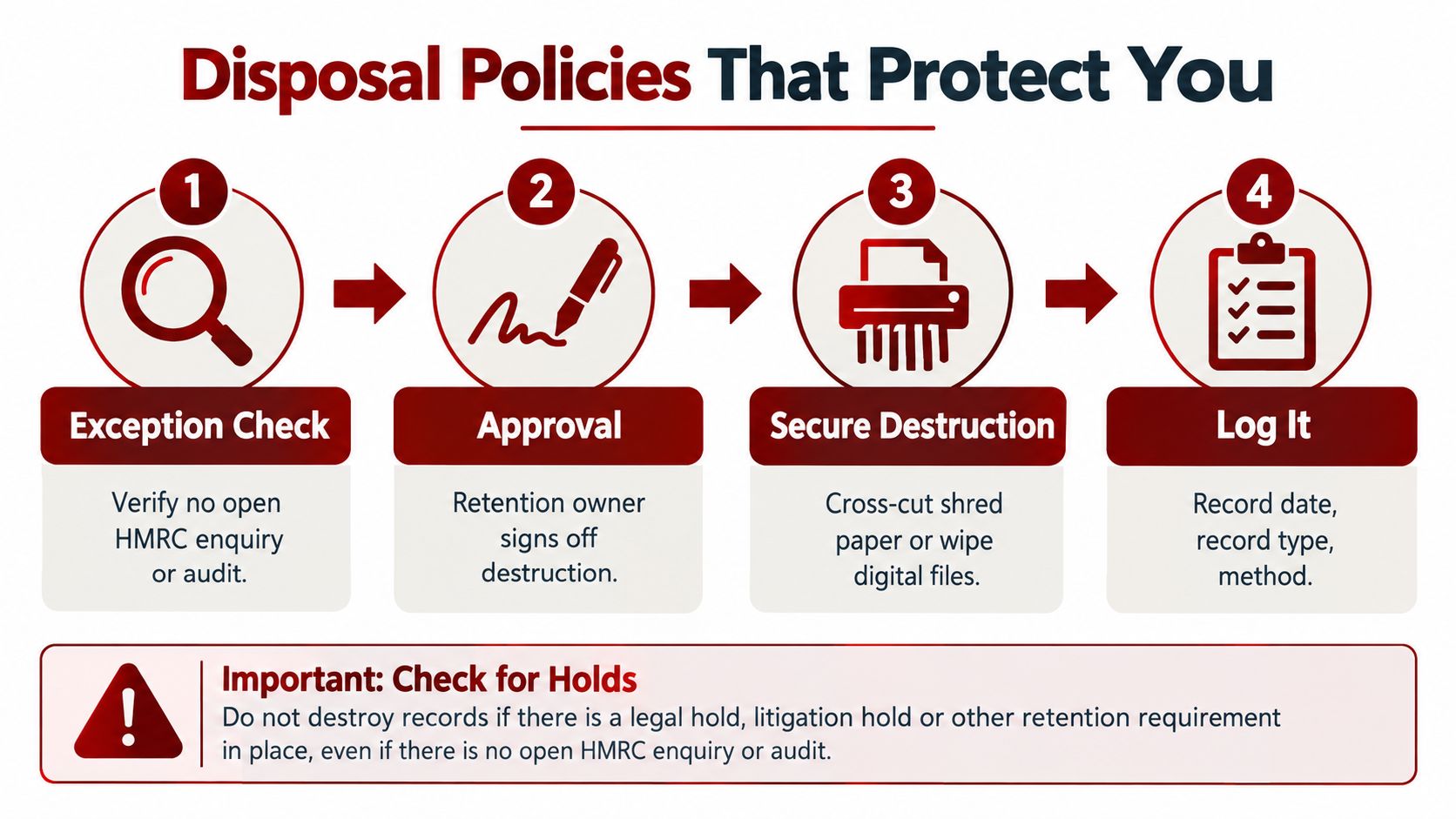
Use a four-stage approval route
First, check exceptions. Search for open HMRC enquiries, late or amended returns, appeals, threatened claims, active litigation, insolvency issues and unresolved supplier or customer disputes. The check should cover both paper and digital locations.
Second, approve destruction. A named retention owner should confirm the category, the applicable expiry date and the absence of a hold. For a company, give directors or a delegated senior manager clear authority rather than allowing routine deletion by whoever manages the shared drive.
Third, destroy securely. Cross-cut paper containing financial or personal data. For digital records, use an approved deletion process that removes accessible copies and records the action. Don't forget exports, email attachments, local downloads and backup retention rules.
Fourth, log the decision. Record the date, record type, covered period, destruction method, approver and any exception check performed. The log proves that destruction followed policy rather than an impulsive office clear-out.
Privacy matters too
Tax law may require retention, but personal-data principles still matter. Keep only what the business needs, restrict access and delete personal information when no applicable purpose remains. A retention schedule should therefore state both the legal reason for keeping a record and the approved method for disposing of it.
Never destroy a record merely because its normal date has passed if a hold applies. Release the hold only when the matter is closed and the applicable period has expired.
Sample Retention Schedule for Small Businesses and Landlords
A small business can pass the ordinary six-year mark and still need its records. The correct expiry date is the longest clock created by company law, tax, VAT, payroll, MTD, AML or an unresolved matter. Use the matrix below as a working schedule, then adjust it for the business's legal form, registrations and records under investigation. A dispute, late filing, enquiry, insolvency issue or other active matter suspends routine disposal.
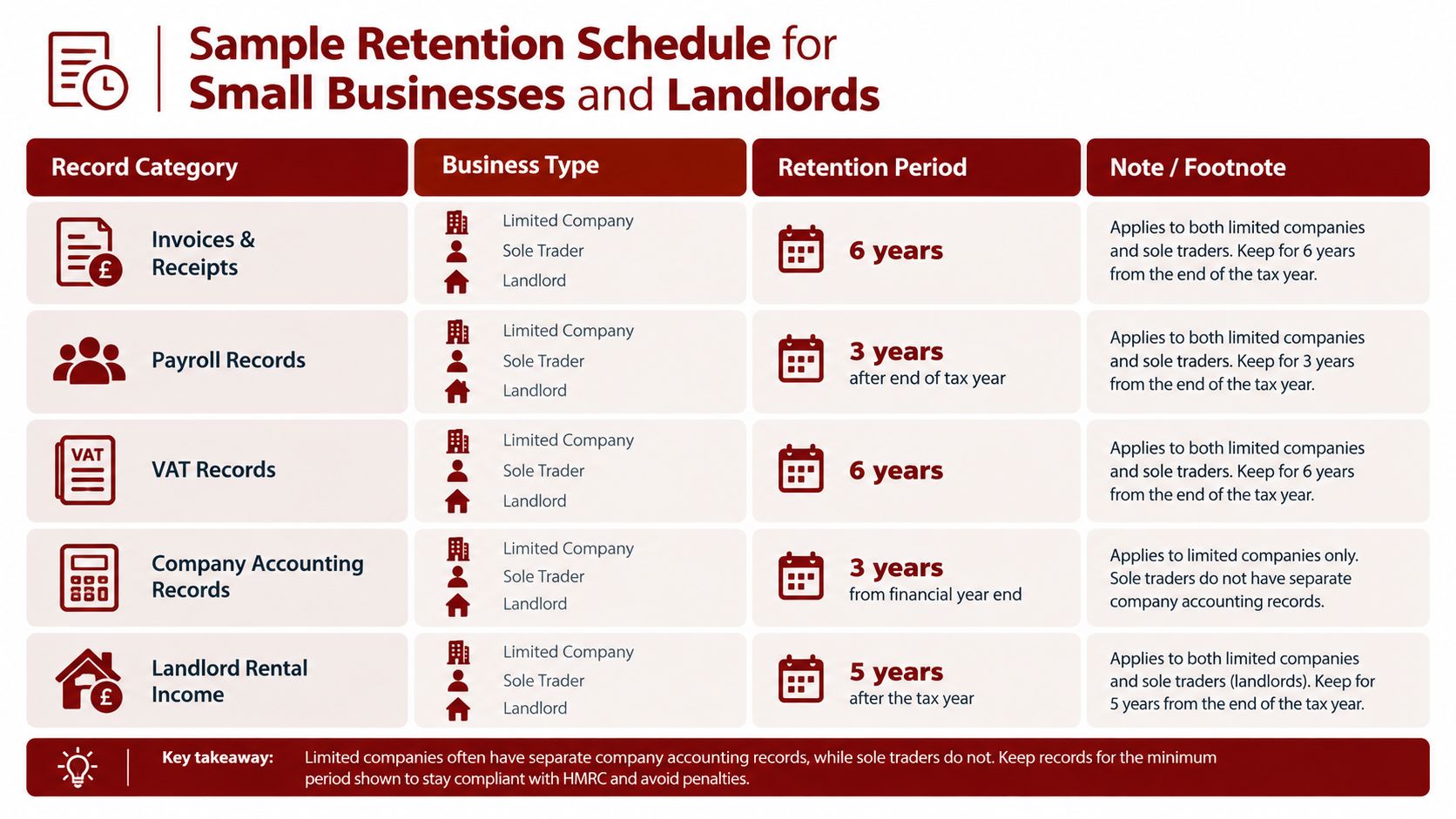
| Record category | Limited company | Sole trader or landlord | Working rule |
|---|---|---|---|
| Invoices and receipts | Commonly six years from the relevant accounting-period end where they support company tax or VAT | Follow the relevant Self Assessment and VAT period | Link to the ledger and bank evidence |
| Payroll and PAYE | Apply the longest payroll, tax and employment requirement | Keep where staff or contractors create payroll obligations | Include journals, submissions and payment evidence |
| VAT records | Six years generally applies | Six years generally applies where VAT registered | VAT evidence controls over shorter periods |
| Company accounting records | Three years from the date made under company law, but tax commonly requires six years from the accounting-period end | Not applicable as company records | Do not rely on the three-year company-law minimum |
| Landlord rental income | Relevant where a company owns property | Normally five years after the 31 January filing deadline for Self Assessment support | Retain rent schedules, agent statements and expense evidence |
| CIS records | Keep with subcontractor invoices, deductions, payments and VAT support | Apply the longest tax and payment-related period | Construction records often serve several purposes |
| AML and due diligence | Five years after the relevant transaction or end of relationship, subject to longer connected requirements | Apply where the business is within the relevant obligations | Separate identity evidence from general client files |
| MTD digital records | Preserve accessible digital records and supporting evidence | From April 2026, scheduled to apply above the stated income threshold | Export and test records through software changes |
From April 2026, Making Tax Digital for Income Tax is scheduled to apply to individuals and landlords with combined self-employment and property income above £50,000. The thresholds are currently planned to fall to £30,000 in April 2027 and £20,000 in April 2028, subject to HMRC confirmation. HMRC currently proposes that digital records be stored for at least five years after the relevant 31 January submission deadline. HMRC's MTD economic-benefit publication sets out the proposed thresholds and storage position.
Special decisions for landlords and contractors
Landlords should preserve the source material behind rental accounts, not just a year-end spreadsheet. Keep tenancy income evidence, agent statements, mortgage or finance records, repair invoices and bank support in a consistent structure for each property. That structure makes a later tax query easier to answer and prevents one property's evidence being mixed with another's.
Construction contractors should connect CIS calculations to subcontractor invoices, verification evidence, payment records and VAT reporting. One file may support several obligations, so retain it for the longest applicable period rather than deleting it when the shortest clock expires.
MTD also makes software changes a retention decision. When changing systems, export prior-year records, preserve original invoices and receipts, document backup ownership and test that an auditor could trace a transaction from source document through to submission. Keep the old data accessible in a usable format, not merely stored in an unreadable export.
A Practical Retention Checklist You Can Use Today
A retention policy becomes useful when a new employee can follow it without asking the founder what “old records” means. Put the following checklist into your bookkeeping procedures and review it with the person responsible for finance.
Classify
- Inventory records: List invoices, receipts, bank statements, ledgers, payroll files, VAT records, CIS documents, statutory books, contracts and due-diligence files.
- Assign purposes: Mark each record as company-law, corporation-tax, VAT, payroll, AML, employment, contractual or another category.
- Set the clock: Record the trigger, expiry date, responsible owner and longest applicable period.
- Flag mixed files: If a client or supplier file contains several record types, apply the longest relevant period or separate the contents.
Control
- Index consistently: Use accounting period, transaction source and record category in file names and physical labels.
- Restrict changes: Lock closed periods and limit deletion rights to named users.
- Back up independently: Keep recoverable copies outside the primary accounting system.
- Test retrieval: Select sample records and confirm that staff can locate, open and understand them.
- Document migrations: Record software changes, export formats, storage locations and access arrangements.
A written policy should explain these controls in plain language. Businesses developing compliant record policies should also define who can approve destruction and how the organisation records that decision.
Clear
- Check holds: Search for HMRC enquiries, amended returns, appeals, disputes, litigation and insolvency concerns.
- Obtain approval: Get documented sign-off from the retention owner or director.
- Destroy securely: Shred paper and follow an auditable digital deletion process.
- Log disposal: Record the period, category, date, method and approver.
- Review annually: Update the matrix after changes to VAT registration, payroll, property ownership, software or business structure.
Before you shred anything, check the accounting period, the filing status, the connected tax types and any unresolved matter. If the answer is uncertain, preserve the record and ask your accountant before deleting it.
Why Retention Is an Ongoing Habit Rather Than a One-Off Task
A retention schedule can be correct on Monday and unsafe on Friday. HMRC may open an enquiry, a return may be amended, a customer may challenge a transaction, or an insolvency investigation may require records that looked ready for disposal. A late return can also move the practical end date beyond the ordinary baseline.
That's why the expiry date must sit beside an exception process. The finance owner should review open enquiries, appeals, disputes, litigation and insolvency concerns before every disposal run. Payroll and property records deserve the same attention, because an employment or landlord dispute can turn routine accounting evidence into important support.
A mature policy doesn't ask staff to remember every rule. It gives them a clear category, trigger, owner, hold check and disposal record.
Review the schedule at least annually and whenever the business changes its legal structure, tax registrations, payroll arrangements, construction activity, property portfolio or accounting software. Directors and owners should sign off the policy, because retention is a governance control, not merely an administrative preference.
If your current system consists of scattered spreadsheets, full filing cabinets and an uncertain deletion date, fix the matrix before the next return is filed. A qualified accountant can map the records to the relevant obligations, separate company and personal records, and turn the policy into a process your team can easily follow.
Action Accountants Limited helps startups, SMEs, landlords, sole traders and construction businesses organise bookkeeping, VAT, payroll, CIS and digital accounting records around practical retention controls. Visit Action Accountants Limited to discuss your records matrix, archive process and compliance requirements.