
Statutory Accounts Preparation: A Practical UK Guide
Master statutory accounts preparation for UK limited companies. Step-by-step guidance on trial balance, adjustments, filings, and common errors to avoid.
A year-end pack rarely arrives in perfect condition. The bank reconciliation is nearly done, but a supplier statement is missing, the CIS control account doesn't agree to the bookkeeping file, and the director loan account has become an uncomfortable question rather than a clear balance. Meanwhile, the broker wants signed accounts for renewal, the bank wants the latest filed figures, and the Companies House deadline is moving closer.
That pressure is why statutory accounts preparation needs a controlled sequence. Start with company classification, clean the underlying records, adjust the trial balance, prepare the statements and notes, obtain director approval, validate the filing and submit it with time to correct problems. The legal framework is set out in the UK Government guidance on company accounts, which confirms that statutory accounts are a formal compliance document, not just an internal management report. A practical year-end accounts checklist can help directors and accountants keep that sequence visible.
Table of Contents
- The Year-End Pressure and What This Guide Solves
- Pre-Year-End Housekeeping and Size Classification
- Turning the Trial Balance into Statutory Accounts
- Core Components, Notes and Disclosures You Cannot Skip
- Filing With Companies House Without Triggering Penalties
- Preparing Your Books for the 2028 iXBRL Filing Model
- Director Checklist and Common Questions Answered
The Year-End Pressure and What This Guide Solves
A construction company reaches year end with plant still in use, a director's personal fuel payment buried in the company card, and a CIS balance that does not match the supporting records. The trial balance may still balance. It does not prove that the fixed assets, obligations or relationships are recorded correctly. Statutory accounts preparation is therefore a records and judgement exercise, not only a debits-and-credits exercise.
A private company normally has nine months after the end of its accounting reference period to deliver acceptable accounts to Companies House. A public company normally has six months, as set out in Companies House filing guidance. That allowance shrinks once the team closes the ledger, obtains missing evidence, answers queries, secures approval, corrects rejected figures and keeps the next trading year moving.
The recurring blockers are concrete: an incomplete fixed-asset register, unclear director-loan transactions, unreconciled payroll, VAT or CIS balances, and related-party activity that has not been identified for disclosure. FRS 102 and the micro-entity rules do not turn weak records into supportable accounts. Leaving these questions until final review forces historic investigation under deadline pressure. A practical year-end accounts checklist keeps ownership and timing visible.
Practical rule: Treat the legal deadline as the latest possible submission date, not as the date your accountant starts preparing the pack.
Use a dated readiness plan:
- Confirm the accounting reference period and company size.
- Lock the nominal ledger and reconcile each control account.
- Gather missing invoices, receipts, statements and director-loan evidence.
- Check the fixed-asset register against purchases, finance agreements and disposals.
- Post accruals, prepayments, depreciation and tax-related adjustments.
- Map the adjusted trial balance to the statutory balance sheet and profit and loss account.
- Prepare notes and disclosures, including related-party and director-loan information.
- Obtain approval, validate the electronic filing, submit early and retain supporting records.
- Prepare the bookkeeping process for the April 2028 iXBRL filing model.
That sequence gives every unresolved item a clear place. It also tests whether the records explain the company's assets, liabilities and relationships, rather than merely producing a set of totals that balance.
Pre-Year-End Housekeeping and Size Classification
The most efficient accounts teams don't begin with the trial balance. They begin with the records that make the trial balance trustworthy.
First, lock the bookkeeping period and reconcile the bank accounts to the statements. Then reconcile payroll, VAT and CIS control accounts to payroll reports, VAT returns, HMRC records and subcontractor documentation. A clear bank reconciliation process is particularly important for construction businesses, where timing differences, retentions, supplier payments and CIS deductions can leave a ledger balance that looks plausible but isn't supported.
Next, request the evidence that tends to disappear during a busy trading year:
- Purchase invoices: Match major supplier balances to statements and investigate old items.
- Expense receipts: Replace unsupported director expenses before deciding whether they're business costs or loan-account entries.
- Fixed-asset evidence: Gather invoices, finance agreements, disposal documents and details of assets still in use.
- Director-loan records: Identify personal payments, company-paid expenses, drawings, dividends and repayments.
- Intercompany support: Obtain statements and transaction listings where companies in the same group trade with one another.
Only after that work should the company's reporting category be confirmed. The classification affects the accounts format, the level of disclosure, whether audit considerations apply and what information can be filed publicly. A company that qualifies for a simpler regime still needs records that support every figure.
The table below deliberately avoids presenting unsupported numeric thresholds. The relevant tests must be applied under the current Companies Act and FRS 102 rules, using the company's results and circumstances rather than an informal assumption that it is “small”.
| Size Band | Turnover / Balance Sheet Test | Audit Required? | Accounts Format | iXBRL Scope |
|---|---|---|---|---|
| Micro-entity | Apply the statutory micro-entity size tests | Consider the statutory audit exemptions and whether any exception applies | Micro-entity accounts, where eligible | Prepare for the future software-based tagging model |
| Small company | Apply the statutory small-company size tests | Small-company audit exemption may apply, subject to conditions | Small-company format, where eligible | Increasingly important for software output and validation |
| Medium company | Apply the statutory medium-company size tests | Audit requirements generally need closer attention | Fuller accounts and disclosures | Broader tagging and disclosure expectations |
| Large company | Apply the statutory large-company size tests | Audit generally required, subject to the applicable rules | Full statutory accounts and reporting | Full digital reporting preparation is essential |
Misclassification can produce the wrong balance-sheet format, missing notes or an inappropriate audit conclusion. It can also create problems when Companies House or HMRC compares the filed accounts with the corporation tax return and supporting records. Classification is a technical decision, not an administrative box to tick at the end.
Turning the Trial Balance into Statutory Accounts
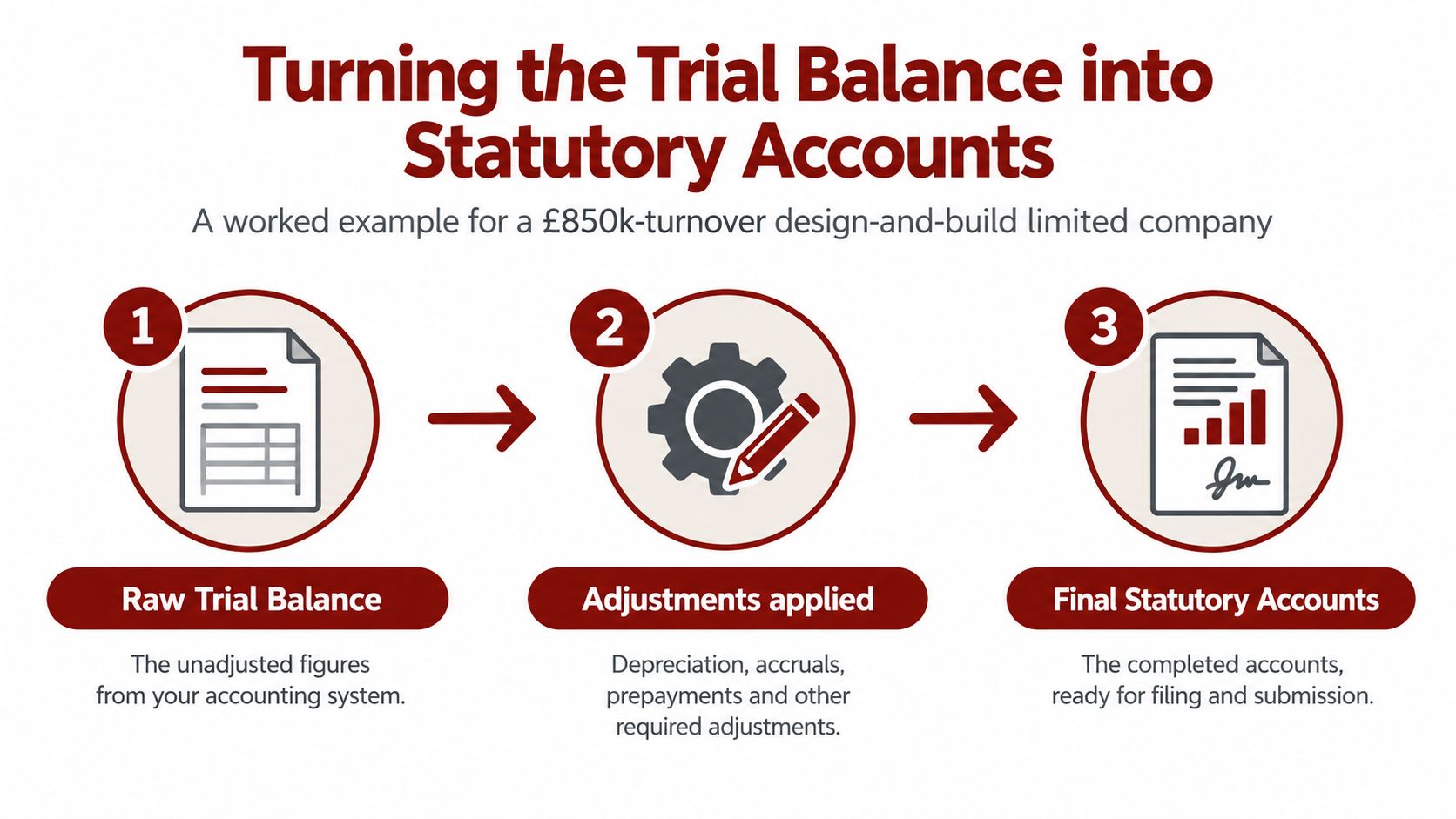
Consider an illustrative design-and-build limited company with £850,000 of turnover. Its raw trial balance includes cash, trade debtors, stock, trade creditors, VAT, plant and vehicles, and a director loan account that contains both business reimbursements and personal transactions. The figures balance mechanically, but they aren't ready for statutory accounts.
Start with timing adjustments
The first adjustment is the cut-off review. Work through unpaid subcontractor invoices, professional fees, utilities, insurance and other costs relating to the year that haven't yet been posted. Those items may require accruals. Conversely, an annual insurance payment may cover a period beyond the year-end, requiring a prepayment so that the accounts report the correct portion for the year.
The supporting schedule matters as much as the journal. An accrual with no invoice, contract or calculation behind it is difficult to defend. For a construction business, the year-end review should also consider work completed, materials held, retentions and costs connected to contracts that remain open.
Then deal with assets and control accounts
The plant and vehicle ledger should be compared with an actual fixed-asset register. Post depreciation using the company's accounting policy, check additions against invoices and investigate disposals that remain on the ledger. A missing register is a warning that the balance sheet may not describe what the company owns or still uses.
Next, reconcile CIS deductions and subcontractor liabilities to the underlying returns, payment records and vouchers. Review VAT balances against submitted returns, and investigate any amount that has remained unchanged for an unusual period. The aim isn't merely to make the control account agree. It's to explain why it agrees.
Finally, analyse the director loan account. Separate genuine company liabilities to the director from amounts the director owes the company, identify transactions that are dividends or expenses, and retain evidence for each material balance. A messy director loan account can affect disclosures, tax treatment and the director's personal position.
A clean adjusted trial balance is the point at which every material balance has an explanation, not simply a debit and a credit.
Before drafting, stop if there is an unbalanced suspense account, no fixed-asset register, an unexplained aged debtor, or an unreconciled intercompany balance. Software can map those figures into neat headings, but it can't repair unsupported bookkeeping. Directors looking for a wider view of how reporting supports decisions may also benefit from these actionable financial insights for CEOs. Where several systems feed the ledger, review the accounting software integration before the next close.
Core Components, Notes and Disclosures You Cannot Skip
UK statutory accounts normally contain a balance sheet, a profit and loss account and explanatory notes. The balance sheet reports assets, liabilities and amounts owed at the year-end. The profit and loss account reports sales, costs and profit or loss. A statement of changes in equity may also be required, depending on the company's reporting framework and circumstances.
The accounts must be prepared under either UK-adopted International Financial Reporting Standards or the UK Generally Accepted Accounting Practice framework. Micro-entities, small companies and medium-sized companies have different presentation and disclosure options, but none of those options removes the need for accurate underlying records.
| Component / Note | Micro-Entity | Small Company | Medium Company |
|---|---|---|---|
| Balance sheet | Required in the applicable micro-entity format | Required, with the permitted small-company presentation | Full presentation requirements apply |
| Profit and loss account | Prepared for members and tax purposes, with public filing treatment changing under the future model | Prepared for members and tax purposes, subject to the filing regime | Full accounts and disclosures required |
| Explanatory notes | Reduced notes where the company qualifies | Abbreviated notes may be available, but eligibility must be checked | Fuller notes are expected |
| Directors' report | Micro-entities are generally exempt | Requirements depend on eligibility and applicable exemptions | Normally required |
| Related parties and director loans | Disclose where the applicable regime requires it | Review carefully and disclose relevant transactions | Detailed review is essential |
| Going concern | Assess and document the conclusion | Assess and document the conclusion | Assess and document the conclusion under the applicable FRS 102 requirements |
The notes are where many owner-managed businesses underestimate the work. Review related-party transactions, director loans and overdrawn accounts, share capital movements, ultimate parent undertakings, contingent liabilities and events after the reporting date. A customer dispute, guarantee, threatened claim or significant post-year-end event may need explanation even if it doesn't change the year-end trial balance.
Going concern also deserves more than a standard sentence. Under FRS 102 Section 3.11, the directors and preparers need to consider whether the company can continue operating and whether material uncertainties need disclosure. That assessment should reflect cash flow, debt repayments, commitments, contract exposure and available support. If an audit is required, or if the directors want an independent review of controls, guidance on how to protect your business with audits can help frame the decision.
Filing With Companies House Without Triggering Penalties
Late filing is the clearest measurable statutory-accounts risk. Companies House issued 317,985 late-filing penalties during 2024–25, according to the Independent Adjudicators' annual report. The figure shows that deadline management remains a widespread compliance failure, even though the filing process is familiar to accountants and directors.
A private company normally gets nine months after the end of its accounting reference period to deliver acceptable accounts. The deadline is calculated to the exact day. It isn't enough to upload a file before midnight if Companies House later rejects it because the accounts are incomplete or technically unacceptable.
Build a filing buffer
A sensible control benchmark is to complete the accounts 10 to 15 working days before the legal deadline, as described in the Companies House reporting material cited above. That buffer gives the directors time to review and approve the accounts, allows the accountant to resolve validation errors, and leaves room for a corrected submission.
Online filing is usually preferable because the Companies House service includes built-in checks and provides near-immediate acknowledgement. Companies House says it aims to process most online filings within 24 hours, while paper submissions can take a week or more and are manually checked. That does not make online submission infallible. A filing can be accepted by the system and later rejected after examination.
Filing control: Save the submission confirmation, the exact accounts file submitted and the final accepted status. “Sent” isn't the same as “accepted”.
Check the mechanics, not just the figures
The company needs the correct accounting period, registered number and company details. The accounts must contain the statements and notes required for the company's size and reporting framework, and the balance-sheet figures must be supported by the adjusted records. The authentication code must be available for the chosen online filing route.
The directors approve the accounts before signing the balance sheet. Approval is a board responsibility. The signature confirms that the accounts have been approved, but it doesn't transfer responsibility for the underlying information to the accountant. The CS01 is a separate confirmation statement process and shouldn't be treated as a substitute for accounts filing. Company secretarial controls, including filing dates and registered-office records, are covered in this guide to company secretarial duties.
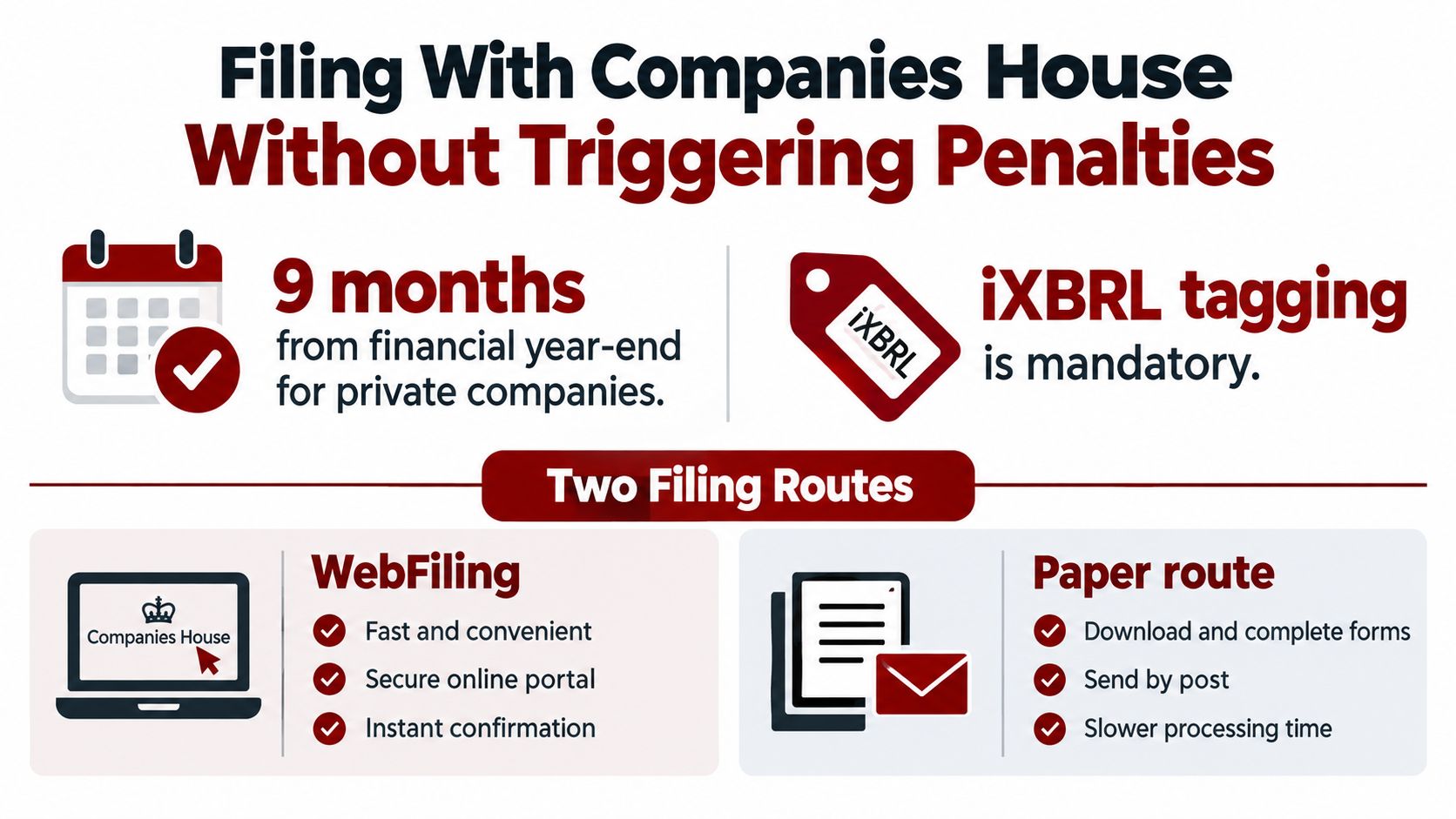
A rejection doesn't create extra filing time. The accounts may continue to show as overdue until Companies House examines and accepts the corrected submission, so the team should validate the company's eligibility, statements, notes and digital format before sending them.
Preparing Your Books for the 2028 iXBRL Filing Model
For a construction company with incomplete subcontractor records, inconsistent fixed-asset registers and director payments posted to general expenses, the main 2026 risk is not the future accounts template. It is the quality of the bookkeeping that feeds it.
The UK Government has announced that, for accounts filed from 1 April 2028, all companies are expected to file through commercial software using iXBRL, according to current Companies House filing guidance. The guidance also indicates that small companies and micro-entities are generally expected to submit a profit and loss account, while abridged accounts are planned for removal. These are future requirements under the announced model, so current work should build readiness rather than treat the new process as applying to today's filing.
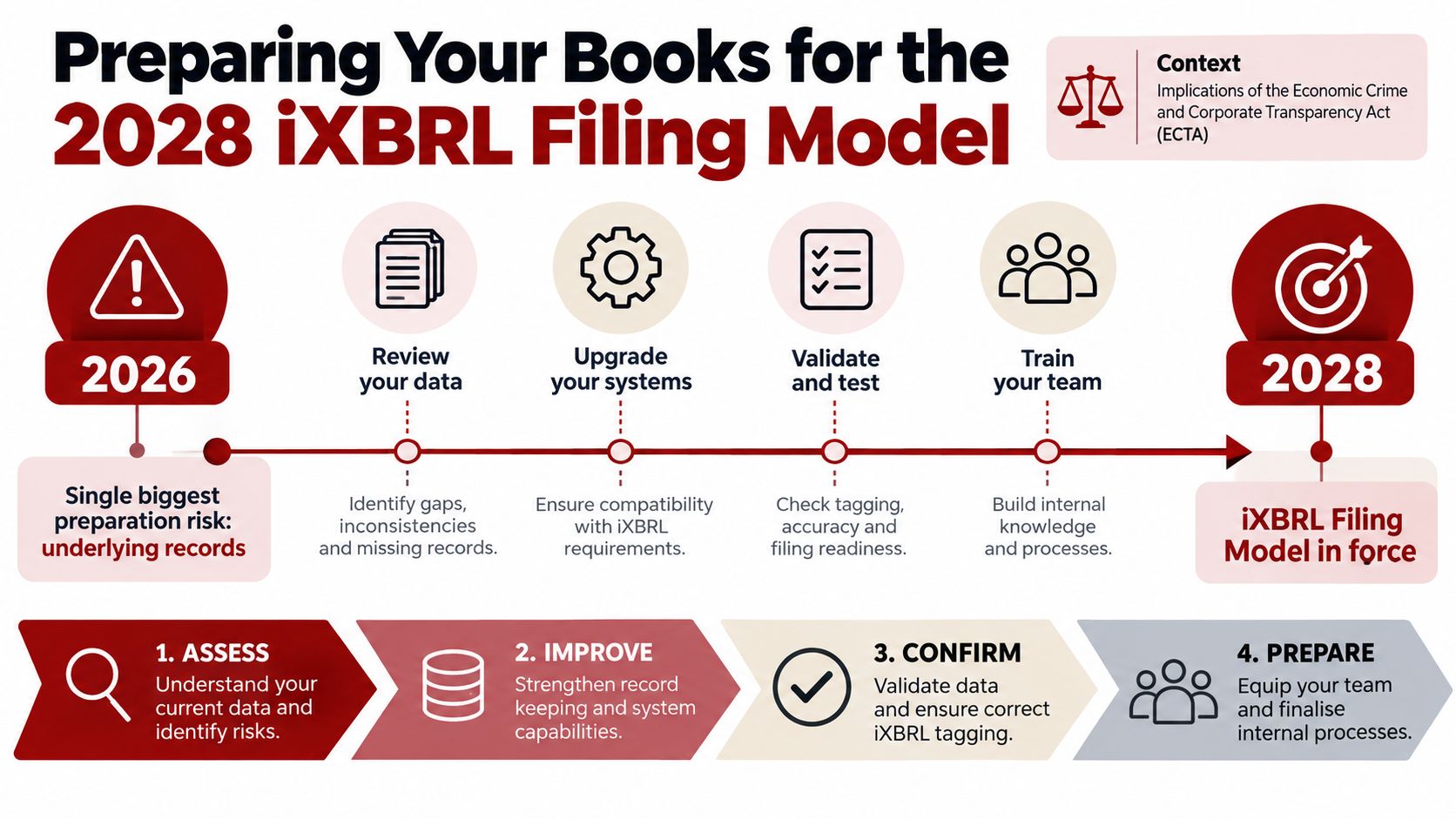
Software can produce tagged accounts quickly when the chart of accounts is consistent and each balance has supporting evidence. It cannot decide whether a director's personal payment is a loan, dividend or expense. It cannot rebuild missing subcontractor records, identify an unrecorded vehicle disposal or correct a fixed-asset register that was never updated. A file can pass technical validation while containing materially wrong information.
A practical readiness sequence
- Confirm the size classification: Record why the company qualifies as micro, small or another category under the applicable rules, then revisit the assessment when the business changes.
- Standardise the nominal ledger: Use consistent codes for subcontractors, plant, vehicles, director transactions, related parties and finance costs.
- Reconcile monthly: Review bank, VAT, payroll, CIS, loan and intercompany balances throughout the year, rather than leaving one large investigation for the accounts deadline.
- Digitise the evidence: Store invoices, receipts, payroll journals, CIS vouchers, statements and fixed-asset documents in an organised digital record.
- Map the chart of accounts: Ask the software provider or accountant how ledger codes map to the relevant taxonomy and whether the output supports the planned filing requirements.
- Test before the first mandatory submission: Run a dry-tag or equivalent review before the first required filing, then resolve unmapped or ambiguous balances.
The proposed model may let companies opt out of publishing profit and loss information on the public register. That option would not remove the obligation to prepare and file the information. Directors should plan for closer evidence and review, especially where the business depends on spreadsheets, manual journals or incomplete records. Related-party transactions and fixed-asset movements deserve particular attention because software cannot infer the underlying relationship or transaction history.
Director Checklist and Common Questions Answered
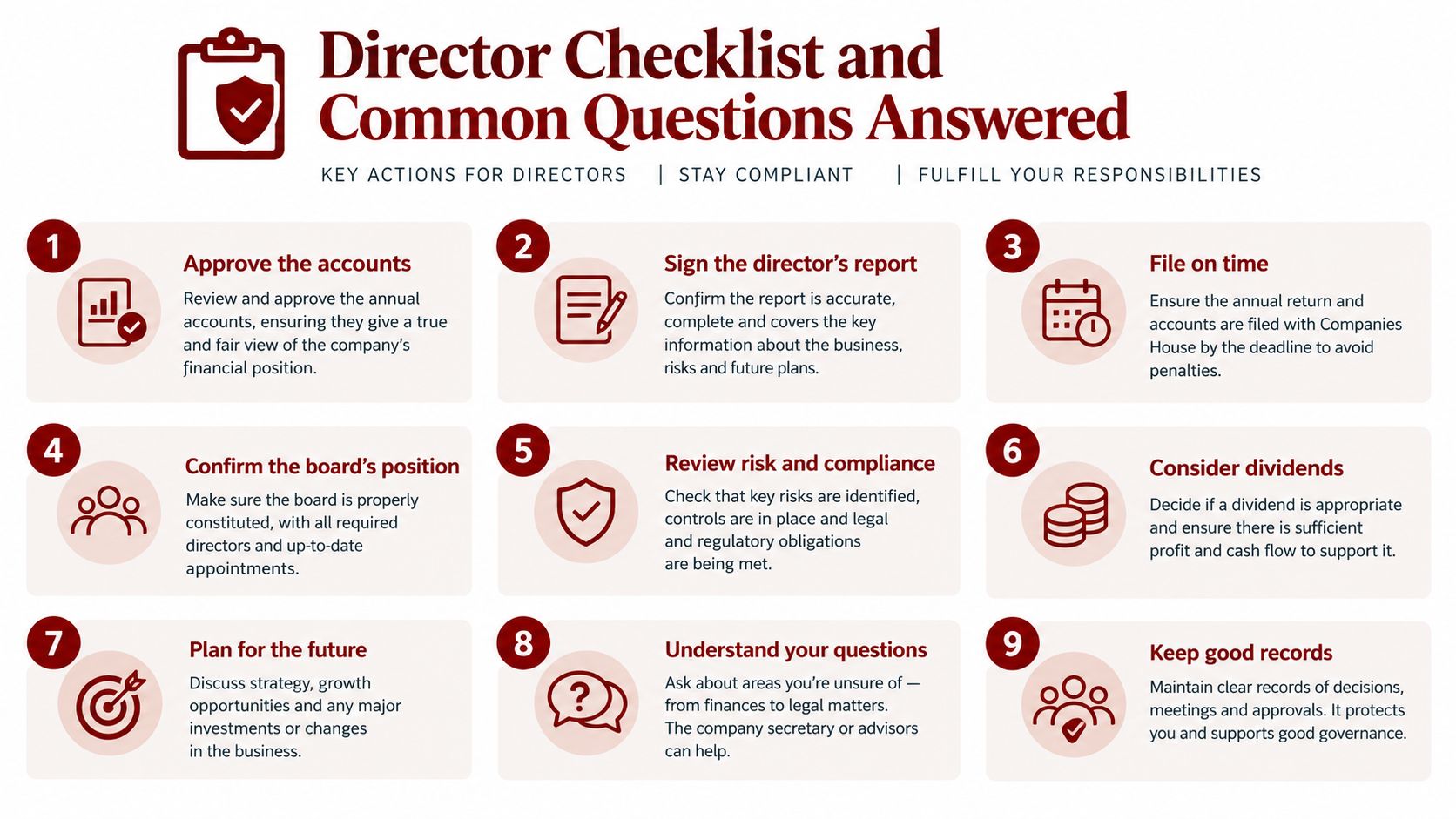
Directors do not need to post every journal, but they must understand the figures and disclosures they approve. Before signing, work through this checklist:
- Confirm the accounting reference date: Check the reporting period, filing deadline and any change to the company's accounting reference date.
- Confirm company size: Record whether the company qualifies as micro, small or medium under the applicable FRS 102 and micro-entity rules.
- Sign off bank reconciliations: Investigate unusual items, old reconciling balances and payments without supporting evidence.
- Review intercompany balances: Obtain matching statements and resolve differences before the accounts are approved.
- Review the director loan account: Separate company liabilities, drawings, dividends, expenses and amounts owed by or to the director.
- Approve related-party disclosures: Identify transactions with directors, shareholders, group companies and connected parties. The relationship and transaction history must be clear in the working papers.
- Approve and sign the balance sheet: Directors approve the accounts and sign the balance sheet in the required form.
- File within the legal period: A private company normally has nine months after its accounting reference period to deliver acceptable accounts, as set out in Companies House guidance.
- Retain the statutory records: Keep the accounts, evidence, approvals and statutory books at the appropriate registered-office or company-record location. Brief the board on the audit position for the next reporting periods.
Common questions
Does the nine-month filing deadline run from the date the accounts are approved?
No. For a private company, the period normally runs from the end of the accounting reference period. Approval delays and accountant availability do not extend the legal deadline.
Does the corporation tax return force the accounts to be filed earlier?
Companies House accounts and the HMRC corporation tax return are separate obligations. The figures should agree, but one timetable does not replace the other.
What triggers a full audit rather than an accountant's report?
The answer depends on company size, legal status and whether an exemption applies. Accounts preparation or compilation is not the same as a statutory audit opinion.
How does the 2028 model affect current-year preparation?
Accounts filed from 1 April 2028 will require the business to be ready for the planned iXBRL model. Consistent bookkeeping, clear classifications, supporting evidence and suitable software should be addressed now. Fixed-asset additions and disposals, related-party balances and manual journals need records that software cannot infer on its own.
What happens if the company is one day late?
Late filing can trigger an automatic penalty. A rejected submission does not create extra time, so allow room to correct errors and confirm acceptance before the deadline.
Does Companies House accept paper accounts?
Paper submissions remain a filing route, but manual checking can delay acknowledgement. Online filing provides built-in checks and near-immediate confirmation where the accounts are suitable for digital submission.
The strongest process connects fixed assets, control accounts, director relationships and filing technology. That combination makes the current accounts more defensible and gives the company a practical preparation plan for 2028. Directors can review the nine-point statutory accounts checklist before approval.
Action Accountants Limited prepares and files annual accounts for limited companies, using year-end figures to produce the required format and submit the accounts to Companies House. London SMEs and construction businesses can visit Action Accountants Limited to discuss CIS-aware bookkeeping, reconciliations and statutory accounts support.


