
Changing Accounting Reference Date: A UK Company Guide
Learn the exact process for changing accounting reference date in the UK. Covers eligibility, Companies House form AA01, tax deadlines, and real-world examples.

You incorporated your company in March, then discovered that the year end lands in the middle of your busiest sales period. Your team is chasing customers, invoices are still being raised, and nobody has enough time to close the books properly. The problem isn't the accounting software. It's the date controlling your reporting timetable.
Changing your accounting reference date can solve that clash, but only if you make the change before the relevant deadline and stay within the statutory limits. The most expensive mistakes happen when directors treat form AA01 as a routine admin update instead of a time-sensitive compliance decision.
Table of Contents
- Why Your Accounting Reference Date Matters More Than You Think
- Eligibility Rules and Hard Limits You Cannot Bend
- Filing Form AA01 With Companies House
- Real Scenarios for Startups Contractors and Landlords
- Common Mistakes That Get Your Application Rejected
- Questions Directors Ask Before Changing Their Year End
Why Your Accounting Reference Date Matters More Than You Think
Your accounting reference date, or ARD, is the date on which your company's financial year ends. If the date is 31 March, the accounting period runs up to 31 March. The period is the span of time, while the ARD is the date that closes it. That distinction matters because Companies House uses the accounting period to calculate when your annual accounts must be filed.
For a private company or LLP, the standard accounts filing deadline is 9 months after the end of the accounting reference period. A public company has 6 months. Companies House confirms these filing rules in its guidance on changing a company accounting reference date.
The ARD also gives your accountant the date around which statutory accounts, corporation tax computations, dividend paperwork and management reporting are organised. A poorly chosen year end can create a recurring workload bottleneck. A sensible one gives you time to reconcile income, verify expenses, review stock or property records and make decisions before filing pressure arrives.
Practical rule: choose a year end your business can actually service, not one that merely looks tidy on the register.
The date controls more than annual accounts
The ARD starts the Companies House filing clock, but it also influences the accounting periods you report to HMRC for corporation tax. Changing the Companies House date doesn't remove the need to check the corporation tax position separately. Your accountant should review the resulting accounting periods rather than assuming every deadline will move in a simple line.
Directors should also consider how the date interacts with confirmation statement planning, dividend declarations and personal tax work. These aren't all governed by the ARD in exactly the same way, but the date often becomes the organising point for board records, profit reviews and director remuneration decisions.
Before filing, use a structured year-end accounts checklist to identify outstanding records and deadline dependencies. If you're building a broader digital acquisition plan for an accountancy practice, guidance on local SEO for accountants is a useful separate resource, but it won't fix a missed filing date.
The right decision is strategic. Move the date away from your busiest trading period, align it with a group reporting cycle or create a more manageable internal timetable. Then test the proposed period against the legal limits before anyone submits AA01.
Eligibility Rules and Hard Limits You Cannot Bend
Companies House gives you some flexibility, but it doesn't give you a blank cheque. The first question is whether you're shortening the accounting period or extending it. The second is whether the relevant accounts are still within their filing deadline.
The hard boundary is 18 months for an accounting reference period, as explained in the Companies House guide to accounting reference dates and periods. A proposed period that exceeds that limit won't become acceptable because the business has a good reason. Check the start and end dates before completing the form.
The second major restriction concerns extensions. Outside the recognised exceptions, a company can extend its accounting reference date only once in a five-year period. The exceptions include administration, alignment with a parent or subsidiary, and Secretary of State consent. Check the company's previous date changes before you plan around an extension.
Shortening and extending are not mirror images
Shortening brings the year end forward. It isn't subject to the same frequency restriction as an extension, so a company can shorten its financial year more than once. That freedom doesn't make it harmless. A shorter period can bring the accounts deadline forward, leaving less time to prepare records.
Extending pushes the year end later. That can give a recently incorporated business more breathing room, but it consumes the available extension flexibility and must stay within the 18-month cap. The proposed change must also be made before the filing deadline for the accounts concerned. If the accounts are already overdue, Companies House says it's too late to change the ARD.
| Rule | Shortening Year End | Extending Year End |
|---|---|---|
| Maximum accounting period | Must remain within the statutory framework | Cannot exceed 18 months |
| Frequency restriction | No equivalent five-year extension restriction | Normally once in a five-year period |
| Filing deadline | May arrive sooner | Must be changed before the existing deadline passes |
| Overdue accounts | Can't be used to repair an overdue period | Can't be used once the period is overdue |
| Preliminary check | Confirm the earlier deadline is achievable | Check the 18-month limit and extension history |
Run this check before AA01
Review the company's incorporation date, current ARD, proposed ARD, current accounts filing deadline and history of previous extensions. If the change is intended to align a group, document that reason and consider whether a statutory exception applies. Don't rely on a form's apparent acceptance as proof that the wider accounts and corporation tax timetable is correct.
A proper company secretarial duties review should sit alongside the date calculation. Directors remain responsible for making sure the company's records and filings reflect the decision.
Filing Form AA01 With Companies House
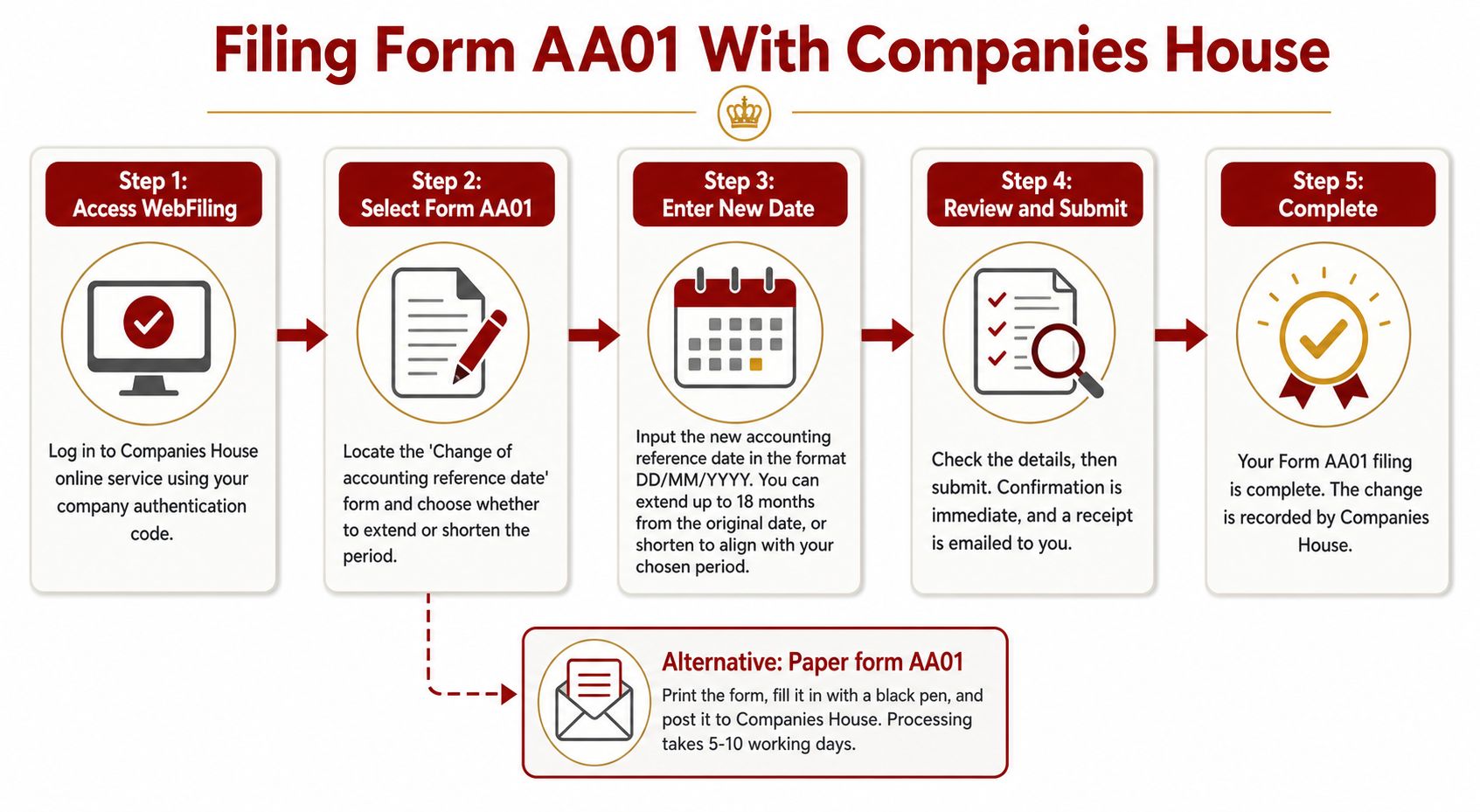
Form AA01 is the formal route for changing a company's accounting reference date. Companies House provides both an online filing route and a paper form. Use WebFiling where possible. It reduces transcription risk, provides an electronic acknowledgement and lets you keep a clear submission record.
The online route
Start by signing in to Companies House WebFiling with the company's authentication details. Open the company dashboard and select the option to change the accounting reference date. Enter the company's registration number, current accounting reference date and proposed new accounting reference date exactly as they appear in the register.
The online authentication code acts as the digital signature. The submission must be authorised by a director or another person permitted to sign for the company. Before pressing submit, compare the proposed date with the incorporation date, the current period and the deadline shown on the Companies House record.
The filing must be made before the filing deadline for the current accounting period. This is the point directors most often underestimate. Submitting on the deadline day leaves no useful margin for correcting an error, and submitting after the deadline won't turn an overdue period into a valid date change.
Companies House guidance states that the change is formally handled through form AA01 or the online filing route. Keep the acknowledgement, the submitted details and the updated register entry with the company's statutory records.
The paper route
Download the current AA01 form from Companies House and complete it in black ink. Enter the company number, existing ARD and new ARD carefully, then arrange the required signature from an authorised individual. Post it to the Companies House address specified on the form.
Paper filing gives you less visibility over progress. Keep a complete copy, proof of posting and a note of the date sent. Don't wait until the final day because the form itself appears straightforward.
Once Companies House accepts the change, review the public record and update your internal accounts timetable. The new date can affect the work your accountant needs to complete for statutory accounts and tax computations. It can also change the practical timing of your confirmation statement, so don't leave the company calendar untouched.
For a visual walkthrough of the sequence, watch the following guide after checking the dates and eligibility rules above.
Real Scenarios for Startups Contractors and Landlords
Worked examples expose the traps better than generic advice. The crucial calculation is always the actual accounting period, not the date that seems convenient on a calendar.
A March startup moving to December
A technology startup incorporated in March may want a December year end to match investor reporting and make due diligence easier. The director enters the company number, existing ARD and proposed December ARD on AA01, then checks the first accounting period from incorporation through the proposed December year end.
That period must remain within the 18-month maximum. A March incorporation followed by a December year end in the following calendar year can create a period longer than the permitted limit, depending on the exact incorporation date and proposed year end. The director must calculate the period from the beginning, not assume that a familiar calendar year end is automatically acceptable.
The corporation tax timetable also needs a separate review. A later first year end may alter the accounting periods used for tax reporting, so the company shouldn't promise investors a reporting date before the accountant has checked both filing calendars.
A CIS contractor choosing 5 April
A contractor operating through a company may prefer a 5 April year end because it makes the company's records easier to compare with personal self-assessment planning. The benefit is administrative alignment, not a magical change to the company's tax treatment.
If the current year end is moved forward to 5 April, the resulting period is shortened. That can bring the accounts deadline forward, so the contractor needs clean CIS records, subcontractor payment data, payroll information and bank reconciliations earlier than before. The change may reduce confusion over internal reporting while creating an immediate preparation task.
Use a plain-English CIS explanation as background, but don't confuse a personal tax-year preference with permission to ignore Companies House deadlines.
A landlord moving to 31 March
A residential landlord with several properties may choose 31 March to create a consistent point for reconciling rent, repairs, finance costs and property-level records. The date can make internal review easier, particularly where the owner wants a clear annual pack for lenders or advisers.
The main risks are the same but appear differently. If the move extends the period, calculate the period against the 18-month cap and check whether the company has already used its permitted extension within the relevant five-year window. If it shortens the period, prepare for the earlier filing date and don't assume the old timetable survives.
| Scenario | Original Date | Target Date | Key Benefit | Primary Deadline Risk |
|---|---|---|---|---|
| Startup | March incorporation year end | December | Cleaner investor reporting cycle | First period may exceed 18 months |
| CIS contractor | Existing company year end | 5 April | Easier comparison with personal planning | Shortened period may require earlier filing preparation |
| Landlord | Existing portfolio year end | 31 March | Simpler rental reconciliation | Extension history and period length must be checked |
These examples show why “move it to the end of the tax year” isn't a complete instruction. The correct target depends on the company's existing date, incorporation timing and previous changes. Calculate first, file second.
Common Mistakes That Get Your Application Rejected
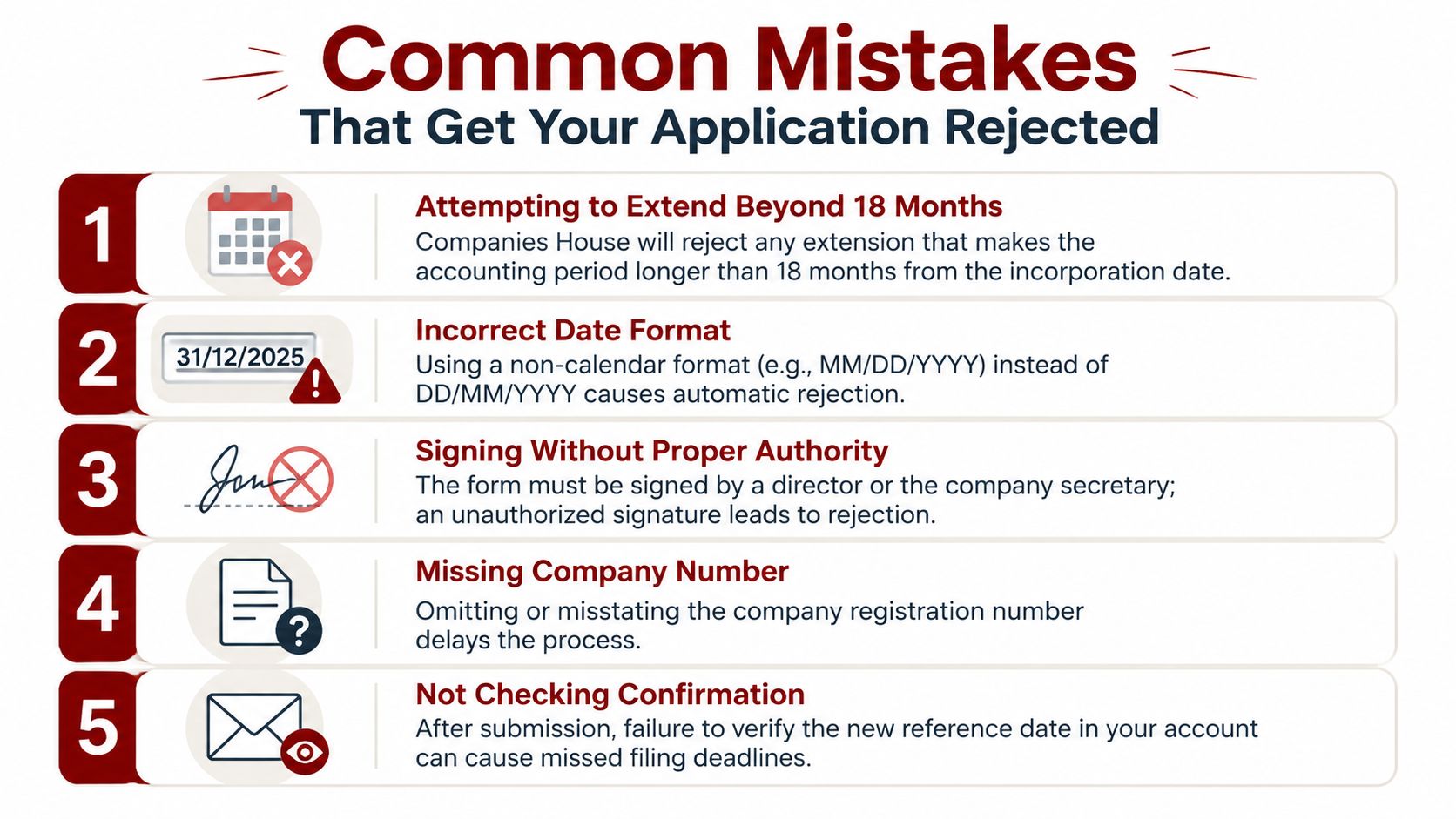
Most failed applications aren't caused by an obscure technicality. Directors usually submit a date that doesn't fit the period rules, file too late or fail to reconcile the Companies House change with the rest of the compliance calendar.
The rejection points to catch early
Exceeding 18 months: calculate the complete accounting reference period from its starting point. If the proposed extension crosses the maximum, choose an earlier target date rather than submitting and hoping Companies House will accept the commercial reason.
Using the extension too soon: check the company's date-change history. A previous extension can block another extension within the five-year restriction, unless a recognised exception applies. Shortening and extending aren't interchangeable, so identify which action you're taking.
Filing after the deadline: Companies House won't use AA01 to rescue accounts that are already overdue. Put the current filing deadline in the diary before selecting the new date, then submit with enough time to deal with a rejected or incomplete filing.
Assuming HMRC will be dealt with automatically: Companies House and HMRC deadlines must be reviewed together. The Companies House guidance establishes the filing restriction, but the tax position still needs its own confirmation and records.
Keeping the old accounts timetable: a date change can alter the period covered and the deadline your accountant is working towards. Recalculate the filing dates, update the bookkeeping close process and tell directors when records must be complete.
A correctly completed form can't repair an incorrect calculation. The practical fix is a short pre-submission review covering the period length, extension history, deadline status, signatory authority and post-filing calendar.
Questions Directors Ask Before Changing Their Year End
Do I need to contact HMRC separately? Treat the tax position as a separate task. Companies House filing updates the company record, but directors should confirm how the new ARD affects corporation tax accounting periods and any required HMRC notification. Don't assume that a Companies House acknowledgement is a corporation tax clearance.
Can a group change its dates to align? Group alignment is a common commercial reason for changing an ARD, particularly where the parent and subsidiaries need coordinated reporting. The 18-month cap and filing deadline still matter, but the rules recognise group alignment as an exception to the normal five-year extension restriction. Document the group rationale and have the consolidated reporting timetable checked before filing.
Can I change the date more than once? You can shorten without the same frequency limit that applies to extensions. Extensions are normally restricted to once in a five-year period, subject to the exceptions already described. Keep a permanent record of every change, not just the latest ARD.
Will the authentication code change? Changing the ARD doesn't itself mean you should replace the company's WebFiling authentication arrangements. Continue using the company's authorised access, and update the statutory calendar and accounting software once the new date appears on the register.
Does AA01 apply to sole traders or LLPs? AA01 is a company filing route. Sole traders don't have a Companies House ARD in the same sense, and LLP compliance should be checked under the relevant rules rather than assumed to follow an ordinary company's process.
How long does processing take? Allow time for Companies House to process the submission and verify the updated record. Online filing is generally the more practical route, while paper filing requires posting time and gives you less immediate visibility. Once accepted, use the recorded new date to rebuild the accounts and tax timetable.
If the change requires formal director approval, a concise board resolution can help create a clear audit trail. For context on what a board resolution is and how it functions, see the By Design Law Firm guide to board resolutions.
If you're changing an accounting reference date, Action Accountants Limited can calculate the permitted period, check the five-year extension history and handle the wider accounts and tax timetable. Visit Action Accountants Limited to arrange practical support before the filing deadline passes.


