
Making a Limited Company Dormant: A 2026 Guide
Learn the process for making a limited company dormant in the UK. Our 2026 guide covers the key steps, requirements, and what to expect.

You stopped trading, paid the last supplier, and told yourself the company could now sit until you need it again. Then the reminders arrive: Companies House accounts, a confirmation statement, perhaps a Corporation Tax notice. The company may be commercially inactive, but that doesn't mean every filing obligation disappears.
Making a limited company dormant properly requires two separate decisions. Companies House applies a test based on significant accounting transactions. HMRC applies a Corporation Tax test based on stopping trade and having no other income. Treat those as parallel tracks, not as one universal dormant status, and the process becomes much easier to control.
Table of Contents
- What Dormant Means and Why Two Regimes Exist
- Checking Eligibility and the Companies House Test
- Practical Steps Before You File Anything
- Filing Dormant Accounts and the AA01 with Companies House
- Notifying HMRC and Stopping Corporation Tax Filings
- Sector Traps and Special Cases to Watch For
- Reactivating the Company and Your Next Steps
What Dormant Means and Why Two Regimes Exist
A UK limited company is dormant for Companies House purposes when it has had no significant accounting transactions in the relevant financial year. Companies House excludes only filing fees paid to Companies House, late filing penalties, and money paid for shares when the company was incorporated from that definition. The official guidance is set out in the Companies House dormant company rules.
That definition doesn't settle the HMRC question. HMRC treats a company as dormant for Corporation Tax when it has stopped trading and has no other income. A company receiving investment income, for example, might satisfy the Companies House test while remaining active for Corporation Tax. That difference affects whether HMRC expects a Company Tax Return, while Companies House still expects accounts and a confirmation statement.
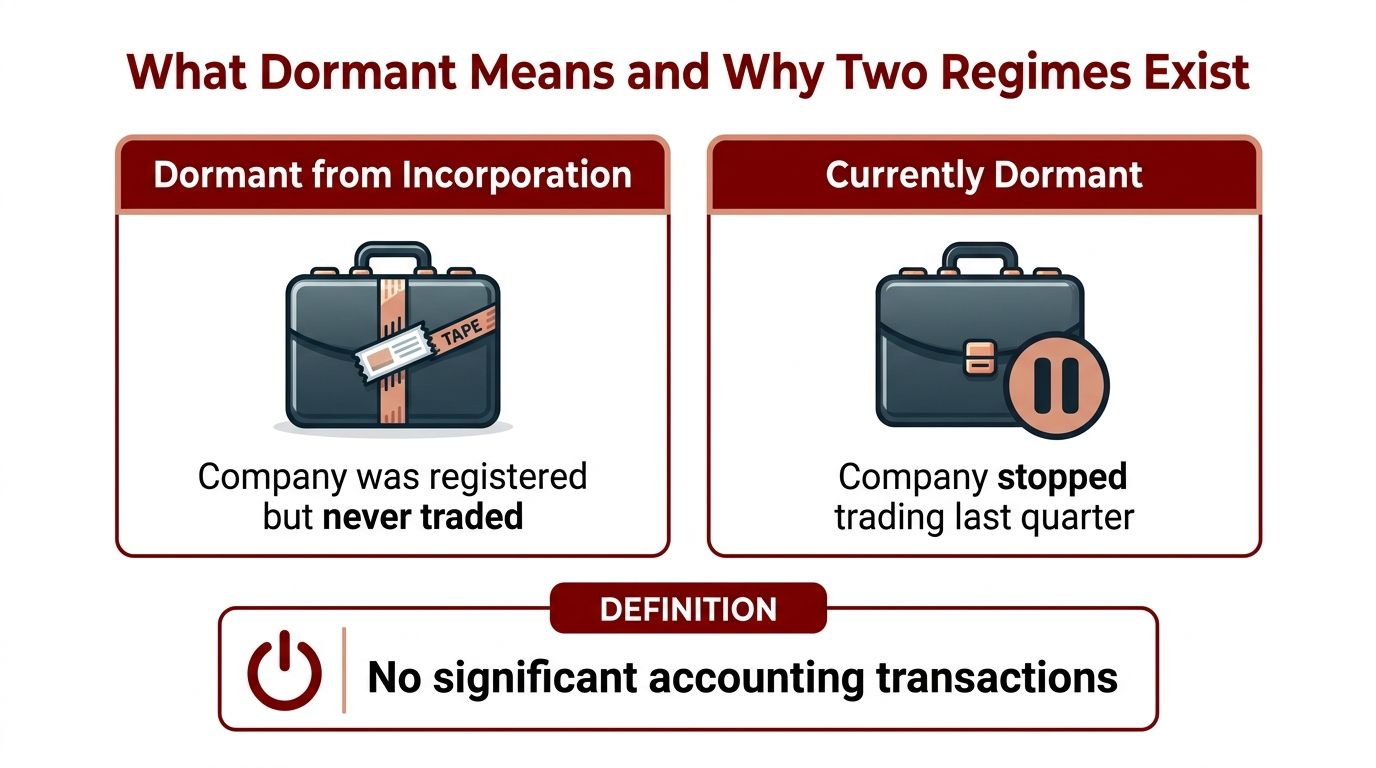
The two tests in practical terms
Companies House asks, “What accounting transactions has the company recorded?” HMRC asks, “Has the company stopped trading and does it have any other income?” Those questions overlap, but they aren't interchangeable.
Practical rule: Don't tell yourself the company is simply “dormant”. Record whether it is dormant for Companies House, HMRC, or both.
The distinction matters whether you incorporated a company and never used it, or stopped an established business after trading. If you're still deciding whether a limited company was the right structure in the first place, review the incorporation choice with FastCorp before creating another entity.
You should also understand the accounts that a company must prepare and file, even during a quiet period. The guidance on statutory accounts gives useful context, but don't assume “dormant” means “no paperwork”.
The principle to follow
Stop the activity first, then test each regime separately. Cease trading, prevent new receipts and invoices, review the bank account, notify HMRC where the Corporation Tax conditions are met, and keep Companies House filings on the calendar.
Checking Eligibility and the Companies House Test
A company that has stopped trading may still fail the Companies House dormancy test. Companies House looks at accounting transactions, while HMRC applies a separate test based on trading and other income. Treat these as parallel checks, not one dormant status.
Companies House eligibility depends on the period's records. Review the bank statements, bookkeeping and ledger entries for the accounting period you want to report as dormant. Do not rely on memory. A payment that appears administrative can still prevent dormant accounts.
The only excluded transactions
Companies House recognises three exceptions:
- Companies House filing fees: Fees paid to the registrar do not count as significant transactions.
- Late filing penalties: A penalty for filing Companies House documents late is also excluded.
- Incorporation share money: Money paid for shares when the company was incorporated is excluded.
Every other movement needs investigation. Bank charges, fees on a dormant bank account, small PAYE settlements and inter-company loans are not listed exceptions. They can therefore prevent dormant accounts for the relevant period.
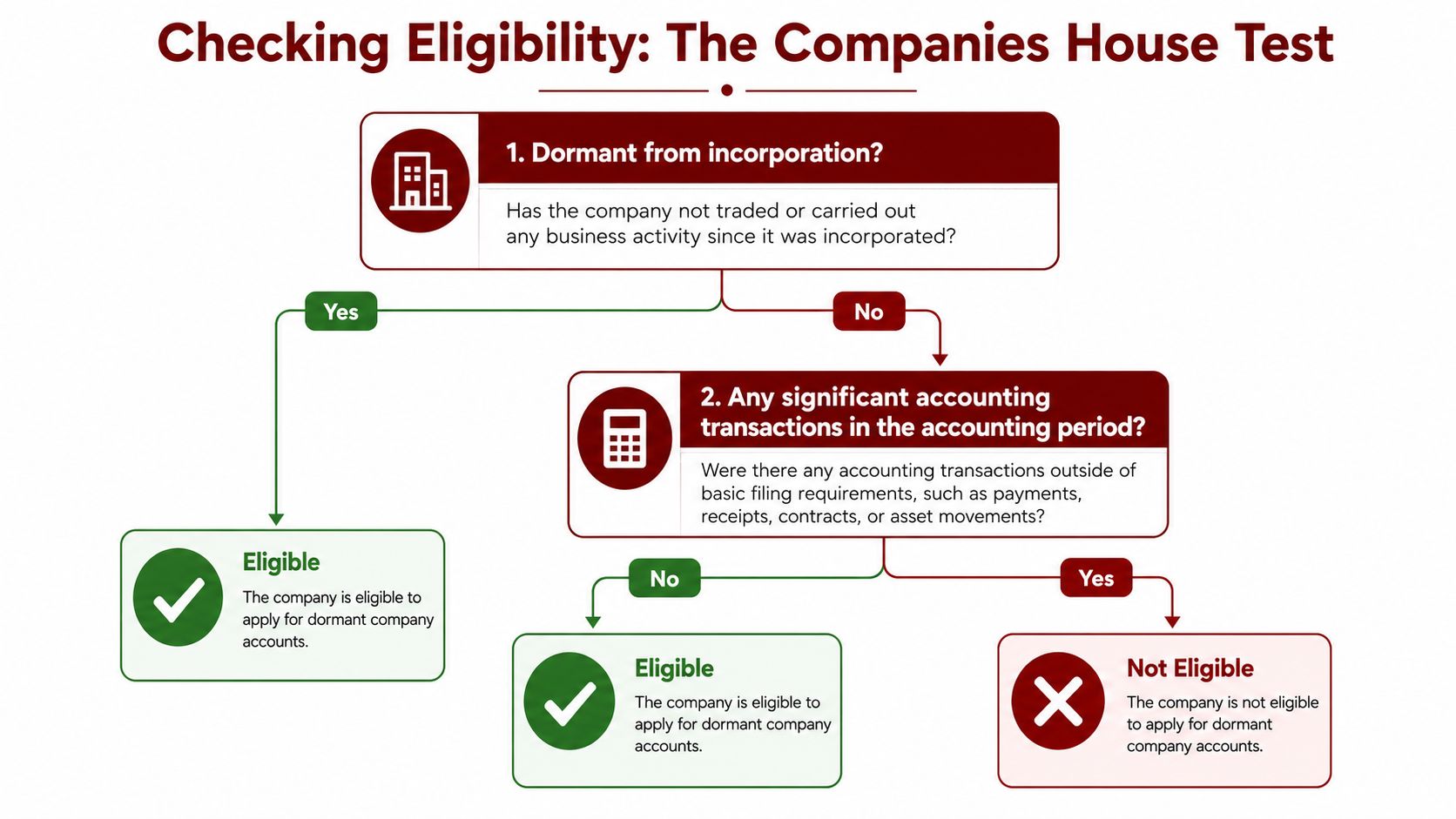
Use this review before filing:
- Trading receipts: Check customer payments, card settlements and transfers from sales platforms.
- Investment income: Look for interest, dividends or other investment returns.
- Property receipts: Identify rent or other property income.
- Bank movements: Review charges, interest credits and automated payments.
- Share allotments: Confirm that no new shares were issued for cash during the dormant period.
- Director loan movements: Check repayments, advances and transfers involving a director.
- Inter-company balances: Review payments or loans involving another company in the same group.
A clean review supports dormant accounts. Any non-excluded transaction means you should not claim Companies House dormancy for that period without proper advice.
Do not tell yourself the company is “dormant”. Record whether it meets the Companies House test, the HMRC test, or both. The separate confirmation statement remains a Companies House obligation even when the company has no business activity.
The following video provides another practical explanation of the Companies House test:
Practical Steps Before You File Anything
Don't start with the form. Start by making the company quiet. Filing a dormant status while leaving ordinary business activity running is how founders create avoidable corrections.
Clear the operating account
Close the company bank account if you can. If closure isn't practical, remove standing orders, direct debits, subscriptions and automated transfers. A bank account that remains open can generate charges or interest, and those movements may affect the Companies House assessment and the HMRC income test.
Stop issuing invoices and tell customers where to send final queries. Chase outstanding debts before the dormant date, because a late receipt can create a transaction after you believe the business has stopped.
Finish the loose ends
Work through this shutdown list:
- Customer balances: Collect genuine trading debts and record them in the final active-period records.
- Supplier invoices: Settle known liabilities rather than allowing late payments to arrive after the cut-off.
- Refunds and rebates: Ask suppliers to process them promptly and include them in the final pre-dormant accounting records where appropriate.
- VAT: Deal with the VAT registration and any final VAT obligations if the company no longer needs registration.
- PAYE: Close the PAYE scheme if there are no continuing employees or director payments.
- CIS: End or deregister construction-related schemes where the business has stopped the relevant activity.
- Share capital: Don't allot new shares for cash during the dormant period.
Don't leave a “small” payment to sort later. The size of a transaction doesn't turn it into an automatic exception.
Check the registered office, directors, shareholders, SIC code and other public details before submitting anything. Companies House correspondence goes to the registered office, so an old address can turn a manageable filing into a missed deadline.
If you're reviewing your wider setup as part of the shutdown, practical LLC setup tips can help you identify structural and administrative gaps before you restart.
Filing Dormant Accounts and the AA01 with Companies House
Once the Companies House review is complete, prepare the right accounts for the company's history. A company that has traded before doesn't automatically become eligible for the same simplified treatment as a company that has never traded. The filing needs to reflect the company's circumstances and the period covered.
For a dormant company, dormant accounts are normally much simpler than full trading accounts. They generally include a balance sheet, the relevant capital position and the directors' approval or signature. A dormant balance sheet commonly shows the company's called-up share capital, but use the correct figures from the company's records rather than copying a template.
What to submit
Use Companies House WebFiling where the company is eligible, or submit the relevant paper form where required. The AA01 is associated with the accounts filing process, while AA02 is the paper dormant accounts route commonly used for a private company. Confirm the current filing route before submission because filing options can change.
The confirmation statement is separate from the accounts. Companies House requires every company, including a dormant company, to file a confirmation statement annually. The accounts requirement also continues, although a small dormant company may use dormant accounts instead of full accounts. The official annual requirements guidance explains this distinction in Companies House guidance on company accounts.
Control the deadline
For a private company, accounts are generally due within nine months after the financial year end. If the company became dormant partway through a year, don't assume the whole period can be treated as dormant. You may need accounts covering the active part of the year before the dormant period begins.
The confirmation statement has its own cycle. Set separate calendar reminders for both filings, and keep the WebFiling login details accessible to the current directors. If responsibility has moved between founders, update internal access before the deadline arrives.
A dormant company still exists. Dormancy reduces activity. It doesn't remove the company from the register or transfer filing responsibility away from its directors.
If deadlines, registers or filing ownership are becoming difficult to manage, company secretarial services can provide a controlled process for the Companies House side.
Notifying HMRC and Stopping Corporation Tax Filings
HMRC is a separate track. The company must have stopped trading and have no other income to be dormant for Corporation Tax. That means you need to consider more than sales. Investment income, property income and other receipts can keep the company within Corporation Tax obligations even when Companies House would accept dormant accounts.
Notify HMRC that the company has stopped trading and meets the dormant conditions. You can use the relevant online service or write to HMRC, giving the company's identifying details and the date trading stopped. Dormancy follows from the facts. It isn't created by ticking a box while the company continues to earn income.
What changes after notification
HMRC says that once it has been told the company is dormant for Corporation Tax, no further Company Tax Return is needed unless HMRC asks for one or trading restarts. That is different from Companies House, which continues to require annual accounts and an annual confirmation statement.
Don't confuse the absence of a Company Tax Return with the absence of every personal tax obligation. A director may still have Self Assessment responsibilities because of personal income, benefits or other circumstances. The company's dormant status doesn't automatically settle the director's own tax position.
Before notifying HMRC, close or settle related registrations and filings:
- VAT: Submit outstanding returns and deal with the registration if the company no longer makes taxable supplies.
- PAYE: Close the employer scheme through PAYE Online when payroll has ended.
- CIS: Deal with the construction industry scheme if the company no longer operates as a contractor or subcontractor.
- Corporation Tax records: Keep the company's UTR and cessation information organised for a future restart.
If HMRC has already issued a notice to deliver a return, don't ignore it because trading has stopped. Deal with the notice and obtain confirmation of the next required action. A dormant company can still need a final return for the period in which it traded.
For help with the active-period filing that may sit before dormancy, see the guidance on a Corporation Tax Return.
Sector Traps and Special Cases to Watch For
Some companies fail the dormancy review because the founder looks only for sales. Contractors, landlords, employers and investment companies need a broader check. A frozen business can still produce receipts, charges or payroll movements that keep one or both regimes active.
A contractor may stop accepting work but still receive a late CIS-related payment or settle a subcontractor balance. A property company may have only one tenant. An investment company may have no trading customers but still receive interest or dividends. Each fact pattern needs to be tested against both authorities.
Transactions That Break Dormancy by Sector
| Transaction Type | Breaks Companies House Dormancy | Breaks HMRC Dormancy |
|---|---|---|
| Customer sales or trading receipts | Yes | Yes |
| Property rent | Yes | Yes |
| Investment interest or dividends | Yes | Yes |
| Bank charges or account fees | Yes | Not compatible with the no-income, no-activity position and needs review |
| PAYE settlements or director payments | Yes | Yes |
| Inter-company loans or transfers | Yes | Requires review and may indicate continuing activity |
| Companies House filing fees | No | Not relevant to the HMRC trading and income test |
| Companies House late filing penalties | No | Not relevant to the HMRC trading and income test |
| Incorporation share money | No | Not relevant to the HMRC trading and income test |
The Companies House exceptions are narrow. They don't create a general allowance for operating costs.
A single residual receipt can matter. Even a small interest payment or dividend can prevent HMRC dormancy, regardless of the Companies House position.
LLPs also need separate treatment. Don't assume that an LLP can use the same dormant-company process as a UK limited company. Check the entity type, governing rules and filing obligations before applying this workflow.
The safest control is a clean bank statement and a documented cessation date. If money continues to move, classify every transaction before claiming that the company is dormant.
Reactivating the Company and Your Next Steps
Dormancy isn't a dissolution. The limited company remains in existence, keeps its identity and can return to trading. Reactivation means reversing the controls, telling HMRC that activity has restarted, and bringing the filing systems back into normal use.
Start with the Companies House record. File any outstanding dormant or active-period accounts for the relevant period, then ensure the next accounts accurately capture the return to activity. Companies House doesn't need a separate “reactivation” form because the company starts trading again. The accounts should show the change in status.
Restart the HMRC track
Use the company's existing Government Gateway access to restart Corporation Tax arrangements with HMRC. Give the date trading resumed and make sure the company is ready to meet the normal Corporation Tax, VAT, PAYE or CIS obligations that apply to its new activities.
Don't restart payroll, issue invoices or register for a sector scheme informally and leave the tax records untouched. The operational date matters, so keep the first invoice, first payroll record and first business receipt together with the reactivation notes.
Keep the dormant company controlled
While the company remains dormant, directors still need to:
- Maintain statutory records: Keep registers and company information accurate.
- File the confirmation statement: Submit it annually, even where no details have changed.
- File annual accounts: Use the appropriate dormant or full accounts route.
- Retain accounting records: Keep the records for six years from the date of the last transaction.
- Monitor correspondence: Respond promptly to Companies House or HMRC notices.
Complete this short review during the same week:
- Review every bank statement for stray receipts, charges and interest.
- Confirm that the registered office is current.
- Mark the next accounts and confirmation statement dates in the diary.
- Decide whether your accounting software should be reopened for controlled use or left read-only.
- Store the cessation date, HMRC notification and final active-period records together.
Action Accountants Limited can prepare dormant accounts, review the Companies House and HMRC position, and help organise the compliance work before a company is restarted. Visit Action Accountants Limited to discuss your dormant-company filings and the next practical step for your business.


