
Payroll Services for Contractors: A Practical UK Guide
Explore payroll services for contractors in the UK. Compare PAYE, CIS, and umbrella options with a clear checklist for choosing the right provider.

You've just been offered the same assignment through three different payment routes. One option promises a simple umbrella PAYE arrangement, another asks you to join an agency payroll, and the third expects you to trade through your limited company. The headline rate looks attractive in each case, but the deductions, responsibilities and compliance exposure aren't the same.
That's why payroll services for contractors should be part of your engagement decision before you sign anything. The route determines who runs PAYE, how CIS deductions work, where IR35 risk sits, what records you must keep and how much administration you'll carry after payday.
Table of Contents
- The Contractor Payroll Question Most People Get Wrong
- What Contractor Payroll Services Actually Do
- How CIS Payroll Works in Practice
- Umbrella PAYE and Limited Company Compared
- Compliance Duties a Good Provider Should Handle
- Reading a Contractor Payslip With a Skeptical Eye
- Choosing a Provider and Next Steps in North West London
The Contractor Payroll Question Most People Get Wrong
A Harrow-based bricklayer might reasonably assume that payroll is just the final step after finding work. That's the wrong order. If the same end client offers agency PAYE, umbrella PAYE and a limited-company engagement, the payment route should be tested before the rate is accepted.
The first question is not, “Which option gives me the highest take-home figure?” It's, “What is the actual working relationship, and which payroll system matches it?”
Start with the engagement, not the calculator
A contractor normally faces three main routes:
- Agency PAYE, where the agency employs or pays the worker through its payroll.
- Umbrella PAYE, where an umbrella company employs the contractor and processes the assignment pay.
- Limited-company payroll, where the contractor's personal service company pays a salary and manages its own tax, National Insurance and company administration.
Construction work may introduce a fourth layer, the Construction Industry Scheme, but CIS isn't a substitute for deciding employment status. A subcontractor payment can require CIS treatment, while an individual's wider working arrangement may still raise employment-status or off-payroll questions. The UK government's guidance on self-employed contractors makes clear that a contractor may be self-employed, a worker or an employee, while construction subcontractors may fall under a separate scheme.
The label on the contract won't settle the issue. Day-to-day control, the right to provide a substitute, financial risk, mutual obligations and the practical way the work is performed all matter.
Practical rule: Choose the compliant payroll route first, then compare the rates available through that route.
PAYE reporting also isn't an occasional year-end exercise. HMRC's Real Time Information system requires employers and pension providers to report pay, Income Tax, National Insurance and other deductions on or before the payment date. The ONS guide to PAYE Real Time Information describes RTI as covering the payrolled employee population and supporting detailed analysis of payroll activity.
The route therefore dictates take-home pay, IR35 exposure and administrative burden. Treat it as a commercial decision, not a payslip preference.
What Contractor Payroll Services Actually Do
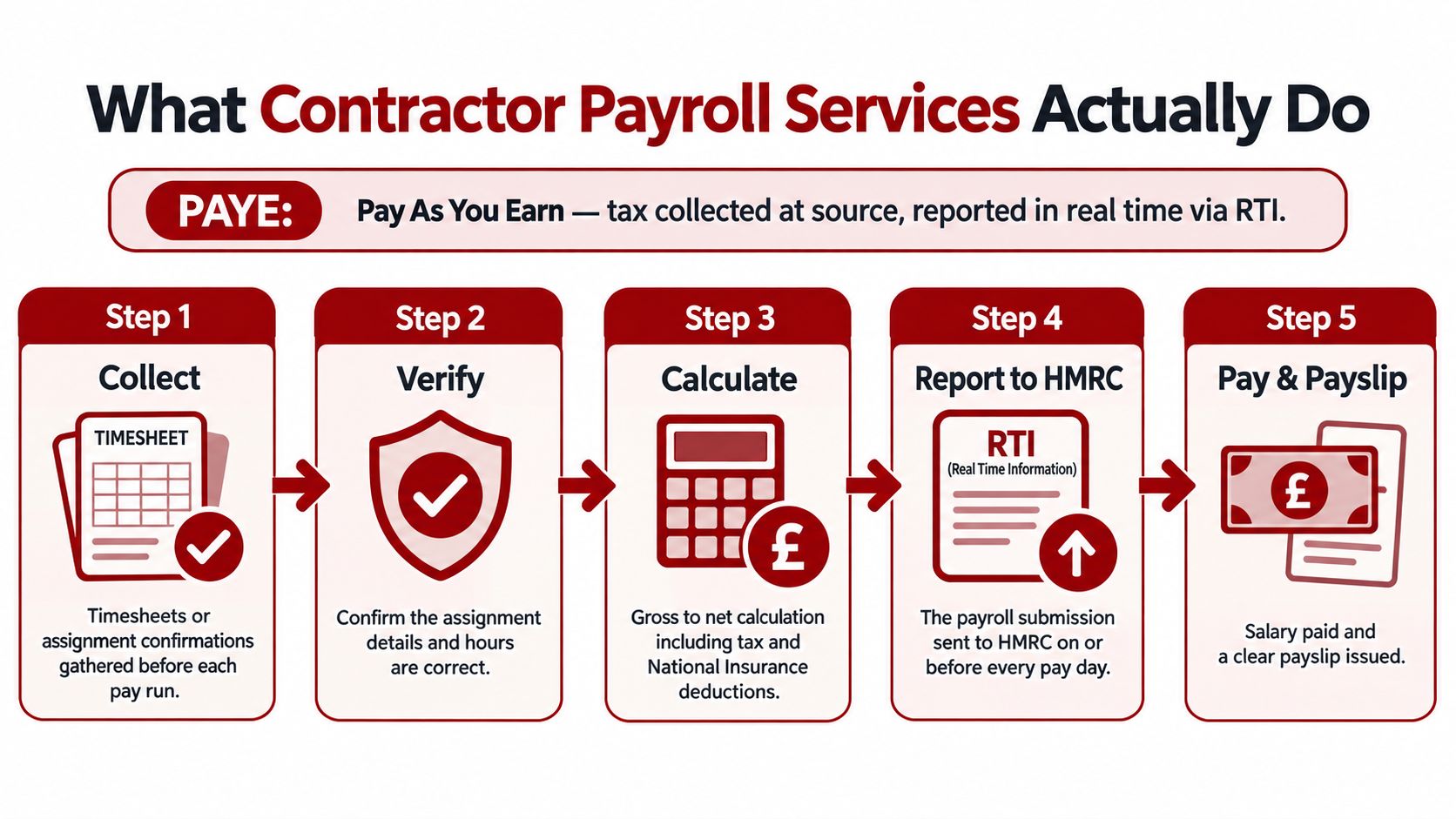
A proper contractor payroll service turns approved assignment information into a compliant payment record. It should collect timesheets or assignment confirmations, check the hours and rate, calculate gross pay and deductions, submit the RTI report and issue the payslip.
PAYE means Pay As You Earn. Tax is collected when the worker is paid rather than left entirely for a later personal tax calculation. RTI means the payment information is sent electronically to HMRC on or before payday. Each payment creates a reporting obligation, including ordinary wages, extra payments and amounts recovered from employees.
What happens during each pay run
A dependable provider should follow a controlled sequence:
- Collect approved timesheets, assignment confirmations and expense information.
- Verify the worker, assignment, pay rate and payment date.
- Calculate gross-to-net pay, including the deductions relevant to that worker.
- Report the payment through RTI on or before payday.
- Pay and document the salary, then issue a payslip showing the calculation.
For an umbrella employee or agency worker, the payroll provider normally handles PAYE deductions and employment-related administration. For a one-person limited company, a payroll bureau can still run salary, issue payslips and prepare year-end documents, even though the company remains responsible for its wider accounts, tax and governance.
A service should also identify pressure points before they become surprises. That includes pension auto-enrolment duties, changes to pay, irregular bonuses, missing information and deductions that don't reconcile with the assignment terms.
Payroll isn't the same as invoicing. An invoice records what a business says it's owed. Payroll records what an employee receives, what the employer reports and what deductions have been accounted for. Contractors working across countries may also need a broader resource on global employment for contractors, particularly where the payer and worker are in different jurisdictions.
How CIS Payroll Works in Practice
CIS payroll is not ordinary invoice processing with a tax line added afterwards. A construction contractor must establish the subcontractor's CIS status before approving payment, apply the correct deduction logic and retain evidence of what happened.
Before the first payment, the contractor verifies the subcontractor with HMRC using identifying details such as the Unique Taxpayer Reference, National Insurance number and name. HMRC determines whether the payment is gross, subject to the standard deduction or subject to the higher deduction where the subcontractor is unregistered or can't be matched.
The operational sequence
The process should work like this:
- Verify before payment. Record the HMRC verification result against the subcontractor's account. Don't rely on a name typed into a spreadsheet.
- Classify the payment. Separate genuine employment payroll from subcontractor payments subject to CIS.
- Calculate the deduction. Exclude permitted amounts such as VAT, qualifying materials paid for by the subcontractor, consumable stores, certain fuel costs and plant hire before applying the deduction.
- Issue the statement. Give the subcontractor a payment-and-deduction statement within the required period after the relevant tax month.
- Pay and reconcile. Pass withheld deductions to HMRC and retain the payment record, verification result and calculation.
The HMRC guidance on making CIS deductions and paying subcontractors sets out the verification, deduction and statement requirements.
| Subcontractor status | CIS deduction rate | When it applies |
|---|---|---|
| Gross-payment status | 0% | HMRC confirms the relevant conditions are met |
| Registered subcontractor | 20% | HMRC verifies the subcontractor for the standard deduction |
| Unregistered or unmatched subcontractor | 30% | The subcontractor isn't registered or can't be matched correctly |
A specialist CIS payroll explanation is useful when a business is moving from informal subcontractor payments to a controlled process. Small onboarding errors have immediate consequences. A mistyped UTR or missing verification can change the amount the subcontractor receives, so the provider should block unverified records from entering the payment run.
CIS also doesn't decide employment status. It's a deduction scheme. If the facts point towards employment or an intermediary arrangement, PAYE and off-payroll analysis still needs to be considered.
Umbrella PAYE and Limited Company Compared
The right model depends on how the assignment operates. Contractors often focus on the day rate and ignore who carries the cost of employment, who makes the status decision and who is responsible for the records.
| Route | Best fit | Control and exposure | Administration |
|---|---|---|---|
| Agency PAYE | A worker paid directly through an agency arrangement | The agency controls payroll processing and employment deductions | Low for the worker, but the agency's documentation must be clear |
| Umbrella PAYE | A short-term or single-client engagement treated as employment | The umbrella employs the worker and processes PAYE; the assignment terms still need scrutiny | Low to moderate, depending on expenses, pensions and assignment changes |
| Limited company | Outside-IR35 or genuinely independent, multi-client work | The company carries payroll, accounts and compliance responsibilities | Highest, but gives the contractor more control over company operations |
When umbrella PAYE wins
Umbrella PAYE is usually the sensible choice for a short engagement where the client controls the work and the contractor wants to avoid running a company. It also suits contractors who move between assignments and don't want to manage payroll, company accounts and statutory filings between contracts.
The warning is simple: compare the assignment rate with the actual worker pay rate. Employer costs, holiday pay treatment, pension deductions, umbrella margin and employee deductions must be visible. A large assignment rate can produce a disappointing payslip if the cost chain is hidden.
When a limited company wins
A limited company can suit a contractor with several clients, genuine commercial risk, control over how work is delivered and a properly assessed outside-IR35 engagement. The company can run salary and deal with its own accounts, VAT where relevant, pension decisions and distributions. That flexibility comes with responsibility. It isn't a shortcut around employment-status rules.
A hybrid arrangement, where a personal service company engagement is processed through an umbrella for an inside-IR35 assignment, can be a legitimate route. It isn't a workaround. Get the status decision and contractual responsibilities documented before work begins.
Contractors moving into company ownership should use a specialist contractor accountant in London before accepting the first assignment. The cheapest structure is rarely the one with the lowest visible fee. It's the one that matches the work and can be supported by consistent records.
Compliance Duties a Good Provider Should Handle
A payroll provider should give you evidence, not reassurance. If the provider can't explain what was filed, when it was filed and which record supports the calculation, you don't have a controlled payroll service.
The core payroll controls
For PAYE contractors, the provider should assess pension duties, calculate the relevant contributions, process deductions accurately and submit RTI information on or before payday. The contractor should receive a payslip that identifies the pay period, gross pay, deductions and net amount.
At year end, the provider should produce the required payroll documentation and explain what the contractor needs to retain. The same discipline applies to a limited company. The director may approve the payroll, but the bureau should retain a clear audit trail showing the inputs, calculation and submission.
Construction businesses need additional controls:
- CIS verification: Confirm each subcontractor before the first payment and retain the outcome.
- Deduction logic: Separate taxable labour from permitted exclusions such as qualifying materials and VAT.
- Monthly reporting: Prepare the CIS return and reconcile it to payment records.
- Statements: Issue payment-and-deduction statements within the required period.
- Status review: Escalate cases where the arrangement looks more like employment than independent subcontracting.
The payroll and bookkeeping service you select should tell you exactly which tasks it owns and which remain with you. Don't accept “full service” as an answer without a written responsibility schedule.
A good monthly pack may include approved timesheets, payroll reports, payslips, RTI submission evidence, pension records, CIS verification results, deduction statements and a reconciliation to the bank payment. Those documents let you audit the provider instead of relying on trust.
Watch this overview for a practical introduction to payroll processes, then ask the provider to map its own workflow against your assignments.
The standard should be consistent processing, clear escalation and records that remain usable if HMRC asks questions later.
Reading a Contractor Payslip With a Skeptical Eye
“Highest take-home” is a marketing claim, not a payroll explanation. A contractor should be able to trace the money from the assignment rate to the amount that reaches the bank.
Start with the rate offered by the agency or end client. Then ask whether it is an employment cost rate or the worker's gross pay rate. Those are different starting points. From there, reconcile the employer costs, holiday pay treatment, pension, employee National Insurance, PAYE tax, student loan deductions where applicable, fees and any taxable benefits.
Build the waterfall
Your reconciliation should show:
- Assignment or contract rate.
- Employer costs and required employment charges.
- Holiday pay, whether accrued or paid under the stated arrangement.
- Pension contributions.
- Employee National Insurance and PAYE tax.
- Student loan or other authorised deductions.
- Umbrella or payroll margin.
- Net pay paid to your bank account.
The provider should explain every line in plain English. If a deduction appears only on the payslip without appearing in the assignment terms or provider agreement, stop and ask for clarification.
Be especially wary of arrangements that promise unusually high take-home pay by routing part of the income through mechanisms you don't understand. HMRC's examples of good practice for umbrella companies emphasise accurate deductions, timely payment and arrangements that don't conceal non-compliance.
Sceptical test: If the provider won't show the complete calculation before you sign, don't accept the assignment on the strength of the net figure.
Three checks before accepting payment
First, compare the payslip with the assignment confirmation and the provider's rate illustration. Second, check the pension deduction against the auto-enrolment information you received. Third, ask for evidence that the payment was reported through the provider's PAYE scheme and retain your payslips.
Don't confuse a clean-looking payslip with a compliant arrangement. The calculation must also make commercial sense, and the provider must be willing to explain the chain.
Choosing a Provider and Next Steps in North West London
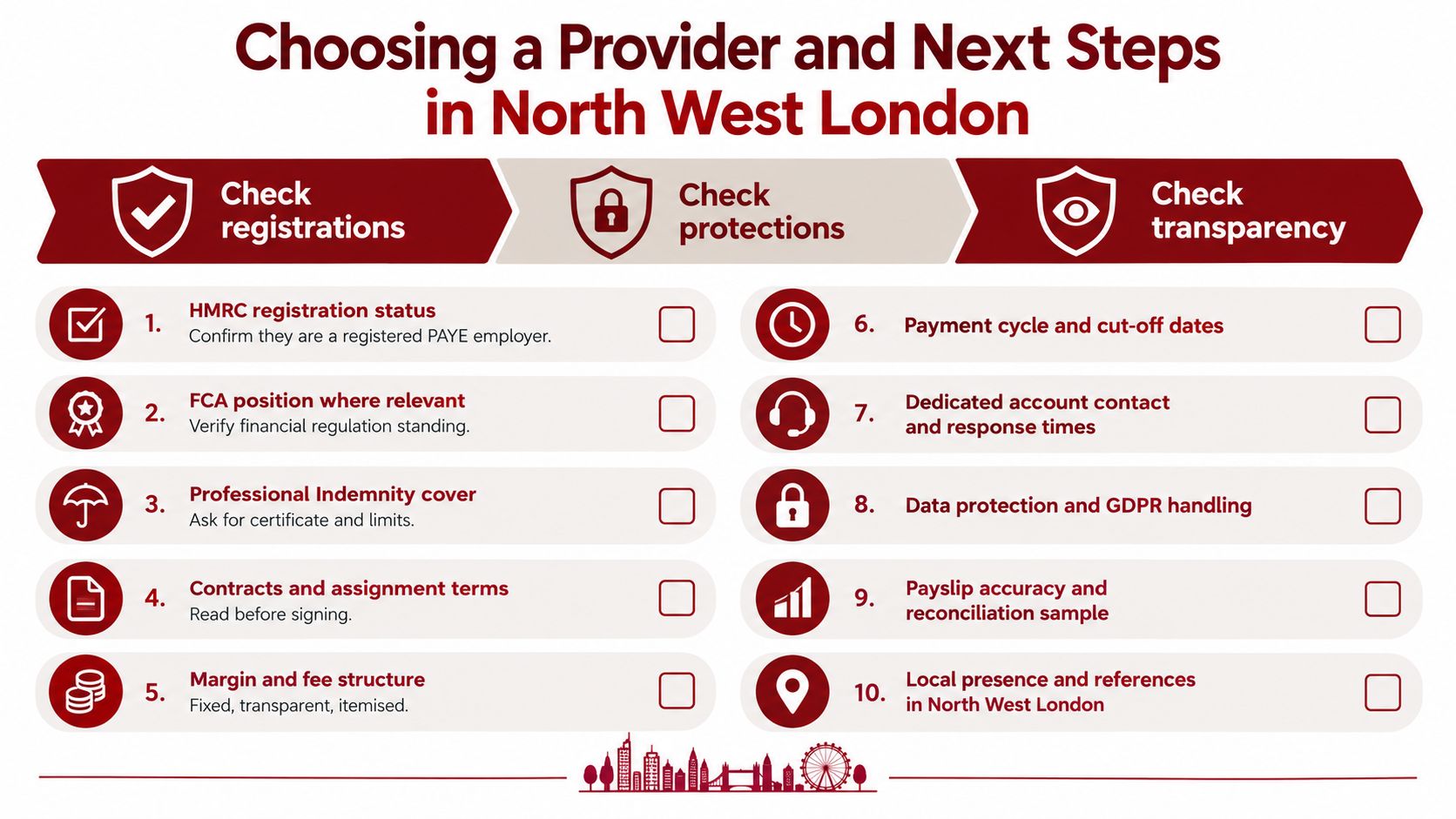
Use three filters before you compare fees: registration, protection and transparency. A provider that passes all three should be able to show who employs the worker, how payroll is filed, what insurance is held and how the margin is calculated.
Ask these questions in writing:
- Is the provider a registered PAYE employer, and whose PAYE scheme will report the payment?
- Where relevant, what is its FCA position and which activities does that cover?
- Can it provide evidence of professional indemnity cover?
- Will it show a complete sample reconciliation from assignment rate to net pay?
- Is the margin fixed, itemised and separate from statutory deductions?
- Is holiday pay accrued or paid, and where is that stated?
- How are pension duties assessed and communicated?
- What are the payment cut-off dates and escalation arrangements?
- Who issues the post-assignment documents, including the P45 or year-end payroll records?
- How will the provider handle a move between PAYE, CIS and limited-company work?
A provider that asks for no meaningful paperwork is not offering convenience. It's removing the evidence you may need later. Upfront joining fees, unexplained deductions, refusal to disclose the margin and promises of unusually high net pay are all reasons to walk away.
Compare the price structure properly
Payroll providers commonly charge through a pay-run fee, a percentage or margin linked to pay, or a wider accounting and compliance arrangement. The cost depends on the number of workers, payment frequency, CIS complexity, pension administration, onboarding and the level of advice required.
A low fee may cover only calculation and payment. A higher fee may include RTI, CIS verification, statements, bookkeeping, year-end documents and support when an assignment changes. Compare the deliverables, not just the price.
Contractors in Brent, Harrow, Hillingdon, Colindale and the surrounding North West London area may prefer a provider that can complete onboarding locally and understand construction payment records as well as professional-services engagements. A North West London payroll service can be assessed on the same basis as any other provider, with particular attention to CIS verification, payslip reconciliation and the handling of limited-company payroll.
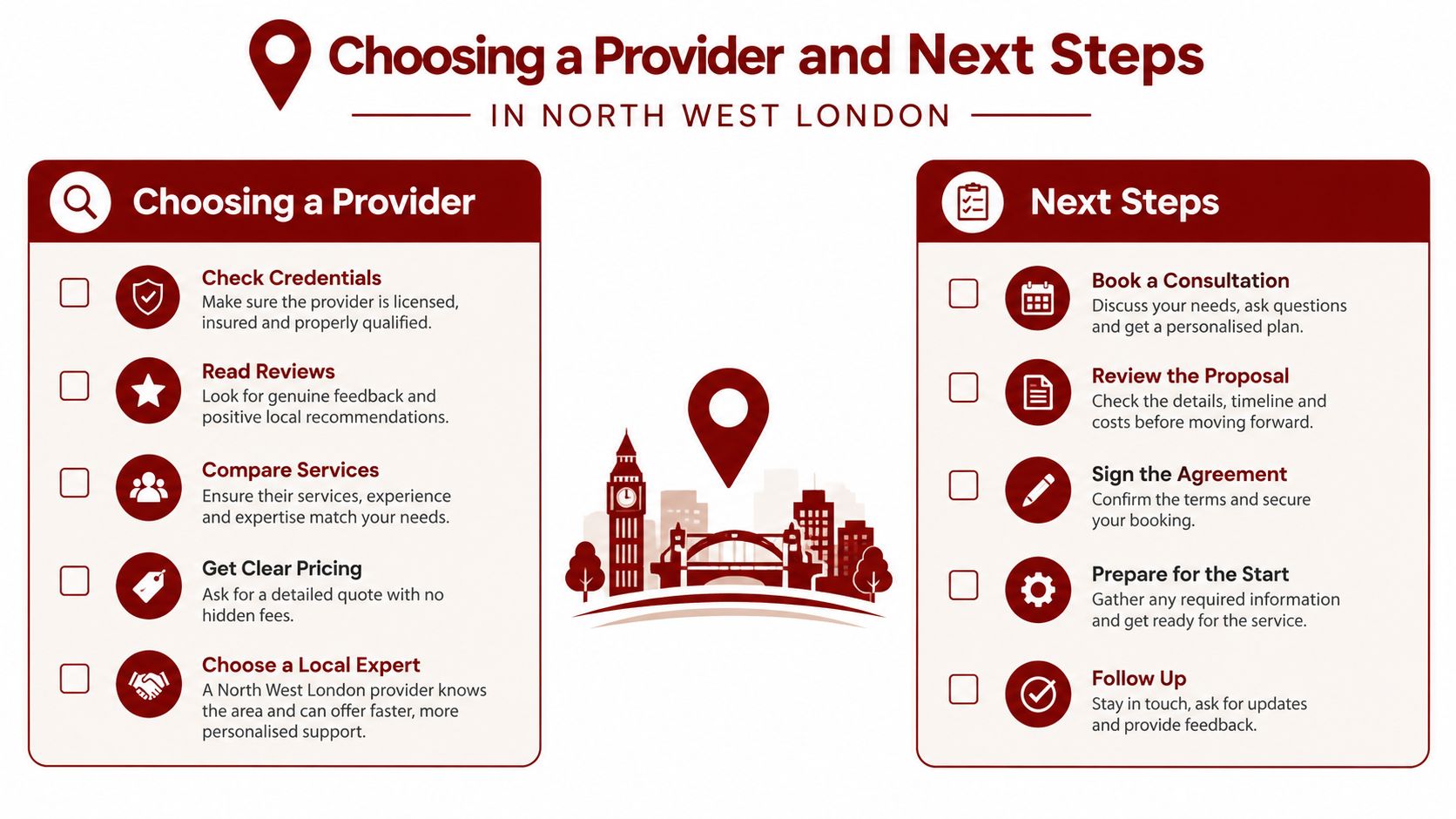
Bring three recent contracts or assignment summaries, your latest payslips and any CIS or umbrella paperwork to a contractor payroll review. Ask the adviser to recommend a route, identify the compliance risks and list the documents you must obtain before signing.
Action Accountants Limited provides payroll, bookkeeping and CIS-aware support for contractors and subcontractors, including help with payroll records and payment compliance. Visit Action Accountants Limited to arrange a contractor payroll review and get a clear recommendation before you accept your next assignment.