
What Is Going Concern and Why It Matters for UK Businesses
Learn what is going concern, how UK directors assess it, and what auditors look for. Practical guide for startups, SMEs and construction firms.

The bank wants to revisit your facility. HMRC has agreed a payment plan, but you've missed an instalment. Your year-end accounts are due in three weeks, and the cash-flow spreadsheet shows a profitable business with very little cash. That's when going concern stops sounding like an accounting phrase and becomes the question nobody can avoid: can the company meet its obligations and keep trading?
For UK founders, the answer isn't found in today's profit figure alone. It sits in the quality of your forecasts, the reliability of customer receipts, the terms of your borrowing, the timing of tax and payroll, and the realism of any proposed rescue measures. This is a forward-looking judgement, and directors need evidence rather than optimism.
Table of Contents
- The Moment a Founder Realises Going Concern Is Real
- What Going Concern Actually Means in UK Accounts
- Why 2025 Insolvency Numbers Make This a Live Risk
- A Practical 12-Month Cash-Survival Assessment
- Directors' Duties and the Auditor's Material Uncertainty Test
- Warning Signs and Mitigation by Business Type
- Actionable Checklist, Sample Disclosure and Next Steps with Action Accountants
The Moment a Founder Realises Going Concern Is Real
A London founder opens the accounts file late at night and works through the same assumptions again. The sales pipeline looks strong, but two customers have delayed payment. The bank has asked for an updated forecast before renewing the facility. HMRC's payment arrangement is behind schedule, and the accountant has asked whether the company can continue trading for the foreseeable future.
Nothing in that situation is abstract. If the company's accounts are prepared on the wrong basis, its assets and liabilities may be measured and classified as though ordinary trading will continue when the evidence points towards a break-up or alternative basis. Directors must make the judgement, and they must make it using information available when the accounts are approved.

The question behind the accounts
Going concern asks whether the business has a credible route through the period ahead. That route might involve ordinary trading, committed finance, cost reductions, shareholder support, or another documented action. It can't be a vague promise that sales will improve. The company needs to show how cash will arrive, when obligations fall due, and which assumptions would cause the plan to fail.
The assessment also matters beyond statutory reporting. Banks use it when reviewing facilities. Investors use it when judging funding needs. Suppliers may change terms when overdue balances accumulate. If you want a useful explanation of the value of an operating business rather than a collection of assets, Bizbe on going concern value provides helpful context, although accounting going concern and valuation going concern aren't identical concepts.
This article takes a practical route through the issue. It defines the accounting basis, uses current UK insolvency data to show why the risk is live, explains how to build a 12-month cash-survival assessment, separates directors' duties from the auditor's role, and applies the warning signs to startups, SMEs, landlords and construction contractors.
The practical test: Could you show an accountant, lender or investor the documents that support your confidence, or would you only be able to explain why things should improve?
What Going Concern Actually Means in UK Accounts
In UK financial reporting, the going-concern basis means preparing accounts on the assumption that the company will continue operating for the foreseeable future, rather than being wound up or forced to stop trading. Assets are therefore considered in the context of normal operations, and liabilities are settled through ordinary trading rather than an immediate sale of everything.
That assumption affects the accounts. A business expecting to continue may realise stock, collect receivables and use equipment through trading. A business expected to cease may need to consider a break-up or alternative basis. The difference isn't cosmetic. It can affect how users understand the company's financial position.
Working definition: Going concern means the company has sufficient liquidity and realistic access to finance to keep meeting obligations and operating for the foreseeable future, normally assessed across at least 12 months from the date the accounts are authorised. UK government guidance sets out this practical horizon for UK directors.
What going concern is not
Going concern isn't the same as being profitable today. A company can report an accounting profit while struggling to pay wages, tax or suppliers because customers pay slowly or a lender can demand repayment. Profit measures performance over an accounting period. Cash survival measures whether obligations can be met when they fall due.
It isn't identical to having a strong balance sheet either. A business may own valuable assets but lack the liquidity to fund payroll next week. Conversely, a loss-making startup may continue if it has committed finance, realistic cost reductions or reliable shareholder support.
Directors should examine the evidence that drives cash:
- Cash-flow forecasts: Show expected receipts and payments by period, not just annual totals.
- Financing arrangements: Check committed facilities, repayment dates, covenants and renewal conditions.
- Trading performance: Compare forecast sales and margins with the company's current results.
- Customer and supplier dependence: Identify relationships where one failure could change the forecast.
- Post-year-end events: Include trading, funding decisions and payment developments after the reporting date.
For smaller businesses, the most useful evidence is often already available. Current management accounts, aged debtor reports, tax liabilities, committed expenditure and a rolling cash forecast can produce a far more defensible assessment than a polished year-end narrative.
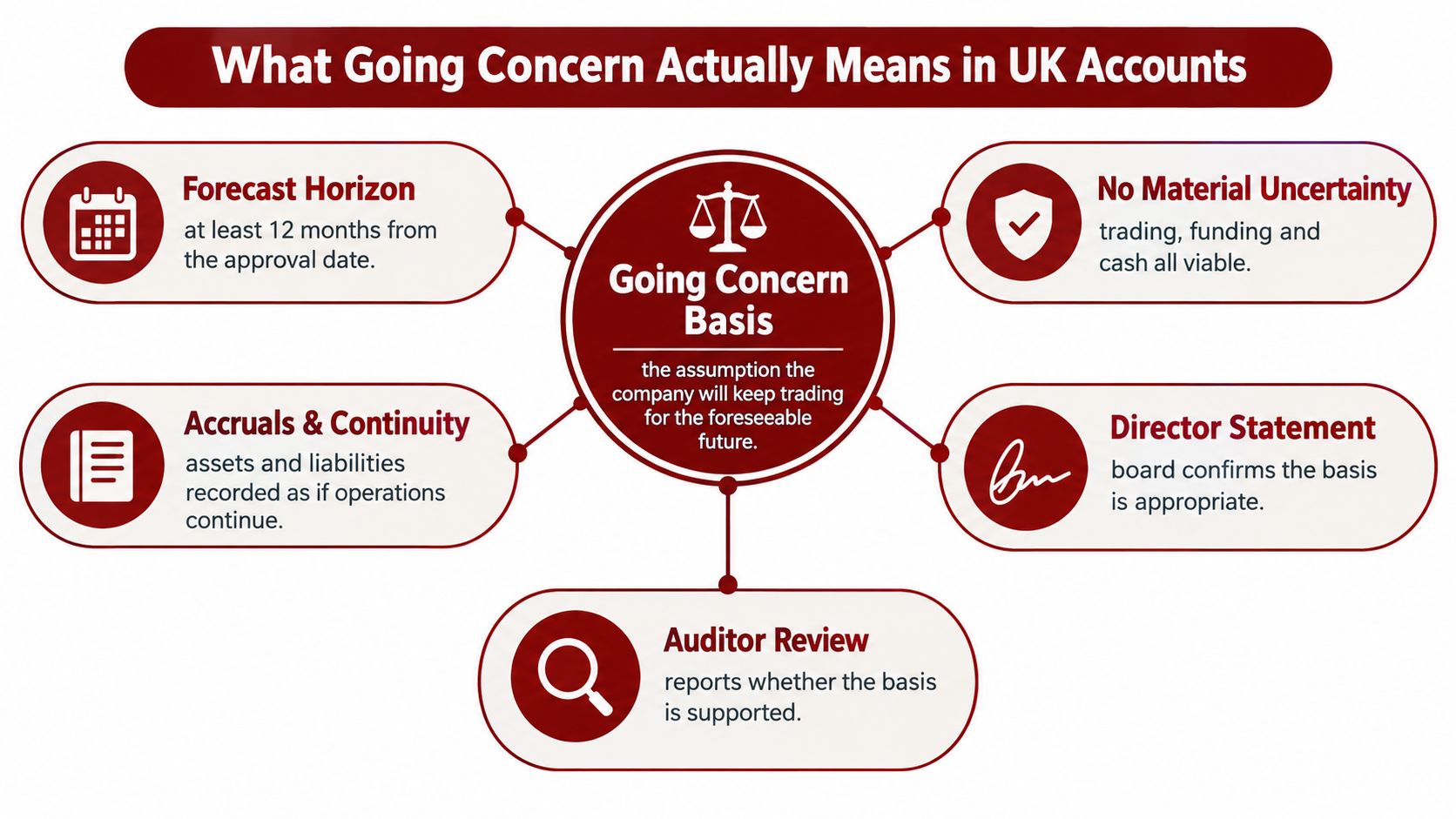
The conclusion is a reasoned judgement, not a guarantee that the company will survive. Directors assess the conditions that exist when the accounts are approved, document the assumptions behind the conclusion, and disclose material uncertainty where leaving it out could mislead users.
Why 2025 Insolvency Numbers Make This a Live Risk
Going concern deserves board-level attention because business failure remains a practical risk, even when the wider economy isn't at its worst. In 2025, England and Wales recorded 23,938 registered company insolvencies, according to the UK company insolvency statistics for December 2025. The annual rate was 52.5 insolvencies per 10,000 companies, approximately one company in every 190 on the effective Companies House register.
That rate was below the 113.1 per 10,000 recorded during the 2008 to 2009 recession, but the comparison shouldn't encourage complacency. A business doesn't need to resemble a national insolvency trend before its own cash position becomes dangerous. A missed tax payment, a withdrawn facility or a major customer failure can create a crisis inside an otherwise viable market.
What the composition tells directors
The type of insolvency matters. Creditors' voluntary liquidations accounted for 18,525 cases, out of the total 23,938, representing about 77.4% of registered company insolvencies, calculated from the published figures. Compulsory liquidations accounted for 3,730, administrations for 1,495, company voluntary arrangements for 186, and receivership appointments for two.
| Insolvency type | Cases in 2025 | Share of total |
|---|---|---|
| Creditors' voluntary liquidations | 18,525 | About 77.4% |
| Compulsory liquidations | 3,730 | About 15.6% |
| Administrations | 1,495 | About 6.2% |
| Company voluntary arrangements | 186 | About 0.8% |
| Receivership appointments | 2 | Less than 0.1% |
| Total | 23,938 | 100% |
The concentration in creditors' voluntary liquidations shows why directors shouldn't wait for a formal crisis before testing viability. Many distressed companies enter liquidation through a process initiated by directors or creditors. Early recognition gives the board more choices, even if those choices are difficult.
The warning signs worth escalating
Persistent losses, overdue taxes, weak cash conversion, covenant pressure, reliance on one customer and an inability to renew borrowing all deserve a documented response. A useful portfolio risk management guide can help owners think about concentration risk more broadly, but the going-concern assessment must still use company-specific evidence.
The right response isn't to make the forecast more optimistic. It's to identify the earliest point at which cash falls short, name the action that could prevent it, and confirm whether that action is available.
A Practical 12-Month Cash-Survival Assessment
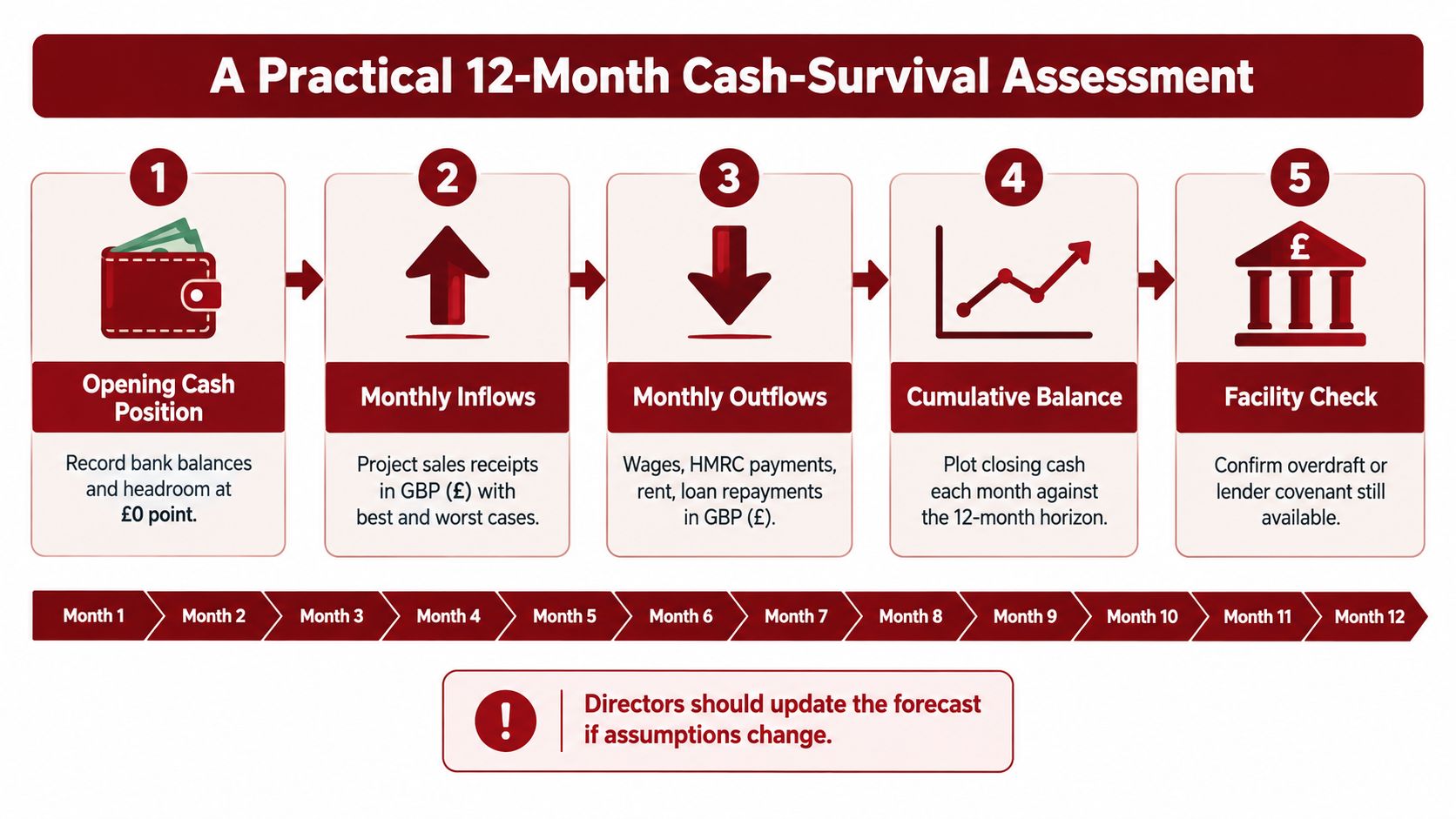
A credible going-concern review starts with a cash forecast, not the profit and loss account. Build the forecast from the date the financial statements are authorised and cover at least the required forward period. For an audit, a forecast that stops after nine months is not enough if the assessment must cover at least twelve months from approval.
Start with the opening cash position. Reconcile every bank balance, overdraft and committed facility. Then list receipts based on expected payment dates, not invoice dates. A signed contract doesn't automatically mean cash will arrive when the business needs it.
Build the forecast from obligations
Map the payments that management can't wish away.
- Payroll: Include wages, employer costs and the dates employees must be paid.
- HMRC commitments: Record VAT, PAYE, corporation tax and any agreed time-to-pay instalments.
- Suppliers: Use actual terms and aged balances, including creditors already outside agreed terms.
- Debt: Include interest, scheduled repayments, refinancing dates and covenant tests.
- Property and operating costs: Include rent, insurance, utilities and committed expenditure.
- Working capital: Allow for stock purchases, retention delays and customer payment behaviour.
A useful cash-flow forecasting resource should support the mechanics, but the director still owns the assumptions. The forecast should reconcile opening cash to monthly inflows, monthly outflows, financing movements and closing cash. Update it when a contract changes, a receipt slips or a lender changes its position.
Test three versions of reality
The base case should reflect the most supportable view of trading. Don't use the sales team's best-case pipeline unless customers have committed and the timing is credible.
The downside case should test delayed receipts, lower sales, margin pressure, higher costs and the loss of an important contract. A reverse-stress scenario asks a harder question: what combination of events makes the company unable to pay its obligations, and how quickly does that happen?
The evidence pack should include:
- Aged debtor and creditor reports.
- Facility letters, repayment schedules and covenant calculations.
- Updated budgets and post-year-end trading.
- Key customer contracts and evidence of renewal risk.
- HMRC correspondence and payment arrangements.
- Board minutes recording the conclusion and challenge.
- Written mitigation plans, with owners and dates.
- Evidence that price increases, headcount changes or cost reductions are feasible.
The FRC's 2025 going-concern guidance emphasises company-specific evidence, including forecast cash inflows, committed expenditure, debt maturities, finance availability, covenant compliance, customer concentration and credible management actions. A forecast becomes defensible when another person can trace each important assumption to a document or a clearly recorded management decision.
The video below provides another practical way to think about cash visibility and forward planning.
If the forecast shows a shortfall, escalate before the accounts deadline. Speak to lenders and HMRC early, model the effect of revised terms, and record the options considered. Waiting for certainty usually means waiting until the options have narrowed.
Directors' Duties and the Auditor's Material Uncertainty Test
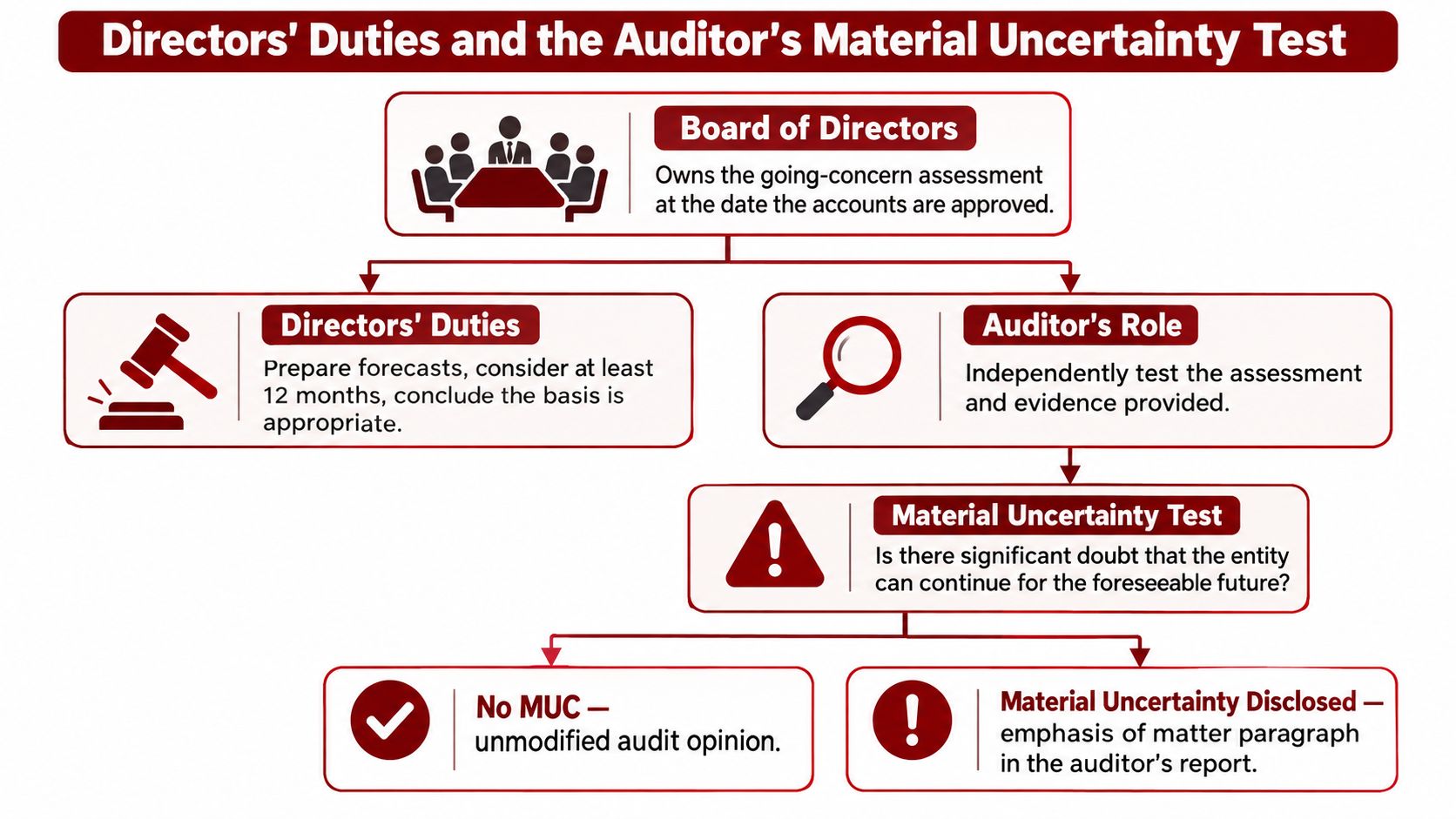
Directors and auditors have different jobs. Directors make the going-concern assessment at the date the accounts are approved. They must consider the company's circumstances, prepare an appropriate forecast, evaluate available finance and decide whether the going-concern basis is suitable.
The auditor doesn't guarantee that the company will remain solvent. Under ISA (UK) 570, the auditor obtains sufficient appropriate evidence about management's assessment, evaluates whether the basis is appropriate and determines whether a material uncertainty exists. The distinction matters because an auditor can test a conclusion, but can't take responsibility for the board's decision.
What material uncertainty means
A material uncertainty exists when the possible effect of events or conditions is significant enough, and their occurrence plausible enough, that disclosure is needed to prevent the accounts from misleading users. It might involve a funding renewal that hasn't been secured, a major customer whose loss would undermine cash flow, or a payment obligation the company can't meet without a proposed action.
The going-concern basis may still be appropriate where uncertainty exists. The accounts should then explain the nature of the uncertainty and the assumptions management relies on to mitigate it. If the conditions meet the relevant test, the auditor reports the matter in a separate “Material Uncertainty Related to Going Concern” section.
What the auditor will challenge
Expect the audit team to test the story against evidence. They may examine:
- Post-year-end trading: Are actual sales and cash receipts consistent with the forecast?
- Financing agreements: Is the facility committed, or does the company merely expect renewal?
- Covenant calculations: Does the company have headroom under the signed terms?
- Board minutes: Did directors identify the risk and challenge the assumptions?
- Lender correspondence: Has the bank agreed to the proposed repayment or renewal?
- Cost reductions: Can management implement the cuts without damaging the forecast?
- Updated budgets: Do the figures reflect the latest trading rather than last year's plan?
If management's assessment covers less than twelve months from the date the financial statements are approved, ISA (UK) 570 requires the auditor to request an extension to at least twelve months from that approval date, as explained by the Institute of Chartered Accountants in England and Wales.
Directors should also connect the assessment to wider governance responsibilities. A practical review of Section 172 of the Companies Act 2006 can help the board frame how it considers creditors, employees and long-term consequences when financial pressure increases.
Audit reality: A persuasive explanation isn't evidence until the board can support it with contracts, calculations, correspondence or documented decisions.
Warning Signs and Mitigation by Business Type
The same going-concern question looks different across a software startup, a trading SME and a construction contractor. Directors should identify the risks that drive their own cash cycle rather than copy a generic checklist.
Startups
A startup may have strong product demand but no reliable route to near-term cash. Watch for dependence on one customer, deferred founder salaries, repeated funding delays and a shareholder loan that exists only as an informal promise. If the next funding round is essential, the board should record its status, timing, conditions and fallback plan.
Mitigation means converting hope into evidence. Secure written shareholder support where appropriate, update the runway forecast, separate committed revenue from pipeline opportunities and model what happens if the funding event slips. An early conversation with a lender, investor or HMRC is more useful than presenting an unsubstantiated funding assumption in the accounts.
Established SMEs
An established SME often fails through working-capital strain rather than a sudden collapse in sales. Aged debtors grow, suppliers tighten terms, a bank covenant loses headroom and management keeps relying on last year's margins. Review customer concentration, supplier dependence, facility conditions and the speed at which invoiced sales become cash.
Use a rolling forecast with clear ownership for overdue balances. Renegotiate payment terms before suppliers stop deliveries, and escalate covenant pressure to the board rather than treating it as an accounts-production issue. Financial ratio analysis can add useful context, but ratios should support a cash assessment rather than replace it.
Construction contractors
Construction businesses need to model the timing and quality of cash, not just the value of work in progress. CIS deductions, delayed valuations, retention held by main contractors, disputed variations and eroding project margins can all move the forecast quickly. A contractor dependent on one large project has a particularly concentrated risk profile, especially where cash receipts arrive after payroll, materials and subcontractor payments.
Mitigation starts at project level. Reconcile forecast margin to live cost records, review applications and retentions, chase certified amounts, and separate secured work from expected work. Communicate early with funders and HMRC, revise payment terms where possible, and obtain advice before a shortfall becomes a statutory disclosure. For broader operational support, a guide to hiring can be useful when customer or contract diversification forms part of the mitigation plan, but new leads don't solve an immediate cash gap without credible conversion and payment timing.
| Business type | Top warning signs | Priority mitigation moves |
|---|---|---|
| Startup | Funding dependence, one major customer, deferred salaries | Document funding support, model funding delays, diversify revenue |
| Established SME | Aged debtors, covenant pressure, supplier concentration | Tighten collections, review facilities, renegotiate terms |
| Construction contractor | Retentions, delayed valuations, margin erosion, CIS cash timing | Reconcile project cash, chase certifications, test contract downside |
Actionable Checklist, Sample Disclosure and Next Steps with Action Accountants
Take this list into the next management meeting:
- Confirm the date the accounts will be approved.
- Build a rolling forecast covering the required forward period.
- Reconcile opening cash and available facilities.
- Add payroll, HMRC, suppliers, rent and debt repayments.
- Review aged debtors and expected receipt dates.
- Check customer and supplier concentration.
- Test a realistic downside and reverse-stress scenario.
- Verify covenant calculations and finance terms.
- Review post-year-end trading.
- Document feasible cost or funding actions.
- Record the board's conclusion in minutes.
- Give the accountant or auditor the complete evidence pack.
A plain-English disclosure might read:
“The directors have prepared the financial statements on a going-concern basis. The company's ability to continue trading depends on achieving forecast receipts, maintaining available finance and implementing the cost actions described in the board's assessment. These conditions indicate a material uncertainty that may cast significant doubt on the company's ability to continue as a going concern. The directors consider the going-concern basis appropriate because the relevant actions and funding arrangements remain available.”
That wording is only an illustration. Your disclosure must describe your actual conditions and assumptions. If you're choosing an adviser, use this guide to choosing an accountant to assess whether they can explain the numbers, challenge the forecast and support the evidence required.
Action Accountants Limited helps startups, SMEs, construction businesses, landlords and sole traders turn going-concern concerns into organised forecasts, documented decisions and practical next steps. Book a 30-minute going-concern health check with Action Accountants Limited and bring your latest management accounts, aged debtors, facility terms and cash forecast.