
How to Pay Yourself from a Limited Company in 2026
Learn how to pay yourself from a limited company in 2026 with clear guidance on salary, dividends, director's loans, pensions and tax-smart strategies.

You've checked the company bank account and it looks healthy. The temptation is obvious: transfer money to your personal account and sort out the paperwork later. That's exactly how directors end up with unexplained drawings, unlawful dividends, an overdrawn loan account, and a nasty tax bill at year-end.
The right answer to how to pay yourself from a limited company isn't a single magic salary figure. It's a controlled sequence. Pay remuneration through payroll, use dividends only when profits support them, keep temporary borrowing properly recorded, and treat pensions and benefits as part of the wider package. In 2026, the timing matters more because dividend tax rates rise from 6 April 2026, while the section 455 charge on certain unpaid director loans rises too.
Table of Contents
- The Four Legal Ways to Take Money from Your Company
- Paying Yourself a Salary Through PAYE
- Declaring Dividends the Right Way
- Salary vs Dividends in 2026
- Using the Director's Loan Account Without Triggering Section 455
- Pension Contributions and Benefits-in-Kind
- Building a Quarterly Pay-Yourself Rhythm
The Four Legal Ways to Take Money from Your Company
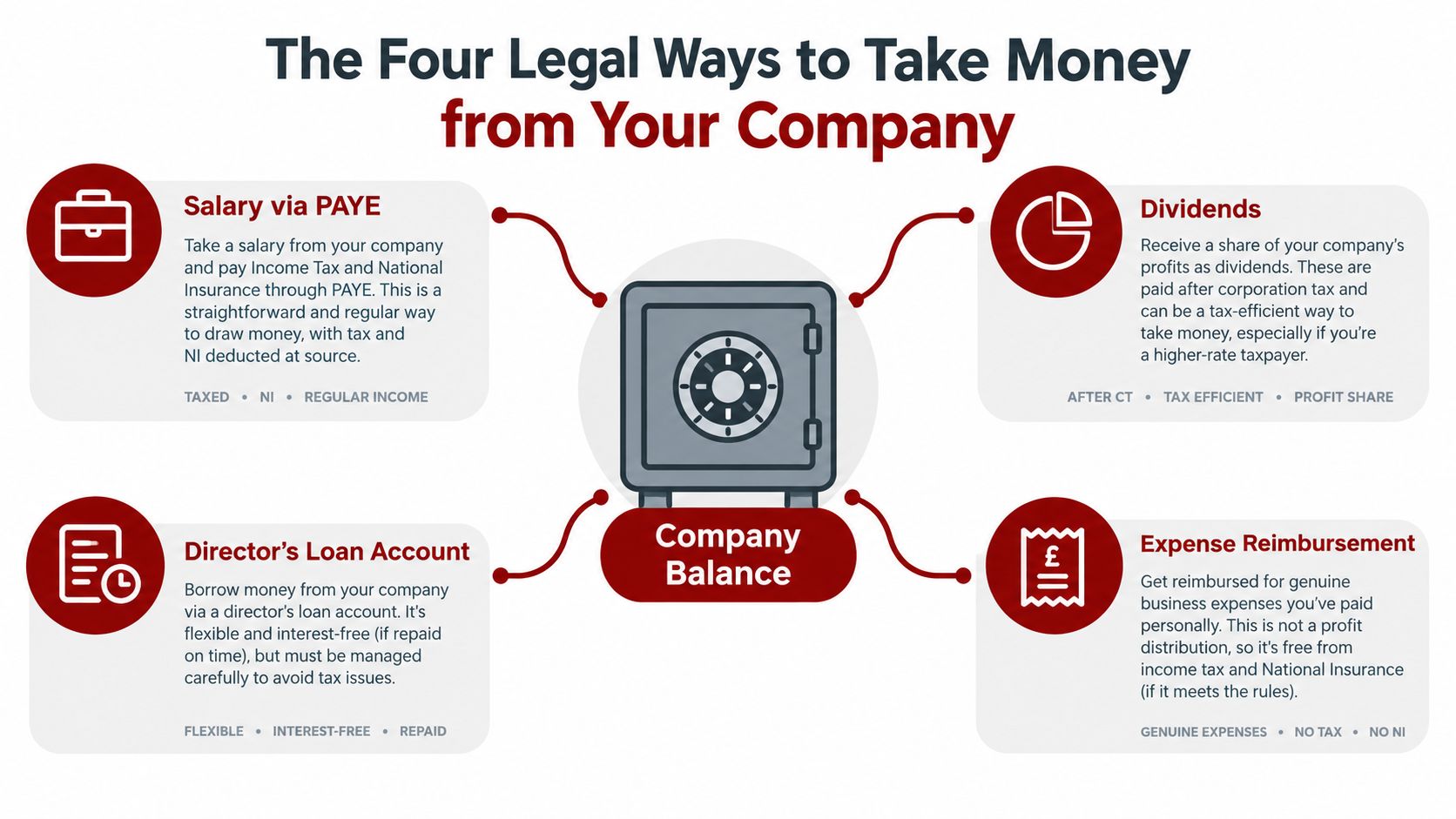
A company bank balance isn't your personal wallet. It can contain money owed for VAT, PAYE, Corporation Tax, suppliers, subcontractors, or future work. Before transferring anything, put the payment into the correct legal category.
The most common route is salary through PAYE. Salary is paid because you work for the company. The company must operate payroll, deduct Income Tax and employee National Insurance, and account for employer National Insurance where due. The payment becomes a formal payroll cost, rather than an informal withdrawal. HMRC's guidance on taking money from a limited company distinguishes salary from dividends and confirms that they have different legal and tax treatments.
Dividends are paid because you own shares. They come from available distributable profits, not just from cash sitting in the current account. They aren't deductible business costs for Corporation Tax, and the company must have sufficient profits from the current and previous financial years. Even a sole director should approve the dividend, keep minutes, and prepare a voucher.
Practical rule: Every personal payment must be identifiable as salary, dividend, expense reimbursement, pension or benefit arrangement, or a properly recorded loan.
A director's loan account records money moving between you and the company that isn't salary, a dividend, expense reimbursement, or repayment of money you previously lent to the company. It can provide short-term flexibility, but it isn't a free drawings facility. An overdrawn balance creates tax and repayment risks, especially if the company later struggles or becomes insolvent.
The fourth route is company-funded personal value, such as an employer pension contribution, an approved benefit, or reimbursement of a genuine business expense. These payments need their own records and tax treatment. Don't relabel personal spending as expenses merely because the company paid the bill.
The same separation matters when you compare company structures internationally. If you're considering an overseas setup, a guide to Australian incorporation costs explained can help you understand why incorporation fees, reporting obligations, and extraction rules need to be assessed together rather than viewed in isolation.
Paying Yourself a Salary Through PAYE
Salary should be the stable layer of your extraction plan. It gives you a predictable personal income and creates a clean record of payment for work. It also means the company handles the tax deductions at the point of payment, rather than leaving every personal liability to a year-end calculation.
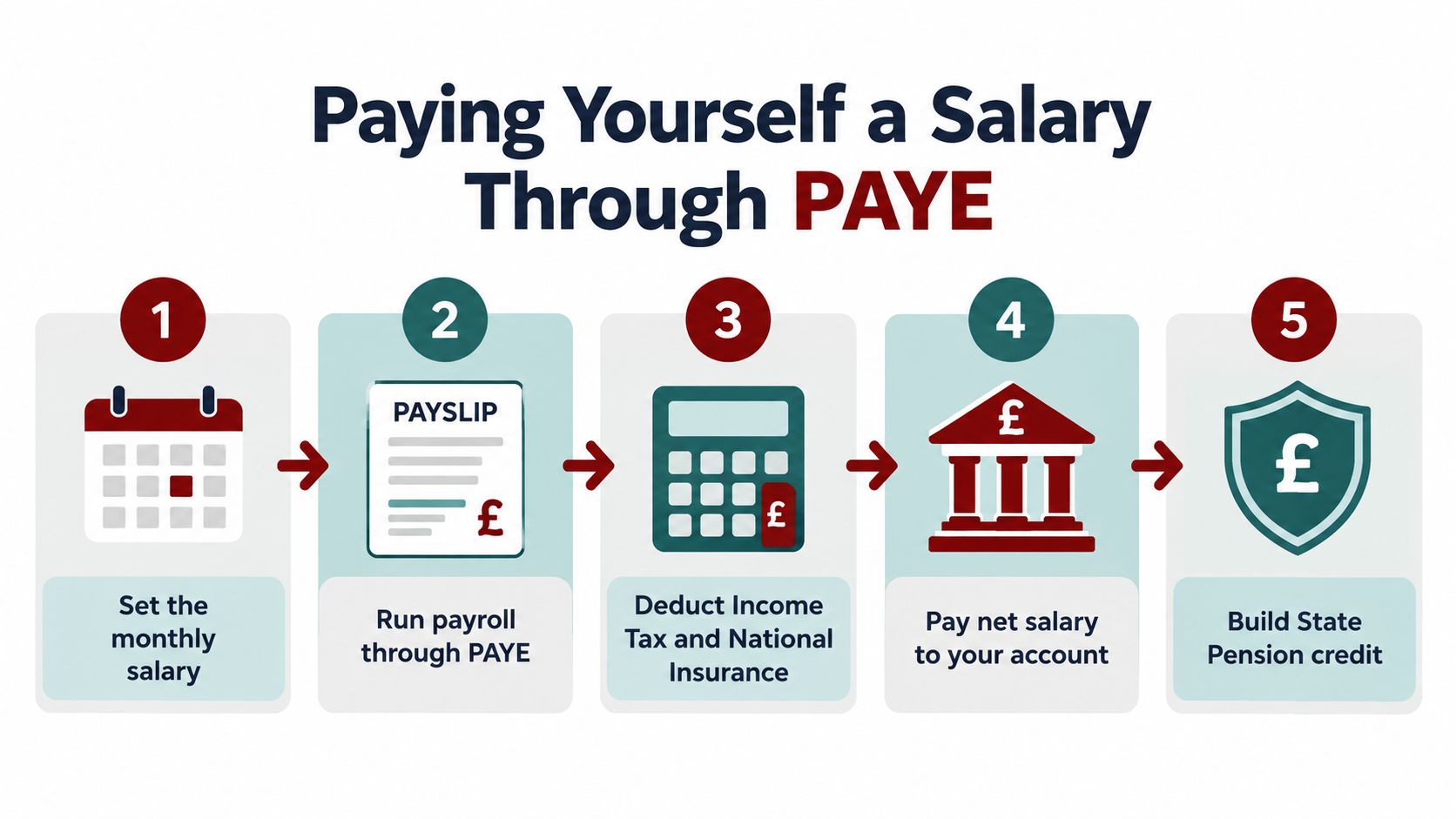
The mechanics are straightforward, but they aren't optional:
- Register the company as an employer with HMRC before operating payroll.
- Set the director's remuneration, taking account of cash flow and other income.
- Run payroll for salary, bonuses, and fees.
- Calculate deductions, including PAYE Income Tax and employee National Insurance.
- Account for employer liabilities and submit the required Full Payment Submission.
- Pay the net amount to your personal account and retain the payroll records.
A small salary still requires proper payroll. HMRC treats directors as employees for National Insurance, and director remuneration, including salary, bonuses, and fees, must be included for PAYE and National Insurance purposes. PAYE can apply when you're paid, become entitled to payment, or the amount is credited in the company records, even if you haven't transferred the cash yet. See the HMRC guidance on employee directors before setting up or changing the arrangement.
Keep the monthly process clean
Directors' National Insurance is generally calculated using annual earnings, although the method can differ for directors appointed during the year. That makes a director payroll different from a simple employee payroll and is one reason to avoid casual spreadsheet calculations.
Each month, reserve the net salary, PAYE deductions, employee National Insurance, and employer liabilities before deciding what cash is available for you personally. If cash is tight, don't credit a salary you can't fund. Review the payroll treatment and cash forecast, then make a documented decision.
Payroll records should agree with the bank, accounting ledger, and Full Payment Submission. If your team handles payroll documents from different jurisdictions, specialist tools such as W-2 document parsing for payroll teams illustrate the importance of extracting structured data before it enters a payroll workflow. For UK directors, use a compliant payroll service or software, and keep the payroll for small business process aligned with the company's accounting records.
This short video provides a visual introduction to the mechanics of paying yourself through payroll:
Salary can reduce company profit because it's a payroll cost, but the company may also face employer National Insurance. The correct level depends on your wider income, company profit, cash reserves, pension objectives, and whether a consistent payslip matters for personal borrowing. Don't choose a figure by copying another contractor's formula.
Declaring Dividends the Right Way
Dividends are where founders most often confuse cash with profit. A positive bank balance doesn't prove that the company can distribute money. The balance may include tax collected on behalf of HMRC, committed project costs, or funds needed to pay creditors.
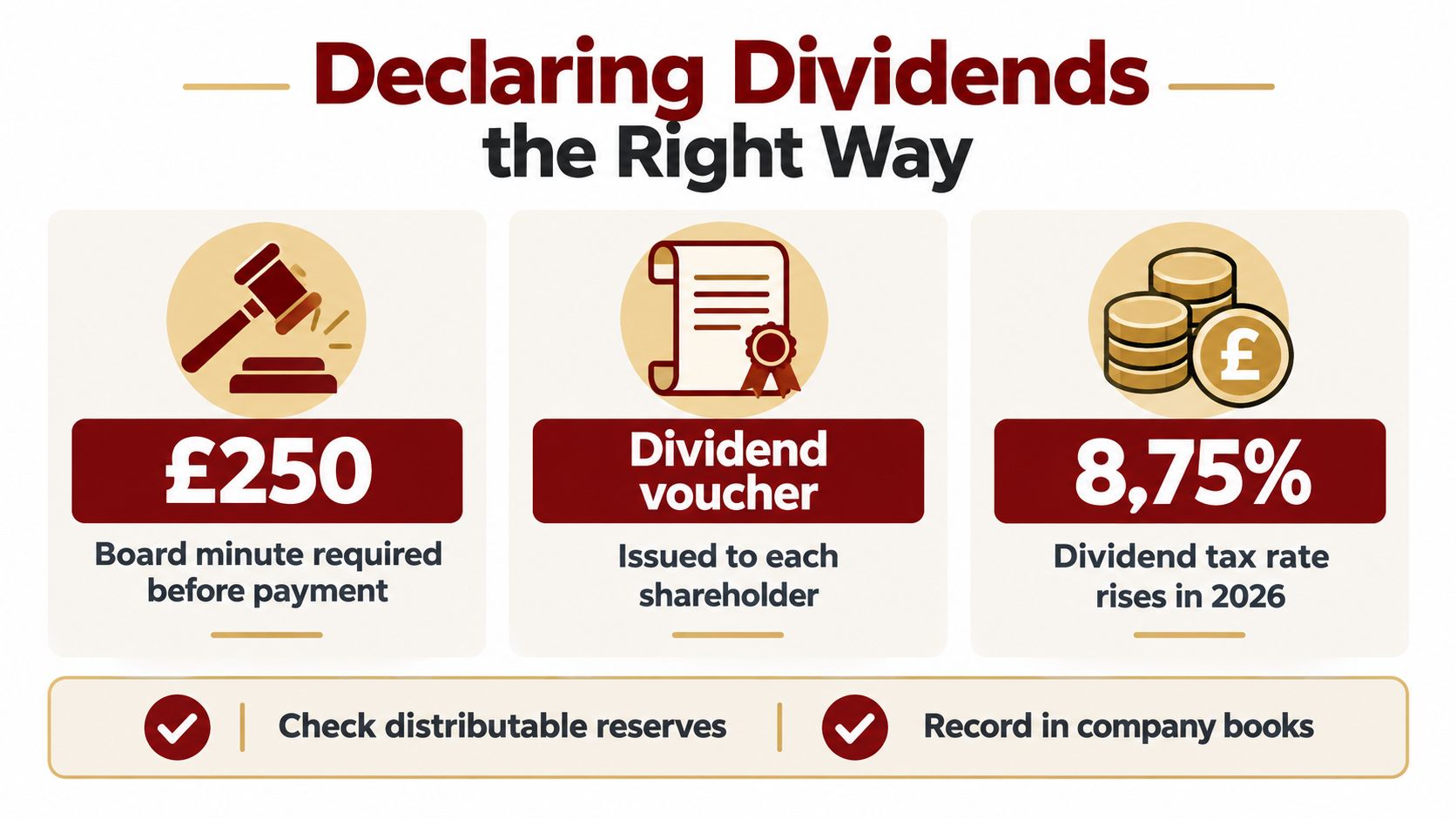
A dividend needs a defensible profit test. Prepare management accounts, account for Corporation Tax and liabilities, confirm available distributable post-tax profits, and check the shareholdings. Then approve the payment formally. A sole director still needs a decision trail.
Use the right paperwork
For each dividend, prepare:
- Board minutes: Record the decision, date, amount, and shareholders entitled to the distribution.
- Dividend voucher: Include the date, company name, shareholder, and amount.
- Accounting entry: Post the dividend against the correct reserves and shareholder account.
- Bank record: Transfer the approved amount and retain evidence that the payment matches the paperwork.
Don't declare a dividend merely because the company has money in the bank. If available profits don't support it, the payment may be unlawful and can create a director's loan or repayment problem.
Personal tax is separate from Corporation Tax. For 2025–26, the Dividend Allowance is £500, and dividends above it are taxed at 8.75% in the basic-rate band, 33.75% in the higher-rate band, and 39.35% in the additional-rate band, as set out in the HMRC Self Assessment dividend notes.
The £10,000 illustration
Suppose you receive £10,000 of dividends above the £500 allowance. That leaves £9,500 subject to the relevant dividend rate:
| Tax band | Rate | Tax on £9,500 |
|---|---|---|
| Basic-rate band | 8.75% | £831.25 |
| Higher-rate band | 33.75% | £3,206.25 |
| Additional-rate band | 39.35% | £3,738.25 |
The applicable result depends on your total taxable income, not just the dividend payment. Salary, rental income, pension income, bonuses, and other taxable receipts can determine which band applies.
The allowance was reduced to £500 from 6 April 2024, so the old assumption that a substantial slice of dividends escapes personal tax is no longer reliable. Notably, the rates rise for 2026–27. The ordinary rate becomes 10.75%, the upper rate becomes 35.75%, and the additional rate remains 39.35%, according to HMRC's dividend tax guidance.
Treat dividends as a quarterly decision, not an automatic monthly salary substitute. If you're updating shareholder records or agreeing different share rights, use a properly drafted shareholder agreement template rather than relying on informal arrangements.
Salary vs Dividends in 2026
At year-end, a company showing £60,000 of profit before extraction may still have little room for a dividend. Payroll, employer liabilities, Corporation Tax, working capital, and unpaid creditors come first. Dividend capacity depends on the supported post-tax profits left after those commitments.
Salary and dividends serve different purposes. Salary is paid for your work as a director or employee, runs through PAYE, and creates payroll evidence. It is a company cost, although employer National Insurance may apply. Dividends are paid because you own shares, are not deductible business costs, and require distributable profits. No National Insurance is charged on the dividend itself.
For 2026–27, the published dividend rates are 10.75%, 35.75%, and 39.35% across the ordinary, upper, and additional bands. For 2025–26, they are 8.75%, 33.75%, and 39.35%. The change applies from 6 April 2026, so the tax year of the payment matters.
| Factor | Salary via PAYE | Dividends |
|---|---|---|
| Why it's paid | For work as a director or employee | For share ownership |
| Company treatment | Formal payroll cost | Not a deductible business cost |
| Tax collection | PAYE and National Insurance deductions | Personal dividend tax calculation |
| Profit requirement | Can be paid for work, subject to affordability | Must be supported by distributable profits |
| Cash-flow pattern | Usually regular and predictable | Better suited to reviewed, variable payments |
| Administration | Payroll, FPS, payslips, and liability records | Minutes, vouchers, reserves test, and accounting entries |
| Personal planning | Provides employment income evidence | Depends on total income and dividend band |
Set a salary the company can fund through weaker months, then review dividends after preparing management accounts. A large fixed salary can create monthly pressure when receipts fluctuate. A fixed dividend creates a different risk, because it may be unlawful if the required profits are not available when declared.
Your wider income also matters. Salary, rental income, pension income, bonuses, and other taxable receipts can push dividends into a higher personal tax band, making a simple online comparison unreliable.
The old low-salary-plus-dividends slogan is incomplete in 2026. Cash timing, retained profits, total personal income, and the new rates decide whether the arrangement works.
A salary suits regular personal cash flow, payroll evidence, and a company that can afford predictable payments. Dividends suit genuine distributable profits and owners who can wait for a proper review. The typical owner-managed company combines a modest salary with periodic dividends, but the appropriate split depends on profit and total personal income. Model both before fixing the arrangement, then revisit it each year.
Using the Director's Loan Account Without Triggering Section 455
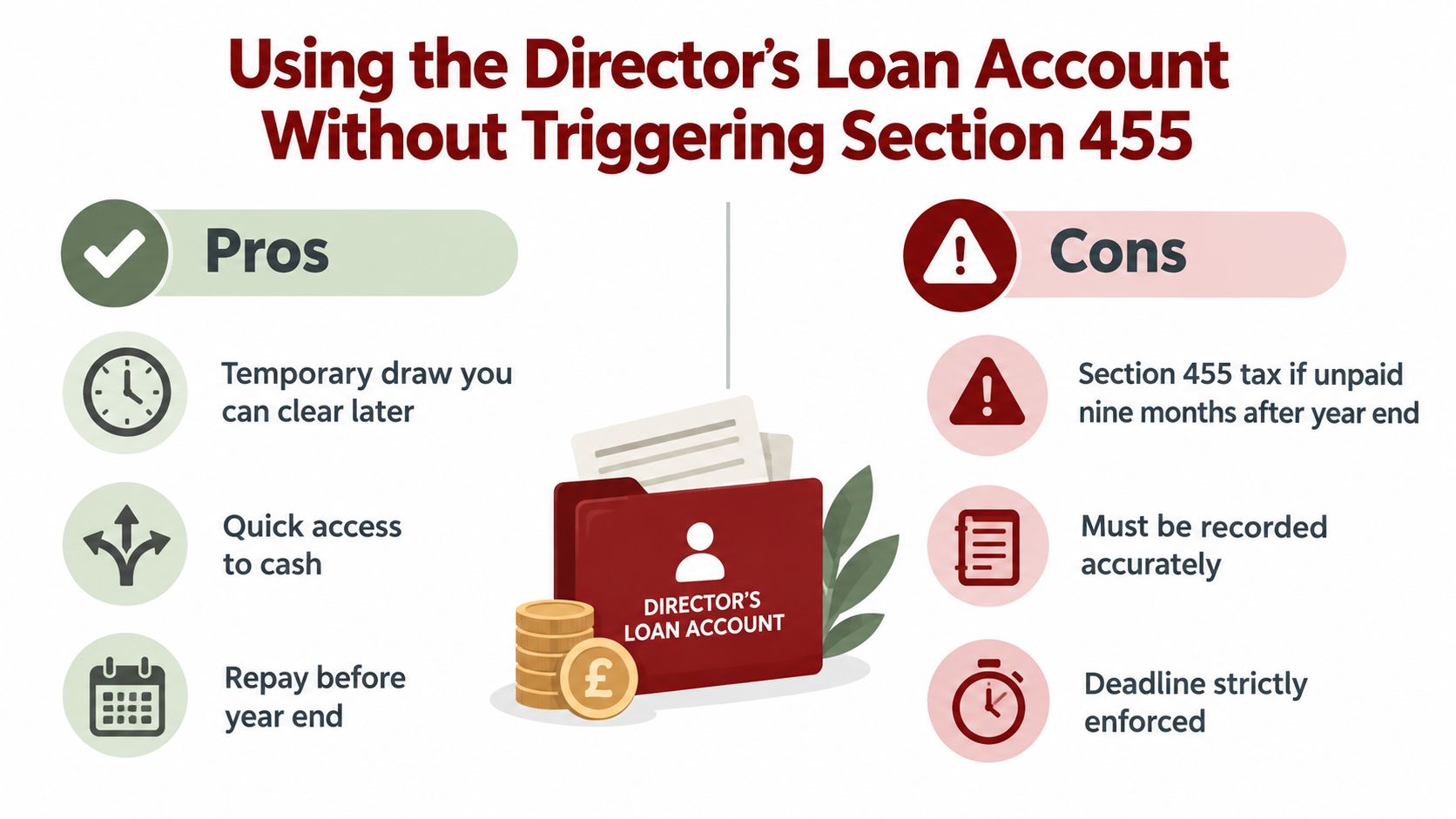
A director's loan account is a ledger, not a personal overdraft facility. It records money taken from the company that isn't salary, a dividend, expense repayment, or repayment of money you previously lent to the company. It also records money you put into the business and payments the company makes on your behalf.
Temporary borrowing can be workable if you control it. The danger starts when you make repeated personal transfers, pay private bills from the business account, and assume an accounting journal at year-end will make the problem disappear.
Reconcile it before it grows
Record every debit and credit as it happens. Review the balance monthly, not just when the accounts are prepared. A useful reconciliation identifies:
- Personal withdrawals: Transfers to you that aren't supported by payroll or dividend paperwork.
- Private expenditure: Personal bills paid using the company card or bank account.
- Company repayments: Money you've returned, with bank evidence.
- Approved remuneration: Amounts credited through payroll or declared as dividends.
- Closing position: Whether the account is overdrawn, in credit, or fully cleared.
If the account is overdrawn, the company may face a tax charge under the loans-to-participators rules. The section 455 charge is aligned with the dividend upper rate and rises to 35.75% from 6 April 2026, as confirmed in HMRC's director loan guidance. That makes casual borrowing particularly expensive.
The charge isn't the only concern. The loan remains company money that must be repaid. If the company becomes insolvent, you can't assume that being the director or shareholder cancels the debt. A year-end journal doesn't automatically legitimise an unlawful dividend or erase evidence of personal borrowing.
If you need a temporary draw, agree the repayment route before taking the money.
For a detailed explanation of the ledger, repayment process, and common traps, review what is a director's loan account. If you want another practical perspective, striveX on directors loans also focuses on the distinction between company money and personal funds.
Keep borrowing exceptional and visible. If you need the same amount every month, convert the arrangement into properly processed remuneration instead of dressing up regular drawings as a loan. The section 455 rules are a warning that flexibility without reconciliation becomes a tax liability.
Pension Contributions and Benefits-in-Kind
Salary and dividends aren't the whole remuneration package. Once the basic extraction process works, consider whether the company should fund retirement saving, genuine business expenses, or benefits that support your role.
An employer pension contribution is paid by the company into your pension rather than transferred to you as personal cash. It isn't a dividend. The contribution needs to be checked against the relevant pension rules and your personal circumstances, including contributions from other arrangements. Your accountant and financial adviser should coordinate the company accounts and pension advice, because an apparently sensible contribution can create a personal allowance issue if it isn't reviewed properly.
Don't route a company pension contribution through your personal bank account. Pay it directly to the pension provider, retain the transaction evidence, and post it correctly in the accounts. Review the company's cash forecast first. A tax-efficient contribution still has to be affordable without starving the business of operating funds.
Benefits-in-kind require the same discipline. A company car, private medical cover, or another personal benefit may create a taxable benefit for you and a reporting obligation for the company. Depending on the benefit, the company may need payroll treatment or a P11D, and employer National Insurance can arise.
Reimburse real expenses only
Expense reimbursement is not remuneration by another name. Claim costs incurred wholly for company business, retain receipts and explanations, and separate them from personal spending. Home-working expenses and business equipment need a clear connection to the work and appropriate records.
The company should also review workplace pension duties and payroll interactions. The auto-enrolment pension rules are relevant where the business has eligible workers, and a director's own pension arrangement shouldn't be treated as a substitute for meeting employee obligations.
Benefits can make sense where they serve a genuine business or long-term planning purpose. They don't make sense when the founder chooses them only because the bank transfer feels less visible than salary. Code each payment correctly at the time it happens.
Building a Quarterly Pay-Yourself Rhythm
The strongest pay-yourself strategy is a routine, not a clever tax trick. Set a conservative recurring salary, then use quarterly management accounts to decide whether the company can support a dividend. Founders with seasonal or irregular income should resist the urge to convert a strong month into a permanent personal commitment.
At each quarter-end, work through the following sequence:
- Forecast company cash: Include expected receipts, payroll, suppliers, operating costs, Corporation Tax, VAT, PAYE, and any CIS liabilities.
- Reserve tax and commitments: Treat tax collected for HMRC and money owed to creditors as unavailable.
- Check payroll: Confirm salary, bonuses, deductions, employer liabilities, payslips, and Full Payment Submissions agree.
- Test distributable profits: Use current management accounts and prior retained profits. A bank balance isn't enough.
- Approve any dividend: Prepare the board minute and dividend voucher before the transfer.
- Reconcile the loan account: Explain every personal payment and clear or formally manage any debit balance.
- Forecast personal tax: Add salary, dividends, and other income before setting aside money for Self Assessment.
A dividend that leaves the company unable to meet VAT, CIS, PAYE, Corporation Tax, or creditor obligations is poor control, even if the payment appeared affordable on the declaration date. HMRC's guidance on taking money out of a limited company reinforces why company cash and distributable profit must be assessed separately.
Use a simple cash-and-tax schedule with columns for opening cash, committed liabilities, reserves, salary cost, proposed dividend, and closing buffer. Update it after each quarter rather than relying on a fixed monthly dividend. The schedule should show both company affordability and your likely personal tax exposure.
At year-end, don't wait for the accounts to reveal unexplained transfers. Give your accountant the bank statements, payroll reports, dividend minutes, vouchers, pension confirmations, benefit details, expense receipts, and loan account reconciliation. A clean file makes the tax return and statutory accounts more reliable.
Action Accountants Limited can help you set up and run the payroll, prepare dividend records, reconcile director loans, and forecast the cash needed for VAT, PAYE, CIS, and personal tax. Visit Action Accountants Limited to arrange practical advice on a salary, dividend, pension, and cash-flow process that fits your company.