
Accounting Services for Small Businesses: 2026 Guide
Looking for accounting services for small businesses in North West London? Get expert tax, payroll and bookkeeping support to grow your company in 2026.
Finding the right accounting services for small businesses in North West London means matching daily compliance and management insight to your industry obligations and growth stage, not just buying the lowest-priced bookkeeping package. The UK has 5.5 million private-sector businesses, including 5.45 million small businesses, and about 4.1 million operate without paid employees beyond the owner.
What does a low monthly fee really save you if a missed VAT control, an incorrect CIS deduction, or a late payroll submission takes more cash from the business than the accountant ever charged?
A builder in Colindale may be managing subcontractors, supplier invoices, retention payments and uneven customer receipts. A landlord in Edgware may be tracking several properties, mortgage interest, repairs and tenant deposits. A growing consultancy in Finchley may need payroll, corporation tax, management accounts and a reliable cash-flow forecast. They all need bookkeeping, but they don't need the same accounting process.
The practical question isn't whether you can find someone to record transactions. It's whether your finance system gives you accurate information early enough to protect cash, meet obligations and make the next decision with confidence.
Table of Contents
- Why Small Business Finance Needs a Plan
- Understanding the UK Small Business Finance Landscape
- Core Accounting Services Small Businesses Need
- Industry-Specific Accounting Requirements
- Pricing Models and Service Delivery Options
- Choosing an Accountant in North West London
- Turning Accounting into a Growth Engine
- Preparing to Work with Your New Accountant
Why Small Business Finance Needs a Plan
Consider a North West London trades business that has won more work and hired several subcontractors. Sales look healthy, but money arrives later than expected. Supplier invoices are being paid quickly, customer applications are still being approved, and the owner is using a spreadsheet to estimate VAT and CIS deductions. Payroll is processed in a rush, while bookkeeping waits until the end of the month.
Nothing looks disastrous on a single day. The problem appears when several small weaknesses meet. A payment is coded to the wrong category, a subcontractor's status isn't checked promptly, or a VAT control account doesn't agree with the underlying records. The owner then discovers that the bank balance isn't the same thing as available cash.

The scale of the UK market explains why this pattern is common. Small businesses employ 13.0 million people, represent 47% of private-sector employment, and generate an estimated £1.8 trillion in turnover, according to the Department for Business and Trade business population estimates. Yet most businesses don't have an internal finance department.
The hidden cost of reactive bookkeeping
Reactive bookkeeping creates costs that don't always appear as a separate invoice:
- Late action: The owner finds out about a cash shortage after committing to labour, stock or equipment.
- Poor coding: Misclassified expenses can distort profitability, VAT calculations and tax planning.
- Repeated work: An accountant has to reconstruct records instead of reviewing a clean monthly close.
- Missed decisions: The business delays hiring, purchasing or marketing because nobody trusts the figures.
A basic invoicing process also matters. Clear payment terms, consistent invoice numbers and convenient payment options can reduce friction for customers. A founder building that process can use practical invoice templates with payment links as a starting point, then connect invoices to the bookkeeping workflow.
Practical rule: Your accountant should help you know what cash is committed, what cash is collectible and what cash must be reserved for tax.
The right service isn't necessarily the most expensive package. It is the one that makes responsibility clear, keeps records current and gives you a usable view of the business. A useful risk checklist is available in these five ways to minimise financial risks as an entrepreneur, but the underlying principle is simple: accounting should support operations every week, not just produce accounts after the year has ended.
Understanding the UK Small Business Finance Landscape
A sole trader, a partnership and a limited company can all sell the same service while carrying very different responsibilities. Legal structure affects statutory records, tax returns, payroll arrangements, ownership records and the way profits reach the people behind the business. Sector and digital maturity then add another layer.
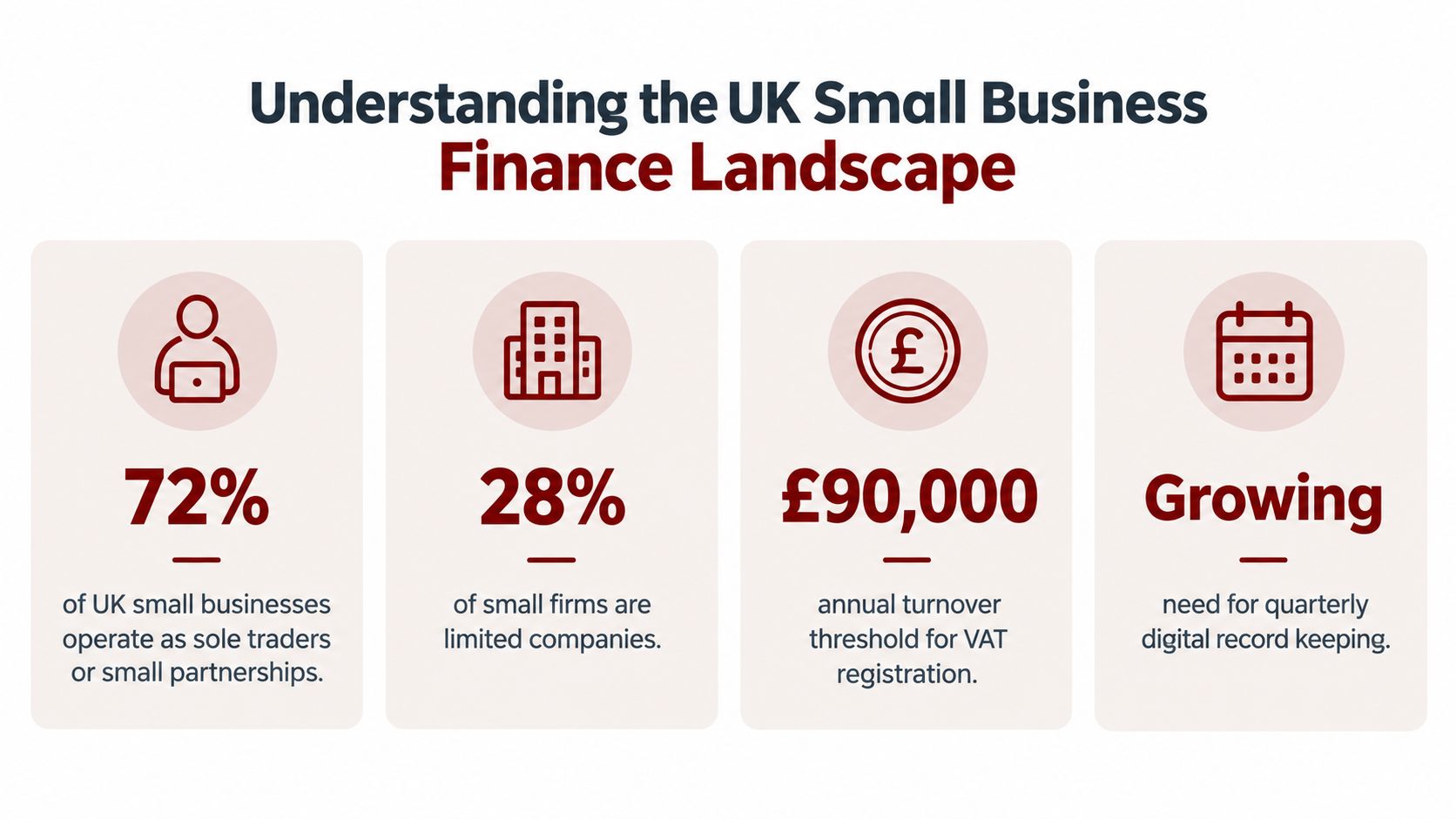
The Office for National Statistics recorded 2.72 million businesses registered for VAT and/or PAYE in March 2024. Companies represented 75.6% of registered businesses, while sole proprietors represented 14.6%, as shown in the ONS business population data. Those proportions don't mean every small business has the same compliance profile. They show why an accountant needs to establish the client's structure before recommending a package.
Digital records are useful only when the process works
The same government survey found that 69% of SME employers used digital tools to sell to customers or manage the business, compared with 50% in 2022, using the figures reported in the same Longitudinal Small Business Survey. Digital adoption is moving forward, but a substantial minority still work with paper records, disconnected spreadsheets or software that nobody reconciles properly.
Software doesn't decide whether a fuel receipt is business-related, whether a landlord's repair is allowable, or whether a subcontractor payment has been split correctly between labour and materials. People still need to set rules, review exceptions and maintain an audit trail.
A sensible provider will assess:
- Legal form: Sole trader, partnership or limited company.
- Operational complexity: Employees, subcontractors, property units, stock or overseas activity.
- Tax registrations: VAT, PAYE, CIS and the relevant personal or corporate obligations.
- Information needs: Basic compliance, monthly management accounts, forecasting or decision support.
- Digital readiness: Existing software, bank-feed discipline and document capture.
The right accounting services for small businesses therefore begin with diagnosis. A low-cost package built for a simple service business can be unsuitable for a North West London contractor with CIS returns, or for a landlord who needs property-level records.
Core Accounting Services Small Businesses Need
Accounting works best as a connected workflow rather than a menu of unrelated tasks. Start with the structure, build reliable records, then use those records to manage tax and cash.
Start with the right foundation
Company formation and company secretarial support establish the records that later compliance depends on. That includes confirming the legal structure, maintaining statutory information and setting up practical responsibilities for directors or owners. A sole trader needs a clear separation between business and personal activity, while a limited company needs disciplined treatment of company money, director transactions and payroll.
Day-to-day bookkeeping comes next. The process should capture sales invoices, purchase invoices, bank transactions, receipts, payment dates and supporting documents. Bank feeds can reduce manual entry, but they don't replace review. Someone still needs to match transactions, investigate duplicates and confirm that the ledger reflects what happened.
Connect payroll, VAT and tax
Payroll deserves its own control process. It requires accurate employee information, timely changes, payslips, reporting and records that agree with the bank. VAT requires the same discipline. HMRC's final evaluation found that 54% of below-threshold businesses used fully functional accounting software and 26% used bridging software. It also reported that 76% saw reduced potential for errors, while up to 40% spent less time preparing VAT returns, according to HMRC's Making Tax Digital evaluation.
That evidence supports digital bookkeeping, but not careless automation. Before submitting a return, review VAT treatment, reconcile control accounts and confirm that digital links and source records are intact.
Turn records into decisions
Annual accounts, corporation tax returns and Self Assessment are outputs of the bookkeeping system. If the underlying records are incomplete, year-end work becomes an expensive reconstruction exercise. Monthly or quarterly management accounts add a different benefit, showing margins, overheads, debtor movements and cash commitments while there is still time to act.
Founders comparing cash and accrual approaches can use this practical explanation of accounting methods from Capital Express, then discuss which basis suits their reporting and financing needs. For hands-on implementation, payroll and bookkeeping services should be assessed by the controls and reporting included, not by transaction entry alone.
Industry-Specific Accounting Requirements
A general bookkeeping package often records transactions adequately while missing the operational detail that creates risk. Construction and property businesses show why sector knowledge matters.

Construction needs a CIS control system
For a North West London contractor, CIS isn't an occasional tax adjustment. The process starts before paying a subcontractor. The contractor must verify the subcontractor with HMRC, apply the correct treatment, calculate deductions and submit monthly returns. Records must connect the subcontractor's identity, verification status, payment date, labour and materials split, deduction statement and return reference.
HMRC specifies that CIS deductions are advance payments towards Income Tax and National Insurance, and that contractors must verify subcontractors, retain detailed records and reconcile payments carefully. The HMRC CIS guidance explains why a wrong deduction affects both the subcontractor's immediate cash and the contractor's compliance position.
A workable monthly process looks like this:
- Verify first: Keep the subcontractor's verification details and deduction rate in a controlled record.
- Check the application: Separate labour, materials and VAT before calculating the deduction.
- Reconcile the payment: Match the approved application or invoice to the CIS calculation and bank settlement.
- File and retain: Keep deduction statements and monthly return evidence with the ledger.
Property records need separation
A landlord or property investor needs more than one income and expense column. Each property should be identifiable, with rent, repairs, insurance, agent charges, financing costs and other costs supported by documents. Personal spending should not disappear into the property ledger, and property income should not be mixed with unrelated business activity.
The best process makes it possible to ask practical questions quickly. Which property generated the rent? Which tenancy produced the repair bill? Was the cost capital in nature or a routine expense? Does the bank balance reflect rent received, deposits held and bills awaiting payment?
For both sectors, the accountant's value lies in maintaining the control points that generalist bookkeeping can overlook.
Pricing Models and Service Delivery Options
Price comparisons become useful only after you understand what the provider will do. A fixed fee may offer predictable budgeting, while an hourly arrangement can suit unusual work. Neither model guarantees responsive advice or accurate records.
| Pricing Model | Typical Coverage | Best For | Key Risk |
|---|---|---|---|
| Fixed monthly package | Agreed bookkeeping, payroll, VAT or reporting tasks | Businesses with stable transaction patterns | Exclusions may apply when activity changes |
| Hourly rates | Time charged for bookkeeping, advice or corrections | Irregular projects and clean-up work | Cost can rise when records arrive incomplete |
| Project-based fee | Defined work such as formation, software migration or year-end accounts | One-off setup or remediation | Ongoing support may not be included |
| Advisory retainer | Regular review, forecasting and management guidance | Owners making active hiring, investment or growth decisions | Scope must be measurable and documented |
Ask for the service boundary in writing. Does the fee include software configuration, receipt capture, bank reconciliation, VAT review, payroll changes, year-end queries and management reporting? How quickly will the provider respond when a payment problem appears?
A low quote can be sensible for a simple business with clean records. It becomes false economy when the accountant only discovers errors at year end. Conversely, a broad advisory package isn't worthwhile if the owner doesn't need regular analysis or won't provide records on time.
Cloud systems can help clients and accountants share current records, but the software is only one part of delivery. Review the cloud accounting services on the basis of workflow, reporting and human support rather than the platform name alone.
Choosing an Accountant in North West London
Local knowledge matters because the business environment is practical and relationship-driven, but proximity alone isn't enough. A suitable accountant should understand the work patterns of businesses around Colindale, Kingsbury, Queensbury, Edgware and Finchley, while also having the systems to support clients elsewhere in the UK.

Start with the questions that expose how the relationship will operate:
- Who will handle the work? Ask whether you deal with the person doing the bookkeeping, a manager or a rotating support team.
- What happens each month? Request a clear close process covering reconciliations, outstanding records and management reporting.
- What sectors are familiar? Construction and property clients should ask for specific experience with CIS, contractor payments or property-level accounts.
- How are deadlines managed? Find out how the firm tracks VAT, payroll, tax and statutory filing dates.
- What does advice look like? Ask for examples of the reports or conversations that support cash-flow and profitability decisions.
A provider should explain what it needs from you as well. If receipts arrive late or bank accounts aren't connected, no accountant can produce dependable information on schedule. The relationship works when both sides agree response times, document standards and escalation points.
Credentials matter, but so does evidence of working practice. Check whether the firm communicates clearly, records advice and understands the difference between preparing compliant accounts and helping an owner run the business.
A short conversation can reveal whether the service is reactive or proactive. Ask what the accountant would review first, which risks they see in your current setup and what information they would provide before a tax deadline.
Here is a useful visual introduction to the kind of relationship founders should seek:
The right partner doesn't promise that business will be effortless. They make the financial position clearer, deadlines more controlled and decisions less dependent on guesswork.
Turning Accounting into a Growth Engine
Accounting becomes commercially useful when it changes what the owner does next. Clean bookkeeping supports credible management accounts. Reliable VAT and CIS controls prevent tax calculations from becoming a surprise. A cash-flow forecast shows when customer receipts, payroll, suppliers and tax commitments compete for the same funds.
HMRC estimates that digital record-keeping can save an average of 26 to 40 hours per year, while only 63% of eligible self-employed and landlord businesses used software to submit their end-of-year return for 2023–24, according to HMRC's Making Tax Digital income tax population statistics. The lesson isn't that software alone creates better decisions. The process must turn records into timely information.
Measure the service by outcomes
Set expectations around practical outputs:
- A defined month-end close date.
- Reconciled bank and VAT control accounts.
- An aged debtor report that supports collection action.
- A cash-flow forecast updated when assumptions change.
- Management accounts that explain margin and overhead movement.
- Documented controls for payroll, CIS and property transactions.
A founder who wants to understand the management-information layer may also benefit from this guida pratica al controllo di gestione, particularly when designing internal reporting. For day-to-day planning, cash-flow forecasting should connect expected receipts and payments to actual operating commitments.
That is how accounting services for small businesses become a growth engine. They don't replace commercial judgement. They give the owner a dependable base for exercising it.
Preparing to Work with Your New Accountant
The first meeting goes better when you bring evidence rather than a general description of the business. Your accountant needs to understand how the business is structured, how money moves and where the current records become unreliable.
Prepare a short working file containing:
- Structure details: Company or trading name, formation information, ownership and director or partner details.
- Bank information: Business accounts, finance facilities and recent statements.
- Tax registrations: VAT, PAYE, CIS and Self Assessment details where relevant.
- Prior records: Previous accounts, tax returns, bookkeeping files and outstanding correspondence.
- Operational records: Customer invoices, supplier bills, payroll data, subcontractor details and property schedules.
- Current concerns: Late payments, unexplained balances, tax surprises, software problems or upcoming decisions.
Don't spend days polishing records before asking for help. A transparent list of missing documents is more useful than a tidy-looking file that hides uncertainty.
Questions to settle before engagement
Ask the provider to confirm:
- Which tasks are included in the recurring fee?
- Which deadlines will they monitor, and what must you supply?
- Which software will hold the records, and who controls access?
- How will corrections, unusual transactions and urgent queries be handled?
- What management information will you receive, and how often?
- How will the arrangement change if you hire staff, register for VAT, take on subcontractors or add properties?
Then agree a simple first-month plan. It might include connecting bank accounts, collecting opening balances, reviewing VAT treatment, checking payroll setup and identifying overdue customer invoices. A clear starting sequence prevents the new relationship from becoming another unfinished administration project.
Action Accountants Limited provides formation and company secretarial support, bookkeeping, payroll, VAT, tax returns, statutory accounts and management advice for founders, SMEs, contractors and landlords. If you need accounting services for small businesses that connect compliance with cash-flow control in North West London or across the UK, visit Action Accountants Limited to discuss your requirements.