Contractor Accounting Service: A Practical UK Guide
A contractor accounting service helps UK builders handle CIS, VAT, payroll, IR35 and tax with confidence. Learn what to expect and how to choose the right one.
You've finished a long day across two or three sites, but the paperwork is still waiting: a subcontractor payment to check, a CIS return to submit, a VAT query to answer and a tax bill you hadn't set aside enough cash to cover. That isn't a sign you're bad at business. Construction accounts involve linked rules, project payments and tax deadlines that are easy to mishandle when you're also responsible for getting the work done.
The UK construction sector is large and fragmented. The Office for National Statistics recorded 370,770 VAT- and PAYE-registered construction firms across Great Britain in 2024, with approximately 1.4 million employees, excluding self-employed workers (ONS construction statistics). For a contractor in North West London, that scale matters because bookkeeping, payroll, VAT, CIS and business structure aren't separate admin chores. Each decision affects the reliability of your records and the cash available to keep projects moving.
A sound contractor accounting service should help you make four practical decisions: which business structure suits your work, how to keep connected HMRC obligations aligned, how to protect cash tied up in unpaid invoices or retentions, and how to choose an accountant who understands construction. The point isn't to produce reports you never use. It's to give you control of compliance and cash before a missed deadline or delayed payment becomes a bigger problem.
Table of Contents
- Why UK Contractors End Up Drowning in Paperwork
- What a Contractor Accounting Service Actually Does
- Core Compliance Areas and How They Interact
- Limited Company vs Umbrella vs Sole Trader
- Bookkeeping as Cash-Flow Protection, Not Just Compliance
- How to Choose the Right Contractor Accounting Service
- Common Compliance Mistakes and the Year Ahead
Why UK Contractors End Up Drowning in Paperwork
A subcontractor in Colindale can start the day moving between sites, finish it checking labour costs, then discover that a CIS submission is due and a customer has queried a VAT invoice. A tax payment may also be coming out of the same account that needs to cover fuel, materials and subcontractor payments. When records are scattered across emails, bank statements and phone notes, even a straightforward query takes too long to answer.
Construction businesses deal with overlapping responsibilities. A contractor might need to record sales and project costs, pay employees through PAYE, verify subcontractors, calculate CIS deductions, submit VAT returns and keep enough evidence to support the figures. The rules don't arrive one at a time, and each system relies on accurate information from the others.
Practical rule: A payment isn't properly recorded just because it appears in the bank. You need to know what work it relates to, how it should be treated for tax, and whether the amount due has been paid in full.
That administrative load reflects the sector's structure. ONS figures show there were 353,365 VAT- and PAYE-registered construction firms in Great Britain in 2021, rising to 374,332 in 2022; the number then stood at 364,514 in 2023 (ONS construction statistics for 2021). The same source reported an average of 674,000 self-employed construction workers in Great Britain in 2022, an important reminder that contractor records must cover more than conventional employee payroll. Those figures are historical markers, not a claim about the current number of businesses or workers.
If your paperwork is slipping, start by identifying where the chain breaks. Are invoices entered promptly? Are subcontractors' details checked before payment? Can you see which customers owe money, including retention? Do you know which tax amounts are already committed? The answers will show whether you need better habits, better software, professional support, or all three.
What a Contractor Accounting Service Actually Does
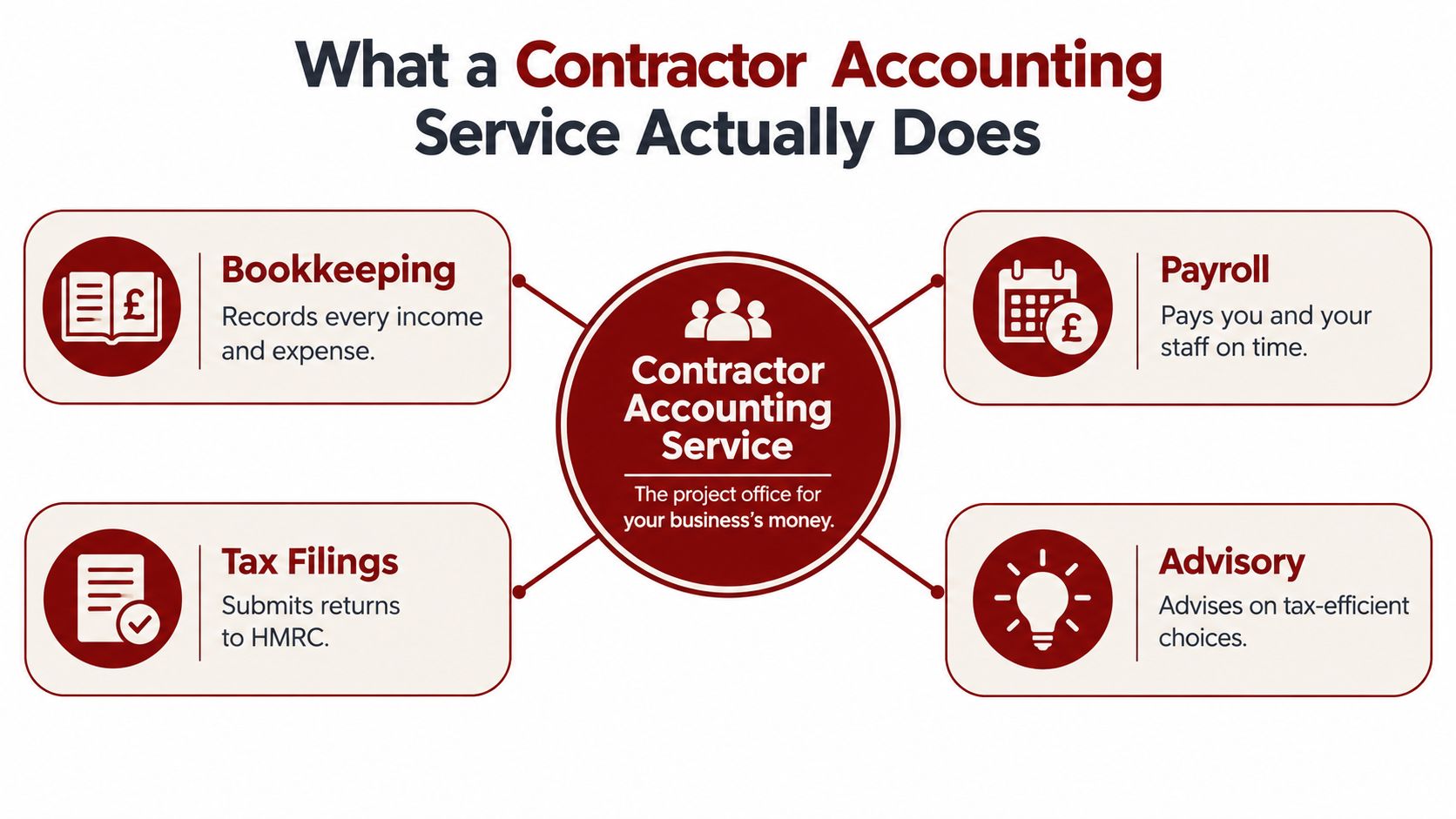
Think of a contractor accounting service as the project office for your business's money. It coordinates the records, deadlines and decisions that keep the financial side working while you manage people, materials and site delivery. It shouldn't just turn up at year-end to explain what happened months ago.
The recurring work behind reliable accounts
A typical service can include bookkeeping that records income and expenses, reconciles bank activity and keeps project costs organised. It may also cover payroll, subcontractor payment records, CIS registration and monthly returns, VAT returns, and the construction domestic reverse charge where it applies.
At year-end, support may include statutory accounts, corporation tax for a limited company, personal tax returns and director guidance. A provider can also help set up accounting software such as Xero, QuickBooks or Sage so transactions and supporting documents are easier to find. Software only helps if someone configures it around how your business invoices, pays suppliers and tracks work.
The right scope depends on your structure and contracts. A sole trader may need help with Self Assessment and VAT, while a limited company also has company reporting and director responsibilities. If you use an umbrella company, payroll arrangements differ again. Ask exactly which submissions the accountant handles and which remain your responsibility.
What you're paying for
The service has three connected jobs:
- Compliance: Prepare and submit the returns and accounts your business is responsible for, using records that can be explained and supported.
- Decision support: Help you weigh incorporation, pay arrangements, dividends and job pricing against your circumstances, rather than relying on generic rules of thumb.
- Cash-flow control: Keep visibility over aged debt, payment applications, project costs and retention receivables so that reported income isn't mistaken for spendable cash.
That last distinction is vital. A contractor may be profitable on paper while still struggling to pay a tax bill or supplier because customers haven't paid. An accountant who only files returns leaves you to spot that pressure yourself. Look for a service that turns the records into timely questions and useful choices.
Core Compliance Areas and How They Interact
CIS, VAT, payroll, IR35 and bookkeeping don't sit in separate boxes. They can all affect one working relationship, and a payment that's recorded incorrectly at the start can create a mismatch across ledgers and returns.
Consider a hypothetical £10,000 invoice from a subcontractor to a main contractor. That amount is only an example, not a calculation of the CIS deduction: the actual deduction depends on the subcontractor's verified status and the relevant payment components. The payer must establish the right CIS treatment before making payment, keep evidence of the calculation, and include the payment in the required reporting. A labour-only subcontracted construction service may also be within the domestic VAT reverse charge if the conditions apply, but the reverse charge is a separate VAT rule, not a CIS deduction.
CIS applies to construction operations as HMRC defines them. The reverse charge broadly uses the CIS construction-operations scope, but exclusions and VAT conditions matter. The payer needs to check both parties' VAT status, whether the payment is reportable under CIS, what service was supplied and whether the customer has given a written end-user notification. HMRC's technical guide to the VAT reverse charge explains that the recipient accounts for the VAT on an affected supply and records it on its VAT return, with eligible input tax reclaimed through the normal process. For a plain-language comparison of VAT compliance topics beyond construction, see this technical VAT guide for e-commerce.
| Stage | Contractor (payer) | Subcontractor (supplier) | HMRC system |
|---|---|---|---|
| Before payment | Verify subcontractor details and status; assess the work and VAT treatment | Provide accurate registration and invoicing details | Holds records used for applicable checks and reporting |
| Payment | Calculate the CIS treatment, retain evidence and pay the correct net amount | Record the invoice and payment received | Receives the reported CIS information |
| VAT reporting | Apply the reverse charge where the conditions are met and record it correctly | Issue an invoice with the required reverse-charge wording when applicable | Receives VAT returns reflecting the treatment |
| Payroll and status | Assess whether the engagement is employment, self-employment or caught by off-payroll working rules | Supply accurate contract and working-practice information | Receives PAYE reporting where relevant |
IR35 needs its own review of the engagement and working practices. Don't assume that labelling someone a subcontractor settles their status. PAYE applies where the relationship and rules require it, while CIS treatment alone doesn't determine employment status. A clear explanation of the CIS rules in practice can help you understand the construction-specific payment process, but unusual status or contract questions need individual assessment.
Limited Company vs Umbrella vs Sole Trader
There's no universally best structure. The right choice depends on how you're engaged, the responsibilities you're willing to take on and how you need to manage your money. Incorporating only because someone told you it means more take-home pay is poor advice.
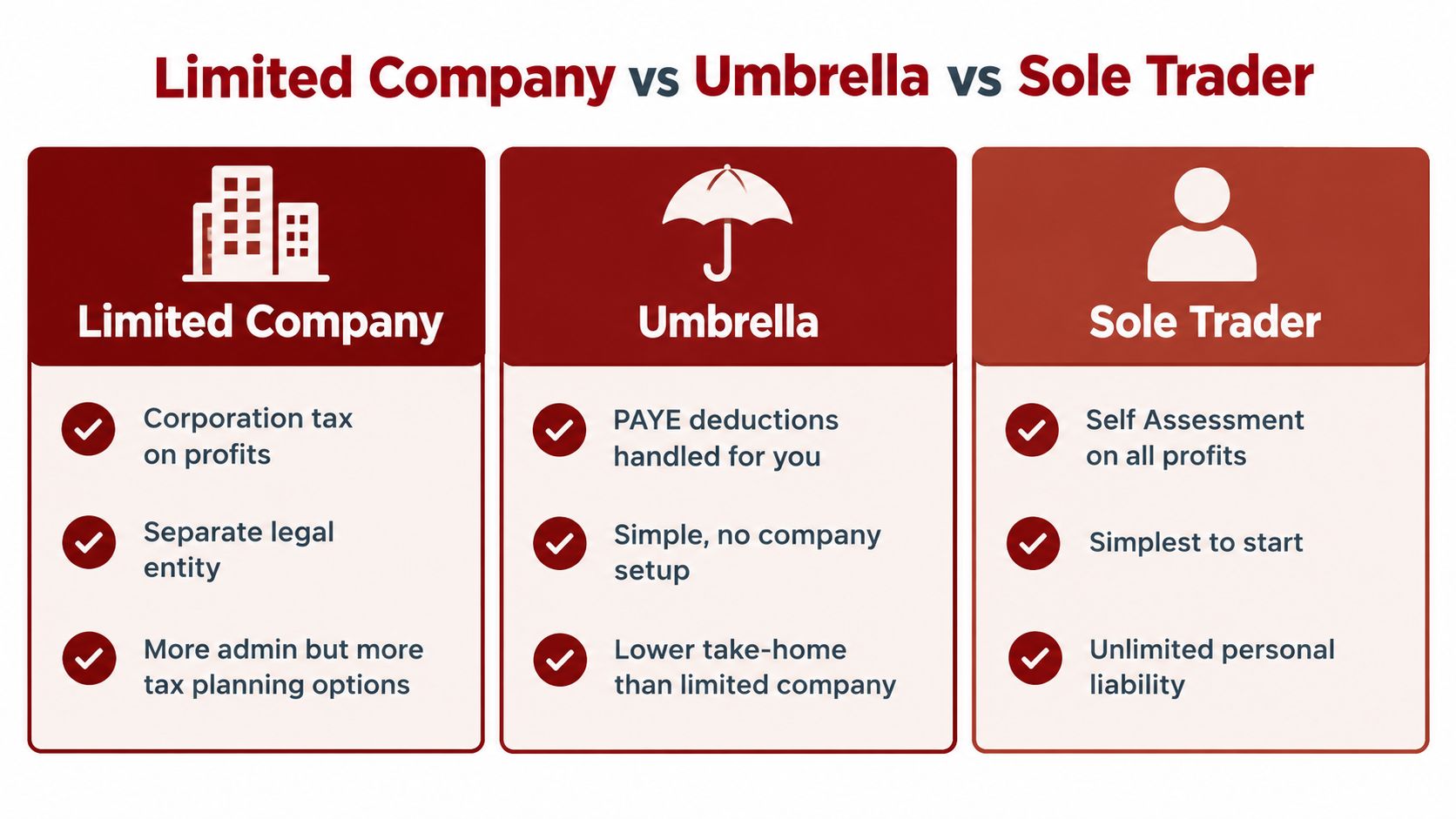
Compare the trade-offs, not just the headline
| Structure | Administration and tax | Liability and engagement considerations |
|---|---|---|
| Limited company | Separate company accounts and corporation tax responsibilities; more administration, with scope for advice on salary, dividends and retained profits | The company is legally separate, but personal guarantees and director responsibilities can expose you personally. IR35 and client arrangements still need careful review. |
| Umbrella company | Usually the simplest route for payroll administration, with PAYE deductions handled through the umbrella | Less company administration, but the arrangement doesn't remove the need to understand your assignment terms or take-home calculation. |
| Sole trader | Straightforward to start, with business profits reported through Self Assessment | You're personally responsible for business debts, and there's no separation between you and the business in the way there is with a limited company. |
A limited company isn't a personal shield in every situation. A bank or supplier may ask for a personal guarantee. Director duties continue even when cash is tight, and company money isn't automatically yours to withdraw. Treating tax reserves as spare cash, taking dividends without checking available profits, or leaving director loans unresolved can turn an apparently tax-efficient setup into a serious problem.
An umbrella company can suit contractors whose engagements call for PAYE treatment or who want less company administration. A sole trader may prefer a simpler structure where the work and risk profile make that appropriate. Neither choice is a shortcut around checking status, tax obligations and the terms of your contract.
Use a limited company and sole trader comparison as a starting point, not a substitute for advice shaped around your work. Before deciding, ask yourself: does my client or agency require a particular route, do I want to handle company administration, and could I manage the personal exposure of trading as a sole trader? If the answers are unclear, get advice before changing structure or signing a new engagement.
Bookkeeping as Cash-Flow Protection, Not Just Compliance
Contractor bookkeeping should tell you whether you can meet obligations as well as what you earned. A bank balance alone can mislead: it may include money needed for VAT, CIS or PAYE, while completed work remains unpaid. Retention receivables and overdue payment applications need to be visible, not buried inside a total sales figure.
Late payment is a real business risk. UK Government research puts the cost to the economy at almost £11 billion a year, affecting more than 1.5 million businesses and contributing to 38 business closures each day. The same research identifies construction retentions, typically 3–5% of contract value, as an unfair practice raised in a government consultation (UK Government research on late payments). These are economy-wide and policy figures, not a forecast of what will happen to an individual contractor.
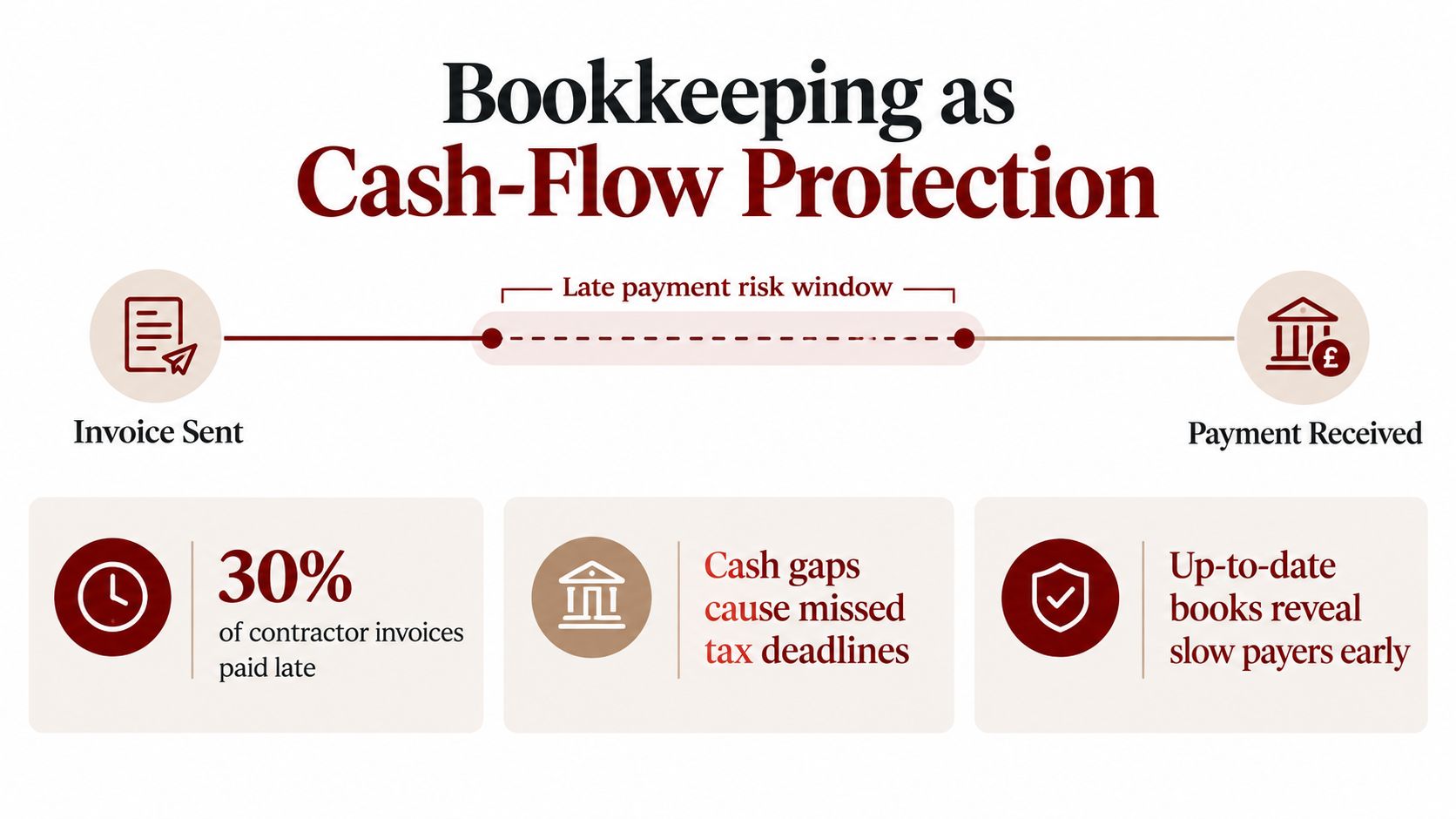
Use the books to see trouble early
Ask your accountant to make the records answer practical questions. Which invoices are overdue? What retention is outstanding, against which project, and who holds it? Are payment applications being submitted on time? Does the margin still make sense after recorded labour, materials and subcontractor costs?
A current aged-debtor list and job-cost view can help you decide which customer to chase, whether to escalate a disputed application and whether a project is consuming more cash than expected. Keep contract records, application evidence and correspondence organised, too. These practical order management tips offer a useful perspective on keeping operational records and hand-offs organised.
A contractor can report accounting profit and still run short of cash. An unpaid retention isn't cash in the bank, and tax withheld or due to HMRC isn't available working capital. If the payer becomes insolvent or disputes the work, a receivable may become harder to recover just when you need funds for wages, materials or tax.
Use a cash-flow forecast that separates expected receipts from money already collected. Review it alongside overdue debt and tax commitments, then act early on late applications instead of waiting for a year-end accounts meeting to reveal the strain.
How to Choose the Right Contractor Accounting Service
Don't choose an accountant on the monthly fee alone. A cheap package can cost you more if it excludes CIS submissions, doesn't understand reverse-charge invoices or leaves you to discover a cash-flow problem after the deadline has passed. Compare providers against the same questions so you're judging the work, not just the sales pitch.
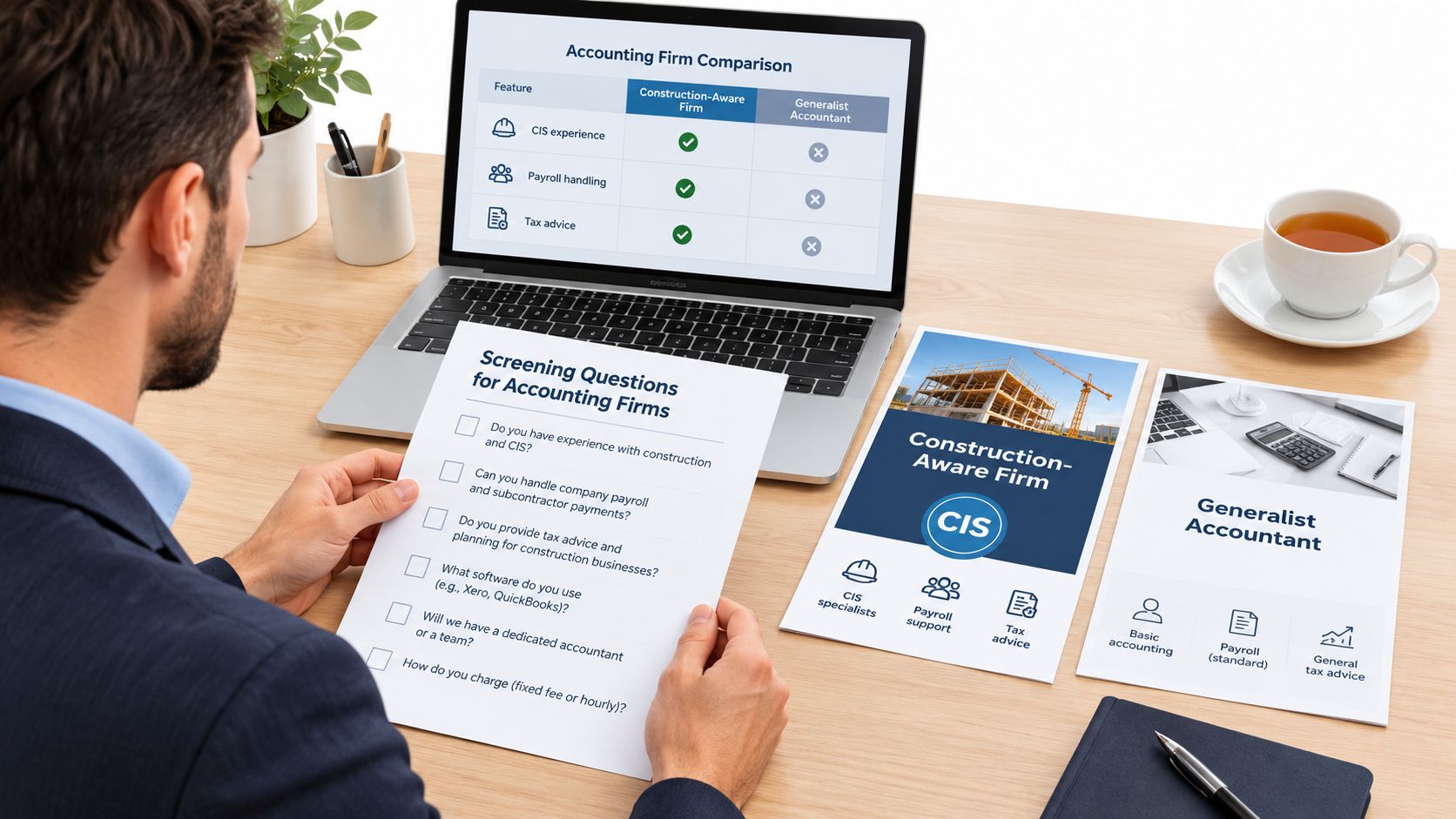
Questions to ask before you agree
Ask each provider:
- CIS experience: Do you handle subcontractor verification, deduction records and monthly CIS returns?
- VAT treatment: How do you check whether the domestic reverse charge applies and record it correctly?
- IR35 and status: What information do you review about the contract and working practices, and when do you refer a specialist issue?
- Software and reporting: Which system will you use, and will you show project costs, aged debt and retentions clearly?
- Scope and fees: What's included in the fee, what costs extra, and who is responsible for submitting each return?
- Communication: Who handles your account, how can you reach them, and what response times can you expect?
Before the first meeting, gather your current accounting records, recent bank information, open contracts, invoices, subcontractor details, payroll records, VAT and CIS correspondence, and a list of overdue customer payments or outstanding retentions. You don't need to arrive with perfect books. You do need to be honest about what's missing and how far behind the records are.
A construction-aware firm should ask about your payment chain, contracts, subcontractors and cash cycle, not only your annual turnover. Be cautious if a provider promises a structure is automatically more tax-efficient, can't explain who submits returns, or avoids setting out what its fee covers. A guide to choosing an accountant can help you prepare for those conversations.
Watch the presentation below for another perspective on questions worth asking when comparing providers.
Choose a provider that fits the risks and complexity you face. A sole trader with straightforward records may need a different package from a limited company managing subcontractors, payroll and retention receivables. Action Accountants Limited provides bookkeeping, payroll, VAT and CIS-focused support for contractors and subcontractors, alongside wider accounting and advisory services.
Common Compliance Mistakes and the Year Ahead
A missed deadline is often the visible symptom of weak records. The fix is usually less complicated than the consequences, but it needs to happen before the next payment or return is due.
- Late CIS returns: Keep a monthly submission routine and reconcile it to subcontractor payments. A late or inaccurate return creates avoidable HMRC compliance problems and leaves your ledger harder to trust.
- Incorrect subcontractor details: Check identification and tax details before payment, then retain the evidence. Errors can mean deductions or reporting don't match the person you paid.
- Unreviewed IR35 status: Assess the actual engagement, not just the contract label. A missed employment-status issue can lead to incorrect PAYE treatment and tax exposure.
- Standard VAT treatment on a reverse-charge supply: Check the customer, service, VAT status and any end-user notification before posting the invoice. Incorrect treatment can distort VAT returns and cash forecasts.
- Spending tax reserves: Keep money committed to tax separate from funds available for drawings or project costs. If you use it to cover a cash gap, the liability still comes due.
Structure choices matter most when trading conditions worsen. The Insolvency Service reported 4,056 construction firm insolvencies in the year to May 2025, while construction accounted for 23% of trader bankruptcies in the 12 months to January 2026 (Insolvency Service figures in the government impact assessment). These figures don't predict an individual contractor's outcome, but they make one point clear: bookkeeping should help you spot pressure early, and business structure should be chosen with liability and tax responsibilities in mind.
Over a working year, organised records make it easier to check deductions, support claims, prepare returns and defend the business's position if HMRC raises a query. They also help you see whether a customer is paying late, a project's costs are rising or tax reserves are being used to fund ordinary spending. Don't wait for year-end to find out your books have stopped reflecting the business you're running.
If you're a contractor in Colindale or elsewhere in North West London, arrange a review of your structure, CIS and VAT processes, records and cash-flow controls with Action Accountants Limited. Bring your current accounts, open contracts and a list of outstanding invoices, and ask for clear advice on what to fix first.