How to Prepare Management Accounts Step by Step
Learn how to prepare management accounts with a clear monthly close process, KPI pack, and cash forecast tailored to UK SMEs and founders.

You're probably looking at a month-end profit figure that says one thing and a bank balance that says something else entirely. The sales landed, the invoices went out, payroll cleared, VAT is looming, and yet the cash in the account doesn't feel anything like the profit in the report. That's the moment most founders realise bookkeeping and management accounts aren't the same job.
I've seen this most often with contractors, consultants, and growing SMEs around London. They export a P&L from the ledger, call it “management accounts”, and then make decisions on numbers that haven't been reconciled, adjusted, or translated into cash consequences. That's how a business can look profitable on paper and still get squeezed by unpaid invoices, VAT timing, CIS deductions, or deferred costs. If you want to learn how to prepare management accounts properly, the work starts well before you press “run report”.
Table of Contents
- What Management Accounts Are Really For
- Setting Up the Records and Chart of Accounts
- Running a Tight Monthly Close
- Posting the Adjustments That Matter
- Choosing KPIs That Actually Change Decisions
- Turning Profit Into a Cash Forecast
- Scaling the Pack as the Business Grows
What Management Accounts Are Really For
By day five of the close, most founders want a simple answer. Are we doing well or not? The trouble is, the first number they look at is often profit, and profit on its own is a poor operating guide if the underlying records aren't clean and the balance sheet hasn't been reviewed.
Management accounts are a decision pack, not a compliance artefact. In practice, that pack usually includes a profit and loss account, balance sheet, cash view, aged receivables and payables, and a small set of KPIs that show what changed and what management needs to do next. Statutory accounts look backwards and satisfy filing requirements. Management accounts should arrive quickly enough to influence pricing, hiring, collections, supplier negotiations, project delivery, and tax planning while there's still time to act.
Why cadence matters more than design
A pretty template won't rescue a weak close. What matters is whether the same discipline happens every month. Transactions are posted continuously, reconciliations are completed on time, judgement calls are documented, and the pack lands in management's hands while the month still feels current.
That discipline is much easier now that digital record keeping is normal rather than optional. HMRC found that the share of UK businesses using software or apps for record keeping rose from 72% before Making Tax Digital to 87% afterward, and 18% of those who previously didn't use software started doing so under MTD, according to the HMRC Making Tax Digital for VAT final evaluation. That matters because timely management accounts depend on records being maintained as the month happens, not rebuilt at quarter end from inboxes and memory.
Practical rule: If your monthly pack doesn't change a decision, it's just delayed bookkeeping.
Who actually uses the pack
The reader isn't only “finance”. In a small business, the pack is for the founder, operations lead, project manager, and sometimes an external adviser. Each of them needs a different answer from the same numbers.
- The founder needs to know whether profit is converting into cash.
- Operations needs to see whether jobs, service lines, or teams are producing margin.
- Whoever chases debtors needs a clean aged receivables report with expected collection dates.
- Anyone approving spend needs to know what is committed, what is optional, and what can wait.
That's why how to prepare management accounts isn't mainly about formatting. It's about producing a monthly pack that answers one hard question. What should management do differently because of these numbers?
Setting Up the Records and Chart of Accounts
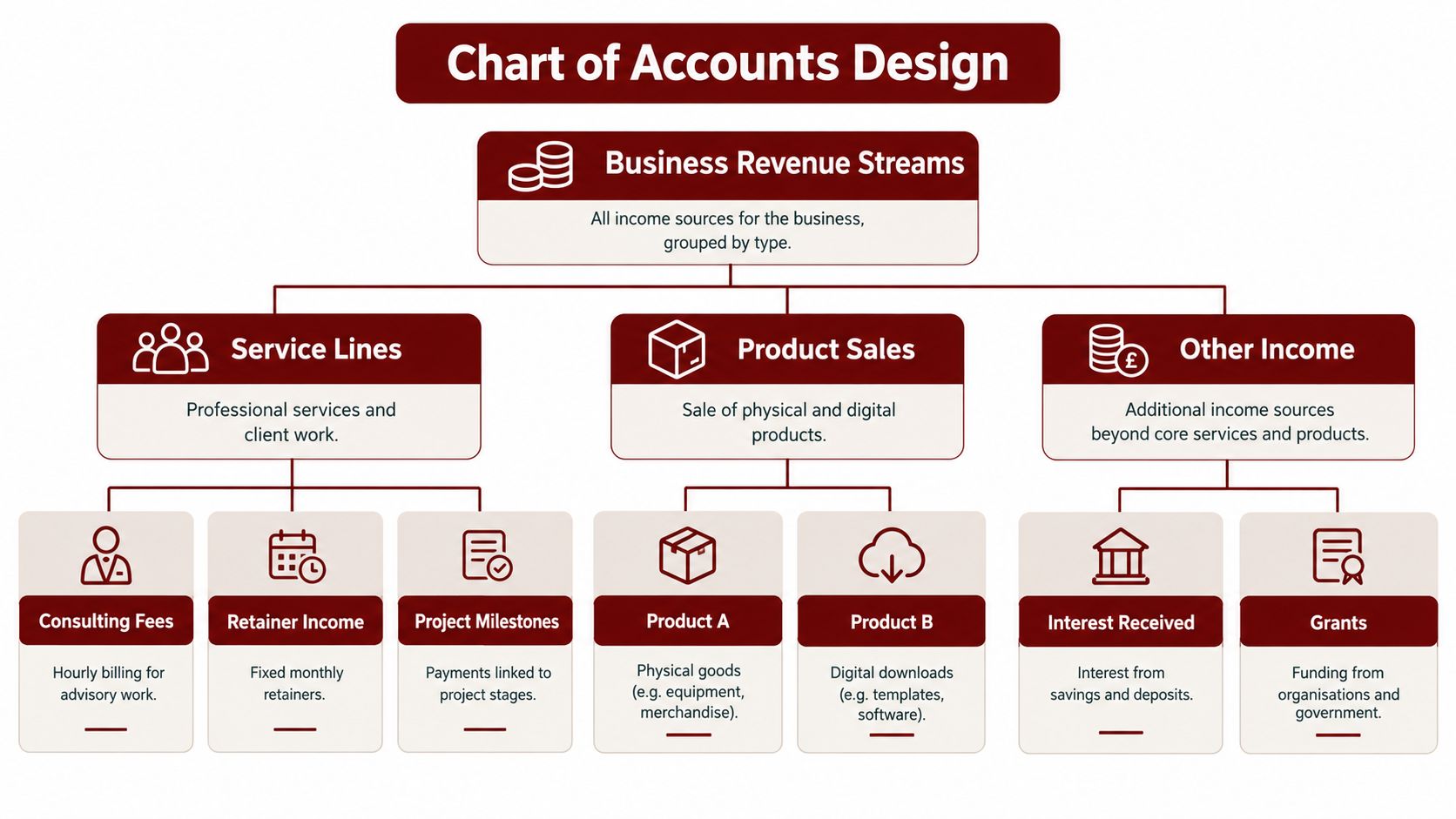
Most month-end pain starts with a chart of accounts that was set up for tax filing rather than management. If the ledger only tells you “sales” and “overheads”, you can't see which service line is carrying the business, which projects are leaking margin, or whether subcontractor cost is drifting.
A workable setup begins with the way the business earns money. Revenue should be split by meaningful streams, not by whatever default nominal codes came with the software. Direct costs should sit close to the revenue they support. If you're in construction or contractor services, that usually means separate lines for labour, subcontractors, materials, plant, travel, and CIS-related items where relevant. If you run a service business, it often means distinguishing retained work, project work, and one-off fees.
Build the ledger around how you manage
The simplest test is this. Can you produce all of the following without rebuilding the numbers in a spreadsheet?
- A service line or project P&L
- A gross margin view
- A credible balance sheet
- A debtor and creditor ageing
- A cash-focused month-end summary
If not, the ledger design is doing too little. A clean nominal ledger is the backbone of the whole process, and it's worth understanding how those categories drive reporting in practice through this guide to the nominal ledger structure.
The digital baseline that makes month-end possible
You won't run a tight close from paper files, screenshots, and manual rekeying. HMRC estimated that businesses using fully compatible software under Making Tax Digital save between 26 and 40 hours per year on business finances and record keeping compared with previous methods, and 40% of surveyed businesses said they spent less time preparing VAT returns, as set out in HMRC's estimate of the wider economic benefit of Making Tax Digital. In practice, that saved time is what lets a small team close the month properly instead of scrambling to catch up.
What works for UK SMEs is usually straightforward:
- Use compatible cloud software with bank feeds, purchase capture, VAT support, and access controls.
- Store documents digitally so cut-off testing is possible at month end.
- Post transactions continuously rather than batching them once a quarter.
- Restrict journals and master-data changes to the people who understand the impact.
For contractors who need something more specific, especially around job costing and day-to-day bookkeeping choices, I'd point people to Growth 4 Trades' recommendations because they're grounded in how trade businesses operate rather than in generic software feature lists.
Clean records don't mean overcomplication. They mean the ledger reflects the business you run, not the tax return you file later.
One practical point that gets missed. User permissions matter. Sales staff shouldn't be able to rewrite coding history, and casual users shouldn't be posting journals into control accounts. Most bad month ends aren't caused by technical accounting. They're caused by loose access, inconsistent coding, and documents that can't be traced.
Running a Tight Monthly Close
A monthly close needs a sequence, ownership, and a rule that nothing is "basically done". If the bank reconciles but the sales ledger doesn't, the P&L can still mislead you. If payroll is posted but liabilities aren't checked, wages might be right while the balance sheet is wrong. With that discipline, small businesses either build trust in their numbers or lose it.
I prefer a controlled close that starts with a hard cut-off date and a locked reporting period. Once the period is closed for routine posting, you pull the trial balance and work down the balance sheet. That order matters. The balance sheet tells you whether the P&L deserves to be believed.
What each reconciliation is proving
Each reconciliation has a job. Bank and credit card reconciliations prove the cash position is real. Sales and purchase ledger reconciliations prove customer and supplier balances agree to the underlying invoices and credit notes. Payroll reconciliation proves wages, PAYE, pension, and net pay have all landed where they should. VAT control proves the return agrees to the ledger position. Loan and director current account reconciliations prove you aren't mixing business performance with financing or drawings.
Government-commissioned research found that 41% of London businesses experienced delayed customer payments, while 36% of SMEs nationally reported that more than one-third of monthly payments arrived late, according to the late payments research on the impact on the UK economy. That's why debtor and creditor ageing belongs in every close. If collections slip, cash tightens quickly, even when revenue looks fine.
A proper bank close also needs supporting evidence. If your team needs a refresher on the standard, this summary of the bank reconciliation process is a useful benchmark.
Monthly Close Checklist for UK SMEs
| Step | What to Reconcile | Owner | Sign-Off Evidence |
|---|---|---|---|
| Lock the period | Reporting date and posting window | Finance lead or founder | Closed period note, cut-off list |
| Reconcile cash | Bank accounts and credit cards | Bookkeeper or finance assistant | Reconciliation report, bank statements |
| Check trading ledgers | Sales ledger and purchase ledger | Finance lead | Aged reports tied to control accounts |
| Verify payroll and taxes | Payroll, PAYE, pension, VAT control | Payroll or finance manager | Payroll reports, tax summaries, ledger tie-out |
| Review financing balances | Loans and director current accounts | Finance lead or external accountant | Supporting schedules and movement analysis |
| Clear problem balances | Suspense, unreconciled items, unusual journals | Named account owner | Investigation notes and correcting journals |
| Final review | Balance sheet, P&L, cash commentary | Founder and finance lead | Sign-off note with actions |
The sign-off rule that saves trouble
I'm sceptical of management packs that go out with “we'll tidy that up next month” attached to key balances. That approach always catches up with the business.
- Every balance sheet account needs an owner. Someone should know what it is, why it moved, and where the support sits.
- Unreconciled items need a decision. Clear them, reserve for them, or flag them in the commentary.
- Unusual journals need explanation. If a journal materially changes profit, cash, or tax exposure, document who posted it and why.
No monthly pack is final until unexplained reconciling items are either cleared or explicitly quantified and assigned.
That's the standard that turns a month-end close into something management can use with confidence.
Posting the Adjustments That Matter
Bookkeeping captures transactions. Management accounts adjust timing so the month reflects what the business earned and incurred. Without that step, you're reading cash movements and invoice dates as if they were performance.

The core monthly adjustments are usually familiar. Accruals for costs incurred but not yet invoiced. Prepayments for costs paid in advance. Depreciation on fixed assets. Payroll liabilities for PAYE, pensions, and wages owed at period end. Where management reporting needs it, a corporation tax estimate can also be included so profit isn't read as fully spendable.
The adjustments most small teams miss
The misses tend to be operational, not academic. A software renewal gets expensed in one month instead of spread. A subcontractor cost lands late and inflates margin in the wrong period. Deferred income sits untouched even though the work has started. Suspense balances are left hanging because the month-end deadline is approaching.
For contractors and subcontractors, the distortion can be sharper. CIS deductions, retentions, certified applications, variations, and unpaid valuations all affect whether reported margin reflects real trading performance. If these items are ignored, management ends up reacting to billing timing instead of job economics.
A few journal patterns come up repeatedly:
- Accrual for an unbilled cost
Debit expense, credit accruals. Reverse when the supplier invoice arrives. - Deferred income release
Debit deferred income, credit revenue, as the service or contract obligation is delivered. - Retention adjustment
Record retention separately from ordinary trade debt so collections and margin reviews aren't muddled.
Mini examples that are worth repeating each month
Suppose a subcontractor completed work before month end, but the invoice arrives later. If you leave the cost out, the month's margin looks stronger than it really is. The accrual fixes that. The same logic applies to accountant fees, utilities, and outsourced support that belongs to the month but hasn't yet been billed.
In a CIS environment, I'd also separate what's collectible now from what's tied up in retention or valuation timing. That keeps the debtor report honest. Management can then distinguish “profitable but delayed” from “profitable and collectible”, which are not the same thing.
This short walkthrough is useful if you want a visual reminder of how month-end adjustments feed into cleaner reporting.
A profitable month can still be a strained month. Adjustments tell you whether the issue is performance or timing.
That distinction is the whole point. Once the adjustments are posted properly, you can start trusting the monthly P&L. Before that, it's only a rough draft.
Choosing KPIs That Actually Change Decisions
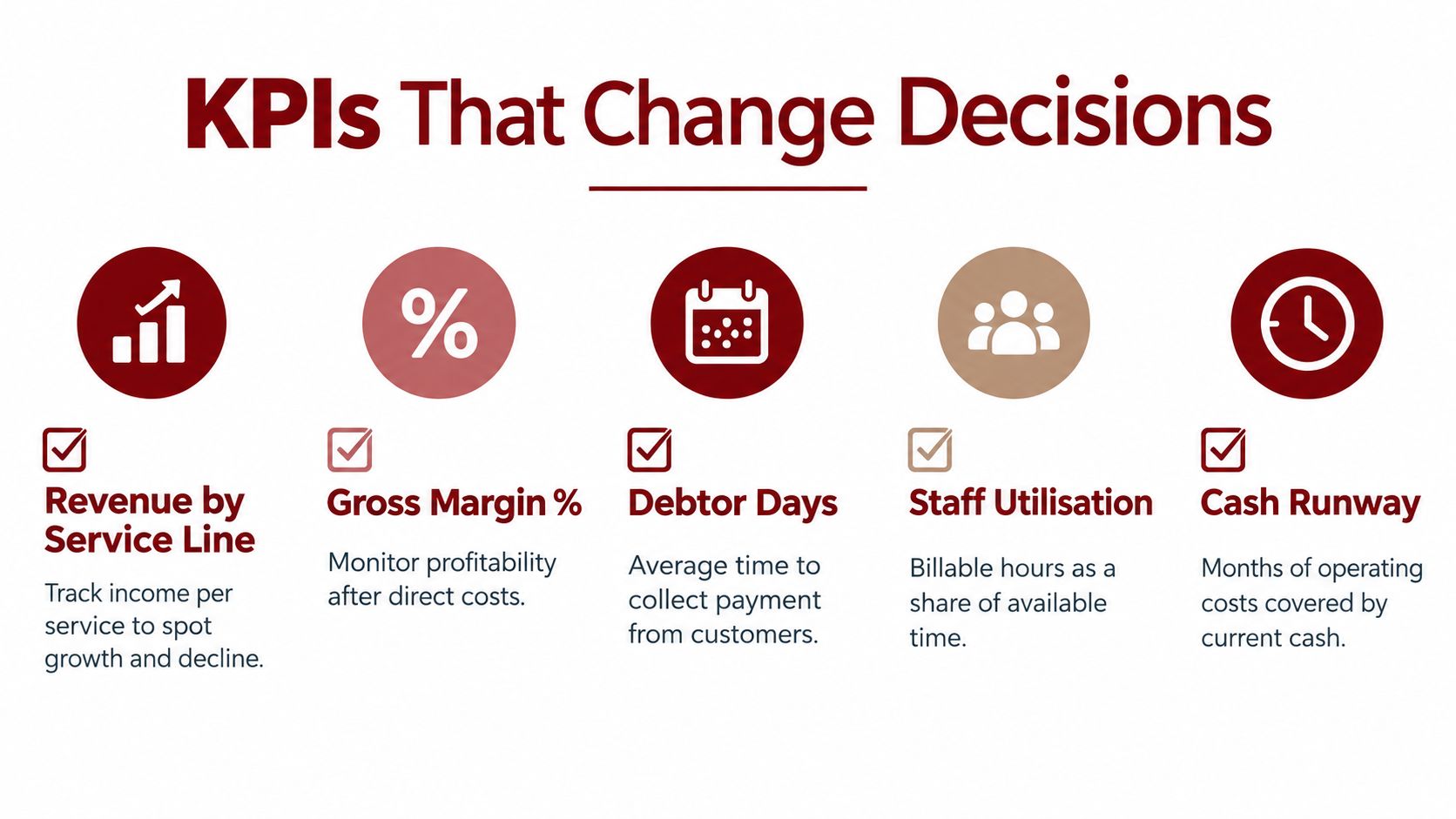
Most management packs carry too many ratios and too little judgment. If nobody changes behaviour after reading the KPI page, the page is decoration. A useful pack keeps the KPI set small and ties each measure to an operational lever someone controls.
Start with the economics of the business. For a service firm, that may mean revenue by service line, gross margin, staff utilisation, work in progress, debtor ageing, and cash conversion. For a contractor, I'd usually add subcontractor cost, retentions, certified applications, and aged valuations so billing timing doesn't disguise project performance.
Set thresholds before you review
The mistake I see often is that teams discuss variances emotionally instead of systematically. A sensible review rule combines a percentage threshold and a fixed sterling threshold. Percentage-only rules can miss a meaningful cash issue on a smaller line. Fixed-only rules can create noise around normal month-to-month movement.
Government research found that the mean proportion of late customer payments was 17% overall and 18% in construction, and 49% of small businesses said customers took longer than agreed terms, according to the UK government's executive summary on payment performance and practices. That's a strong reason to treat receivables KPIs as operating measures, not just finance admin.
A few KPIs are worth keeping on the first page:
- Revenue mix: Which service line, customer segment, or project type is driving change.
- Margin quality: Whether gross profit is holding after direct labour, materials, or subcontractors.
- Collection pressure: Which debtors are overdue, disputed, or slow-paying.
- Capacity use: Whether labour is deployed profitably or sitting underused.
- Cash conversion: Whether accounting profit is turning into bank liquidity.
For project environments, how to choose project KPIs is a useful external read because it connects metrics to delivery behaviour rather than just reporting format.
Every variance needs an owner
A good commentary line is short and concrete. What changed, why it changed, what the cash consequence is, and what action follows. That's enough.
If you want a wider framework for reading the numbers once they're prepared, this guide to financial ratio analysis helps put individual KPI movements in context without turning the pack into a textbook.
Management note: A variance without an owner is just an observation.
That's the discipline to keep. Every material variance should have a cause, a named owner, a corrective action, and an expected financial effect. If the team can't write those four things, they probably don't understand the movement yet.
Turning Profit Into a Cash Forecast
Generic advice usually falls apart at this point. A technically correct P&L can still give dangerous guidance if it ignores when cash moves. Founders don't fail because they misunderstood accrual accounting in theory. They fail because the VAT bill, payroll run, supplier pressure, and slow receipts hit the bank before the profit ever turns into cash.
That risk isn't abstract. 47% of surveyed UK small businesses reported cash-flow challenges in June 2025, 9% described cash flow as a major problem, and 22% said they couldn't accurately predict costs or profit margins, according to the OFX UK SMB Report. If you're preparing management accounts and not ending with a cash view, you're leaving the most urgent question unanswered.
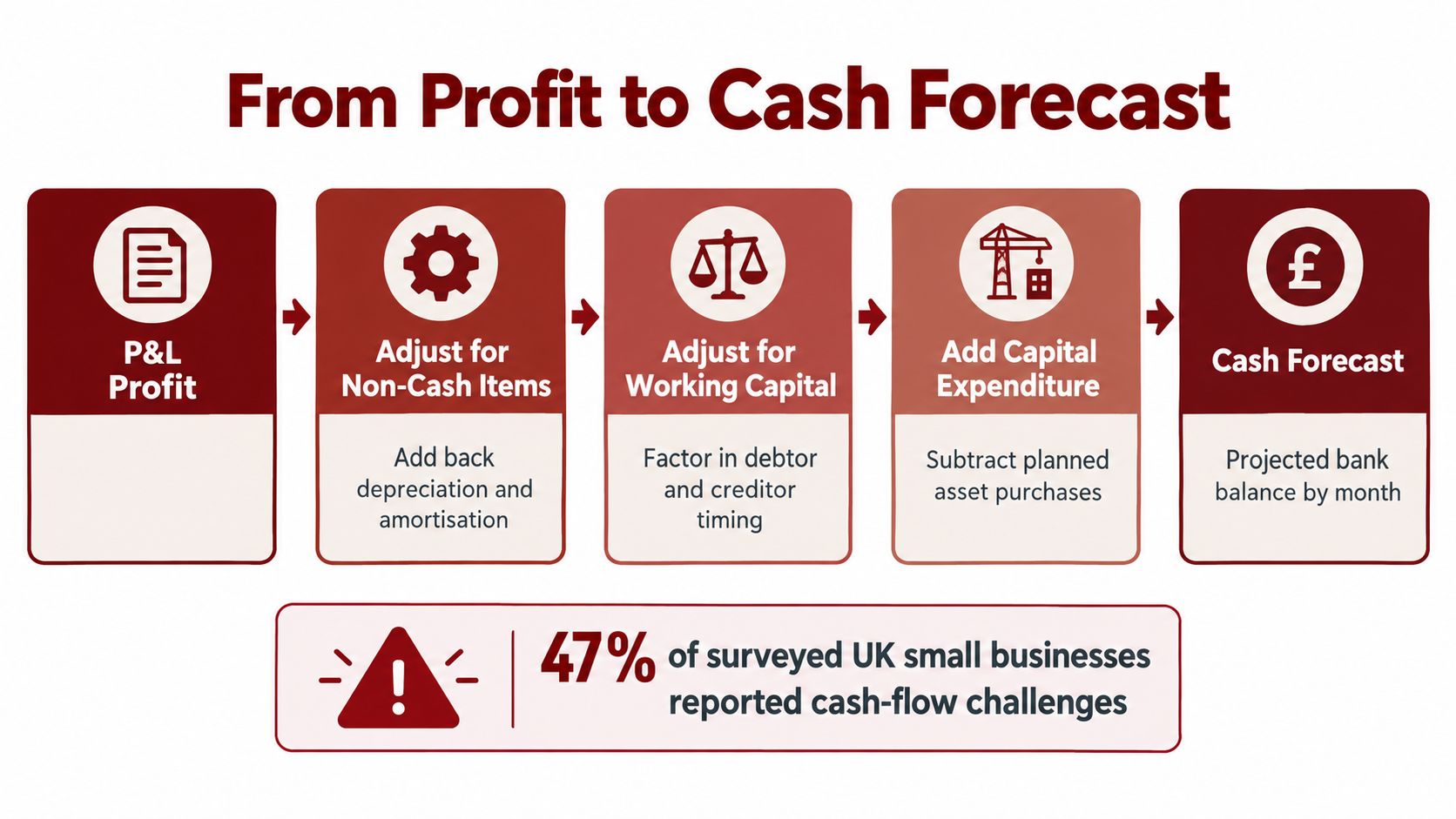
The bridge from accrual profit to bank liquidity
Start with the month's profit, then strip out what didn't affect cash and layer in what will.
- Remove non-cash items, such as depreciation.
- Adjust for working capital, especially debtors, creditors, and tax balances.
- Include statutory and payroll timing, including VAT, PAYE, and CIS-related payments where relevant.
- Add financing movements, such as loan repayments and director drawings.
- Subtract capital expenditure that will hit the bank but not the P&L immediately.
That process is why a profitable month can still coincide with a falling bank balance. Sales may be up, but if debtors are stretching, VAT is due, and a new asset was bought, liquidity can tighten fast.
A practical weekly forecast beats a monthly comfort blanket
I'd always pair monthly management accounts with a rolling 13-week cash forecast. Weekly is the right rhythm because cash stress rarely arrives monthly. It arrives on a Thursday when payroll clears before a large customer pays.
A useful forecast separates:
- Committed payments, such as wages, rent, taxes, loan repayments, and key suppliers
- Likely receipts, based on invoice-level collection expectations rather than optimism
- Discretionary spend, which can be paused if collections slip
- Stress cases, where slower receipts are modelled before the problem becomes urgent
For founders who want a ready-made structure to build from, this financial roadmap builder is a sensible reference point because it pushes planning beyond a single-month snapshot.
If you need the accounting side of that bridge set up properly, including how the forecast ties back to reporting, this guide on cash flow forecasting is the right internal starting point.
Profit explains performance. Cash decides survival.
That's the trade-off too many guides gloss over. If receipts weaken, you may need to pause non-essential spend, renegotiate supplier timing, or arrange finance before the month-end accounts are even final. Management accounts should help you make that call early, not explain afterward why the bank got tight.
Scaling the Pack as the Business Grows
The pack that works for a founder-led business won't be enough forever. As the company grows, hires staff, takes on more projects, or joins a group structure, management accounts need more definition, not just more pages.
From 6 April 2025, the UK small-company thresholds increased to £15 million turnover and £7.5 million balance-sheet total, with the 50-employee limit unchanged, and qualification generally depends on meeting at least two of the three criteria, according to Companies House guidance on company size thresholds. That change affects statutory reporting, but it doesn't remove the need for reliable internal management information. If anything, growth increases the need for clearer ownership, tighter KPI definitions, and better cash oversight.
A tiered design works better than one template
A practical progression looks like this:
- Lean founder pack for sole traders and micro businesses. P&L, balance sheet, aged debtors, tax view, short cash forecast.
- Growing-company pack for SMEs. Department or service-line margin, budget variance, working-capital analysis, management commentary.
- Project or division pack for contractors and more complex businesses. Job profitability, retentions, customer concentration, covenant and tax monitoring.
The sign-off standard should stay the same at every size. What changed, why it changed, the cash consequence, and who acts next. If your management accounts can answer those four points every month, they're doing their job.
If you want help building a close process that produces reliable monthly numbers, cash-aware reporting, and management accounts that fit the way your business runs, Action Accountants Limited can support that work alongside bookkeeping, VAT, payroll, CIS-aware reporting, and management consulting. Visit Action Accountants Limited to see how the firm helps founders, contractors, and growing SMEs turn month-end numbers into practical decisions.