Accountants for Charities: A Practical UK Guide
Find the right accountants for charities in the UK. Learn what they do, how SORP, Gift Aid and VAT work, typical fees and what to check before you hire.
You're preparing for a trustee meeting. The bank balance looks comfortable, the manager wants approval for running costs, and a grant report is due. But the accounts don't clearly show which money belongs to funded projects and which money trustees can commit. Before approving another payment, you need a better answer than "there's enough in the bank".
Table of Contents
- Why Charities Need Specialist Accountants
- What Charity Accountants Actually Do
- SORP, Independent Examination and Audit Thresholds
- Specialist Versus General Accountants
- Typical Fees and How to Read a Quote
- Getting Ready for SORP 2026
- Choosing and Working with Your Accountant
- Key Takeaways for Trustees
Why Charities Need Specialist Accountants
Consider a hypothetical community charity in North West London. Its bookkeeper has coded restricted grants and general donations identically. Trustees are about to approve general running costs using cash that a donor intended for a particular programme.
Nobody needs to have acted dishonestly for this to happen. A tidy ledger can still give trustees the wrong information. The immediate problem is an unsafe spending decision; the wider problem is whether trustees can explain the charity's use of funds to the donor.
The bank balance isn't the spending budget
Accountants for charities should treat fund accounting as a control, not a year-end adjustment. Their job is to connect each funding agreement to the ledger, the programme budget and the reports trustees receive.
Commercial bookkeeping experience is useful, but it isn't enough on its own. A charity needs accounts that distinguish the resources available for general operations from money committed to specific purposes. Without that distinction, trustees can mistake restricted cash for usable reserves.
The scale matters. The wider UK voluntary sector generated £69.1 billion of income and spent £65.4 billion in 2021/22, according to the NCVO UK Civil Society Almanac executive summary. These are voluntary-sector figures, not figures solely for registered charities, but they demonstrate why financial oversight deserves serious board attention.
Charity accounts should let trustees follow the money from a funding commitment to the public benefit it supports.
Protect delivery without weakening restrictions
Good accounting doesn't turn restricted funds into unrestricted money. It helps trustees identify legitimate programme expenditure, document permitted allocations and avoid using general donations for costs that a funding agreement properly covers.
That's the distinction behind protecting cash for mission delivery. Use restricted money correctly, rather than treating restrictions as an obstacle to work around.
Ask for a service proposal that connects reporting, donation administration, tax assessment and staff costs to trustee decisions. It should also explain the assurance route, the fee structure and the work needed for SORP 2026. Buying an accounts template without those controls leaves the underlying risk untouched.
What Charity Accountants Actually Do
A useful engagement produces evidence trustees can use, not just submissions they can file. Specify the outputs before discussing software or price.
Four core services and the files they produce
| Service area | What the accountant does | Artefact for trustees |
|---|---|---|
| SORP accounts and fund reporting | Prepares the applicable accounts, reviews fund classifications and supports the trustees' annual report | Draft accounts, fund schedules and a report-preparation checklist |
| Gift Aid | Assesses eligible donations, maintains declaration records and manages the agreed claims process | Declaration register, claim schedule and exception list |
| VAT | Reviews activities, recovery positions and any partial-exemption or trading-subsidiary questions | Written VAT assessment and supporting calculations where applicable |
| Payroll and governance | Processes staff pay, addresses pension administration and connects employment costs to budgets | Payroll approval pack, cost allocation schedule and management accounts |
For trustees who want broader reporting context, CEFCore's financial reporting for nonprofits guide is a supplementary resource. Keep the charity's applicable UK reporting requirements as the basis for decisions.
Take a hypothetical youth charity with grant-funded activities, donations, paid staff and trading income. Ask the accountant to trace these activities through the same reporting system rather than maintain disconnected spreadsheets.
For SORP work, the grant agreement should support the recognition policy and the fund schedule. The board needs to understand both the accounting treatment and the expenditure still committed to delivery.
Gift Aid needs a different evidence trail. Ask who checks declarations, resolves incomplete records and approves claims. Don't accept an assumption that every receipt described as a donation belongs in a claim.
Connect tax and staff costs to programme decisions
For VAT, request an assessment before budgeting on the assumption that tax can be recovered. Where mixed activities create recovery questions, ask for the reasoning and supporting calculation, not just a return total.
Payroll should show trustees the cost of employing people across activities, including the administration relevant to pensions. Agree how timesheets or another documented allocation method will support charges to funded projects.
A payroll and bookkeeping service scope can help frame the operational tasks to discuss. Your engagement must still identify who supplies information, who approves it and who investigates discrepancies.
The board dashboard should bring these outputs together: programme commitments, unrestricted headroom, staffing costs and unresolved accounting issues. The test is whether trustees can make a defensible decision from it.
SORP, Independent Examination and Audit Thresholds
Start with the charity's legal form and jurisdiction, not its bank balance. Then establish gross income, gross assets, governing-document requirements and funder conditions.
The accounting basis and the assurance requirement are separate decisions. Preparing accruals accounts doesn't, by itself, mean the charity needs an audit. Equally, a small organisation shouldn't assume that modest income overrides a contractual requirement for scrutiny.
Establish the reporting route
The government guidance on charity accounts and charitable-company rules sets out these reporting and assurance milestones:
- Receipts-and-payments eligibility: Eligible non-company charities with income of £250,000 or less may use receipts-and-payments accounts; SORP supplies the framework for true-and-fair accruals accounts.
- Lower-income scrutiny: Charities with gross income of £25,000 or less generally don't need an independent examination or audit unless their governing document or funding agreement requires one.
- Independent examination: Above £25,000 and up to £1 million, examination or audit may usually be chosen, subject to applicable requirements. Above £250,000, an examiner must belong to a recognised professional body.
- Registered-charity audit thresholds: An audit is required when gross income exceeds £1 million, or income exceeds £250,000 and gross assets exceed £3.26 million.
- Charitable-company thresholds: The higher statutory thresholds include income above £1.5 million, or income above £500,000 combined with gross assets above £5 million.
Have your accountant confirm how the relevant rules apply to your reporting period and structure. Don't treat an England-and-Wales decision as a substitute for checking the position elsewhere in the UK.
Apply the rules to the organisation
A modest unincorporated charity should first establish whether simpler accounts remain appropriate. A CIO needs its own income-and-assets assessment, not an assumption based on another community organisation's accounts.
A charitable company needs the company and charity requirements considered together. If its governing document promises an audit, a threshold discussion alone won't settle the question.
Use this explanation of audit exemption thresholds as preparation for that conversation, not as a charity-specific conclusion. Require a written reporting-route assessment, including whether SORP 2026 affects the accounts being prepared.
Specialist Versus General Accountants
Choose demonstrated charity competence over a label on the website. A general practice with an experienced charity lead may be a better appointment than a self-described specialist who can't explain your funding model.
The comparison should focus on evidence. Ask candidates to work through a grant agreement and describe what they would need before taking responsibility for the accounts.
Compare the answers that matter
| Criterion | Evidence to request | An inadequate answer |
|---|---|---|
| SORP fluency | Explanation of relevant policies and transition work | “Our software produces charity accounts” |
| Gift Aid experience | Examples of declaration checks and claim administration | “We'll look at donations at year-end” |
| Regulator and funder reporting | Relevant assignments and verifiable references | General business clients presented as equivalent |
| Trading activities | A clear approach to assessing activities and specialist tax input | Blanket assumptions about charity tax treatment |
| Trustee access | Named meeting support and an escalation arrangement | Contact only through an accounts-preparation inbox |
A cheap quote can become expensive if trustees later have to fund recoding, rebuild schedules or explain inconsistent reports. That isn't an argument for buying the most expensive service. It's an argument for checking whether the quoted work addresses the charity's actual risks.
Test their approach to controls
Ask how the accountant would respond if the same person created suppliers, approved invoices and released payments. You want a workable separation of responsibilities, not a recommendation for elaborate procedures nobody will follow.
The Charity Commission's internal financial controls guidance recommends involving more than one person in receiving income and authorising expenditure, alongside fraud-risk reviews, documented procedures and appropriate training. A competent adviser should translate that guidance into controls suited to your staffing and payment methods.
Watch for these warning signs:
- No funding review: The firm quotes without asking about grant conditions or fund balances.
- No transition ownership: Nobody can identify who will assess SORP 2026.
- No accountable contact: Questions pass between staff without a named decision-maker.
Appointment test: Ask for verifiable charity references and a clear explanation of what the firm will do when the records are incomplete.
Typical Fees and How to Read a Quote
There isn't a defensible universal tariff for charity accounting. Transaction volume, fund complexity, record quality, staffing, trading activities and assurance requirements all affect the work. Budget from written proposals, not an unsupported headline price.
Ask firms to price the same scope. Otherwise, a low quote for statutory accounts can appear better value than a proposal that also includes bookkeeping review, trustee reporting and transition support.
Build an annual fee schedule
For a hypothetical CIO, separate recurring work from year-end work and assurance. This makes the overall commitment visible without pretending that a generic fee range fits the organisation.
| Quote component | What to clarify |
|---|---|
| Bookkeeping | Processing, coding review, reconciliations and correction of old records |
| Payroll | Included administration, changes, pension support and additional charges |
| Management accounts | Frequency, fund detail, commentary and trustee meeting support |
| Year-end accounts | Drafting, annual-report assistance and supporting schedules |
| Examination or audit | Separate scope, provider, evidence requirements and timetable |
| SORP transition | Policy assessment, opening records, disclosures and training |
Include software subscriptions and handover work in the comparison. Ask whether the quote assumes clean records and what happens if that assumption proves wrong.
Read the engagement letter as a control document
A fixed fee is useful only when the scope is fixed. Check which tasks trigger additional charges and require approval before the firm undertakes them. For time-based work, agree a budget cap and a notification point.
Gift Aid shouldn't be hidden behind “tax services”. State whether the engagement includes declaration maintenance, claim preparation, submission support or only advice.
Likewise, “accounts preparation” doesn't automatically tell you whether trustees will receive management reports or help drafting the reserves-policy explanation. Either include that work or assign it explicitly elsewhere.
- Ownership: Name the person responsible for the relationship and the person authorised to approve extra fees.
- Assurance boundaries: Distinguish preparation support from the examiner's or auditor's separate responsibilities.
- Delivery conditions: Record both the firm's deadlines and the charity's information deadlines.
- Exit arrangements: Confirm access to records, working schedules and a supported handover.
A quote that omits trustee reporting or reserves-policy support isn't necessarily unusable. It is incomplete unless the board has deliberately arranged those functions elsewhere.
Negotiate scope before price. Removing unnecessary work is sensible; removing the evidence trustees need isn't.
Getting Ready for SORP 2026
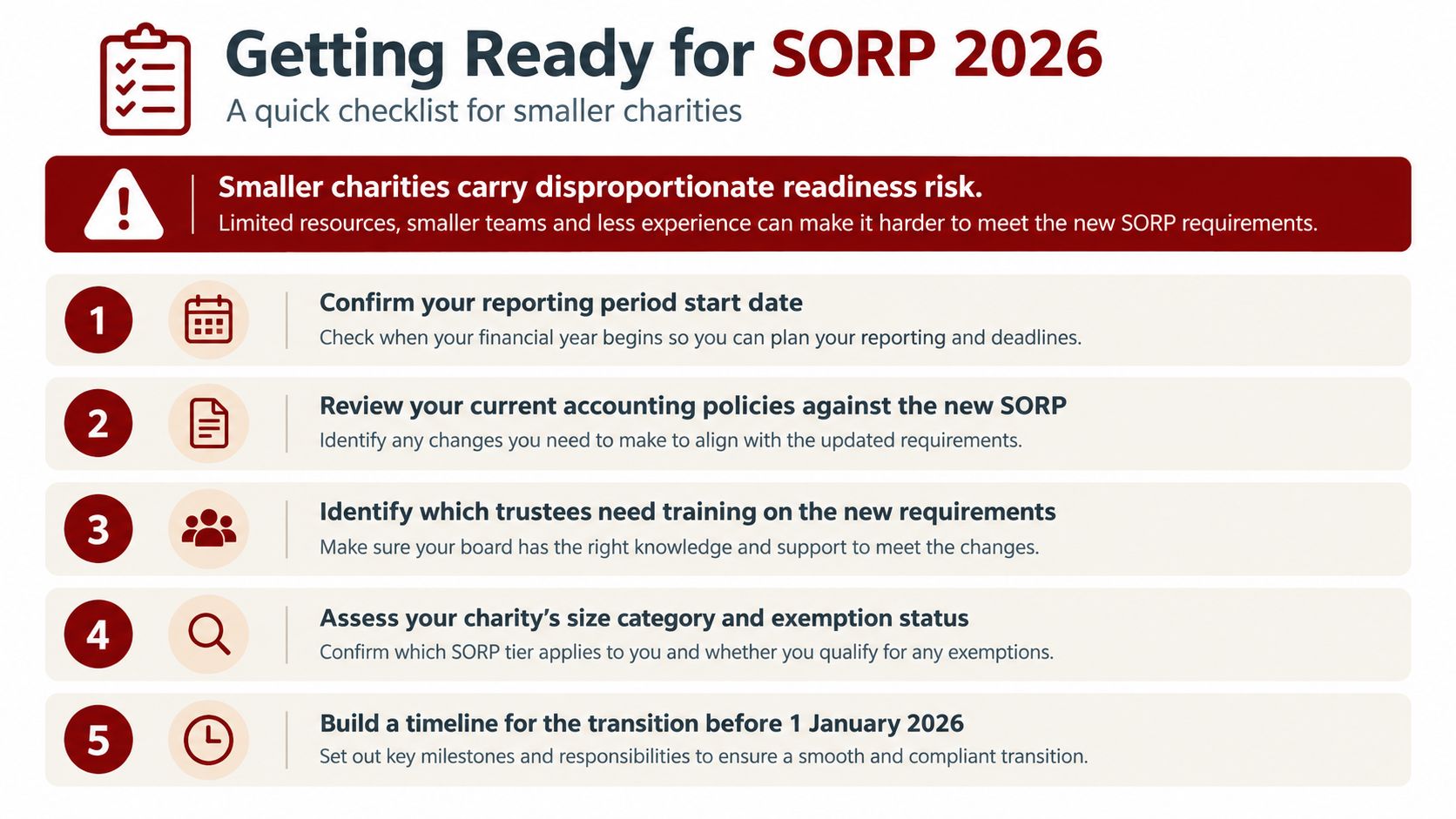
SORP readiness is a records-and-controls project, not a template change. In my judgement, smaller charities can face greater implementation risk because the same small team may handle bookkeeping, funding administration and report drafting without much independent review.
The government announcement on the new charity accounting rules confirms that SORP 2026 applies to reporting periods beginning on or after 1 January 2026, introduces three income-based reporting tiers, and adds requirements covering income recognition, leases, reserves, future plans, impact and ESG reporting.
Use the checklist as a board discussion aid. Its pre-transition timeline now needs adapting to your actual reporting period and any work already outstanding.
Rebuild the evidence before drafting disclosures
Begin with a written applicability assessment. For a trust or unincorporated association, confirm the appropriate accounting basis. For a CIO or charitable company, assess the requirements for that structure rather than borrowing another charity's transition checklist.
Then give each workstream an owner:
- Income policies: Index grant agreements, donation conditions and trading contracts. Ask the accountant which streams need revised recognition policies and what evidence supports each conclusion.
- Lease records: Gather signed agreements, amendments and payment schedules. Let the accountant determine the applicable treatment before changing the ledger.
- Reserves documentation: Match the policy to the board's commitments and the required disclosures. Keep the reasoning and approval record.
- Narrative evidence: Organise programme outcomes, future plans and relevant environmental information so trustees aren't reconstructing explanations during accounts approval.
- Opening schedules: Resolve unexplained balances and identify missing supporting records before the reporting timetable becomes urgent.
A review of FRS 102 changes can support the technical conversation. Require charity-specific conclusions rather than importing a commercial accounts checklist unchanged.
Make the board approve the transition plan
The video can accompany a trustee briefing, but the accountant should still document the decisions that apply to your charity.
Agree the sequence: assess applicability, review policies, repair records, draft disclosures and obtain trustee approval. Set deadlines against the actual year-end and assurance timetable.
Don't wait for the examiner or auditor to identify missing evidence. Being below an audit threshold doesn't make incomplete records an acceptable transition strategy.
Choosing and Working with Your Accountant
Send prospective firms an information pack before requesting proposals. Include the legal structure, latest accounts, funding arrangements, reporting calendar, staffing details and unresolved issues. A candid pack helps you compare meaningful proposals rather than introductory sales promises.
Ask questions that expose responsibility
- Relevant experience: Which comparable charities can provide references, and who performed their work?
- Technical ownership: Who will decide the accounting policies and lead SORP transition work?
- Fund reporting: What will trustees receive between statutory reporting dates?
- Quality assurance: Who reviews the preparer's work and resolves difficult judgements?
- Delivery recovery: What happens if information is late or the named manager is unavailable?
Ask candidates to show an anonymised management-report format and explain the issues they would escalate. Good answers identify people, documents and decision points.
Verify professional-body registration, professional indemnity insurance and the named client manager. Obtain a written response-time commitment and an escalation route that reaches someone authorised to act.
A polished website isn't evidence of technical competence. Operosus's accountant website design services provide useful context for recognising that presentation is a separate discipline from accounting capability. Judge the firm's work and references, not its visual identity.
Agree how the relationship will operate
Use a simple selection flow: prepare the information pack, obtain comparable proposals, discuss the difficult issues, check references, approve the engagement and organise the handover. This guide to choosing an accountant can help structure the appointment discussion.
After appointment, agree a calendar covering trustee reports, reserves-policy review, donation administration and control checks. Place SORP actions on that calendar with named owners, rather than leaving them in a separate technical email.
Late management accounts are a relationship problem worth preventing at the outset. Set a fixed monthly close, define the information needed from staff and nominate a single coordinating contact.
The accountant must explain delays promptly. The charity must supply complete records on time. Trustees should review both sides of that agreement instead of accepting repeated slippage as normal.
Key Takeaways for Trustees
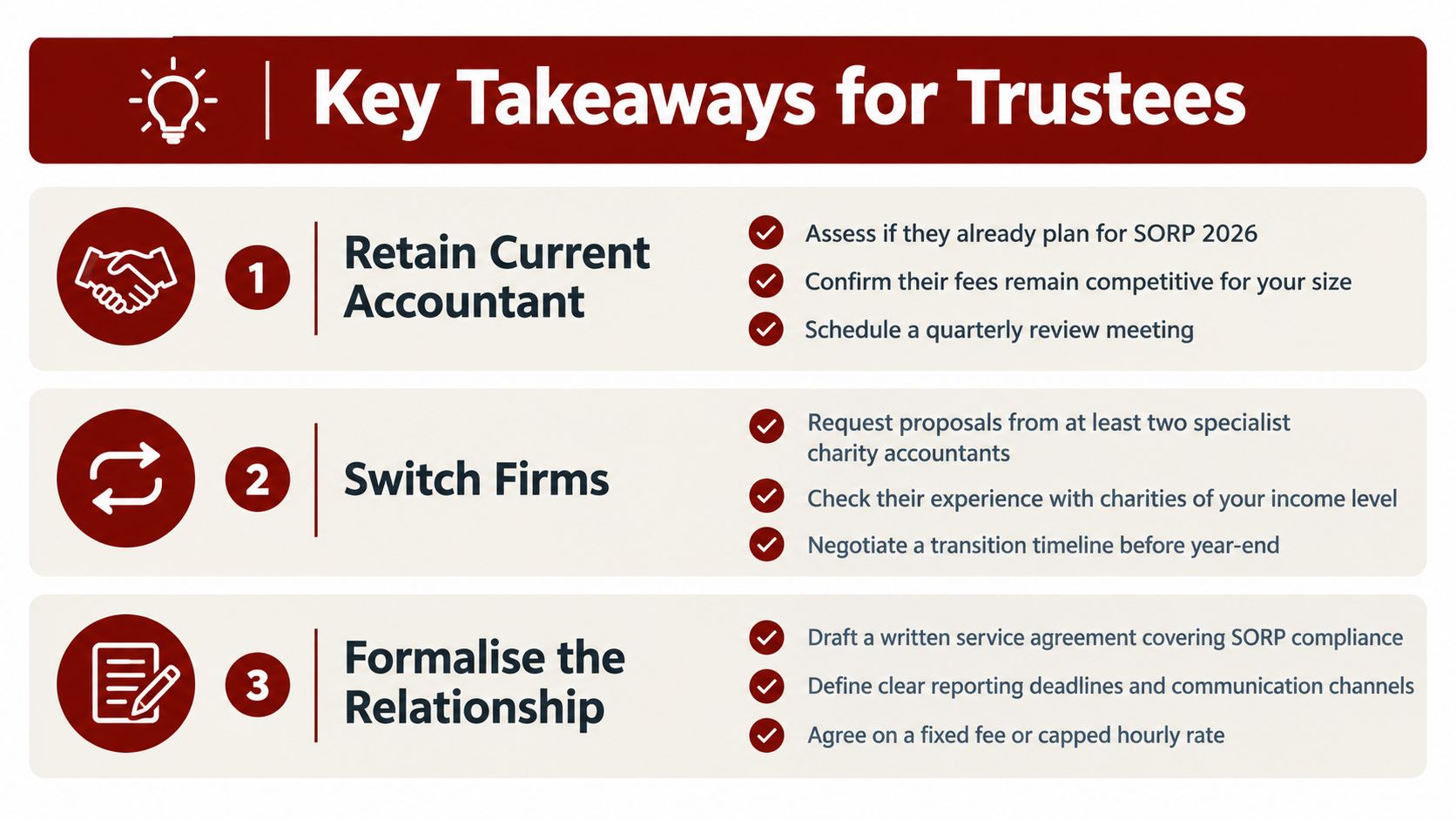
Make an explicit board decision: retain the accountant, switch firms or formalise the relationship. Don't allow the appointment to continue by default because changing arrangements feels inconvenient.
The right route depends on capability and accountability, not whether trustees like the person handling the accounts. Use the decision summary to turn the discussion into an agreed action.
Choose the route and record the reason
- Retain: Keep a capable accountant who provides usable reports and owns the transition work. Refresh the scope and resolve any service gaps. Record what trustees expect next.
- Switch: Replace a firm that can't demonstrate relevant competence or repeatedly misses agreed deliverables. Arrange a controlled handover before ending access. Make ownership of outstanding work explicit.
- Formalise: Keep a workable relationship but replace informal assumptions with a written agreement. Specify reports, deadlines, fees and escalation. Ensure nobody mistakes goodwill for an assigned responsibility.
Whichever route you choose, preserve the basic financial disciplines. The Charity Commission's essential trustee guidance supports monthly bank reconciliations reviewed by another person, banking funds gross rather than net of costs, documenting the reserves policy for accruals accounts and retaining accounting records for at least six years.
Give trustees a compact evidence pack
Keep the reporting-route assessment, service schedule, transition plan and latest management report together. Add a short list of unresolved matters, each with an owner and a deadline.
Trustees don't need to reproduce the accountant's technical work. They do need to understand the conclusions, challenge unexplained balances and know which commitments the charity can safely make.
A useful accountant makes those decisions clearer without pretending to remove trustee responsibility. That's the standard to apply when approving the appointment, reviewing performance or authorising the next programme commitment.
Action Accountants Limited offers bookkeeping, payroll, statutory accounts, compliance and management advisory support to help trustees organise reliable records and clearer financial reporting. Visit Action Accountants Limited to discuss your charity's current arrangements, the scope of support you need and how to coordinate specialist input for SORP readiness.