Small Tax Business in the UK: What Founders Actually Need
A practical UK guide to small tax business essentials — covering PAYE, VAT, Corporation Tax, MTD readiness, and compliance for London founders.

You've got six months of receipts in a carrier bag, a VAT notice on the kitchen table and a payroll message you meant to answer last week. The problem isn't that you're bad at business. It's that one busy month can create several tax obligations, and they don't wait for you to sort out the paperwork at year-end.
For a small tax business, good compliance starts by seeing the whole picture. An invoice can affect VAT, payroll, Corporation Tax, Self Assessment and, in construction, CIS. Treat those as connected cash and record-keeping decisions, not separate boxes to tick.
Table of Contents
- What Small Tax Business Headlines Hide
- The Four Tax Obligations Every UK Small Business Faces
- Key Filing Deadlines and What Actually Goes Wrong
- Making Tax Digital for Income Tax in Practice
- VAT, CIS and Payroll, Cash Flow Choices That Decide Survival
- Why Bookkeeping Discipline Matters More Than Software Choice
- A Worked Example for a North West London Small Tax Business
- Your 30, 90 and 365 Day Compliance Checklist
What Small Tax Business Headlines Hide
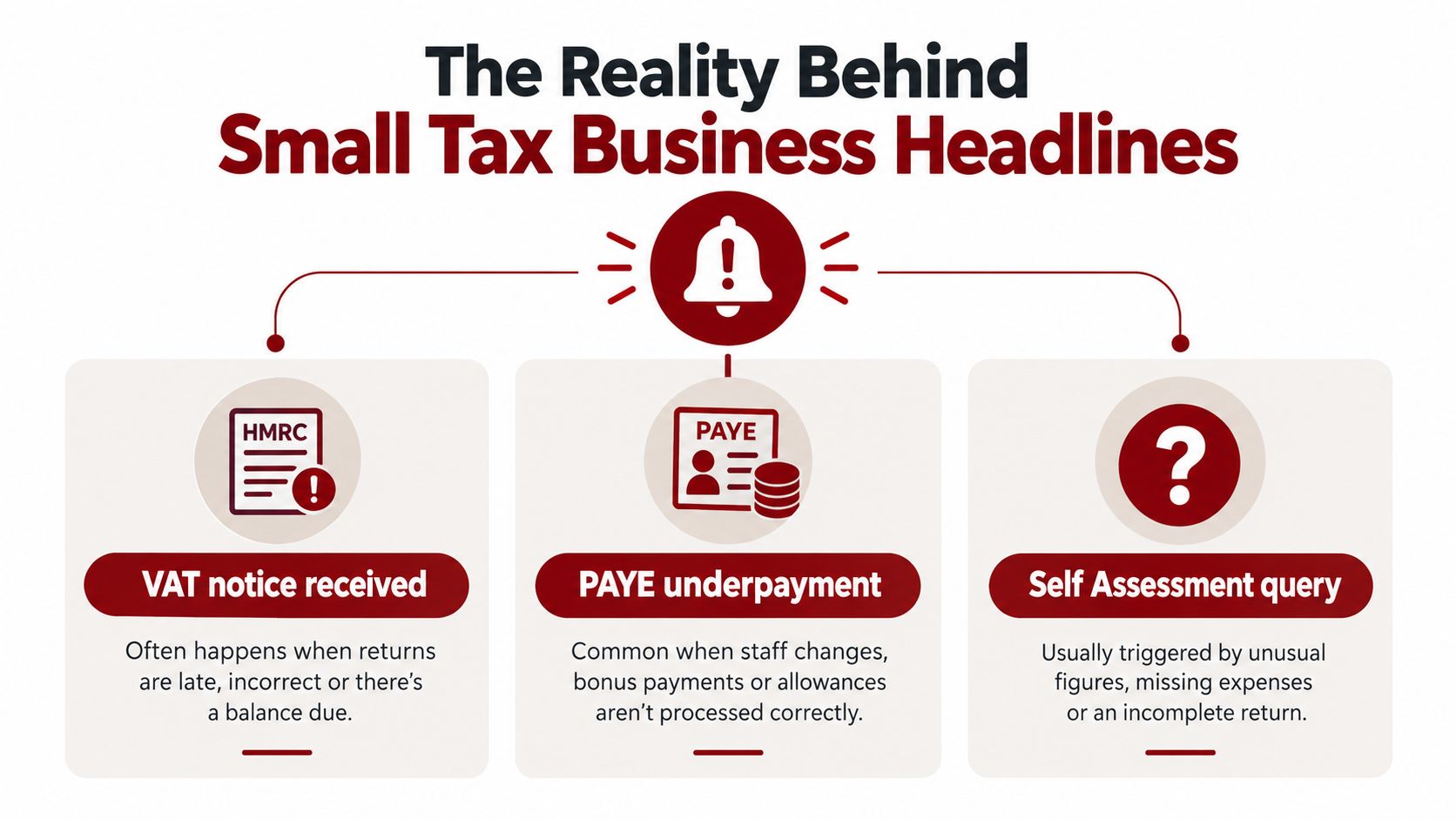
A founder searches for small-business tax advice after an HMRC letter arrives or a filing goes wrong. The temptation is to deal with that notice alone. Start by checking the records behind it: late sales, uncategorised expenses or payroll that does not match the bank can point to a wider reporting problem.
HMRC's 2024–25 customer-group analysis defines small businesses as those with turnover below £10 million and typically fewer than 20 employees. By that definition, the sector included approximately 5.1 million businesses, around 93% of UK businesses. HMRC estimated these firms generated around £45 billion in PAYE and National Insurance contributions, plus approximately £100 billion through other taxes. HMRC's small-business tax figures show why HMRC's view of a business extends beyond its annual Corporation Tax return.
A firm's tax records can cover payroll deductions, VAT, Corporation Tax and a director's or sole trader's Self Assessment. Construction businesses also need to account for CIS. These obligations connect through the same records and cash. A missing subcontractor invoice, for example, can leave the expense total wrong, CIS evidence incomplete and the cash available for tax overstated. One gap can distort several decisions.
Compliance is a cash decision
HMRC estimated that compliance work involving small businesses produced £7.8 billion in additional yield, against approximately £750 million spent on compliance activity. Those figures do not mean every small firm is a target. They show why you should keep records and file on time across each tax stream, rather than focusing on one return and leaving the rest until later.
Build a reference library with find tax resources, then use it to prepare specific questions for your accountant. Check the guidance against your actual sales, payroll and expenses. General information can explain the rules; your records show which obligations apply and what action to take.
The Four Tax Obligations Every UK Small Business Faces
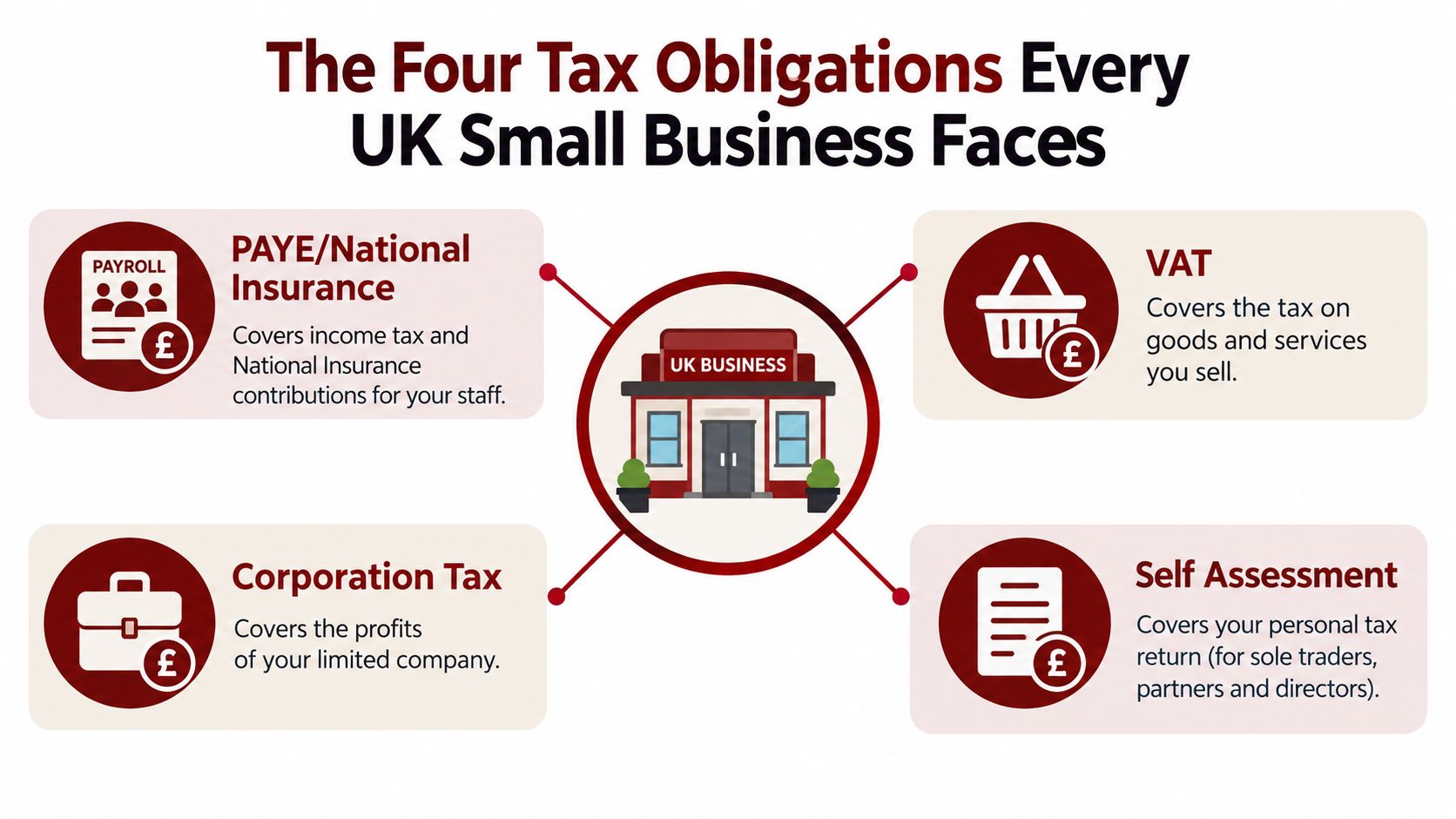
Think of business income as water entering one tank. PAYE, VAT, Corporation Tax and Self Assessment are separate outlets. The same pound can pass through more than one reporting system, but each system measures something different.
Take a £10,000 monthly invoice as a simple illustration. It isn't a tax calculation or a claim that a particular amount is due. The result depends on the invoice terms, business structure, VAT status, expenses and who did the work.
Four outlets, four different questions
- PAYE and National Insurance: If the business employs staff, payroll records the wages and deductions due through the payroll system. The business must account for what it withholds and its employer obligations. A director's salary also needs to be handled through payroll where applicable.
- VAT: VAT asks whether the business must charge and report VAT on taxable supplies, and what eligible VAT it can recover on costs. Registration depends on taxable turnover, not whether the company made a profit.
- Corporation Tax: A limited company calculates its taxable profits under the relevant rules and reports them to HMRC. The invoice contributes to income, but it isn't the company's profit. Allowable costs and other adjustments matter.
- Self Assessment: A sole trader reports business income through their personal tax return. A company director may also need to report personal income, such as salary and dividends, depending on their circumstances.
With the example invoice, payroll may be relevant if staff carried out the work. VAT may apply if the business is registered or required to register. The invoice contributes to company revenue for Corporation Tax purposes, while a director's personal return deals with their own reportable income. One invoice doesn't mean one tax bill.
Practical rule: Record what the transaction is, who it belongs to, whether VAT applies, and how it was paid. Don't rely on the bank balance to tell you the tax position.
For founders building a wider digital presence alongside their finance processes, AI help for your website can support website work. Keep that decision separate from tax compliance: a website tool can't replace reconciled accounts or correctly filed returns.
Key Filing Deadlines and What Actually Goes Wrong
Most deadline failures start well before the due date. A business owner waits for “the paperwork”, then discovers that invoices are missing, a bank feed hasn't been checked or the person responsible for payroll thought someone else was filing. Put the deadline in the calendar, but put the evidence-gathering date earlier.

Tie each return to its evidence
VAT returns are generally filed online, according to the business's VAT accounting periods. Before filing, reconcile the sales ledger, purchase invoices and VAT account. If figures don't match, don't plug the difference with an estimate and hope it disappears next quarter.
PAYE reporting follows the payroll cycle. The employer sends payroll information to HMRC through Real Time Information when employees are paid, and the payroll figures should agree with payslips, payroll reports and payments from the business account. If the business pays subcontractors under CIS, it also needs to reconcile contractor statements, deductions and monthly returns. Keep the payment records and deduction statements with the relevant invoices.
A limited company files its Company Tax Return, usually called a CT600, within the filing deadline set in relation to its accounting period. The tax payment deadline is a separate matter. Don't mistake a filing date for a payment date; confirm both against the company's circumstances and HMRC guidance.
Self Assessment is where people most often leave the job until the last minute. Check income records, expenses and any supporting evidence well before filing. For a plain-English overview of the timing and preparation, read this guide to the UK Self Assessment deadline.
Use the following as a working control, then confirm the exact dates for your business and accounting periods:
| Obligation | Practical control before filing | Evidence to keep |
|---|---|---|
| VAT | Reconcile sales, purchases and VAT balances | Sales invoices, purchase invoices and VAT account |
| PAYE | Match payroll reports to payments and employee records | Payslips, payroll reports and bank records |
| Corporation Tax | Reconcile accounts and tax adjustments | Trial balance, year-end records and supporting schedules |
| Self Assessment | Check income and expenses against source records | Statements, invoices and expense evidence |
| CIS | Match deductions and payments to the contractor records | Subcontractor invoices, deduction statements and returns |
The practical lesson is simple: a missed filing is often the final visible mistake, not the first one. Use a calendar, assign an owner to each return and make the reconciliation part of the routine, not a job for the night before. A short video can help you review how to organise the process before you set your own controls.
Making Tax Digital for Income Tax in Practice
A sole trader can have a thin profit and still fall within MTD. Repairs, materials and other costs reduce what's left, but the entry test is How much qualifying income did I have? For sole traders and landlords, that means gross turnover from self-employment and property before expenses. Start with the income figure on your tax return.
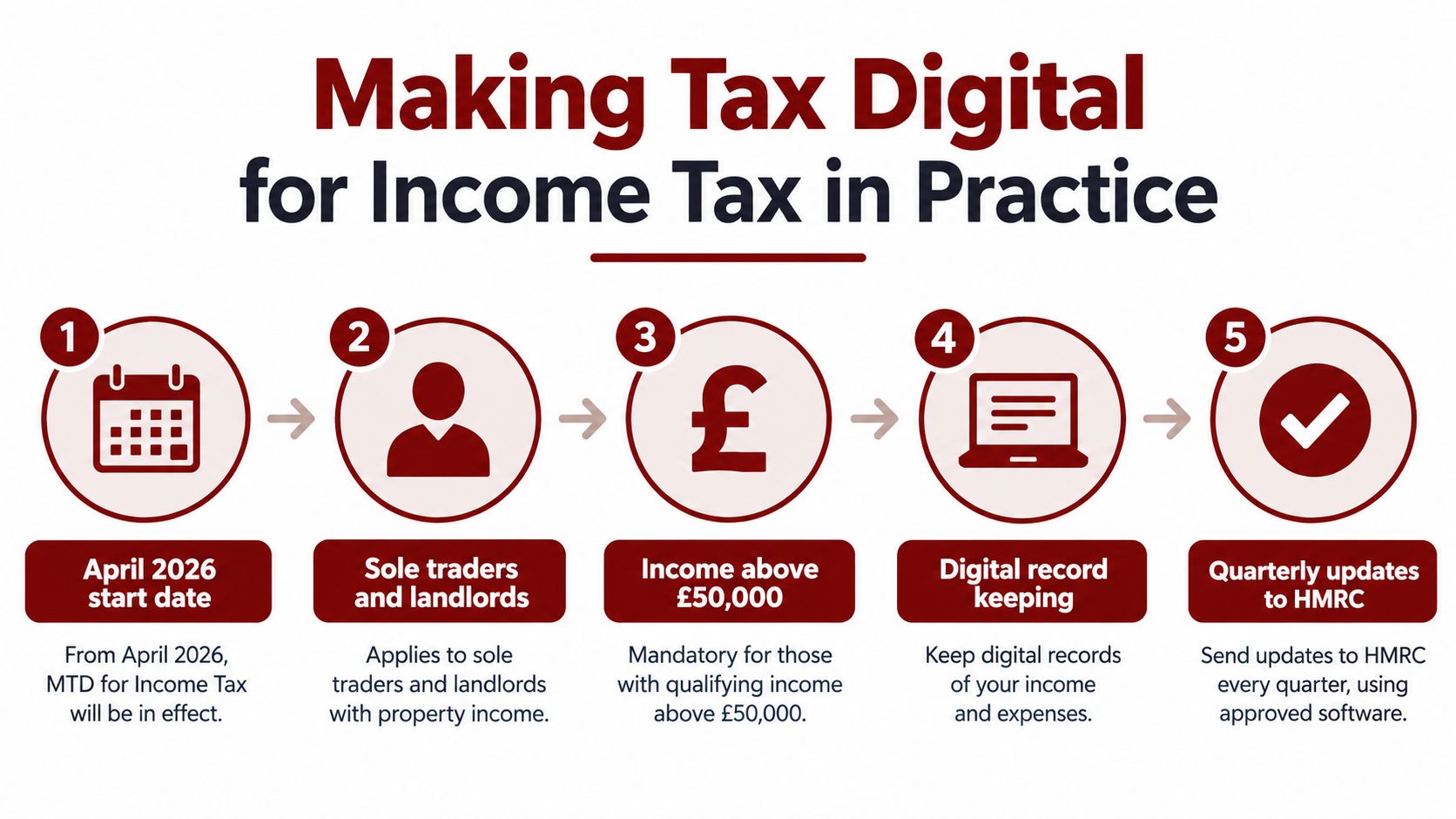
MTD is now in force from 6 April 2026 for those whose qualifying income exceeded £50,000 in 2024–25. Under the current planned schedule, the threshold is due to fall to more than £30,000, based on 2025–26 income, for a start from 6 April 2027, then to more than £20,000, based on 2026–27 income, from 6 April 2028, subject to legislation. Check HMRC's MTD guidance for the requirements and eligibility before deciding your start date.
Make the first quarter a data-quality exercise
Once mandated, you need digital records, compatible software, quarterly income-and-expense updates and an annual tax submission. A wrongly categorised receipt can flow into repeated updates and leave you with corrections at year-end.
Get the income screening done first.
Use the relevant previous tax return, separate self-employment and property income, then check the combined gross qualifying figure before expenses. Record which tax year determines your start date. The government's threshold announcement estimates that the planned April 2028 expansion would bring approximately 970,000 additional individuals with qualifying income between £20,000 and £30,000 into scope. Annual filers below today's threshold should prepare their records now.
For a subcontractor, gross receipts and the amount arriving after CIS deductions need separate attention. For a landlord, rent and expenditure need separate records. The same income feeds different tax and reporting calculations: treating the bank balance as turnover breaks that chain. MTD for Income Tax does not replace separate VAT, payroll, CIS or Corporation Tax obligations where they apply.
For your first quarter, set up software and enter or import transactions. Match bank activity to invoices and receipts, investigate missing or duplicate entries, and review expense categories and private-use items before submitting. Use the quarterly update to review expected tax and cash, while retaining the annual review. The MTD compliance guide can support preparation, but your immediate priorities are a confirmed start date and income records you can reconcile.
VAT, CIS and Payroll, Cash Flow Choices That Decide Survival
A construction subcontractor can be technically compliant and still run short of cash. The usual reason is timing: CIS deductions reduce what arrives from a contractor, VAT collected may need to be reserved, payroll has its own payment cycle, and customers don't always pay when expected.
VAT registration is generally required when taxable turnover exceeds £90,000 in the previous 12 months, or when the business expects to exceed that amount in the next 30 days. Check current HMRC guidance against your circumstances. Voluntary registration before that point may allow recovery of eligible input VAT and may suit some business-to-business pricing arrangements. It can also add reporting, affect customer prices and create working-capital pressure.
Separate the cash buckets
The table below is a qualitative illustration, not a forecast or tax calculation. No amounts are shown because the net effect depends on the contract, VAT treatment, payroll, costs and payment timing.
| Cash Item | Inflow | Outflow | Net Effect |
|---|---|---|---|
| Customer payment | Contract payment received | CIS deduction may reduce the amount received | Less cash arrives than the gross invoice suggests |
| VAT | VAT collected on taxable sales | VAT due after eligible input VAT is considered | Part of the cash may be owed to HMRC |
| Payroll | None directly | Net wages and payroll liabilities | A scheduled cash demand that shouldn't be treated as spare funds |
| Business costs | None directly | Materials, subcontractors and operating expenses | Reduces working cash and may affect taxable profit |
| Corporation Tax reserve | None directly | Transfer to a tax reserve | Cash remains in the business but is not safely available to spend |
| Late customer payment | Expected receipt delayed | Costs and payroll continue | The gap must be funded from working capital |
CIS, VAT and Corporation Tax aren't interchangeable deductions. CIS affects the payment chain and needs to be recorded correctly; VAT follows its own rules; Corporation Tax is based on taxable company profits. Don't treat a CIS deduction as a reason to ignore VAT or assume it settles a company tax bill.
Cash rule: Don't distribute money just because it has reached the bank. First identify VAT due, payroll commitments, operating costs and the company's tax reserve.
If you're weighing how to manage the timing gap, this practical overview of cash flow advice for sole traders can help you think through working-capital habits. A construction business should also review how payroll is recorded and paid. Payroll support for a small business is one place to examine the process, alongside your own payroll reports and bank reconciliation.
Why Bookkeeping Discipline Matters More Than Software Choice
A personal purchase sits among your business card transactions, and the software labels it as an expense. Approve that entry without checking the receipt and you risk overstating business costs or claiming VAT you cannot recover. The dashboard can look tidy while the records underneath are wrong.
Make checking the evidence part of your monthly close. HMRC's distinction between customer groups in its 2024–25 customer-group analysis provides context for small-business compliance, rather than a bookkeeping checklist. Your working records need to support the filings you make.
A monthly close should answer real questions
Reconcile business bank and card accounts at month-end. Match payments to invoices and receipts, chase missing documents, identify costs paid personally and separate private spending. For construction work, match CIS deductions to contractor statements rather than leaving the difference as an unexplained balance.
Follow each transaction through the relevant records. A sale needs the correct VAT treatment where applicable; a CIS deduction needs its supporting statement. Payroll payments must agree with payroll reports, while business costs feed into the taxable-profit calculation. For a sole trader using MTD, those same records also underpin digital reporting. Software cannot resolve a missing invoice or decide whether a purchase was for the business.
Review the exceptions before approving the month.
Which transactions remain unmatched? Which customer invoices are unpaid? Do VAT entries agree with invoices, and payroll reports with bank payments? Investigate duplicate expenses and unexplained transfers while you can still remember what happened.
Assign responsibility for entering, checking and approving records before choosing software. Ask your accountant to flag unresolved items during the year, with clear actions for you to complete.
If keeping records current is a recurring problem, consider bookkeeping support for sole traders. Keep ownership of the review: retain evidence, resolve queries and approve the figures before they become a filing.
A Worked Example for a North West London Small Tax Business
Consider a small limited-company subcontractor in Colindale. The company has two employees, works for a handful of main contractors, and pays its director a salary and dividends. A £60,000 invoice lands during the quarter. That figure is a worked example only, not a claim about a typical contract or a tax calculation.
First, the company checks the invoice terms and records the sale in its accounting system. If the invoice is subject to VAT, the company records the VAT separately from its sales value. When the contractor pays, the bank receipt may be lower than the gross amount because CIS deductions can be taken at source. The company matches the deduction to the contractor's statement instead of treating the missing cash as an unexplained short payment.
The employees' wages go through payroll. The company checks the payroll report against the payslips and bank payments, then submits the required payroll information through the appropriate reporting process. That payroll record is separate from the subcontractor invoice, even though both affect the same business bank balance.
What the director can safely take out
The company then reconciles its costs, checks eligible input VAT, and reviews the quarter's cash commitments. It sets aside money for VAT due and payroll obligations, and estimates its Corporation Tax position from the company's taxable profits, not from the invoice total or the current bank balance.
The director's salary is handled through payroll. Dividends are not another name for leftover cash: the company must check that the distribution is properly supported and that funds are available after business and tax commitments. The director then considers their personal reporting obligations.
The decision point is not “How much of the £60,000 can I withdraw?” It's “What remains after costs, CIS reconciliation, VAT, payroll and the company's tax position are accounted for?” If the records are current, that question can be answered before the cash is spent. If the records are months behind, the bank balance is a poor guide.
Your 30, 90 and 365 Day Compliance Checklist
In 30 days: Reconcile the bank, chase missing invoices, review payroll and assess whether taxable turnover is approaching the VAT registration threshold.
In 90 days: Screen qualifying income for MTD using the relevant previous return, choose compatible software if required and practise quarterly-style reconciliations.
In 365 days: Prepare year-end accounts, check the CT600 and review personal Self Assessment obligations. An accountant makes sense when filing, payroll, VAT or CIS is taking time away from running the business, or when you can't confidently explain your figures.
Action Accountants Limited provides bookkeeping, payroll, VAT, Corporation Tax, Self Assessment and CIS-aware support for founders and contractors in Colindale and across North West London. If your records need a clear process or your tax obligations are crossing over, contact Action Accountants Limited to discuss the support your business needs.