Setting Up a Family Investment Company in the UK
A practical guide to setting up a family investment company in the UK, covering structure, shares, tax, governance and common pitfalls.
You're probably at the kitchen table with a set of investment statements, a property or two, and a growing concern about what happens to family wealth when you're no longer making every decision. Someone has suggested a family investment company as the answer. Before you pay for incorporation documents, decide what you need the company to do, who should control it, and whether the family can live with its costs and rules.
Setting up a family investment company is first a legal and governance project, then a tax-planning exercise. A company can help organise ownership and succession, but it isn't an automatic tax saving or a shortcut around inheritance tax. The right structure depends on the assets, the family's need for income, and the way decisions will be made.
Table of Contents
- Why a Family Investment Company Is a Governance Decision First
- Choosing the Legal Structure and Incorporating the Company
- Share Classes, Ownership and How the Family Will Actually Vote
- Taxes That Actually Apply to an FIC in 2026
- Funding the Company With Loans, Cash and Existing Assets
- Governance, Board Minutes and the Family Decision-Making Habit
- When an FIC Is the Wrong Choice
Why a Family Investment Company Is a Governance Decision First
Two siblings hold equal shares in the company their parents built. One wants dividends to live on; the other wants every pound reinvested. The articles of association say nothing about who wins, and the founder who used to settle these arguments has stepped back.
That is the problem a family investment company solves. An FIC is a private limited company whose shares sit with family members, while directors run the investments day to day. The structure can separate ownership, voting control and economic benefit in useful ways, but only if the family decides in advance how each of those rights works. Incorporation does not settle a disagreement about money. It gives the disagreement a more expensive room to happen in.
Inheritance tax adds urgency, not certainty. The nil-rate band has been frozen at £325,000 since 2009 and is expected to stay frozen until at least 2031, while from April 2027 pensions are expected to be brought within inheritance-tax rules (Evelyn Partners' discussion of FIC planning and inheritance-tax changes). Those pressures justify a review. They do not mean an FIC moves assets out of your estate, because a parental loan to the company stays on the lender's balance sheet.
Be honest about the break-even point too. On a modest portfolio, annual accounts, corporation tax returns and legal advice can eat the return that direct ownership would have kept. A trust may also fit better where the goal is fixed succession rather than shared control. A plain-language Bryan Fagan firm trust guide is a reasonable starting point for that comparison, though UK planning needs UK-specific advice.
My recommendation: Agree what the company is for, who controls it, and what happens when the founder steps back. Incorporate only after those three answers exist in writing.
Choosing the Legal Structure and Incorporating the Company
For most FICs, the starting point is a private company limited by shares. Incorporating is straightforward compared with designing the company properly. The key choices are who owns which shares, who can vote, and what happens when family circumstances change.
Start with the investment mandate and the family's governance expectations. Then identify proposed directors and persons with significant control, or PSCs, and design the share structure. Only after those decisions should you settle the constitutional documents and incorporation details.
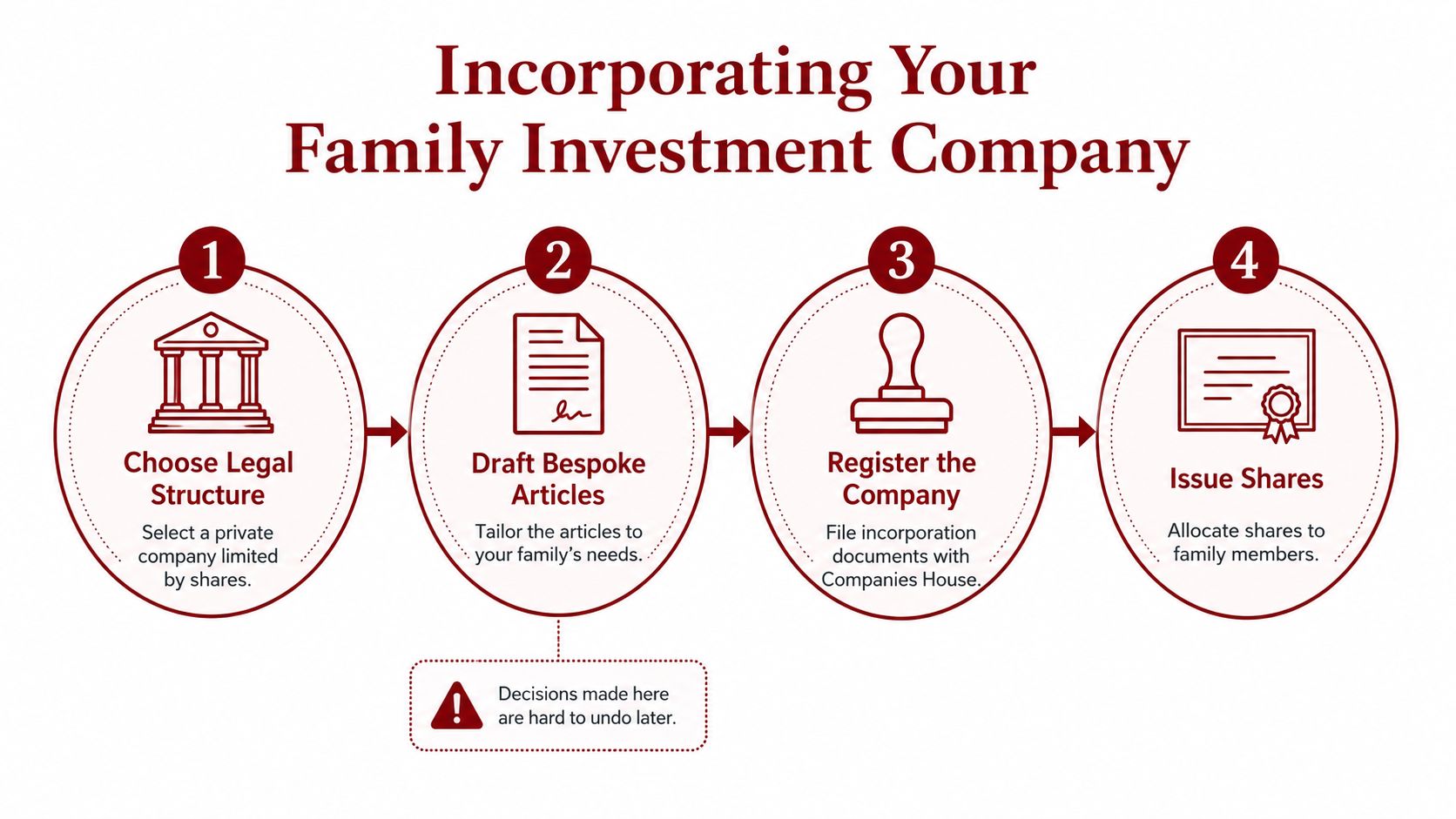
The articles of association need to match the family's actual plan. Address director appointments, reserved matters, transfer restrictions, dividends, conflicts of interest, and what happens on death or incapacity. Default articles may not reflect the arrangements a multigenerational family needs. Companies incorporating with share capital must provide a statement of capital and initial shareholdings, and PSC information is required at incorporation (Companies House guidance on company filings and events).
A recurring mistake is confusing beneficial ownership with legal share ownership. The register of members, share certificates, subscription documents and PSC information must present a consistent account of who owns what and who exercises control. Inconsistencies are more than clerical untidiness; they can complicate later transactions, reviews and family discussions.
After incorporation, open a dedicated company bank account and, where appropriate, an investment account in the company's name. Keep company funds separate from personal money from the outset. If you're comparing a company with another business form, this overview of limited company vs sole trader can help frame the broader structural differences. For a general checklist of formation documents, see new business filing requirements.
Share Classes, Ownership and How the Family Will Actually Vote
Share classes decide who runs the company, so design them before you think about tax. Ordinary shares usually carry voting and economic rights together. Separate classes (often called alphabet shares) split those rights apart: one class can hold the votes while others hold rights to dividends or future growth. The label means less than the precise rights written into the articles.

A common arrangement puts voting shares with the parents and non-voting growth shares with the adult children. That solves the control question and creates three new ones. Who can declare a dividend, and on which class? Can a shareholder sell or transfer shares, and to whom? What happens if one family member needs cash while the rest want profits retained? If the articles and the shareholder agreement stay silent on these points, the family will argue about them later, usually at the worst possible moment.
Two practical recommendations. First, avoid deadlocks: an even voting split between two parents or two siblings is a dispute waiting to happen, so give someone a casting vote or issue a third class. Second, keep dividend flexibility: separate classes let the board pay different dividends to different shareholders, which is much harder if everyone holds identical ordinary shares.
Tax is secondary here, though one distinction is worth making now. The company's tax rate isn't the same as the tax cost to a shareholder taking money out; retained profits and distributed profits are different decisions with different consequences, and the full 2026 rate framework is covered in the next section. Never treat the company's rate as the family's final tax rate.
Gifting shares adds another layer. A gift may be a potentially exempt transfer, and the donor normally needs to survive seven years for the value to fall outside their estate, so timing and the donor's circumstances matter. The share design doesn't remove that rule. If the vocabulary around equity feels slippery, this refresher on shares vs stocks for investors clears up the terms; the core FIC question is always the rights attached to each share, whatever name anyone gives it.
Before shares are issued or transferred, make the register of members, certificates, subscription records and PSC details agree with each other. A shareholder agreement template works well as a discussion prompt, but the signed agreement must fit the company's articles and the family's actual arrangements, not a generic version of them.
Taxes That Actually Apply to an FIC in 2026
Twenty-five percent is the figure families quote, and it is the figure that misleads them. The company's tax rate is not the family's tax rate, and for most FICs the headline number is only the first charge.
The status question comes first. Most family investment companies are close investment-holding companies, and that status generally removes access to the small-profits rate. Profits can be taxed at up to 25% even when they are modest, so a small rental portfolio inside a company does not automatically enjoy the lowest band.
Under the standard regime, HMRC's published rates since 1 April 2023 are 19% on profits of £50,000 or less, 25% above £250,000, with marginal relief between the two thresholds. Have the company's classification confirmed before assuming the lower end applies.
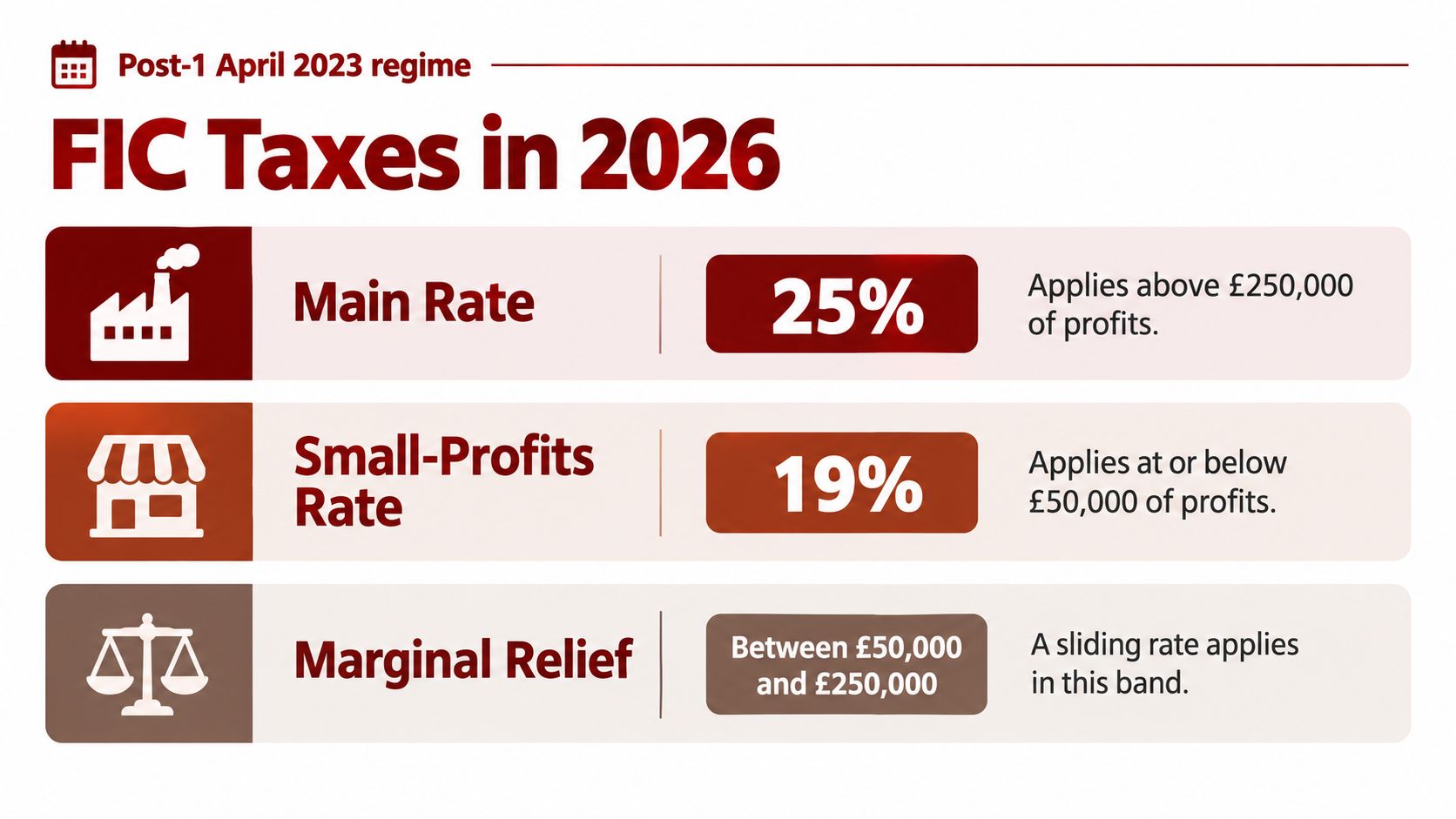
A worked example shows why the headline rate is only half the story. On £100,000 of retained rental profit, a close investment-holding company pays 25%, leaving £75,000 inside the company. The same profit held personally by a higher-rate taxpayer attracts 40% income tax, leaving £60,000, but there is no second charge when that person spends it. The company wins on paper until the family needs the money, at which point dividend tax applies to whatever is extracted. The comparison only works once withdrawal plans are modelled.
That is the honest break-even. A family intending to reinvest for a decade or more benefits from the gap between the company rate and higher-rate income tax compounding internally. A family drawing most of the profit as income pays corporation tax and then dividend tax, and can end up worse off than holding the assets directly. This is why the FIC is a governance project first: the tax outcome follows the withdrawal pattern, and the withdrawal pattern follows decisions the family has to govern.
As noted earlier, the nil-rate band is frozen at £325,000 until at least 2031. Treat that as context rather than a reason to incorporate. A business tax planning review should model the company against personal ownership and a trust using the family's actual figures, because the right answer depends on who needs income, when, and for how long.
Funding the Company With Loans, Cash and Existing Assets
Funding determines what the company can invest and what the family has given up in return. The common routes are a loan, a share subscription or a gift, and they don't achieve the same outcome.
A parental loan gives the company funds while the parent retains a debt claim against it. That loan remains an asset in the lender's estate. Repayment changes the form of the asset, from a loan balance to cash, but doesn't itself reduce inheritance-tax exposure. The potential succession benefit is generally the future investment growth accruing to shares held by younger family members, not the original loan capital.
A gift may move value out of the donor's estate if the rules are met, including the survival period relevant to potentially exempt transfers. But gifting shares or cash needs careful design. The family must consider who controls the company, who receives economic benefits, and whether the donor has effectively retained the benefit of what was supposedly given.
Existing assets need a separate tax review before transfer. Moving an appreciated property or portfolio into the company may trigger capital gains tax for the transferor. A low-cost share subscription doesn't erase the gain built up in an asset already owned personally.
Practical rule: Put the funding terms in writing before money moves. Record whether each amount is a loan or share capital, the repayment terms where relevant, and the board's approval.
If a director is advancing funds, keep a clear ledger and formal records rather than relying on memory. This guide to a director's loan account offers useful context, but a family should document its own arrangement to match the company's circumstances.
Governance, Board Minutes and the Family Decision-Making Habit
An FIC's most durable benefit may be the discipline it imposes on family investment decisions. Directors have to act for the company, not just follow the founder's personal preference without recording why. That distinction protects the company's records and gives family members a shared account of how decisions were made.

Directors should approve investments, related-party transactions, dividend decisions and changes in ownership through properly recorded decisions. Minutes should state what was considered, who attended, any conflict disclosed, and the decision reached. Keep valuation evidence, loan terms and the reasoning behind material investments alongside those records.
Set reserved matters in the articles or shareholders' agreement. These are decisions that need a defined level of approval, such as issuing shares, changing the investment mandate or disposing of a significant asset. A family may also consider an independent director where the founder's influence could otherwise make challenge difficult. Independence is useful only if the person has a real role and the authority to ask uncomfortable questions.
A board meeting shouldn't be a formality where the founder announces a decision already made. Directors need enough information to assess the proposal, particularly when the company is lending to a family member, buying an asset from a shareholder or paying a dividend. Record conflicts and manage them according to the company's documents and legal obligations.
A short operating calendar makes good governance more reliable:
- Monthly: Reconcile bank and investment accounts, record transactions and update bookkeeping.
- Quarterly: Hold board discussions and document investment approvals, related-party dealings and ownership changes.
- At year end: Prepare statutory accounts and tax computations, then review the company's Corporation Tax reporting and payment obligations.
- Before the Companies House anniversary: Check the company's public details against its internal registers and supporting records.
The company must file at least one confirmation statement every 12 months. It can be filed up to 14 days after the review period ends; the online filing fee is £50, compared with £110 for a paper CS01 (Companies House confirmation-statement guidance). Check the registered office, directors, registered email, SIC code, share capital, shareholders and PSC information. PSCs must also meet the current identity-verification requirements.
The confirmation statement is not a tax return. It doesn't replace annual accounts, Corporation Tax reporting, statutory registers or board minutes. Assign the calendar to a named director, with a documented review and sign-off. Keep the company's accounting records, maintain its registered office and ensure filing responsibilities don't disappear into a general family inbox.
A company should never become the family's personal bank account. Separate spending, document loans and dividends, and make investment decisions at board level. That's not bureaucracy for its own sake. It's what makes the legal structure credible and keeps family expectations grounded in records everyone can inspect.
For a visual prompt on the incorporation journey, review the infographic above, then use it as a starting point for a family-specific process, not as a substitute for legal documents.
When an FIC Is the Wrong Choice
Say a family puts £500,000 of listed investments into a new company and it returns 4% a year. At that size, the annual gross saving from paying 25% corporation tax rather than 40% personal tax is roughly £3,000 before withdrawals. If accounts, tax work, registered office support and company-secretarial time cost £2,000 to £3,000 a year, the edge is already gone. Take money out for school fees or living costs and the position can turn negative.
That is the honest break-even test. An FIC tends to work when capital can stay inside the company for years, the portfolio is large enough to absorb fixed professional costs, and the family will run board decisions through minutes and records. It underperforms when the structure is bought for a headline rate.
Regular withdrawals are the clearest warning sign. Profits may compound better inside the company, but dividends or salary to family members can create a second shareholder-level charge. If the parents need income every month, direct ownership is often cleaner.
Modest portfolios and short horizons are next. A company needs accounts, Corporation Tax reporting, statutory registers, confirmation statements, PSC upkeep and documented decisions even in a flat year. Those costs do not scale down because the portfolio had a disappointing year.
As noted earlier, close investment-holding company status can also remove access to the lower corporation tax rates families assume they will get. Do the comparison on the family's own numbers, not on a brochure rate.
A trust can fit better where the priority is succession control rather than reinvestment. Direct ownership can be better where income needs to reach family members now, the asset base is limited, or no one wants the discipline of running a company. If the family will not keep minutes, separate spending and respect the company as a separate legal person, the governance case collapses and the tax case usually goes with it.
Before paying for incorporation, force the awkward questions:
- What will it own? Cash, buy-to-lets, a share portfolio, operating-company shares, or a mix.
- Who controls decisions? Directors, PSCs, reserved matters, and what happens if the founder loses capacity.
- Who benefits? Which children or grandchildren hold growth shares, and who should not hold shares at all.
- How is it funded? Loan, gift, subscription or asset transfer, and what each does to tax and control.
- How long can money stay in? The longer the runway, the more defensible the structure.
- What will it cost to run? Put a realistic annual compliance figure in the model.
Take those answers to an adviser and ask for one comparison table: direct ownership, trust and FIC, using the same return assumption and the same withdrawal pattern. If the FIC only wins after optimistic assumptions, it is the wrong choice.
Action Accountants Limited provides company formation and secretarial support, alongside accounting, tax and compliance advice for founders, investors and family businesses. If you're considering an FIC, discuss the funding, tax modelling and ongoing governance before incorporating with Action Accountants Limited.