VAT Registration for Sole Traders: A Step-by-Step Guide
VAT registration for sole traders explained: the £90,000 threshold, voluntary sign-up, schemes, records, CIS and penalties to avoid.
You've won another job, your invoices are rising, and your bookkeeping suddenly looks less straightforward. You might still have a modest profit, or a bank balance that barely covers materials, yet already need to consider VAT registration. The uncomfortable question is whether you'll be able to add VAT to your prices, or whether you'll have to pay it out of money you thought was yours.
VAT registration for sole traders is a turnover decision first, then a pricing and cash-flow decision. Getting the application submitted matters, but so does choosing the right effective date, protecting your margin and setting up records that support both VAT and Income Tax reporting.
Table of Contents
- Working Out Whether You Must Register
- How to Register for VAT Step by Step
- Choosing Standard, Flat Rate or Cash Accounting
- Records and Making Tax Digital After You Register
- Deadlines, Penalties and the Cost of Registering Late
- CIS Contractors, Subcontractors and Reverse Charge
- Decide Your Registration Position Before Quarter End
Working Out Whether You Must Register
A UK sole trader must register when taxable turnover exceeds £90,000 in any rolling 12-month period, or when there are reasonable grounds to expect taxable turnover above £90,000 in the next 30 days alone, under HMRC's registration rules. For the backward-looking test, notification is required within 30 days after the relevant month ends, and registration normally takes effect on the first day of the second month after that month.
Taxable turnover isn't profit. It's the value of taxable supplies, excluding VAT, rather than what remains after materials, software, subcontractors and other expenses. Separate exempt and outside-scope income before calculating the total.
That distinction catches growing businesses. A trader can spend heavily, draw little personally and still have a registration obligation. Equally, a large bank deposit doesn't automatically represent taxable sales, so don't classify income from the bank statement alone.
Registration tests and what they trigger
Use the following table to identify the decision you need to make. The compulsory tests establish a legal obligation; voluntary registration requires a commercial judgement.
| Test | Trigger | Notify HMRC by | Effective date |
|---|---|---|---|
| Past 12-month test | Taxable turnover above £90,000 at a month end | Within 30 days after that month ends | Normally the first day of the second month after the month of the breach |
| 30-day forward test | Reasonable grounds to expect taxable turnover above £90,000 in the next 30 days alone | Within 30 days of the expectation arising | Beginning of the period creating the registration obligation |
| Voluntary registration | Below the compulsory threshold, with a commercial reason to register | When you choose to apply | Requested date, subject to HMRC's acceptance |
| Leaving the scheme | Expected taxable turnover meets HMRC's deregistration conditions, or taxable trading stops | Apply to deregister when eligible | Date accepted by HMRC |
Don't treat deregistration as an automatic consequence of a quiet month. Prepare a forecast and obtain confirmation rather than stopping VAT invoices.
Voluntary registration can make sense where customers can recover VAT and your eligible purchases carry substantial input VAT. However, reclaiming purchase VAT isn't a free benefit: you also take on sales VAT, record-keeping and return obligations. HMRC's threshold publication confirms that registration below the compulsory threshold remains voluntary.
Build a month-end control
A spreadsheet works if someone updates it consistently. Your bookkeeping software is more useful when its sales classifications are reliable.
- List taxable sales by month. Reconcile the figures to invoices and credit notes, not just bank receipts.
- Move the rolling window forward. Add the latest month and remove the oldest month from the calculation.
- Compare the total with the registration threshold. Record the result and who checked it.
- Keep evidence of forward expectations. Save dated contracts, accepted orders and forecasts showing when a substantial new commitment became reasonably certain.
For example, a freelance designer whose rolling sales move above the threshold at March month end would notify HMRC during April and normally register from the beginning of May. The important distinction is between the month of the breach, the notification deadline and the effective date.
Our UK VAT registration threshold guide provides further context for reviewing your position. Run the calculation at every month end, and record the relevant dates immediately rather than leaving them for the year-end accounts.
How to Register for VAT Step by Step
A defensible application starts with a reconciled sales calculation, not an estimate typed into a form. You should be able to explain why registration is required, why the proposed date is correct and how the forecast relates to work you expect to deliver.
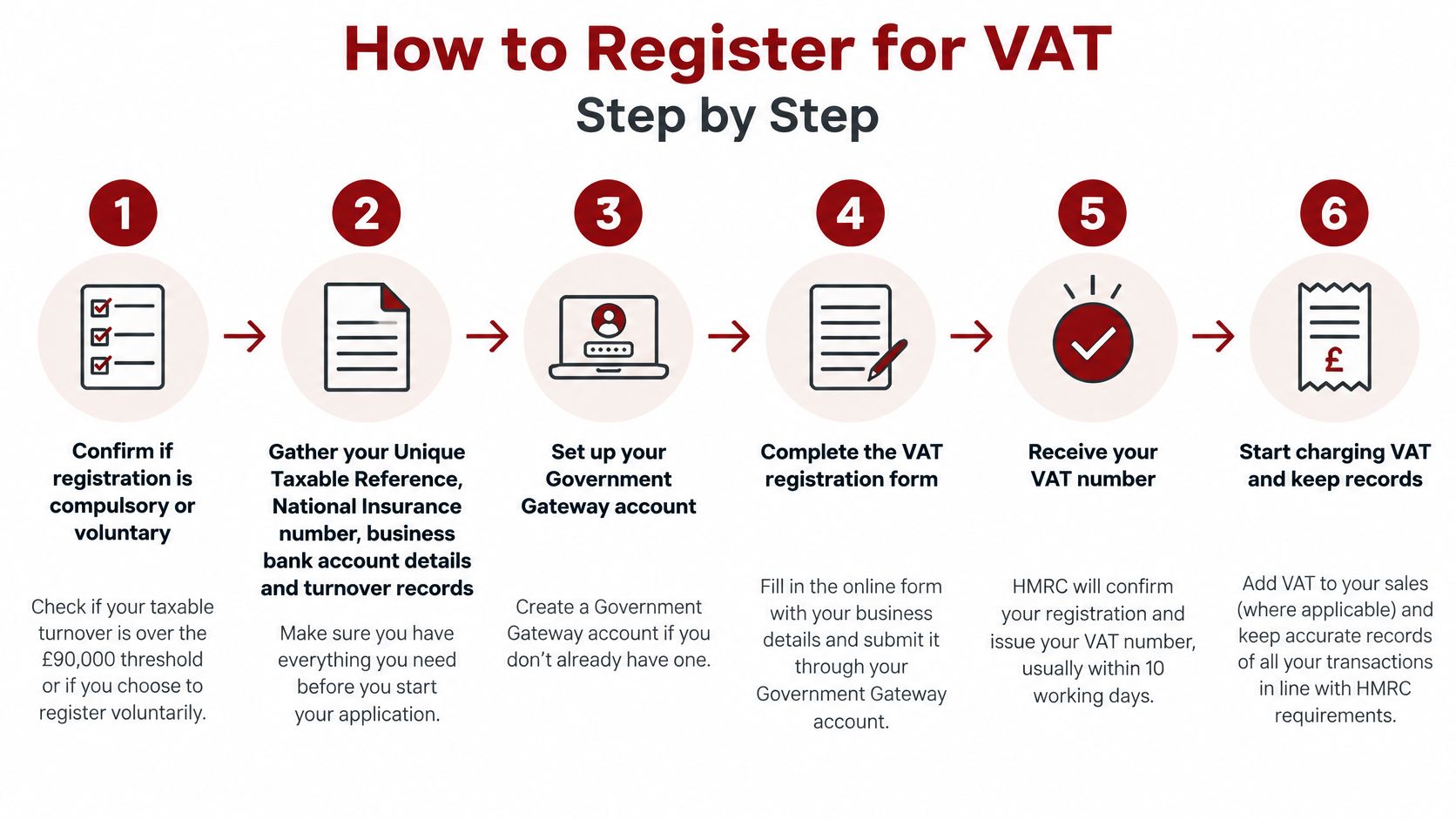
The process illustration provides an overview of the application and its immediate follow-up.
Prepare and submit the application
Confirm the registration basis. Establish whether the application is compulsory or voluntary. Don't select voluntary registration merely because you haven't previously checked your turnover.
Gather identity and business details. Have your Unique Taxpayer Reference, National Insurance number, business bank details and a clear description of your activities ready. Use descriptions that explain what you supply rather than a vague label such as consulting.
Prepare a supported forecast. The application requires estimated taxable turnover for the 12 months beginning on the registration date, as explained in VAT Notice 700/1. Reconcile that forecast to your ledger, contracts and realistic pipeline rather than copying an aspirational sales target.
Establish the effective date. Apply the rule appropriate to your registration basis. A forward-looking obligation needs its own assessment, so don't automatically use the backward-looking rule for every application.
Submit through HMRC's online service. Sign in using the credentials required by the service and retain the application confirmation. Save the turnover calculation alongside it so the submission and supporting evidence remain together.
Prepare compatible bookkeeping. Connect your business bank feed and test the tax codes before importing transactions in bulk. A wrongly configured default VAT code can spread an error across the ledger.
Update invoicing and your diary. Review quotations, invoice templates, customer communications and the first return period. Make sure your treatment follows the effective registration date rather than the day the registration confirmation arrives.
Check the awkward transactions
Deposits and advance payments deserve a separate review. Don't leave them out because the work hasn't finished, and don't assume every gross receipt has the same VAT treatment.
Check credit notes, payments covering several jobs and customer reimbursements individually. Where registration is retrospective, identify affected invoices before deciding how to approach customers.
Application check: Keep a dated turnover calculation, a forecast reconciled to the ledger and a written explanation of any forward-looking expectation.
That file is what makes the application defensible. It also gives whoever prepares the first return a clear starting point instead of an unexplained registration date.
Choosing Standard, Flat Rate or Cash Accounting
Choose your accounting method by looking at your purchases and payment cycle, not the name of the scheme. Ask how your sales are treated, how much recoverable VAT appears on business purchases and how long customers take to pay.
A service business with few physical purchases can look like an obvious Flat Rate Scheme candidate. That doesn't mean the scheme will produce the lowest bill. You need to check eligibility, the applicable category and whether limited-cost-business rules alter the calculation.
The comparison below highlights the practical differences.
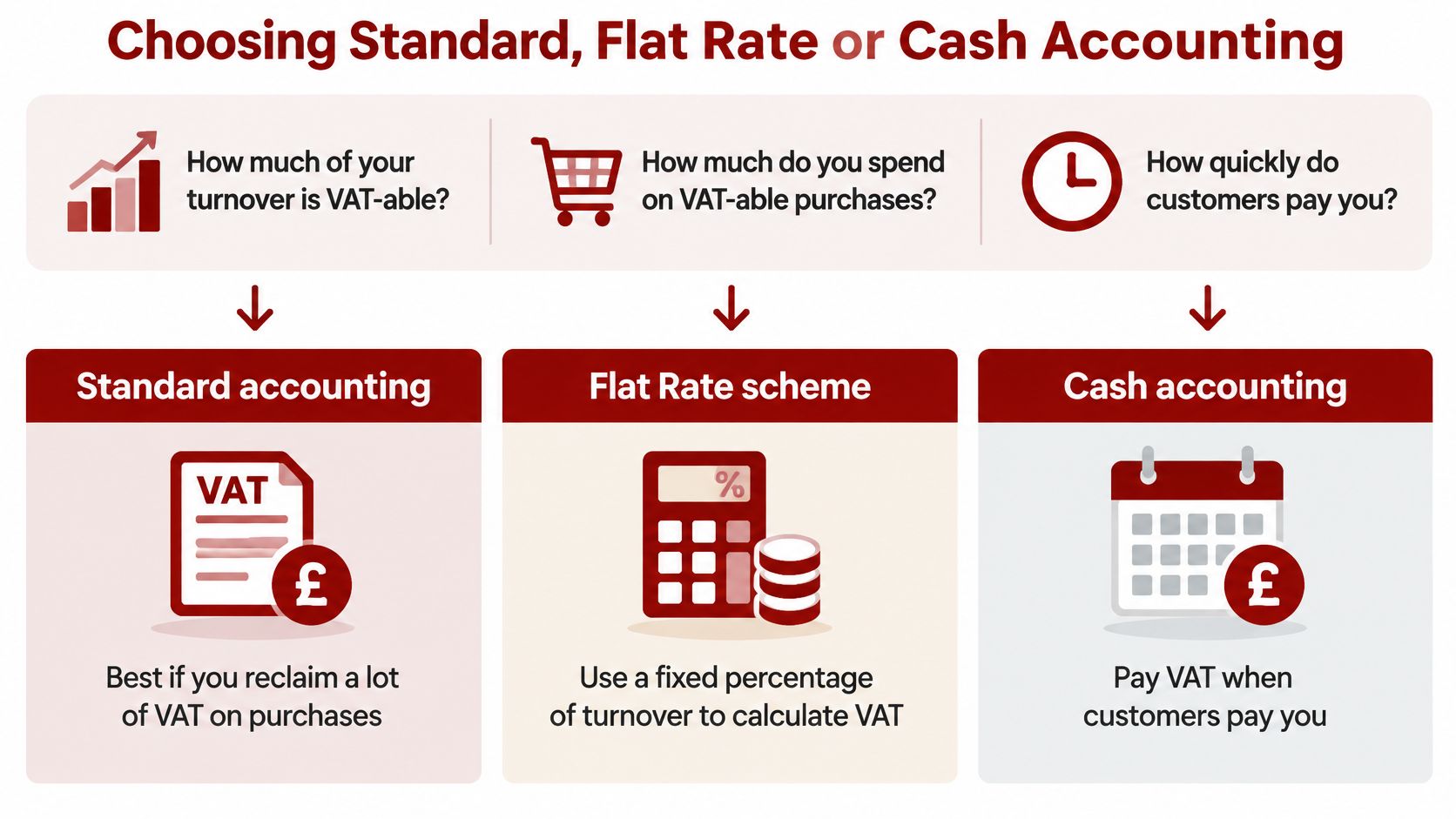
VAT schemes for sole traders compared
| Scheme | Who it suits | How VAT is worked out | Eligibility limit |
|---|---|---|---|
| Standard accounting | Traders with regular recoverable VAT on purchases | Sales VAT less eligible purchase VAT, using the applicable tax points | No special scheme turnover ceiling |
| Flat Rate Scheme | Eligible businesses whose actual calculation demonstrates a benefit | Applicable scheme percentage applied to relevant turnover, with restricted purchase VAT recovery | Check HMRC's current entry and exit turnover conditions |
| Cash accounting | Eligible traders whose customers pay slowly | VAT follows customer receipts and supplier payments | Check HMRC's current turnover and eligibility conditions |
| Annual accounting | Eligible traders who prefer an annual return with payments on account | Instalments followed by a balancing calculation | Check HMRC's current entry and exit conditions |
These aren't interchangeable labels. Cash accounting changes timing, while flat rate changes the calculation. Annual accounting changes the reporting and payment arrangement, but it doesn't remove the need for reliable ongoing records.
Compare like with like
Take a consultant who has relatively little recoverable purchase VAT. Under standard accounting, the comparison starts with sales VAT and deducts eligible input VAT. Under flat rate, apply the correct scheme percentage to the appropriate turnover figure, then account for the restrictions on purchase VAT recovery.
Run both calculations using the same expected sales and costs. Include equipment purchases, software, professional fees and any changes in the mix of goods and services. Don't compare a flat-rate estimate based on cash received with a standard-accounting estimate based on a different sales period.
Our Flat Rate Scheme guide can help you identify the questions to resolve before choosing it.
A simpler calculation isn't necessarily a cheaper calculation. Compare the expected VAT bill and the bookkeeping work separately.
For slow-paying customers, cash accounting may be more useful than a superficially attractive flat-rate result. However, purchase VAT recovery also follows payment, so unpaid supplier bills affect the comparison.
I would use standard accounting as the starting benchmark. Choose an alternative only after modelling your actual transactions and checking the current GOV.UK conditions. Low costs alone aren't enough to justify flat rate, and a preference for fewer returns isn't enough to justify annual accounting.
Records and Making Tax Digital After You Register
Your bank feed tells you that money moved. The invoice explains the VAT treatment. Keep both, with a clear connection between the transaction, its supporting document and the relevant ledger entry.
Build your records around the following:
- Sales evidence. Keep invoices, credit notes and documents supporting unusual VAT treatments.
- Purchase evidence. Retain supplier invoices showing the information needed to support eligible input VAT recovery.
- VAT control account. Reconcile the return calculation to the ledger rather than relying on an unexplained software total.
- Bank reconciliation. Match receipts and payments, and investigate duplicates, transfers and missing entries.
For cross-border invoicing context, GetBill's EU VAT invoicing rules explained is a useful reference. EU guidance doesn't replace the UK requirements governing your domestic invoices.
One ledger, separate obligations
HMRC's Making Tax Digital guidance describes digital VAT record-keeping and compatible-software filing requirements in place since April 2022, alongside the separate Income Tax MTD rollout. That rollout starts with combined gross self-employment and property income above £50,000 from 6 April 2026, with lower thresholds scheduled for subsequent phases.
Income Tax quarterly updates aren't VAT returns. The regimes have separate obligations and penalty points, even when the figures originate in the same bookkeeping system.
Use one ledger and connect each relevant bank account once. Separate trading and property activity through ledger accounts or tracking categories, attach invoices at entry and reconcile regularly. Don't duplicate the same bank feed into disconnected records and expect the totals to stay aligned.
Our VAT Making Tax Digital compliance guide helps frame the software checks. Confirm that your chosen setup supports each required submission, then maintain separate deadline reminders.
A reconciled ledger can support both regimes. It can't make their filing calendars interchangeable.
Deadlines, Penalties and the Cost of Registering Late
The penalty isn't necessarily the largest cost of late registration. VAT on sales you've already completed can be the harder bill to fund, particularly where customers agreed a fixed final price and won't accept an additional charge.
HMRC's registration guidance explains that late registration can leave VAT payable on past sales and may also trigger a penalty. It also allows an application for exception where a threshold breach was temporary and expected turnover meets the relevant conditions. Exception is something to apply for, not something to assume.
Failure-to-notify penalty bands
The published bands below use net VAT due, meaning sales VAT less recoverable purchase VAT, rather than turnover. They should be checked against the rules applicable to the period and circumstances of a late registration.
| Lateness | Penalty rate | Worked example using £4,000 net VAT |
|---|---|---|
| Less than 9 months late | 5% of net VAT due | £200 |
| 9 to 18 months late | 10% of net VAT due | £400 |
| More than 18 months late | 15% of net VAT due | £600 |
| Any case within these published bands | £50 minimum penalty | Applies where the percentage gives less than £50 |
Don't confuse failure to notify with the separate consequences of filing or paying late. Confirm the actual return periods and payment dates shown in your VAT account, and diarise both submission and cleared payment.
Model the price before sending the invoice
There are three commercial responses to compare:
- Increase the customer's total. Preserve your underlying fee by adding the applicable VAT where your agreement permits it. A customer able to recover VAT may be less concerned about the increase than a private consumer.
- Keep the final price unchanged. Treat the agreed amount as VAT-inclusive and calculate the VAT element correctly. Your retained sales income falls, so rebuild the job margin before accepting more work at that price.
- Renegotiate the contract. Agree revised pricing or a documented variation before invoicing disputed amounts.
Absorbing VAT means calculating it within the existing selling price, not simply subtracting the headline VAT percentage from that price.
Review fixed-price contracts spanning the effective date, then forecast the cash needed for the return. Compare all three pricing responses before that liability becomes payable.
CIS Contractors, Subcontractors and Reverse Charge
CIS deductions don't turn gross sales into a smaller turnover figure. If you calculate your registration position from the amount reaching the bank, you can understate the value of your work.
Keep the sales invoice, CIS deduction statement and receipt connected in the ledger. That reconciliation is the starting point for separating turnover from cash received.
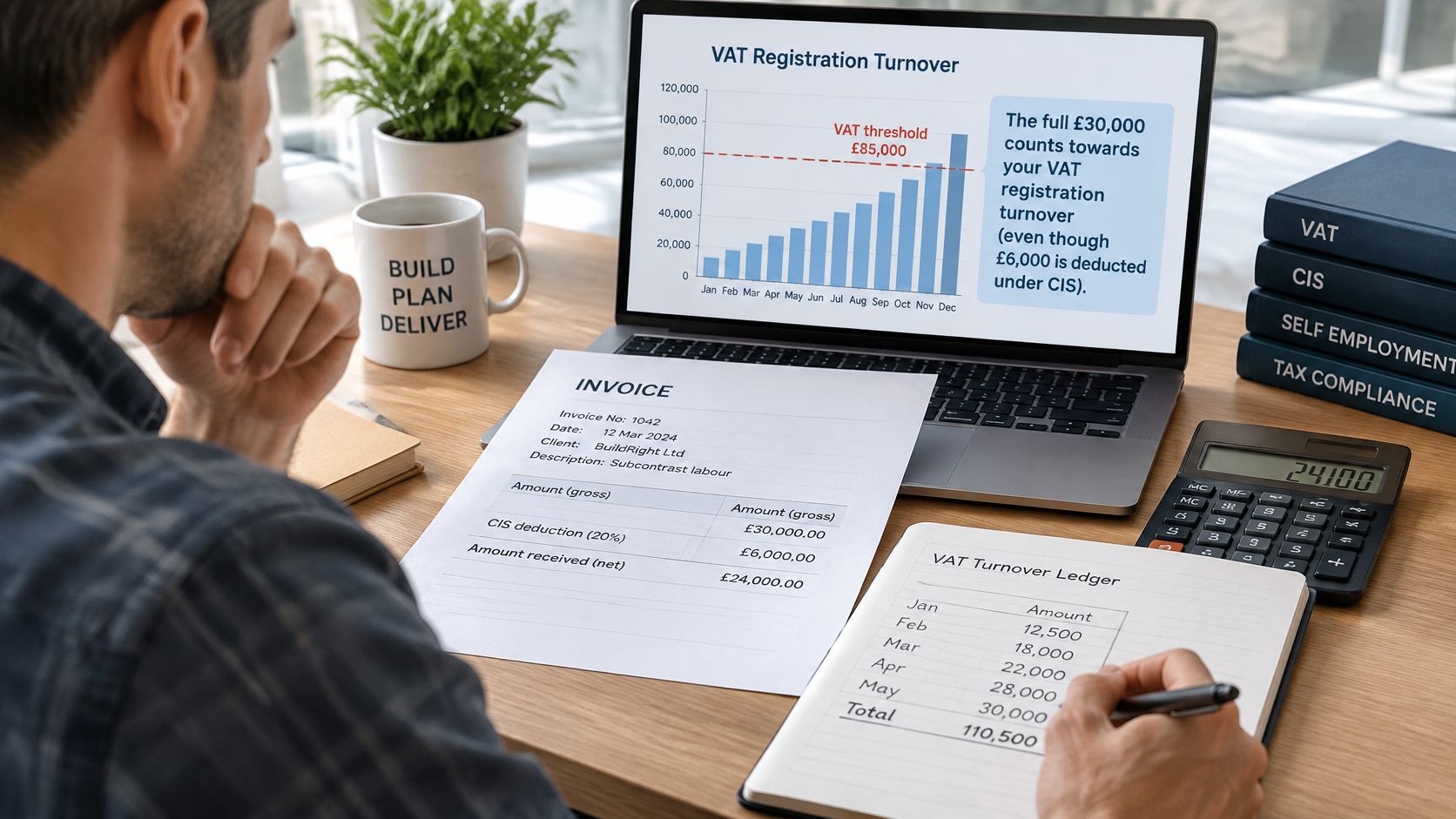
Follow the invoice through the ledger
Say you invoice a contractor for qualifying construction work and the contractor makes a CIS deduction before paying you. Record the full sale, allocate the deduction separately and match the remaining payment against the invoice. Don't post the bank receipt as the entire sale.
VAT requires another decision. Where the domestic reverse charge applies, the customer accounts for VAT instead of paying that VAT to the supplier. The supply remains relevant to taxable turnover, even though the subcontractor hasn't collected the VAT.
Our domestic VAT reverse charge guide explains the checks needed before applying that treatment. Don't assume every construction invoice qualifies merely because both parties work in the building trade.
The video provides additional context for reviewing your construction invoicing process.
Check each customer and job
- Customer status. Confirm the customer's VAT registration and relevant status for reverse-charge purposes.
- Work supplied. Establish whether the particular services fall within the reverse-charge rules.
- Invoice treatment. Use the required reverse-charge information rather than deleting the VAT calculation.
- CIS reconciliation. Record deductions separately from turnover and retain the supporting statement.
- Cash forecast. Allow for the fact that reverse-charge customers aren't paying sales VAT into your bank account.
The same controls apply to construction work in North West London. Build them into your invoice approval routine so VAT, CIS and the bank receipt are checked together rather than reconciled months later.
Decide Your Registration Position Before Quarter End
Don't wait for quarter end if your sales are already close to requiring action. A review is most useful while you can still settle the effective date, change quotations and prepare customer communications without rushing.
Bring a compact evidence pack:
- Monthly sales schedule. Include the rolling turnover calculation and reconcile it to your bookkeeping.
- Forward commitments. Gather dated invoices, accepted contracts, order books and forecasts supporting substantial expected sales.
- Purchase invoices. Show the input VAT you're likely to recover so the accounting-method comparison reflects your real costs.
- Customer list. Identify private consumers, VAT-registered businesses, contractors and customers with fixed-price agreements.
- Software access. Include your current ledger, bank-feed setup and any separate property records.
- Open quotations. Flag work that could begin before registration and finish afterwards.
Get the date, pricing and records agreed together
We're Action Accountants Limited, a Colindale-based firm of Certified Public Accountants serving North West London, including Kingsbury, Queensbury, Edgware and Finchley. Our VAT return service includes assistance with VAT registration, so the application can be considered alongside the records needed for ongoing compliance.
Our Sole Trader / Partnerships / MTD Premium package starts from £85 + VAT per month and includes VAT returns, MTD quarterly updates, year-end accounts, Self-Assessment, a Xero or QuickBooks subscription, quarterly management accounts and meetings, and consultancy and tax planning. The Starter package starts from £42 + VAT per month and includes MTD quarterly updates, year-end accounts, Self-Assessment, an annual meeting and ad-hoc advisory.
Choose support around the obligations you have. A useful review should leave you with a supported registration decision, an invoice-pricing approach and bookkeeping that can produce the required returns without rebuilding the figures.
Action Accountants Limited offers VAT registration assistance as part of its VAT return service, alongside bookkeeping and MTD support. Visit Action Accountants Limited to book a review before your next month end, bringing your rolling sales calculation, open contracts and purchase invoices so we can help settle your registration position and its cash-flow implications.