
Accountancy for Contractors: Structure, CIS and Tax
Accountancy for contractors explained for 2026: choose sole trader, limited company or umbrella, then handle CIS, IR35, VAT and late-payment cash flow.
HMRC recorded 880,300 registered and active subcontractors in March 2025 in its Construction Industry Scheme data for 2024 to 2025. That is not a payroll curiosity. It's proof that accountancy for contractors lives or dies on verification, deductions and cash timing, not on hunting one more receipt in January.
Table of Contents
- Why Construction Books Are Not Ordinary Books
- Sole Trader Limited Company or Umbrella
- How CIS Withholding Hits Profit and Cash
- IR35 When the Status Can Still Move
- Reverse Charge VAT Salary and Dividends
- Allowable Expenses and the Monthly Workflow
- A Month When the Client Pays Late
- Brief a Specialist Before the Next Return
Why Construction Books Are Not Ordinary Books
On £10,000 of labour, a registered subcontractor receives £8,000 after 20% CIS withholding. An unregistered subcontractor faces 30% withholding, while a subcontractor with gross-payment status receives the full amount without a CIS deduction. Record the full labour income, then reconcile the deduction against the CIS statement. Booking only the bank receipt understates turnover and distorts your margin.

The invoice may also show no VAT because the domestic reverse charge shifts VAT accounting to the customer. Keep labour, materials, VAT, payroll and CIS in separate records. Profit, tax due and cash available are different figures. A profitable job can still leave you short of cash while a client pays late.
The Office for National Statistics construction statistics for 2022 recorded an average of 674,000 self-employed construction workers in Great Britain in 2022, down 24,000, or 3.4%, from 2021. Construction still accounted for 16.7% of all self-employed jobs and had the highest number of any UK industry. For contractors, accurate records are working tools: they show what was earned, what was withheld and what cash remains available.
Where the Office Side Leaks Cash
Missed calls, unsigned variations and vague daywork sheets create bookkeeping problems before the records reach your accountant. If enquiries go unanswered while your team is on site, explore HVAC call answering insights. Record variations and daywork clearly, then check that the invoice matches the work completed. Poor job records can leave legitimate work unbilled.
Practical rule: If the bank receipt, invoice and CIS statement tell different stories, reconcile them before treating the difference as cash available.
Keep the job records clear enough to trace each amount from work completed to invoice, deduction and bank receipt. That gives you a reliable view of profit and cash, even when the payment date slips.
Sole Trader Limited Company or Umbrella
Don't incorporate because someone in the merchants told you companies pay less tax. Incorporate only when the working pattern justifies the filings, payroll discipline and status risk. Most labour only subcontractors with straightforward work and no staff should start as sole traders.
Contractor Structures Compared for 2026
| Structure | Tax and NI | CIS position | IR35 | Best when |
|---|---|---|---|---|
| Sole trader | Income tax plus Class 2 and Class 4 NI on profit | 20% registered, 30% unregistered, 0% gross-payment status | Does not apply; no intermediary | Simple labour or small mixed jobs where company costs would swallow the saving |
| Limited company | Corporation tax on company profit, then director salary and dividends | Same 0%, 20% or 30% rates on the company's labour receipts | Medium or large client decides; inside means PAYE through the fee-payer | Real outside contracts, staff, plant or profit worth retaining |
| Umbrella | PAYE employment; employer NI usually inside the day rate | Normally employed, so not a CIS subcontractor | Treated as inside with no separate status fight | Short jobs, an inside determination, or no appetite for company filings |
A sole trader is taxed on profit, not drawings. You can take cash from the business account, but that doesn't change the tax computation. Keep business and private spending separate anyway, or your accountant will waste billable time unpicking fuel, tools and supermarket receipts.
There's also no separate legal shield. If a job goes wrong, the business debt is your debt. That risk matters more once you're hiring, signing larger contracts or buying plant on finance.
When a Company Earns Its Admin
A limited company works when there's profit worth retaining, employees or subcontractors to manage, and contracts that sit outside IR35. The company pays corporation tax on its profit. You then extract money through salary and dividends, in that order, with paperwork for both.
That separation cuts both ways. Company cash isn't your cash until it's properly paid to you. If CIS has been deducted from the company's labour income, track that credit inside the company. Don't assume a personal repayment is coming.
Our detailed comparison of limited company versus sole trader trading is worth reading before you file formation documents. Run your actual day rate, expenses and expected drawings through both routes. A saving that disappears after accountancy, payroll and confirmation statement costs isn't a saving.
When Umbrella Is the Honest Answer
An umbrella employs you and processes PAYE. It's rarely the most exciting option, but it's clean for a short assignment or an inside IR35 determination. You avoid company accounts, corporation tax returns and dividend vouchers.
Read the assignment rate carefully. Employer National Insurance and the umbrella margin usually come out of that rate, so compare take home pay on the same gross contract value. Contractors lose money here by comparing an umbrella assignment rate with a limited company day rate as if they were the same number.
A spouse holding shares, a van on finance or several concurrent clients can strengthen or weaken the company case. One inside determination on one contract doesn't automatically kill an existing company, especially if other outside work continues. But a company kept alive for one inside job often costs more in admin than it saves.
If you can't name who assesses IR35 and who owns the CIS deduction, you're not ready to incorporate.
Choose based on status, risk and retained profit. Tax rate headlines come last.
How CIS Withholding Hits Profit and Cash
The diagram below shows why CIS squeezes cash without reducing the value of work done.
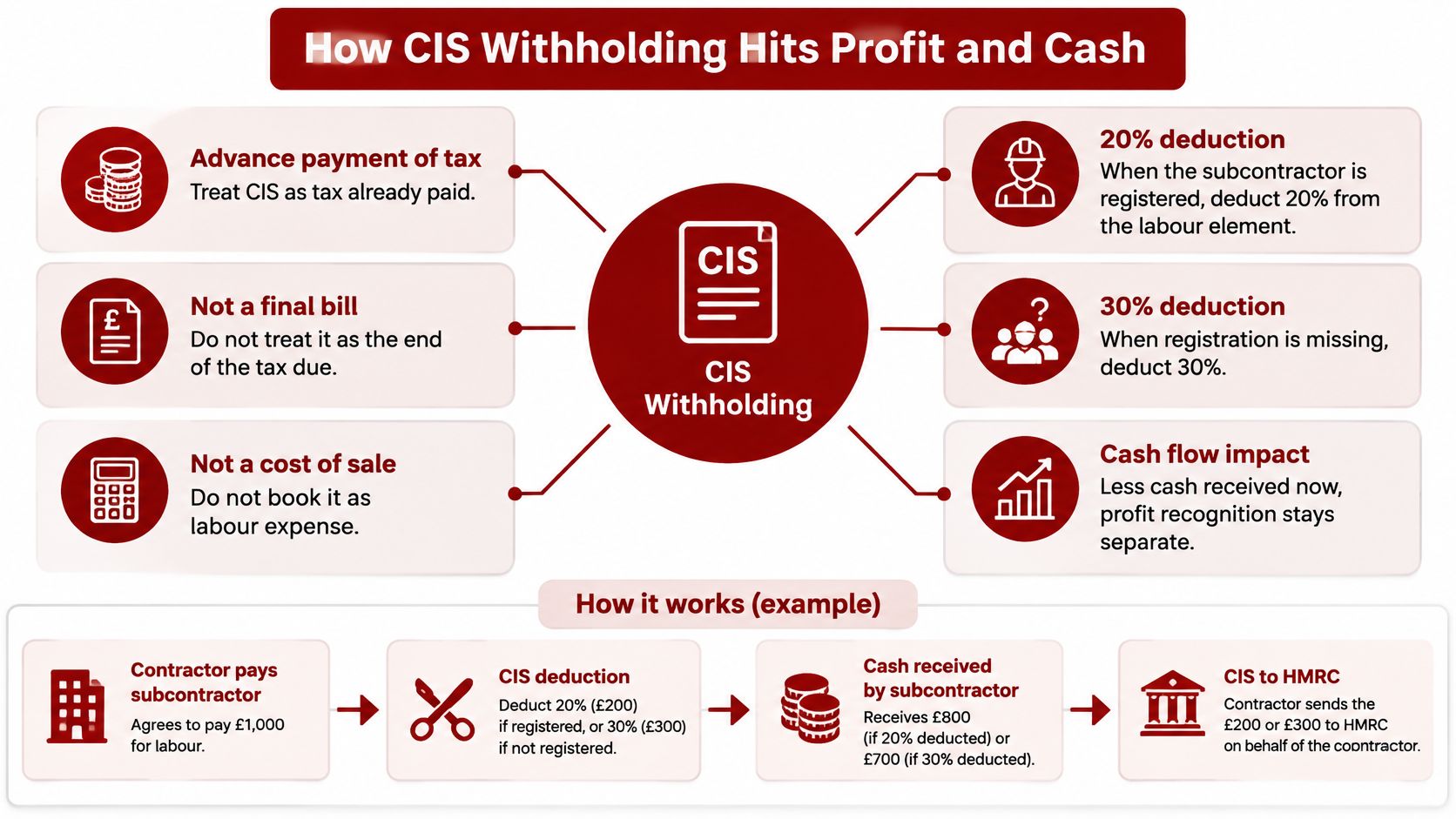
Treat CIS as tax paid on account. It's not a final bill and it is not a cost of sale. HMRC explains in its guidance on what you must do as a CIS subcontractor that a contractor must deduct 20% from a registered subcontractor's relevant payment, the rate rises to 30% where the subcontractor is not registered, and a subcontractor with approved gross-payment status receives payment without CIS deductions.
Deduct from the labour element. Separately invoiced materials sit outside that deduction. If you bundle labour and materials into one lazy line, expect arguments and excessive withholding.
CIS Deduction Rates on a Labour Payment
| Subcontractor status | Deduction on labour | On £10,000 labour | How to record it |
|---|---|---|---|
| Gross-payment status | 0% | £0 withheld, £10,000 banked | Full turnover; no CIS tax credit |
| Registered | 20% | £2,000 withheld, £8,000 banked | £10,000 turnover and £2,000 tax on account |
| Not registered or failed verification | 30% | £3,000 withheld, £7,000 banked | £10,000 turnover and £3,000 tax on account |
Record the full £10,000 as turnover in each case. The withheld amount is credited against eventual income tax and National Insurance. Only the banked figure is cash received.
Booking £8,000 as sales understates revenue. It also distorts margin, management accounts and the year-end computation. Your job can look less profitable while your tax credit disappears into the wrong nominal code.
The short video below is a useful visual check before you set up the monthly control.
The Six Point Monthly Control
- Verify first: Check each subcontractor with HMRC before the first payment in the period.
- Split the invoice: Show labour separately from materials.
- Apply the verified rate: Don't copy last month's rate without checking status.
- Issue the statement: Give the payment and deduction statement promptly.
- File the return: Submit the monthly CIS return from reconciled figures.
- Match everything: Tie every statement back to that return and the bank payment.
An unmatched subcontractor name isn't a trivial typo. It can mean wrong legal entity details, failed verification and the higher deduction rate. Fix the master record before the next payment run, not after three months of complaints.
Our plain English guide to what a CIS deduction means in practice shows where the credit belongs in the books. Use it when training whoever posts sales receipts. Receipt posting is where most CIS errors start.
Forecast withheld CIS as tax already paid. It reduces liquidity now, but it doesn't reduce accounting profit. Gross-payment status protects working capital, yet it depends on a clean compliance history. Late returns and sloppy payroll records can therefore cost cash long before HMRC sends a tax bill.
IR35 When the Status Can Still Move
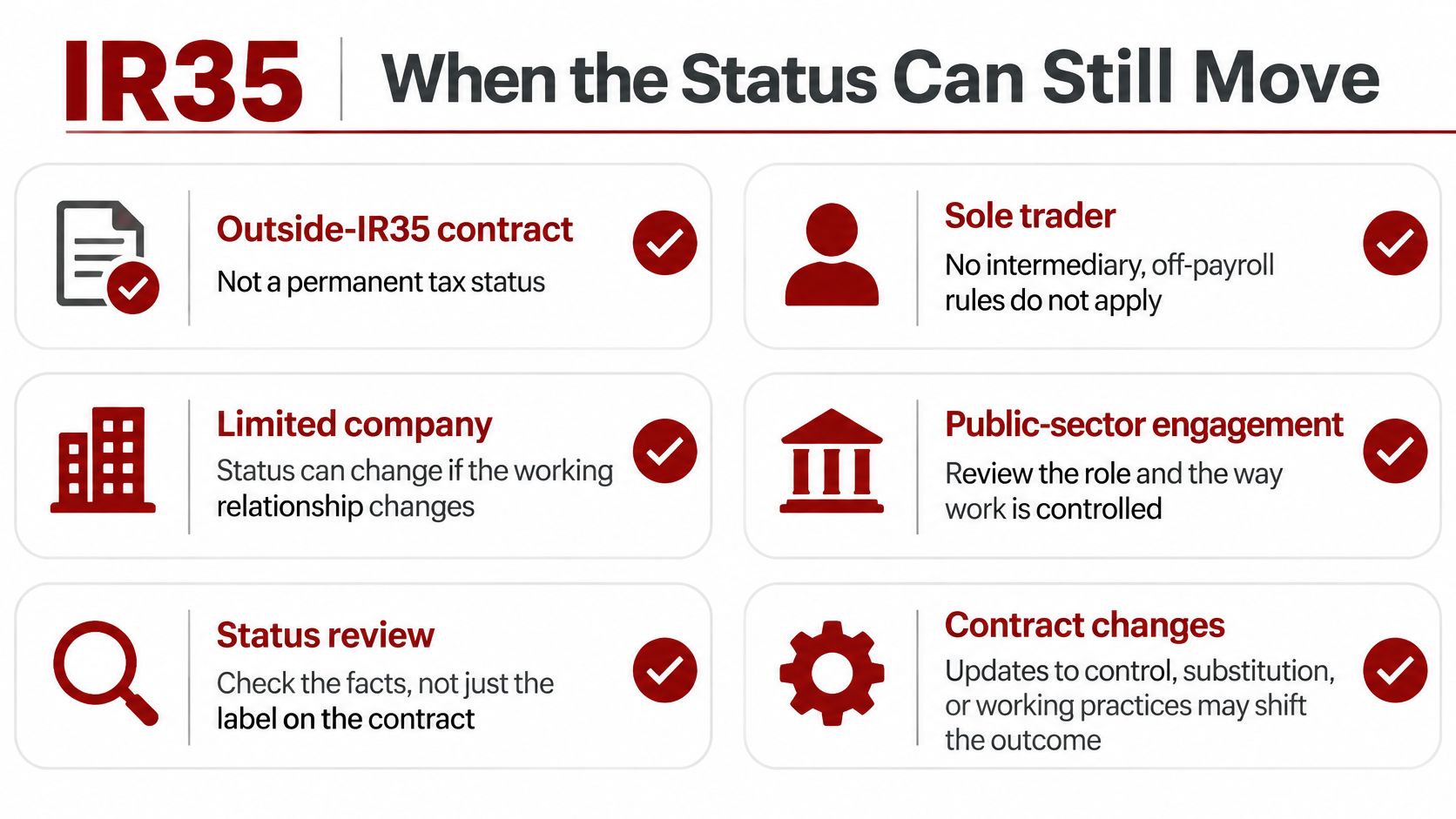
An outside IR35 decision applies to a particular engagement and the way the work is carried out. It can change if the client alters supervision, control or the practical right to send a substitute. Treat the status as specific to the job, not a permanent feature of your company.
The checklist below separates the contract's wording from the working practices a client or HMRC may examine.
For a sole trader, the off-payroll rules do not apply in the same way because there is no intermediary. For a limited company, a public sector client or a medium or large private sector client determines status. A small private client leaves that decision with the contractor.
HMRC sets out the responsibilities of contractors, intermediaries, agencies and clients in its off-payroll working detailed information collection. The client's decision should reflect the actual working practices, so keep records of what happens on site and raise changes before they become the routine.
Test the Job Not the PDF Heading
- Substitution: Can you send a suitably qualified substitute, and could that right be used in practice?
- Control: Who sets start times, work sequence and methods? Can you work elsewhere that day?
- Mutuality: Must the client offer ongoing work, and must you accept it?
- Multiple clients: Do you work for other clients, or remain embedded in one team indefinitely?
- Kit and risk: Who provides major equipment, and who pays to correct defective work?
Keep a monthly evidence pack: the status determination statement, notes on working practices, the substitution clause, emails about supervision and equipment, and the fee-payer's identity. Short notes made at the time are more useful than trying to reconstruct the arrangement years later.
If the Answer Comes Back Inside
Compare the same contract value across three options: stay limited and accept fee-payer PAYE deductions, move to an umbrella, or take direct employment if offered. Include employer National Insurance where it is priced into the assignment rate.
Then negotiate the rate and terms. An inside rate can still work, but assess the deductions before agreeing. Ask who bears employer costs, how holiday pay is handled and what margin the agency takes. A take-home percentage alone will not show where the money goes.
Challenge a determination with evidence: a genuine substitution right, limited line management, project-based deliverables or work for other clients. Keep those records even if the client agrees. A later review can reopen the decision, and memory is a poor archive.
Reverse Charge VAT Salary and Dividends
The reverse charge isn't a VAT saving. It's a cash timing change that removes VAT from your invoice and removes the temporary float from your bank account. If you budgeted on holding customers' VAT until the return date, your forecast is already wrong.
This flow shows where the VAT accounting moves and why owner pay must be considered separately.
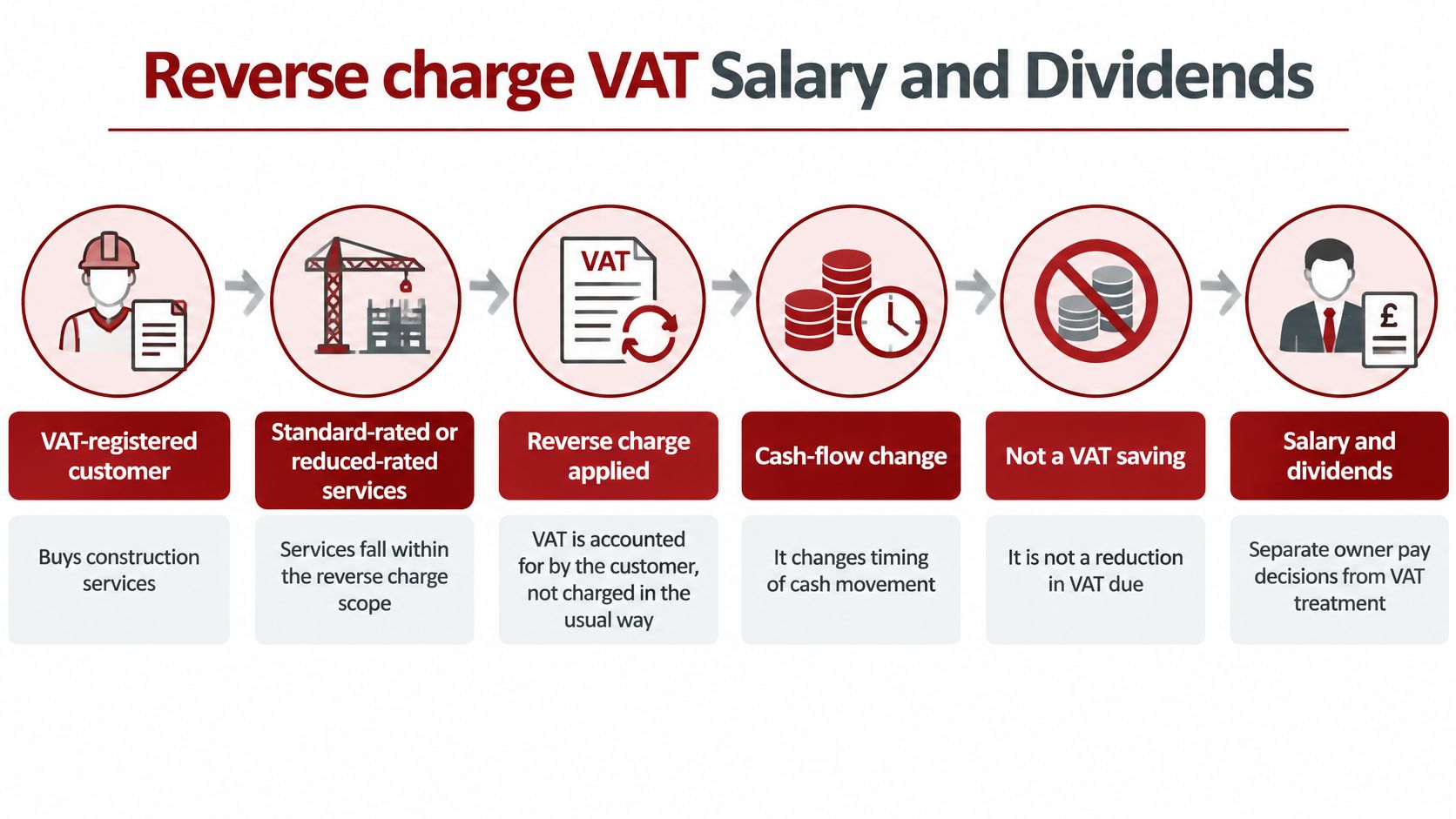
HMRC states in its VAT domestic reverse charge technical guide that the charge generally applies where a VAT-registered customer buys standard- or reduced-rated construction services whose payment is reportable under CIS, subject to exclusions such as end users, certain intermediaries, zero-rated supplies and employment businesses supplying staff. When it applies, the customer accounts for VAT as output tax in box 1 and, where normal recovery conditions are met, claims corresponding input tax in box 4.
For the customer, the net VAT effect is usually zero. For you as supplier, a hypothetical £10,000 net invoice no longer brings in the VAT amount to hold until the return. That's cleaner compliance and tighter cash. Both things are true.
When the Domestic Reverse Charge Applies
| Supply situation | Who accounts for VAT | Cash effect |
|---|---|---|
| CIS construction service to a VAT-registered contractor | Customer reverse charges boxes 1 and 4 | Supplier invoices net and loses the VAT float |
| End user, or intermediary acting for an end user | Supplier charges VAT in the normal way | Supplier holds VAT until the return is paid |
| Zero-rated construction supply | No VAT is charged | Reverse charge does not apply |
| Employment business supplying staff | Excluded from the reverse charge | Follow employment or umbrella VAT treatment |
Use a dedicated reverse charge tax code in Xero, QuickBooks or Sage. Post the net sale value to turnover. Keep the customer's VAT number and written evidence on end user status with the contract. State clearly on the invoice that the domestic reverse charge applies.
Charging VAT when you shouldn't creates a false liability and a reconciliation mess. Failing to reverse charge a qualifying supply exposes the supplier to assessment and correction. Don't let whoever raises invoices guess based on the last customer. Our guide to VAT reverse charge explained for construction businesses gives the invoice wording and coding checks to copy into your process.
Salary and Dividends Come After the Reserve
Only a limited company director with outside IR35 income should use the familiar mix of modest salary plus dividends. The salary goes through payroll. Dividends come from post-tax profits, supported by dividend vouchers and sufficient distributable reserves.
Don't declare a dividend from cash that's still needed for corporation tax, PAYE, VAT or retentions. Bank balance isn't distributable profit. Umbrella workers don't use this mix at all because they're paid as employees.
Run a monthly exception report. Flag reverse charge invoices missing the required wording, customers with no end user evidence on file, and proposed dividends entered before the corporation tax reserve. That one report stops a VAT error becoming an unlawful dividend discussion.
Allowable Expenses and the Monthly Workflow
Start with the ledger, not the tax return. Set up separate nominal codes for CIS labour income, materials, CIS tax on account, reverse-charge sales, subcontractor costs and payroll. If those balances don't reconcile monthly, year-end will be archaeology.
What You Can Usually Claim
Claim costs that are wholly and exclusively for the trade. For most contractors that includes tools and small plant, the business share of van running costs, PPE, required training, insurance, phone, software and travel between sites. Ordinary commuting from home to a regular base is different, so code it separately and take advice.
Flag a van bought on finance, private fuel and home office use for specific treatment. They aren't automatic disallowances, but they need the right capital allowance or business use calculation. Don't dump them into repairs and hope.
If you're reviewing systems to capture receipts and job costs in one place, compare all-in-one business software before buying another disconnected app. The best system is the one your site team will use on the day costs are incurred.
The Monthly Close in Order
- Import the bank feed: Clear unmatched items while you still remember the jobs.
- Split labour and materials: Do it on sales and purchase invoices at entry.
- Post CIS statements: Match each one to the related bank receipt.
- Check VAT codes: Reverse charge sales need their dedicated code every time.
- Reconcile CIS and VAT: Agree ledger totals to returns before filing.
- Review expenses last: Check job references and receipts before drawing money.
Record date, supplier, job reference and tax code on every receipt. Expenses reduce taxable profit. They never reduce CIS tax that's already been withheld.
A Month When the Client Pays Late
Say a limited company dry-lining contractor in North West London certifies £40,000 net sales in March. In this worked example, £24,000 is labour, £16,000 is materials, CIS has been withheld from the labour, and a retention is trapped until practical completion. The profit and loss account looks healthy. The bank tells a thinner story.
Payroll still has to run. Suppliers still expect payment for boards and metal stud. Corporation tax on the profit still needs reserving even though part of the application hasn't arrived. Profitable contractors go short here.
A profitable application you haven't collected can't pay Friday's wages.
Build the forecast in a strict order. Record gross sales first and show the retention as a debtor, not lost income. Treat CIS withheld as tax on account. Reserve corporation tax on the profit before discussing a dividend. Schedule PAYE for employed operatives on its normal payment date. Chase the aged application before promising drawings.
Our practical guide to cash flow forecasting for growing businesses shows how to turn that sequence into a rolling weekly view. For a contractor, the forecast must show certified value, retention release dates, CIS deductions and expected payment dates as separate lines. A single sales forecast hides every problem that matters.
You're not uniquely unlucky if this sounds familiar. The UK government response on tackling poor payment practices estimates late payments affect more than 1.5 million businesses annually, cost the economy almost £11 billion a year, and leave businesses owed approximately £26 billion at any given time, an average of £17,000 per affected business.
That national picture doesn't pay your wages. Your controls might. Use staged applications tied to measurable progress. Ask for a deposit on materials before they're ordered. Get the retention percentage, release trigger and defects process in writing before starting. Keep a dispute log with dates, photographs, delivery notes and names of whoever agreed variations.
Price the risk before you mobilise. A client with slow certification and long payment terms isn't offering the same job as a client who pays promptly, even at the same contract sum. Your margin needs to cover financing time or your terms need to shorten it.
The government has proposed mandatory statutory interest at 8% above the Bank of England base rate and a 60-day maximum payment term for large firms dealing with smaller suppliers. Treat that as policy direction, not cash in this month's bank. Don't build March payroll on a proposal.
Chase in a sequence. Send the statement before the due date, call on the due date, escalate to the commercial manager with the dispute log attached, then decide whether statutory interest or formal recovery is commercially worthwhile. Preserve the relationship where the client is solvent and communicating. Stop supplying more labour where silence and broken promises repeat.
The best tax planning that month isn't a marginal expense claim. It's collecting the application, protecting the tax reserve and refusing a dividend the business hasn't yet received in cash. Operational discipline keeps the company alive long enough for tax planning to matter.
Brief a Specialist Before the Next Return
Don't book an accountant and arrive with a carrier bag of statements. Bring five things: your current trading structure, the last three application invoices, subcontractor verification records, any status determination statements, and a list of invoices that are overdue. Those papers reveal the main risks in minutes.
With them, a specialist can tell whether you should stay sole trader, whether the company is declaring dividends ahead of collected cash, or whether an umbrella rate has been priced without employer National Insurance. The conversation should start with cash and status, not software features.
If you share files with an external bookkeeper, tidy the PDF evidence pack before you send it. Tools such as PDFWix for accounting teams can help keep statements, invoices and determination documents readable and in order. Clean evidence shortens the first review.
Action Accountants Limited, led by Georgie Zdrenghea from Colindale in North West London, provides CIS-aware bookkeeping, VAT, payroll, statutory accounts and company secretarial support for contractors. Use that kind of monthly close, not a January panic.
Book the review before the next monthly CIS or VAT deadline. Don't incorporate, switch to an umbrella or declare a dividend until withheld tax and unpaid applications are both on the table.
If CIS deductions, reverse charge VAT or late applications are making a profitable month feel short of cash, get your structure and monthly close reviewed before the next return. Visit Action Accountants Limited to book a practical contractor accountancy review covering CIS, VAT, payroll and tax reserves.