
What Is Tax Planning? a UK Guide for Founders and Landlords
What is tax planning in the UK? Legal levers for salary, dividends, CIS and property, plus a checklist to start this year.

Tax planning is arranging income, spending and timing before the tax year ends so you pay the correct tax using the allowances, reliefs and rate bands the law provides.
You've paid suppliers, taken money out for living costs and watched the bank balance rise and fall. Now you need to know how much is actually yours, how much belongs in the tax reserve, and whether a decision you make today will create a bigger bill later.
That's the practical starting point. A useful tax plan gives you reliable figures and enough cash to meet your obligations before it looks for savings.
Table of Contents
- What Tax Planning Means in the UK
- Tax Levers, Pay Routes and When to Incorporate
- Expenses and CIS Deductions Contractors Can Control
- Landlord Rules and Capital Gains Timing
- Three Planning Cases for Founders, Contractors and Landlords
- Pitfalls That Cost More Than the Tax You Save
- Start Your Plan and Decide When to Call an Accountant
What Tax Planning Means in the UK
Think of tax planning as packing your suitcase to the airline's weight limit before leaving home, rather than unpacking at check-in. You make better choices while you still have time to change them.
Tax planning covers your whole financial position, not just your tax return. Its scope includes:
- Personal affairs: Salary, savings, pensions and other household income.
- Business affairs: Profit, allowable expenses, payroll, VAT and money withdrawn by owners.
- Investment affairs: Property income, ownership arrangements and capital gains.
The UK Parliament's taxation overview illustrates the separate development of the taxes that make up the UK system. In practice, each tax needs its own calculation, records and filing timetable.
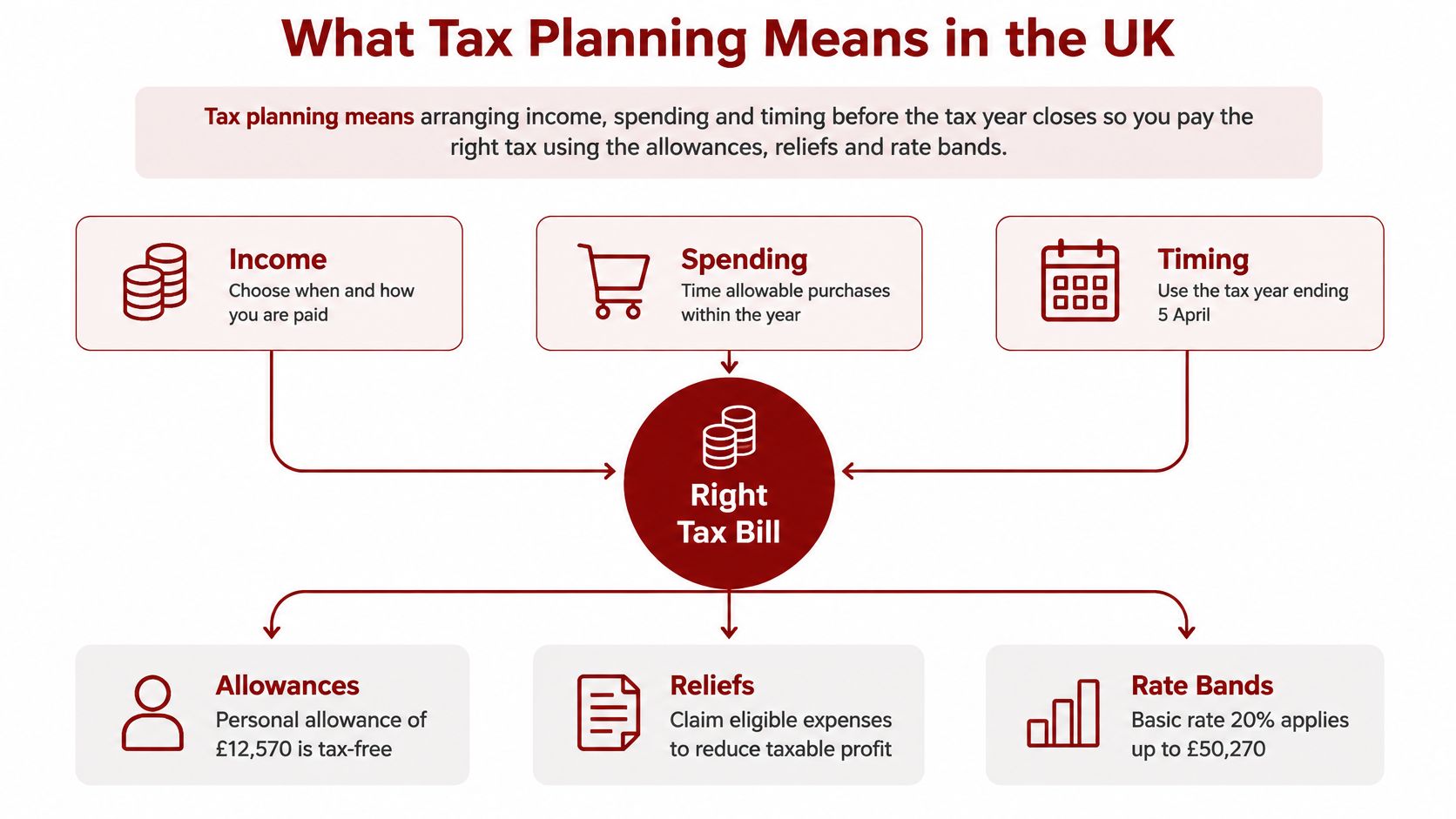
The benefits are practical:
- Fewer filing surprises: You identify liabilities while you can still prepare.
- Cash available for bills: Your bank balance includes a deliberate tax reserve.
- Better income timing: You avoid unnecessary bunching of taxable income.
- Fewer missed claims: You collect evidence while transactions are fresh.
Tax planning compared with tax avoidance and tax evasion
| Approach | Legal status | Method | Typical example |
|---|---|---|---|
| Tax planning | Legal | Using reliefs, allowances and timing within the rules | Making an eligible pension contribution within the relevant tax year |
| Tax avoidance | May technically comply, but can be challenged and counteracted | Artificial arrangements intended to defeat the purpose of legislation | Routing transactions through an artificial scheme without a genuine commercial purpose |
| Tax evasion | Illegal | Concealing income or falsifying records | Receiving cash for work and deliberately leaving it out of returns |
Don't confuse a complicated arrangement with a well-designed plan. If nobody can explain the commercial purpose without mentioning the tax saving, get independent advice before signing anything.
Cross-border investments add questions about residence, reporting and foreign tax. For context on organising those decisions, Mazurly's guide to investing abroad is a useful starting resource, alongside advice specific to your circumstances.
The legal line is straightforward: planning means lawful timing, accurate records and timely filing, never hidden income or invented deductions.
Tax Levers, Pay Routes and When to Incorporate
A founder can have a profitable company and still face a cash squeeze after drawing too much as salary or dividends. Plan from the company's available profit and the personal cash needed, then compare the tax and administrative cost of each route.
Key UK tax levers and thresholds for 2026–27
Use a calculation for the relevant tax year. Tax rates and thresholds can change, so base payment decisions on the rules that apply when income is received or a contribution is made.
| Lever | 2026–27 position | Planning move | Key date |
|---|---|---|---|
| Income tax bands | Main rates are 20%, 40% and 45%. The basic-rate band extends to £37,700, and the dividend allowance is £500, according to HMRC's income-tax rates and allowances. | Model taxable income before paying bonuses or dividends; confirm the rates that apply to your location and income type. | Relevant personal tax year end |
| Personal Allowance | £12,570, reduced by £1 for every £2 of adjusted net income above £100,000. | Check whether eligible pension contributions or charitable giving change adjusted net income and the allowance available. | Relevant personal tax year end |
| Dividend allowance | £500, included in HMRC's linked current-year figures above. | Coordinate genuine shareholder distributions with other income. | Dividend payment date and tax year end |
| Corporation tax | The rate depends on taxable profits and the applicable profit limits; associated-company rules can affect those limits. | Compare remuneration and qualifying expenditure with profits retained in the company. | Company accounting year end |
| Pension annual allowance | The standard annual allowance is £60,000, subject to tapering and other limits. Unused allowance may be carried forward if the conditions are met. | Check available capacity, including previous contributions and carry-forward eligibility, before contributing. | Relevant contribution deadline |
| VAT registration threshold | Compulsory registration generally applies when taxable turnover exceeds £90,000 over a rolling 12-month period, or is expected to exceed it in the next 30 days. | Monitor taxable turnover and expected sales rather than waiting for annual accounts. | The applicable registration deadline |
A pension contribution can reduce the income used to calculate the Personal Allowance taper, but it also ties up money for retirement. Compare the tax effect with the company's working-capital needs and the founder's personal cash requirements.
Compare take-home cash, not headline rates
A software founder with profitable trading, no outside salary and spare cash for a pension contribution should compare each route from the same starting point: company profit before remuneration. The calculation should end with the personal cash available for spending.
A salary-heavy route creates a payroll cost. Salary can reduce taxable company profit, but employer and employee National Insurance may affect the result. The full employer cost must fit within available profit.
A dividend-heavy route uses profits available for distribution after corporation tax. Dividends require sufficient distributable reserves and proper authorisation. A positive bank balance alone does not make a dividend permissible.
| Pay route | What it can achieve | What needs checking |
|---|---|---|
| Salary-heavy | Regular income and potentially a qualifying National Insurance record | Employer costs, employee deductions and other personal income |
| Dividend-heavy | Flexible distributions from available profits | Corporation tax, dividend tax, reserves and shareholder rights |
| Mixed remuneration | A balance between regular pay and distributions | The combined company and personal result |
| Employer pension contribution | Retirement funding without taking all available cash personally | Relief conditions, pension limits and cash locked away |
Practical rule: Compare the same starting company profit and the same personal cash requirement. Otherwise, an apparent tax saving may simply be money left in the business.
A low salary is not automatically the best choice, and dividends cannot replace every employment benefit. Pension funding may be tax-efficient, but it is unsuitable for money needed for rent, suppliers or a near-term house purchase.
Incorporate for a reason
A limited company brings accounts, payroll decisions, company filings and restrictions on withdrawals. Any tax advantage needs to justify those costs, alongside commercial reasons such as retaining profits to fund growth.
Use this comparison of a limited company and sole trader structure to frame the decision, then model actual profit and household cash needs. Include the transition period: tax liabilities from before incorporation remain due.
Forecast income and profit, compare salary-heavy, dividend-heavy and mixed outcomes, then agree payment timing. Check the cash flow as well as the tax total.
Expenses and CIS Deductions Contractors Can Control
Start with the wholly and exclusively for the business test. An expense doesn't become deductible just because you paid it from a business account or discussed work while incurring it.
For mixed-use costs, identify the business element and retain a defensible calculation. A consistent method supported by bills is stronger than an ambitious estimate assembled when the return is due.
Common business expenses and how HMRC treats them
| Expense | Usually allowable | Condition or evidence |
|---|---|---|
| Business mileage | Qualifying business travel under the applicable method | Keep dates, destinations, purpose and distance; ordinary commuting generally doesn't qualify |
| Working from home | A reasonable business proportion of eligible costs, or an applicable simplified method | Keep bills and a consistent basis for allocating business use |
| Phone and broadband | Business share under the relevant rules | Retain bills and a written explanation of any apportionment |
| Client entertaining | Generally no tax deduction | Record it separately so it isn't accidentally claimed |
| Clothing | Qualifying uniforms or protective clothing | Everyday clothing doesn't qualify simply because you wear it for work |
Use a receipt-capture app such as Dext, or the attachment function in Xero or QuickBooks, to connect evidence to the transaction. Keep a mileage log as journeys happen, not from memory at year end.
The self-employed deductible-expenses guide can help you review categories, but your own evidence determines whether a particular claim stands up.
Separate CIS withholding from the final tax bill
CIS deductions are amounts withheld towards tax, not a calculation of your final liability. Your profit, other income and available credits still matter when the final position is established.
For each invoice, separate labour, qualifying materials and VAT where applicable. Check that the contractor's deduction statement agrees with the invoice breakdown and the amount received, then investigate differences promptly.
Improving CIS cash flow means getting the withholding calculation right, not treating withheld tax as an additional business expense.
Reconcile statements monthly and keep supplier invoices supporting material costs. A missing statement or unexplained deduction becomes harder to resolve once several jobs and payment runs have passed.
Landlord Rules and Capital Gains Timing
A property disposal can't be planned in isolation from your income. For gains on residential property, HMRC's capital-gains rates guidance sets the rate at 18% on the part of the gain falling within your basic-rate band and 24% on the part above it. Which band a slice of the gain lands in depends on your taxable income for the year and on the annual exempt amount, and non-residential assets follow different rates.
The practical consequence: a landlord whose salary and rental profit already use most of the basic-rate band will see more of the gain taxed at 24%, while a sale in a quieter income year leaves more of it at 18%. That is a timing lever, though it never justifies delaying a commercially attractive sale on tax grounds alone.
Check the whole property position
| Issue | What to establish | Planning consequence |
|---|---|---|
| Capital gains | Acquisition cost, qualifying expenditure, disposal costs, losses and reliefs | Calculate the taxable gain before choosing timing |
| Joint ownership | Each owner's beneficial interest and personal circumstances | Prepare separate calculations rather than dividing the final bill casually |
| Mortgage finance | Whether finance-cost restrictions apply to the ownership structure | Model after-tax rental cash flow, not just accounting profit |
| Property allowance | Eligibility and the alternative treatment of actual expenses | Compare the available methods without claiming incompatible deductions |
| Pension contributions | Eligibility, available capacity and effect on the income-tax calculation | Check whether contributions preserve basic-rate capacity |
Mortgage payments can make a property look cash-poor even when its taxable result is less forgiving, because the finance-cost restriction works on a separate calculation from the interest you pay. The landlord mortgage-interest relief guide explains how that restriction is applied and why it belongs in the cash-flow model before you decide to hold or sell.
Make decisions before committing to a sale
Ask your adviser to establish the relevant disposal date before exchange. Receiving the sale proceeds in a later tax year does not move the gain with them.
Then compare:
- Disposal timing: Assess the tax result alongside buyer certainty, finance costs and market risk.
- Available losses: Check ownership, evidence and whether the losses can be used.
- Ownership changes: Consider legal costs, lender consent and possible tax consequences before transferring an interest.
- Reliefs and contributions: Confirm eligibility before relying on them in the forecast.
Changing ownership between spouses or civil partners isn't just a spreadsheet adjustment. The legal and beneficial ownership must support the tax treatment, and a transfer may affect more than capital gains.
Keep purchase documents, improvement invoices, ownership records and the draft completion statement together. Without them, a precise-looking gain calculation may still be wrong. Digital record-keeping through the year, which Making Tax Digital increasingly expects of landlords, beats reconstructing improvement costs from memory after completion.
Three Planning Cases for Founders, Contractors and Landlords
These illustrative scenarios show what a useful planning exercise changes. They focus on decisions and evidence rather than promising a standard saving.
The pay-route comparison starts with the same business resources, not the same headline salary.

A founder separates spending money from retirement funding
A software founder initially plans to withdraw every available pound as salary. Before running payroll, the founder builds a spreadsheet comparing salary-only, dividend-only and mixed remuneration, with an optional employer pension contribution.
| Before | After |
|---|---|
| Salary-only calculation without a separate employer-cost check | Side-by-side calculations including company tax, employer and employee National Insurance, personal tax and remaining cash |
| All available cash treated as spendable | Household spending, business reserves and retirement funding separated |
The founder chooses the route that meets personal spending needs without leaving the company short. Exact combined tax totals require current National Insurance, corporation-tax and dividend-tax inputs; showing totals without those inputs would create false precision.
What changed: The decision became a comparison of complete costs rather than salary against dividends alone. The decisive record: A dated remuneration model tied to the management accounts.
A subcontractor challenges unexplained withholding
A subcontractor receives less than expected after a contractor calculates CIS withholding using an invoice total without a clear materials breakdown. The subcontractor reconstructs the invoice schedule, distinguishing labour, qualifying material costs and VAT where applicable.
The contractor reviews the supporting documents and corrects any excessive withholding. That improves working capital, but it doesn't reduce the subcontractor's underlying tax liability.
What changed: The payment calculation used the correct components instead of an undifferentiated invoice total. The decisive record: Supplier invoices matched to the job's materials schedule.
A landlord tests the sale before accepting an offer
A landlord receives an attractive offer while also expecting unusually strong trading income. Rather than estimating tax from the sale price, the landlord prepares a gain calculation using acquisition documents, qualifying expenditure, available losses and personal circumstances.
The adviser compares feasible disposal dates and checks whether any ownership proposal has a genuine legal basis. The landlord weighs the possible tax difference against the risk of losing the buyer and the cost of continuing to hold the property.
What changed: The landlord evaluated net proceeds and commercial risk together. The decisive record: A property-cost schedule supported by original documents.
Pitfalls That Cost More Than the Tax You Save
A plan that reduces the current bill but leaves weak records or thin cash reserves can cost more than a modest, well-documented alternative. Paying for emergency bookkeeping, correcting payroll and borrowing to meet tax liabilities can outweigh a small saving.
In its annual report executive summary, HMRC stated that Making Tax Digital for Income Tax would begin in April 2026 for sole traders and landlords with qualifying income above £50,000. Check your applicable start date and qualifying-income position rather than assuming that taxable profit determines whether you're included.
The operational risks deserve the same attention as the tax calculation.
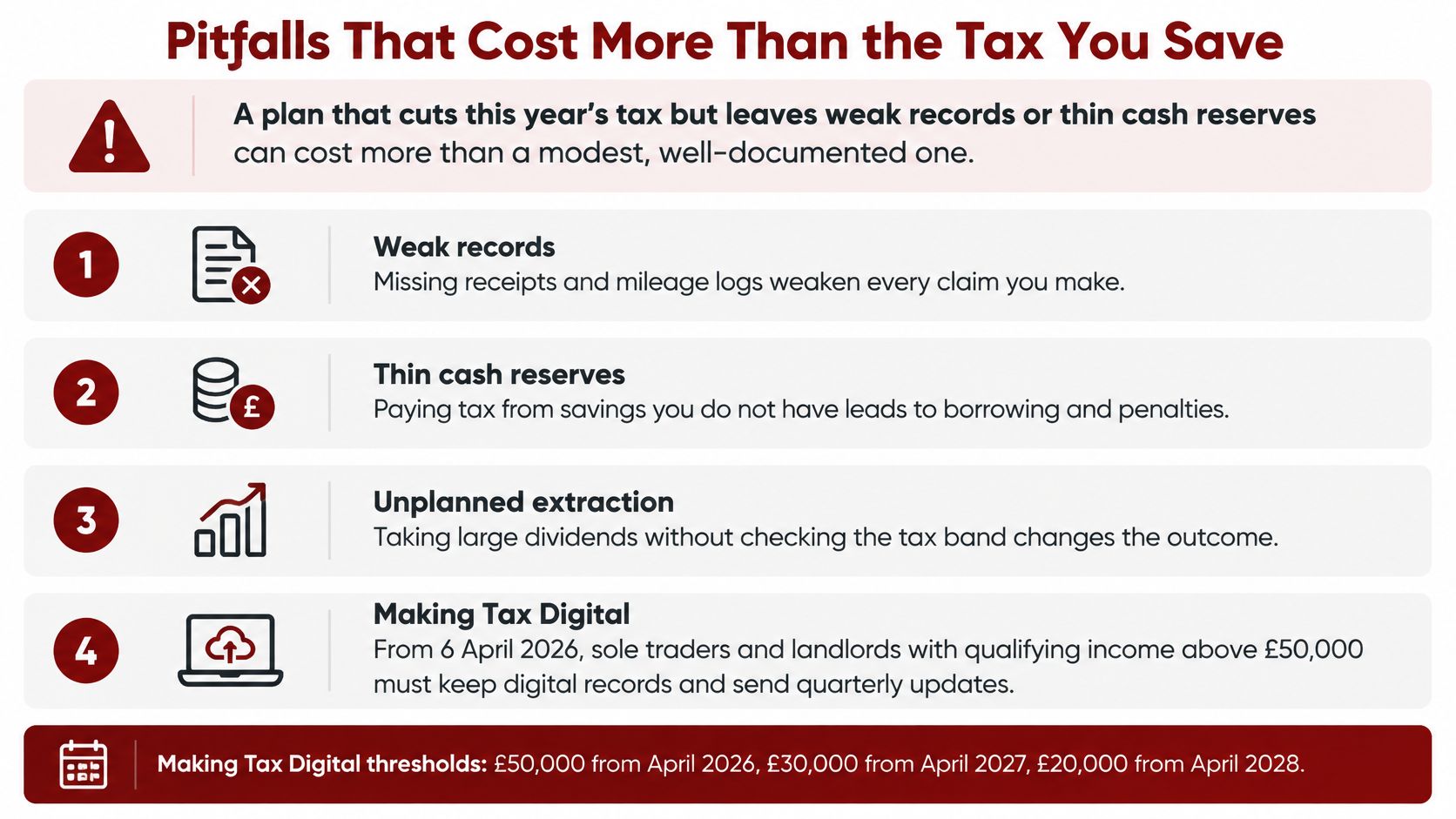
Common failures and the cheapest useful fixes
- Headline-rate comparisons: Include employer costs, personal tax and administration before choosing a structure.
- Late decisions: Put review dates in the calendar while payments and transactions can still be changed.
- Unsupported expenses: Attach receipts and explain mixed-use calculations when recording the transaction.
- Missed VAT triggers: Review taxable turnover regularly, including expected sales where relevant.
- Irregular-income shortfalls: Transfer a forecast-based reserve when receipts arrive rather than saving whatever remains.
- Artificial schemes: Obtain independent advice from someone who isn't selling the arrangement.
A tax saving is only useful if you can explain it, document it and afford the consequences.
Build a plan you can maintain
Digital reporting makes unresolved bookkeeping differences more disruptive. Decide who categorises transactions, who checks reconciliations and who approves submissions before the workload increases.
Treat proposed reporting-threshold changes as proposals until you've checked their implementation and your obligations. An announcement doesn't by itself establish that you can stop filing.
Review the plan after material policy changes and whenever income, ownership or borrowing changes. The final test is whether the approach remains defensible and manageable as the business grows.
Start Your Plan and Decide When to Call an Accountant
- List every income source. Include employment, trading, rent, dividends and other investment income, with realistic expected amounts and payment timing.
- Capture expenses as you go. Connect receipts, mileage and explanations to the accounting entry rather than keeping an unlabelled folder.
- Build comparable extraction models. Use the same starting resources and show what reaches your personal bank account.
- Create a monthly tax provision. Base transfers on the forecast and reconcile the reserve against updated liabilities.
- Check trading controls. Match CIS statements to invoices and review VAT registration exposure.
- Authorise planned payments properly. Confirm relief conditions, available cash and relevant deadlines before pension contributions or asset purchases.
- Refresh the forecast. Revisit assumptions during the year and after significant commercial or policy changes.
Use the process below as a prompt, not a substitute for checking your own obligations.
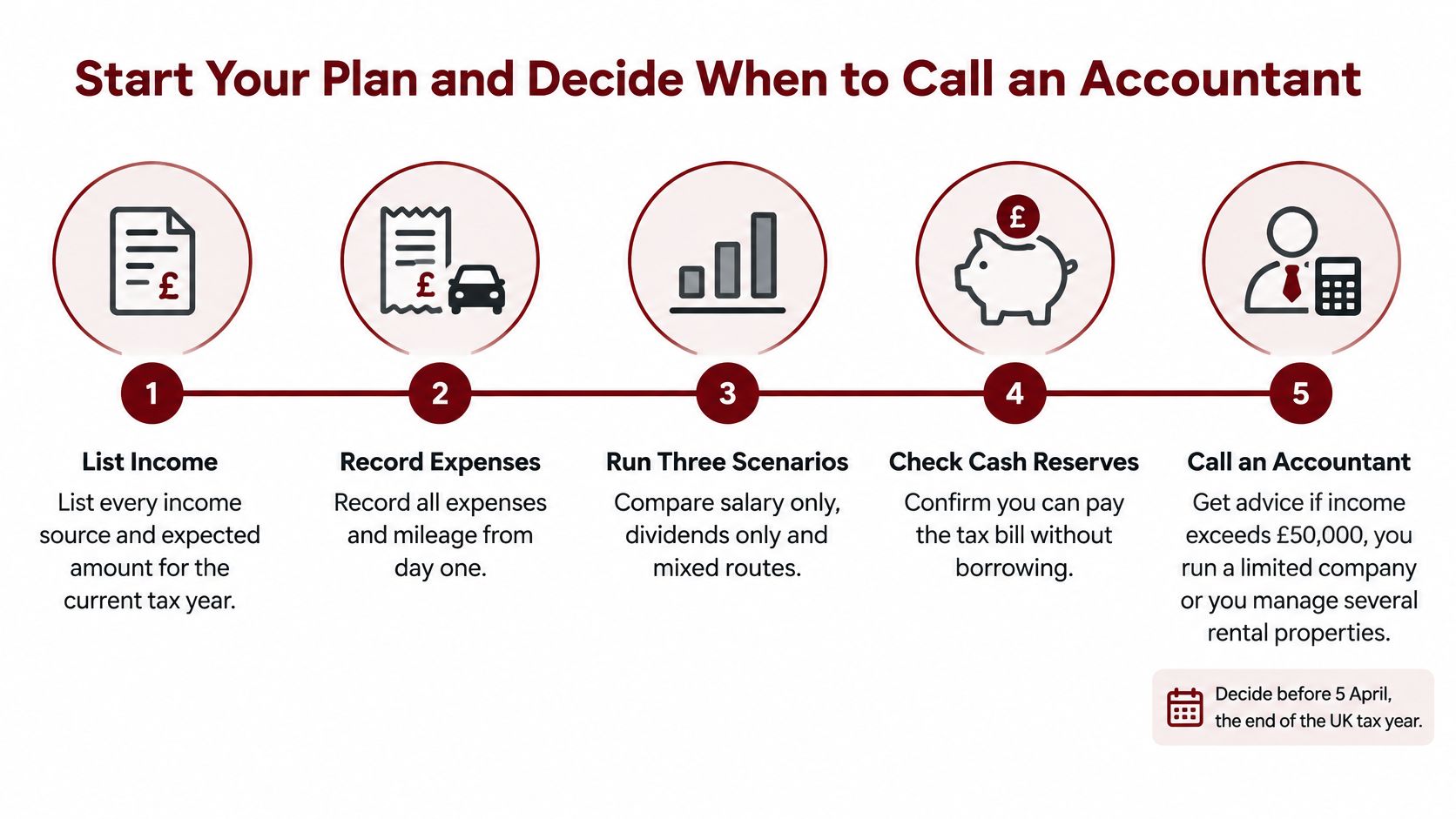
Get advice before the decision becomes expensive to reverse
Book advice when you're incorporating, preparing to sell a property, taking on contractor responsibilities under CIS, approaching digital-reporting requirements or combining several income sources. An HMRC enquiry also calls for prompt, organised support.
You don't necessarily need a broad advisory package. A sole trader with straightforward records might need a focused annual forecast, while a growing company may need regular management accounts, payroll and VAT oversight.
Action Accountants Limited, a Colindale-based firm of Certified Public Accountants with construction-sector experience, is one option for forecasting, incorporation, payroll, VAT and CIS-aware bookkeeping. You can also use bookkeeping software yourself and commission targeted advice, provided someone owns the checks and deadlines.
Use this guide to choosing an accountant to agree responsibilities, communication and fees before appointing a firm. Ask what you must provide, what the adviser will review and which decisions need advance approval.
For an additional explanation of the planning process, watch the video below.
Bring current accounts, recent returns, payroll details, pension information and any proposed transaction documents to the review. Book while you can still change the decision, not after the payment or contract has made it final.
A planning review can connect your profit forecast, personal withdrawals and tax reserve, with payroll, VAT and CIS support where needed. Visit Action Accountants Limited to discuss a focused review before your next tax year end or major transaction.