Partnership vs Limited Company: Liability, Tax and Costs
Partnership vs limited company compared on liability, tax, admin and costs, with a clear verdict by situation for UK founders, contractors and landlords.
The advice you hear most often is simple. Incorporate, cut your tax, and sleep better. That advice treats partnership vs limited company as a slogan, not a decision. A general partnership can be the cleaner choice when two or three founders draw the profit, share the risk, and don't need outside shareholders. A limited company wins when debts, retained profit, or a future sale matter more than a lighter HMRC calendar. The right pick depends on profit, how many partners share it, and whether the business will still look the same in five years.
Table of Contents
- Partnership and Limited Company Side by Side
- Personal Liability When the Business Owes Money
- How Profits Are Taxed in Each Structure
- Filings and Deadlines Each Structure Creates
- Set-Up and Running Costs Compared
- Ownership Changes, Governance and Growth
- Choose Between Partnership and Limited Company by Situation
Partnership and Limited Company Side by Side
A general partnership has no legal existence apart from its owners. The partners are the business. A limited company is a separate legal person, owned by shareholders and run by directors. That single difference drives liability, tax, filings, and how owners join or leave.
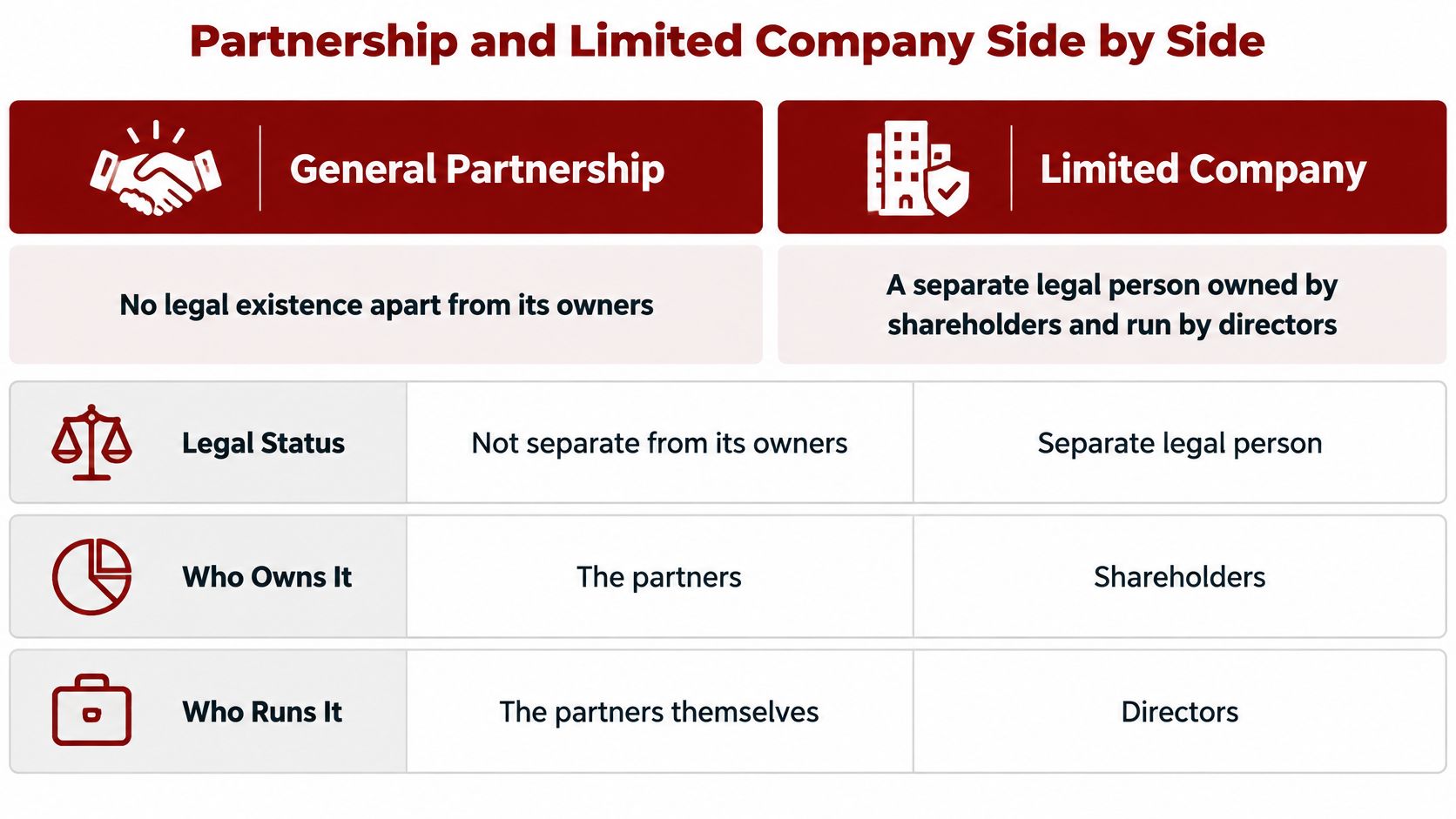
| Criterion | General partnership | Limited company |
|---|---|---|
| Legal status | Not separate from its owners | Separate legal person owned by shareholders |
| Owner liability | Unlimited and shared between partners | Limited to shares, subject to guarantees and misconduct |
| Tax on profits | Each partner taxed on their share | Corporation Tax on company profit, then personal tax on pay or dividends |
| Filing burden | Partnership return plus one Self Assessment per partner | Entity-level accounts, Company Tax Return and confirmation statement |
| Public record | Ordinary partnerships not on the Companies House register | Directors, shareholders and filed accounts are public |
| Set-up | HMRC registration and a partnership agreement | Companies House incorporation and articles of association |
| Adding or removing owners | New agreement and partner consent | Share transfers and register updates |
| Raising outside money | Harder without changing structure | Issue shares to investors |
| Typical fit | Small, low-risk teams with a simple profit split | Trading businesses, contractors and growth plans |
One row in that table hides the true cost of a partnership. Every partner files their own Self Assessment on top of the partnership return, keeps a capital account, and signs off the profit split. Two partners means two returns. Five means five, plus five people who must agree each time the agreement changes. Incorporation does not remove that workload so much as move it. A company swaps per-partner filings for accounts, a Company Tax Return and a confirmation statement filed once, no matter how many shareholders sit behind it.
The tax comparison founders run first is usually wrong too. Putting the headline Corporation Tax rate next to a partner's income tax band proves nothing. What matters is the combined bill on the profit the owners in fact draw, including the personal tax on salary and dividends.
On the population figures, keep two datasets apart. Companies and public corporations made up 76.7% of the UK business population in 2024, while sole proprietorships and partnerships together accounted for 19.8%, according to the ONS UK business activity bulletin. That bulletin counts every UK business. The Companies House register covers a narrower population: at the end of March 2023 it held 4,929,778 private limited companies (92.7% of all corporate bodies on the register), 57,537 limited partnerships (1.1%) and 52,627 limited liability partnerships (1.0%), per the Companies House register activities release. Ordinary partnerships never appear on that register. Treat these as two separate pictures, not figures to combine.
Formation steps for either route sit in this guide to registering a new business in the UK.
Personal Liability When the Business Owes Money
A company shield is not a blanket. In a general partnership, each partner is jointly and severally liable for the firm's debts. A creditor can pursue any one partner for the full amount, not just that partner's share.

In a company limited by shares, shareholders generally risk only what they have paid in, or agreed to pay in. The company's debts stay with the company. That is the protection founders are buying. It stops at the edges.
Limited liability is not a promise that your house is safe. It fails where you sign a personal guarantee, trade on while insolvent, or misconduct yourself.
Where the company shield gives way
- Personal guarantees: Banks, landlords and suppliers often ask a director to guarantee a loan, a lease or trade credit. The company debt becomes your debt the moment you sign.
- Wrongful trading: Directors who keep the business going when they know, or ought to know, it can't avoid insolvency can be pursued personally.
- Fraud and misconduct: Personal wrongdoing isn't covered by the company veil.
- Trust taxes: Amounts such as PAYE deducted from staff sit in trust. They are not spare cash.
Take two plumbers who owe a supplier £40,000. In the partnership, the supplier can claim the full £40,000 from either partner. In the company, the supplier claims against the company. A director is exposed only for unpaid share capital, or for a guarantee, wrongful trading or personal misconduct. Check every contract for a guarantee before you sign. That clause, not the certificate of incorporation, is where most personal exposure sits.
A short briefing on how creditors reach owners, and where the company line holds, is worth ten minutes before you pick a structure.
An LLP is the middle route. Members get limited liability, while profits are still taxed in a partnership style, and the LLP has its own filing duties. It suits professional teams who want a shield without turning every drawing into a dividend. It doesn't remove the need for a proper agreement, and it doesn't cancel a guarantee you sign in your own name.
How Profits Are Taxed in Each Structure
The two structures are taxed on different things. A partnership isn't assessed for income tax itself. Each partner pays income tax, and self-employed National Insurance, on their allocated share whether or not they take the cash. A company pays Corporation Tax on its profit first. The owner pays personal tax only when money leaves as salary or dividends.
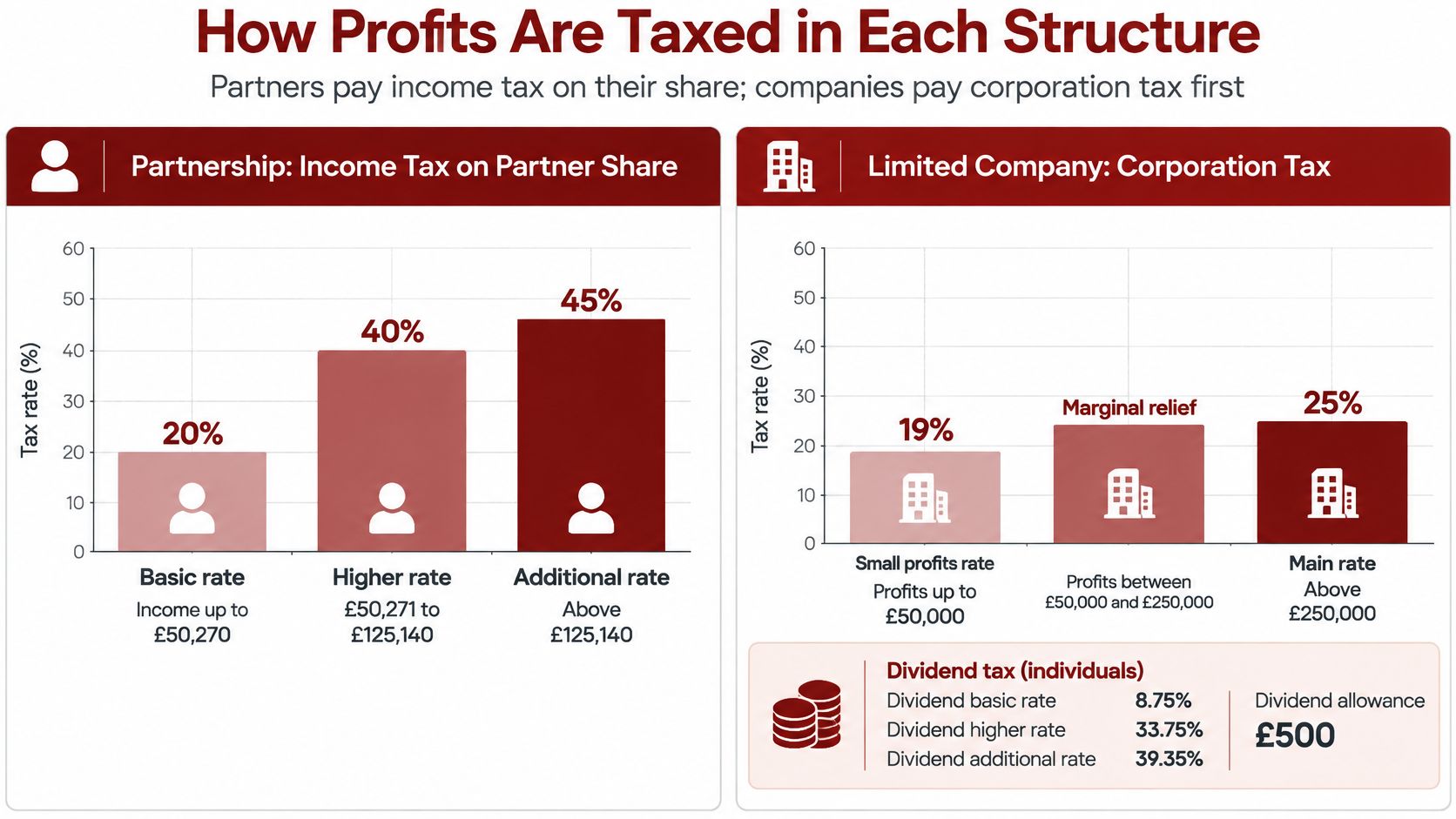
HMRC's starting-out guidance on choosing a business structure confirms that partnership profit is taxed on the partners, while a company faces Corporation Tax and then personal tax when money is taken out. Headline rates don't decide the winner. The extraction plan does.
Rates that set the result
| Tax or rate | 2025/26 figure | Applies to |
|---|---|---|
| Personal allowance | £12,570 | Partner shares, salary and dividends |
| Basic rate income tax | 20% | Partner share or salary in the basic band |
| Higher rate income tax | 40% | Partner share or salary above the basic band |
| Class 4 NI (self-employed) | 6% | Partnership and sole trader profit shares |
| Corporation Tax small profits rate | 19% | Company profits |
| Corporation Tax main rate | 25% with marginal relief between | Company profits |
| Dividend allowance | £500 | Dividends received by the owner |
| Dividend basic rate | 8.75% | Dividends in the basic band |
| Dividend higher rate | 33.75% | Dividends in the higher band |
Confirm the current bands on GOV.UK before you model a year. Dividend rates are also due to change from April 2026, so a calculation built on today's dividend rates will be stale for the following tax year.
Draw it all, or leave it in
Everything withdrawn. On a partnership, the whole profit is in the partner's tax bill, including Class 4 National Insurance. On a company, Corporation Tax comes off first, then dividend tax (and any salary tax and employer National Insurance) applies to what you take. For an owner who needs the cash to live on, that second layer often wipes out the gap, and can leave the company route more expensive once accountancy and payroll are added. Employer National Insurance applies to salary above the secondary threshold, so a large salary is rarely the cheap route.
Profit left in the business. Here the company usually wins. You have paid Corporation Tax, and you haven't triggered dividend tax on money you didn't take. The partnership still taxes the partner on the full allocated share, even if the cash stays in the bank to buy a van or fund next quarter. Retained profit is the honest case for incorporation, not a vague claim that "companies pay less tax".
Uneven splits change the picture again. Partnership profit can be allocated by agreement, so one founder can take more without issuing new shares. In a company, uneven rewards need salary, dividends on different share classes, or a bonus, each with its own tax and paperwork. Pension contributions can be efficient in a company, but only if you weren't going to draw that money anyway.
Compare tax on the cash you actually take, and on the cash you leave behind. A single headline rate answers neither question.
Filings and Deadlines Each Structure Creates
Incorporation moves the admin rather than removing it. A partnership multiplies work with every partner you add. A company concentrates work at entity level, then adds payroll if you pay a salary.
The partnership year
HMRC's Self Assessment legal framework requires partnership registration by 5 October after the end of the first tax year of trading, which falls in the business's second tax year. One nominated partner files the Partnership Tax Return. Every partner registers for Self Assessment and reports the exact allocated profit from that return. Payment is generally due by 31 January. Document the profit-sharing ratio and tie every personal return to the partnership statement, because HMRC expects the same figure on both.
Two partners means one partnership return and two personal returns. Three partners means three personal returns, three payment positions, and three sets of other income to keep off the partnership figures. Drawings, pensions and a partner who also has a job all sit on those personal returns. That is the multiplication people miss when they call a partnership "simple".
The company year
You incorporate, then register the company for Corporation Tax with HMRC within three months of starting to trade. Each year you file statutory accounts, a Company Tax Return and a confirmation statement. If anyone is on payroll, Real Time Information runs on payday. For what goes into the company filing itself, see this note on the Corporation Tax return.
| Obligation | Partnership | Limited company | Typical deadline |
|---|---|---|---|
| HMRC registration | Partnership registration with HMRC | Companies House incorporation, then Corporation Tax registration with HMRC | Partnership by 5 October after the end of the first tax year of trading; company within three months of starting to trade |
| Main tax return | Partnership Tax Return by the nominated partner | Company Tax Return | 31 January for the partnership; 12 months after the period end for the company |
| Personal tax return | Self Assessment for every partner | Self Assessment only where extra income needs reporting | 31 January |
| Payroll | Not needed for profit shares | Real Time Information if a salary is paid | Each payday |
| Statutory accounts | None | Filed at Companies House | 9 months after the year end |
| Annual Companies House filing | None | Confirmation statement | Every 12 months |
| Tax payment | Each partner pays their share through Self Assessment | Corporation Tax | 9 months and 1 day after the period end |
The partnership burden grows by one full personal return per extra partner. The company burden stays one set of accounts and one Company Tax Return, and it grows with the complexity of the accounts, not with the number of shareholders. A three-founder company with a clean salary and dividend pattern is often less fiddly than a three-partner firm with uneven drawings.
Diarise three dates and you will avoid most penalties.
- 5 October: partnership registration deadline, falling after the end of the first tax year of trading.
- 31 January: Self Assessment filing and payment for partners.
- Confirmation statement anniversary: twelve months from the company statement date, separate from the accounts deadline.
Set-Up and Running Costs Compared
The formation fee is the smallest bill and the easiest to compare, which is why founders fixate on it and get the decision wrong. A general partnership has no Companies House formation fee and registers with HMRC without a filing charge. The biggest set-up cost is a solicitor-drafted partnership agreement covering profit shares, drawings, decision-making and what happens if someone leaves. Skipping it feels thrifty until the first dispute.
A company pays the current Companies House incorporation fee, adopts articles of association, and usually needs a shareholders' agreement where there is more than one owner. Take the government fees from the live Companies House fee schedule, not from a blog post that may be years out of date. That schedule also lists the confirmation statement fee, which a general partnership never pays.
What you pay every year
Side by side, the recurring picture looks like this.
| Cost line | General partnership | Limited company |
|---|---|---|
| Annual government filing | None | Confirmation statement at the fee in the live schedule |
| Accountancy work | One partnership return plus a personal return for every partner | Statutory accounts, one Company Tax Return, payroll if you take a salary |
| Fee driver | Headcount: each extra partner adds a return, payments on account and January queries | Complexity: transaction volume, employees and how clean your records are |
| Shared extras | Bank account, bookkeeping software, pension duties once you hire | Same |
Count the owners before you count the forms. Four partners can mean four personal tax returns and four sets of questions every January. One company with four shareholders produces one set of accounts and one confirmation statement, and that workload stays flat as shareholders join. The partnership quote climbs with every partner you add; the company quote climbs with the messiness of the books. For a four-owner business the company can cost less in total, because its fee follows complexity rather than headcount. Get itemised quotes for both structures before you decide.
A cheap set-up with a weak agreement usually costs more than fair drafting. The expensive problems are predictable: two owners deadlocked over a decision, a leaver demanding their capital back, drawings taken that the profits never covered. Those bills arrive two or three years after you saved the fee, and they dwarf it.
Ownership Changes, Governance and Growth
A general partnership leaves no footprint at Companies House. A company leaves a permanent one, and it now starts with your identity. From 18 November 2025, identity verification is a legal requirement for company directors and people with significant control, with a 12-month transition for appointments already in place. You verify through GOV.UK One Login or an authorised provider, as set out in the Companies House identity verification guidance. An ordinary general partnership has no verification duty, because it files nothing there. Incorporation does not shrink the paperwork, it moves it into the open. What that openness buys you is continuity when people come and go.

When someone wants out
A partnership is only ever its current partners. Losing or adding one usually means consent from the rest plus a new or varied agreement. A company survives its shareholders: shares move, the register updates, filings follow the shareholders' agreement, and the business keeps trading under the same name, the same bank account and the same contracts.
Outside money only knows how to hold shares. An investor can value equity, transfer it and eventually sell it. A partnership interest is a contract between named individuals, a much harder thing to sell to someone who was not in the room when it was signed.
Unless the agreement says otherwise, a general partnership can dissolve when a partner leaves or dies. A company does not die because one shareholder does.
Take two founders three years in, one ready to leave. In the partnership, the exit can dissolve the firm, force a final profit split and leave the survivor re-signing every client contract under a new trading name. In the company, the leaver is bought out under the agreement, the bank account stays open and customers notice nothing. Where the business has contracts, staff or a brand, that continuity outweighs a modest difference in the tax on what each owner draws. The buy-out mechanics need to exist in writing before the row starts, and a shareholder agreement template is a practical starting point for those rules.
Apply one test before you commit. How likely is an ownership change, outside investment or a sale within five years? If the honest answer is "quite likely", choose the company and accept the identity checks and the public register. If the answer is "two of us, equal split, no outside money", the partnership's thin public footprint is the point. Remember the scaling law either way: every added partner adds another signature to each consent and another person who can stall a decision, while every added shareholder fits into transfer rules the company already has.
Choose Between Partnership and Limited Company by Situation
Stop looking for a universal winner. Match the structure to the situation, and name the figure that would flip the answer.
| Situation | Usual fit | Reason |
|---|---|---|
| Two friends, equal split, low-risk service, modest profit | Partnership | Low entity admin, and profit is taxed once on the partners |
| Sole founder wanting liability protection | Limited company | Separates business debts from personal assets, subject to guarantees |
| Construction contractor under CIS | Either, decide on liability and profit retention | CIS duties apply to both structures |
| Contractor via a personal service company | Limited company, if profit is retained | Off-payroll working can tax the engagement like employment, so the company only helps when profit genuinely stays in |
| Landlord with a growing buy-to-let portfolio | Depends on mortgage terms and the profit plan | Company mortgages cost more, but retained rental profit can favour incorporation |
| Startup planning outside investors or share options | Limited company | Shares and governance are what investors expect |
| Partners who draw all profit each year | Partnership | Avoids a second tax layer on money that never stays in the company |
The flip figures are practical. For the two friends, rising profit you don't need to draw, or a contract that demands limited liability, pushes you to a company. For the sole founder, a personal guarantee on the only loan removes much of the shield. For the CIS contractor, the flip is how much profit you can leave in after materials and drawings, not the CIS scheme itself. For the personal service company, failing the off-payroll test removes the tax prize. For the landlord, a lender who won't offer a company mortgage, or an owner who spends every pound of rent, flips it back. For the startup, a single angel term sheet flips it immediately. For partners who draw everything, leaving a real surplus in the business for two years running flips it the other way.
Work through four steps before you file anything.
- Estimate annual profit and how much will stay in the business.
- List the partners and how their roles, hours and exits may change.
- Read the liability in your contracts, premises and debts, including guarantees.
- Be honest about how much admin you will handle each January, multiplied by the number of partners.
A limited company versus sole trader comparison is a different decision, and it is set out separately in limited company vs sole trader. If you already have a co-founder, don't borrow that answer. Model both structures on your profit, your drawings and your contracts. Action Accountants Limited can run that comparison for partnerships, limited companies and LLPs, including CIS and property cases, and can form the company when the numbers say it is the better fit.
Action Accountants Limited works with founders who need a straight comparison of partnership and limited company tax, liability and filings before they commit. The firm handles formation, company secretarial support, partnership and company accounts, CIS and property work from its North West London practice, and it will tell you when staying a partnership is the better call. Visit Action Accountants Limited and bring your profit estimate, your partner list and the contracts you are about to sign.