
Landlords Tax Return Guide for UK Property Income
Complete UK landlords tax return guide covering filing rules, expenses, finance costs, property income, deadlines and practical preparation steps.

You've collected rent all year, paid the plumber, the agent and the mortgage, and there's money left in the account. That balance feels like profit. On a landlords tax return, it usually isn't. What follows works through the records-to-return journey in order, so you can see where gross receipts, allowable expenses and finance costs go, and why the tax bill rarely matches the bank balance.
Table of Contents
- Start With the Numbers Your Return Must Reconcile
- Work Out Whether You Must File
- Reconcile Each Property on the Return
- Classify Expenses Finance Costs and Allowances
- Handle Property Rules That Change the Result
- Prepare and Submit the Return on Time
- Test the Rules With Worked Property Examples
- Build a Reliable Year-End Landlord Checklist
Start With the Numbers Your Return Must Reconcile
It's late January. A landlord in North West London has bank statements on one tab, agent statements in a folder, and a mortgage statement that mixes interest with capital repayments. The spreadsheet shows a comfortable surplus, yet the return produces a higher taxable figure and an unexpected bill. Nothing has gone wrong with the arithmetic. Three different numbers have been treated as one.
Accounting profit is what your records show after every cost you have paid. Taxable property profit is a narrower figure, built only from items the tax rules allow in that computation. Final Income Tax liability comes later still, after your other income, allowances and any separate tax reduction for finance costs are taken into account.
Keeping those three apart from the start changes how you work, as the reconciliation map below shows.

Why the journey matters more than the form
The form itself is the last step. The earlier stages decide the result:
- Gross rent: the full amount attributable to the tax year, before anyone deducts fees.
- Allowable expenses: ordinary revenue costs that reduce property profit.
- Residential finance costs: handled separately, not deducted from rent.
- Taxable income: the property result combined with your wider tax position.
The surplus in your bank account is a cash figure, not a tax figure. Reconciling between the two is the whole job.
There's also a structural split to settle first. An individual landlord generally reports through Self Assessment. A company landlord follows a different reporting route entirely, so mixing company and personal property records creates errors before you've entered a single number.
Landlords who code transactions during the year spend late January checking. Landlords who don't spend it reconstructing, guessing at dates and hunting receipts. The second approach is where allowable costs get lost and ineligible costs creep in. Organised records aren't admin for its own sake. They're the evidence that lets each figure on the return stand up.
Work Out Whether You Must File
Many landlords ask whether they need to file by looking at what they kept. HMRC asks a different question. You test both the gross and the net position, and either test can trigger reporting.
Rental income generally needs reporting where it exceeds £2,500 after allowable expenses or £10,000 before allowable expenses, and a landlord who doesn't normally file must register by 5 October following the relevant tax year, as set out in GOV.UK guidance on paying tax when renting out a property.
The two tests in plain figures
Take a property with £12,000 of rent and £3,000 of allowable expenses. That produces £9,000 of net property income. Now run both tests. The gross amount is above £10,000, and the net amount is above £2,500. Reporting is required on either measure, so arguing about which one applies is beside the point here.
The trap sits with high-cost properties. A landlord with large expenses might focus on a modest net figure and overlook a gross figure that clears its threshold comfortably. That's why you calculate both, every time.
When a Landlord Must Report Property Income
| Property income result | Reporting result | Reason |
|---|---|---|
| £12,000 gross, £9,000 net | Report | Both thresholds exceeded |
| Gross above £10,000, net below £2,500 | Report | Gross test is met on its own |
| Gross below £10,000, net above £2,500 | Report | Net test is met on its own |
| Below both thresholds | Check your position | Neither test met on these figures |
What the test actually measures
The thresholds concern rental income, not every pound you receive from employment, pensions or elsewhere. Don't inflate the test with unrelated income, and don't shrink it by netting off costs that aren't allowable expenses.
Portfolios change the answer. Several modest properties, each unremarkable alone, combine into a total that crosses both thresholds. Work from the combined rental picture, not your favourite property.
If you're new to this and don't normally file, the 5 October registration point comes well before any filing deadline, and missing it creates problems that a timely return can't fix. The practical steps in this guide to registering for Self Assessment are worth working through before that date arrives, not after.
Reconcile Each Property on the Return
A single portfolio total hides more than it reveals. One property carries the repair bills, another sits empty for a spell, a third is jointly owned. Reconciling property by property gives you an audit trail from bank record to reported figure, and it's the only way to spot what's really happening. The flow below shows the sequence for each property.
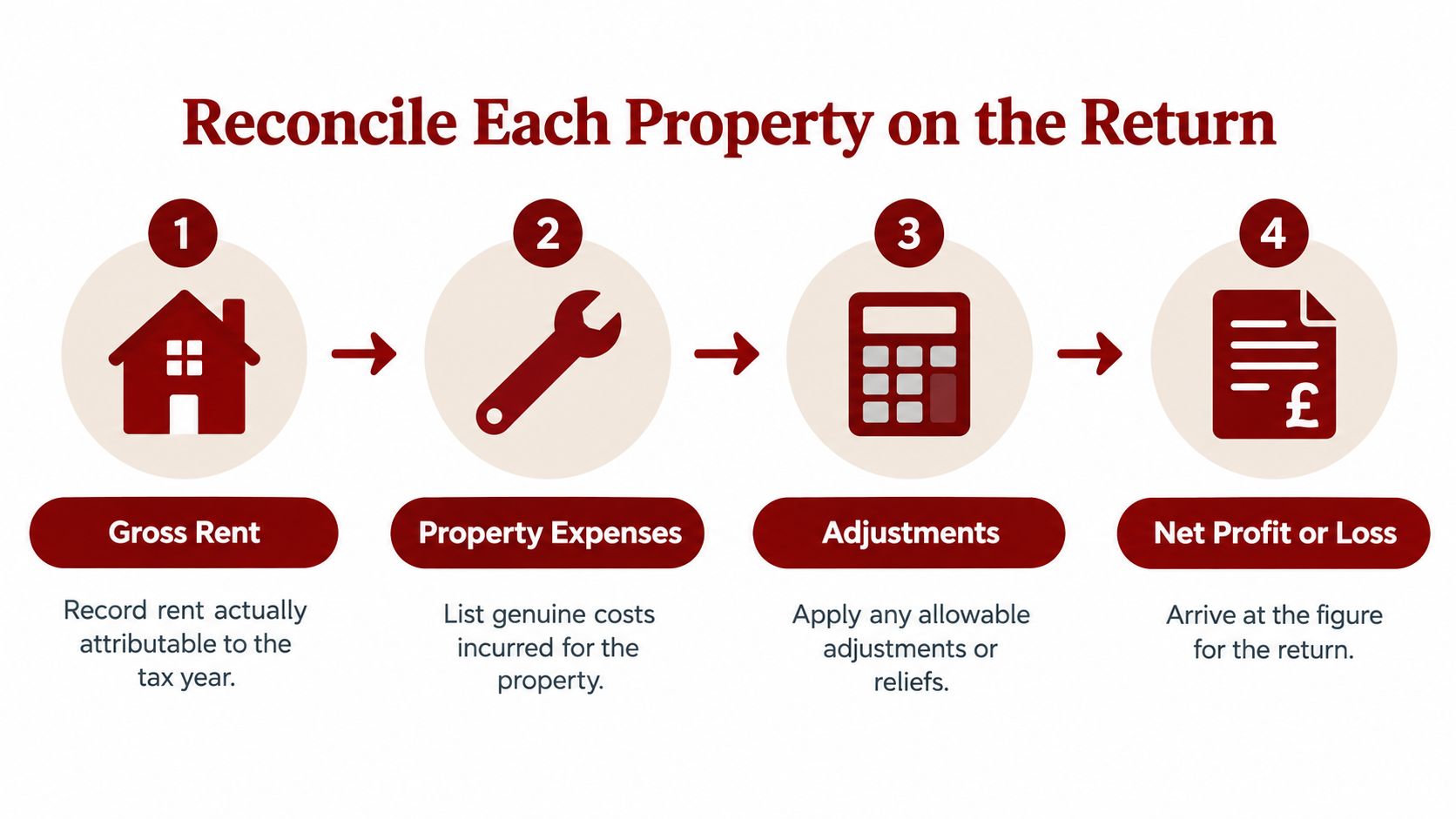
Start with gross rent attributable to the tax year. If an agent collects rent and deducts fees before passing the balance on, the amount landing in your account isn't the gross figure. Work back to what the tenant was charged, then show the agent's fee as an expense. Netting off at source understates both income and costs.
Building the expense schedule
Give each property its own schedule, grouped by type of cost:
- Repairs and maintenance: supported by invoices describing the work done.
- Insurance: the premium relating to that property for the period.
- Management costs: agent fees traced to agent statements.
- Service charges and water: matched to demand notices and statements.
- Other revenue items: only where a source document supports them.
This discipline pays off when a figure looks odd. You can trace it to a document instead of defending a memory.
Practical rule: if you can't tie a number to a bank entry and a source document, it isn't ready for the return.
Empty periods, arrears and personal spending
Short voids produce no rent, but the property may still incur costs. Record both clearly rather than inventing a smoother story, and take advice where the treatment of a particular cost during a void isn't clear. Arrears need the same care. What's owed, what's received and what's written off are three different things, and blurring them distorts gross rent.
Personal spending is the leak in most reconciliations. A personal card used for a repair, or a property account used for household costs, breaks the trail. Keep a separate account for property money where you can, and flag anything personal at the time, not a year later.
Where a property gives rise to gains or other property-specific adjustments, identify them separately per property rather than burying them in rent. The video below walks through presenting this kind of reconciliation clearly.
Classify Expenses Finance Costs and Allowances
Think of your costs as tools being sorted into workshop drawers. Every tool cost money, but putting one in the wrong drawer doesn't make it the right tool. On a landlords tax return, misclassification is the commonest route to a wrong profit figure, because the return treats each drawer differently. The classification below sets out the main split.
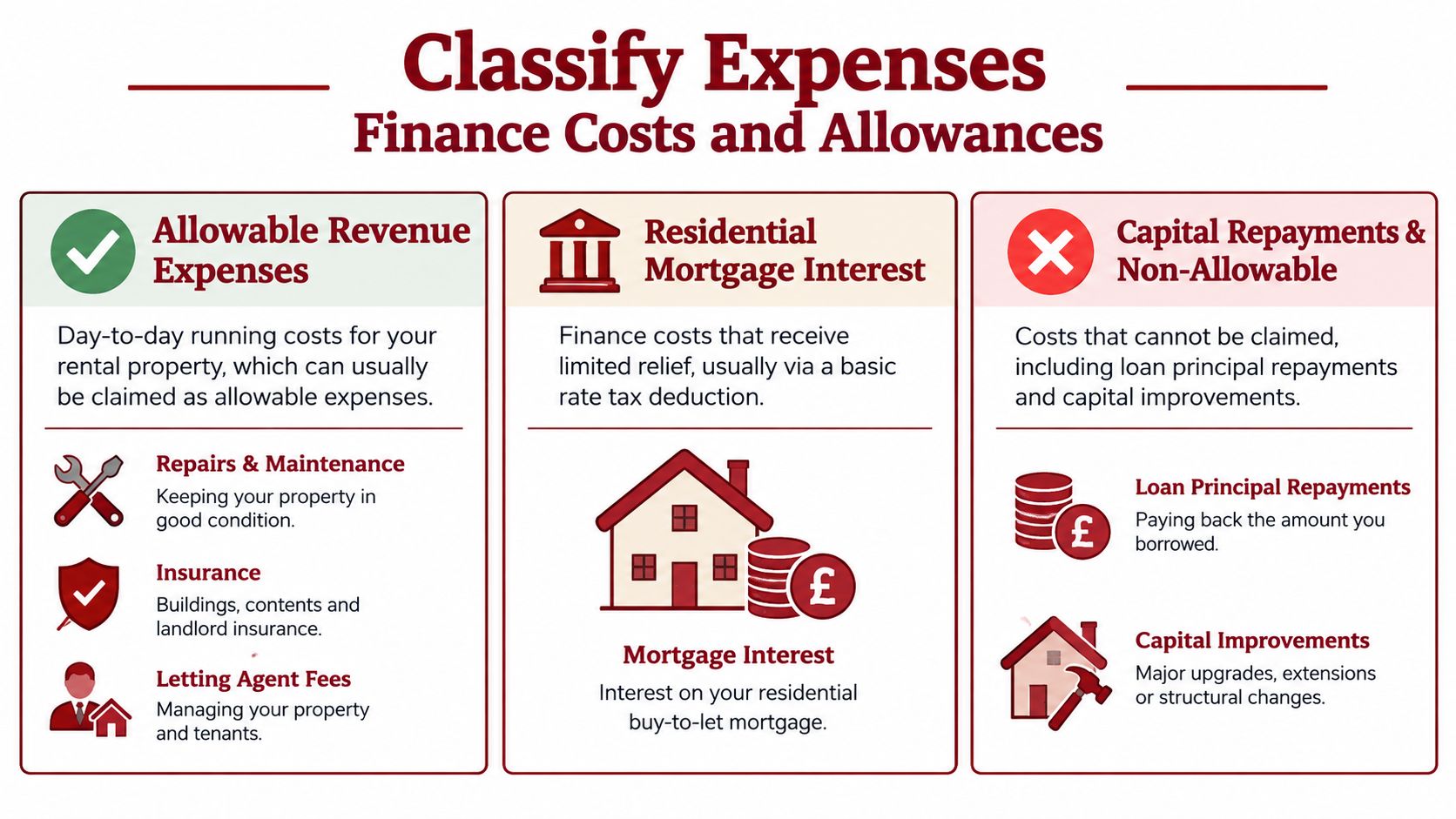
Drawer one, ordinary revenue expenses
Day-to-day running costs belong here. Repairs that restore what's already there, insurance premiums, letting and management fees, and similar revenue items are generally considered in the property profit computation. The question to ask is whether the cost maintains the property as it is, rather than creating or improving something.
Evidence matters as much as classification. An invoice that says what was repaired, where and when supports the entry. A card receipt for a round sum supports very little.
Drawer two, residential finance costs
Returns most often go wrong here. For 2025–26, no residential property finance costs are allowable as a direct deduction from property income, and qualifying amounts are entered separately to calculate a tax reduction generally capped at 20% of those costs, as confirmed in HMRC's trust and estate and property return notes for 2026.
Read that again if your instinct is to deduct mortgage interest from rent. That instinct belongs to an older system. Deducting it now understates taxable property profit and overstates your relief if you're taxed above the basic rate.
This treatment can also push your total income into a higher band, with knock-on effects for income-tested benefits and allowances. That's a planning point, not just a filing point, and it's worth modelling before you borrow more.
Mortgage interest on a residential let doesn't reduce your taxable profit. It feeds a separate basic-rate reduction, and confusing the two is expensive.
Drawer three, capital items and repayments
Capital repayments are not qualifying finance costs at all. The capital element of a mortgage payment builds your equity, it doesn't attract relief. Only the interest element, taken from the lender's statement, belongs in the finance cost figure.
Capital improvements sit outside current revenue deductions too. An extension, a new configuration, or work that upgrades the property beyond its previous condition isn't a repair merely because you've paid the invoice. Treating it as one inflates expenses for the year and stores up a correction later.
Loan-arrangement costs also need separating from interest, repairs and fees, since only qualifying finance costs feed into the tax reduction. Keep the lender's completion statement with the property file so each element can be identified.
Capital allowances require their own assessment rather than a blanket assumption. What qualifies depends on the asset and the circumstances, so document what was bought and why, then take specific advice before claiming.
If you want the expense categories in more depth before you code a year's costs, this breakdown of rental income allowable expenses is a useful reference to work alongside your schedules.
Handle Property Rules That Change the Result
Most returns aren't difficult because the basic computation is hard. They're difficult because one feature of the property changes how the figures are handled. Treat each feature below as a separate decision rather than assuming a standard answer.
Joint ownership
Where property is jointly owned, your return should reflect your share of the income and costs according to the ownership position, supported by records that show the split. Shared bank accounts and informal arrangements make this harder than it needs to be. If two owners take different shares of rent but the paperwork suggests something else, resolve that before filing, not during an enquiry.
Joint ownership also affects each person's wider position individually. Two owners can look at the same property and reach different conclusions about thresholds, tax bands and reporting, because their shares and other income differ.
Residential versus non-residential finance costs
The restriction described earlier applies to residential property. For non-residential property, loan-obtaining costs and interest on qualifying finance can generally be deducted in calculating taxable profits. A landlord with a shop and a flat who applies one treatment to both will get at least one of them wrong.
Mixed-use property sharpens the point. You need records that identify which borrowing relates to which element before any computation starts.
CIS deductions and contractor payments
Landlords with construction links sometimes meet the Construction Industry Scheme in their property dealings. Amounts withheld under CIS are deductions to be reconciled properly, not rent and not a property expense. Blending them into rental figures corrupts both the property schedule and the wider return.
Keep CIS statements apart from property documents, and reconcile each on its own terms. Where the same person earns contracting income and rental income, that separation becomes even more important.
How common this filing population is
You're not dealing with a niche filing obligation. In 2024–25, 2.88 million unincorporated landlords declared property income through Income Tax Self Assessment returns, and approximately 99% were individuals, according to HMRC's property rental income statistics for 2026.
That figure has a limit worth respecting. It excludes incorporated companies and some lower-income cases, so it isn't a count of everyone who owns rental property. It does show the scale of individual landlord reporting, which is why HMRC expects these returns to be reconcilable.
Properties involving joint ownership, mixed residential and non-residential use, or CIS deductions merit review before submission. The treatment of borrowing across those categories is covered further in this guide to landlord mortgage interest relief, which is worth checking against your lender statements.
Prepare and Submit the Return on Time
Good returns are assembled, not written in one sitting. The routine below works whether you have one flat or a portfolio, and it surfaces problems while they can still be fixed. The checklist summarises the sequence.

The preparation routine
- Organise records by property: one folder, physical or digital, per property.
- Reconcile to banks and lenders: rent to statements, interest to the lender's annual figure.
- Separate finance costs: interest away from capital repayments and arrangement costs.
- Review unusual figures: a cost far larger than last year's usually has a reason. Find it and note it.
- Complete the return sections: from reconciled schedules, never from memory.
Records to collect before you start
- Tenancy and agent statements: gross rent and fees shown separately.
- Bank statements: the account or accounts property money moved through.
- Mortgage statements: interest and capital identified by the lender.
- Invoices and receipts: repairs, insurance, service charges, professional fees.
- Ownership documents: anything supporting shares in jointly owned property.
Filing, payment and the digital shift
Don't confuse a filing deadline with a payment deadline. They're separate obligations, even where dates coincide. Protect the 31 January online filing and payment deadline where it applies to you, and diary it well before the work starts. Landlords who begin in January leave themselves no room when a lender statement is slow to arrive.
A warning from practice: the landlords who struggle at deadline aren't the ones with complex affairs. They're the ones who started too late to obtain a document.
A bigger operational change is now in force. From 6 April 2026, Making Tax Digital for Income Tax applies to sole traders and landlords with qualifying combined self-employment and property income above £50,000 based on 2024–25 income, and affected landlords must keep digital records, send quarterly updates and submit an annual return by 31 January after the tax year, per HMRC's Making Tax Digital for Income Tax collection.
The critical point is that qualifying income means gross turnover before expenses. Mortgage interest and repairs don't reduce it. A landlord with several modest properties, or rents alongside freelance or contracting income, can be in scope despite modest taxable profit.
The threshold falls to £30,000 from 6 April 2027 based on 2025–26 income, and to £20,000 from 6 April 2028 based on 2026–27 income. If you're anywhere near those figures, moving to monthly digital coding now is cheaper than converting a year's paper under pressure later.
Where you need the dates set out in one place, this summary of the Self Assessment deadline in the UK helps you build the calendar. Contact an accountant before submitting if you have mixed income, uncertain capital items or a Making Tax Digital question you can't resolve with confidence. Firms such as Action Accountants Limited in North West London prepare rental accounts and landlords' Self Assessment returns and file them with HMRC, which is one route where the position isn't straightforward.
Test the Rules With Worked Property Examples
Examples expose the gap between a plausible surplus and the taxable answer. Work through these three and check you can identify the gross figure, the allowable expenses, any separate finance costs and the resulting taxable property profit each time.
Example one, the straightforward computation
A property brings in £12,000 of rent. Allowable revenue expenses, properly invoiced, come to £3,000. Deduct those expenses and you arrive at a £9,000 property profit.
That £9,000 is the property result feeding into the return. It isn't the tax due. Tax follows after your wider income and allowances are considered, which is why two landlords with identical property profits can owe different amounts.
Example two, where finance costs change the picture
Now suppose the same landlord also pays mortgage interest on the property. The tempting move is to deduct that interest from the £9,000 and report a smaller profit. That move is wrong for residential property.
From 2020–21, none of the qualifying residential finance costs could be deducted from property income, and they are instead dealt with through a basic-rate Income Tax reduction, while capital repayments are not eligible finance costs, as explained in HMRC's case studies on income tax when you rent out a property.
So the taxable property profit stays at £9,000, and the qualifying interest amount travels separately into the tax reduction. The landlord's cash position reflects the interest paid. The taxable profit doesn't.
The phased history explains why older advice still circulates. Relief was restricted gradually from 2017–18, when 75% of finance costs remained deductible, through 50% and then 25%, until the deduction disappeared entirely. Advice written for the earlier years will mislead you now.
Example three, repair or improvement
A landlord pays to fix a leaking roof section, restoring what's there, and in the same year pays to convert a loft into an extra bedroom. Both invoices relate to the same roof, but they don't belong in the same drawer. The repair is a revenue question. The conversion creates something new and needs capital treatment rather than a current deduction.
The records distinction decides the outcome. An invoice itemising the repair separately from the conversion work lets you classify each part. A single builder's bill for the whole job leaves you arguing from memory.
Before you file, run this check on every property. Gross rent identified, allowable expenses evidenced, finance costs separated, capital items excluded. If any stage fails, the profit figure isn't reliable yet.
Build a Reliable Year-End Landlord Checklist
Everything in this guide reduces to one disciplined sequence. Follow it in order and the return becomes a reporting exercise rather than an investigation.
The completion sequence
- List every property: note the ownership arrangement for each one first.
- Reconcile gross rent: agree rent attributable to the year back to receipts and agent statements.
- Classify by purpose: revenue expenses by what the cost did, not what the invoice heading says.
- Separate finance costs: qualifying residential interest apart from capital repayments and arrangement costs.
- Review property-specific items: joint shares, non-residential elements and CIS deductions handled on their own terms.
- Trace to the return: every reported field backed by a reconciled schedule.
The central lesson bears repeating because it causes the most grief. Accounting profit, taxable property profit and tax liability are different numbers. A reconciled evidence trail showing how you moved from one to the next is worth far more than a single estimated surplus, however confident it feels.
When to get help
Some situations justify professional input before you submit rather than correction afterwards:
- Mixed income: rents combined with self-employment, affecting thresholds and digital obligations.
- Multiple ownership arrangements: different shares across different properties.
- CIS deductions: withholding that must be reconciled outside the property computation.
- Uncertain capital treatment: building work that mixes repair and improvement.
- Making Tax Digital readiness: gross income near a threshold, or records still on paper.
None of these make you an unusual landlord. They're ordinary features of property income in places like Colindale, Edgware and Finchley, where portfolio investors often run businesses alongside their properties. They reward review at the right moment, which is before the return goes in.
Start the sequence early enough and each stage is short. Leave it until deadline week and every stage competes with the others. That's the key trade-off in a landlords tax return, and it's entirely within your control.
If your property records need turning into rental accounts and a landlords tax return you can reconcile and defend, Action Accountants Limited prepares property accounts, calculates the resulting tax liability and files Self Assessment returns with HMRC for landlords across North West London and the UK. Visit Action Accountants Limited to discuss your properties, your deadlines and whether Making Tax Digital affects you, and get this year's return started while there's still time to do it properly.


