
Self Employed National Insurance Explained for 2026
Understand self employed National Insurance in 2026: Class 2 vs Class 4 rates, thresholds, Self Assessment payments, voluntary NICs and benefit…

You've finished your first year as a sole trader. The invoices looked healthy, the bank balance felt comfortable, and then your Self Assessment calculation arrived. The self-employed National Insurance figure was higher than expected, even though you'd already set money aside for income tax. The problem usually isn't the calculation. It's that people confuse turnover with profit, overlook allowable expenses, or forget that HMRC can ask for advance payments as well as the amount already due.
The rules also changed in a way that still catches experienced contractors. Since 6 April 2024, compulsory Class 2 National Insurance has been abolished for most self-employed people above the small profits threshold. The contribution no longer appears as a separate payment in the way many older guides describe it. Instead, eligible people receive an automatic credit for State Pension and contributory benefit purposes.
This guide gives you the working knowledge you need to forecast your bill, understand what Class 4 charges, decide whether voluntary contributions deserve attention, and plan properly if you're a contractor, landlord with trading income, or new founder. By the end, you should be able to estimate your National Insurance from your profit figure instead of treating the Self Assessment calculation as a surprise.
Table of Contents
- Why Your First Self Assessment Bill Shocked You
- How Self Employed National Insurance Actually Works
- Class 2 Versus Class 4 Contributions
- Registering and Paying Through Self Assessment
- Worked Examples at Different Profit Levels
- Voluntary Contributions and Protecting Your Benefits
- Record-Keeping and Tax Planning for the Year Ahead
Why Your First Self Assessment Bill Shocked You
A new freelance designer might invoice £30,000 during the year and assume National Insurance will be calculated on that figure. It won't. HMRC starts with taxable trading profit, broadly your business income less allowable business expenses, before applying the relevant National Insurance rules. Equipment, professional fees, business travel and other legitimate costs may reduce profit, but private spending doesn't.
That distinction matters. A contractor who records every invoice but misses allowable expenses can overstate profit and therefore overstate the charges based on profit. A contractor who claims personal costs as business expenses creates a different problem, an inaccurate return that may need correcting and could attract HMRC questions.
The second shock is often the payment timetable. Your first January bill may include the liability for the year just ended and, where the rules require it, a payment on account towards the following year. That's why a return can feel much more expensive than the underlying annual calculation. The practical mechanics are set out in this guide to payments on account, but the planning point is simple: the money must be reserved before the bill arrives.
Profit is the starting point
Your bank balance isn't your profit. Drawings aren't an expense, and an unpaid invoice may still belong in the accounting period depending on the accounting basis you use. Keep a running profit estimate throughout the year rather than waiting until the return is due.
A basic monthly routine should include:
- Reconcile income: Match invoices and payment records to your business bank activity.
- Check expenses: Keep receipts and separate business costs from private spending.
- Forecast profit: Update your expected annual figure whenever sales or costs change.
- Reserve cash: Treat the projected tax and National Insurance as money that isn't available for personal spending.
The bill becomes predictable
Once you know your taxable profit, the current thresholds and Class 4 rates do most of the work. The remaining judgement concerns your National Insurance record, whether voluntary contributions make sense, and whether your business structure still suits your income.
That's the difference between reacting to Self Assessment and managing it. You don't need to fear the January calculation. You need a reliable profit number and a plan for the payment.
How Self Employed National Insurance Actually Works
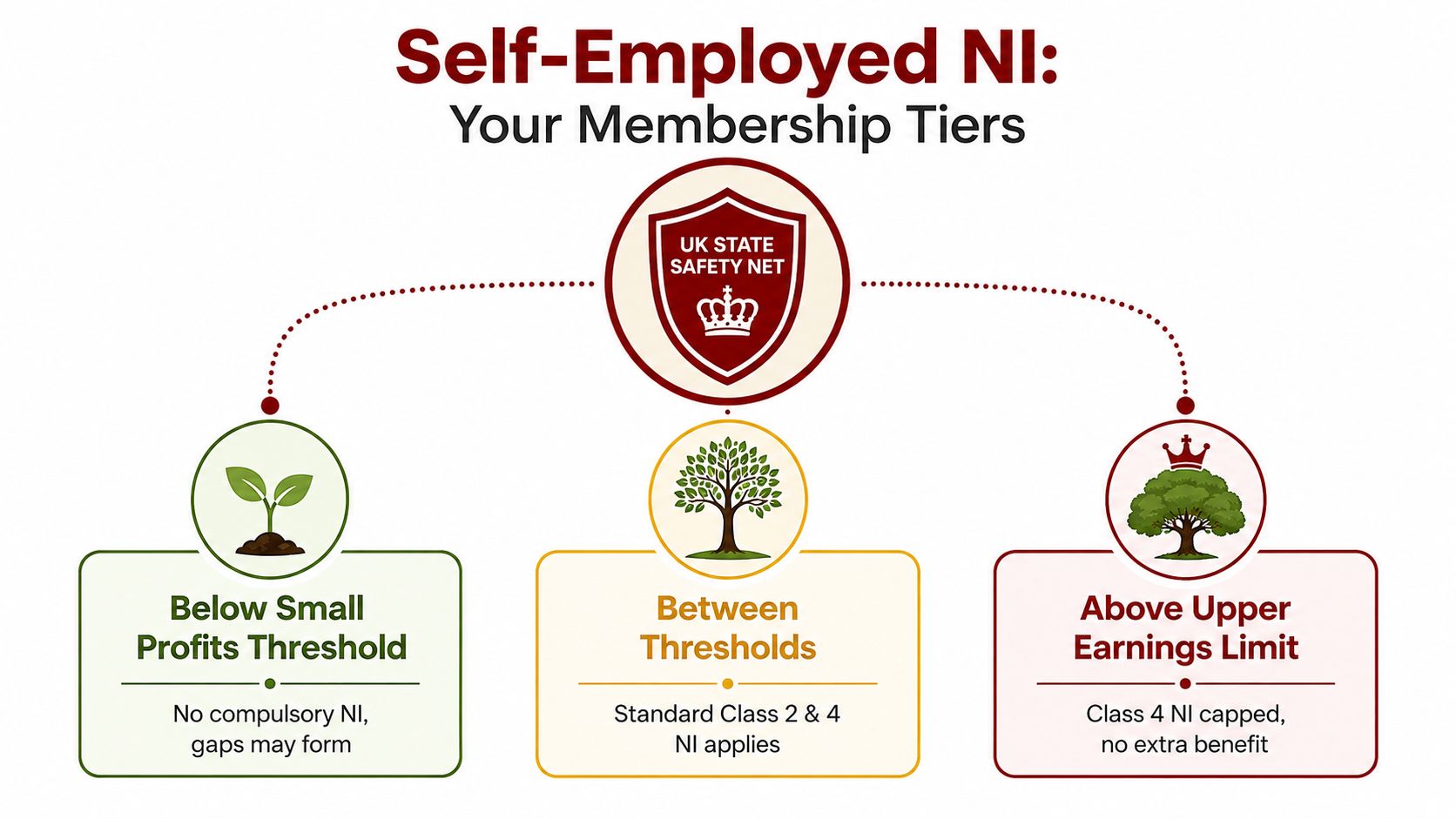
Think of National Insurance as access to parts of the UK's state safety net. Your profit level determines how the system treats your contribution record and whether Class 4 becomes payable. It's not a single charge applied uniformly to every sole trader.
Three profit points organise the system for the 2026 to 2027 tax year. The GOV.UK guidance on self-employed National Insurance rates identifies the small profits threshold of £7,105, the lower profits limit of £12,570, and the upper profits limit of £50,270.
The three thresholds
Below £7,105. You generally won't have compulsory self-employed National Insurance through the ordinary Class 4 calculation, and the automatic Class 2 treatment described below doesn't apply just because you're trading. That can leave a gap in your record, so low-profit traders shouldn't ignore their pension position.
From £7,105 to £12,570. This is the area where the post-reform credit matters most. You may have no Class 4 payment because profits haven't reached the lower profits limit, but people above the small profits threshold are treated as having paid Class 2 for State Pension and contributory benefit purposes.
From £12,570 to £50,270. Class 4 National Insurance is charged at 6% on annual profits within this band, subject to the exact profit calculation on your return. The automatic Class 2 credit also applies where the relevant conditions are met.
Above £50,270. Class 4 continues, but the rate on profits above the upper profits limit falls to 2%. The upper limit therefore changes the rate rather than ending Class 4 altogether.
The April 2024 change
On 6 April 2024, compulsory Class 2 contributions were abolished for self-employed people with profits above the small profits threshold. The separate payment disappeared, but the State Pension and contributory benefit protection remained through an automatic credit for people above that threshold. The reform changed the cash flow, not the importance of checking your record.
The key point: Class 2 is no longer a routine separate payment for most eligible self-employed people, but the credit still matters because it supports your contribution record.
Don't confuse this with director National Insurance. A director receiving salary through a company generally sits within the employment system, not the sole trader Class 4 calculation. If you're weighing those structures, review the practical differences in National Insurance for directors before deciding that incorporation automatically reduces your overall liability.
Class 2 Versus Class 4 Contributions
A contractor with modest profits can owe no Class 4, yet still need to protect their State Pension record. A successful sole trader may receive the relevant credit while paying a sizeable Class 4 charge through Self Assessment. Those outcomes reflect different rules, so treating the two classes as interchangeable leads to poor planning.
The April 2024 reform removed compulsory Class 2 payments above the small profits threshold, while eligible traders generally retain the associated credit.
Class 2 vs Class 4 National Insurance at a Glance
| Feature | Class 2 NICs | Class 4 NICs |
|---|---|---|
| Main trigger | Profits above the small profits threshold can produce automatic credit treatment | Profits above the lower profits limit |
| Current cash payment for most eligible traders | No separate compulsory payment after the April 2024 reform | Yes, calculated through Self Assessment |
| Calculation method | Historically a flat weekly contribution, now generally replaced by a credit for eligible people | Percentage of annual taxable profits within the relevant bands |
| 2026 to 2027 treatment | Automatic credit above £7,105 where the conditions are met | 6% from £12,570 up to £50,270, then 2% above £50,270 |
| Main purpose | Supports State Pension and contributory benefit entitlement | National Insurance charge on self-employed profit |
| Voluntary relevance | Can matter for people below the small profits threshold or with contribution gaps | Not normally something you choose to pay voluntarily |
The practical dividing line is purpose. Class 2 affects your contribution record and may matter when profits are below the small profits threshold or gaps appear. Class 4 is a profit-based charge, so it affects take-home pay once profits cross the relevant limit. Check your projected profit and contribution record separately, rather than assuming one answers both questions.
The historical comparison explains why older articles can mislead. In 2016 to 2017, GOV.UK materials described Class 2 at £2.80 per week, or £145.60 for the year, alongside Class 4 at 9% on profits above £8,060 and up to £43,000, then 2% above that upper limit. The government National Insurance fact sheet provides that historical benchmark. Use current-year rules for planning, not an old weekly payment figure.
Where the figures appear
Class 4 is calculated from the profit reported on your Self Assessment return and included in the overall amount due. It is not a separate return or payment arrangement. Class 2 questions or credit information appear in the self-employed pages and calculation flow, depending on your circumstances and the tax year.
Landlords and new founders also need to separate trading profit from other income before making decisions. If a business is growing quickly, compare the sole trader route with incorporation rather than chasing one National Insurance rate. A company changes how you extract income and may introduce salary-related National Insurance, company compliance and other tax considerations. Review sole trader to limited company options before restructuring.
Registering and Paying Through Self Assessment
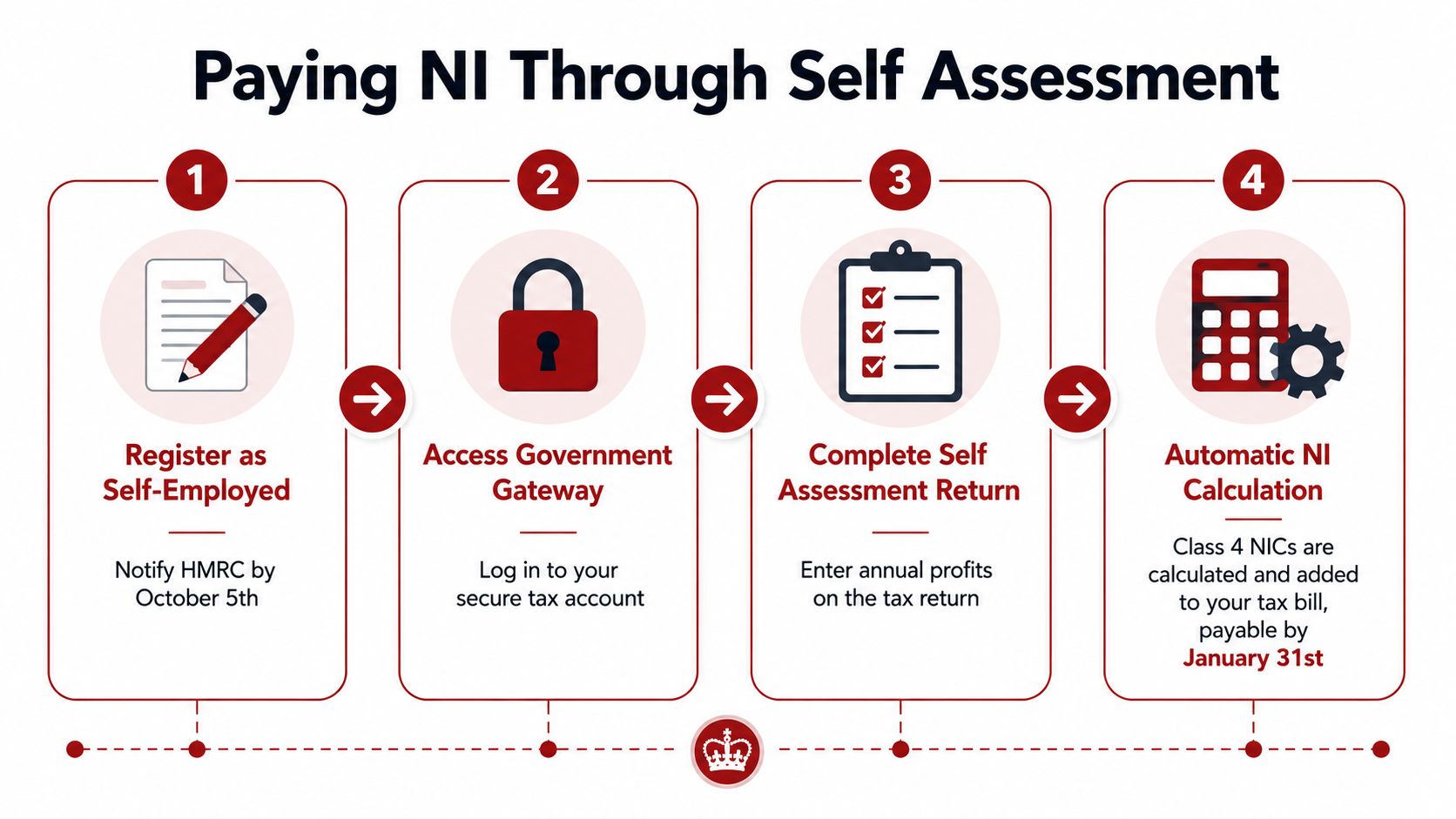
Register with HMRC as soon as you begin trading as a sole trader and know you must file a return. Set up your Government Gateway access, keep your National Insurance details available, and store your Unique Taxpayer Reference, or UTR, with your business records. Use the official Self Assessment registration guidance to check the information HMRC requires. Leaving registration until filing season creates avoidable pressure and increases the chance of missing a requirement.
Set up the right record
Your registration creates the Self Assessment record used for annual reporting. Report trading income and allowable expenses accurately, then review the calculation before accepting the return. The profit figure drives the charges shown in the account, so correcting an expense classification or omitted cost before submission can change the amount due.
Class 2 is different after April 2024. For eligible self-employed people, it generally provides a National Insurance credit rather than a regular payment. Check the credit shown in your return and records, particularly if your profit is low or your pension entitlement depends on maintaining a qualifying year. If the automatic credit does not apply, investigate voluntary contributions before assuming you are covered.
Plan around the January deadline
The online filing and payment cycle centres on 31 January. If payments on account apply, that date may require the balancing liability for the year just ended plus an advance payment towards the following tax year. A further instalment can arise later in the year.
That structure explains why the second year often feels expensive. Your first return establishes the reference liability, while payments on account bring part of the next period forward. Put the expected bill into your cash forecast from the first month of trading, rather than treating January as an unexpected event.
Keep records throughout the year. Software can organise transactions and flag missing expenses, but it does not remove the need to check categories, private use and unusual income. Before choosing automation, compare Keeper vs FlyFin against your record-keeping and filing needs.
North West London taxpayers can use HMRC's online services and seek help from a qualified local accountant if the return includes CIS deductions, property income, multiple trades or a change in structure. Landlords, contractors and new founders should resolve those complications before filing. A pre-submission review can prevent a missed expense or incorrect classification from inflating the final bill.
Worked Examples at Different Profit Levels
The cleanest way to estimate Class 4 is to split profit into the relevant bands. These examples use the 2026 to 2027 rates and thresholds published by GOV.UK, and they isolate Class 4 only. Income tax, payments on account and other parts of Self Assessment aren't included.
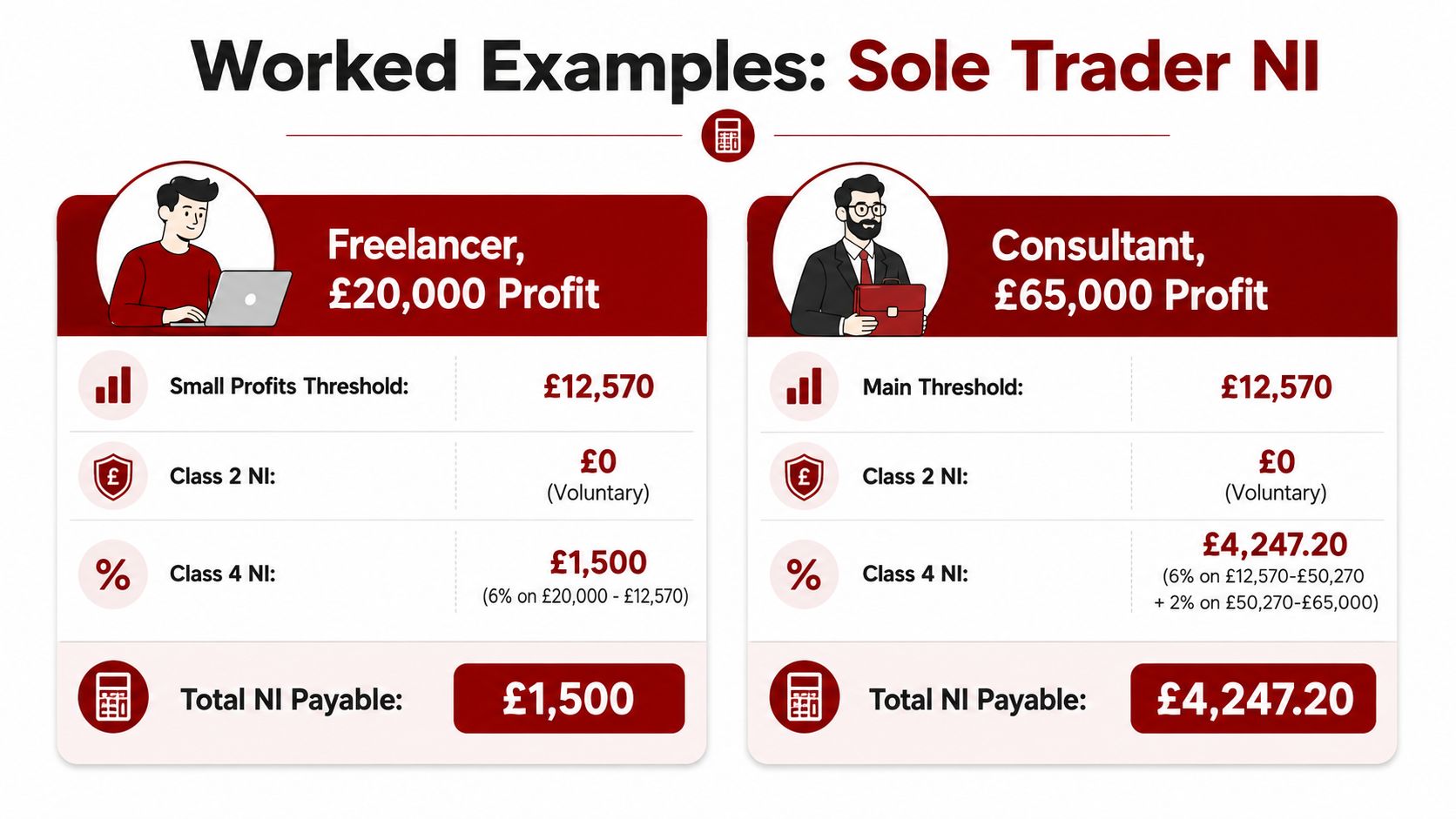
A freelancer with £20,000 profit
The freelancer's profit is £20,000.
- The first £12,570 falls below the lower profits limit for Class 4.
- The remaining £7,430 is within the main Class 4 band.
- £7,430 multiplied by 6% produces £445.80.
The effective Class 4 rate on the whole £20,000 profit is therefore £445.80 divided by £20,000, which is 2.229%. The trader doesn't make a separate compulsory Class 2 payment under the post-April 2024 rules, assuming the relevant automatic credit conditions are met.
The important correction here is that the infographic supplied for this topic shows £1,500 by applying 6% to the full amount above £12,570 while describing the profit as £20,000. That arithmetic doesn't match the stated profit. On the verified rates, the chargeable slice is £7,430, so the correct Class 4 calculation is £445.80.
A consultant with £65,000 profit
The consultant's profit is £65,000.
- The slice from £12,570 to £50,270 is £37,700.
- £37,700 multiplied by 6% is £2,262.
- The slice above £50,270 is £14,730.
- £14,730 multiplied by 2% is £294.60.
- Total Class 4 National Insurance is £2,556.60.
The effective Class 4 rate across £65,000 of profit is £2,556.60 divided by £65,000, or 3.933%. The average rate is lower than 6% because the upper slice is charged at 2%.
A trader below £7,105
Someone with profit below the small profits threshold won't have the same automatic Class 2 credit treatment and won't normally generate Class 4 from these bands. The immediate cash charge may be nil, but the pension record still needs checking. That's where voluntary contributions become a planning decision, not an administrative afterthought.
Voluntary Contributions and Protecting Your Benefits
Low profits don't automatically mean your National Insurance record is safe. If your profit falls below the small profits threshold, the automatic credit available above that point may not protect the year. A career break, a slow trading period or a business launch can therefore create a gap even when you've done nothing wrong.
Start by checking your record through your personal tax account. Look for missing years, credits and the State Pension position before paying anything voluntarily. The correct choice depends on your existing record, future working plans and whether another source of credits already covers the period.
When voluntary Class 2 deserves attention
Voluntary Class 2 is usually the first option to investigate for a low-profit self-employed person because it is designed around self-employed contribution records. Class 3 can also fill gaps, but it's a different voluntary contribution route and shouldn't be selected without checking the exact year and eligibility.
The logic is straightforward. A contribution that protects a qualifying year can be a highly efficient way to support future pension entitlement, but only if that year improves your record. Paying blindly is poor planning. Check first, then decide.
Accountant's rule: Never buy voluntary National Insurance years before checking whether the year is already covered by employment, credits or an automatic self-employed credit.
Contact HMRC or obtain regulated advice about the available window for filling historic gaps. Deadlines can restrict which years you can repair, and those rules can change. Don't assume you'll be able to correct the omission whenever retirement is closer.
The practical sequence is:
- Check the record: Use your personal tax account rather than relying on memory.
- Identify the gap: Confirm the year is incomplete.
- Test the benefit: Establish whether the payment would improve your eventual entitlement.
- Compare the route: Consider voluntary Class 2 and Class 3 only after checking eligibility and cost.
- Act before the deadline: Historic gaps may become unavailable after the relevant period closes.
For a new founder, this review belongs in the first year's financial plan. Protecting the contribution record is part of the cost of operating, not a task to postpone until the business is profitable.
Record-Keeping and Tax Planning for the Year Ahead
Your National Insurance bill is only as accurate as your profit records. A contractor who mixes CIS deductions, invoices and bank receipts can misread the amount already paid and still report the wrong trading result. Keep CIS statements, invoices, expense evidence and tax payment records in one organised system.
Landlords need a separate discipline. Property income and sole trader profits don't become one undifferentiated business just because they appear on the same tax return. Keep property records apart from trading records, then give your accountant a complete picture of both income streams before the liability is calculated.
Three decisions to make early
Contractors: Reconcile CIS deductions as they arrive. Don't wait until January to discover that a deduction statement is missing or has been assigned to the wrong period.
Landlords with a trade: Maintain distinct categories for rents, property costs and trading expenses. This makes it easier to identify which figures belong in the property pages and which determine self-employed profit.
New founders: Compare remaining a sole trader with forming a company before profits, drawings and commercial risk become difficult to unwind. A company can change the National Insurance picture, but it also introduces payroll, statutory accounts and company administration.
Forecast profit at regular intervals. If your work pipeline has strengthened, increase the cash reserve for the January bill. If profit has fallen, investigate whether the relevant payment-on-account position can be adjusted rather than hoping the cash pressure resolves itself.
Use this month's checklist:
- Reconcile the bank: Match transactions to invoices and receipts.
- Review expenses: Remove private costs and capture legitimate business costs.
- Check CIS records: Tie deductions to the correct contractor statements.
- Separate property activity: Keep rental and trading records clearly identifiable.
- Review your NI record: Confirm whether voluntary action is needed.
- Update the forecast: Estimate profit and reserve for Self Assessment.
- Choose your structure deliberately: Get advice before incorporating.
Action Accountants Limited handles sole trader tax returns, bookkeeping, tax compliance, company formation and CIS-aware support for contractors and growing businesses. If you want your profit calculation and National Insurance position reviewed before the next filing deadline, visit Action Accountants Limited and arrange a practical discussion about your records and plans.


