
Company Formation Steps: A Practical UK Checklist
Work through company formation steps for a UK limited company, from naming and Articles to Companies House, HMRC registration and first compliance tasks.
A founder gets the company number, forwards the certificate to a client and assumes the paperwork is behind them. Then a director's identity check holds up a filing, a letter goes to an address nobody checks, or the first payroll is due before anyone has set it up.
That's why company formation steps shouldn't stop at submitting a form. The choices you make before filing affect ownership, tax registrations and the work you'll need to keep up with after the company exists.
Table of Contents
- Why Company Formation Is Only the Starting Line
- Choosing Your Company Name, Structure and Articles
- Verifying Identities Before You File
- Filing with Companies House and Setting a Registered Office
- Registering for HMRC Tax, PAYE and VAT
- Post-Formation Compliance and Company Secretarial Tasks
- Choosing Support and Your Next Practical Step
Why Company Formation Is Only the Starting Line
A company number confirms that a company has been incorporated. It doesn't confirm that the founders have agreed how decisions will be made, that the right people have completed identity checks, or that anyone has planned for payroll and statutory filings.
The wider business population is active and constantly changing. The Office for National Statistics' UK business demography figures put the number of active UK businesses at approximately 2.9 million in 2023, with around 316,000 businesses created and an 11.0% business birth rate that year. The figures include more than newly incorporated limited companies, but they're a useful reminder: starting a business is one thing; keeping its records and obligations in order is another.
Think of the certificate as the point where the legal entity begins, not the point where the founder's responsibilities end. A useful formation checklist moves from decisions about the structure, name, ownership and articles to identity verification and the Companies House application. It then accounts for the tax and administrative work that follows, including deciding whether the company needs PAYE or VAT registration and setting up a filing calendar.
For founders still planning how their practice or professional firm will operate, it can also help to consider the systems required after launch. This guide to technology planning for a CPA startup offers context for thinking about the tools that support day-to-day work, alongside the legal setup.
By the end of this guide, you should be able to identify which decisions need to be settled before filing, what to prepare for Companies House, and which post-formation tasks need attention straight away. The aim isn't to make every decision complicated. It's to avoid rushing choices that become awkward to correct later.
Choosing Your Company Name, Structure and Articles
Before opening the application, agree what you're forming and who will own it. A private limited company is a common choice for a business that wants a separate legal entity, but it isn't automatically the right structure for every founder. Compare the responsibilities and tax treatment with other options, including working as a sole trader. This comparison of limited companies and sole traders can help frame that decision.
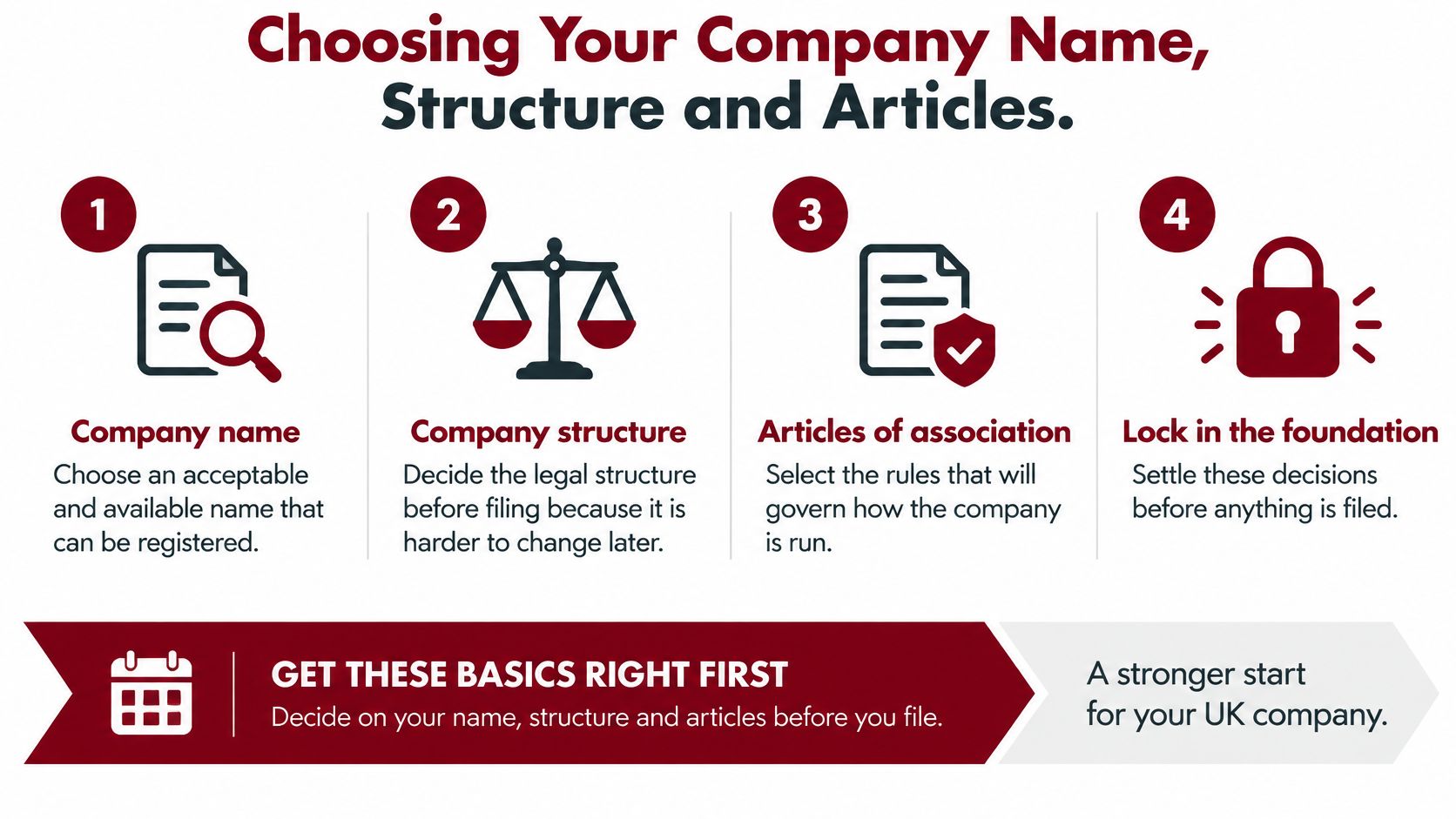
A name needs to meet Companies House requirements and be available to register. Check it before settling on branding or printing materials. A name that can be registered isn't, by itself, a guarantee that it's suitable for every commercial purpose, so consider whether customers can distinguish it from others and whether it accurately represents the business.
Decide who owns and controls the company
Set out the initial directors and shareholders, and make sure everyone understands their role. Directors manage the company and carry legal responsibilities. Shareholders own shares and have rights associated with them. One person can hold both roles, but the records must still make each capacity clear.
Then decide what the shares represent. If you expect outside investment, think through whether the proposed share structure supports the ownership and decision-making arrangements you anticipate. A hurried setup can leave founders needing to revisit allotments or amend records when an investor appears. Don't issue shares just because an online form makes it easy. Agree the intended ownership first and document it consistently.
The Articles of Association are the company's rules. They cover matters such as how decisions are made and how shares can be transferred. Standard articles may be appropriate for a straightforward company with simple ownership. Bespoke articles may make sense where founders need specific arrangements, or where investment plans make governance more complex. Get advice before filing if the founders' expectations differ. The filing date is a poor time to discover that one founder assumed a different voting arrangement.
DIY or a formation service
| Decision | Doing it yourself | Using a formation service |
|---|---|---|
| Name and structure | You compare options and remain responsible for the choices. | The service can guide the filing process, but you still need to choose an appropriate structure. |
| Ownership and shares | You enter the details yourself, so agree them carefully before starting. | A service may simplify data entry, but it can't resolve a disagreement between founders for you. |
| Articles | Standard provisions may suit a simple setup. | A provider may offer document options, but complex terms need suitable professional advice. |
| Filing | You submit and check the application. | The provider may handle submission, while you remain responsible for supplying accurate information. |
Neither route makes a poor ownership decision good. Use a service to save time on administration, not as a substitute for agreeing how the company should work.
Verifying Identities Before You File
Identity verification is part of the formation process, not a detail to leave until after the application. It confirms a person's identity, rather than verifying the company as an entity. Each relevant person needs to consider their own verification status.

Companies House says identity verification became a legal requirement on 18 November 2025, with a 12-month transition period. New directors and people with significant control usually verify through GOV.UK One Login or an Authorised Corporate Service Provider. Check the Companies House identity verification guidance for the current routes and requirements.
Check each person's role
Work through the people involved before filing:
- Proposed directors: Confirm who will be appointed and whether each person has completed the required verification. Don't assume that one founder's check covers the others.
- People with significant control: Identify who meets the relevant control criteria and check what verification applies to them.
- Overseas founders: Allow time to confirm which route is available to each person. Don't assume that a founder outside the UK can use the same digital process as a UK-based colleague.
- Agents and accountants: If you want a professional to handle verification, ask whether they're an Authorised Corporate Service Provider and what information they need from each person.
GOV.UK One Login is a route for individuals who can use the relevant digital identity process. An ACSP can also carry out verification as part of its authorised service. If a founder doesn't have suitable digital ID, check the official guidance for alternative options before planning the filing date. A provider can support the process, but the identity check is still personal. Don't treat an agent's involvement as a transfer of the director's or PSC's responsibility.
An incomplete or unsuccessful check can delay the application or a later filing. That's particularly frustrating when the rest of the form is ready but a person's verification is not. If an application involves founders in different countries, agree who is checking what and when before asking anyone to submit.
Use a simple sign-off list: each proposed director has checked their route; each PSC has been identified and considered; overseas founders know what documents or process they may need; and any ACSP has confirmed the service it can provide. The video below provides additional context on identity verification.
Filing with Companies House and Setting a Registered Office
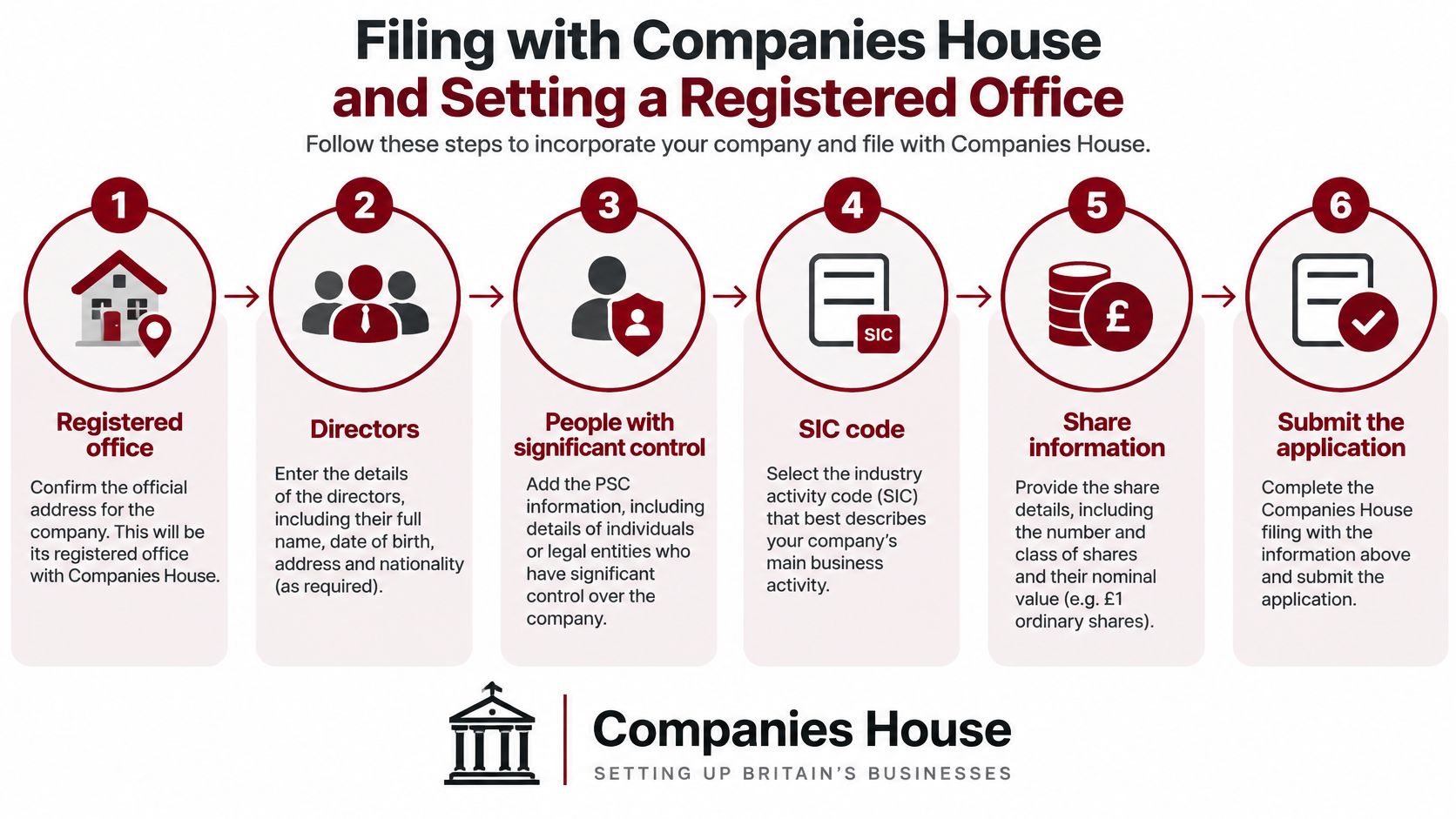
The application is easier to check when you gather the information in a sensible order. Start with the official address, then add the people, activity and ownership details. Filing quickly is less useful than filing accurately.
Prepare the application details
First, choose a registered office at an appropriate address in the relevant part of the UK. It's the company's official address for notices and correspondence. Using a home address may expose it on the public register and create a practical problem if post isn't checked reliably. Consider privacy, access to mail and who will act if an important letter arrives while you're away.
Next, enter the directors and people with significant control, including their required details and verification information. Add an official email address that the company will monitor. Choose a SIC code that accurately describes the company's principal activity. The code becomes part of the public record, so avoid choosing a broad or irrelevant description just to get through the form.
Then check the share information against the founders' agreement. The shareholders, share allotments and ownership percentages should tell the same story across the application and company records. If the details differ, correct them before filing rather than trying to explain inconsistent information later.
A company secretary isn't compulsory for a private limited company. The directors remain responsible for the company's obligations whether or not they appoint one. A secretary can help maintain records and organise governance; professional support may be useful when the company has more complex ownership or governance needs. For a simple company, the directors may handle these tasks themselves if they understand what needs to be kept up to date.
Companies House says online incorporation costs £100, and applications are usually registered within 24 hours. A successful application results in a certificate of incorporation confirming the company number and formation date. Those details make the company's legal existence official. They don't replace tax registrations, bookkeeping or ongoing filings.
Before uploading supporting documents, organise them so the relevant information is easy to reconcile. If you need to combine separate files into one, this practical guide on how to join separate PDFs may help with document handling.
Pre-submission check: Compare the proposed name, director details, PSC information, registered office, SIC code and share information against one agreed set of records. Fix mismatches before submitting.
Registering for HMRC Tax, PAYE and VAT
Companies House registration doesn't settle every tax or operating requirement. Work out which registrations apply by considering what the company will do, when it will start trading, whether it will employ staff and what it expects to sell.
Corporation Tax registration is generally set up alongside incorporation unless the company is dormant. Check the company's position rather than assuming that incorporation alone has completed every tax step. Keep the company's activity and records clear from the start, including if it won't trade immediately.
Payroll depends on what the company pays
If the company will pay a director a salary or employ staff, consider PAYE before the first payroll run. A director drawing salary from their own company is still being paid by an employer, so the company needs an appropriate payroll process. Decide who will run payroll, what information they need and how the company will pay HMRC.
VAT needs a separate assessment. Consider whether the company makes taxable supplies, what its expected turnover will be and whether voluntary registration suits its circumstances. Registration timing affects when the company must account for VAT and submit returns. Don't rely on a rough guess or leave the decision until invoices are already being issued. This guide to the UK VAT registration threshold can help you assess the question.
Construction founders should also think about the Construction Industry Scheme. For example, a subcontractor could win a first contract before setting up bookkeeping or checking what information the contractor needs. That's the wrong order. Confirm what CIS obligations apply, gather the necessary records and put a process in place before payments start. The precise requirements depend on the company's role and circumstances.
A business bank account helps keep company transactions distinct from personal spending and makes bookkeeping more reliable. Insurance also needs attention before the company undertakes work that creates relevant risks or contractual requirements. Neither step should be confused with the Companies House filing itself.
For practical ordering, deal first with the registrations and checks required for the company's actual start of activity, including payroll before paying staff and relevant VAT or CIS arrangements. Arrange banking, insurance and bookkeeping around the contracts and risks the company will take on. Some items can be scheduled shortly after incorporation, but don't defer a registration or control that needs to be in place before trading or paying people.
Post-Formation Compliance and Company Secretarial Tasks
Once the company is on the register, it has an ongoing reporting relationship with Companies House. The annual report records 890,684 incorporations in the 2023–24 financial year and a register of about 5.35 million companies at 31 March 2024. The same Companies House annual report and accounts describes ongoing requirements including confirmation statements, annual accounts and updates when company details change.
Keep the records and filings in view
A confirmation statement keeps the company's registered information under review. Annual accounts have their own preparation and filing obligations. Changes to directors or people with significant control may trigger event-driven updates, so don't wait for the next routine check if something has changed.
Company secretarial work is the practical administration that keeps those obligations manageable. Maintain statutory registers, keep company details current and record decisions in minutes or other appropriate records. Put Companies House and HMRC deadlines in one calendar, assign someone to monitor them and review the calendar regularly. A useful overview of company secretarial duties can help clarify what needs to be managed.
The company's tax and employment routines need to sit alongside its Companies House deadlines. Keep Corporation Tax, payroll and VAT tasks visible where they apply. A filing calendar that tracks only statutory accounts can miss the work created by a new employee, a VAT registration or a change in company ownership.
Build a first-quarter routine
- At the outset: Store the certificate and incorporation information with the company's records. Set up a central place for invoices, receipts, contracts and payroll information.
- As activity begins: Record transactions promptly and check that bookkeeping reflects the way the company earns and spends money.
- When details change: Record the decision and check whether a Companies House or HMRC update is needed.
- At regular reviews: Check upcoming filings, outstanding customer payments, tax reserves and any unresolved records.
Monthly management accounts are good practice, not a replacement for statutory accounts. They can help directors see issues such as slow collections, weak margins or rising overheads before they become harder to address. Review the filing calendar with the directors, and don't assume that an outside accountant will know about a change unless someone tells them.
Choosing Support and Your Next Practical Step
You can handle a straightforward formation yourself if you're comfortable making the decisions, checking the details and keeping track of the follow-up work. An online formation service can help with the administrative filing. An accounting firm may suit founders who also need help connecting formation choices to bookkeeping, tax, payroll or company secretarial support.
The filing itself is only one part of staying ready to trade. The ONS reports that 39.4% of UK businesses born in 2018 survived to 2023, and that London's five-year survival rate was 36.7% for businesses born in 2015 and surviving to 2020. These figures describe business survival, not the outcome for any individual founder. They underline a practical point: incorporation doesn't guarantee viability. Cash control, accurate records, realistic pricing and filing discipline all matter once the company starts operating. The ONS business demography release gives the wider context.
If you're weighing up professional support, this guide to choosing an accountant can help you think about the fit. Action Accountants Limited provides company formation and company secretarial support, alongside bookkeeping, payroll, statutory accounts, VAT and tax services. Its construction experience also covers CIS-aware support for contractors and subcontractors. The firm is based in Colindale and serves North West London and clients across the UK.
Before a first conversation, write down your proposed company names, director and shareholder details, intended business activity and expected payroll or VAT needs. Note whether you plan to hire, subcontract, seek investment or take on contracts with specific insurance or registration requirements. That gives an adviser something concrete to work from and helps surface decisions that shouldn't be left until after filing.
For formation advice that connects the Companies House application to tax registrations, bookkeeping and ongoing company secretarial work, contact Action Accountants Limited. Gather your proposed name, ownership details, business activity and expected payroll or VAT needs, then discuss the right setup for your company.


