
How to Maintain Construction Company Accounts in the UK
Learn how to maintain construction company accounts with CIS controls, job costing, retention tracking and a monthly close routine that keeps HMRC deadlines.

Your accounts show a profit, but the bank balance won't cover the next supplier run comfortably. A client hasn't certified the latest application, retention is still outstanding, and the money set aside for subcontractors includes deductions you owe HMRC. Nothing necessarily looks wrong in the profit and loss account. You still have a cash problem.
Knowing how to maintain construction company accounts means keeping those differences visible throughout the job, not discovering them at year end. Build the ledger around contracts, payment obligations and recoverable cash, then use a monthly close to keep those records dependable.
Table of Contents
- Chart of Accounts and Cost Codes to Set Up First
- How to Calculate CIS Deductions Without Errors
- CIS Errors HMRC Finds and How to Fix Them
- How to Run the Monthly Close Step by Step
- Job Costing and Work in Progress for Each Contract
- Retention, Disputed Applications and Cash Forecasting
- Set Your Deadline Calendar and Book the First Review
Chart of Accounts and Cost Codes to Set Up First
Say a builder discovers at year end that retention has been sitting inside ordinary trade debtors. Staff have been changing expected payment dates while waiting for release, so the ageing report looks reassuring. Nobody can immediately identify what's overdue, what's contractually withheld or what needs chasing.
The fix starts with the chart of accounts, not a more elaborate spreadsheet. Your nominal ledger should distinguish earned income, customer balances, withheld money and statutory liabilities.
Core accounts and cost codes for a construction ledger
| Account or code | Type | What belongs in it | Common mistake |
|---|---|---|---|
| Certified applications | Income | Certified contract work, subject to revenue adjustments | Treating certification as automatic evidence of earned profit |
| Variations income | Income | Recognised variation revenue supported by evidence | Including every submitted claim |
| Trade debtors | Asset | Unpaid customer invoices and certified balances | Leaving retention mixed into ordinary collections |
| Retention receivable | Asset | Money customers withhold under the contract | No release conditions recorded |
| Accrued income | Asset | Recognisable work completed but not yet billed or certified | Posting unsupported estimates |
| Billed-in-advance balance | Liability | Billings exceeding recognised revenue | Treating advance billing as profit |
| Retention payable | Liability | Amounts withheld from subcontractors | Reducing subcontract cost instead |
| CIS deductions payable | Liability | Deductions withheld pending HMRC payment | Netting deductions against labour costs |
| PAYE and NIC control | Liability | Payroll deductions and employer liabilities | Combining payroll and CIS without separate reconciliations |
| VAT control | Control account | Output VAT, recoverable input VAT and settlements | Treating VAT as income or cost indiscriminately |
| Direct labour | Direct cost | Site wages and allocated employment costs | Leaving site labour in overheads |
| Gross subcontract labour | Direct cost | Subcontract labour before CIS withholding | Posting only the net bank payment |
| Direct materials | Direct cost | Materials attributable to contracts | Coding purchases from the supplier name alone |
| Plant hire | Direct cost | Hired equipment attributable to jobs | Charging everything to the first site |
| Preliminaries | Direct cost | Site setup, supervision and project running costs | Hiding site costs in office overheads |
| Variation costs | Direct cost | Costs attached to identifiable changes | Losing the connection to the variation claim |
Keep contract codes separate from nominal accounts
Use the nominal account to describe what the cost is, and the contract code to identify which job incurred it. Add a variation reference where necessary. Don't create a separate nominal account for every supplier or project.
Start with categories site managers can use in practice: labour, subcontractors, materials, plant, preliminaries and variations. Excessive detail creates coding disputes without improving decisions.
Give every balance-sheet account a named owner and reconciliation frequency. Reconcile control accounts monthly, and review collections more frequently. The practical test is straightforward: can the bookkeeper produce a live contract's cost to date without rebuilding it from invoices?
How to Calculate CIS Deductions Without Errors
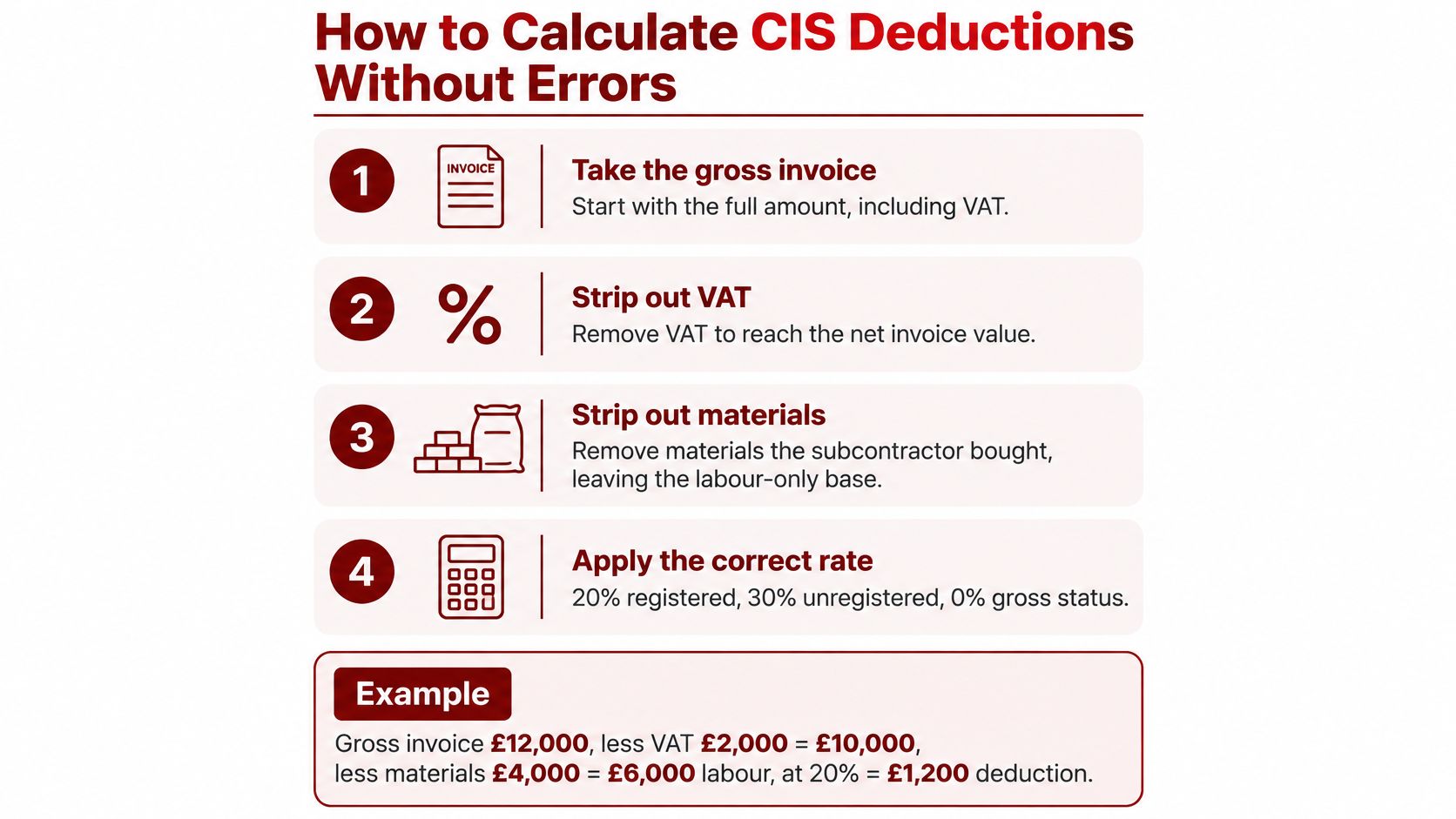
A correct deduction starts with the right base. Applying the right percentage to the wrong amount still changes the subcontractor's payment and the CIS liability in your ledger.
Start with the invoice and remove VAT. Then identify qualifying exclusions supported by the subcontractor's records, such as materials bought directly by the subcontractor, qualifying plant hire, job fuel and certain consumable stores. Check what an expenses line contains before excluding it. The calculation should be reproducible from the invoice and supporting records.
The CIS deduction rates are 20% for registered subcontractors, 30% for unregistered subcontractors, and no deduction for gross-payment status. Apply the applicable rate to the eligible payment after allowable exclusions, rather than automatically using the invoice total. For guidance and a worked calculation, see how to calculate CIS deductions.
CIS deduction rates and a worked example
| Subcontractor status | Deduction rate | Example on £10,000 eligible payment | Your action |
|---|---|---|---|
| Registered, standard rate | 20% | £2,000 withheld, £8,000 paid | Check the applicable verification result before payment and retain the reference |
| Not registered | 30% | £3,000 withheld, £7,000 paid | Ask them to register; apply the higher rate until verification establishes otherwise |
| Gross-payment status | No deduction | Nothing withheld, £10,000 paid | Monitor status notices and re-verify when required |
The examples assume the eligible payment is the whole amount being settled. If the invoice includes VAT or excluded materials, account for those elements when working out the actual bank payment.
Use the same sequence for each payment: establish the eligible amount, confirm the status, calculate the deduction, then record the settlement.
Make verification part of payment approval
Check the subcontractor's legal identity and applicable status before approving payment. Review your records at each payment run. An established subcontractor does not necessarily need a fresh verification request every time.
Post the gross subcontract cost to the purchase ledger. On payment, split the settlement between the amount paid to the subcontractor and the CIS liability. Posting only the net bank payment can understate job costs and leave the amount withheld missing from the liability account.
Keep the invoice, verification result, exclusions calculation, payment evidence and deduction statement connected by a transaction reference. That gives the reviewer a clear audit trail and lets them reproduce the calculation without relying on the original bookkeeper.
Payment control: Approve the invoice, deduction base and applicable status before releasing cash. A return correction does not recover an overpayment from the subcontractor.
CIS Errors HMRC Finds and How to Fix Them
A digitally filed return can still be wrong. Software processes the identities, classifications and payment records entered into it; it doesn't establish that the underlying treatment is correct.
HMRC's CIS contractor guidance identifies omitted payments, incorrect payment or deduction figures, and verification or employment-status failures as return errors. Treat these as reconciliation problems with identifiable causes, not mere filing mistakes.
CIS return errors, causes and fixes
| Symptom | Likely cause | Fix |
|---|---|---|
| CIS reconciliation doesn't explain the bank settlement | Materials or VAT incorrectly included in the deduction base | Recalculate the base, correct the ledger and document the change |
| Subcontractor paid but absent from the return | Payment processed through an expense claim | Bring it into the CIS records and correct the relevant return |
| Deduction rate seems wrong for a payee | Verification missing, status information overlooked or manual override | Check the applicable status, establish the correct treatment and record the correction |
| Quiet month has no filing confirmation | Nil-return process omitted | Confirm whether a nil return or inactivity notification is appropriate and complete it |
| Worker treated as a subcontractor without assessment | Employment status assumed from an invoice | Review the working arrangement against HMRC guidance before further payment |
| Duplicate or omitted invoice in the return | Duplicate posting or missing payment link | Clear the exception against the invoice and bank evidence |
A deduction total shouldn't equal the subcontractor's bank payment. The reconciliation must explain how the gross payment, exclusions, withholding and net settlement fit together. Investigate the relationship, not just whether totals happen to match.
Build an audit trail that survives staff changes
Keep the subcontractor contract and employment-status assessment with the verification record. Link these to the invoice, gross amount, materials exclusion, CIS deduction, payment date, return and statement.
For amendments, retain the original figure alongside the corrected figure, reason, supporting evidence and approval date. Don't overwrite a spreadsheet and leave the reviewer unable to explain why the filed return changed.
Run an exception report before filing. Include unverified payees, unexpected rates, duplicate payments, missing payment links and differences between the bank, purchase ledger and CIS records.
A spreadsheet can support this process if access and amendments are controlled. Software becomes more useful as transaction volumes grow, but neither option compensates for incomplete source documents.
How to Run the Monthly Close Step by Step
Close the accounts in a fixed order so corrections don't keep reopening completed work. Set a cut-off for site paperwork and make project managers responsible for explaining missing invoices, disputed costs and incomplete coding.
This process overview is useful for assigning the work.
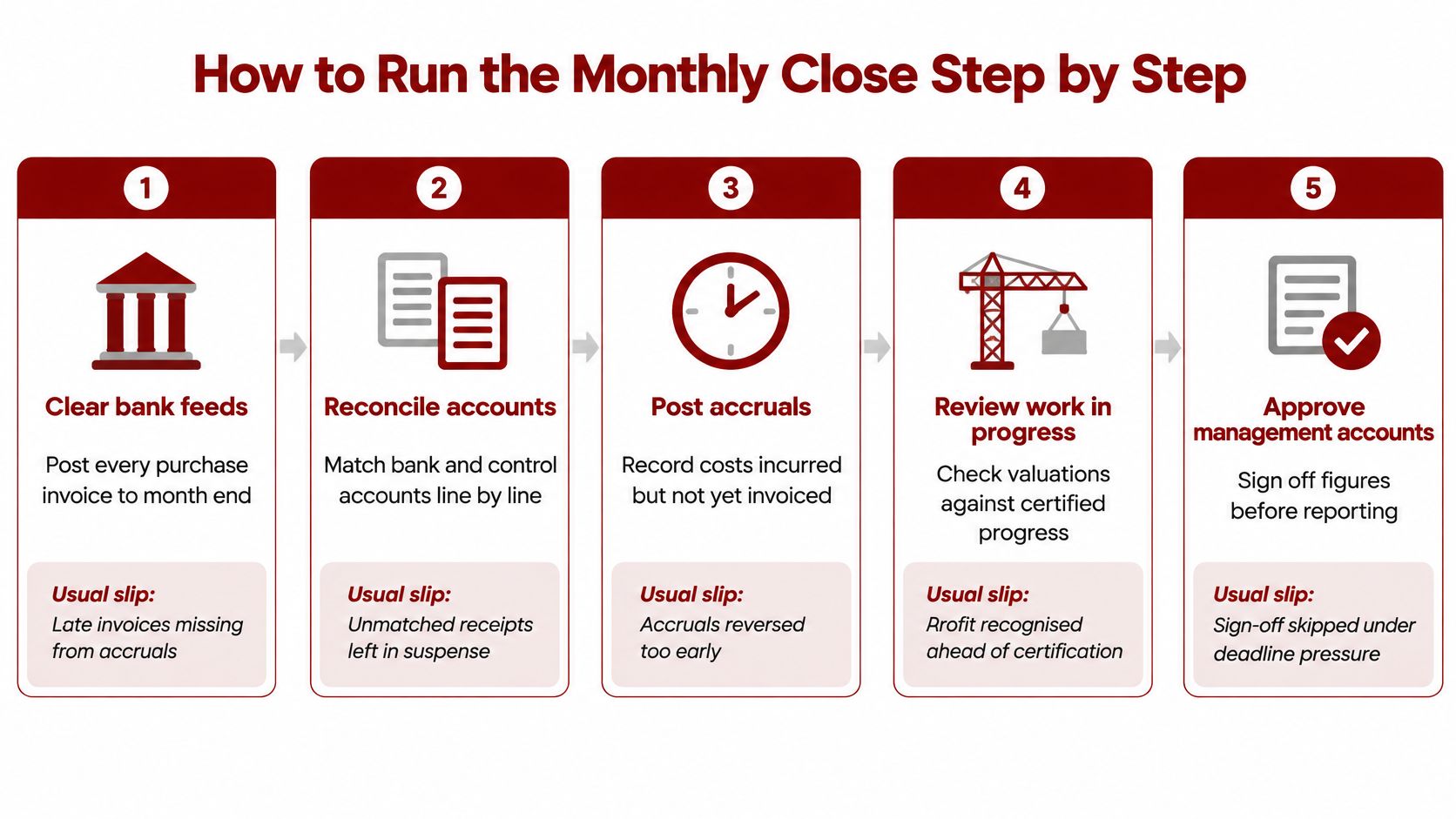
Clear bank feeds and purchase records. Match transactions to evidence and post invoices belonging to the period. Accrue costs already incurred where the invoice hasn't arrived, rather than reporting an artificially strong margin.
Assign every invoice and timesheet to its contract and cost category. Keep unallocated items on an exception list with an owner instead of moving them into overheads to finish quickly.
Reconcile subcontractor records. Compare invoices, supplier statements, bank settlements and deduction statements. Check the gross amount, VAT, materials and withholding separately.
Post and reconcile CIS deductions. Prepare a liability roll-forward showing the opening balance, deductions added, HMRC payments and closing balance.
Review work completed but not yet certified. Post only supported income adjustments, and reverse or replace earlier accruals so the same work isn't recognised again.
Reconcile customer balances. Match certified applications to invoices, credits and receipts. Investigate short payments rather than automatically treating every difference as retention.
Ask project managers to update remaining costs. Recalculate forecast margin using current commitments and the remaining work, not the original tender alone.
Reconcile VAT and PAYE control accounts to supporting records. Identify unexplained journals before preparing submissions.
Issue the management pack and refresh cash expectations. Include contract margins, customer exposure, the subcontractor exception report, CIS roll-forward and confirmed payment dates.
Review before release
The HMRC CIS monthly-return guidance sets the return deadline at the 19th following the relevant tax month, including the need to address months without relevant payments. Keep the tax-month reporting period distinct from your calendar-month management accounts.
For the underlying matching work, follow a documented bank reconciliation process. To turn the close into assigned tasks and evidence requirements, Loopfour's month-end close checklist provides a useful starting framework.
Don't issue the pack until every unreconciled item is either cleared or has an explanation, an owner and an agreed resolution date.
A second reviewer should agree the CIS reconciliation to payment records and retain the filing receipt. Where the team is small, a director can perform that review without repeating the bookkeeper's entire job.
Use the accompanying video as a supplementary walkthrough.
Job Costing and Work in Progress for Each Contract
A healthy bank receipt doesn't prove a contract is profitable. The client may have paid ahead of earned revenue while the project manager's remaining-cost estimate has become unrealistic.
Use cost to date plus cost to complete to assess the job. The latter needs a fresh operational estimate: outstanding orders, remaining labour, subcontract commitments, remedial work and unresolved scope.
A hypothetical extension review
Take an illustrative extension with an agreed contract value, incurred costs and remaining costs as shown below. These are scenario figures, not industry benchmarks.
Worked contract margin and WIP example
| Measure | How to calculate |
|---|---|
| Contract value | Agreed contract sum, assumed here to be £240,000 |
| Cost to date | Actual labour, subcontract, materials and plant, assumed £96,000 |
| Cost to complete | Latest remaining-cost estimate, assumed £132,000 |
| Forecast total cost | £96,000 + £132,000 = £228,000 |
| Forecast margin | £240,000 − £228,000 = £12,000, or 5% |
| Percentage complete | £96,000 ÷ £228,000 = approximately 42.1% |
| Revenue earned | Unrounded completion proportion × £240,000 = approximately £101,053 |
| Certified to date | Applications certified by the client, assumed £115,000 |
| Billed in advance | £115,000 − £101,053 = approximately £13,947 |
This assumes an over-time, cost-to-cost revenue approach is appropriate for the contract. Agree the accounting policy with your accountant; certification alone doesn't determine revenue recognition, and materials purchased ahead of use may need particular attention.
Under those assumptions, the billed-in-advance balance is a liability, not extra profit. It represents certification ahead of the revenue recognised from progress.
Now suppose the remaining-cost estimate increases by £18,000 to £150,000. Forecast total cost becomes £246,000, turning the expected margin into a £6,000 loss. Investigate the cost category responsible and ask your accountant how the expected loss should be reflected.
Challenge the estimate, not just the arithmetic
Ask the site manager what remains to be bought and built. Check whether subcontract orders cover the complete scope and whether variation costs have been included without recoverable revenue.
If estimating and accounting use different categories, translate the tender into ledger cost codes before work starts. When evaluating tools such as Exayard construction estimating software, check that estimate outputs can be mapped into your contract-cost structure rather than assuming a particular integration exists.
The monthly question is specific: has forecast margin moved, and which cost code explains the movement?
Retention, Disputed Applications and Cash Forecasting
Accurate accrual accounts don't show spendable cash. Retention can be a valid receivable while remaining unavailable for wages, and a disputed application needs a different collection assumption from an accepted invoice.
The government's late-payment policy document explains that construction retentions can be lost through upstream insolvency or delayed, partial or non-payment. Recording the balance correctly doesn't remove that exposure.
Keep the working documents together so the person forecasting cash can trace each expected receipt.
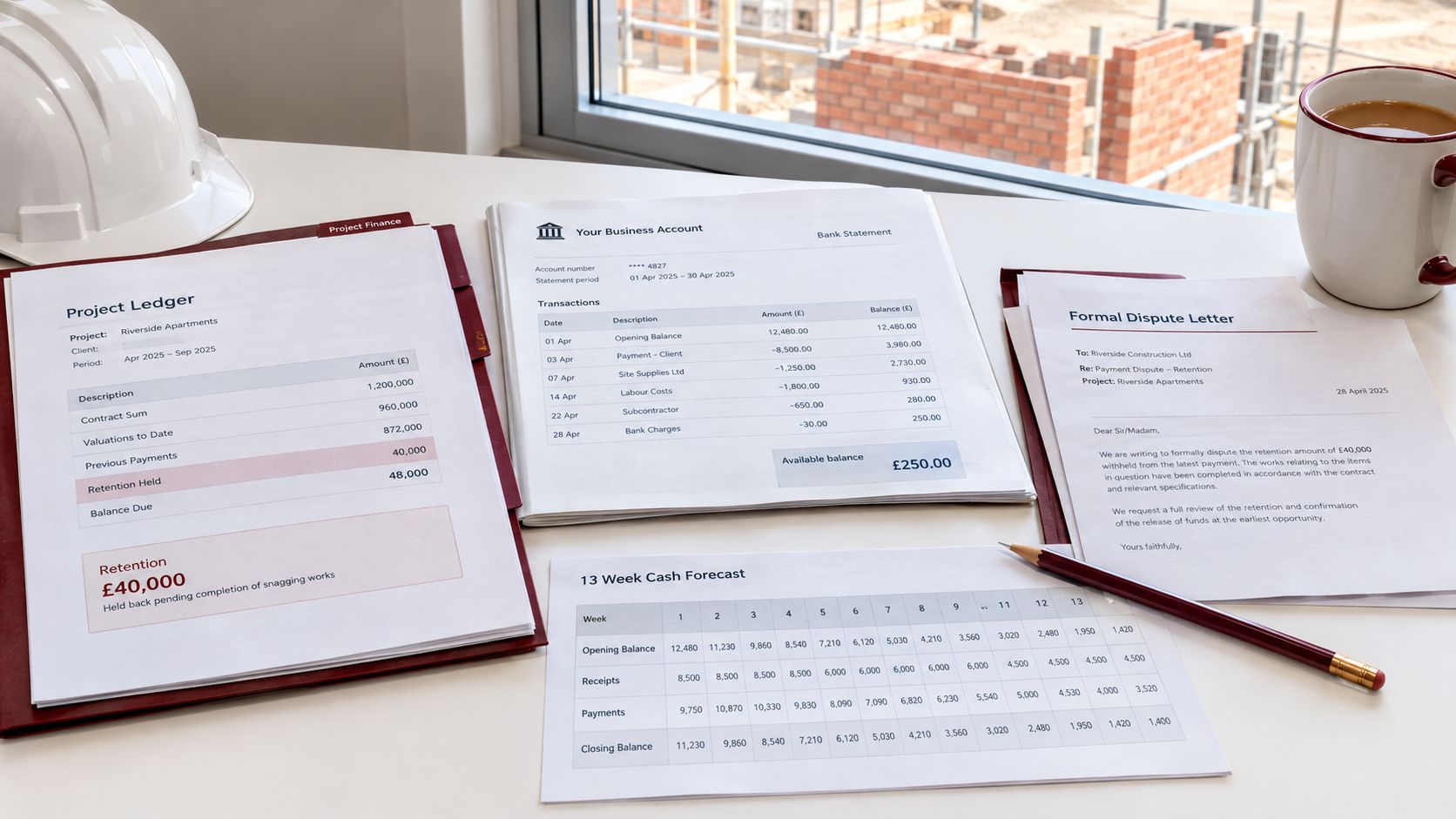
Give each retention a collection plan
Your retention ledger needs more than a total. Record:
- Contract and counterparty: Identify the job, customer and relevant contractual terms.
- Amount and basis: Show the balance withheld and the contractual retention percentage.
- Release requirements: Record the expected release date, completion evidence and outstanding conditions.
- Chasing responsibility: Name the person responsible and set an escalation date.
- Recovery assessment: Note disputes, missed promises and concerns about the payer's financial position.
Reconcile the schedule to the retention control account. Keep amounts your customers owe separate from retention you owe subcontractors, because the contracts and release conditions may differ.
A missed payment isn't automatically a dispute. Mark it overdue, establish the reason and reassess its forecast date; move it into a disputed category when the payer contests entitlement or amount.
Cash warning: A retained balance is not a cash reserve. Don't commit it to payroll merely because the job has produced an accounting profit.
Forecast receipts by evidence, not hope
Use a rolling 13-week cash forecast with separate lines for ordinary customer receipts, retention releases, payroll, suppliers, CIS, VAT, other taxes and equipment finance. This is a recommended planning horizon, not a statutory requirement.
For practical cash-flow forecasting, give expected receipts an evidence-based date. Distinguish an approved certificate awaiting payment from an application awaiting assessment and a variation whose value remains contested.
Review aged debt weekly and identify customers responsible for a large share of receivables. Set escalation rules that trigger a commercial discussion before further exposure grows.
Say a certificate slips into a later payment run while wages and a tax payment remain due. Move the receipt in the forecast immediately, identify the resulting shortfall and decide whether to chase certification, negotiate supplier timing or arrange finance.
Don't move the wage or tax payment just to make the spreadsheet balance. The forecast should expose the decision you need to make.
Set Your Deadline Calendar and Book the First Review
Build the calendar around your company's reporting periods, HMRC obligations and Companies House record. Set separate preparation, approval, submission and payment dates. A return can be filed while its liability remains unpaid, so track both actions and keep evidence of each.
Statutory and internal deadlines for a UK contractor
| Obligation | Due date | Note for your calendar |
|---|---|---|
| CIS monthly return | 19th after the tax month ends | Record a nil return decision for months with no relevant payments. |
| CIS deductions paid to HMRC | 22nd of the following month for electronic payment | Schedule approval and bank processing before the deadline. |
| PAYE and NIC payment | 22nd of the following month for electronic payment | Check the payment reference and period. |
| VAT quarterly return and payment | One month and seven days after the VAT period ends | Confirm the VAT period and any special scheme arrangements. |
| Corporation tax payment, small company | Nine months and one day after the accounting period ends | Keep the payment deadline separate from the return deadline. |
| Annual accounts to Companies House, private company | Nine months after the financial year ends | Complete WIP and retention reconciliations before sign-off. |
Check that these dates match the company's actual accounting and VAT periods and its payment method. Build in internal cut-offs ahead of statutory deadlines, allowing time to investigate differences rather than submit figures that have not been reconciled. Assign a named preparer and approver to each task, and retain the supporting reconciliation and payment or filing receipt.
Make the first review diagnostic
Book a CIS-aware accountant to review the chart of accounts, subcontractor onboarding, recent returns, and the controls that connect job costs and liabilities to cash. An internal finance team, outsourced bookkeeper and specialist accountant can divide the work, but one person must own each approval.
Start with the weakest control, such as missing purchase invoices, unsupported variation income or uncertain retention releases. Accurate profit figures can still conceal a cash shortfall if retention, uncertified variations and CIS liabilities are not tracked separately. Fixing the source of the uncertainty makes the management report more useful, while adding another dashboard does not correct unreliable entries.
For construction contractors and subcontractors, Action Accountants Limited provides CIS-aware bookkeeping, payroll, tax compliance and management-accounting support. A review of the ledger, subcontractor verification records, WIP and retention schedules can identify corrections to make before the next filing and help establish a dependable cash-control routine.